Label: COLUMBIA RECORDS
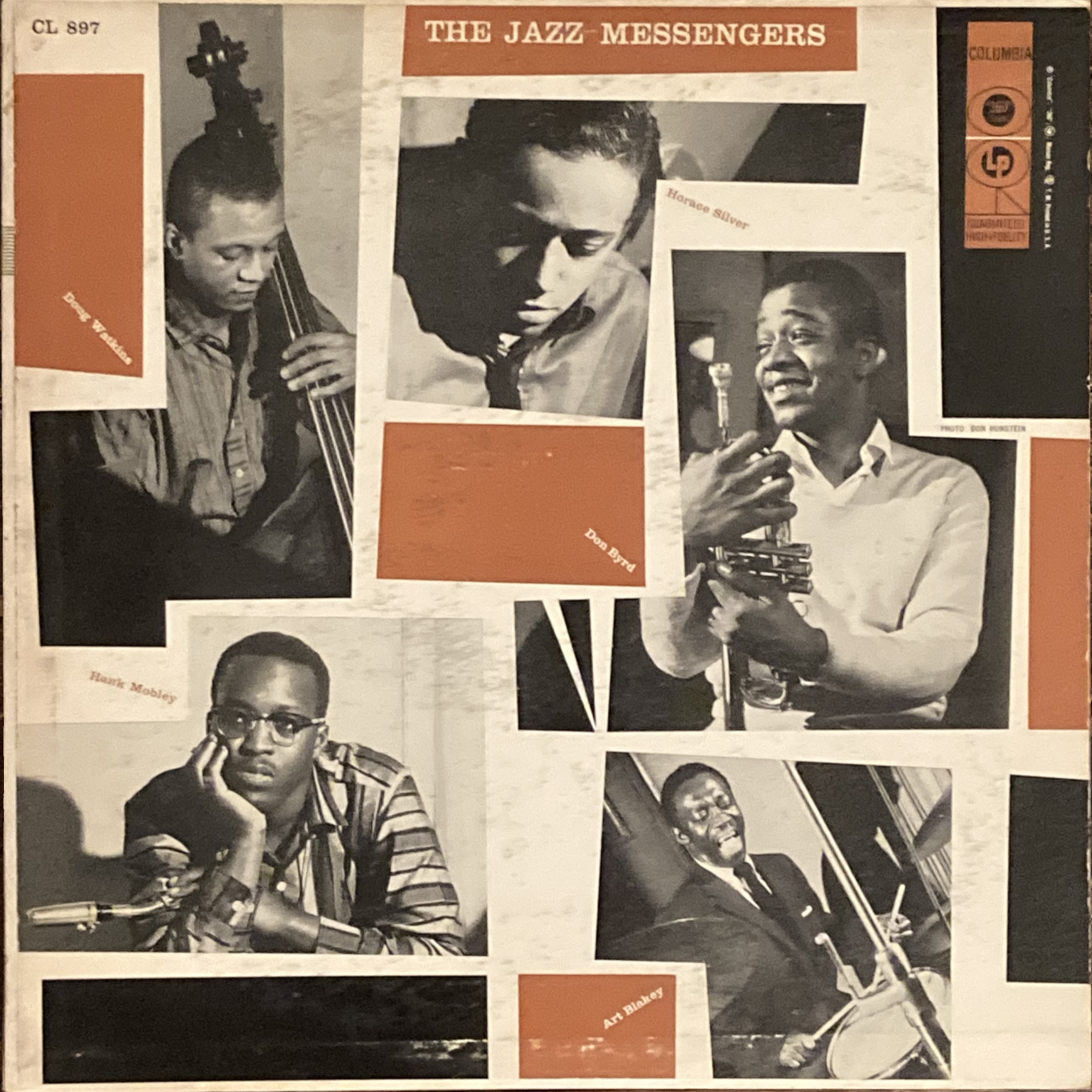
No.: CL 897
Title: THE JAZZ MESSENGERS
Musician: THE JAZZ MESSENGERS
Recorded: 1956/4/5
Monaural
Cover address: None
Coating 無し
Groove Guard
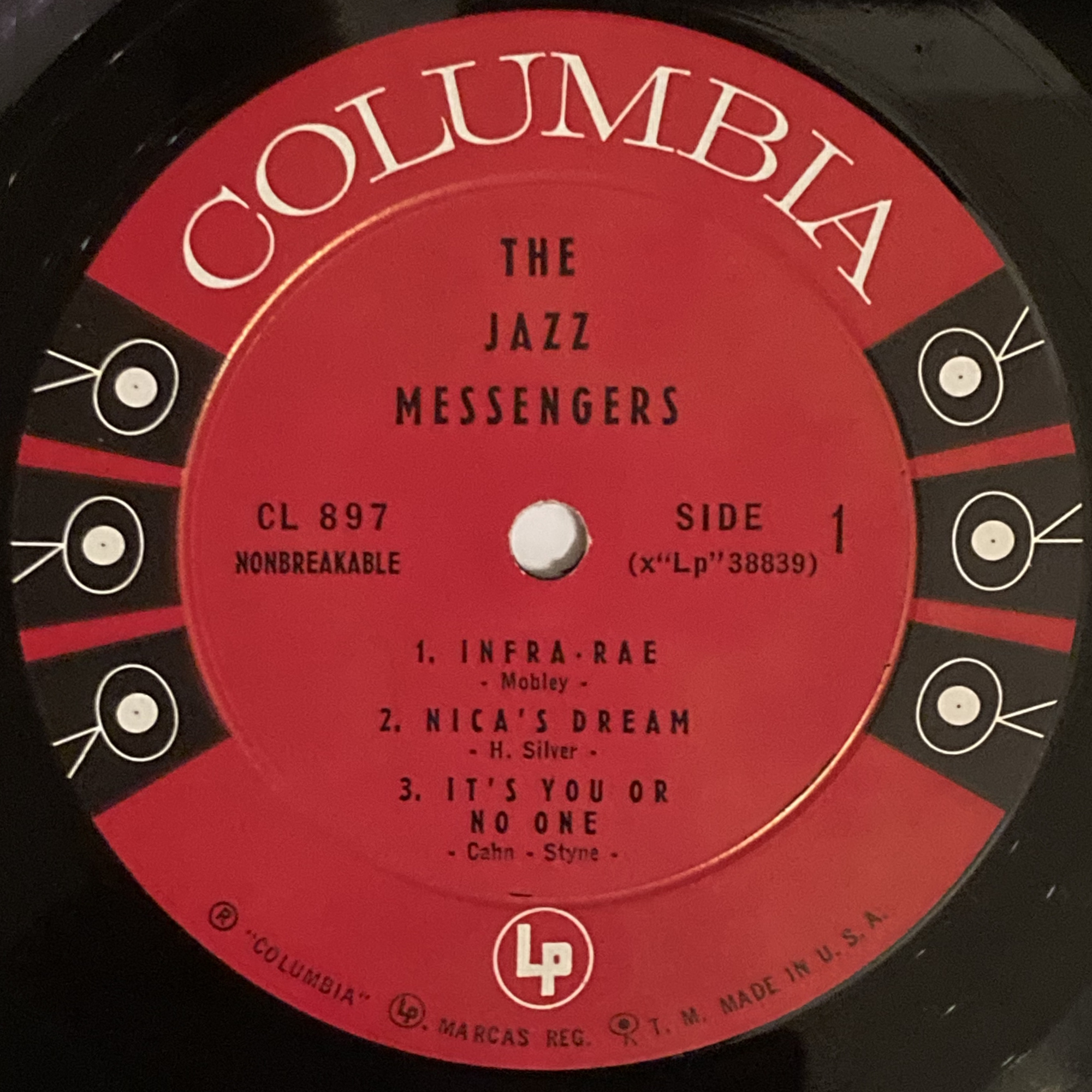
Label Side-1
Red Background
Black Letter
6 Eyes w/o CBS
Address: None
Deep Groove
Dead Wax Info: XLP-38839-1F.., ☆
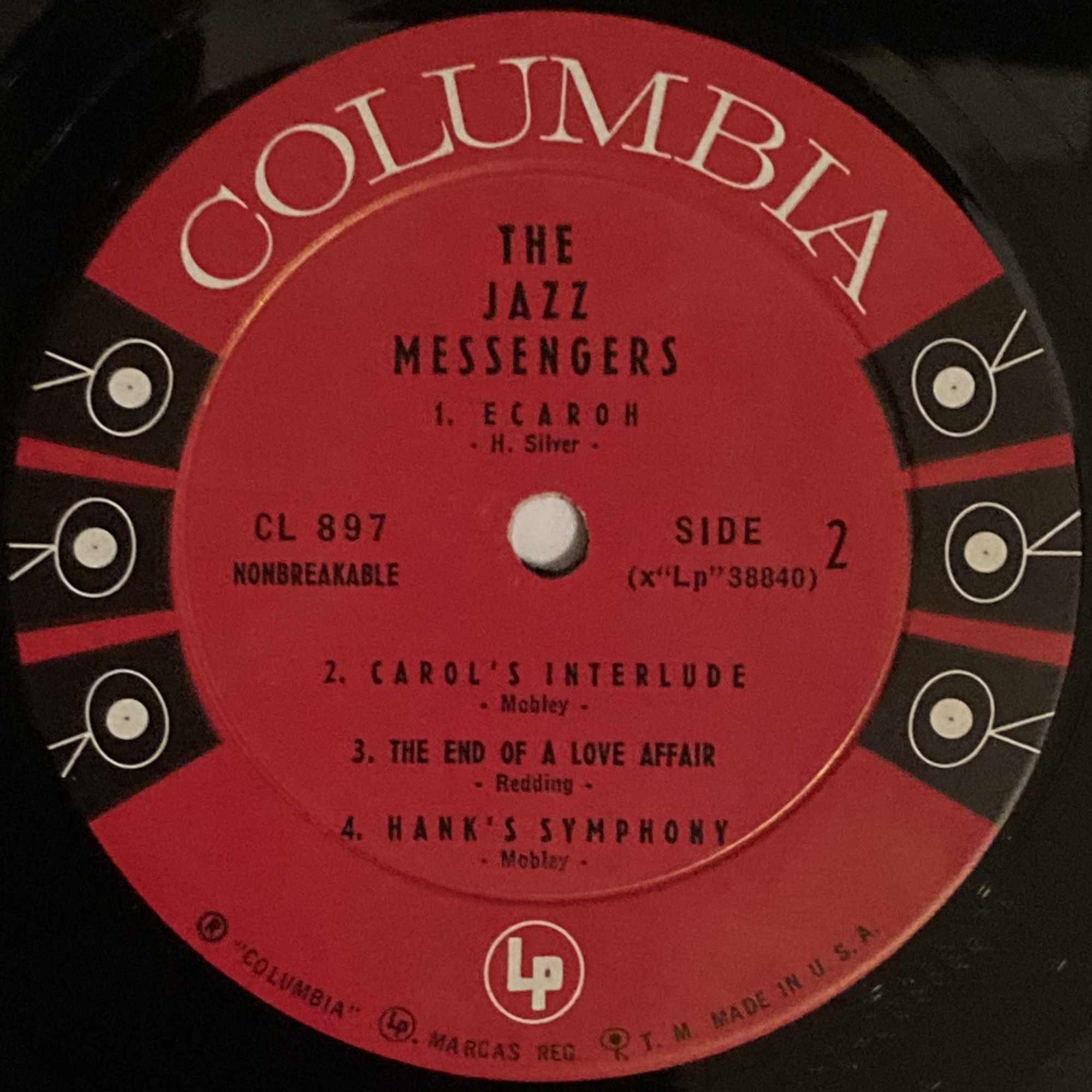
Label Side-2
Red Background
Black Letter
6 Eyes w/o CBS
Address: None
Deep Groove
Dead Wax Info: XLP-38839-1J., ☆
Personnel-
Drums: Art Blakey
Bass: Doug Watkins
Piano: Horace Silver
Tenor Sax: Hank Mobley
Trumpet: Donald Byrd
Tracks-
Side-1
1) Infra-Rae 6’57”
2) Nica’s Dream 11’51”
3) It’s You or No One 5’36”
Side-2
1) Ecaroh6’02”
2) Carol’s Interlude 5’36”
3) The End of a Love Affair 6’43”
4) Hank’s Symphony 4’37”
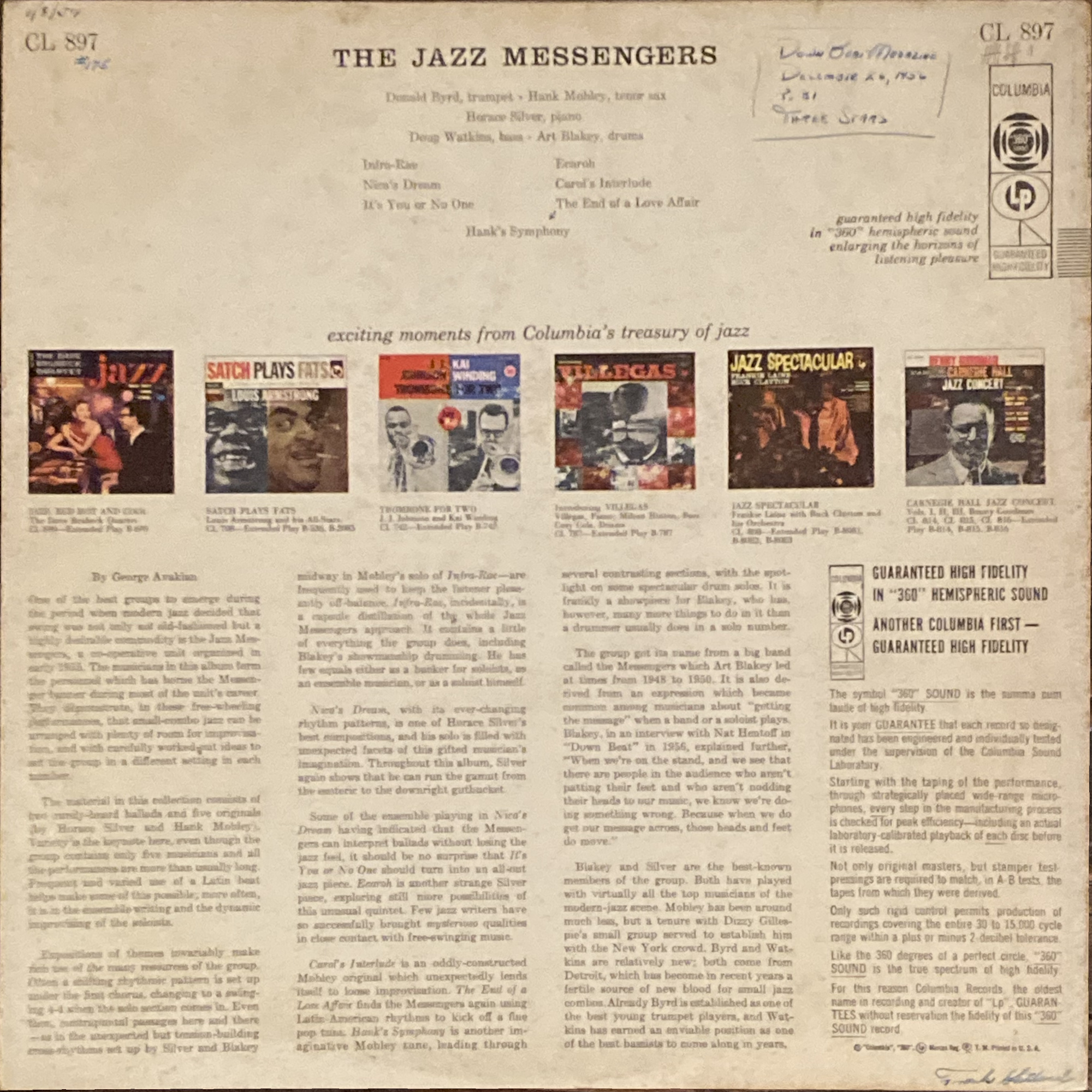
<裏ジャケ原文>
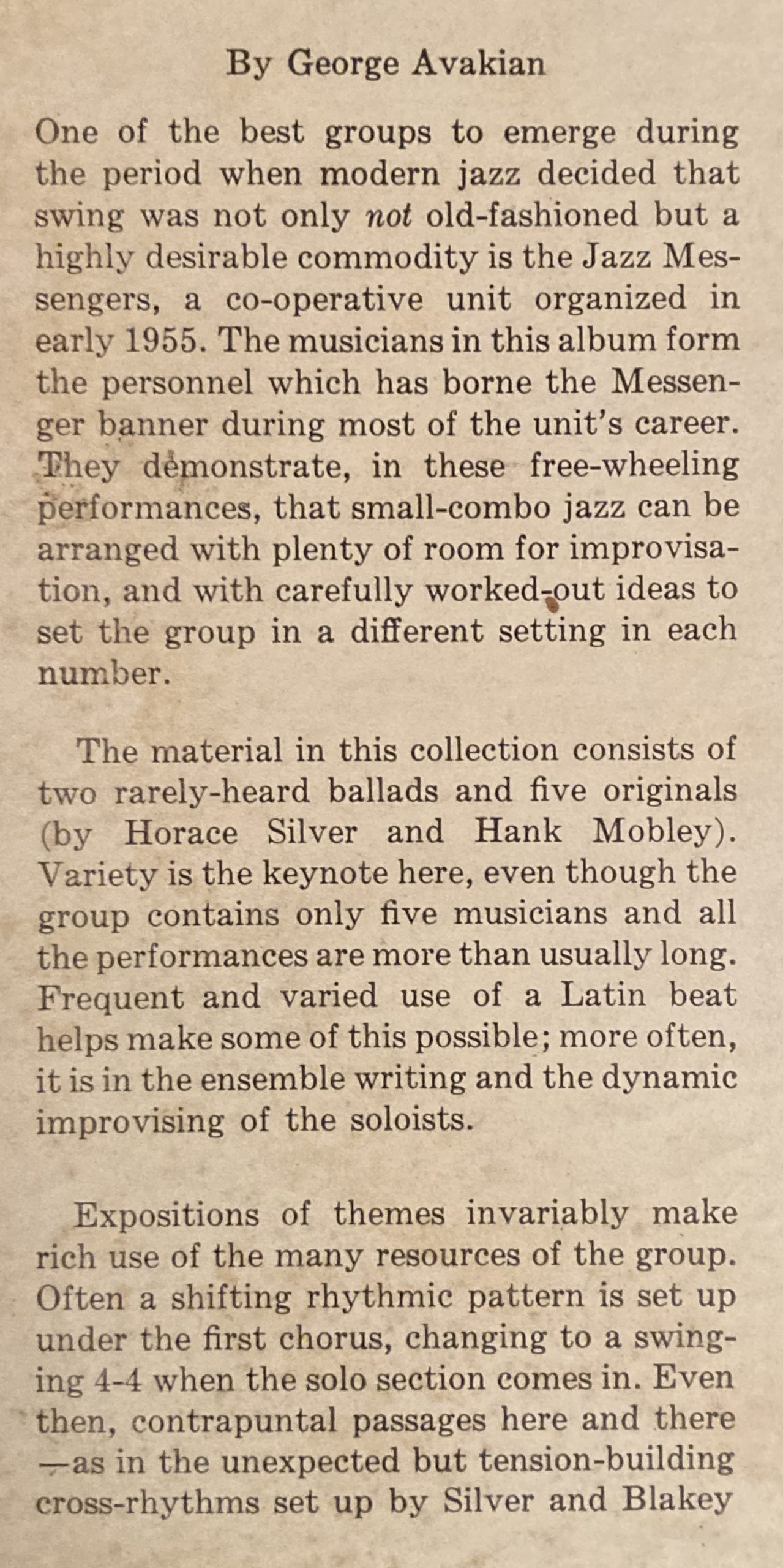
By George Avakian
One of the best groups to emerge during the period when modern jazz decided that swing was not only not old-fashioned but a highly desirable commodity is the Jazz Mes- sengers, a co-operative unit organized in early 1955. The musicians in this album form the personnel which has borne the Messen- ger banner during most of the unit’s career. They demonstrate, in these free-wheeling performances, that small-combo jazz can be arranged with plenty of room for improvisa- tion, and with carefully worked-out ideas to set the group in a different setting in each number.
The material in this collection consists of two rarely-heard ballads and five originals (by Horace Silver and Hank Mobley). Variety is the keynote here, even though the group contains only five musicians and all the performances are more than usually long. Frequent and varied use of a Latin beat helps make some of this possible; more often, it is in the ensemble writing and the dynamic improvising of the soloists.
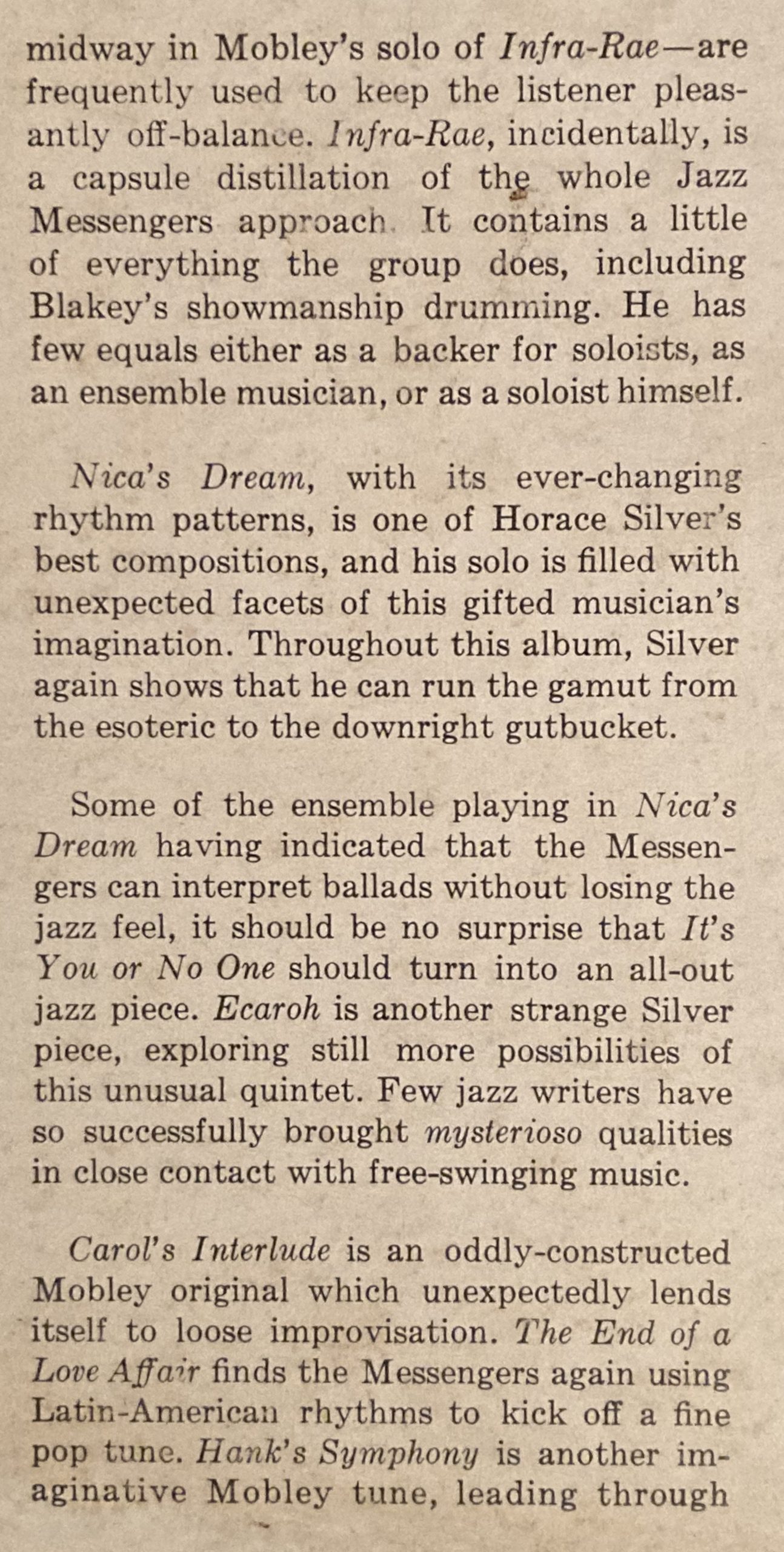
Expositions of themes invariably make rich use of the many resources of the group. Often a shifting rhythmic pattern is set up under the first chorus, changing to a swing- ing 4-4 when the solo section comes in. Even then, contrapuntal passages here and there -as in the unexpected but tension-building cross-rhythms set up by Silver and Blakey midway in Mobley’s solo of Infra-Rae-are frequently used to keep the listener pleas- antly off-balance. Infra-Rae, incidentally, is a capsule distillation of the whole Jazz Messengers approach. It contains a little of everything the group does, including Blakey’s showmanship drumming. He has few equals either as a backer for soloists, as an ensemble musician, or as a soloist himself.
Nica’s Dream, with its ever-changing rhythm patterns, is one of Horace Silver’s best compositions, and his solo is filled with unexpected facets of this gifted musician’s imagination. Throughout this album, Silver again shows that he can run the gamut from the esoteric to the downright gutbucket.
Some of the ensemble playing in Nica’s Dream having indicated that the Messen- gers can interpret ballads without losing the jazz feel, it should be no surprise that It’s You or No One should turn into an all-out jazz piece. Ecaroh is another strange Silver piece, exploring still more possibilities of this unusual quintet. Few jazz writers have so successfully brought mysterioso qualities in close contact with free-swinging music.
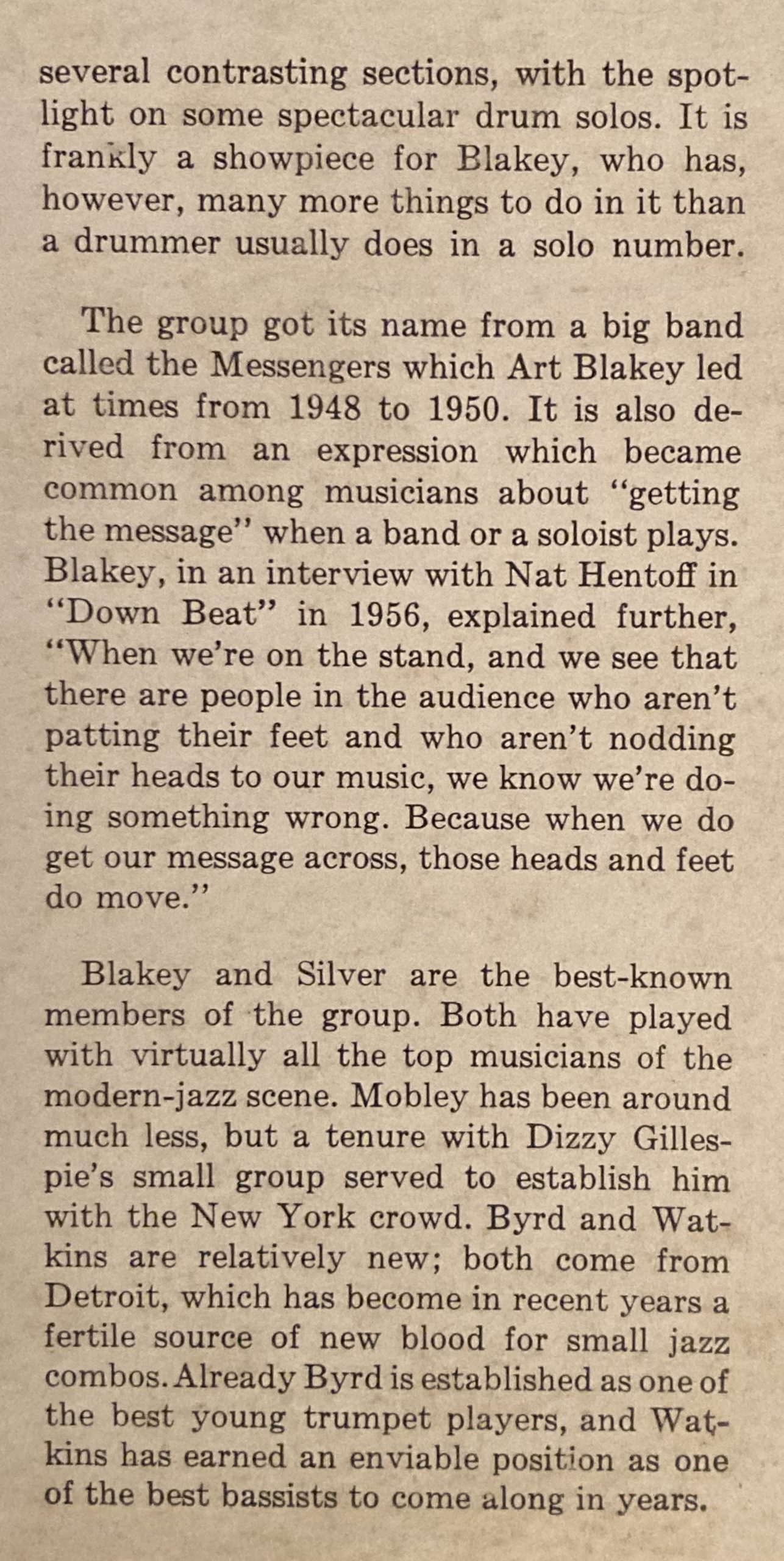
Carol’s Interlude is an oddly-constructed Mobley original which unexpectedly lends itself to loose improvisation. The End of a Love Affair finds the Messengers again using Latin-American rhythms to kick off a fine pop tune. Hank’s Symphony is another im- aginative Mobley tune, leading through several contrasting sections, with the spot- light on some spectacular drum solos. It is frankly a showpiece for Blakey, who has, however, many more things to do in it than a drummer usually does in a solo number.
The group got its name from a big band called the Messengers which Art Blakey led at times from 1948 to 1950. It is also de- rived from an expression which became common among musicians about “getting the message” when a band or a soloist plays. Blakey, in an interview with Nat Hentoff in “Down Beat” in 1956, explained further, “When we’re on the stand, and we see that there are people in the audience who aren’t patting their feet and who aren’t nodding their heads to our music, we know we’re do- ing something wrong. Because when we do get our message across, those heads and feet do move.”
Blakey and Silver are the best-known members of the group. Both have played with virtually all the top musicians of the modern-jazz scene. Mobley has been around much less, but a tenure with Dizzy Gilles- pie’s small group served to establish him with the New York crowd. Byrd and Wat- kins are relatively new; both come from Detroit, which has become in recent years a fertile source of new blood for small jazz combos. Already Byrd is established as one of the best young trumpet players, and Wat- kins has earned an enviable position as one of the best bassists to come along in years.
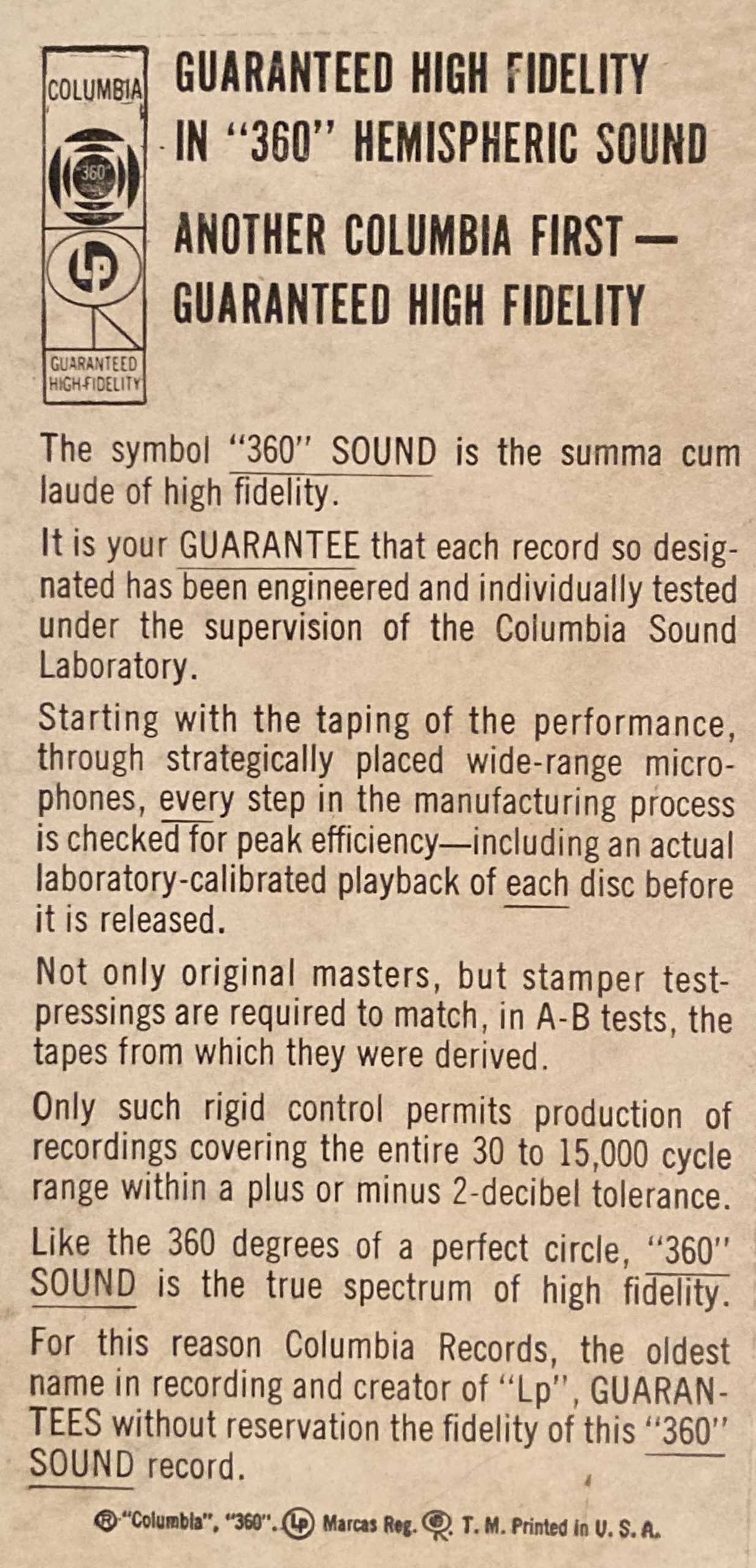
GUARANTEED HIGH FIDELITY
IN “360” HEMISPHERIC SOUND
ANOTHER COLUMBIA FIRST-
GUARANTEED HIGH FIDELITY
The symbol “360” SOUND is the summa cum laude of high fidelity.
It is your GUARANTEE that each record so desig- nated has been engineered and individually tested under the supervision of the Columbia Sound Laboratory.
Starting with the taping of the performance, through strategically placed wide-range micro- phones, every step in the manufacturing process. is checked for peak efficiency-including an actual laboratory-calibrated playback of each disc before it is released.
Not only original masters, but stamper test- pressings are required to match, in A-B tests, the tapes from which they were derived.
Only such rigid control permits production of recordings covering the entire 30 to 15,000 cycle range within a plus or minus 2-decibel tolerance. Like the 360 degrees of a perfect circle, “360” SOUND is the true spectrum of high fidelity. For this reason Columbia Records, the oldest name in recording and creator of “Lp”, GUARAN- TEES without reservation the fidelity of this “360” SOUND record.
“Columbia”, “360”. Marcas Reg. Q. T. M. Printed in U. S. A.
<裏ジャケ和訳>
ジョージ・アヴァキアン著
モダン・ジャズの世界において、「スウィング」が決して時代遅れなものではなく、むしろ大いに求められる要素であると再認識された時期に登場した最高のグループの一つが、1955年初頭に結成された共同運営ユニット「ジャズ・メッセンジャーズ」です。本作に参加しているミュージシャンたちは、このグループの活動期間の大半を通じて「メッセンジャーズ」の旗印を掲げてきたメンバーそのものです。彼らは、この自由奔放な演奏の中で、小編成のジャズであっても、即興演奏のための十分な余地を残しつつ、楽曲ごとにグループの個性を際立たせるような緻密なアイデアを盛り込んだアレンジが可能であることを証明しています。
本作に収録された楽曲は、あまり耳にする機会のないバラード2曲と、ホレス・シルヴァーおよびハンク・モブレーによるオリジナル曲5曲で構成されています。わずか5人のミュージシャンによる編成であり、かつ各演奏が通常よりも長い尺であるにもかかわらず、ここには豊かな多様性が息づいています。ラテン・ビートが頻繁かつ多彩に取り入れられていることもその一因ですが、それ以上に重要なのは、アンサンブルの構成や、ソリストたちによるダイナミックな即興演奏の力です。
テーマの提示においては、グループが持つ多彩な表現力が遺憾なく発揮されています。しばしば、最初のコーラスでは流動的なリズム・パターンが用いられ、ソロ・セクションに入るとスウィングする4/4拍子へと切り替わります。そうした展開の中でも、随所に「対位法」的なアプローチ――例えばモブレーの「インフラ・レイ(Infra-Rae)」でのソロ中盤、シルヴァーとブレイキーが仕掛ける、予想外でありながら緊張感を高めるクロス・リズムのような手法――が取り入れられ、聴き手を心地よく揺さぶり、意表を突くような仕掛けがなされています。ちなみに「インフラ・レイ」は、ジャズ・メッセンジャーズの音楽的アプローチを凝縮したような一曲です。ブレイキーのショーマンシップあふれるドラミングを含め、このグループの持ち味がすべて盛り込まれています。ソリストのバックを務める際も、アンサンブルの一員としても、あるいは彼自身がソロをとる場合でも、彼に匹敵するドラマーはほとんど存在しません。
絶えず変化するリズム・パターンが特徴的な「ニカズ・ドリーム(Nica’s Dream)」は、ホレス・シルヴァーの最高傑作の一つであり、そこでの彼のソロには、この才能あるミュージシャンの想像力が生み出す意外性に満ちた側面が表れています。アルバム全体を通して、シルヴァーは、難解で玄人好みなスタイルから、泥臭く骨太な「ガットバケット(gutbucket)」なスタイルに至るまで、実に幅広い表現が可能であることを改めて証明しています。 『Nica’s Dream』でのアンサンブル演奏が、メッセンジャーズがジャズのフィーリングを損なうことなくバラードを解釈できることを示した以上、『It’s You or No One』が本格的なジャズ・ナンバーへと変貌を遂げたとしても、何ら不思議ではありません。「Ecaroh」もまたシルバーによる一風変わった楽曲であり、この異色のクインテットが持つさらなる可能性を探求しています。ミステリアスな雰囲気を、自由でスウィンギーな音楽とこれほど見事に融合させたジャズの作曲家は、そう多くはいません。
「キャロルズ・インターリュード(Carol’s Interlude)」は、モブレイのオリジナル曲の中でも一風変わった構成を持っていますが、意外にも自由な即興演奏に適した楽曲となっています。「ジ・エンド・オブ・ア・ラヴ・アフェア(The End of a Love Affair)」では、メッセンジャーズが再びラテン・アメリカのリズムを取り入れ、素晴らしいポップ・チューンを聴かせてくれます。「ハンクス・シンフォニー(Hank’s Symphony)」もまたモブレイによる独創的な楽曲で、対照的な複数のセクションを経て展開し、圧巻のドラム・ソロが大きな見せ場となっています。率直に言えば、これはブレイキーのためのショーピース(見せ場となる曲)ですが、単なるソロ・ナンバーにおけるドラマーの役割をはるかに超えた、多彩なプレイが求められる楽曲でもあります。
このグループの名称は、アート・ブレイキーが1948年から1950年にかけて率いた「メッセンジャーズ」というビッグ・バンドに由来しています。また、バンドやソリストの演奏を聴いて「メッセージを受け取る(get the message)」という、ミュージシャンの間で使われていた表現からも名付けられました。ブレイキーは1956年、『ダウン・ビート』誌でのナット・ヘントフとのインタビューで次のように説明しています。「ステージに立っていて、客席に足でリズムを取ったり頭を縦に振ったりしていない人がいると、自分たちの演奏のどこかが間違っていると分かるんです。なぜなら、メッセージがしっかりと伝われば、自然と頭や足が動き出すものだからです。」
ブレイキーとシルバーは、このグループの中で最もよく知られたメンバーです。二人とも、モダン・ジャズ・シーンのトップ・ミュージシャンたちと数多く共演してきました。モブレイはそれほど頻繁に表舞台に出ていたわけではありませんが、ディジー・ガレスピーの小編成グループに在籍した経験が、ニューヨークの音楽関係者にその実力を認めさせるきっかけとなりました。バードとワトキンスは比較的新しいメンバーですが、二人ともデトロイト出身です。デトロイトは近年、小編成ジャズ・コンボに新たな才能を供給する豊かな土壌となっています。バードはすでに若手トランペット奏者の中で屈指の存在としての地位を確立しており、ワトキンスもまた、ここ数年で登場した最高のベーシストの一人として、羨望を集めるほどの評価を得ています。
保証されたハイ・フィデリティ(高忠実度)
「360」ヘミスフェリック・サウンド(半球状音響)
コロンビアの新たな先駆的試み――
保証されたハイ・フィデリティ
「360」サウンドというシンボルは、ハイ・フィデリティにおける最高水準の証です。 「360」サウンドの刻印があるレコードはすべて、コロンビア・サウンド・ラボの監修の下で技術的な処理と個別のテストが行われたものであることを保証いたします。
演奏の録音(戦略的に配置された広帯域マイクを使用)から製造工程のあらゆる段階に至るまで、最高の品質を確保するためのチェックが徹底されています。これには、発売前の各ディスクについて、ラボで校正された機器を用いて実際に再生確認を行う工程も含まれます。
オリジナルのマスターテープだけでなく、スタンパーから作成されたテストプレス盤についても、元のテープとのA-B比較テストを行い、その音質が一致することが求められます。
このような厳格な管理体制があってこそ、30Hzから15,000Hzの全帯域にわたり、±2デシベル以内の許容範囲に収まる録音の制作が可能となるのです。完全な円を描く360度のように、「360」サウンドはハイ・フィデリティ(高忠実度)の真のスペクトルを体現しています。録音の分野で最も長い歴史を持ち、「LP」を世に送り出したコロンビア・レコードは、この「360」サウンド・レコードの忠実な音質を全面的に保証いたします。
“Columbia”、”360″は登録商標です。米国製。
※訳文の制作にはGoogleドライブとGoogle翻訳のお世話になりました。

コメント