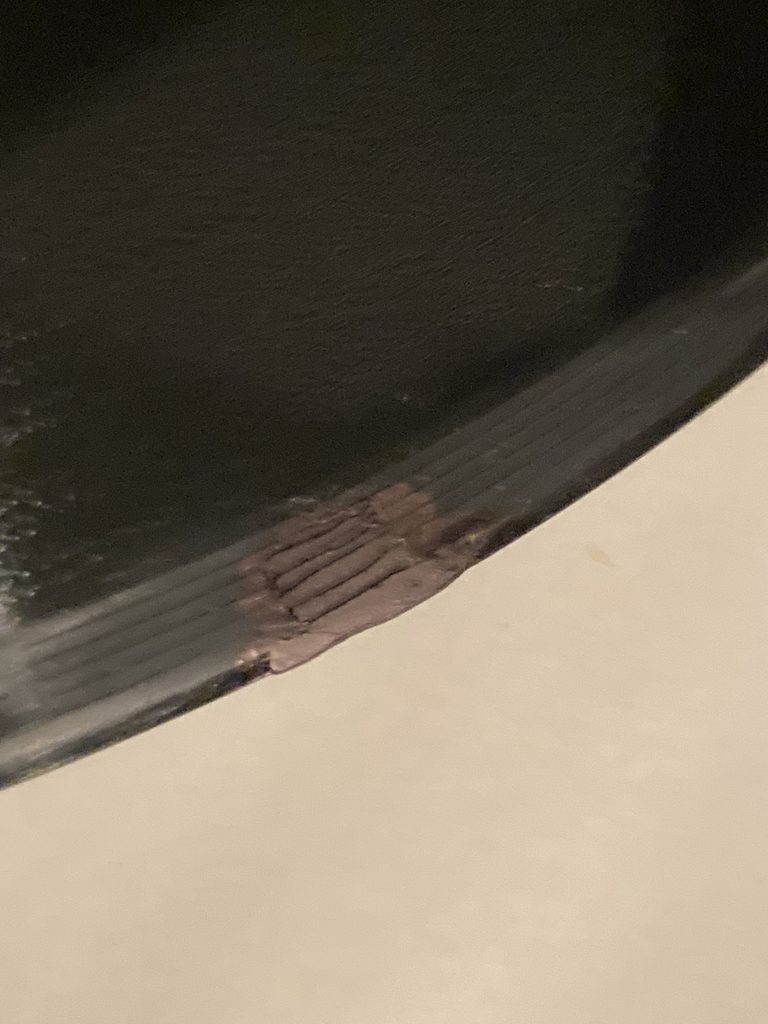
本盤はいわゆるオリジナル盤ですがA面のリードinの部分に欠けががあったため安く購入することができました。その部分はパテ埋めを行って針先が引っ掛かってしまわないように補修しました。あまり良い出来ではありませんが、少なくとも機能しているのでOKとしています。
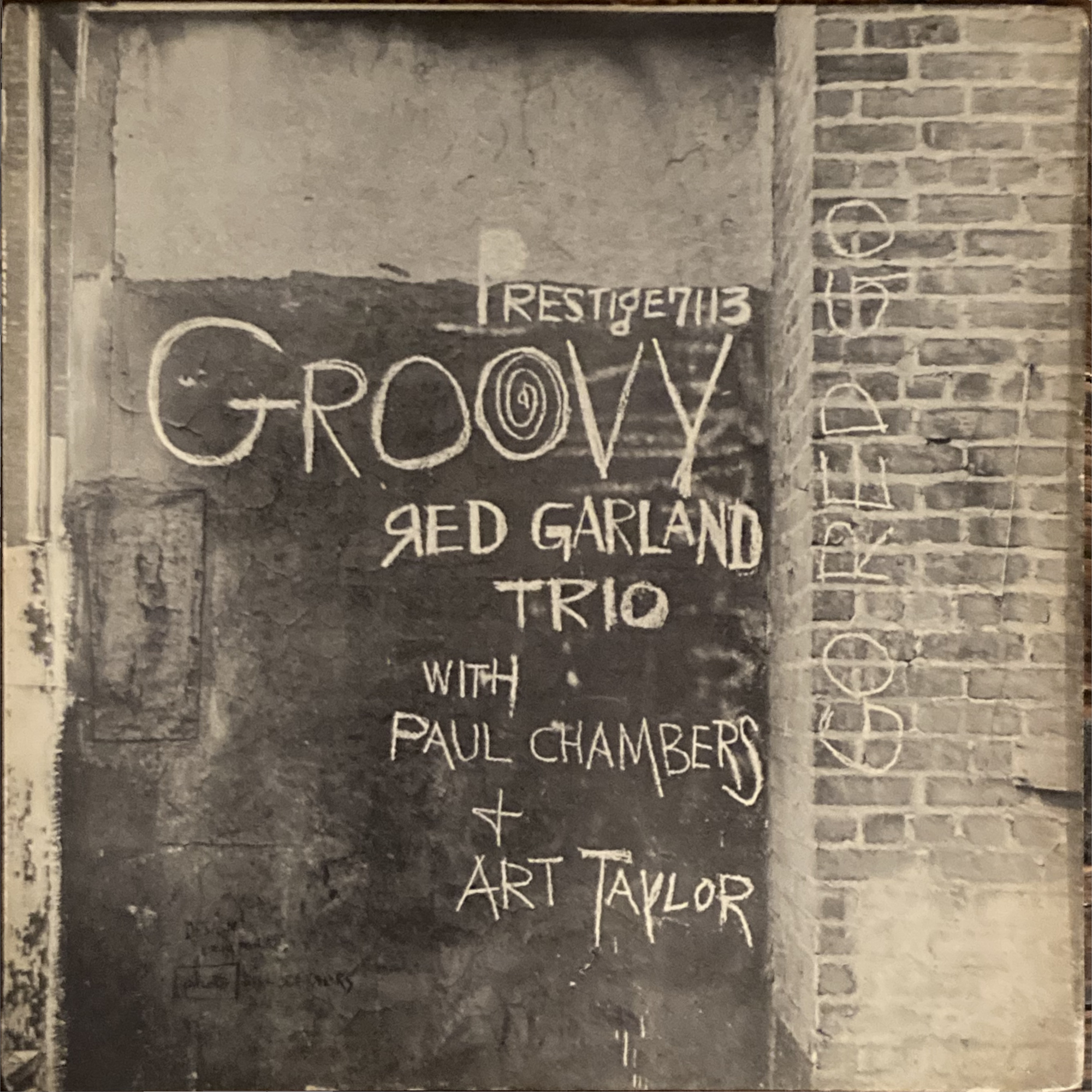
Label: PRESTIGE
No.: PRLP-7113
Title: GROOVY
Musician: RED GARLAND
Recorded: 1957/8/9
Monaural
Cover address: 447 West 50th STREET, New York 19, N.Y.
Laminate Coating
Groove Guard
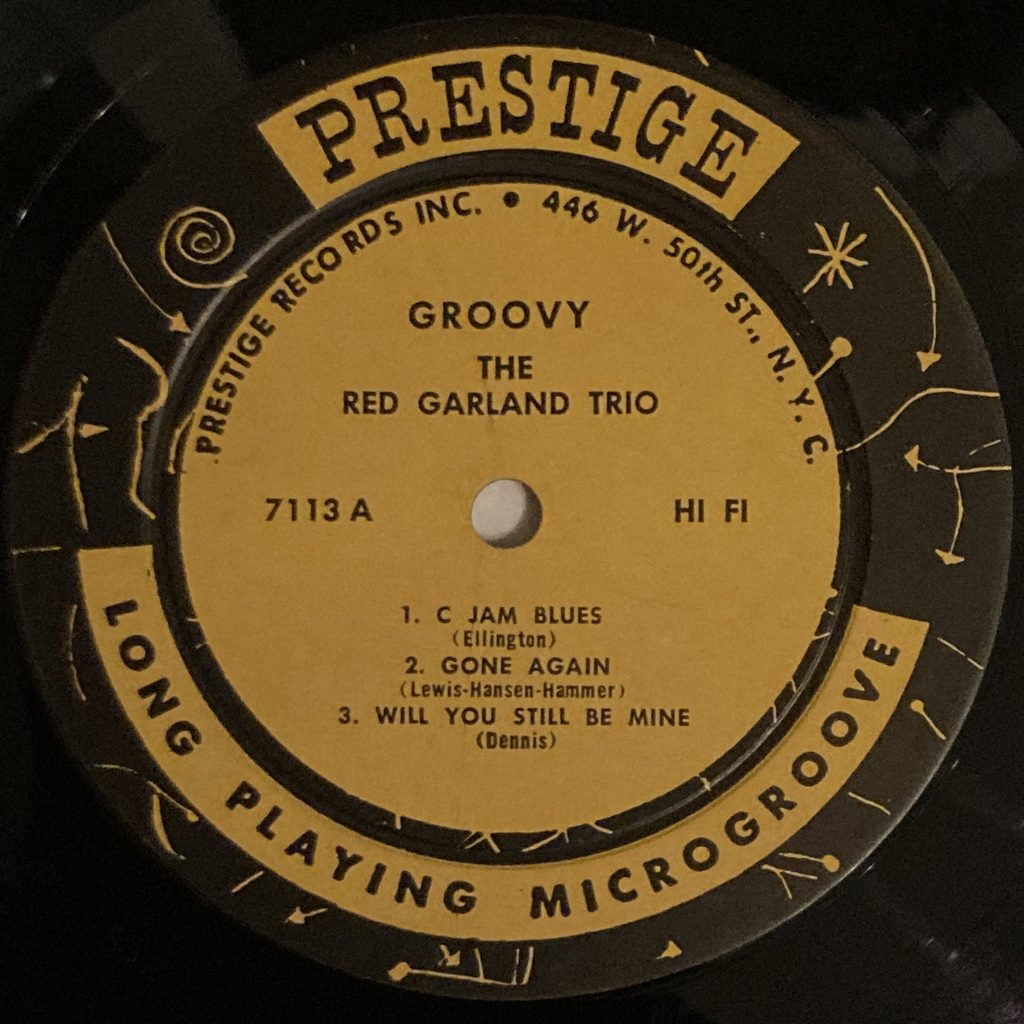
Label Side-A
Yellow Background
Black Letter with HI FI
Address: 446 W. 50th ST., N.Y.C.
Deep Groove
Dead Wax Info: RVGスタンプ, PRLP-7113-A, B, AB
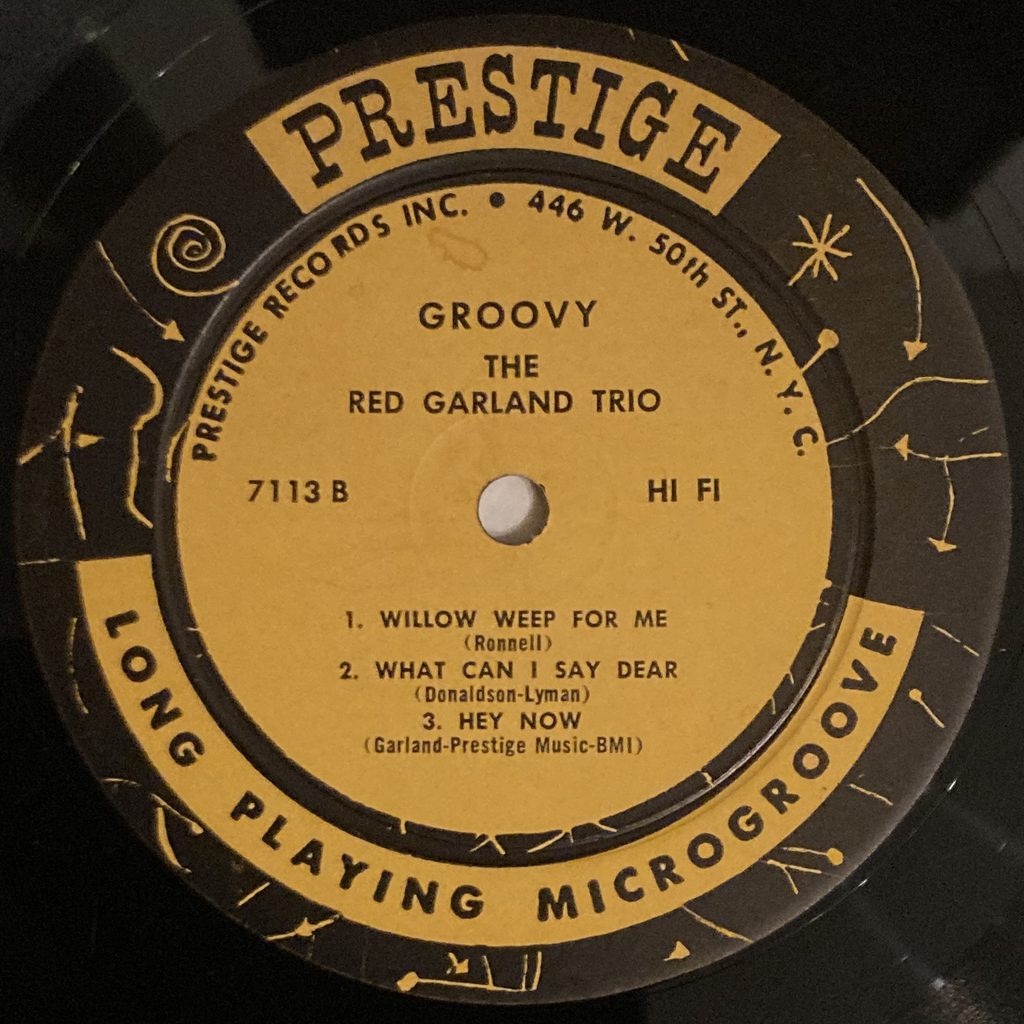
Label Side-B
Yellow Background
Black Letter with HI FI
Address: 446 W. 50th ST., N.Y.C.
Deep Groove
Dead Wax Info: RVGスタンプ, PRLP-7113-B, B, AB
Personnel-
Drums: Arthur Taylor
Bass: Paul Chambers
Piano: Red Garland
Tracks-
Side-A
1) C-Jam Blues 8’21”
2) Gone Again 6’46”
3) Will You Still Be Mine? 4’43”
Side-B
1) Willow Weep for Me 9’35”
2) What Can I Say Dear? 7’14”
3) Hey Now 3’41”
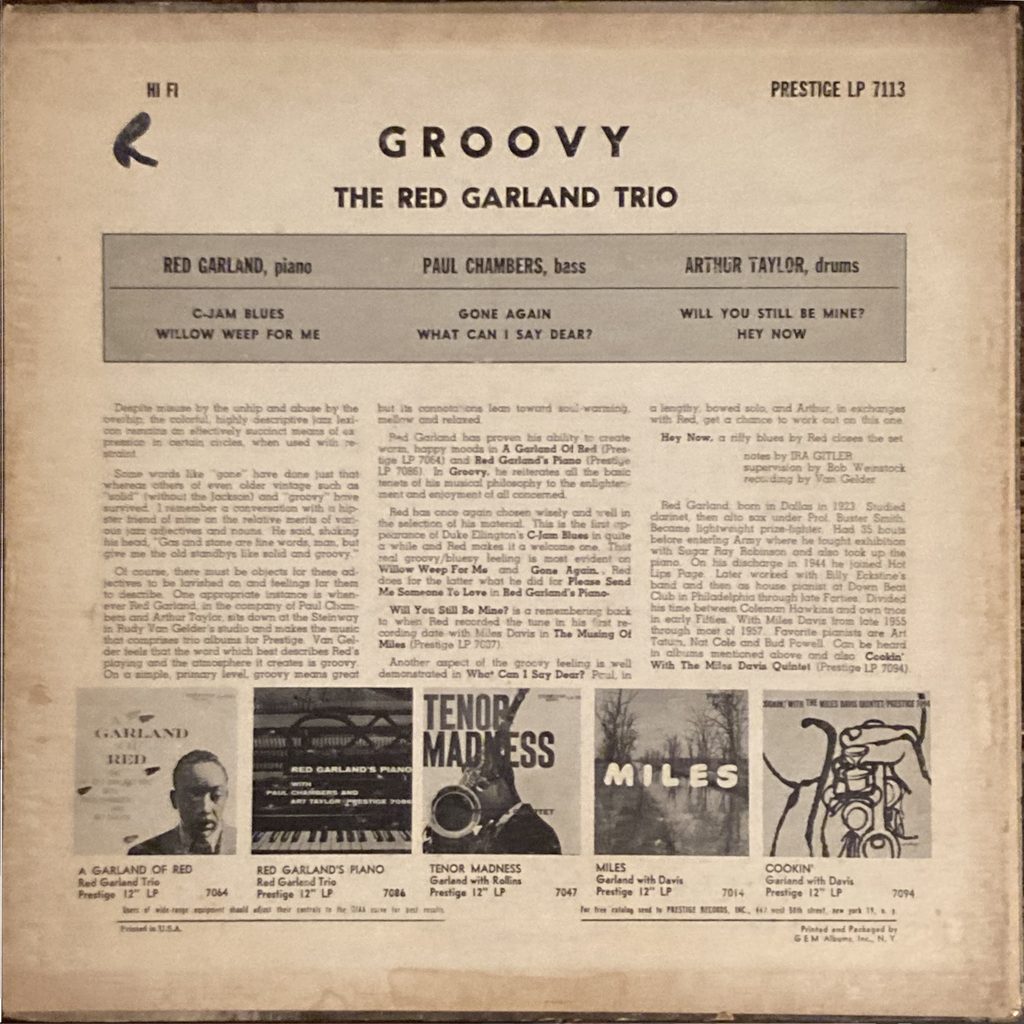
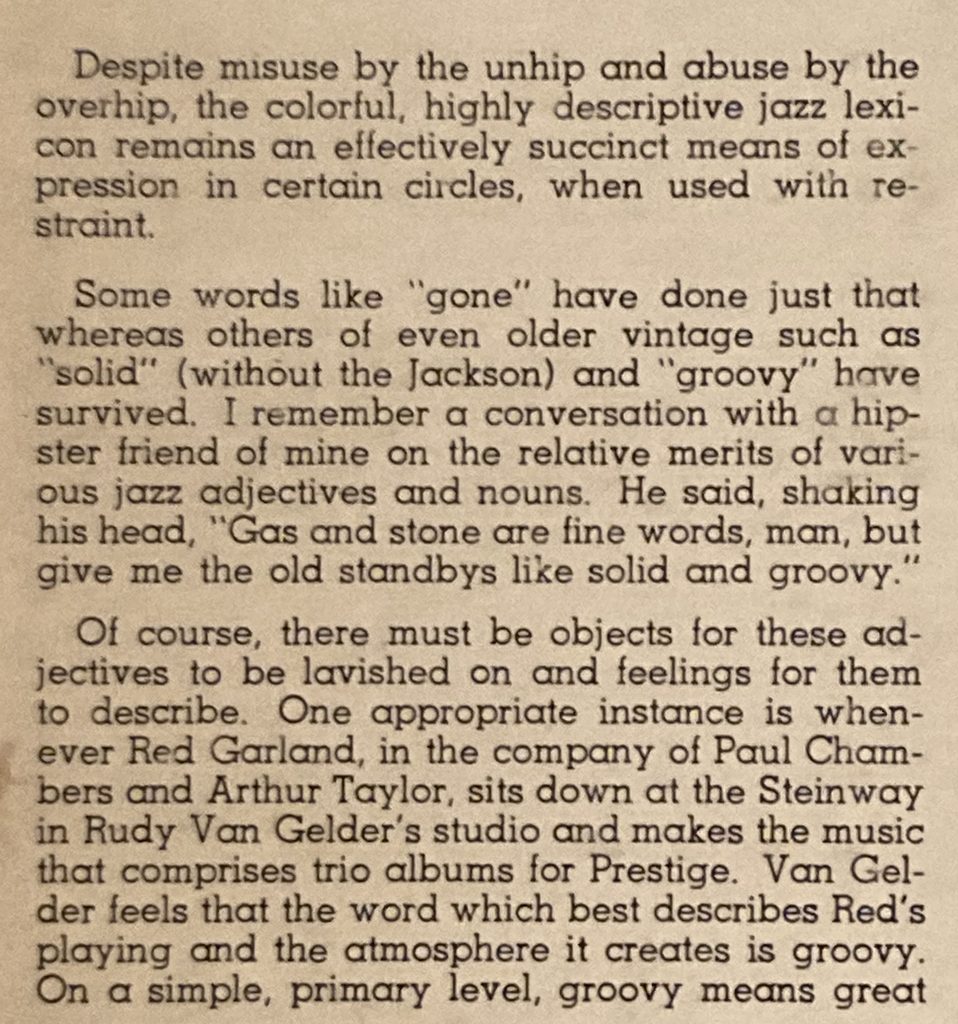
<裏ジャケ原文>
Despite misuse by the unhip and abuse by the overhip, the colorful, highly descriptive jazz lexi- con remains an effectively succinct means of ex- pression in certain circles, when used with re- straint.
Some words like “gone” have done just that whereas others of even older vintage such as “solid” (without the Jackson) and “groovy” have survived. I remember a conversation with a hip- ster friend of mine on the relative merits of vari- ous jazz adjectives and nouns. He said, shaking his head, “Gas and stone are fine words, man, but give me the old standbys like solid and groovy.”
Of course, there must be objects for these ad- jectives to be lavished on and feelings for them to describe. One appropriate instance is when- ever Red Garland, in the company of Paul Cham- bers and Arthur Taylor, sits down at the Steinway in Rudy Van Gelder’s studio and makes the music that comprises trio albums for Prestige. Van Gel- der feels that the word which best describes Red’s playing and the atmosphere it creates is groovy. On a simple, primary level, groovy means great but its connotations lean toward soul-warming, mellow and relaxed.
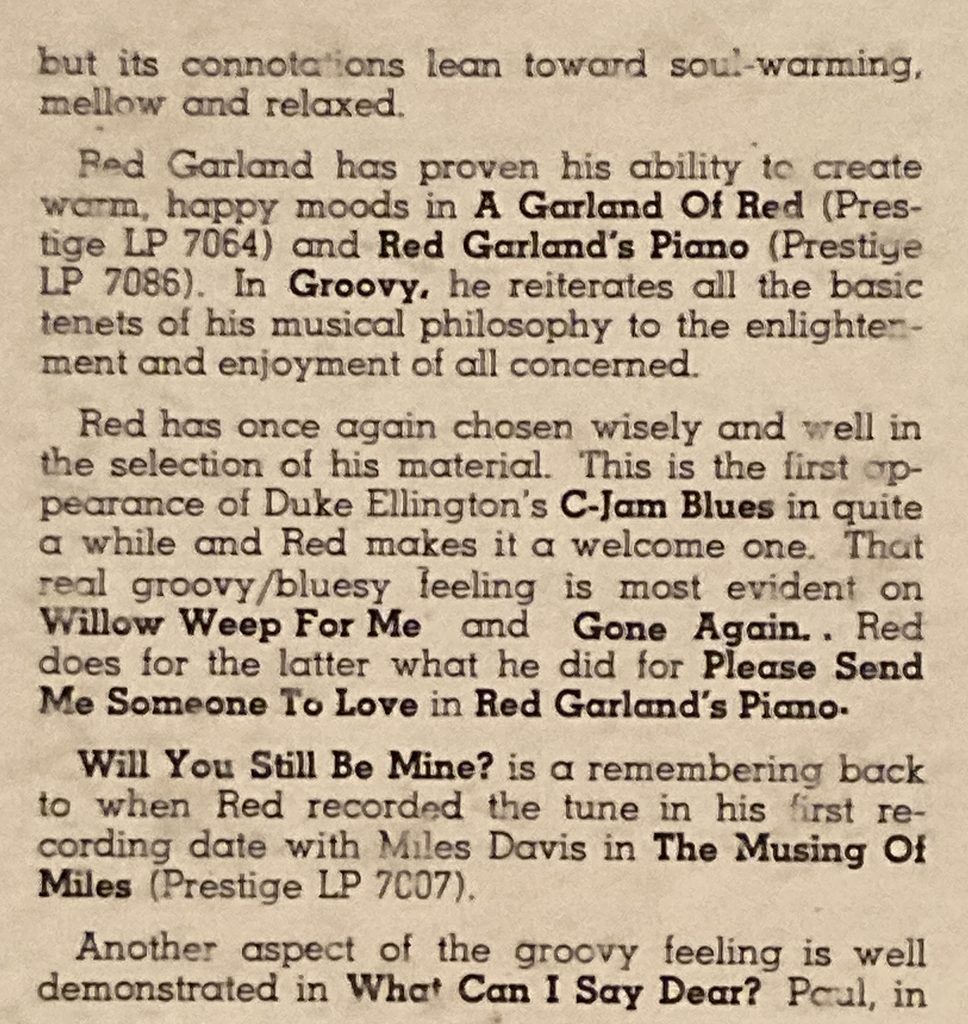
Red Garland has proven his ability to create warm, happy moods in A Garland Of Red (Pres- tige LP 7064) and Red Garland’s Piano (Prestige LP 7086). In Groovy, he reiterates all the basic tenets of his musical philosophy to the enlighten- ment and enjoyment of all concerned.
Red has once again chosen wisely and well in the selection of his material. This is the first op- pearance of Duke Ellington’s C-Jam Blues in quite a while and Red makes it a welcome one. That real groovy/bluesy feeling is most evident on Willow Weep For Me and Gone Again.. Red does for the latter what he did for Please Send Me Someone To Love in Red Garland’s Piano.
Will You Still Be Mine? is a remembering back to when Red recorded the tune in his first re- cording date with Miles Davis in The Musing Of Miles (Prestige LP 7C07).
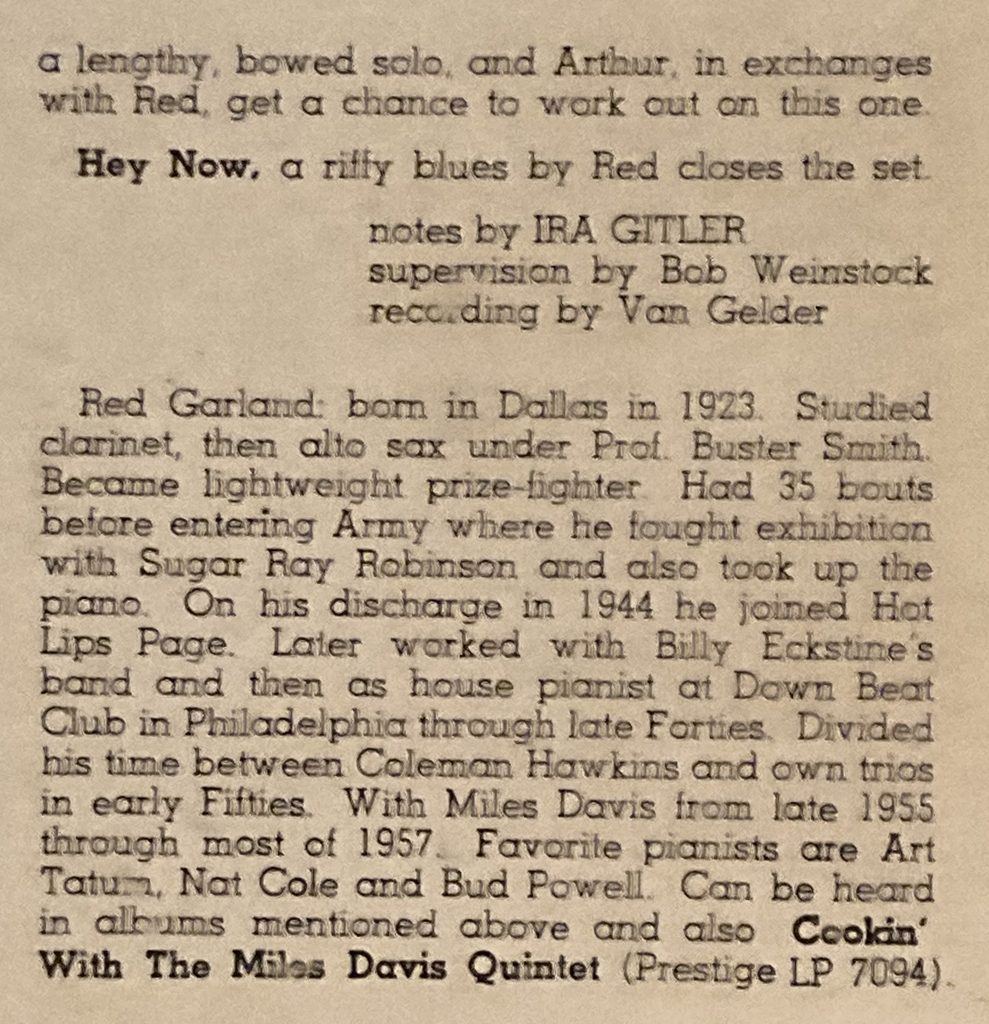
Another aspect of the groovy feeling is well demonstrated in What Can I Say Dear? Paul, in a lengthy, bowed solo, and Arthur, in exchanges with Red, get a chance to work out on this one.
Hey Now, a riffy blues by Red closes the set.
notes by IRA GITLER
supervision by Bob Weinstock recc.ding by Van Gelder
Red Garland: born in Dallas in 1923. Studied clarinet, then alto sax under Prof. Buster Smith. Became lightweight prize-fighter. Had 35 bouts before entering Army where he fought exhibition with Sugar Ray Robinson and also took up the piano. On his discharge in 1944 he joined Hot Lips Page. Later worked with Billy Eckstine’s band and then as house pianist at Down Beat Club in Philadelphia through late Forties. Divided his time between Coleman Hawkins and own trios in early Fifties. With Miles Davis from late 1955 through most of 1957. Favorite pianists are Art Tatum, Nat Cole and Bud Powell. Can be heard in albums mentioned above and also Cookin’ With The Miles Davis Quintet (Prestige LP 7094).
<裏ジャケ和訳>
「イケてない」人たちによる誤用や、「イケてる」ことを意識しすぎた人たちによる乱用にもかかわらず、色彩豊かで表現力に富んだジャズ用語は、節度を持って使えば、特定のコミュニティにおいて依然として効果的かつ簡潔な表現手段であり続けています。
「Gone(ゴーン)」のように消えていった言葉もあれば、「Solid(ソリッド)」(「Jackson」を付けない場合)や「Groovy(グルーヴィー)」のように、さらに古い時代から生き残っている言葉もあります。ある「ヒップ」な友人と、ジャズで使われる様々な形容詞や名詞の良し悪しについて語り合ったことを覚えています。彼は首を横に振りながらこう言いました。「『Gas(ガス)』や『Stone(ストーン)』もいい言葉だけど、俺なら『Solid』や『Groovy』といった定番を選ぶね」
もちろん、こうした形容詞を惜しみなく注ぎ込む対象や、それによって表現される感情が存在しなければなりません。その好例と言えるのが、レッド・ガーランドがポール・チェンバースやアーサー・テイラーと共に、ルディ・ヴァン・ゲルダーのスタジオでスタインウェイのピアノに向かい、プレスティッジ・レーベル向けのトリオ・アルバムを制作する場面です。ヴァン・ゲルダーは、レッドの演奏とそれが生み出す雰囲気を最もよく表す言葉は「Groovy」だと感じています。単純かつ根本的なレベルで言えば、「Groovy」は「素晴らしい(great)」を意味しますが、そのニュアンスは、心が温まるような、メロウでリラックスした雰囲気を帯びています。
レッド・ガーランドは、『A Garland Of Red』(Prestige LP 7064)や『Red Garland’s Piano』(Prestige LP 7086)において、温かく幸福感に満ちたムードを作り出す才能を証明してきました。本作『Groovy』でも、彼は自身の音楽哲学の基本を改めて提示し、聴き手を楽しませ、その魅力を伝えています。
レッドは今回もまた、楽曲選びにおいて賢明かつ素晴らしい選択をしました。デューク・エリントンの「C-Jam Blues」が取り上げられるのは久しぶりですが、レッドはそれを歓迎すべき名演に仕上げています。「Groovy」かつ「Bluesy(ブルージー)」な感覚が最も色濃く表れているのは、「Willow Weep For Me」や「Gone Again」といった曲です。後者において、彼は『Red Garland’s Piano』収録の「Please Send Me Someone To Love」で見せたのと同様の手腕を発揮しています。
「Will You Still Be Mine?」は、レッドがマイルス・デイヴィスとの初レコーディング・セッション(アルバム『The Musings of Miles』/Prestige LP 7007)でこの曲を録音した時のことを想起させる一曲です。 「グルーヴィー」な感覚のもう一つの側面は、「What Can I Say Dear?」で実証されています。この曲では、ポールが弓弾き(アルコ)による長いソロを披露し、アーサーもレッドとの掛け合いの中で存分にプレイしています。
セットの最後を飾るのは、レッドによるリフ主体のブルース・ナンバー「Hey Now」です。
解説:アイラ・ギトラー
監修:ボブ・ワインストック 録音:ヴァン・ゲルダ―
レッド・ガーランド:1923年ダラス生まれ。バスター・スミス教授に師事し、クラリネットとアルト・サックスを学びました。その後、ライト級のプロボクサーに転身。35戦を経験した後、陸軍に入隊し、そこではシュガー・レイ・ロビンソンとのエキシビション・マッチを行うとともに、ピアノも弾き始めました。1944年の除隊後はホット・リップス・ペイジのバンドに参加。その後、ビリー・エクスタインのバンドを経て、40年代後半にはフィラデルフィアの「ダウン・ビート・クラブ」でハウス・ピアニストを務めました。50年代初頭はコールマン・ホーキンスとの共演と自身のトリオでの活動を並行させ、1955年後半から1957年の大半にかけてはマイルス・デイヴィスのグループに在籍しました。好みのピアニストはアート・テイタム、ナット・コール、バド・パウエル。彼の演奏は、前述のアルバムのほか、『Cookin’ With The Miles Davis Quintet』(Prestige LP 7094)でも聴くことができます。
※訳文の制作にはGoogleドライブとGoogle翻訳のお世話になりました。


コメント