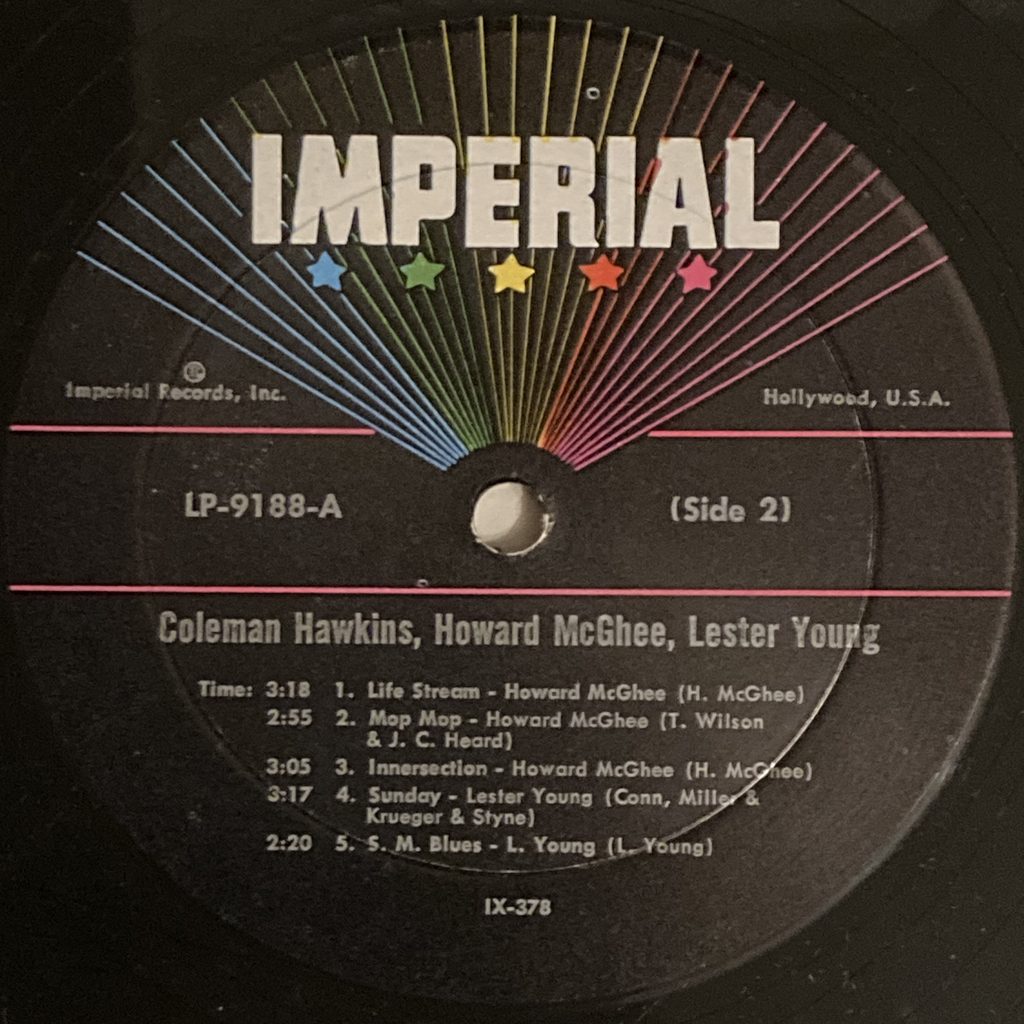
Label: IMPERIAL RECORDS
No.: LP-9188A
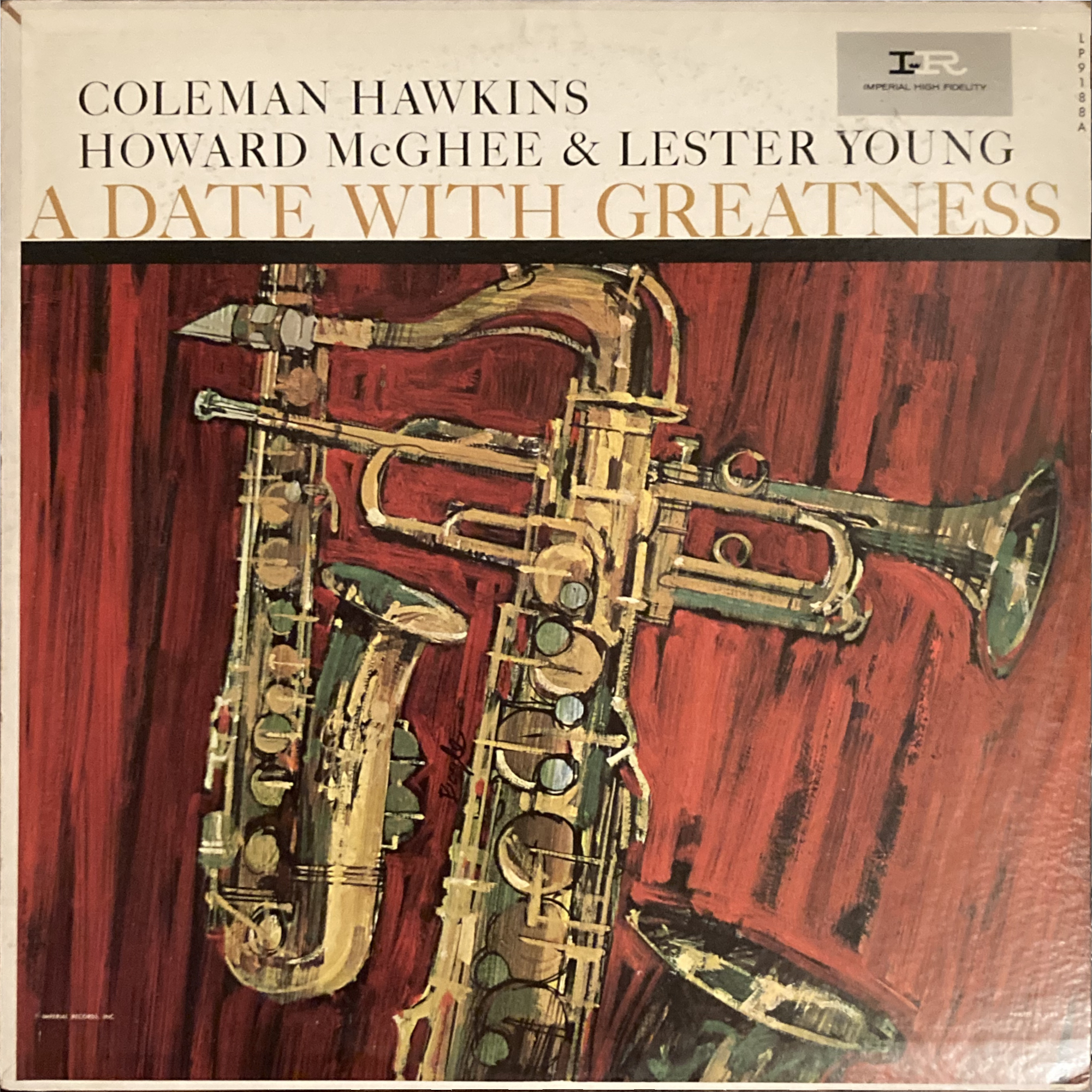
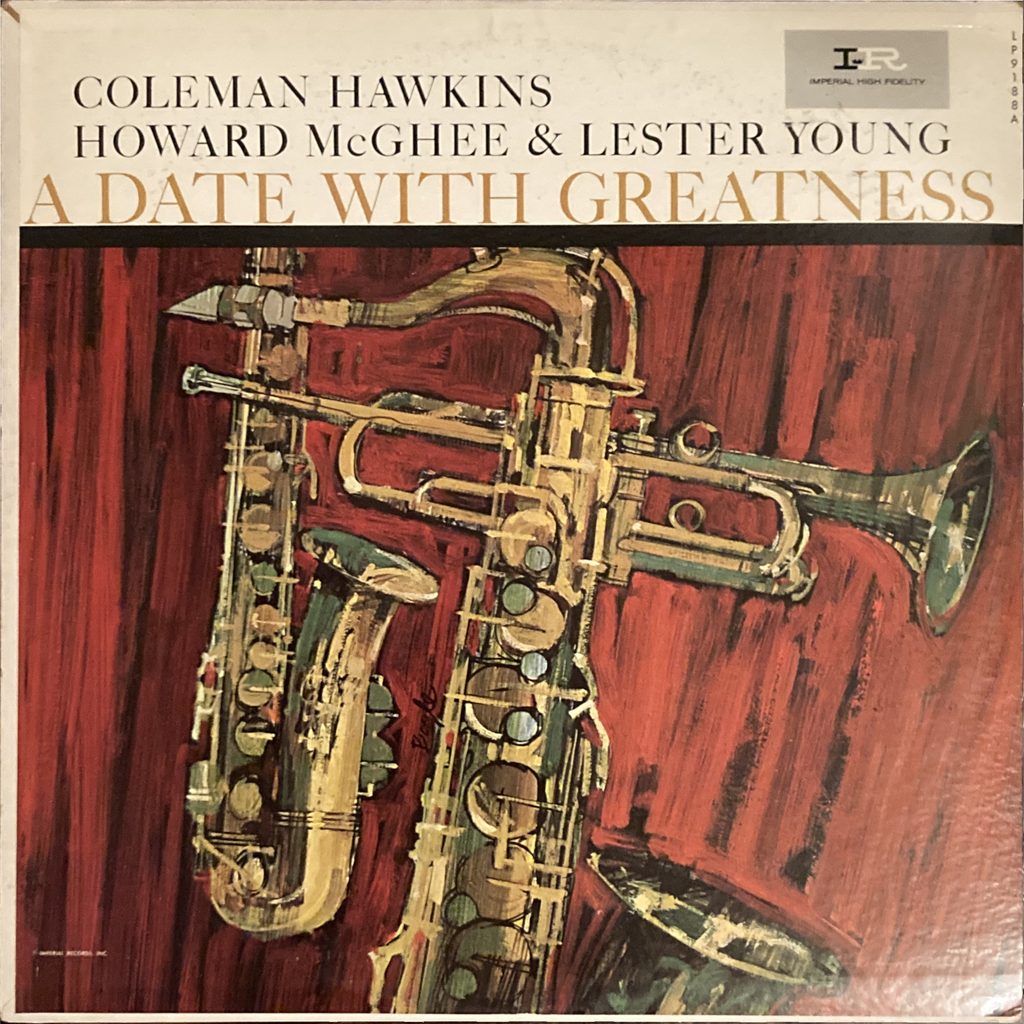
Title: A DATE WITH GREATNESS
Musician: COLEMAN HAWKINS, HOWARD McGHEE, LESTER YOUNG
Recorded: 1945/9, 1947/2, 1947/6
Monaural
Cover address: None
Coating無し
Groove Guard
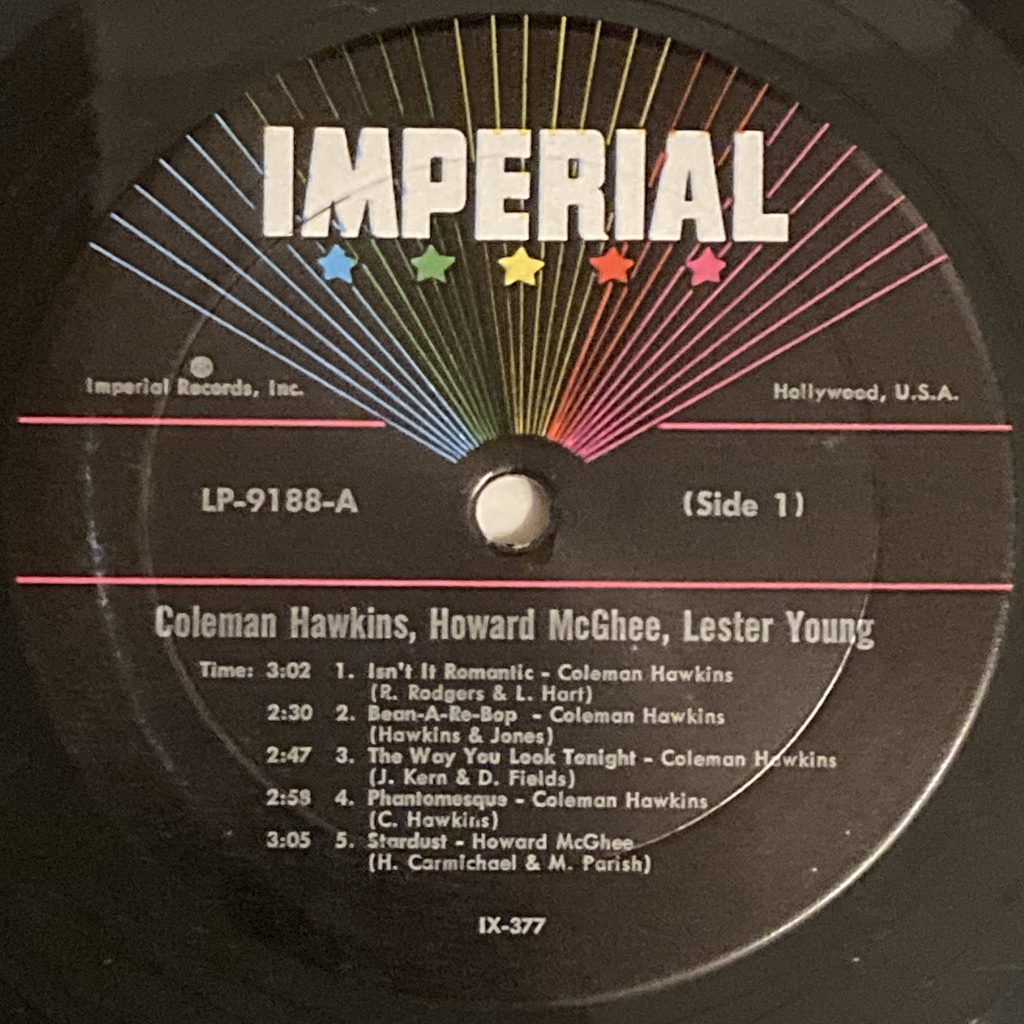
Label Side-A
Black Background
Silver Letter
Address: None
Deep Groove無し
Dead Wax Info: IX-377
Label Side-B
Black Background
Silver Letter
Address: None
Deep Groove無し
Dead Wax Info: IX-378
Personnel- Recorded June 1947 Side1-(1),(2),(3),(4)
Drums: Max Roach
Bass: Curley Russell, Tommy Potter
Piano: Hank Jones
Tenor Sax: Coleman Hawkins
Alto Sax: Howard Johnson
Trumpet: Miles Davis
Trombone: Kai Winding
Personnel- Recorded Sep 1945 Side1-(5),Side2-(1),(2),(3)
Trumpet: Howard McGhee
others
Personnel- Recorded Feb 1947 Side2-(4),(5)
Drums: Lyndell Marshall
Bass: Rodney Richardson
Piano: Argonne Thornton
Tenor Sax: Lestor Young
Trumpet: Shorty McConnell
Guitar: Fred Lacey
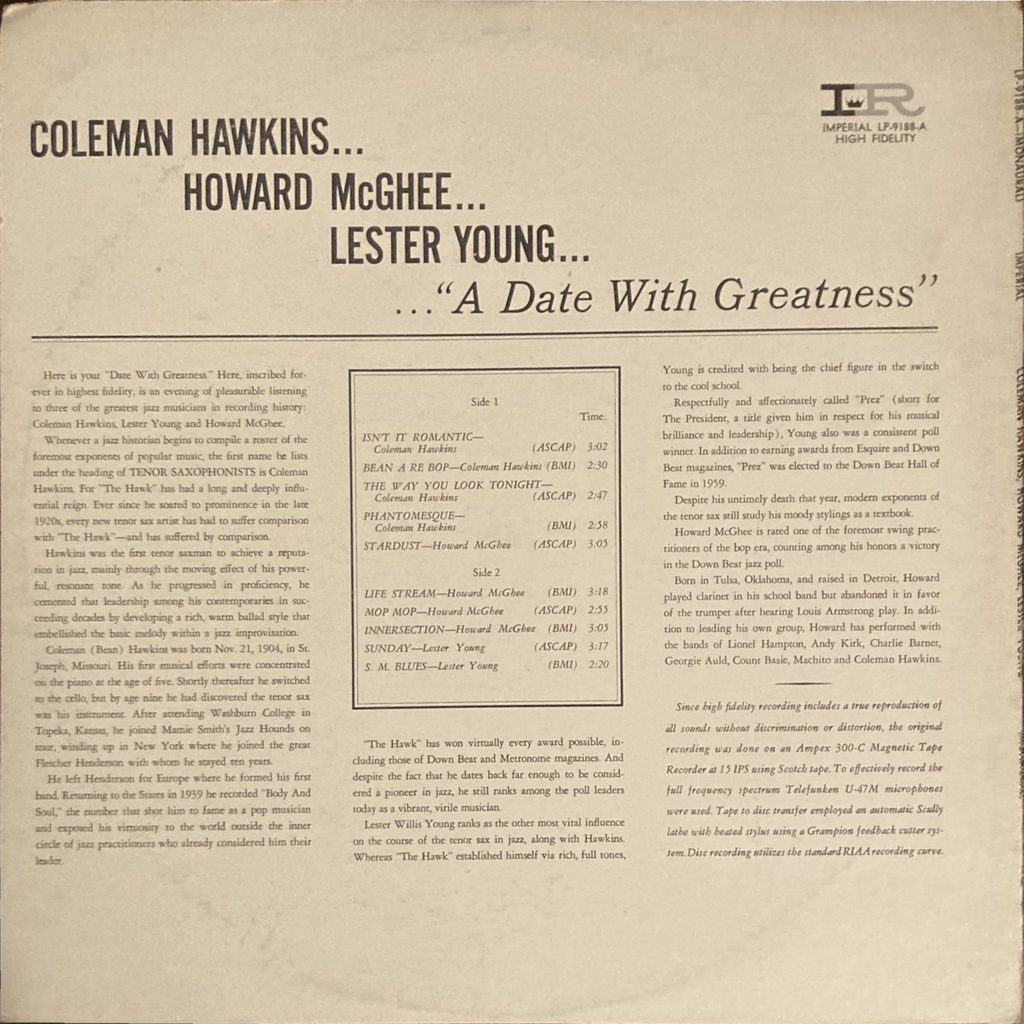
Tracks-
Side-A
1) Isn’t it Romantic 3’02”
2) Bean a Re Bop 2’30”
3) The Way You Look Tonight 2’47”
4) Phantomesque 2’58”
5) Stardust 3’05”
Side-B
1) Life Stream 3’18”
2) Mop Mop 2’55”
3) Innersection 3’05”
4) Sunday 3’17”
5) S. M. Blues 2’20”
<裏ジャケ原文>
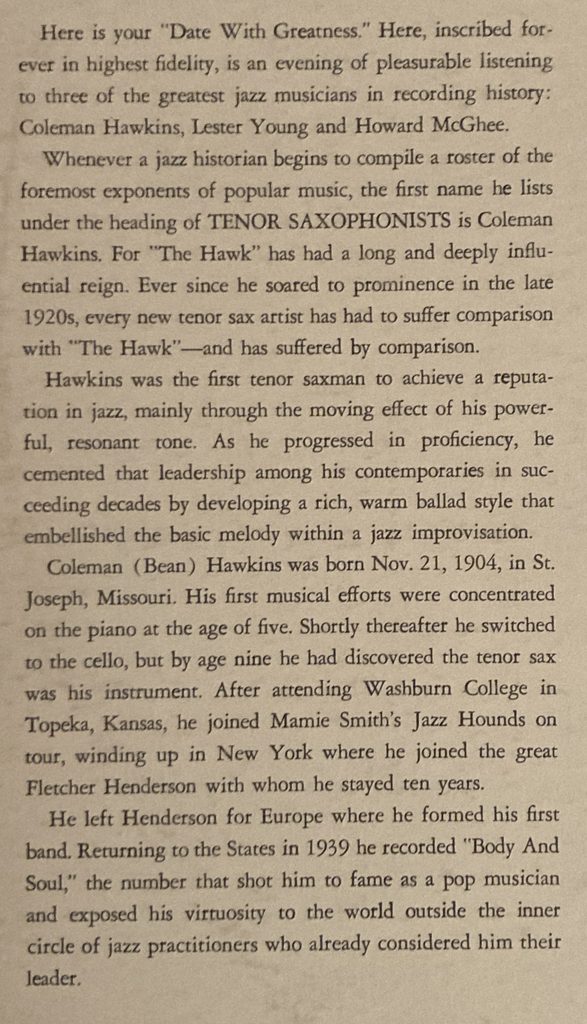
Here is your “Date With Greatness.” Here, inscribed for- ever in highest fidelity, is an evening of pleasurable listening to three of the greatest jazz musicians in recording history: Coleman Hawkins, Lester Young and Howard McGhee.
Whenever a jazz historian begins to compile a roster of the foremost exponents of popular music, the first name he lists under the heading of TENOR SAXOPHONISTS is Coleman Hawkins. For “The Hawk” has had a long and deeply influ- ential reign. Ever since he soared to prominence in the late 1920s, every new tenor sax artist has had to suffer comparison with “The Hawk”-and has suffered by comparison.
Hawkins was the first tenor saxman to achieve a reputa- tion in jazz, mainly through the moving effect of his power- ful, resonant tone. As he progressed in proficiency, he cemented that leadership among his contemporaries in suc- ceeding decades by developing a rich, warm ballad style that embellished the basic melody within a jazz improvisation.
Coleman (Bean) Hawkins was born Nov. 21, 1904, in St. Joseph, Missouri. His first musical efforts were concentrated on the piano at the age of five. Shortly thereafter he switched to the cello, but by age nine he had discovered the tenor sax was his instrument. After attending Washburn College in Topeka, Kansas, he joined Mamie Smith’s Jazz Hounds on tour, winding up in New York where he joined the great Fletcher Henderson with whom he stayed ten years.
He left Henderson for Europe where he formed his first band. Returning to the States in 1939 he recorded “Body And Soul,” the number that shot him to fame as a pop musician and exposed his virtuosity to the world outside the inner circle of jazz practitioners who already considered him their leader.
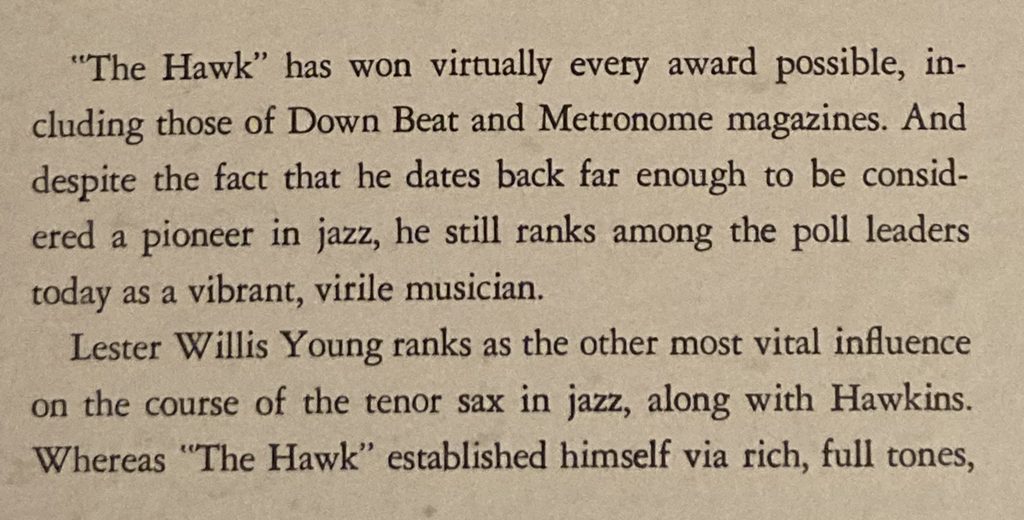
“The Hawk” has won virtually every award possible, in- cluding those of Down Beat and Metronome magazines. And despite the fact that he dates back far enough to be consid- ered a pioneer in jazz, he still ranks among the poll leaders today as a vibrant, virile musician.
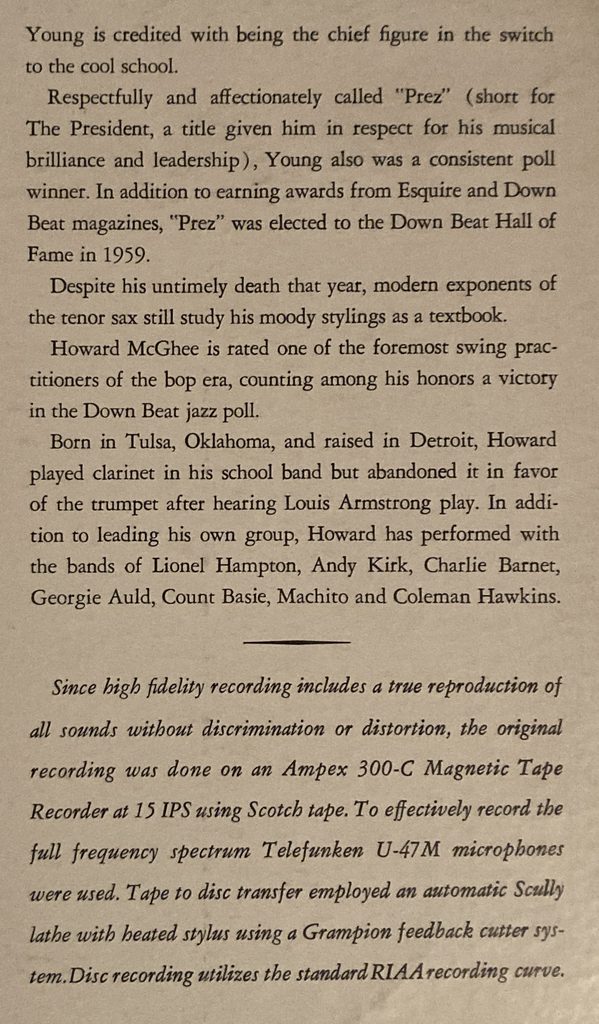
Lester Willis Young ranks as the other most vital influence on the course of the tenor sax in jazz, along with Hawkins. Whereas “The Hawk” established himself via rich, full tones, Young is credited with being the chief figure in the switch to the cool school.
Respectfully and affectionately called “Prez” (short for The President, a title given him in respect for his musical brilliance and leadership), Young also was a consistent poll winner. In addition to earning awards from Esquire and Down Beat magazines, “Prez” was elected to the Down Beat Hall of Fame in 1959.
Despite his untimely death that year, modern exponents of the tenor sax still study his moody stylings as a textbook.
Howard McGhee is rated one of the foremost swing prac- titioners of the bop era, counting among his honors a victory in the Down Beat jazz poll.
Born in Tulsa, Oklahoma, and raised in Detroit, Howard played clarinet in his school band but abandoned it in favor of the trumpet after hearing Louis Armstrong play. In addi- tion to leading his own group, Howard has performed with the bands of Lionel Hampton, Andy Kirk, Charlie Barnet, Georgie Auld, Count Basie, Machito and Coleman Hawkins.
Since high fidelity recording includes a true reproduction of all sounds without discrimination or distortion, the original recording was done on an Ampex 300-C Magnetic Tape Recorder at 15 IPS using Scotch tape. To effectively record the full frequency spectrum Telefunken U-47M microphones were used. Tape to disc transfer employed an automatic Scully lathe with heated stylus using a Grampion feedback cutter sys- tem.Disc recording utilizes the standard RIAA recording curve.
<裏ジャケ和訳>
ここに、「偉大さとの邂逅(Date With Greatness)」をお届けします。ジャズの録音史上、最も偉大なミュージシャン3人――コールマン・ホーキンス、レスター・ヤング、ハワード・マギー――による、聴く喜びにあふれた一夜が、最高音質で永遠に刻み込まれています。
ジャズ史家がポピュラー音楽の主要な演奏家リストを作成する際、「テナー・サックス奏者」の項で最初に名を挙げるのは、決まってコールマン・ホーキンスです。「ザ・ホーク(The Hawk)」の愛称で親しまれる彼は、長きにわたって多大な影響力を持ち続けてきました。1920年代後半に頭角を現して以来、後に続くテナー・サックス奏者は皆、「ザ・ホーク」と比較される宿命を背負い、そしてその比較において常に分が悪い思いをしてきたのです。
ホーキンスは、力強く響き渡る音色で聴く者の心を揺さぶり、ジャズ界で最初に名声を確立したテナー・サックス奏者でした。キャリアを重ねるにつれ、彼はジャズ即興演奏の中で基本のメロディを豊かに装飾する、温かみのあるバラード・スタイルを確立し、同時代のミュージシャンたちの中での不動の地位を確固たるものにしました。
コールマン・“ビーン”・ホーキンスは、1904年11月21日、ミズーリ州セント・ジョセフで生まれました。5歳の頃、最初に音楽に触れたのはピアノでしたが、その後まもなくチェロに転向。しかし9歳になる頃には、テナー・サックスこそが自分の楽器であると見出しました。カンザス州トピカのウォッシュバーン・カレッジに通った後、メイミー・スミスの「ジャズ・ハウンズ」のツアーに参加。最終的にニューヨークへ渡り、偉大なフレッチャー・ヘンダーソンの楽団に加わると、そこで10年間活動しました。
その後、ヘンダーソンの楽団を離れてヨーロッパへ渡り、自身の最初のバンドを結成します。1939年にアメリカへ帰国すると、「ボディ・アンド・ソウル(Body And Soul)」をレコーディング。この曲は彼をポピュラー音楽界のスターへと押し上げ、それまでジャズ関係者の間だけで「リーダー」と目されていた彼の卓越した技巧を、広く世界に知らしめることとなりました。
「ザ・ホーク」は、『ダウン・ビート』誌や『メトロノーム』誌をはじめ、あらゆる賞を総なめにしてきました。ジャズのパイオニアと呼べるほど長いキャリアを持ちながらも、彼は今なお、エネルギッシュで力強いミュージシャンとして、人気投票のトップに名を連ね続けています。レスター・ウィリス・ヤングは、コールマン・ホーキンスと並び、ジャズにおけるテナー・サックスの発展に最も重要な影響を与えた人物の一人である。「ザ・ホーク(ホーキンスの愛称)」が豊かで充実した音色によってその地位を確立したのに対し、ヤングは「クール・スクール(クール・ジャズ)」への転換を主導した人物として評価されている。
「プレズ(Prez)」という愛称で親しまれた彼は(これは「ザ・プレジデント=大統領」の略で、彼の音楽的才能とリーダーシップに対する敬意から贈られたもの)、各種の音楽投票でも常に上位に名を連ねた。『エスクァイア』誌や『ダウン・ビート』誌から賞を授与されたほか、1959年には『ダウン・ビート』誌の「ホール・オブ・フェイム(殿堂)」入りを果たしている。
その年、若くしてこの世を去ったにもかかわらず、現代のテナー・サックス奏者たちは、今なお彼の情緒あふれるスタイルを「教科書」として研究し続けている。
ハワード・マギーは、ビバップの時代においてスウィング・ジャズを体現する最も重要な奏者の一人とされており、『ダウン・ビート』誌のジャズ投票で1位を獲得した経験も持つ。
オクラホマ州タルサで生まれ、デトロイトで育ったハワードは、学生時代にバンドでクラリネットを演奏していたが、ルイ・アームストロングの演奏を聴いてトランペットに転向した。自身のグループを率いるだけでなく、ライオネル・ハンプトン、アンディ・カーク、チャーリー・バーネット、ジョージー・オールド、カウント・ベイシー、マチート、そしてコールマン・ホーキンスといったミュージシャンのバンドでも演奏を重ねた。
ハイ・フィデリティ(高忠実度)録音とは、あらゆる音を歪みや偏りなく忠実に再現するものである。本作のオリジナル録音には、アンペックス(Ampex)社製300-C磁気テープ・レコーダーが使用され、スコッチ(Scotch)社製のテープを用いて15 IPS(毎秒15インチ)の速度で収録された。全周波数帯域を効果的に捉えるため、マイクにはテレフンケン(Telefunken)社製のU-47Mが採用されている。テープからディスクへの転写には、加熱式スタイラスを備えたスカーリー(Scully)社製の自動カッティング・レース(旋盤)が用いられ、カッター・ヘッドにはグランピアン(Grampion)社のフィードバック・システムが組み込まれた。ディスク録音には、標準的なRIAAカーブが適用されている。
※訳文の制作にはGoogleドライブとGoogle翻訳のお世話になりました。
コメント