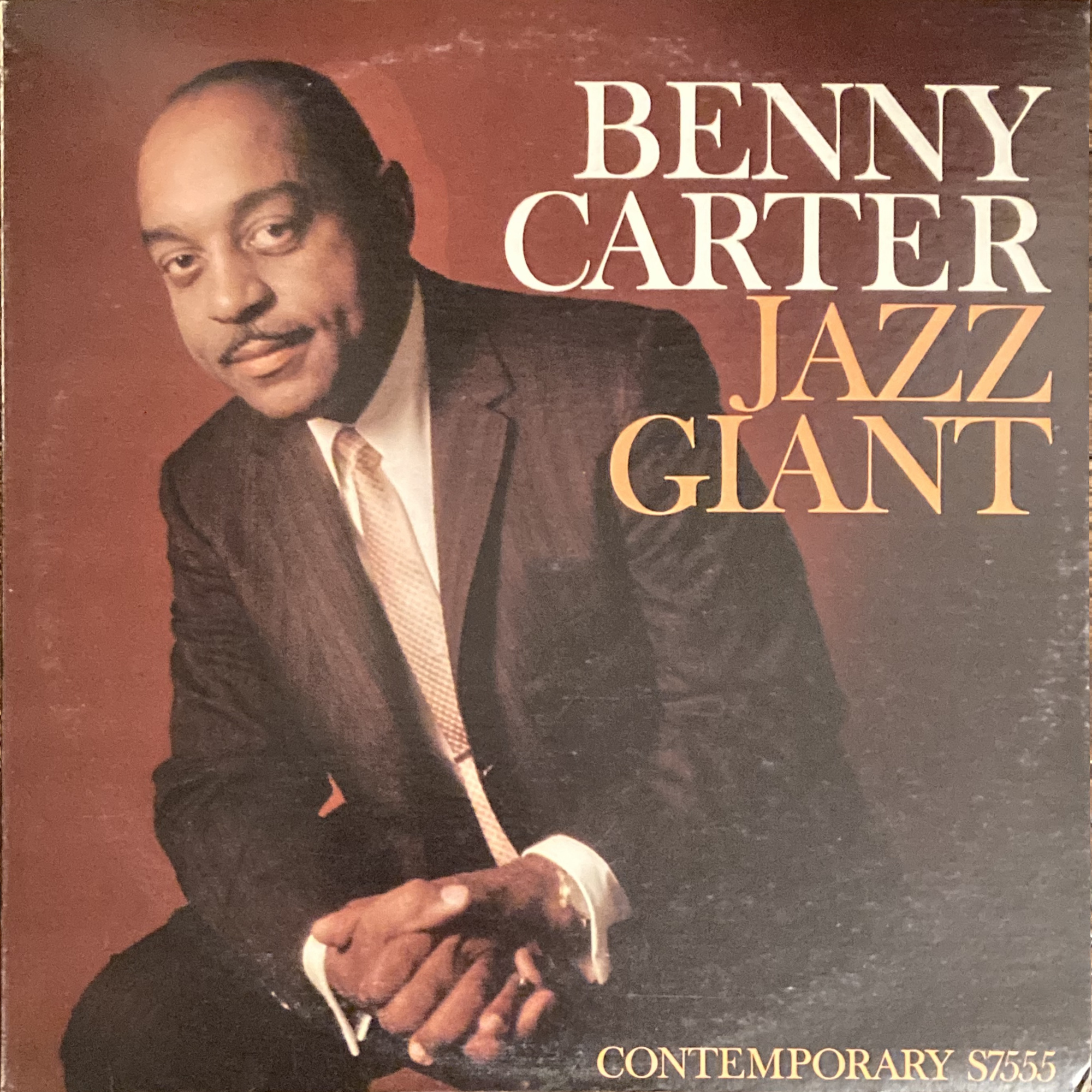
Label: CONTEMPORARY RECORDS
No.: S 7555
Title: BENNY CARTER, JAZZ GIANT
Musician: BENNY CARTER
Recorded: 1957/6/11, 1957/7/22, 1957/10/7, 1958/4/21
Stereo
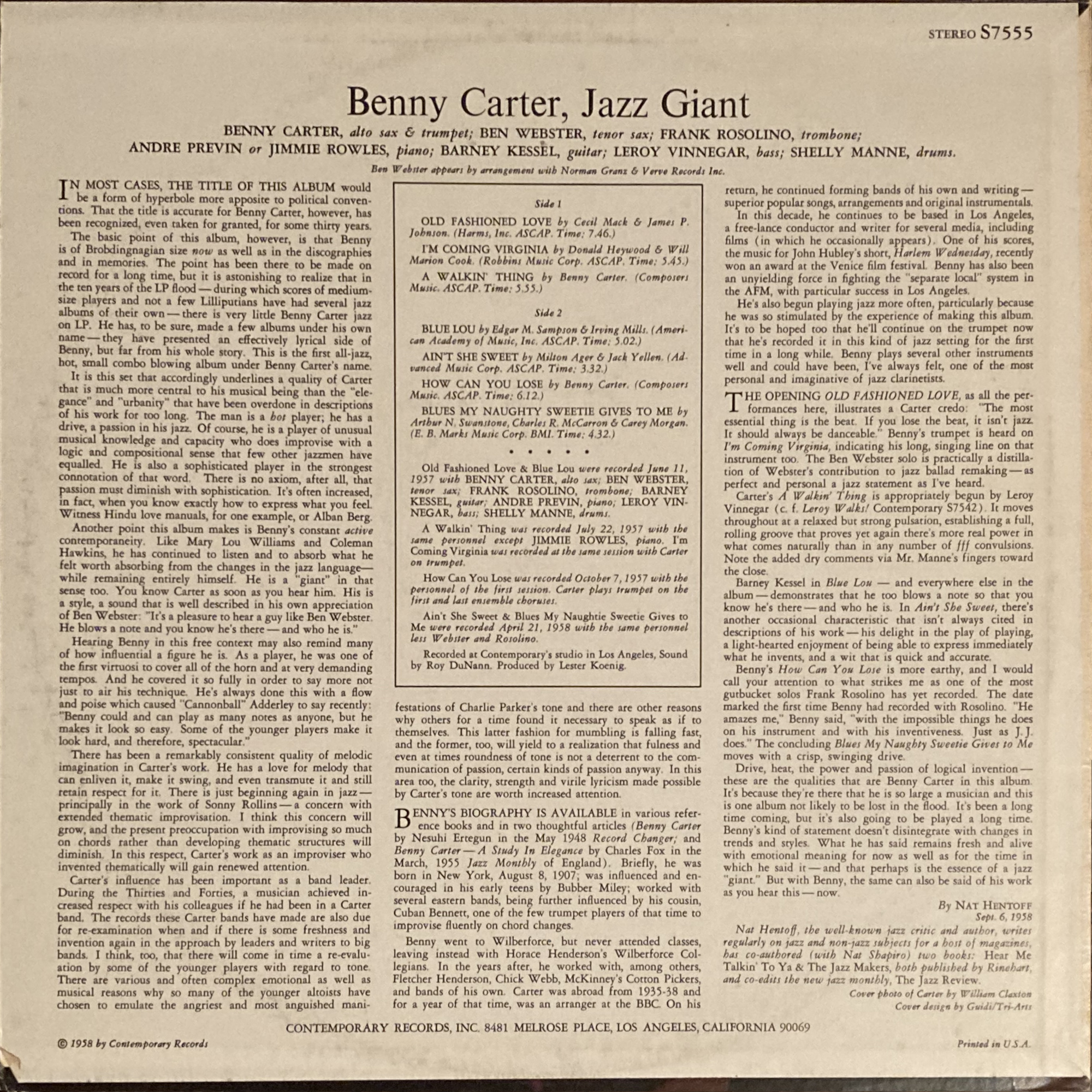
Cover address: 8481 MELROSE PLACE, LOS ANGELS, CALIFORNIA 90069
Coating無し
Groove Guard
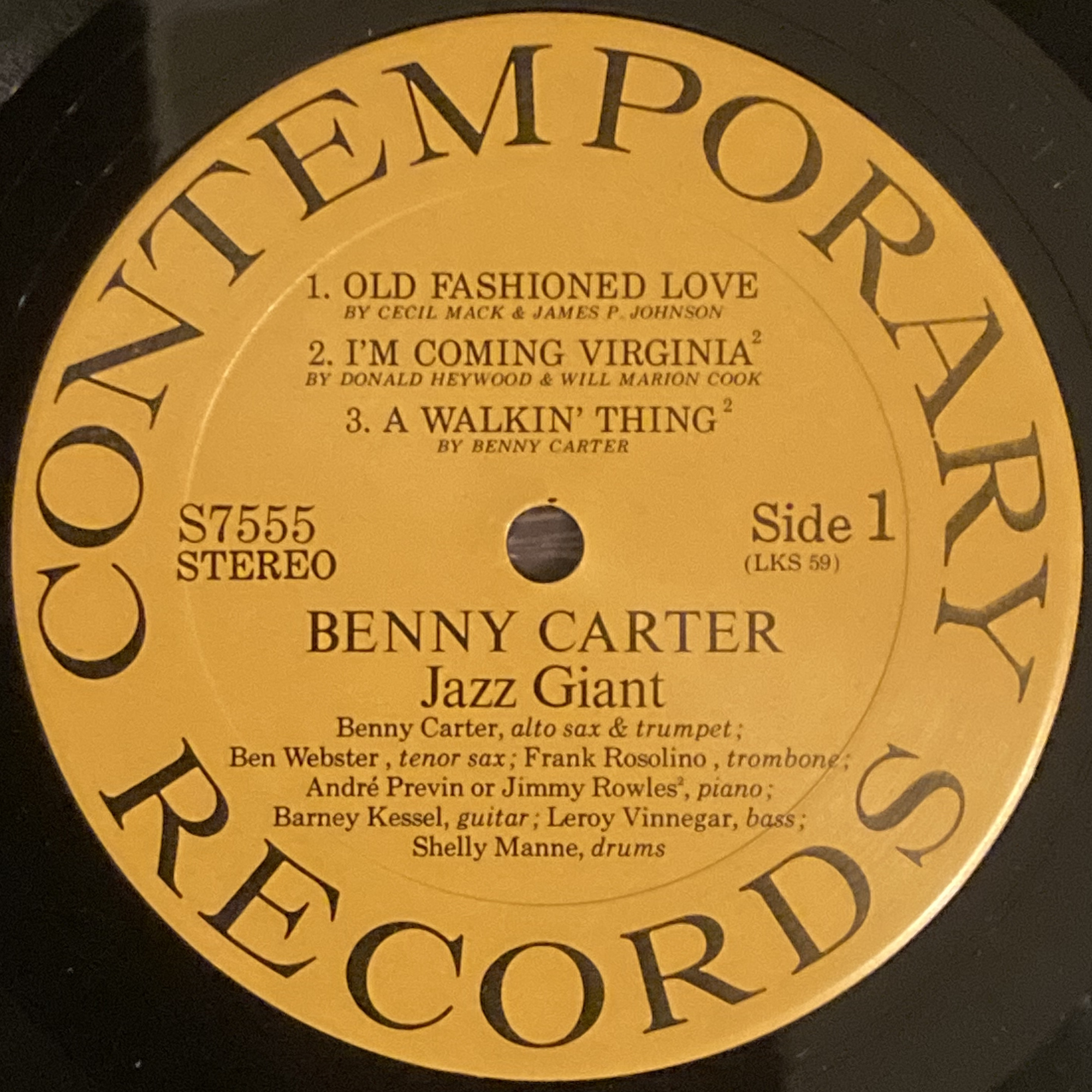
Label Side-1
Yellow Background
Black Letter
Address: None
Deep Groove無し
Dead Wax Info: LKS-59-D3, S1
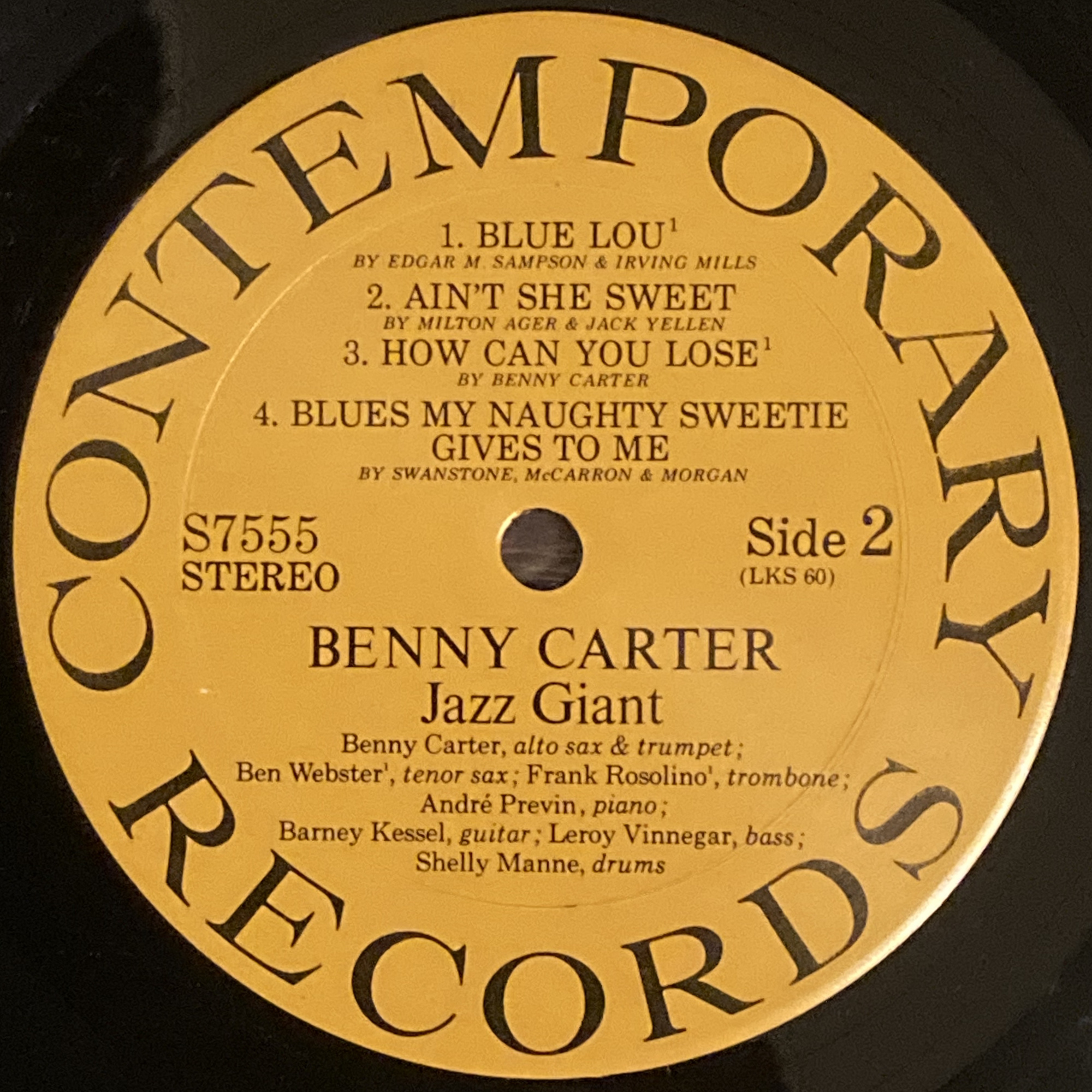
Label Side-2
Yellow Background
Black Letter
Address: None
Deep Groove無し
Dead Wax Info: LKS-60-D3, S1, B1
Personnel- Recorded on 1957/6/11 Side-1(1), Side-2(1)
Drums: Shelly Manne
Bass: Leroy Vinnegar
Piano: Andre Previn
Tenor Sax: Ben Webster
Alto Sax: Benny Carter
Trombone: Frank Rosolino
Guitar: Barney Kessel
Personnel- Recorded on 1957/7/22 Side-1(2),(3)
Drums: Shelly Manne
Bass: Leroy Vinnegar
Piano: Jimmy Rowles
Tenor Sax: Ben Webster
Alto Sax: Benny Carter
Trumpet: Benny Carter
Trombone: Frank Rosolino
Guitar: Barney Kessel
Personnel- Recorded on 1957/10/7 Side-2(3)
Drums: Shelly Manne
Bass: Leroy Vinnegar
Piano: Andre Previn
Tenor Sax: Ben Webster
Alto Sax: Benny Carter
Trumpet: Benny Carter
Trombone: Frank Rosolino
Guitar: Barney Kessel
Personnel- Recorded on 1958/4/21 SIde-2(2),(4)
Drums: Shelly Manne
Bass: Leroy Vinnegar
Piano: Andre Previn
Alto Sax: Benny Carter
Guitar: Barney Kessel
Tracks-
Side-1
1) Old Fashioned Love 7’46″
2) I’m Comming Virginia 5’45”
3) A Walkin’ Thing 5’55”
Side-2
1) Blue Lou 5’02”
2) Ain’t She Sweet 3’32”
3) How Can You Lose 6’12”
4) Blues My Naughty Sweetie Gives to Me 4’32”
<裏ジャケ原文>
IN MOST CASES, THE TITLE OF THIS ALBUM would be a form of hyperbole more apposite to political conven- tions. That the title is accurate for Benny Carter, however, has been recognized, even taken for granted, for some thirty years.
The basic point of this album, however, is that Benny is of Brobdingnagian size now as well as in the discographies and in memories. The point has been there to be made on record for a long time, but it is astonishing to realize that in the ten years of the LP flood-during which scores of medium- size players and not a few Lilliputians have had several jazz albums of their own-there is very little Benny Carter jazz on LP. He has, to be sure, made a few albums under his own name they have presented an effectively lyrical side of Benny, but far from his whole story. This is the first all-jazz, hot, small combo blowing album under Benny Carter’s name.
It is this set that accordingly underlines a quality of Carter that is much more central to his musical being than the “ele- gance” and “urbanity” that have been overdone in descriptions of his work for too long. The man is a hot player; he has a drive, a passion in his jazz. Of course, he is a player of unusual musical knowledge and capacity who does improvise with a logic and compositional sense that few other jazzmen have equalled. He is also a sophisticated player in the strongest connotation of that word. There is no axiom, after all, that passion must diminish with sophistication. It’s often increased, in fact, when you know exactly how to express what you feel. Witness Hindu love manuals, for one example, or Alban Berg.
Another point this album makes is Benny’s constant active contemporaneity. Like Mary Lou Williams and Coleman Hawkins, he has continued to listen and to absorb what he felt worth absorbing from the changes in the jazz language- while remaining entirely himself. He is a “giant” in that sense too. You know Carter as soon as you hear him. His is a style, a sound that is well described in his own appreciation of Ben Webster: “It’s a pleasure to hear a guy like Ben Webster. He blows a note and you know he’s there- and who he is.”
Hearing Benny in this free context may also remind many of how influential a figure he is. As a player, he was one of the first virtuosi to cover all of the horn and at very demanding tempos. And he covered it so fully in order to say more not just to air his technique. He’s always done this with a flow and poise which caused “Cannonball” Adderley to say recently: “Benny could and can play as many notes as anyone, but he makes it look so easy. Some of the younger players make it look hard, and therefore, spectacular.”
There has been a remarkably consistent quality of melodic imagination in Carter’s work. He has a love for melody that can enliven it, make it swing, and even transmute it and still retain respect for it. There is just beginning again in jazz- principally in the work of Sonny Rollins-a concern with extended thematic improvisation. I think this concern will grow, and the present preoccupation with improvising so much on chords rather than developing thematic structures will diminish. In this respect, Carter’s work as an improviser who invented thematically will gain renewed attention.
Carter’s influence has been important as a band leader. During the Thirties and Forties, a musician achieved in- creased respect with his colleagues if he had been in a Carter band. The records these Carter bands have made are also due for re-examination when and if there is some freshness and invention again in the approach by leaders and writers to big bands. I think, too, that there will come in time a re-evalu- ation by some of the younger players with regard to tone. There are various and often complex emotional as well as musical reasons why so many of the younger altoists have chosen to emulate the angriest and most anguished mani-festations of Charlie Parker’s tone and there are other reasons why others for a time found it necessary to speak as if to themselves. This latter fashion for mumbling is falling fast, and the former, too, will yield to a realization that fulness and even at times roundness of tone is not a deterrent to the com- munication of passion, certain kinds of passion anyway. In this area too, the clarity, strength and virile lyricism made possible by Carter’s tone are worth increased attention.
BENNY’S BIOGRAPHY IS AVAILABLE in various refer-ence books and in two thoughtful articles (Benny Carter by Nesuhi Ertegun in the May 1948 Record Changer; and Benny Carter-A Study In Elegance by Charles Fox in the March, 1955 Jazz Monthly of England). Briefly, he was born in New York, August 8, 1907; was influenced and en- couraged in his early teens by Bubber Miley; worked with several eastern bands, being further influenced by his cousin, Cuban Bennett, one of the few trumpet players of that time to improvise fluently on chord changes.
Benny went to Wilberforce, but never attended classes, leaving instead with Horace Henderson’s Wilberforce Col- legians. In the years after, he worked with, among others, Fletcher Henderson, Chick Webb, McKinney’s Cotton Pickers, and bands of his own. Carter was abroad from 1935-38 and for a year of that time, was an arranger at the BBC. On his return, he continued forming bands of his own and writing- superior popular songs, arrangements and original instrumentals. In this decade, he continues to be based in Los Angeles, a free-lance conductor and writer for several media, including films (in which he occasionally appears). One of his scores, the music for John Hubley’s short, Harlem Wednesday, recently won an award at the Venice film festival. Benny has also been an unyielding force in fighting the “separate local” system in the AFM, with particular success in Los Angeles.
He’s also begun playing jazz more often, particularly because he was so stimulated by the experience of making this album. It’s to be hoped too that he’ll continue on the trumpet now that he’s recorded it in this kind of jazz setting for the first time in a long while. Benny plays several other instruments well and could have been, I’ve always felt, one of the most personal and imaginative of jazz clarinetists.
THE OPENING OLD FASHIONED LOVE, as all the performances here, illustrates a Carter credo: “The most essential thing is the beat. If you lose the beat, it isn’t jazz. It should always be danceable.” Benny’s trumpet is heard on I’m Coming Virginia, indicating his long, singing line on that instrument too. The Ben Webster solo is practically a distilla- tion of Webster’s contribution to jazz ballad remaking- perfect and personal a jazz statement as I’ve heard.
Carter’s A Walkin’ Thing is appropriately begun by Leroy Vinnegar (c. f. Leroy Walks! Contemporary S7542). It moves throughout at a relaxed but strong pulsation, establishing a full, rolling groove that proves yet again there’s more real power in what comes naturally than in any number of fff convulsions. Note the added dry comments via Mr. Manne’s fingers toward the close.
Barney Kessel in Blue Lou and everywhere else in the album-demonstrates that he too blows a note so that you know he’s there-and who he is. In Ain’t She Sweet, there’s another occasional characteristic that isn’t always cited in descriptions of his work- his delight in the play of playing, a light-hearted enjoyment of being able to express immediately what he invents, and a wit that is quick and accurate.
Benny’s How Can You Lose is more earthy, and I would call your attention to what strikes me as one of the most gutbucket solos Frank Rosolino has yet recorded. The date marked the first time Benny had recorded with Rosolino. “He amazes me,” Benny said, “with the impossible things he does on his instrument and with his inventiveness. Just as J. J. does.” The concluding Blues My Naughty Sweetie Gives to Me moves with a crisp, swinging drive.
Drive, heat, the power and passion of logical invention these are the qualities that are Benny Carter in this album. It’s because they’re there that he is so large a musician and this is one album not likely to be lost in the flood. It’s been a long time coming, but it’s also going to be played a long time. Benny’s kind of statement doesn’t disintegrate with changes in trends and styles. What he has said remains fresh and alive with emotional meaning for now as well as for the time in which he said it and that perhaps is the essence of a jazz “giant.” But with Benny, the same can also be said of his work as you hear this- now.
By NAT HENTOFF Sept. 6, 1958
Nat Hentoff, the well-known jazz critic and author, writes regularly on jazz and non-jazz subjects for a host of magazines, has co-authored (with Nat Shapiro) two books: Hear Me Talkin’ To Ya & The Jazz Makers, both published by Rinehart, and co-edits the new jazz monthly, The Jazz Review.
Cover photo of Carter by William Claxton Cover design by Guidi/Tri-Arts
<裏ジャケ和訳>
通常、このアルバムのタイトル(「ジャズの巨人」)のような表現は、政治集会などで使われる誇張に過ぎないことが多いでしょう。しかし、ベニー・カーターに関しては、そのタイトルが的確であることは、もう30年近くも前から認められ、いわば当然のこととして受け止められてきました。
このアルバムの核心は、ベニーがディスコグラフィーや人々の記憶の中だけでなく、今この瞬間もまた「ブロブディンナグ(ガリバー旅行記に登場する巨人の国)」級の巨大な存在であるという点にあります。その事実は以前からレコードで証明し得るものでしたが、驚くべきことに、LPレコードが大量にリリースされたこの10年間――その間、中堅クラスの演奏家や、少なからぬ「リリパット(小人)」のような演奏家たちでさえ、自身のジャズ・アルバムを何枚も発表してきたというのに――ベニー・カーターのジャズ・アルバムはほとんど作られてきませんでした。確かに、彼自身の名義でいくつかのアルバムは制作されており、それらはベニーの叙情的な側面を効果的に伝えてはいましたが、彼の全貌を物語るには程遠いものでした。ベニー・カーターの名義で、純粋なジャズ、それもホットな小編成コンボによる即興演奏(ブローイング)を中心としたアルバムが作られるのは、これが初めてのことなのです。
それゆえに、このアルバムこそが、カーターという音楽家の本質において、これまで彼の作品評で語られすぎてきた「優雅さ」や「都会的な洗練」よりもはるかに重要な要素を浮き彫りにしていると言えます。彼は「ホット」な演奏家であり、そのジャズには推進力と情熱がみなぎっています。もちろん、彼は並外れた音楽的知識と能力の持ち主であり、他のジャズ・ミュージシャンがめったに到達できないような論理と作曲的センスをもって即興演奏を行います。また、彼は「洗練された」演奏家でもありますが、それはこの言葉が持つ最も強い意味合いにおいてです。そもそも、洗練されることで情熱が薄れるなどという決まりごとは存在しません。実際、自分の感じていることをどう表現すべきかを熟知していれば、情熱はむしろ高まることさえあるのです。その一例として、ヒンドゥー教の愛の教本や、アルバン・ベルクの音楽を挙げてみればよいでしょう。
このアルバムが示しているもう一つの点は、ベニーが常に「今」という時代と積極的に関わり続けているということです。メアリー・ルー・ウィリアムズやコールマン・ホーキンスと同様に、彼はジャズという言語の変化に耳を傾け、吸収する価値があると感じたものを自らのものにし続けてきました
あくまで自分自身というスタイルを保ちながら。その意味でも、彼は「巨人」なのです。カーターの音を聴けば、すぐに彼だとわかります。彼のスタイルやサウンドは、彼自身がベン・ウェブスターについて語った言葉に実によく表れています。「ベン・ウェブスターのような人の演奏を聴くのは喜びだ。彼がひと吹きすれば、そこに彼がいること、そして彼が何者であるかがすぐにわかる」。
こうした自由な文脈でベニーの演奏を聴けば、彼がいかに影響力のある人物であるかを改めて実感する人も多いでしょう。演奏家として、彼は楽器の全音域を駆使し、極めて速いテンポでも演奏できる最初の名手の一人でした。しかも、単にテクニックを誇示するためではなく、より多くのことを表現するために、その全音域を余すところなく使いこなしていたのです。彼は常に、流麗かつ堂々とした佇まいで演奏してきました。「キャノンボール」・アダレイが最近こう語ったのもそのためです。「ベニーは誰にも負けないほど多くの音を吹くことができるし、今も吹けるが、それをいとも簡単にやってのける。若い奏者の中には、難しそうに、それゆえに凄そうに見せようとする者もいるけれどね」。
カーターの作品には、驚くほど一貫した質の高い旋律的イマジネーションが息づいています。彼には旋律への深い愛情があり、それに命を吹き込み、スウィングさせ、さらには変容させながらも、その旋律への敬意を失うことはありません。ジャズの世界では今、再び「テーマ(主題)を拡張して展開する即興演奏」への関心が高まりつつあります(主にソニー・ロリンズの作品に見られるように)。こうした関心は今後さらに強まり、テーマの構造を展開させることよりもコード(和音)上での即興演奏に終始する現在の傾向は薄れていくことでしょう。その意味で、テーマを基軸に即興演奏を展開してきたカーターの仕事は、改めて注目を集めることになるはずです。
カーターはバンドリーダーとしても重要な影響力を持っていました。1930年代から40年代にかけて、カーターのバンドに在籍した経験を持つことは、ミュージシャン仲間から一目置かれることにつながりました。彼が率いたバンドによる録音は、リーダーや作編曲家がビッグバンドという形態に対して再び新鮮な視点や独創性を持って取り組むようになった暁には、改めて再評価されるべきものでしょう。また、若い演奏家の間でも、やがて「トーン(音色)」に関する再評価が進むものと思われます。多くの若いアルトサックス奏者が、チャーリー・パーカーのトーンの中でも最も激しい怒りや苦悩に満ちた側面を模倣しようとしたのには、音楽的な理由だけでなく、複雑な感情的理由も絡んでいました。一方で、独り言をつぶやくような奏法を一時的に必要とした奏者たちにも、また別の理由がありました。後者の「つぶやき」のようなスタイルは急速に廃れつつありますし、前者のスタイルについても、豊かで時に丸みのあるトーンこそが情熱――少なくとも特定の種類の情熱――を伝える妨げにはならないという認識へと変わっていくはずです。この点においても、カーターのトーンが可能にした明瞭さ、力強さ、そして男性的な叙情性は、もっと注目されるべきでしょう。
ベニーの経歴については、様々な参考図書や、二つの優れた記事(1948年5月発行『レコード・チェンジャー』誌に掲載されたネスヒ・エルテガンによる「ベニー・カーター」、および1955年3月発行の英国『ジャズ・マンスリー』誌に掲載されたチャールズ・フォックスによる「ベニー・カーター
優雅さの探求」)で知ることができます。簡単に言えば、彼は1907年8月8日にニューヨークで生まれ、10代前半にババー・マイリーから影響と励ましを受けました。その後、東部のいくつかのバンドで活動し、従兄弟であるキューバン・ベネットからもさらなる影響を受けています。ベネットは、当時のトランペット奏者としては珍しく、コード進行に合わせて流暢な即興演奏ができる人物でした。
ベニーはウィルバーフォース(大学)へ行きましたが、授業には一度も出席せず、ホレス・ヘンダーソン率いる「ウィルバーフォース・コレジアンズ」と共にその地を離れました。その後数年間は、フレッチャー・ヘンダーソン、チック・ウェブ、マッキニーズ・コットン・ピッカーズなどのバンドや、自身のバンドで活動しました。カーターは1935年から1938年まで海外に滞在し、そのうちの1年間はBBC(英国放送協会)でアレンジャー(編曲家)を務めました。帰国後も彼は自身のバンドを結成し続け、優れたポピュラー・ソングやアレンジ、オリジナルのインストゥルメンタル曲を書き続けた。この10年間はロサンゼルスを拠点とし、映画(時には本人も出演する)を含む様々なメディアで、フリーランスの指揮者や作曲家として活動している。ジョン・ハブリーの短編映画『Harlem Wednesday』のために彼が手がけた音楽は、最近ヴェネツィア国際映画祭で賞を獲得した。またベニーは、AFM(全米ミュージシャン連盟)における「地域別支部(セパレート・ローカル)」制度との闘いにおいても不屈の姿勢を貫き、特にロサンゼルスで大きな成果を上げている。
彼はジャズの演奏機会も増やし始めているが、それはとりわけ、このアルバム制作の経験から大きな刺激を受けたためである。久しぶりにこうしたジャズの文脈でトランペットを録音したのだから、今後もトランペットを吹き続けてくれることが期待される。ベニーは他にもいくつかの楽器を巧みに操るが、私は以前から、彼こそ最も個性的で独創的なジャズ・クラリネット奏者の一人になり得た人物だと感じてきた。
オープニング曲の「Old Fashioned Love」は、本作のすべての演奏と同様に、カーターの信条を体現している。「最も重要なのはビートだ。ビートを失えば、それはジャズではない。常にダンスができるものでなければならない」。ベニーのトランペットは「I’m Coming Virginia」で聴くことができ、彼がその楽器でも、長く歌うようなフレージングを披露していることがわかる。ベン・ウェブスターのソロは、ジャズ・バラードの再解釈における彼の貢献を凝縮したような内容であり、私がこれまでに聴いた中でも、完璧かつ極めて個人的なジャズの表現となっている。
カーターの「A Walkin’ Thing」は、リロイ・ヴィネガー(アルバム『Leroy Walks!』[Contemporary S7542]参照)による演奏で適切に幕を開ける。曲全体を通してリラックスしつつも力強いパルスが流れ、豊かでうねるようなグルーヴが確立されている。これは、無理やり「fff(極めて大きな音)」で激しくかき乱すような演奏よりも、自然に生まれるものの中にこそ真の力があることを改めて証明している。終盤における、マン氏の指が繰り出すドライなコメント(オブリガート)にも注目してほしい。
バーニー・ケッセルは、「ブルー・ルー(Blue Lou)」やアルバムの他のあらゆる場面で、自身の存在と個性をはっきりと印象づけるような演奏を披露しています。「エイント・シー・スウィート(Ain’t She Sweet)」では、彼の作品評であまり語られない特徴がもう一つ見られます。それは、演奏することそのものを楽しむ喜び、思いついたことを即座に表現できる軽やかな楽しさ、そして機知に富んだ素早く的確な反応です。
ベニーの「ハウ・キャン・ユー・ルーズ(How Can You Lose)」は、より土臭く(アーシーで)力強い雰囲気を帯びています。ここで特に注目していただきたいのは、フランク・ロソリーノがこれまでに録音した中でも、とりわけ「ガットバケット(泥臭く情熱的)」なソロだと私が感じる演奏です。このセッションは、ベニーとロソリーノが初めて共演した録音でもありました。「彼には驚かされるよ」とベニーは語っています。「楽器でやってのける信じられないような技や、その独創性にはね。J.J.(J.J.ジョンソン)と同じようにね。」アルバムを締めくくる「ブルース・マイ・ノーティ・スウィーティ・ギブズ・トゥ・ミー(Blues My Naughty Sweetie Gives to Me)」は、歯切れが良く、スウィング感あふれるドライブ感で展開します。
ドライブ感、熱気、そして論理的な創意工夫から生まれる力強さと情熱――これらこそが、このアルバムにおけるベニー・カーターの真髄です。それらがあるからこそ、彼は偉大な音楽家であり、このアルバムは数多ある作品の中に埋もれてしまうことのない一枚なのです。リリースまでには長い時間がかかりましたが、これからも長く聴き継がれていくことでしょう。ベニーが提示する音楽は、流行やスタイルの変化によって色あせることはありません。彼が表現したものは、当時だけでなく今この瞬間においても、新鮮さを保ち、感情的な意味を伴って生き続けています。それこそが、ジャズの「巨人」たる所以なのかもしれません。そしてベニーの場合、今こうして彼の作品を耳にするとき、同じことがその演奏そのものについても言えるのです。
ナット・ヘントフ(1958年9月6日)
著名なジャズ評論家・作家であるナット・ヘントフは、数多くの雑誌でジャズやそれ以外の分野について定期的に執筆しています。ナット・シャピロとの共著に『Hear Me Talkin’ To Ya』と『The Jazz Makers』(いずれもラインハート社刊)があり、新しいジャズ月刊誌『The Jazz Review』の共同編集も務めています。
カーターのカバー写真:ウィリアム・クラクストン カバー・デザイン:グイディ/トライ・アーツ
※訳文の制作にはGoogleドライブとGoogle翻訳のお世話になりました。
コメント