Label: EPIC RECORDS, INC
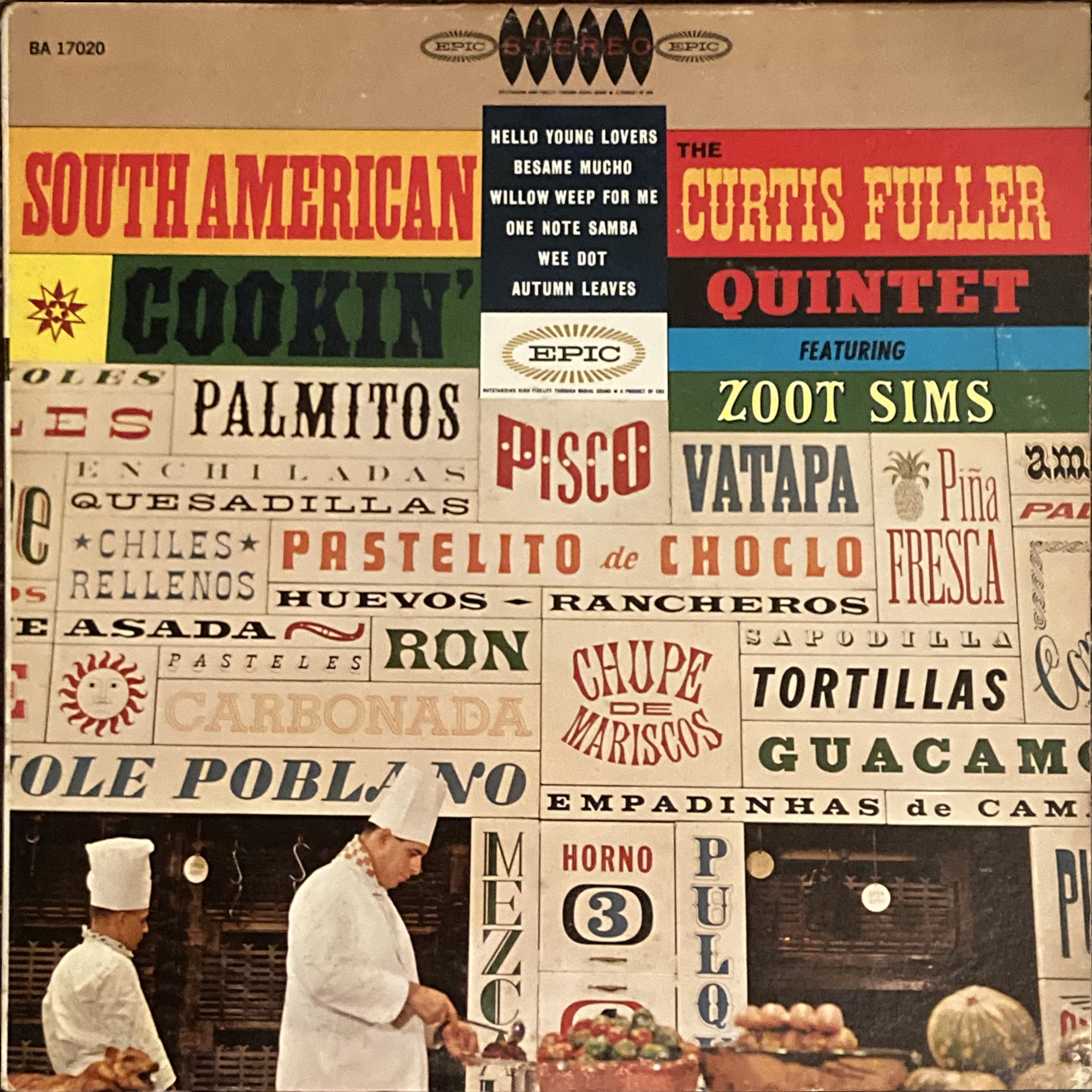
No.: BA-17020
Title: SOUTH AMERICAN COOKIN’
Musician: The Curtis Fuller Quintet
Recorded: 1961 Summer
Stereo
Cover address: None
Coating
Groove Guard
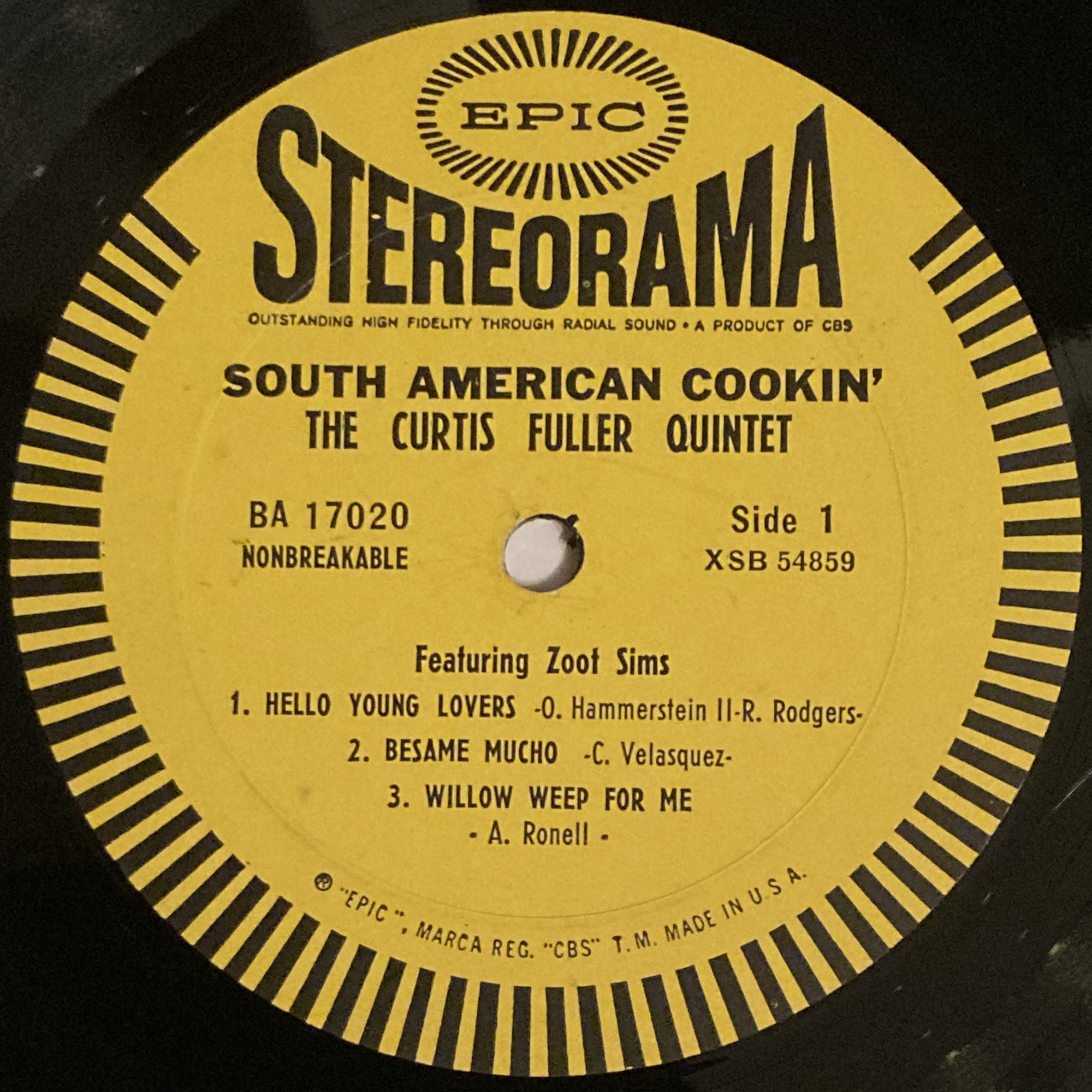
Label Side-1
Yellow Background
Black Letter
Address: None
Deep Groove無し
Dead Wax Info: XSB-54859-1A, I
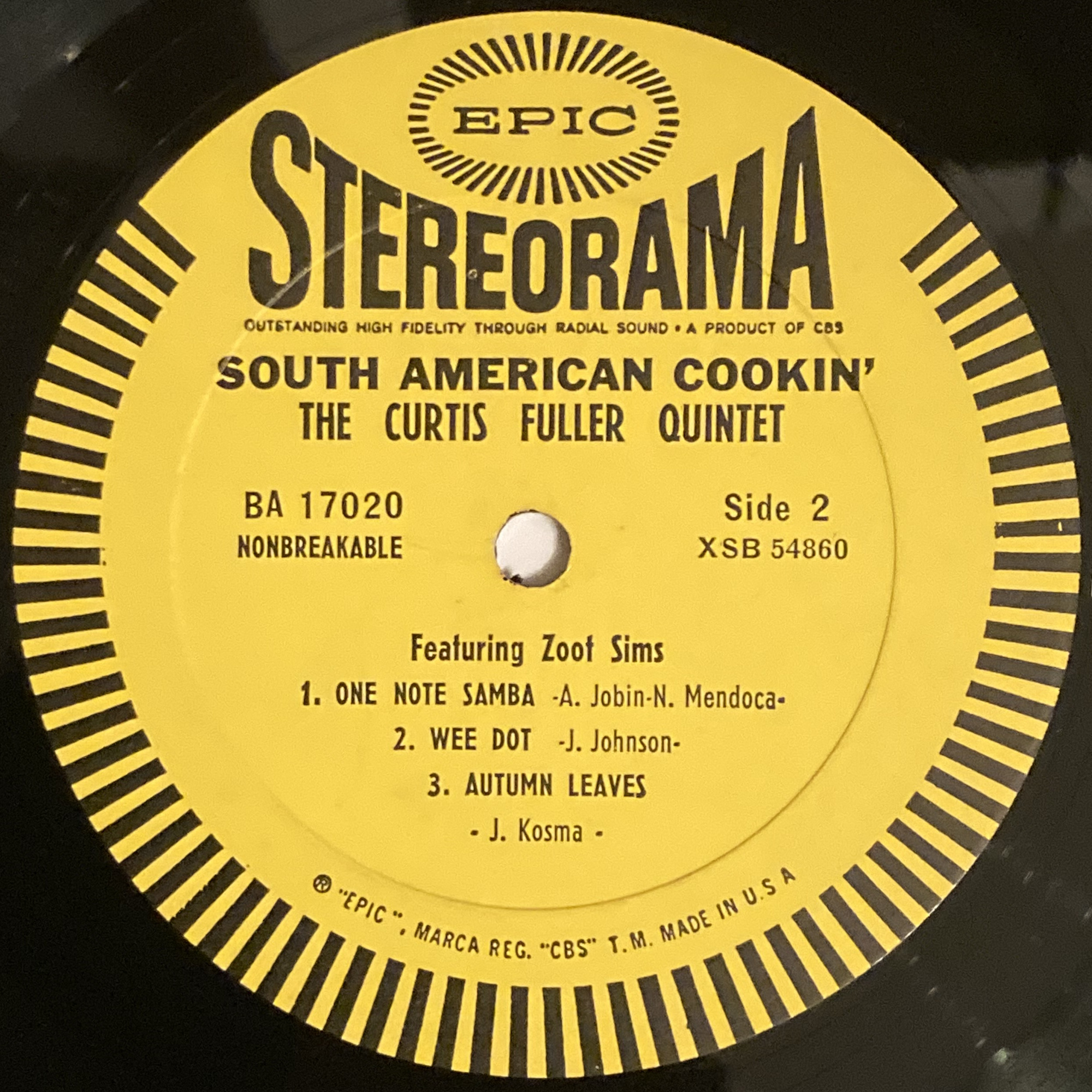
Label Side-2
Yellow Background
Black Letter
Address: None
Deep Groove無し
Dead Wax Info: XSB-54860-1A, I
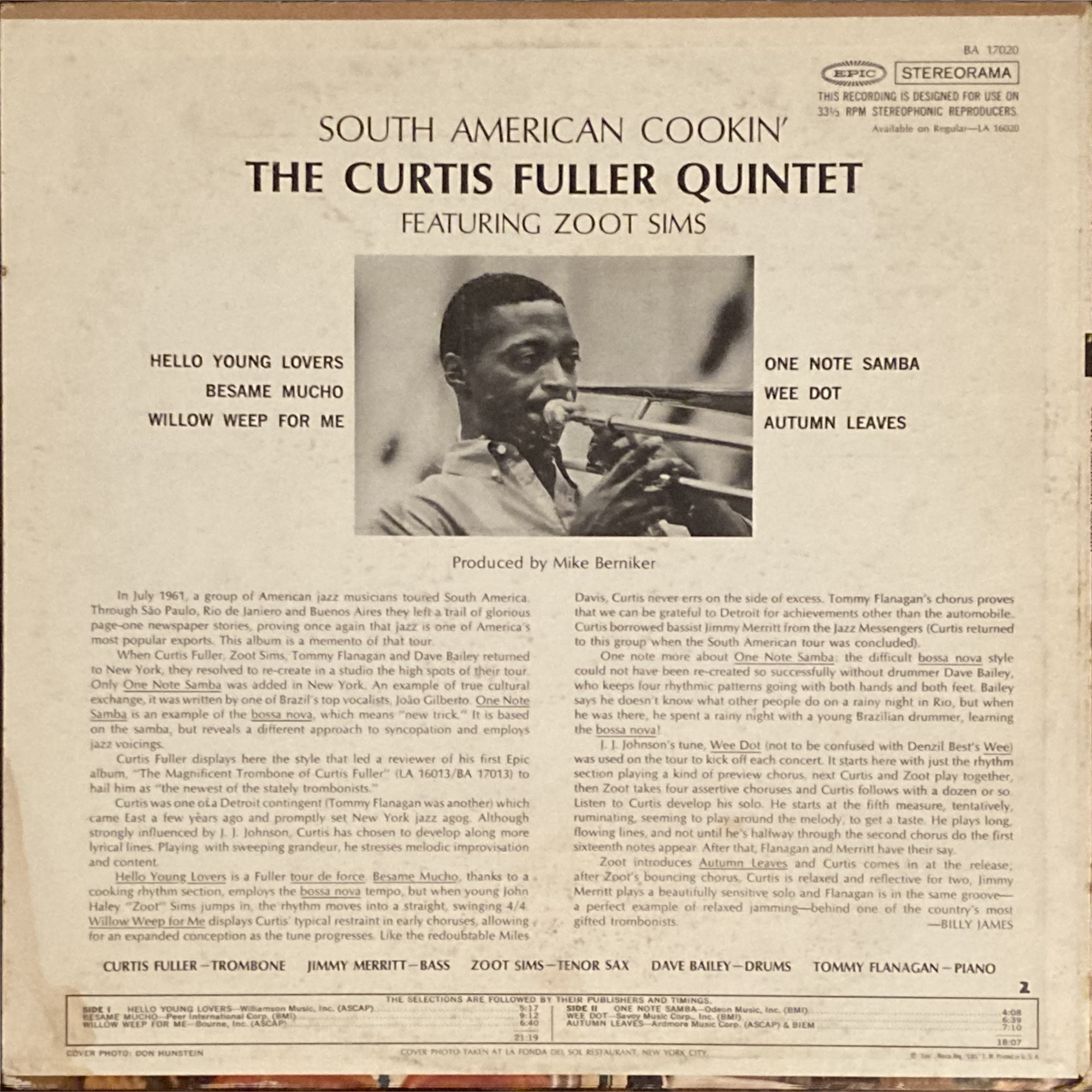
Personnel-
Drums: Dave Bailey
Bass: Jimmy Merritt
Piano: Tommy Flanagan
Tenor Sax: Zoot Sims
Trombone: Curtis Fuller
Tracks-
Side1
- Hello Young Lovers 5’17”
- Besame Mucho 9’12”
- Willow Weep for Me 6’40”
Side2
- One Note Samba 4’08”
- Wee Dot 6’39”
- Autumn Leaves 7’10”
<裏ジャケ原文>
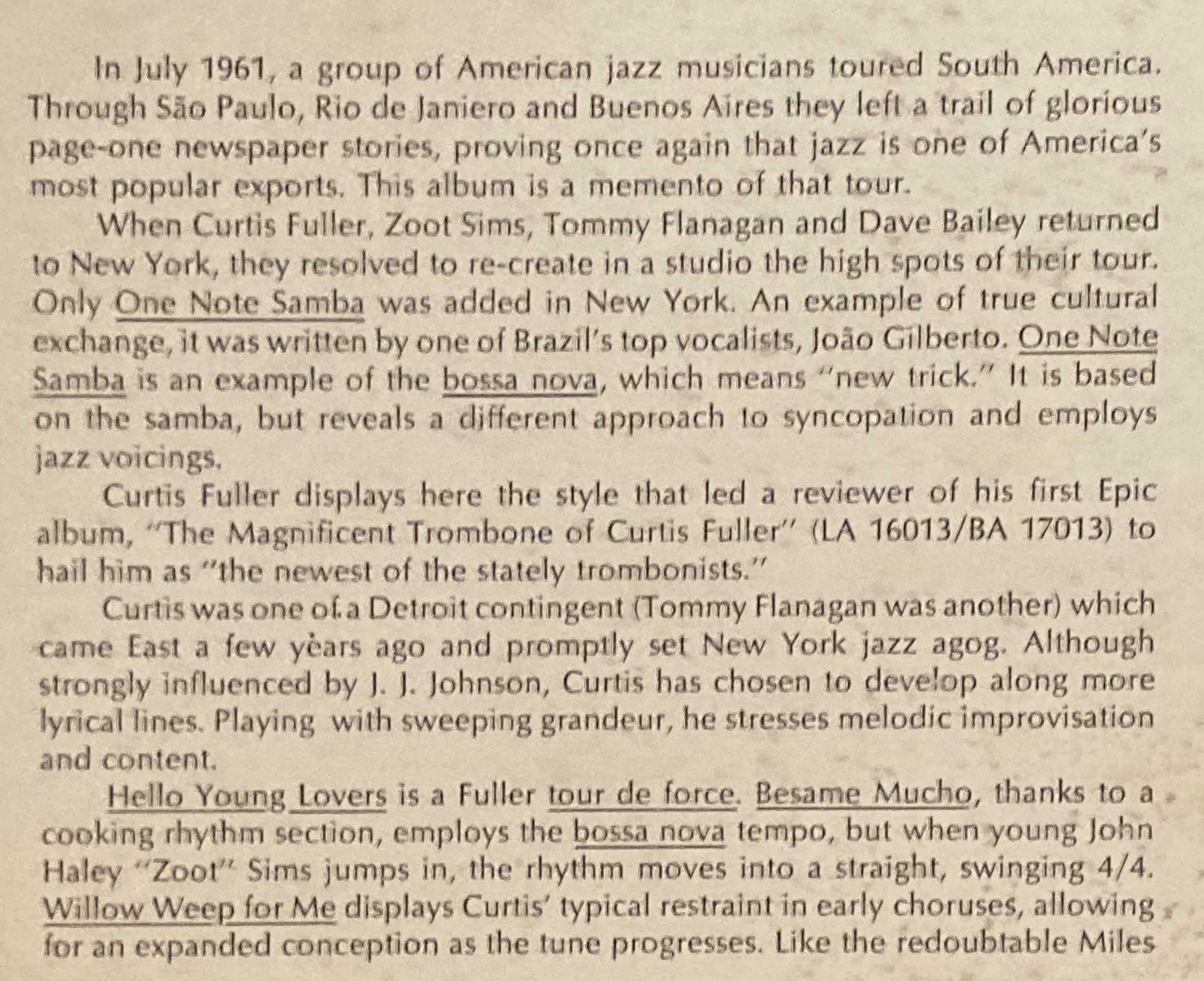
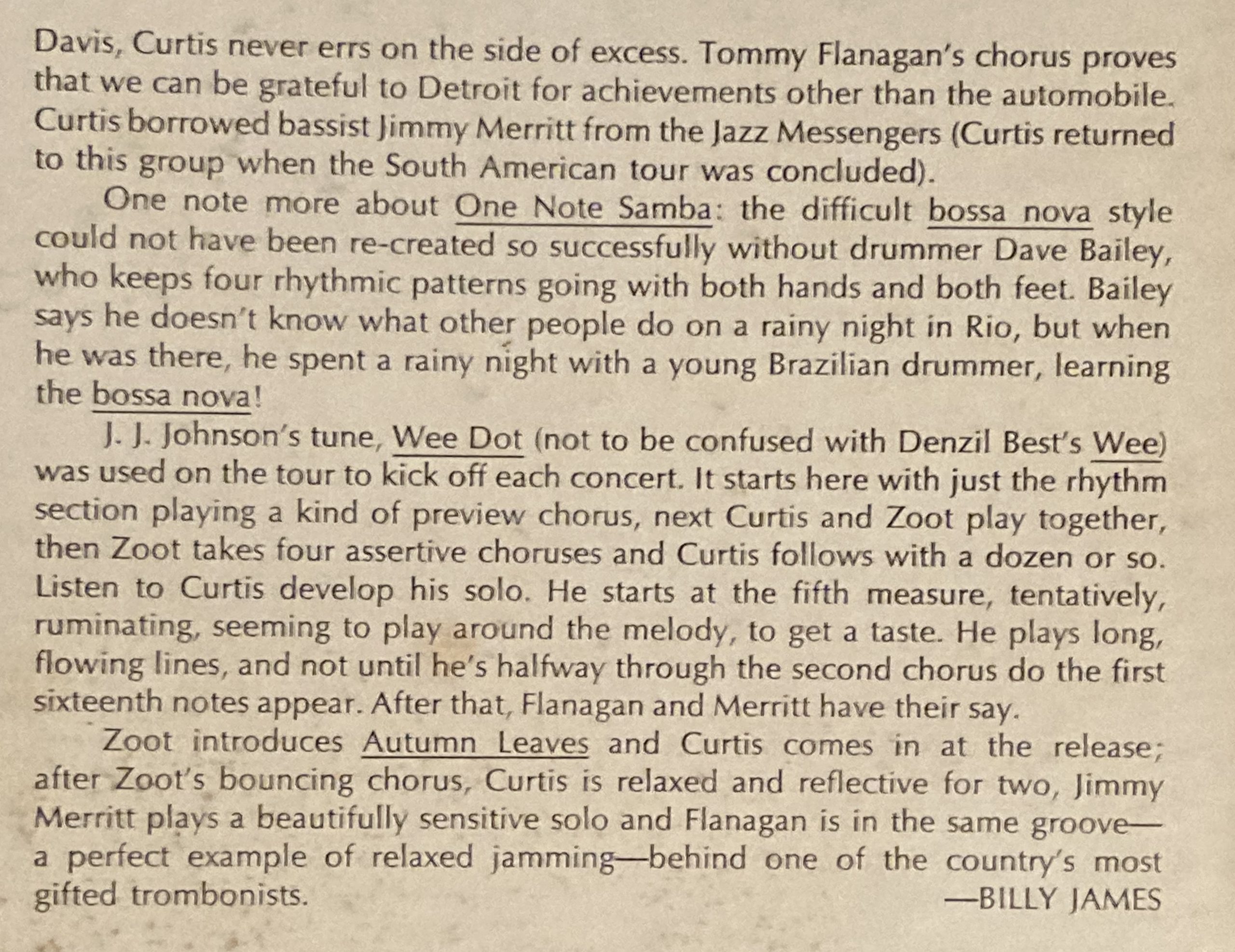
In July 1961, a group of American jazz musicians toured South America. Through São Paulo, Rio de Janiero and Buenos Aires they left a trail of glorious page-one newspaper stories, proving once again that jazz is one of America’s most popular exports. This album is a memento of that tour.
When Curtis Fuller, Zoot Sims, Tommy Flanagan and Dave Bailey returned to New York, they resolved to re-create in a studio the high spots of their tour. Only One Note Samba was added in New York. An example of true cultural exchange, it was written by one of Brazil’s top vocalists, João Gilberto. One Note Samba is an example of the bossa nova, which means “new trick.” It is based on the samba, but reveals a different approach to syncopation and employs jazz voicings.
Curtis Fuller displays here the style that led a reviewer of his first Epic album, “The Magnificent Trombone of Curtis Fuller” (LA 16013/BA 17013) to hail him as “the newest of the stately trombonists.”
Curtis was one of a Detroit contingent (Tommy Flanagan was another) which came East a few years ago and promptly set New York jazz agog. Although strongly influenced by J. J. Johnson, Curtis has chosen to develop along more lyrical lines. Playing with sweeping grandeur, he stresses melodic improvisation and content.
Hello Young Lovers is a Fuller tour de force. Besame Mucho, thanks to a cooking rhythm section, employs the bossa nova tempo, but when young John Haley “Zoot” Sims jumps in, the rhythm moves into a straight, swinging 4/4. Willow Weep for Me displays Curtis’ typical restraint in early choruses, allowing for an expanded conception as the tune progresses. Like the redoubtable Miles Davis, Curtis never errs on the side of excess. Tommy Flanagan’s chorus proves that we can be grateful to Detroit for achievements other than the automobile. Curtis borrowed bassist Jimmy Merritt from the Jazz Messengers (Curtis returned to this group when the South American tour was concluded).
One note more about One Note Samba: the difficult bossa nova style could not have been re-created so successfully without drummer Dave Bailey, who keeps four rhythmic patterns going with both hands and both feet. Bailey says he doesn’t know what other people do on a rainy night in Rio, but when he was there, he spent a rainy night with a young Brazilian drummer, learning the bossa nova!
J. J. Johnson’s tune, Wee Dot (not to be confused with Denzil Best’s Wee) was used on the tour to kick off each concert. It starts here with just the rhythm section playing a kind of preview chorus, next Curtis and Zoot play together, then Zoot takes four assertive choruses and Curtis follows with a dozen or so. Listen to Curtis develop his solo. He starts at the fifth measure, tentatively, ruminating, seeming to play around the melody, to get a taste. He plays long, flowing lines, and not until he’s halfway through the second chorus do the first sixteenth notes appear. After that, Flanagan and Merritt have their say.
Zoot introduces Autumn Leaves and Curtis comes in at the release; after Zoot’s bouncing chorus, Curtis is relaxed and reflective for two, Jimmy Merritt plays a beautifully sensitive solo and Flanagan is in the same groove- a perfect example of relaxed jamming-behind one of the country’s most gifted trombonists.
-BILLY JAMES
<裏ジャケ和訳>
1961年7月、アメリカのジャズ・ミュージシャンの一団が南米ツアーを行いました。サンパウロ、リオデジャネイロ、ブエノスアイレスを巡る彼らの活躍は新聞の一面を飾るほどの大きな話題となり、ジャズがアメリカを代表する人気輸出品の一つであることを改めて証明しました。本作は、そのツアーの記念碑的なアルバムです。
カーティス・フラー、ズート・シムズ、トミー・フラナガン、デイヴ・ベイリーがニューヨークに戻った際、彼らはツアーのハイライトをスタジオで再現しようと決意しました。ニューヨークで唯一追加された楽曲が「ワン・ノート・サンバ(One Note Samba)」です。ブラジルを代表するボーカリスト、ジョアン・ジルベルトが作曲したこの曲は、真の文化交流の好例と言えるでしょう。「ワン・ノート・サンバ」はボサノヴァ(「新しい感覚」や「新しい傾向」を意味する言葉)の代表曲の一つです。サンバをベースにしつつも、シンコペーションへの異なるアプローチやジャズ的なボイシングを取り入れています。
ここでカーティス・フラーは、彼のEpicレーベルでの初リーダー作『The Magnificent Trombone of Curtis Fuller』(LA 16013/BA 17013)の批評家から「堂々たるトロンボーン奏者たちの系譜に連なる、最新の逸材」と称賛されたそのスタイルを遺憾なく発揮しています。
カーティスは、数年前に東部へ進出し、瞬く間にニューヨークのジャズ・シーンを熱狂させたデトロイト出身のミュージシャンの一人でした(トミー・フラナガンもその一人です)。J.J.ジョンソンから強い影響を受けてはいますが、カーティスはより叙情的な方向性を追求する道を選びました。雄大かつ伸びやかな演奏の中で、彼はメロディックな即興と楽曲の内容(音楽的実質)を重視しています。
「Hello Young Lovers」はフラーの傑作(トゥール・ド・フォース)です。「Besame Mucho」では、ノリの良いリズム・セクションのおかげでボサノヴァのテンポが採用されていますが、若きジョン・ヘイリー・“ズート”・シムズが加わると、リズムはストレートでスウィング感あふれる4/4拍子へと変化します。「Willow Weep for Me」では、カーティス特有の抑制の効いた演奏が序盤のコーラスで見られ、曲の進行とともにその音楽的構想が大きく広がっていきます。あの偉大なマイルス・デイヴィスと同様、カーティスは決して過剰な演奏に陥ることはありません。トミー・フラナガンのソロ・コーラスは、デトロイトが自動車産業以外でも素晴らしい功績を残していることに感謝したくなるような名演です。カーティスは、ジャズ・メッセンジャーズからベーシストのジミー・メリットを借り受けて参加させていました(南米ツアー終了後、カーティスはこのグループに復帰しています)。 「ワン・ノート・サンバ」についてもう一つ。この難易度の高いボサノヴァ・スタイルをこれほど見事に再現できたのは、ドラマーのデイヴ・ベイリーの存在があってこそでした。彼は両手と両足を駆使して、4つの異なるリズム・パターンを同時に刻み続けているのです。ベイリー曰く、リオの雨の夜に他の人々が何をして過ごすかは知りませんが、彼自身は現地の若いブラジル人ドラマーと共に雨の夜を過ごし、そこでボサノヴァを学んだそうです!
J.J.ジョンソンの楽曲「ウィー・ドット」(デンジル・ベストの「ウィー」とは別曲)は、ツアー中の各コンサートのオープニングを飾るナンバーでした。ここではまずリズム・セクションが「プレビュー・コーラス」のような演奏で幕を開け、続いてカーティスとズートが共演します。その後、ズートが力強いソロを4コーラス分展開し、カーティスがそれに続いて10数コーラスを演奏します。カーティスがソロを展開していく様子に耳を傾けてみてください。彼は5小節目から、まるでメロディの周囲を探るように、あるいは味わいを確かめるように、思案深げで控えめな様子で演奏を始めます。長く流麗なフレーズを紡ぎ、2コーラス目の中盤に差し掛かってようやく、最初の16分音符が登場します。その後、フラナガンとメリットがそれぞれのソロを披露します。
ズートが「枯葉(Autumn Leaves)」を提示し、カーティスは「リリース(ブリッジ)」部分から参加します。ズートが弾むようなコーラスを演奏した後、カーティスはリラックスしつつも内省的な雰囲気で2コーラスを吹き、ジミー・メリットが繊細で美しいソロを聴かせます。フラナガンも同様のグルーヴで応じ、国内屈指の才能を持つトロンボーン奏者をバックに、リラックスしたジャム・セッションの理想的な姿を見せています。
―ビリー・ジェームス
※訳文の制作にはGoogleドライブとGoogle翻訳のお世話になりました。

コメント