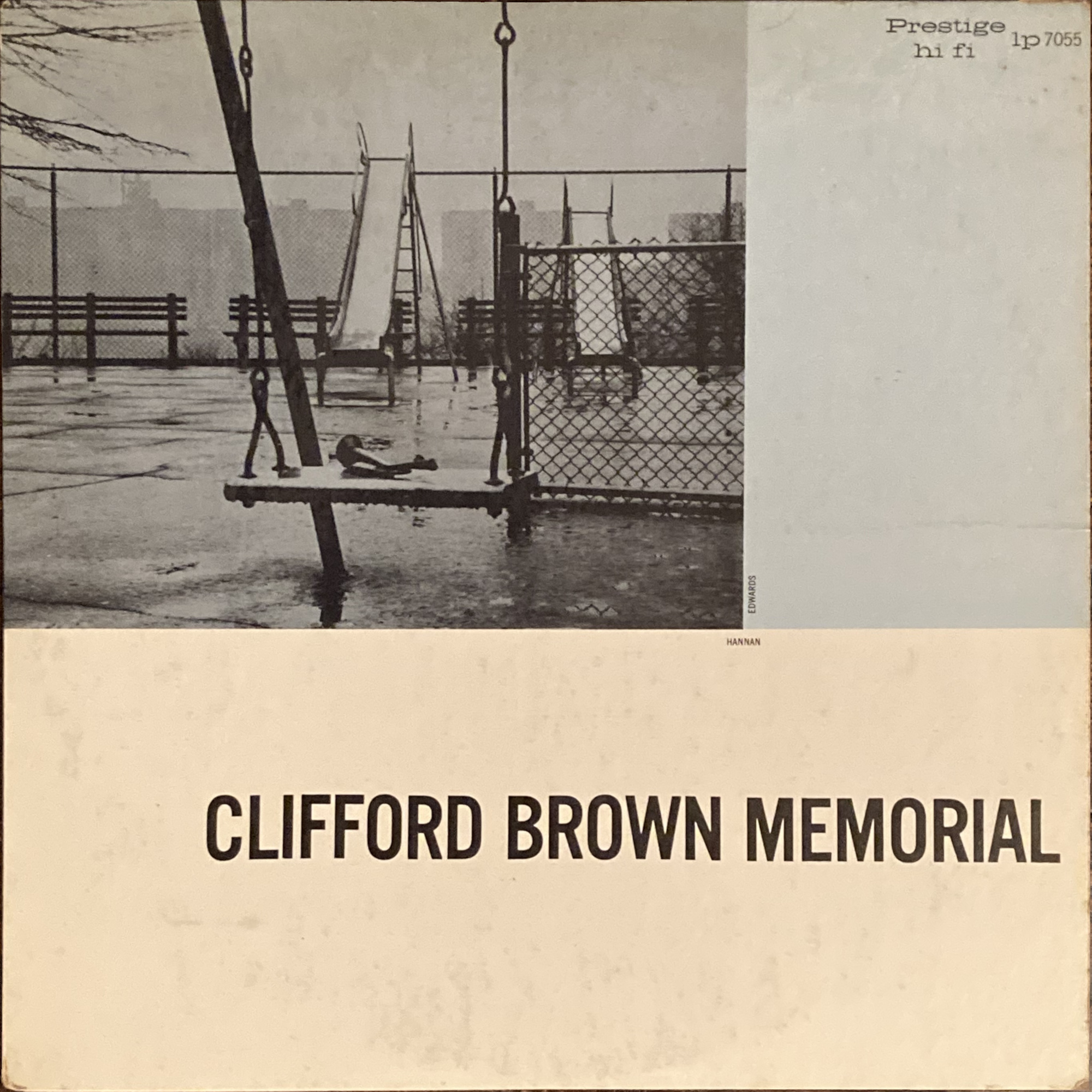
Label: PRESTIGE
No.: PRLP-7055
Title: CLIFFORD BROWN MEMORIAL
Musician: CLIFFORD BROWN
Recorded: 1953/6/11, 1953/9/15
Monaural
Cover address: 447 West 50th St., New York 19, N. Y.
Laminate Coating, 背文字無し
Groove Guard
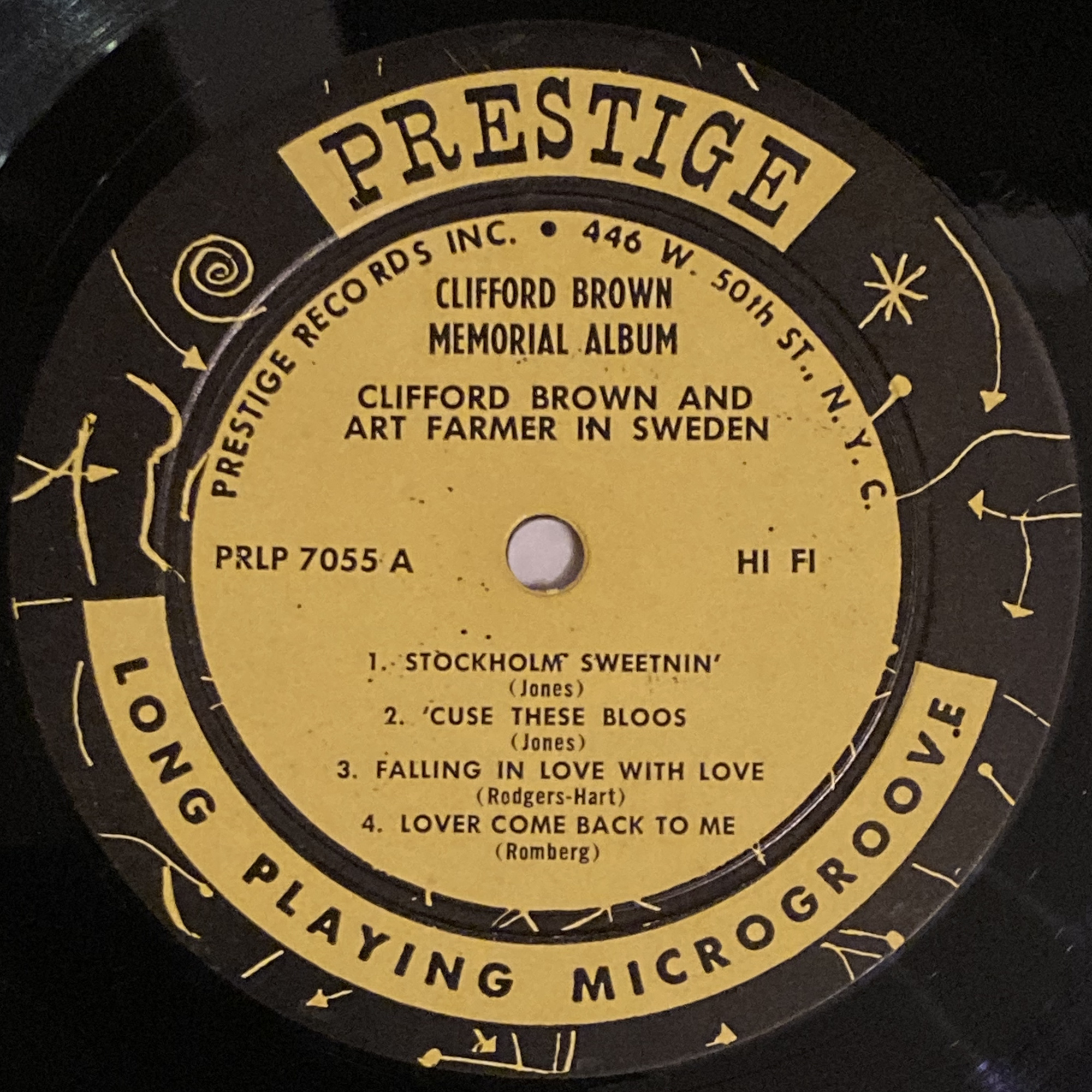
Label Side-A
Lemon Yellow Background
Black Letter with HI FI
Address: 446 W. 50th ST., N.Y.C.
Deep Groove
Dead Wax Info: PRLP-7055-A, A, AB, 手書きRVG
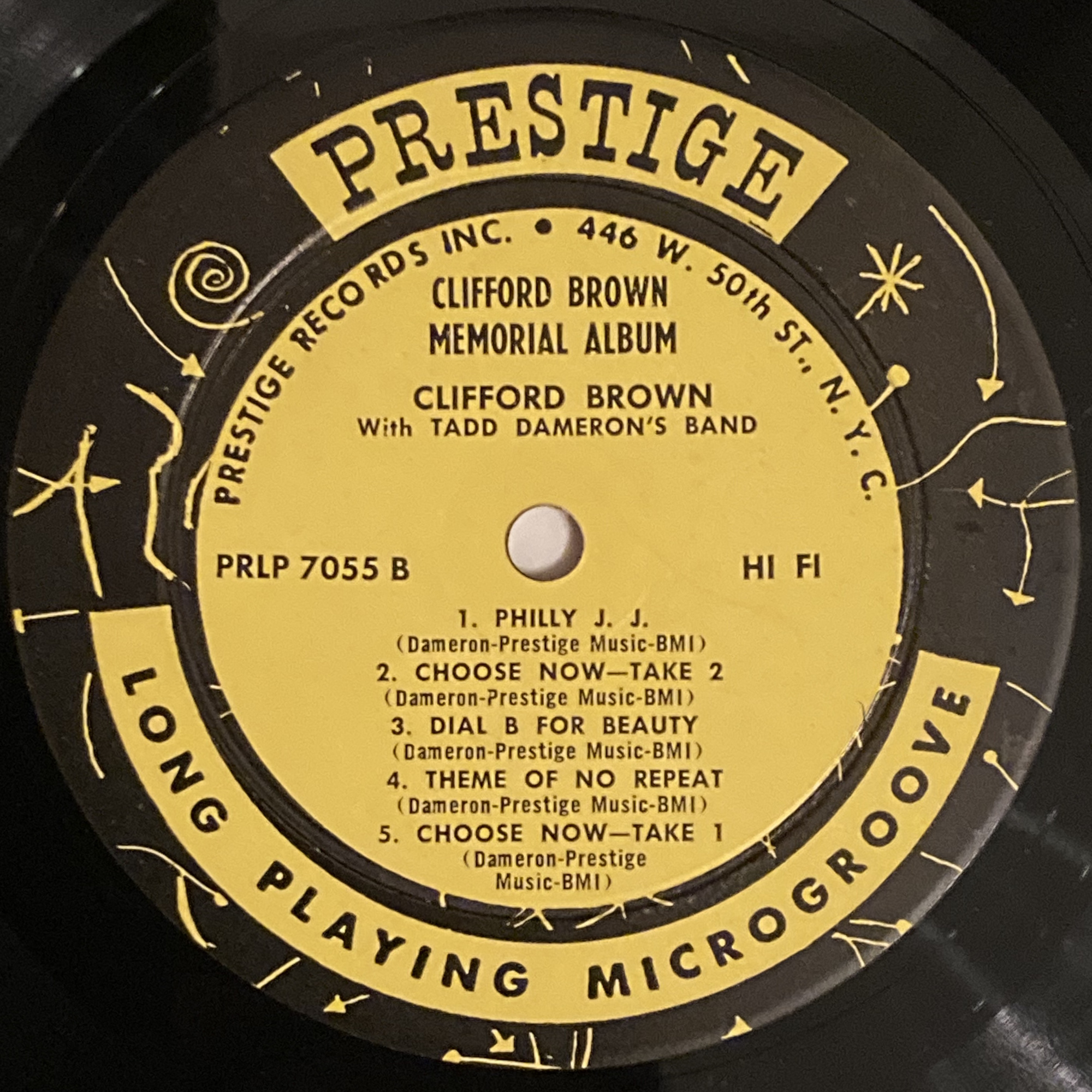
Label Side-B
Lemon Yellow Background
Black Letter with HI FI
Address: 446 W. 50th ST., N.Y.C.
Deep Groove
Dead Wax Info: PRLP-7055-B, A, AB, 手書きRVG
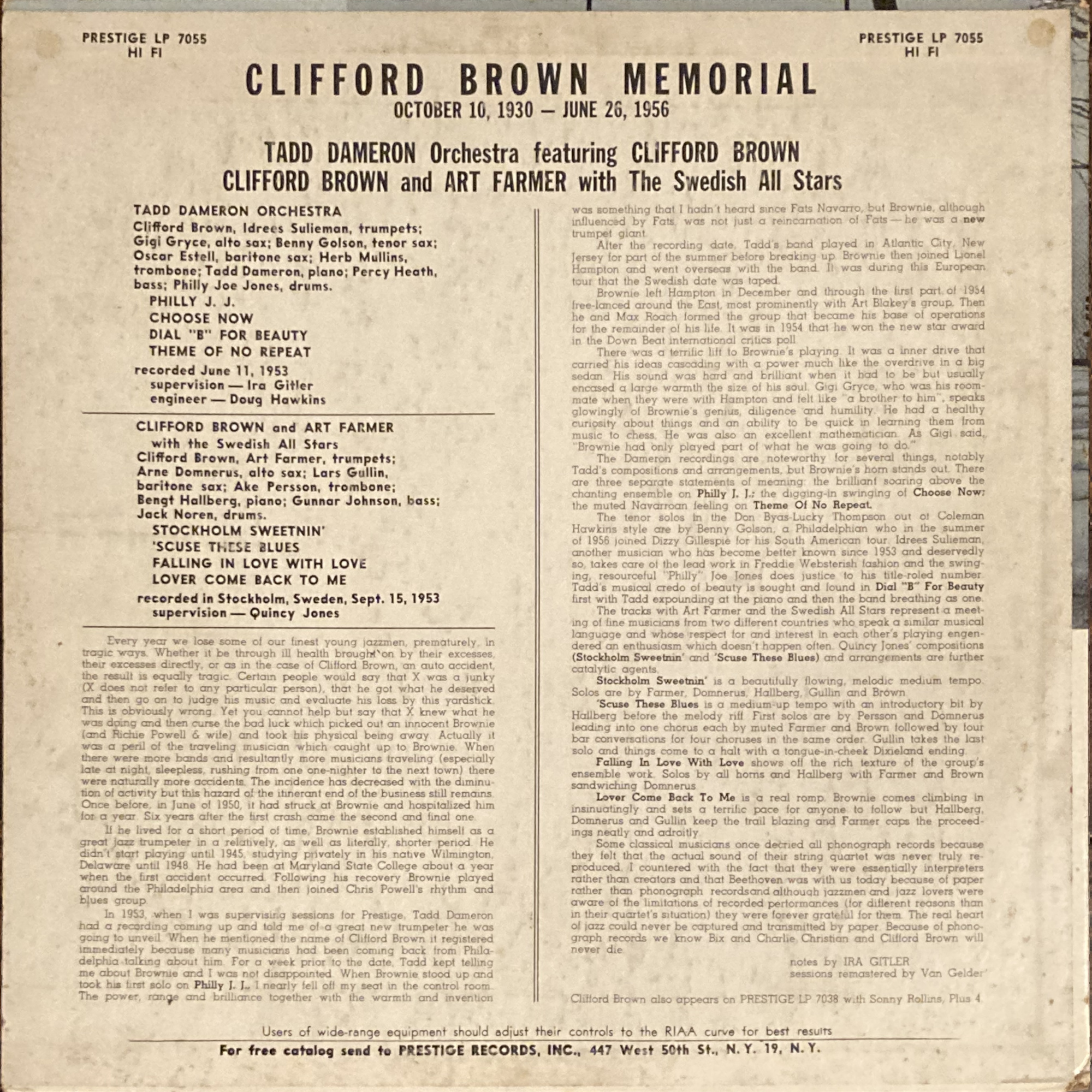
Personnel- Recorded on 1953/9/15, Stockholm Side-A
Drums: Jack Noren
Bass: Gunnar Johnson
Piano: Bengt Hallberg
Tenor Sax: Benny Golson
Alto Sax & Clarinet: Arne Domnerus
Baritone Sax: Lars Gullin
Trumpet: Clifford Brown, Art Farmer
Trombone: Ake Persson
Personnel- Recorded on 1953/6/11, NYC Side-B
Drums: Philly Joe Jones
Bass: Percy Heath
Piano: Tadd Dameron
Tenor Sax: Benny Golson
Alto Sax: Gigi Gryce
Baritone Sax: Oscar Estell
Trumpet: Clifford Brown, Idrees Sulieman
Trombone: Herb Mullins
Tracks-
Side-A
1) Stockholm Sweetnin’ 5’20”
2) ‘Cuse These Bloos 4’20”
3) Falling in Love with Love 5’15”
4) Lover Come Back to Me 5’15”
Side-B
1) Philly J. J. 5’05”
2) Choose Now-Take 2 3’20”
3) Dial “B” for Beauty 4’30”
4) Theme of No Repeat 5’15”
5) Choose Now-Take 1 4’50”
<裏ジャケ原文>
Every year we lose some of our finest young jazzmen, prematurely, in tragic ways. Whether it be through ill health brought on by their excesses, their excesses directly, or as in the case of Clifford Brown, an auto accident, the result is equally tragic. Certain people would say that X was a junky (X does not refer to any particular person), that he got what he deserved and then go on to judge his music and evaluate his loss by this yardstick. This is obviously wrong. Yet you cannot help but say that X knew what he was doing and then curse the bad luck which picked out an innocent Brownie (and Richie Powell & wife) and took his physical being away. Actually it was a peril of the traveling musician which caught up to Brownie. When there were more bands and resultantly more musicians traveling (especially late at night, sleepless, rushing from one one-nighter to the next town) there were naturally more accidents. The incidence has decreased with the diminu- tion of activity but this hazard of the itinerant end of the business still remains. Once before, in June of 1950, it had struck at Brownie and hospitalized him for a year. Six years after the first crash came the second and final one.
If he lived for a short period of time, Brownie established himself as a great jazz trumpeter in a relatively, as well as literally, shorter period. He didn’t start playing until 1945, studying privately in his native Wilmington, Delaware until 1948. He had been at Maryland State College about a year when the first accident occurred. Following his recovery Brownie played around the Philadelphia area and then joined Chris Powell’s rhythm and blues group.
In 1953, when I was supervising sessions for Prestige, Tadd Dameron had a recording coming up and told me of a great new trumpeter he was going to unveil. When he mentioned the name of Clifford Brown it registered immediately because many musicians had been coming back from Phila- delphia talking about him. For a week prior to the date, Tadd kept telling me about Brownie and I was not disappointed. When Brownie stood up and took his first solo on Philly J. J.. I nearly fell off my seat in the control room. The power, range and brilliance together with the warmth and invention was something that I hadn’t heard since Fats Navarro, but Brownie, although influenced by Fats, was not just a reincarnation of Fats-he was a new trumpet giant.
After the recording date, Tadd’s band played in Atlantic City, New Jersey for part of the summer before breaking up. Brownie then joined Lionel Hampton and went overseas with the band. It was during this European tour that the Swedish date was taped.
Brownie left Hampton in December and through the first part of 1954 free-lanced around the East, most prominently with Art Blakey’s group. Then he and Max Roach formed the group that became his base of operations for the remainder of his life. It was in 1954 that he won the new star award in the Down Beat international critics poll.
There was a terrific lift to Brownie’s playing. It was a inner drive that carried his ideas cascading with a power much like the overdrive in a big sedan. His sound was hard and brilliant when it had to be but usually encased a large warmth the size of his soul. Gigi Gryce, who was his room- mate when they were with Hampton and felt like “a brother to him”, speaks glowingly of Brownie’s genius, diligence and humility. He had a healthy curiosity about things and an ability to be quick in learning them from music to chess. He was also an excellent mathematician. As Gigi said, “Brownie had only played part of what he was going to do.”
The Dameron recordings are noteworthy for several things, notably Tadd’s compositions and arrangements, but Brownie’s horn stands out. There are three separate statements of meaning: the brilliant soaring above the chanting ensemble on Philly J. J.; the digging-in swinging of Choose Now: the muted Navarroan feeling on Theme Of No Repeat.
The tenor solos in the Don Byas-Lucky Thompson out of Coleman Hawkins style are by Benny Golson, a Philadelphian who in the summer of 1956 joined Dizzy Gillespie for his South American tour. Idrees Sulieman, another musician who has become better known since 1953 and deservedly so, takes care of the lead work in Freddie Websterish fashion and the swing- ing, resourceful “Philly” Joe Jones does justice to his title-roled number. Tadd’s musical credo of beauty is sought and found in Dial “B” For Beauty first with Tadd expounding at the piano and then the band breathing as one.
The tracks with Art Farmer and the Swedish All Stars represent a meet- ing of fine musicians from two different countries who speak a similar musical language and whose respect for and interest in each other’s playing engen- dered an enthusiasm which doesn’t happen often. Quincy Jones’ compositions (Stockholm Sweetnin’ and ‘Scuse These Blues) and arrangements are further catalytic agents.
Stockholm Sweetnin’ is a beautifully flowing, melodic medium tempo. Solos are by Farmer, Domnerus, Hallberg, Gullin and Brown.
‘Scuse These Blues is a medium-up tempo with an introductory bit by Hallberg before the melody riff. First solos are by Persson and Dómnerus leading into one chorus each by muted Farmer and Brown followed by four bar conversations for four choruses in the same order. Gullin takes the last solo and things come to a halt with a tongue-in-cheek Dixieland ending.
Falling In Love With Love shows off the rich texture of the group’s ensemble work. Solos by all horns and Hallberg with Farmer and Brown sandwiching Domnerus.
Lover Come Back To Me is a real romp. Brownie comes climbing in insinuatingly and sets a terrific pace for anyone to follow but Hallberg, Domnerus and Gullin keep the trail blazing and Farmer caps the proceed- ings neatly and adroitly.
Some classical musicians once decried all phonograph records because they felt that the actual sound of their string quartet was never truly re- produced. I countered with the fact that they were essentially interpreters rather than creators and that Beethoven was with us today because of paper rather than phonograph records and although jazzmen and jazz lovers were aware of the limitations of recorded performances (for different reasons than in their quartet’s situation) they were forever grateful for them. The real heart of jazz could never be captured and transmitted by paper. Because of phono- graph records we know Bix and Charlie Christian and Clifford Brown will never die.
notes by IRA GITLER
sessions remastered by Van Gelder
Clifford Brown also appears on PRESTIGE LP 7038 with Sonny Rollins, Plus 4.
<裏ジャケ和訳>
毎年、私たちは極めて優秀な若きジャズ・ミュージシャンたちを、悲劇的な形で早すぎる死によって失っています。不摂生が招いた病気であれ、その不摂生そのものであれ、あるいはクリフォード・ブラウンの場合のような自動車事故であれ、その結末は等しく悲劇的です。ある種の人々は、「Xはヤク中だった(Xは特定の人物を指すわけではありません)」とか「自業自得だ」と言い放ち、その物差しで彼の音楽を裁き、彼を失ったことの評価を下そうとします。これは明らかに間違っています。しかし一方で、Xが自らの行いの結果を承知していたと言わざるを得ないのも事実です。その一方で、罪のない「ブラウニー」(そしてリッチー・パウエルとその妻)を選び出し、その肉体を奪い去った不運を呪わずにはいられません。実のところ、ブラウニーを襲ったのは、旅を続けるミュージシャンにつきものの危険でした。かつてはバンドの数も多く、その結果、移動するミュージシャン(特に深夜、睡眠不足のまま、ある街での公演を終えて次の街へと急ぐ人々)も多かったため、当然ながら事故も多く発生していました。活動の減少とともに事故の発生率は下がりましたが、この「旅する」という仕事に伴う危険は今も残っています。実は以前にも、1950年6月に彼は事故に遭い、1年間の入院を余儀なくされたことがありました。最初の事故から6年後、二度目にして最後となる事故が起きたのです。
ブラウニーの生涯は短いものでしたが、彼はその(文字通り、そして相対的にも)短い期間のうちに、偉大なジャズ・トランペット奏者としての地位を確立しました。彼が演奏を始めたのは1945年のことで、1948年までは故郷のデラウェア州ウィルミントンで個人レッスンを受けていました。最初の事故が起きたとき、彼はメリーランド州立大学に1年ほど在籍していました。回復後、ブラウニーはフィラデルフィア周辺で演奏活動を行い、その後、クリス・パウエルのリズム・アンド・ブルース・グループに加わりました。
1953年、私がプレスティッジ・レーベルでセッションの監修をしていた頃、タッド・ダメロンがレコーディングを控えており、そこでデビューさせる素晴らしい新人トランペット奏者について話してくれました。彼がクリフォード・ブラウンの名を挙げたとき、私はすぐにピンときました。フィラデルフィアから戻ってきた多くのミュージシャンたちが、彼のことを話題にしていたからです。レコーディング当日の1週間前から、タッドはしきりにブラウニーのことを話して聞かせてくれましたが、実際に彼を聴いてみて、期待を裏切られることはありませんでした。ブラウニーが立ち上がり、「Philly J.J.」で最初のソロを吹いたとき、私はコントロール・ルームの椅子から転げ落ちそうになった。その力強さ、音域の広さ、輝き、そして温かみと独創性は、ファッツ・ナヴァロ以来耳にしたことのないものだった。しかし、ブラウニーはファッツの影響を受けてはいたものの、単なるファッツの再来ではなく、新たなトランペットの巨匠だったのだ。
レコーディング・セッションの後、タッドのバンドは解散するまでのひと夏、ニュージャージー州アトランティック・シティで演奏した。その後、ブラウニーはライオネル・ハンプトンのバンドに加わり、海外ツアーに出た。スウェーデンでの録音が行われたのは、このヨーロッパ・ツアー中のことである。
ブラウニーは12月にハンプトンのバンドを離れ、1954年前半は東部各地でフリーランスとして活動した。特にアート・ブレイキーのグループでの活動が顕著だった。やがて彼はマックス・ローチと共にグループを結成し、それが彼の生涯にわたる活動の拠点となった。彼が『ダウン・ビート』誌の国際批評家投票でニュースター賞を受賞したのも、1954年のことである。
ブラウニーの演奏には、素晴らしい高揚感があった。それは、大型セダンのオーバードライブ(高速走行時の加速力)にも似た力強さで、彼のアイデアを次々とあふれ出させる内なる推進力だった。彼のサウンドは、必要なときには硬質で輝きを放ったが、普段はその魂の大きさを物語るような豊かな温かみを湛えていた。ハンプトンのバンド時代にルームメイトであり、「兄弟のような存在」だったジジ・グライスは、ブラウニーの天才性、勤勉さ、そして謙虚さを絶賛している。彼は物事に対して健全な好奇心を抱き、音楽からチェスに至るまで、素早く習得する能力を持っていた。また、優れた数学者でもあった。ジジが言ったように、「ブラウニーは、彼が成し遂げようとしていたことの、ほんの一部を演奏したに過ぎなかった」のである。
ダメロンとの録音はいくつかの点で注目に値するが、特にタッドの作曲とアレンジが素晴らしい。しかし、何といってもブラウニーのトランペットが際立っている。そこには、それぞれ異なる意味を持つ3つの演奏がある。「Philly J.J.」での、コーラス(合奏)の上を鮮やかに舞い上がるような演奏。「Choose Now」での、力強くスウィングする演奏。そして「Theme Of No Repeat」での、ナヴァロを彷彿とさせるミュートを使った演奏だ。
コールマン・ホーキンスの流れを汲むドン・バイアスやラッキー・トンプソンのスタイルで吹かれているテナー・サックスのソロは、ベニー・ゴルソンによるものだ。フィラデルフィア出身の彼は、1956年の夏にディジー・ガレスピーの南米ツアーに参加している。 1953年以降、その実力にふさわしい知名度を獲得したもう一人のミュージシャン、イドリース・スレイマンがフレディ・ウェブスターを彷彿とさせるスタイルでリード・パートを担い、スウィング感に溢れ多彩な技量を持つ「フィリー」・ジョー・ジョーンズが、自身の名を冠したナンバーで見事なプレイを披露しています。タッドが追求する「美」という音楽的信条は、まず彼自身のピアノによる展開から始まり、やがてバンド全体が一体となって息づく「Dial ‘B’ For Beauty」の中で見事に体現されています。
アート・ファーマーとスウェーディッシュ・オール・スターズによるこれらのトラックは、異なる国出身でありながら共通の音楽言語を操る優れたミュージシャンたちの出会いを象徴しています。互いの演奏への敬意と関心が、滅多にないほどの熱気を生み出しました。クインシー・ジョーンズによる作曲(『Stockholm Sweetnin’』と『’Scuse These Blues』)やアレンジも、その熱量をさらに高める触媒となっています。
『Stockholm Sweetnin’』は、美しく流れるようなメロディを持つミディアム・テンポの曲です。ソロはファーマー、ドムネラス、ハルベリ、グリン、ブラウンが担当しています。
『’Scuse These Blues』はミディアム・アップ・テンポの曲で、メロディのリフに入る前にハルベリによる導入部があります。最初のソロはパーションとドムネラスが取り、続いてファーマー(ミュート使用)とブラウンがそれぞれ1コーラスずつソロをとり、その後、同じ順序で4小節ずつの掛け合い(交換ソロ)が4コーラス続きます。グリンが最後のソロをとり、遊び心あふれるディキシーランド・スタイルのエンディングで曲が締めくくられます。
『Falling In Love With Love』では、このグループのアンサンブルが持つ豊かな響きが際立っています。ホーン奏者全員とハルベリがソロをとり、ファーマーとブラウンがドムネラスを挟むような構成になっています。
『Lover Come Back To Me』は実に活気あふれる演奏です。ブラウニー(クリフォード・ブラウン)が挑発的かつ魅力的に入ってきて素晴らしいペースを作り出し、続くハルベリ、ドムネラス、グリンもその勢いを維持し、ファーマーが見事に締めくくっています。
かつて、あるクラシック音楽家たちがレコードという媒体を全面的に否定したことがありました。彼らは、自分たちの弦楽四重奏の実際の音がレコードでは決して忠実に再現されないと感じていたからです。それに対し私はこう反論しました。彼らは本質的に「創造者」ではなく「解釈者」であり、ベートーヴェンが今日まで生き続けているのはレコードのおかげではなく「楽譜(紙)」のおかげであること。そして、ジャズ・ミュージシャンやジャズ愛好家も(彼らの四重奏団の場合とは異なる理由で)録音演奏の限界を認識してはいるものの、それに対して常に感謝の念を抱いていること。ジャズの真髄は、決して紙の上では捉えられず、伝えられるものではないのです。レコードのおかげで、私たちはビックス、チャーリー・クリスチャン、そしてクリフォード・ブラウンが決して忘れ去られることはないと知っているのです。
ライナーノーツ:アイラ・ギトラー
リマスター:ヴァン・ゲルダー
クリフォード・ブラウンは、ソニー・ロリンズとのアルバム『Plus 4』(Prestige LP 7038)にも参加しています。
※訳文の制作にはGoogleドライブとGoogle翻訳のお世話になりました。

コメント