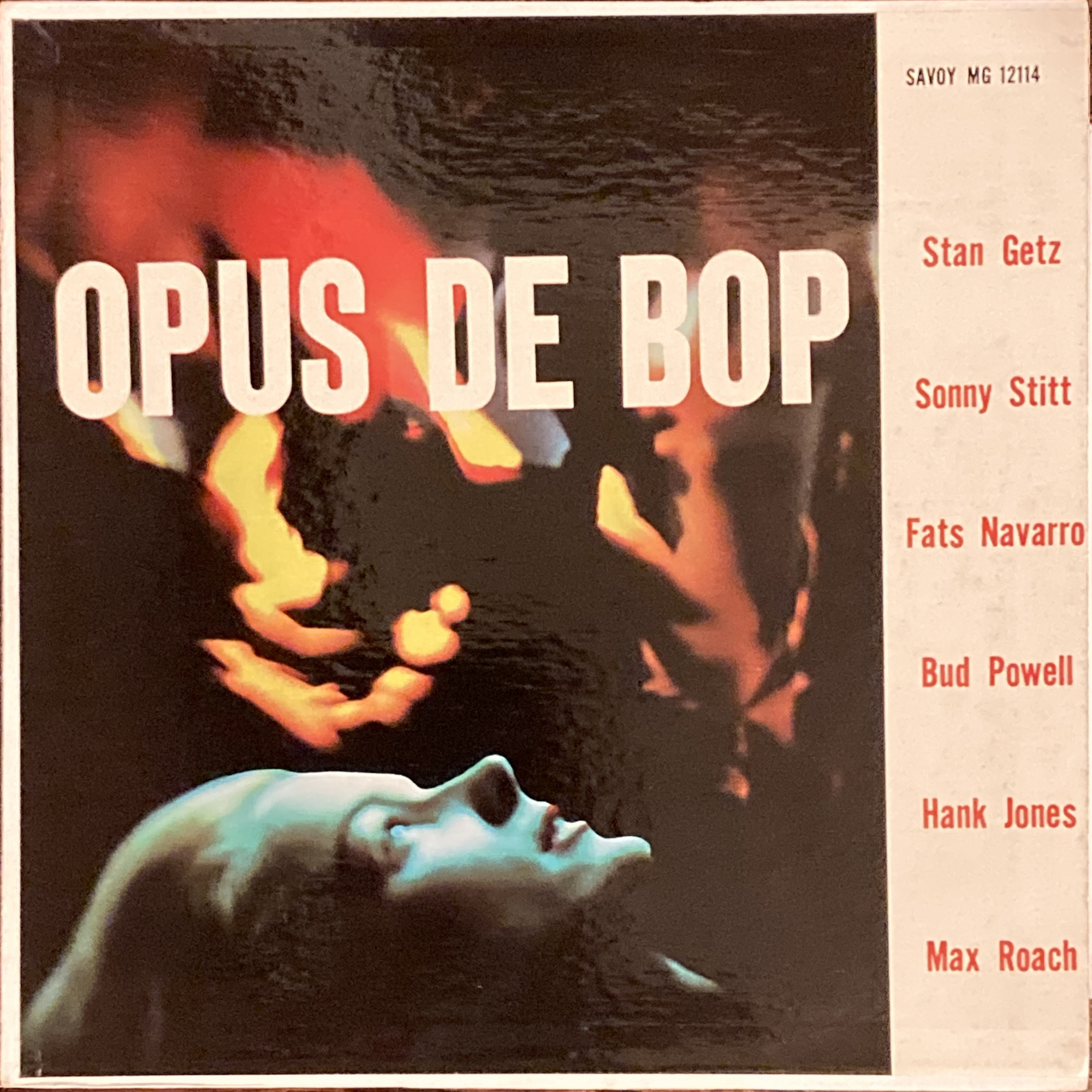
Label: SAVOY
No.: MG 12114
Title: OPUS DE BOP
Musician: VARIOUS ARTISTS
Recorded: 1946/7/31, 1946/8/23, 1947/1/29
Monaural
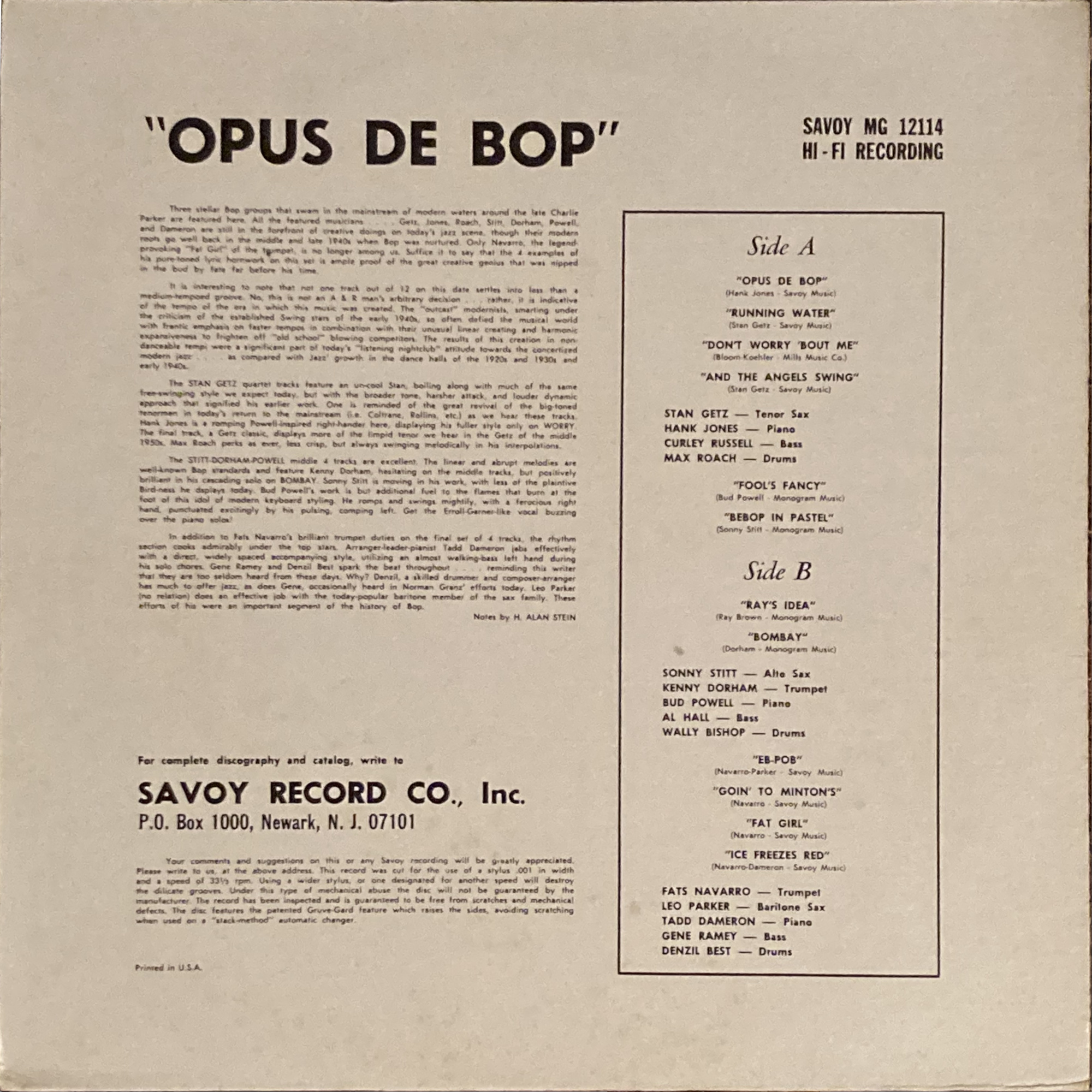
Cover address: P.O. BOX 1000, NEWARK, N. J. 07101
Laminate Coating
Groove Guard
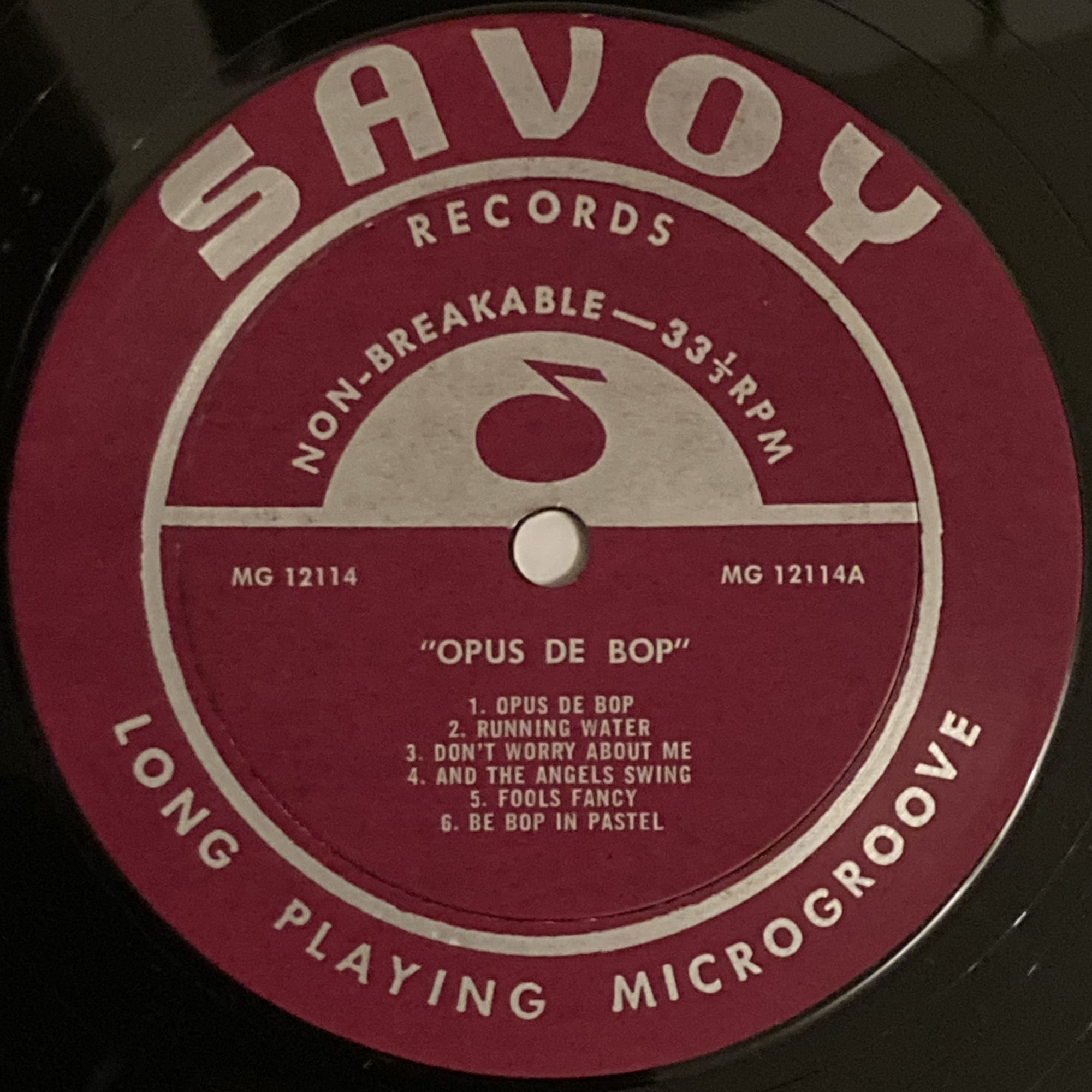
Label Side-A
Maroon Background
Silver Letter
Address: None
Deep Groove
Dead Wax Info: RVGスタンプ, MG 12114A, X20, 1
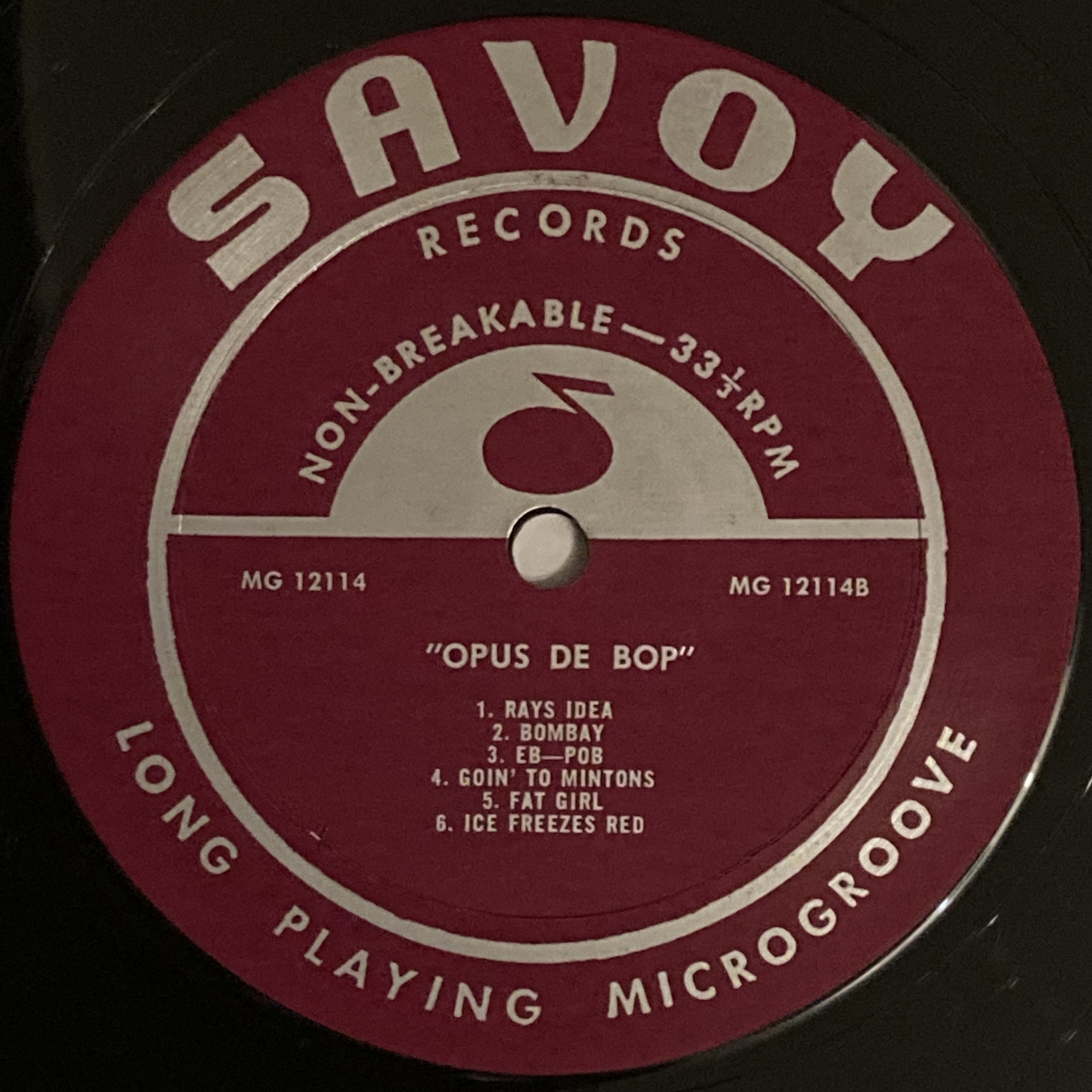
Label Side-B
Maroon Background
Silver Letter
Address: None
Deep Groove
Dead Wax Info: RVGスタンプ, MG 12114B, X20, 1
Personnel- Recorded on 1946/7/31 SideA-(1),(2),(3),(4)
Drums: Max Roach
Bass: Curly Russell
Piano: Hank Jones
Tenor Sax: Stan Getz
Personnel- Recorded on 1946/8/23 SideA-(5),(6), SideB-(1),(2)
Drums: Wallace Bishop
Bass: Al Hall
Piano: Bud Powell
Alto Sax: Sonny Stitt
Trumpet: Kenny Dorham
Personnel- Recorded on 1947/1/29 SideB-(3),(4),(5),(6)
Drums: Denzil Best
Bass: Gene Ramey
Piano: Tadd Dameron
Alto Sax & Baritone Sax: Leo Parker
Trumpet: Fats Navarro
Tracks-
Side-A
1) Opus de Bop
2) Running Water
3) Don’t Worry ‘Bout Me
4) And the Angels Swing
5) Fool’s Fancy
6) Bebop in Pastel
Side-B
1) Ray’s Idea
2) Bombay
3) Eb-Pob
4) Goin’ to Minton’s
5) Fat Girl
6) Ice Freezes Red
<裏ジャケ原文>
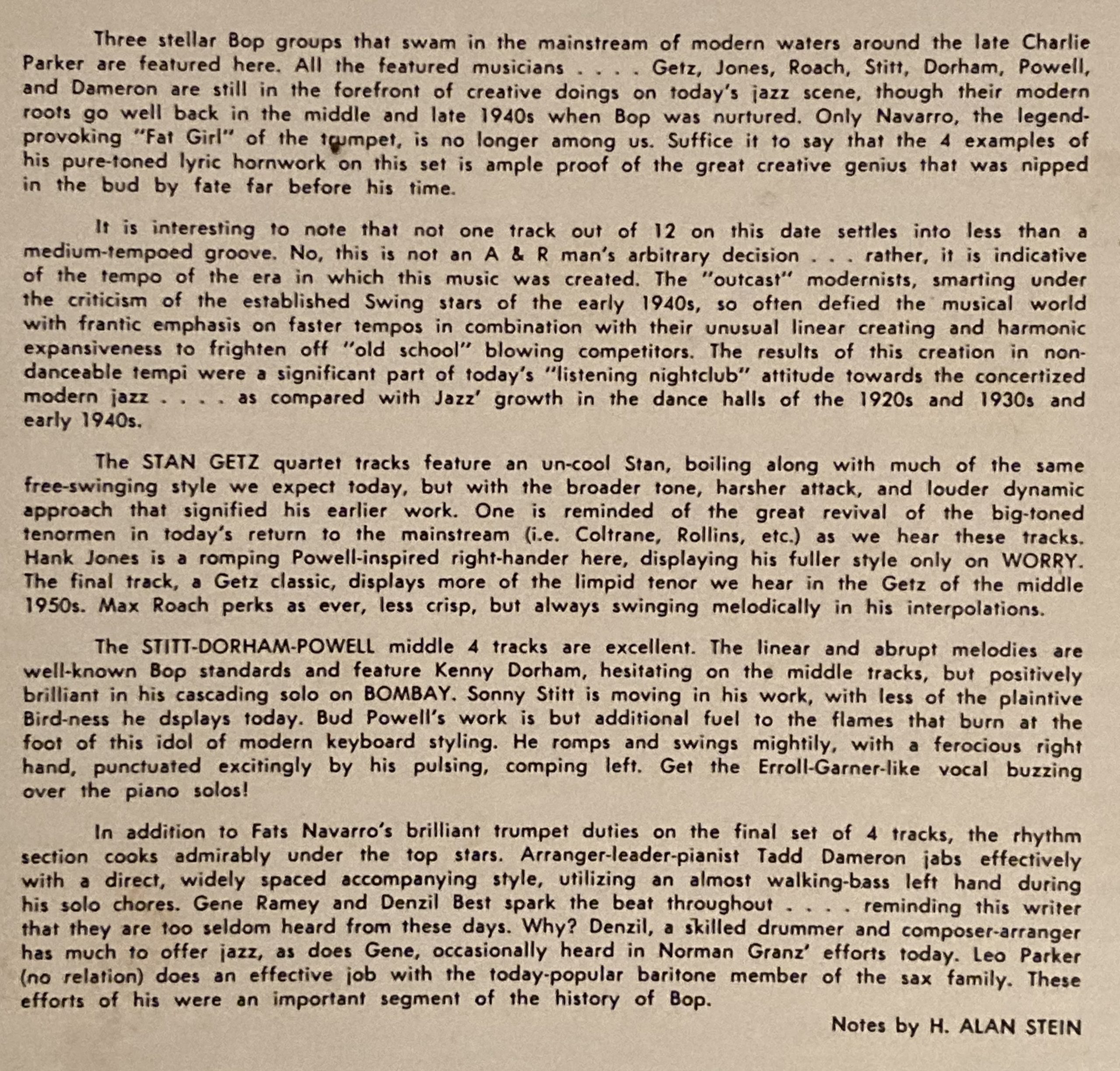
Three stellar Bop groups that swam in the mainstream of modern waters around the late Charlie Parker are featured here. All the featured musicians Getz, Jones, Roach, Stitt, Dorham, Powell, and Dameron are still in the forefront of creative doings on today’s jazz scene, though their modern roots go well back in the middle and late 1940s when Bop was nurtured. Only Navarro, the legend- provoking “Fat Girl” of the trumpet, is no longer among us. Suffice it to say that the 4 examples of his pure-toned lyric hornwork on this set is ample proof of the great creative genius that was nipped in the bud by fate far before his time.
It is interesting to note that not one track out of 12 on this date settles into less than a medium-tempoed groove. No, this is not an A & R man’s arbitrary decision … rather, it is indicative of the tempo of the era in which this music was created. The “outcast” modernists, smarting under the criticism of the established Swing stars of the early 1940s, so often defied the musical world with frantic emphasis on faster tempos in combination with their unusual linear creating and harmonic expansiveness to frighten off “old school” blowing competitors. The results of this creation in non- danceable tempi were a significant part of today’s “listening nightclub” attitude towards the concertized modern jazz as compared with Jazz’ growth in the dance halls of the 1920s and 1930s and
early 1940s.
The STAN GETZ quartet tracks feature an un-cool Stan, boiling along with much of the same free-swinging style we expect today, but with the broader tone, harsher attack, and louder dynamic approach that signified his earlier work. One is reminded of the great revival of the big-toned tenormen in today’s return to the mainstream (i.e. Coltrane, Rollins, etc.) as we hear these tracks. Hank Jones is a romping Powell-inspired right-hander here, displaying his fuller style only on WORRY. The final track, a Getz classic, displays more of the limpid tenor we hear in the Getz of the middle 1950s. Max Roach perks as ever, less crisp, but always swinging melodically in his interpolations.
The STITT-DORHAM-POWELL middle 4 tracks are excellent. The linear and abrupt melodies are well-known Bop standards and feature Kenny Dorham, hesitating on the middle tracks, but positively brilliant in his cascading solo on BOMBAY. Sonny Stitt is moving in his work, with less of the plaintive Bird-ness he dsplays today. Bud Powell’s work is but additional fuel to the flames that burn at the foot of this idol of modern keyboard styling. He romps and swings mightily, with a ferocious right hand, punctuated excitingly by his pulsing, comping left. Get the Erroll-Garner-like vocal buzzing over the piano solos!
In addition to Fats Navarro’s brilliant trumpet duties on the final set of 4 tracks, the rhythm section cooks admirably under the top stars. Arranger-leader-pianist Tadd Dameron jabs effectively with a direct, widely spaced accompanying style, utilizing an almost walking-bass left hand during his solo chores. Gene Ramey and Denzil Best spark the beat throughout. . . . reminding this writer that they are too seldom heard from these days. Why? Denzil, a skilled drummer and composer-arranger has much to offer jazz, as does Gene, occasionally heard in Norman Granz’ efforts today. Leo Parker (no relation) does an effective job with the today-popular baritone member of the sax family. These efforts of his were an important segment of the history of Bop.
Notes by H. ALAN STEIN
For complete discography and catalog, write to
SAVOY RECORD CO., Inc.
P.O. Box 1000, Newark, N. J. 07101
Your comments and suggestions on this or any Savoy recording will be greatly appreciated. Please write to us, at the above address. This record was cut for the use of a stylus .001 in width and a speed of 333 rpm. Using a wider stylus, or one designated for another speed will destroy the dilicate grooves. Under this type of mechanical abuse the disc will not be guaranteed by the manufacturer. The record has been inspected and is guaranteed to be free from scratches and mechanical defects. The disc features the patented Gruve-Gard feature which raises the sides, avoiding scratching when used on a “stack-method” automatic changer.
Printed in U.S.A.
<裏ジャケ和訳>
ここでは、チャーリー・パーカーを中心に発展したモダン・ジャズ(ビバップ)の主流を形成した、3つの素晴らしいグループが取り上げられています。ゲッツ、ジョーンズ、ローチ、スティット、ドーハム、パウエル、ダメロンといった参加ミュージシャンたちは、ビバップが育まれた1940年代半ばから後半にかけてそのルーツを築きながら、今日に至るまでジャズ・シーンの最前線で創造的な活動を続けています。唯一、トランペットの伝説的奏者であり「ファット・ガール(Fat Girl)」の愛称で知られたナヴァロだけは、すでにこの世を去っています。本作に収録された、彼の純粋で叙情的なホーン・プレイが聴ける4曲を聴けば、運命によってあまりにも早くその才能の芽を摘み取られてしまった偉大な天才の姿を十分に感じ取ることができるでしょう。
興味深いことに、本作に収録された全12曲の中に、ミディアム・テンポを下回るような遅い曲は一つもありません。これはA&R担当者が恣意的に決めたことではなく、むしろこの音楽が生まれた時代のテンポ感を反映したものです。1940年代初頭、既存のスウィング・スターたちからの批判に苦しめられた「異端児」であるモダニストたちは、しばしば音楽界に反旗を翻すように、猛烈な速さのテンポを強調しました。彼らは、独特の旋律構築やハーモニーの拡張性とこの速いテンポを組み合わせることで、「オールド・スクール」な競合奏者たちを圧倒しようとしたのです。ダンスには不向きなテンポで演奏されたこうした音楽は、1920年代から40年代初頭にかけてダンスホールで発展したジャズとは対照的に、コンサート形式のモダン・ジャズを「聴くための音楽」として楽しむ今日のスタイルを確立する上で、重要な役割を果たしました。
スタン・ゲッツ・カルテットのトラックでは、いわゆる「クール・ジャズ」的なスタイルとは一線を画すゲッツの姿が聴かれます。今日私たちが期待するような自由で軽快なスウィング感で突き進みつつも、その音色には、彼の初期の作品に見られたような、より太い響き、鋭いアタック、そして力強いダイナミクスが表れています。これらのトラックを聴くと、コルトレーンやロリンズといった、太い音色を持つテナー・サックス奏者たちが今日のメインストリーム回帰の中で再評価されていることと、その姿が重なって見えてきます。ハンク・ジョーンズはここで、パウエルに影響を受けた躍動感あふれる右手主体のプレイを披露していますが、彼らしい豊かなスタイルを存分に発揮しているのは「Worry」という曲においてです。最後のトラックはゲッツの代表曲であり、1950年代半ばの彼が聴かせたような、澄み切ったテナー・サックスの音色が際立っています。マックス・ローチのドラミングは相変わらず活気に満ちており、鋭さは控えめながらも、楽曲の合間に見せるフレーズは常にメロディアスでスウィング感に溢れています。
スティット、ドーハム、パウエルが参加した中盤の4曲は素晴らしい出来栄えです。直線的かつ急展開するメロディは有名なバップ・スタンダード曲であり、ケニー・ドーハムがフィーチャーされています。彼は中盤のトラックではやや迷いが見られるものの、「ボンベイ(Bombay)」での滝のように流れるようなソロでは圧倒的な輝きを放っています。ソニー・スティットの演奏は感動的で、後年の彼に見られるような「バード(チャーリー・パーカー)」特有の哀愁を帯びたスタイルとは一味違う魅力を感じさせます。バド・パウエルの演奏は、モダン・キーボード・スタイルの偶像である彼への評価をさらに高めるものです。彼は猛烈な勢いの右手で縦横無尽にスウィングし、躍動感あふれる左手のコンピングがそれをスリリングに際立たせています。ピアノ・ソロの背後で聴こえる、エロール・ガーナーを彷彿とさせるハミング(ヴォーカル)にも注目してください!
最後の4曲のセットでは、ファッツ・ナヴァロが見事なトランペットを披露しているほか、トップ・スターたちを支えるリズム・セクションも素晴らしい熱演を見せています。アレンジャー兼リーダー、そしてピアニストでもあるタッド・ダメロンは、音の間隔を広くとったストレートな伴奏スタイルで効果的なアクセントを加え、ソロ演奏中には左手でウォーキング・ベースに近いラインを奏でています。ジーン・レイミーとデンジル・ベストは全編にわたってビートを盛り上げています……。彼らの演奏を耳にする機会が近年あまりに少ないことを、筆者は改めて痛感させられます。なぜなのでしょうか?熟練のドラマーであり作曲・編曲家でもあるデンジルは、ジャズ界に多くの貢献ができる才能の持ち主です。ジーンも同様で、彼はノーマン・グランツの企画作品などで時折その名を目にすることができます。レオ・パーカー(チャーリー・パーカーとは無関係)は、今日人気のあるサックス・ファミリーの一員、バリトン・サックスで効果的なプレイを聴かせてくれます。彼のこうした演奏は、バップの歴史における重要な一幕を担うものでした。
解説:H・アラン・スタイン
完全なディスコグラフィおよびカタログをご希望の方は、下記までご連絡ください。
SAVOY RECORD CO., Inc.
P.O. Box 1000, Newark, N. J. 07101
本盤やその他のサヴォイ・レコード作品に関するご意見・ご提案をいただければ幸いです。上記住所までお寄せください。本盤は、幅0.001インチのスタイラス(針)を使用し、回転数33 1/3 rpmで再生するようにカッティングされています。太いスタイラスや、異なる回転数用に設計されたスタイラスを使用すると、繊細な溝が破損する恐れがあります。このような不適切な取り扱いによる損傷については、メーカーの保証対象外となります。本レコードは検品済みであり、傷や機械的な欠陥がないことが保証されています。本盤には特許取得済みの「Gruve-Gard(グルーヴ・ガード)」機能が採用されており、盤面の縁が高くなっているため、「スタック方式」のオートチェンジャーで使用する際も傷がつきにくくなっています。
米国製
※訳文の制作にはGoogleドライブとGoogle翻訳のお世話になりました。

コメント