Label: VERVE RECORDS
No.: MG V-8271
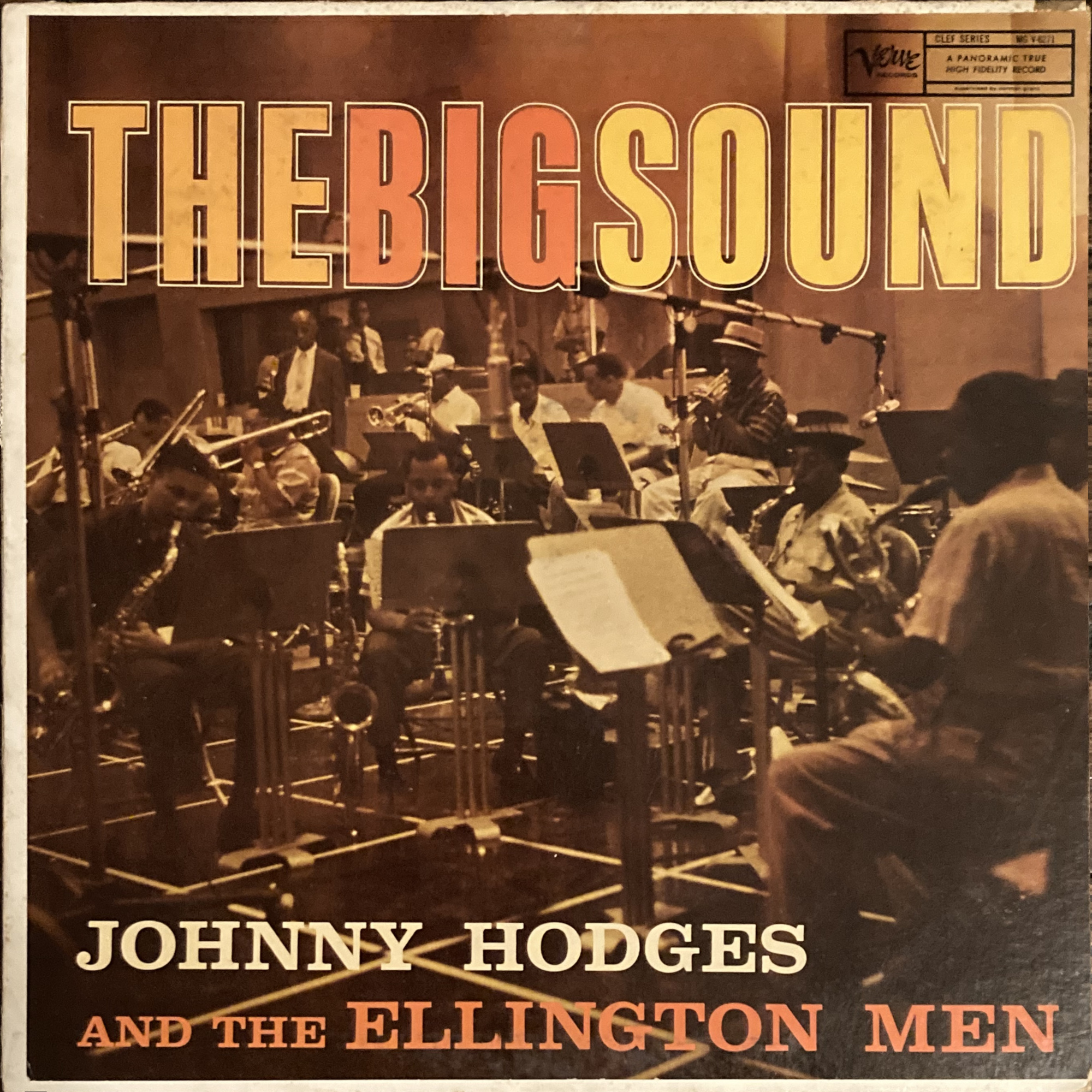
Title: THE BIG SOUND
Musician: JOHNNY HODGES AND THE ELLINGTON MEN
Recorded: 1957/6/26, 1957/9/3
Monaural
Cover address:
Coating無し
Groove Guard
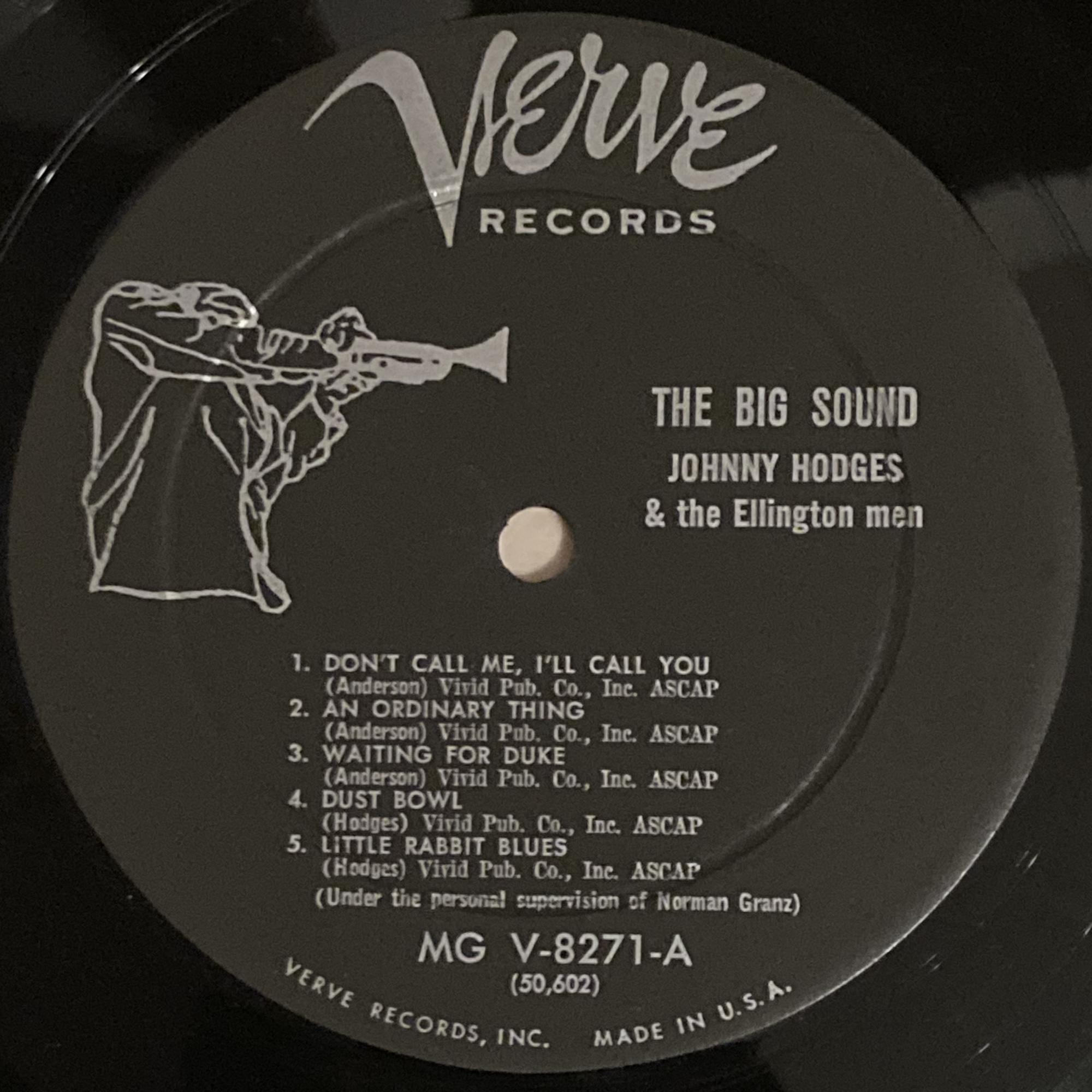
Label Side-A
Black Background
Silver Letter with Trumpeter
Address: None
Deep Groove
Dead Wax Info: MGV-8271-A
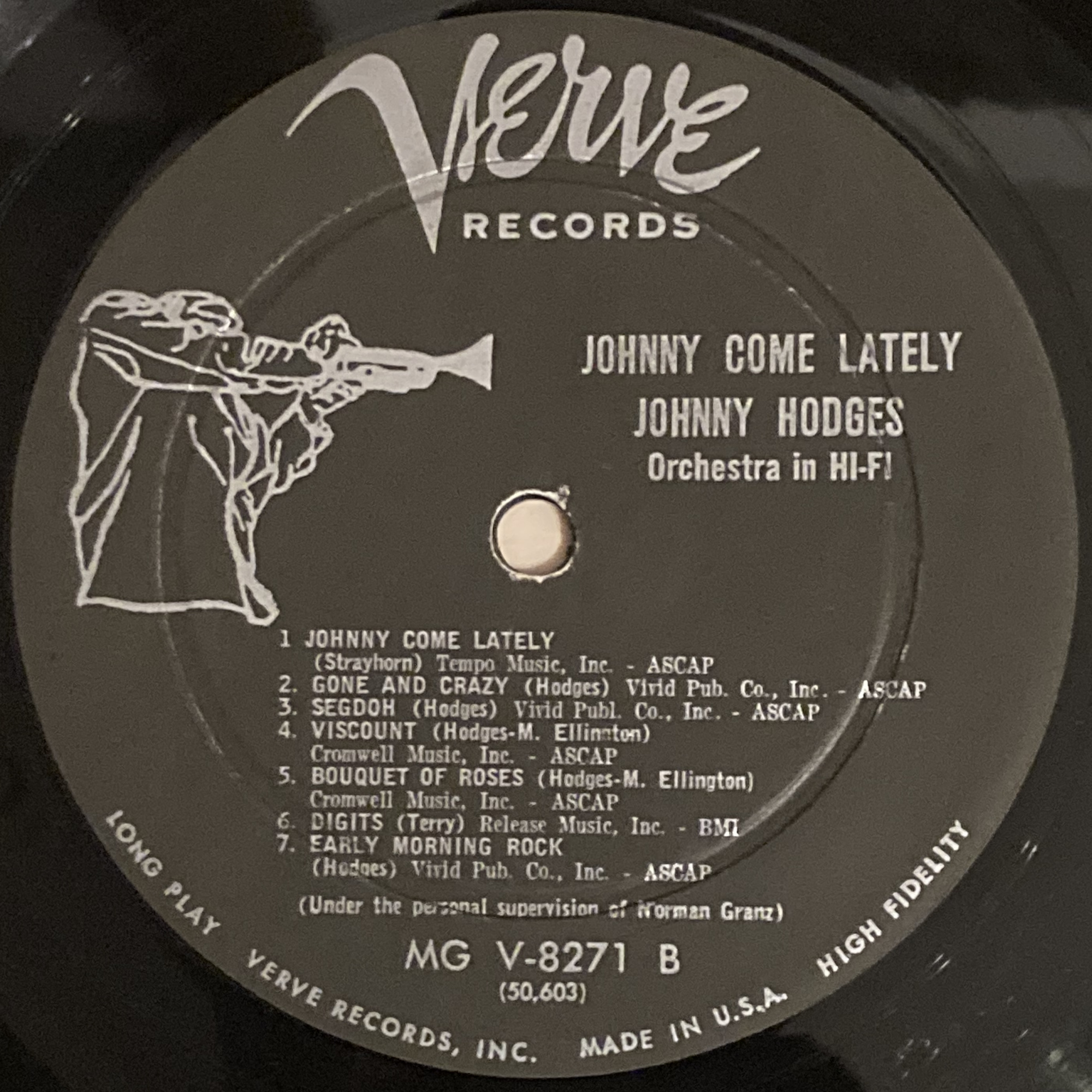
Label Side-B
Black Background
Silver Letter with Trumpeter
Address: None
Deep Groove
Dead Wax Info: MGV-8271-B, 50603
Personnel- Recorded on 1957/6/26 SideA-(1),(2),(3),(4)
Johnny Hodges and His Orchestra
Drums: Sam Woodyard
Bass: Jimmy Woode
Piano: Billy Strayhorn]
Tenor Sax & Clarinet: Jimmy Hamilton
Alto Sax: Johnny Hodges
Alto Sax & Clarinet: Russell Procope
Baritone Sax: Harry Carney
Trumpet: Ray Nance, Clark Terry
Trombone: Quentin Jackson, John Sanders, Britt Woodman
Personnel- Recorded on 1957/9/3 SideA-(5),(6),SideB-(1),(2)
Johnny Hodges and His Orchestra
Drums: Sam Woodyard
Bass: Jimmy Woode
Piano: Billy Strayhorn
Tenor Sax: Paul Gonsalves
Tenor Sax & Clarinet: Jimmy Hamilton
Alto Sax: Johnny Hodges
Alto Sax & Clarinet: Russell Procope
Baritone Sax: Harry Carney
Trumpet: Willie Cook, Clark Terry, Cat Anderson, Harold ‘Shorty’ Baker
Trombone: Quentin Jackson, John Sanders, Britt Woodman
Personnel- Recorded on 1957/9/3 SideB-(3),(4),(5),(6)
Johnny Hodges and His Orchestra
Drums: Sam Woodyard
Bass: Jimmy Woode
Piano: Billy Strayhorn
Tenor Sax: Paul Gonsalves
Tenor Sax & Clarinet: Jimmy Hamilton
Alto Sax: Johnny Hodges
Alto Sax & Clarinet: Russell Procope
Baritone Sax: Harry Carney
Trumpet & Violin: Ray Nance
Trumpet: Clark Terry, Harold ‘Shorty’ Baker
Trombone: Quentin Jackson, John Sanders, Britt Woodman
Tracks-
Side-A
1) Don’t Call Me, I’ll Call You
2) An Ordinary Thing
3) Waiting For Duke
4) Dust Bowl
5) Little Rabbit Blues
6) Johnny Come Lately
Side-B
1) Gone and Crazy
2) Segdoh
3) Viscount
4) Bouquet of Roses
5) Digits
6) Early Morning Rock
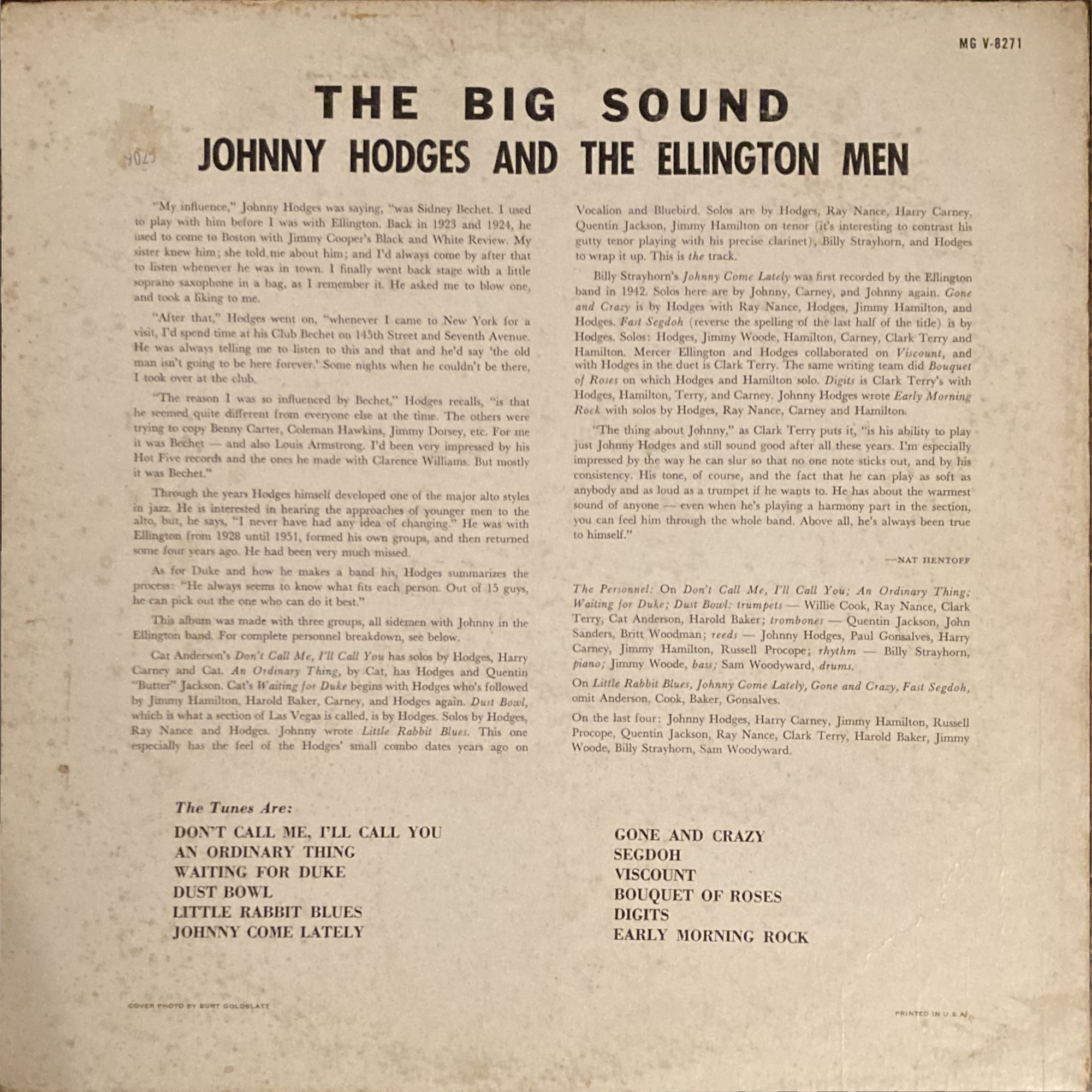
<裏ジャケ原文>
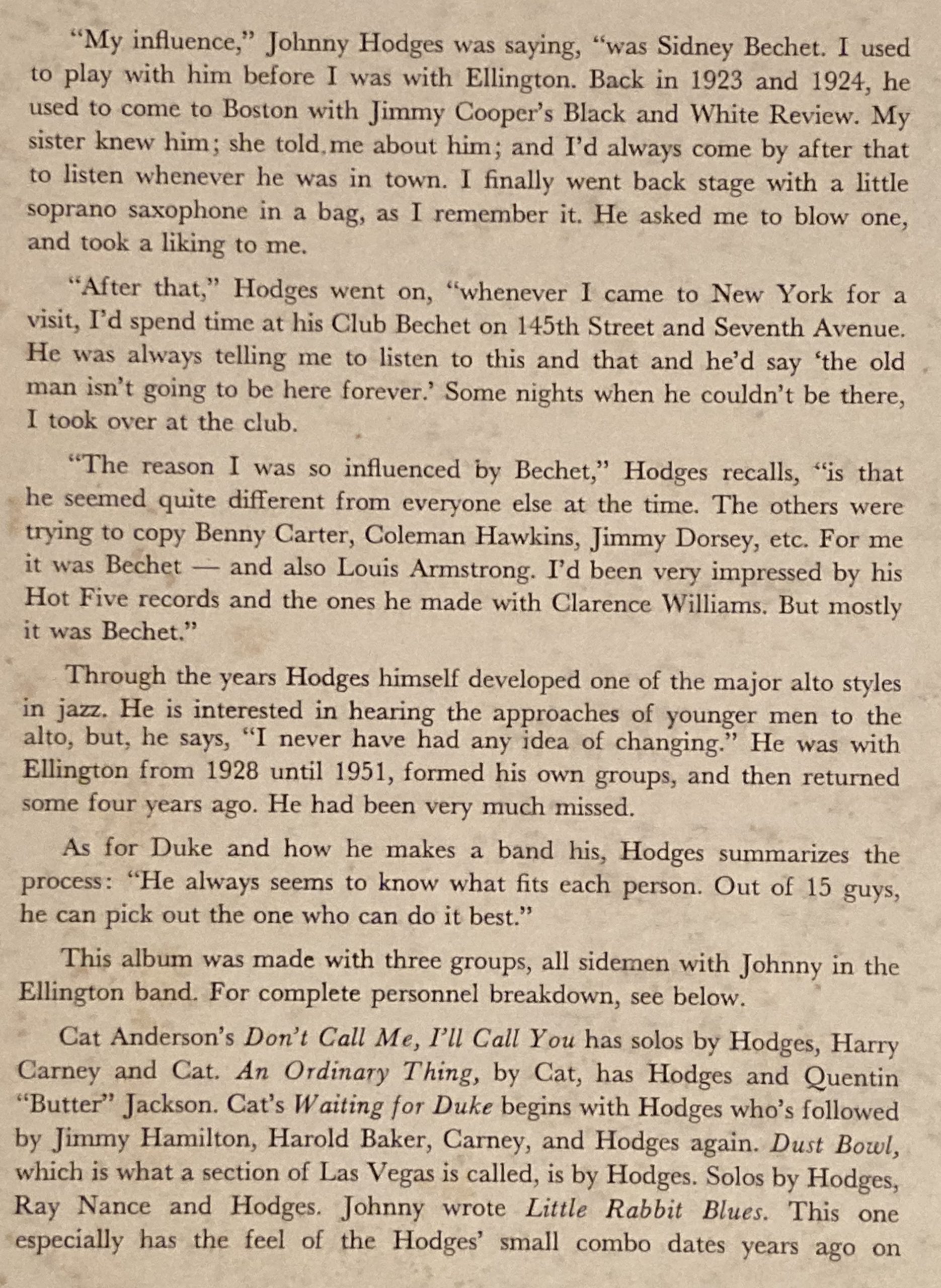
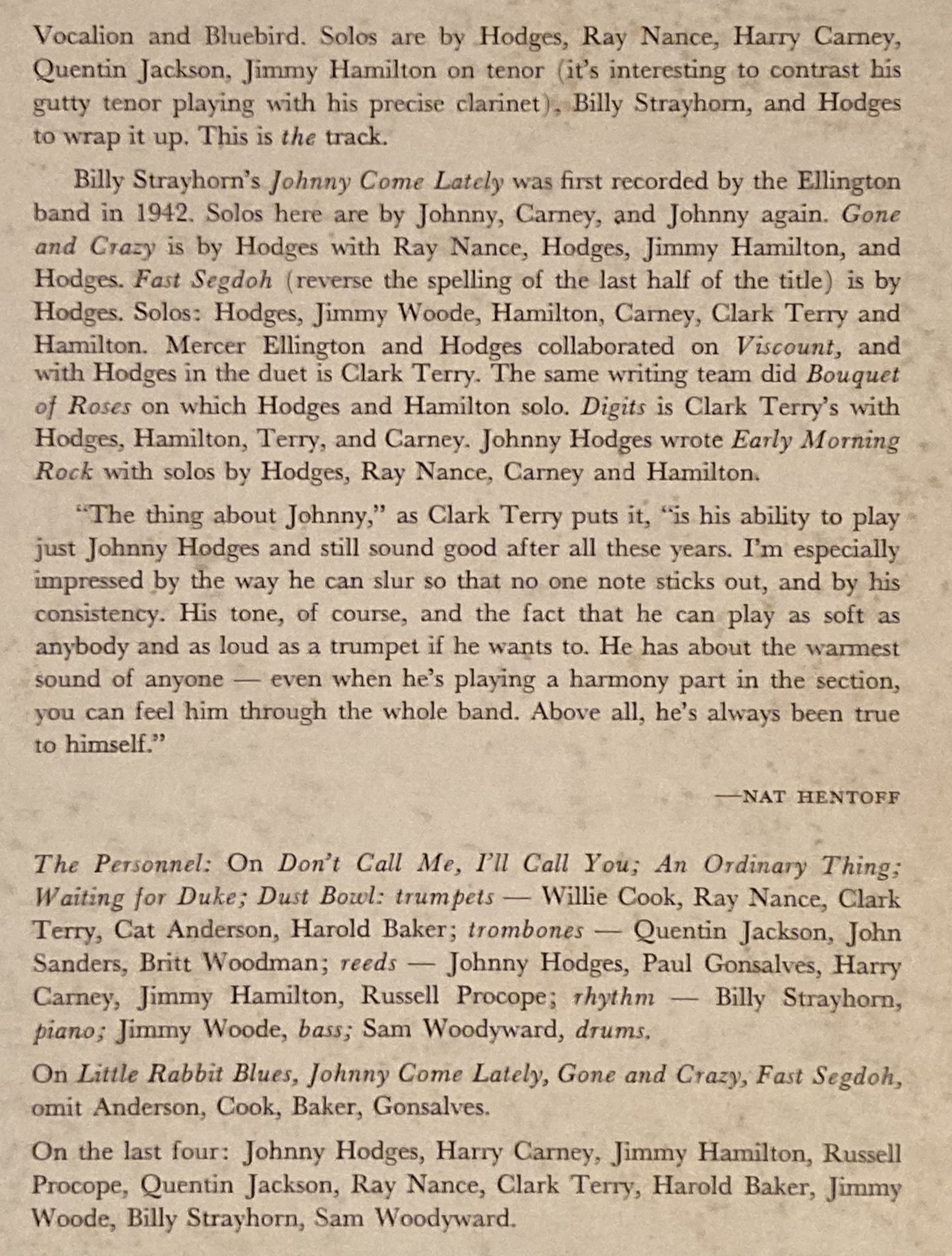
“My influence,” Johnny Hodges was saying, “was Sidney Bechet. I used to play with him before I was with Ellington. Back in 1923 and 1924, he used to come to Boston with Jimmy Cooper’s Black and White Review. My sister knew him; she told, me about him; and I’d always come by after that to listen whenever he was in town. I finally went back stage with a little soprano saxophone in a bag, as I remember it. He asked me to blow one, and took a liking to me.
“After that,” Hodges went on, “whenever I came to New York for a visit, I’d spend time at his Club Bechet on 145th Street and Seventh Avenue. He was always telling me to listen to this and that and he’d say ‘the old man isn’t going to be here forever.’ Some nights when he couldn’t be there, I took over at the club.
“The reason I was so influenced by Bechet,” Hodges recalls, “is that he seemed quite different from everyone else at the time. The others were trying to copy Benny Carter, Coleman Hawkins, Jimmy Dorsey, etc. For me it was Bechet and also Louis Armstrong. I’d been very impressed by his Hot Five records and the ones he made with Clarence Williams. But mostly it was Bechet.”
Through the years Hodges himself developed one of the major alto styles in jazz. He is interested in hearing the approaches of younger men to the alto, but, he says, “I never have had any idea of changing.” He was with Ellington from 1928 until 1951, formed his own groups, and then returned some four years ago. He had been very much missed.
As for Duke and how he makes a band his, Hodges summarizes the process: “He always seems to know what fits each person. Out of 15 guys, he can pick out the one who can do it best.”
This album was made with three groups, all sidemen with Johnny in the Ellington band. For complete personnel breakdown, see below.
Cat Anderson’s Don’t Call Me, I’ll Call You has solos by Hodges, Harry Carney and Cat. An Ordinary Thing, by Cat, has Hodges and Quentin “Butter” Jackson. Cat’s Waiting for Duke begins with Hodges who’s followed by Jimmy Hamilton, Harold Baker, Carney, and Hodges again. Dust Bowl, which is what a section of Las Vegas is called, is by Hodges. Solos by Hodges, Ray Nance and Hodges. Johnny wrote Little Rabbit Blues. This one especially has the feel of the Hodges’ small combo dates years ago on Vocalion and Bluebird. Solos are by Hodges, Ray Nance, Harry Carney, Quentin Jackson, Jimmy Hamilton on tenor (it’s interesting to contrast his gutty tenor playing with his precise clarinet), Billy Strayhorn, and Hodges to wrap it up. This is the track.
Billy Strayhorn’s Johnny Come Lately was first recorded by the Ellington band in 1942. Solos here are by Johnny, Carney, and Johnny again. Gone and Crazy is by Hodges with Ray Nance, Hodges, Jimmy Hamilton, and Hodges. Fast Segdoh (reverse the spelling of the last half of the title) is by Hodges. Solos: Hodges, Jimmy Woode, Hamilton, Carney, Clark Terry and Hamilton. Mercer Ellington and Hodges collaborated on Viscount, and with Hodges in the duet is Clark Terry. The same writing team did Bouquet of Roses on which Hodges and Hamilton solo. Digits is Clark Terry’s with Hodges, Hamilton, Terry, and Carney. Johnny Hodges wrote Early Morning Rock with solos by Hodges, Ray Nance, Carney and Hamilton.
“The thing about Johnny,” as Clark Terry puts it, “is his ability to play just Johnny Hodges and still sound good after all these years. I’m especially impressed by the way he can slur so that no one note sticks out, and by his consistency. His tone, of course, and the fact that he can play as soft as anybody and as loud as a trumpet if he wants to. He has about the warmest sound of anyone even when he’s playing a harmony part in the section, you can feel him through the whole band. Above all, he’s always been true to himself.”
NAT HENTOFF
The Personnel: On Don’t Call Me, I’ll Call You; An Ordinary Thing; Waiting for Duke; Dust Bowl: trumpets Willie Cook, Ray Nance, Clark Terry, Cat Anderson, Harold Baker; trombones Quentin Jackson, John Sanders, Britt Woodman; reeds Johnny Hodges, Paul Gonsalves, Harry
Carney, Jimmy Hamilton, Russell Procope; rhythm piano; Jimmy Woode, bass; Sam Woodyward, drums,
Billy Strayhorn,
On Little Rabbit Blues, Johnny Come Lately, Gone and Crazy, Fast Segdoh, omit Anderson, Cook, Baker, Gonsalves.
On the last four: Johnny Hodges, Harry Carney, Jimmy Hamilton, Russell Procope, Quentin Jackson, Ray Nance, Clark Terry, Harold Baker, Jimmy Woode, Billy Strayhorn, Sam Woodyward.
<裏ジャケ和訳>
「僕に影響を与えたのはシドニー・ベシェだった」とジョニー・ホッジスは語っていた。「エリントンの楽団に入る前、彼と共演したことがあるんだ。1923年から24年にかけて、彼はジミー・クーパーの『ブラック・アンド・ホワイト・レビュー』の一員としてボストンに来ていた。姉が彼と知り合いでね、僕に彼のことを教えてくれたんだ。それ以来、彼が街に来るたびに演奏を聴きに行っていたよ。ある時、小さなソプラノ・サックスを袋に入れて楽屋を訪ねたんだ。彼に『ちょっと吹いてみろ』と言われて、気に入ってもらえたんだよ」
「それからというもの」とホッジスは続けた。「ニューヨークを訪れるたびに、145丁目と7番街にあった彼の店『クラブ・ベシェ』で過ごしたものさ。彼はいつも『あれを聴け、これを聴け』と教えてくれたし、『この老いぼれもいつまでもここにいるわけじゃないからな』なんて言っていたよ。彼が店に出られない夜には、僕が代わりに演奏することさえあった」
「ベシェに強く惹かれた理由」とホッジスは振り返る。「当時の他の連中とは全く違って見えたからだ。他の連中はベニー・カーターやコールマン・ホーキンス、ジミー・ドーシーなんかを真似しようとしていたけれど、僕にとってはベシェ、そしてルイ・アームストロングだった。彼の『ホット・ファイブ』のレコードや、クラレンス・ウィリアムズとの共演作には本当に感銘を受けたよ。でも、何と言っても一番はベシェだったね」
長い年月を経て、ホッジス自身もジャズにおける主要なアルト・サックスのスタイルを確立した。彼は若い奏者たちがアルトにどう取り組んでいるかを知ることには関心を持っているが、「自分のスタイルを変えようと思ったことは一度もない」と語る。彼は1928年から1951年までエリントン楽団に在籍し、その後自身のグループを結成したが、約4年前に楽団へ復帰した。彼の不在は多くの人に惜しまれていた。
デュークがどのようにしてバンドをまとめ上げ、自分のものにしていくかについて、ホッジスはその過程をこう要約している。「彼はいつも、誰に何が合っているのかを心得ているんだ。15人のメンバーの中から、それを一番うまくやれる人間を見つけ出すことができるのさ」
本作は3つのグループによって制作されたが、サイドマンはいずれもエリントン楽団でホッジスと共演したメンバーである。詳細な参加メンバーについては下記を参照のこと。キャット・アンダーソン作の「Don’t Call Me, I’ll Call You」では、ホッジス、ハリー・カーネイ、そしてキャット自身がソロをとっています。同じくキャット作の「An Ordinary Thing」では、ホッジスとクエンティン・“バター”・ジャクソンがソロを披露します。キャット作の「Waiting for Duke」はホッジスの演奏で始まり、ジミー・ハミルトン、ハロルド・ベイカー、カーネイ、そして再びホッジスへとソロが続きます。「Dust Bowl」(ラスベガスの一角を指す名称)はホッジスの作品で、ホッジス、レイ・ナンス、そして再びホッジスがソロをとります。ジョニーが作曲した「Little Rabbit Blues」は、かつてVocalionやBluebirdレーベルで行われたホッジスの小編成コンボでの録音を彷彿とさせる雰囲気を特に強く持っています。ソロはホッジス、レイ・ナンス、ハリー・カーネイ、クエンティン・ジャクソン、ジミー・ハミルトン(テナー・サックスでの演奏。彼の正確なクラリネット演奏と、この力強く骨太なテナー演奏との対比が興味深い)、ビリー・ストレイホーン、そして最後を締めくくるホッジスという構成です。まさに聴きどころと言えるトラックです。
ビリー・ストレイホーン作の「Johnny Come Lately」は、1942年にエリントン・バンドによって初めて録音されました。ここでのソロはジョニー、カーネイ、そして再びジョニーが担当しています。「Gone and Crazy」はホッジスの作品で、レイ・ナンス、ホッジス、ジミー・ハミルトン、ホッジスがソロをとります。「Fast Segdoh」(タイトルの後半の綴りを逆にしたもの)はホッジスの作品で、ホッジス、ジミー・ウッド、ハミルトン、カーネイ、クラーク・テリー、ハミルトンがソロをとります。マーサー・エリントンとホッジスが共作した「Viscount」では、ホッジスとクラーク・テリーがデュエットを披露しています。同じコンビによる「Bouquet of Roses」では、ホッジスとハミルトンがソロをとります。「Digits」はクラーク・テリーの作品で、ホッジス、ハミルトン、テリー、カーネイがソロをとります。ジョニー・ホッジス作の「Early Morning Rock」では、ホッジス、レイ・ナンス、カーネイ、ハミルトンがソロをとります。
クラーク・テリーはジョニーについてこう語っています。「ジョニーのすごいところは、長年演奏し続けてもなお、あくまで『ジョニー・ホッジス』らしいスタイルで素晴らしい音を響かせられる点だ。特に感心させられるのは、特定の音が突出することなく滑らかにつなげるスラーの技術と、その一貫した安定感だ。もちろん音色もそうだし、望めば誰よりもソフトに吹くことも、トランペット並みに大きな音を出すこともできる。セクションでハーモニー・パートを吹いている時でさえ、誰よりも温かみのある音色で、バンド全体の中に彼の存在感が感じられるんだ。何よりも、彼は常に自分自身に忠実であり続けてきた。」ナット・ヘントフ
参加メンバー:『Don’t Call Me, I’ll Call You』『An Ordinary Thing』『Waiting for Duke』『Dust Bowl』の各曲 — トランペット:ウィリー・クック、レイ・ナンス、クラーク・テリー、キャット・アンダーソン、ハロルド・ベイカー;トロンボーン:クエンティン・ジャクソン、ジョン・サンダース、ブリット・ウッドマン;リード楽器:ジョニー・ホッジス、ポール・ゴンザルヴェス、ハリー・カーニー、ジミー・ハミルトン、ラッセル・プロコープ;リズム・セクション:ピアノ(ビリー・ストレイホーン)、ベース(ジミー・ウッド)、ドラムス(サム・ウッドヤード)。
『Little Rabbit Blues』『Johnny Come Lately』『Gone and Crazy』『Fast Segdoh』では、アンダーソン、クック、ベイカー、ゴンザルヴェスは不参加。
最後の4曲のメンバー:ジョニー・ホッジス、ハリー・カーニー、ジミー・ハミルトン、ラッセル・プロコープ、クエンティン・ジャクソン、レイ・ナンス、クラーク・テリー、ハロルド・ベイカー、ジミー・ウッド、ビリー・ストレイホーン、サム・ウッドヤード。
※訳文の制作にはGoogleドライブとGoogle翻訳のお世話になりました。

コメント