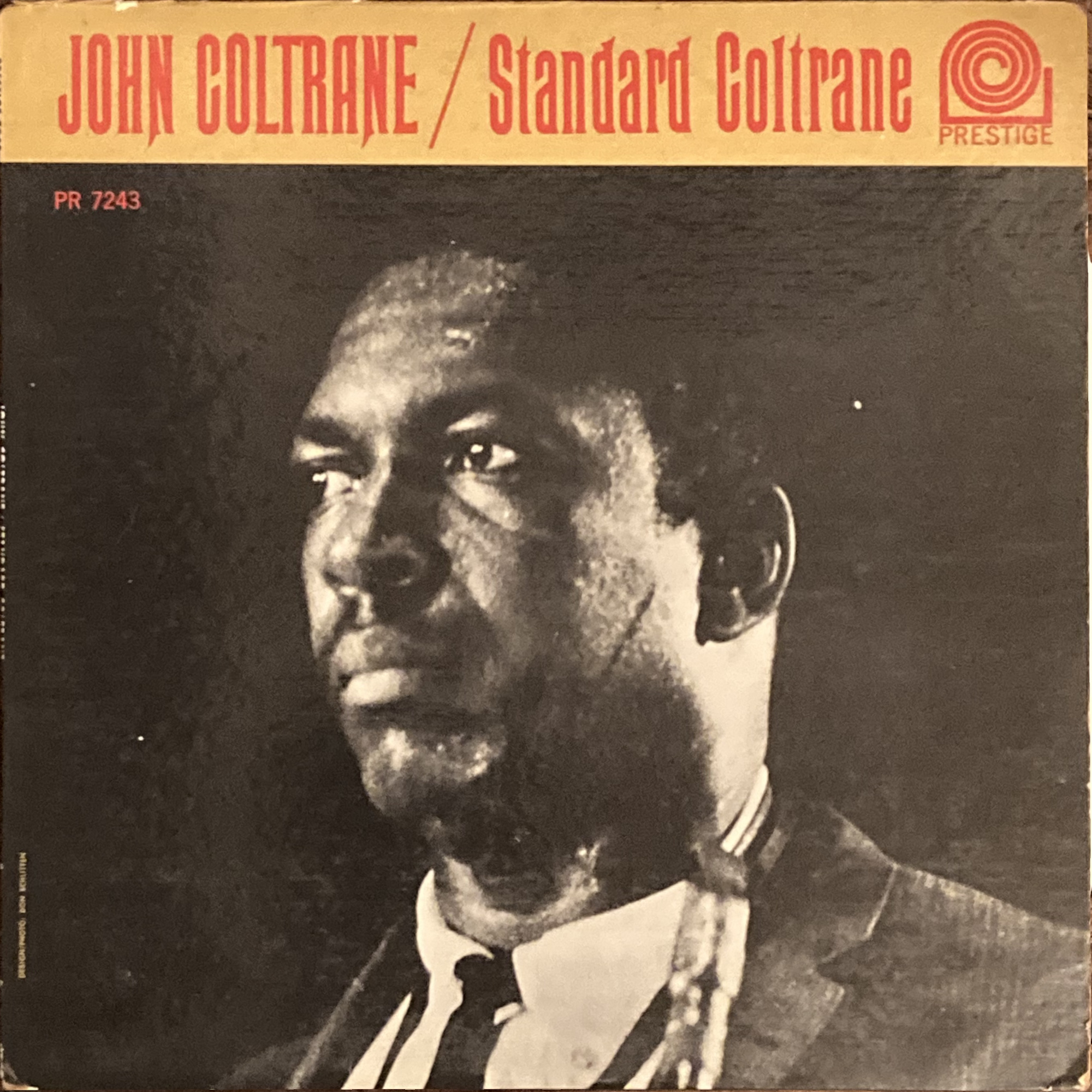
Label: PRESTIGE
No.: PRLP-7243
Title: STANDARD COLTRANE
Musician: JOHN COLTRANE
Recorded: 1958/7/11
Monaural
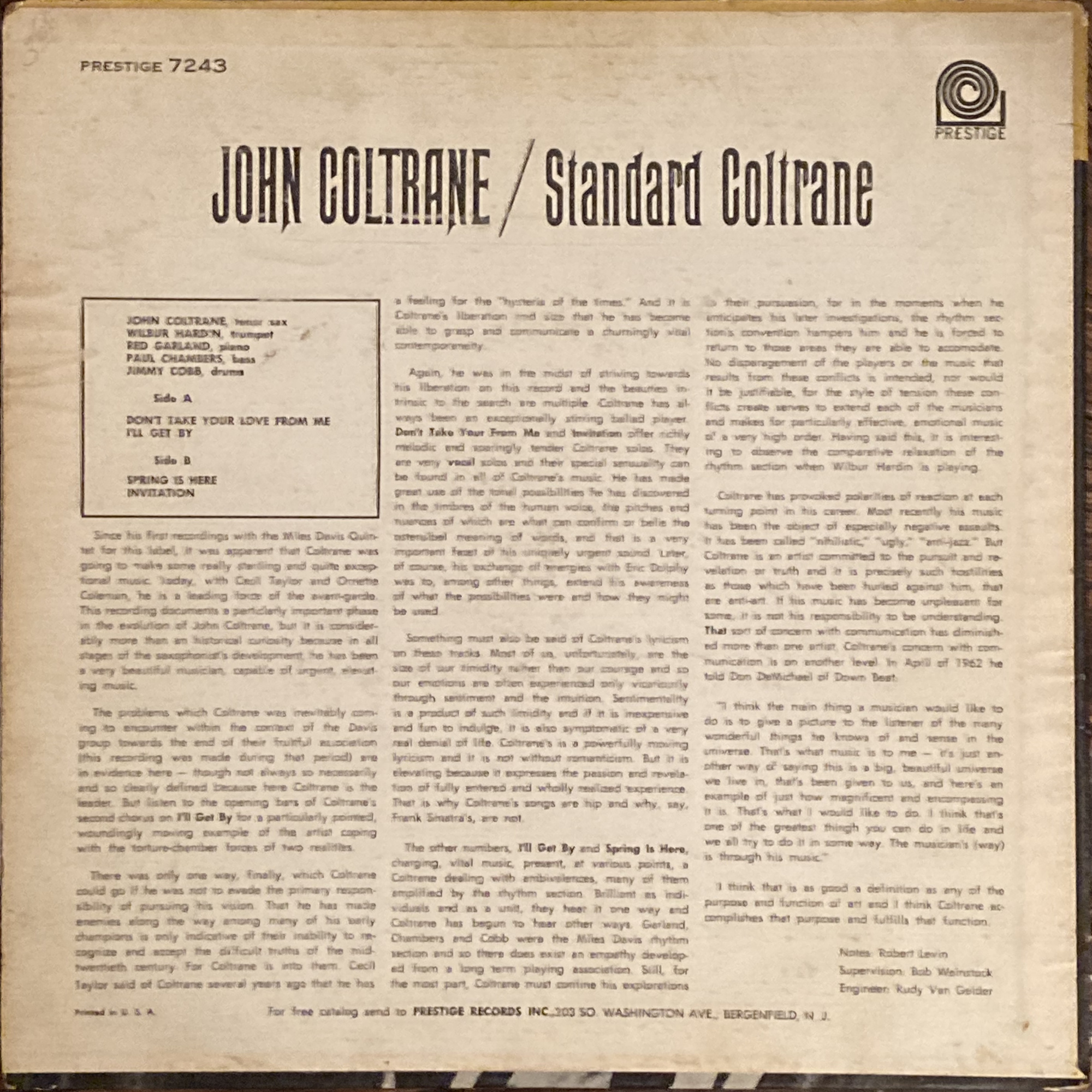
Cover address: 203 SO. WASHIGTON AVE. BERGENIFIELD N.J.
Laminate Coating, 背文字有り
Groove Guard
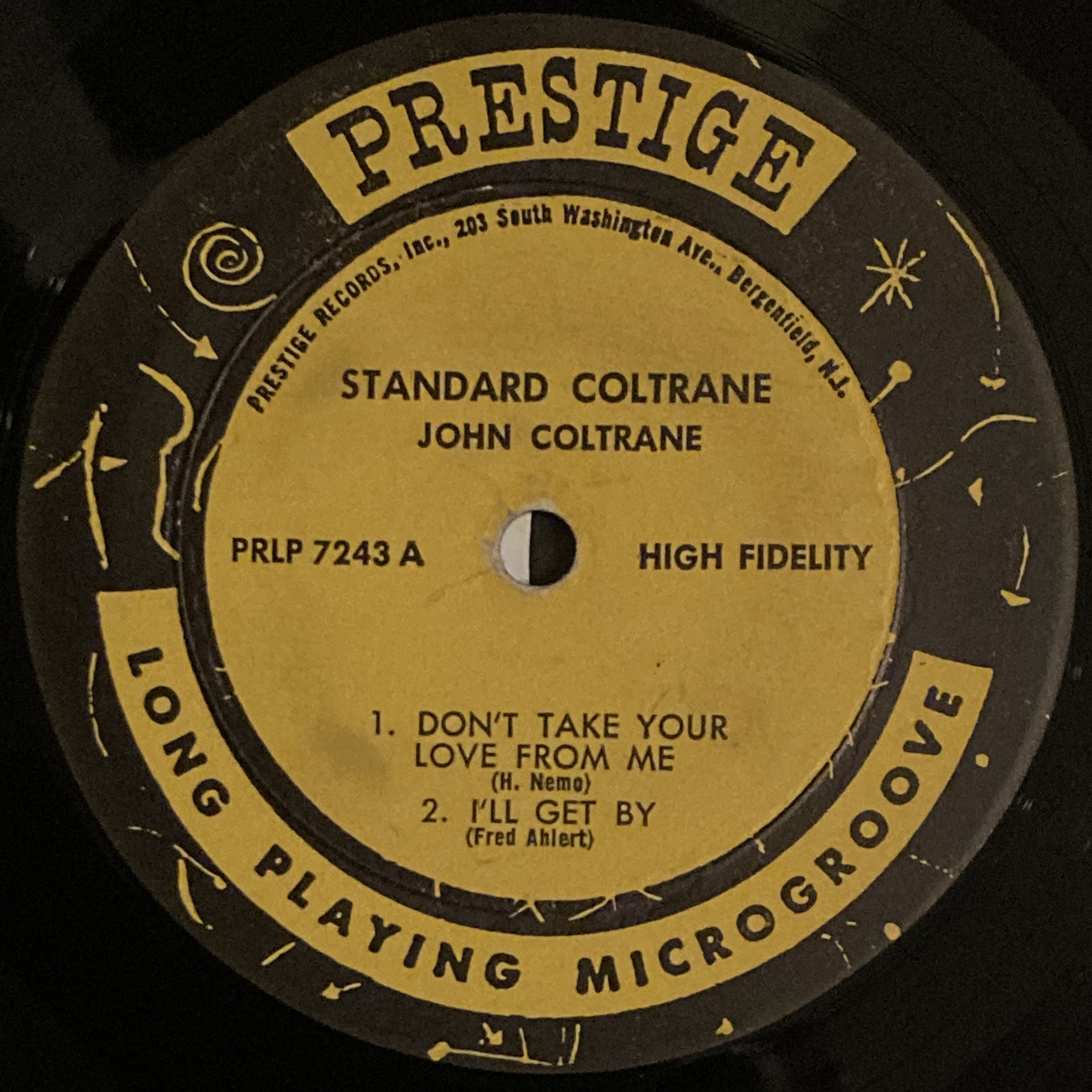
Label Side-A
Yellow Background
Black Letter
Address: 203 South Washington Ave., Bergenfield, N.J.
Deep Groove
Dead Wax Info: PRLP-7243-A, RVGスタンプ
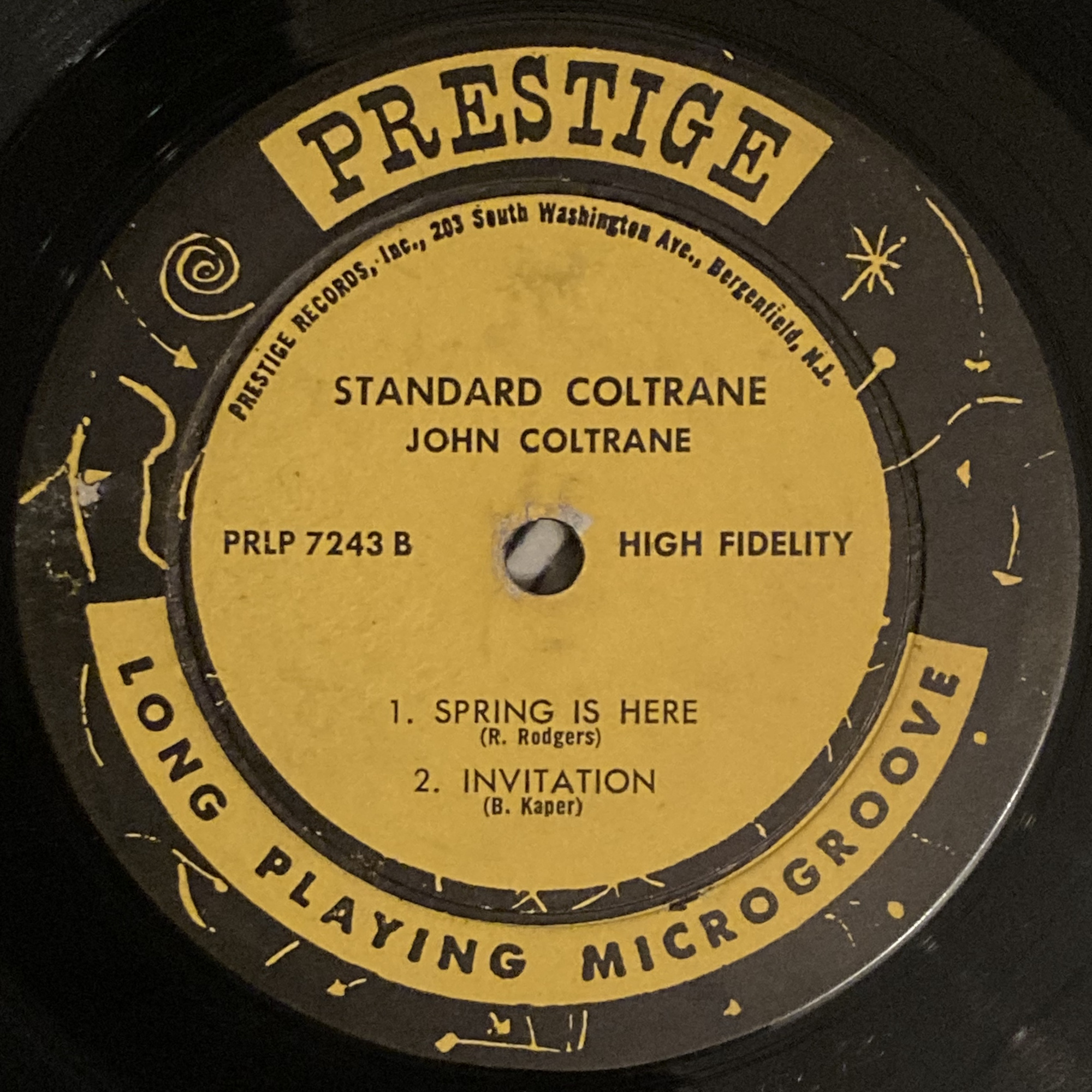
Label Side-B
Yellow Background
Black Letter
Address: 203 South Washington Ave., Bergenfield, N.J.
Deep Groove
Dead Wax Info: PRLP-7243-B, RVGスタンプ
Personnel-
Drums: Jimmy Cobb
Bass: Paul Chambers
Piano: Red Garland
Tenor Sax: John Coltrane
Trumpet: Wilbur Hardin
Tracks-
Side-A
1) Don’t Take Your Love From Me
2) I’ll Get By
Side-B
1) Spring is Here
2) Invitation
<裏ジャケ原文>
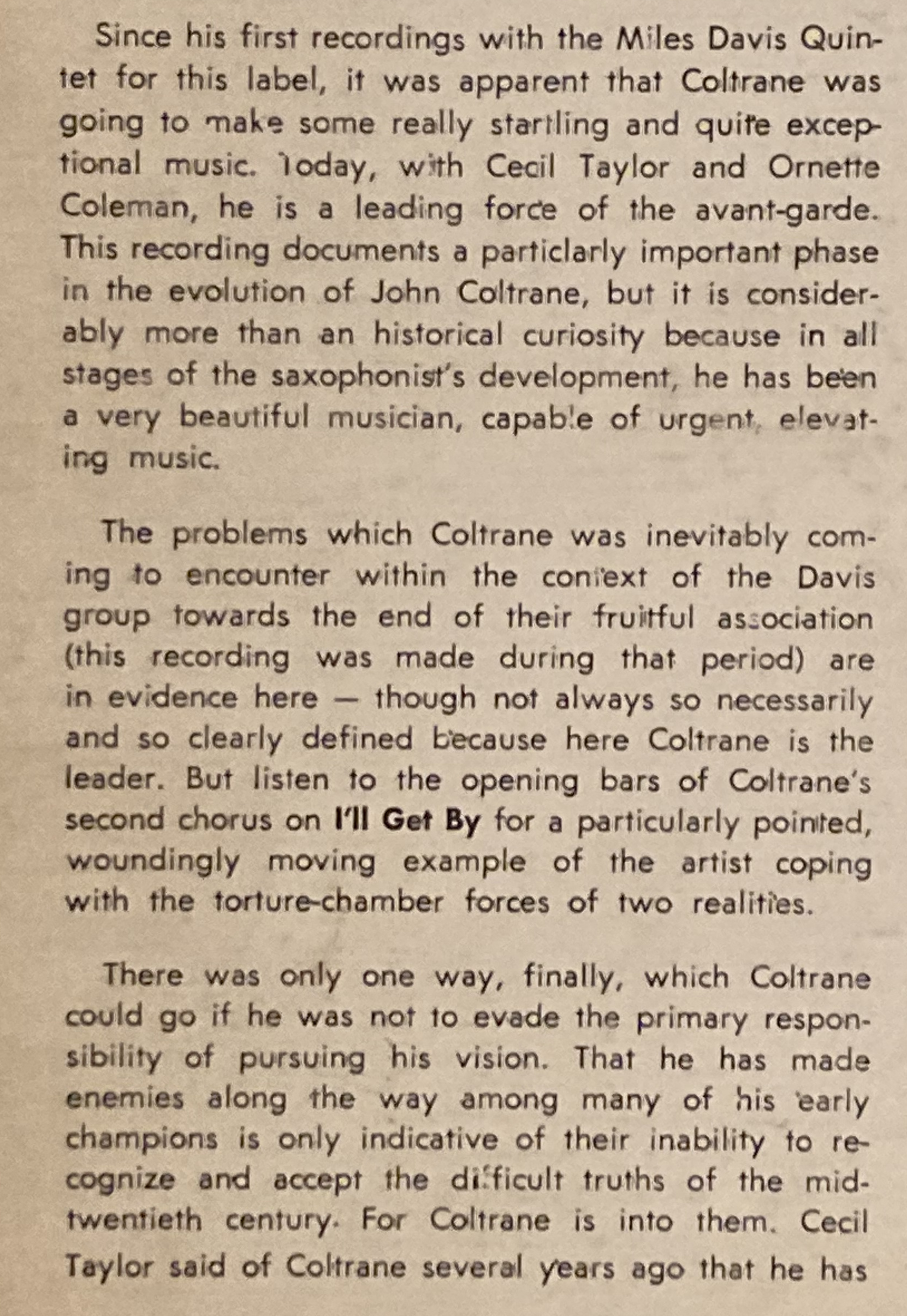
Since his first recordings with the Miles Davis Quin- tet for this label, it was apparent that Coltrane was going to make some really startling and quite excep- tional music. Today, with Cecil Taylor and Ornette Coleman, he is a leading force of the avant-garde. This recording documents a particlarly important phase in the evolution of John Coltrane, but it is consider- ably more than an historical curiosity because in all stages of the saxophonist’s development, he has been a very beautiful musician, capable of urgent, elevat- ing music.
The problems which Coltrane was inevitably com- ing to encounter within the context of the Davis. group towards the end of their fruitful association (this recording was made during that period) are in evidence here – though not always so necessarily and so clearly defined because here Coltrane is the leader. But listen to the opening bars of Coltrane’s second chorus on I’ll Get By for a particularly pointed, woundingly moving example of the artist coping with the torture-chamber forces of two realities.
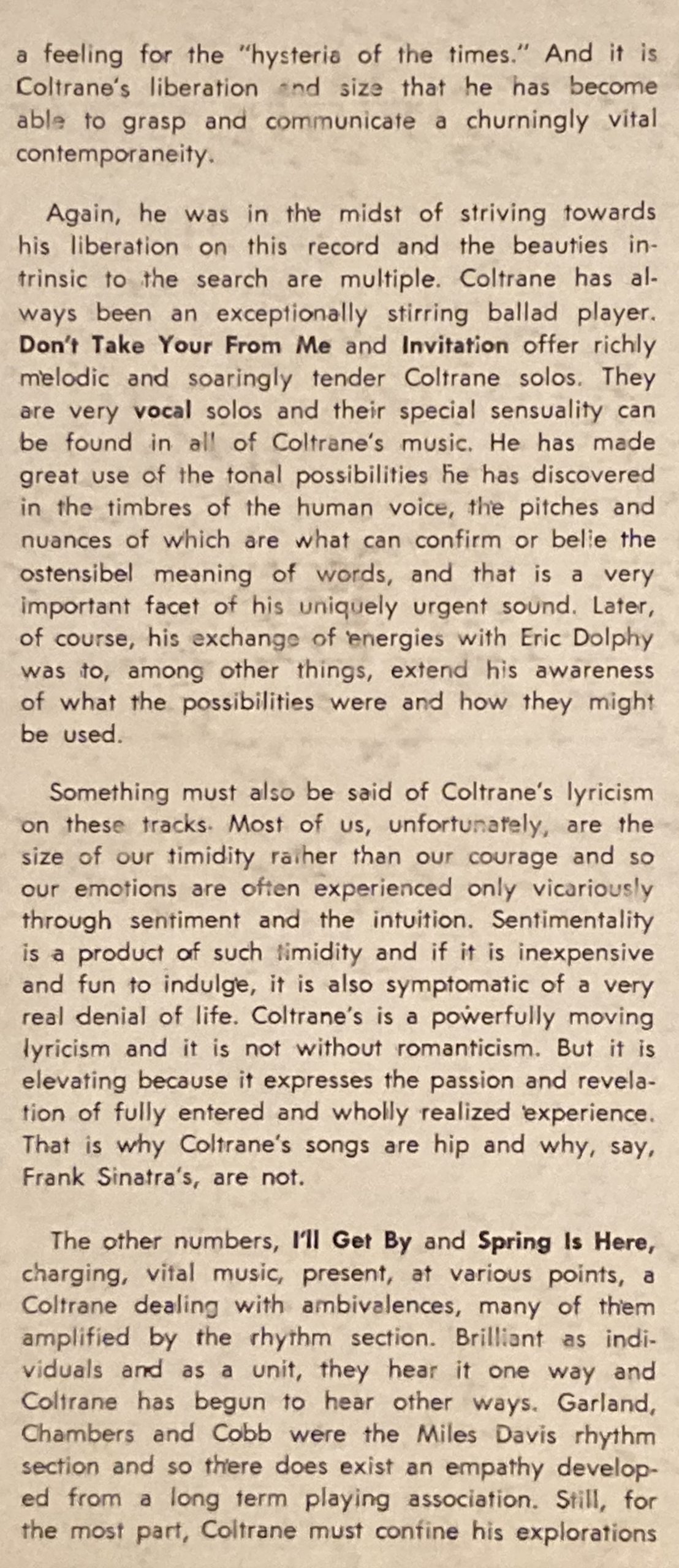
There was only one way, finally, which Coltrane could go if he was not to evade the primary respon- sibility of pursuing his vision. That he has made enemies along the way among many of his early champions is only indicative of their inability to re- cognize and accept the difficult truths of the mid- twentieth century. For Coltrane is into them. Cecil Taylor said of Coltrane several years ago that he has a feeling for the “hysteria of the times.” And it is Coltrane’s liberation and size that he has become able to grasp and communicate a churningly vital contemporaneity.
Again, he was in the midst of striving towards his liberation on this record and the beauties in- trinsic to the search are multiple. Coltrane has al- ways been an exceptionally stirring ballad player. Don’t Take Your From Me and Invitation offer richly melodic and soaringly tender Coltrane solos. They are very vocal solos and their special sensuality can be found in all of Coltrane’s music. He has made great use of the tonal possibilities he has discovered in the timbres of the human voice, the pitches and nuances of which are what can confirm or belie the ostensibel meaning of words, and that is a very important facet of his uniquely urgent sound. Later, of course, his exchange of energies with Eric Dolphy was to, among other things, extend his awareness of what the possibilities were and how they might be used.
Something must also be said of Coltrane’s lyricism on these tracks. Most of us, unfortunately, are the size of our timidity rather than our courage and so our emotions are often experienced only vicariously through sentiment and the intuition. Sentimentality is a product of such timidity and if it is inexpensive and fun to indulge, it is also symptomatic of a very real denial of life. Coltrane’s is a powerfully moving lyricism and it is not without romanticism. But it is elevating because it expresses the passion and revela- tion of fully entered and wholly realized experience. That is why Coltrane’s songs are hip and why, say, Frank Sinatra’s, are not.
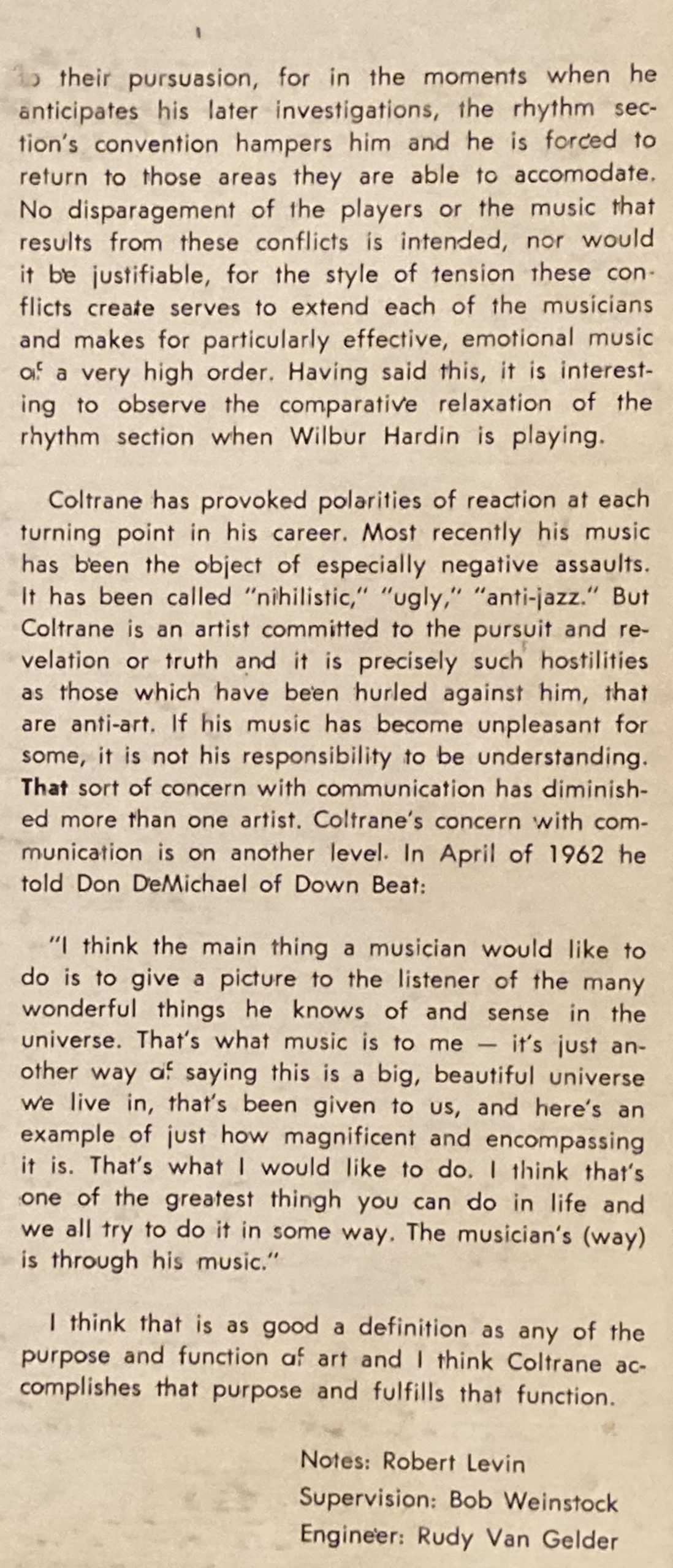
The other numbers, I’ll Get By and Spring Is Here, charging, vital music, present, at various points, a Coltrane dealing with ambivalences, many of them amplified by the rhythm section. Brilliant as indi- viduals and as a unit, they hear it one way and Coltrane has begun to hear other ways. Garland, Chambers and Cobb were the Miles Davis rhythm section and so there does exist an empathy develop- ed from a long term playing association. Still, for the most part, Coltrane must confine his explorations their pursuasion, for in the moments when he anticipates his later investigations, the rhythm sec- tion’s convention hampers him and he is forced to return to those areas they are able to accomodate. No disparagement of the players or the music that results from these conflicts is intended, nor would it be justifiable, for the style of tension these con- flicts create serves to extend each of the musicians and makes for particularly effective, emotional music of a very high order. Having said this, it is interest- ing to observe the comparative relaxation of the rhythm section when Wilbur Hardin is playing.
Coltrane has provoked polarities of reaction at each turning point in his career. Most recently his music has been the object of especially negative assaults. It has been called “nihilistic,” “ugly,” “anti-jazz.” But Coltrane is an artist committed to the pursuit and re- velation or truth and it is precisely such hostilities as those which have been hurled against him, that are anti-art. If his music has become unpleasant for some, it is not his responsibility to be understanding. That sort of concern with communication has diminish- ed more than one artist. Coltrane’s concern with com- munication is on another level. In April of 1962 he told Don DeMichael of Down Beat:
“I think the main thing a musician would like to do is to give a picture to the listener of the many wonderful things he knows of and sense in the universe. That’s what music is to me it’s just an- other way of saying this is a big, beautiful universe we live in, that’s been given to us, and here’s an example of just how magnificent and encompassing it is. That’s what I would like to do. I think that’s one of the greatest thingh you can do in life and we all try to do it in some way. The musician’s (way) is through his music.”
I think that is as good a definition as any of the purpose and function af art and I think Coltrane ac- complishes that purpose and fulfills that function.
Notes: Robert Levin
Supervision: Bob Weinstock
Engineer: Rudy Van Gelder
<裏ジャケ和訳>
同レーベルにおけるマイルス・デイヴィス・クインテットとの最初の録音の時点で、コルトレーンが実に驚異的かつ並外れた音楽を創造しようとしていることは明らかでした。今日、彼はセシル・テイラーやオーネット・コールマンと並び、アヴァンギャルド・シーンを牽引する存在となっています。本作はジョン・コルトレーンの進化における極めて重要な一時期を記録したものですが、単なる歴史的興味の対象にとどまるものではありません。なぜなら、このサックス奏者はその発展のどの段階においても、切迫感に満ち、聴き手の精神を高揚させるような音楽を奏でる、極めて美しい表現者であり続けたからです。
デイヴィス・グループとの実り多き共演関係の終盤(本作はその時期に録音されました)、コルトレーンが必然的に直面することになった葛藤の跡が、ここにも見て取れます。もっとも、ここではコルトレーン自身がリーダーであるため、その対立構造は必ずしも明確な形で表れているわけではありません。しかし、『I’ll Get By』における彼の2コーラス目の冒頭を聴いてみてください。そこには、二つの相反する現実がもたらす「拷問部屋」のような力学と格闘するアーティストの姿が、痛いほどに感動的な形で鮮烈に描き出されています。
自らのヴィジョンを追求するという根本的な責務から逃げない限り、コルトレーンが進むべき道はただ一つしかありませんでした。その過程で、かつての支持者たちの多くを敵に回すことになったとしても、それは彼らが20世紀半ばの困難な真実を認識し、受け入れることができなかったことを示しているに過ぎません。なぜなら、コルトレーンこそがその真実の只中に身を投じていたからです。セシル・テイラーは数年前、コルトレーンについて「時代のヒステリー(狂騒や切迫感)」を感じ取る力を持っていると語りました。そして、激しくうねるような現代性を捉え、それを表現し得るようになったことこそが、コルトレーンの「解放」であり、彼の偉大さなのです。
繰り返しになりますが、本作において彼はまさに「解放」へと向かって突き進んでおり、その探求の過程には数多くの美しさが宿っています。コルトレーンは常に、聴く者の心を強く揺さぶるバラード・プレイヤーであり続けてきました。『Don’t Take Your Love From Me』や『Invitation』で聴ける彼のソロは、豊かな旋律と、天に昇るような優しさに満ちています。それらは極めて「歌うような」ソロであり、コルトレーンのすべての音楽に通底する独特の官能性が、そこには息づいているのです。彼は人間の声の音色の中に、ある種の音響的な可能性を見出し、それを巧みに活用してきました。声のピッチやニュアンスこそが、言葉の表向きの意味を裏付けたり、あるいは否定したりするものであり、それこそが彼の音楽が持つ、あの独特で切迫した響きの重要な側面なのです。もちろん後になって、エリック・ドルフィーとのエネルギーの交歓を通じて、彼はそうした可能性やその活用法についての認識をさらに広げていくことになります。
これらのトラックにおけるコルトレーンの叙情性についても触れておくべきでしょう。残念ながら、私たちの多くは勇気よりも臆病さの枠に収まってしまっており、そのため感情を体験するといっても、感傷や直感を通じた代理的なものにとどまりがちです。感傷主義とはそうした臆病さの産物であり、それに浸るのは手軽で楽しいことかもしれませんが、同時に、生を真に受け入れることを拒絶している証拠でもあります。コルトレーンの叙情性は人々の心を強く揺さぶるものであり、ロマンティシズムもそこに息づいています。しかし、彼の音楽が高揚感をもたらすのは、それが、自らの身を完全に投じ、余すところなく体現した体験から生まれる情熱や「啓示」を表現しているからです。それこそがコルトレーンの楽曲が「ヒップ(粋で本質的)」であり、例えばフランク・シナトラの楽曲がそうではない理由なのです。
「I’ll Get By」や「Spring Is Here」といった他の曲は、エネルギーに満ちた生命力あふれる演奏ですが、そこでは随所で、コルトレーンがアンビバレンス(相反する感情や葛藤)と向き合う姿が見られます。その葛藤の多くは、リズム・セクションによって増幅されたものでした。個人としてもユニットとしても卓越した彼らはある種の聴き方をしていましたが、コルトレーンはすでに別の聴き方をし始めていたのです。ガーランド、チェンバース、コブはマイルス・デイヴィスのリズム・セクションを務めていたメンバーであり、長年の共演で培われた深い共鳴関係がありました。それでも、コルトレーンは大部分において、彼らの説得力ある演奏の枠内で自身の探求を行わざるを得ませんでした。なぜなら、彼が自身の後の音楽的探求を予感させるような瞬間であっても、リズム・セクションの慣習的なアプローチが彼を妨げ、彼らは対応可能な領域へと引き戻されてしまうからです。こうした対立から生まれる演奏や音楽を軽んじるつもりは毛頭なく、またそうすることは正当化もできないだろう。なぜなら、そうした対立が生み出す緊張感は、各ミュージシャンの可能性を押し広げ、極めて質の高い、感動的で効果的な音楽をもたらすからである。とはいえ、ウィルバー・ハーディンが演奏している際、リズム・セクションが比較的リラックスした状態にあることには興味深いものがある。
コルトレーンは、そのキャリアの転換点ごとに、極端に分かれる反応を巻き起こしてきました。とりわけ最近では、彼の音楽に対して激しい非難が浴びせられています。「虚無的」「醜悪」「反ジャズ」といった言葉で評されることもあります。しかし、コルトレーンは真理の探求と開示に身を捧げる芸術家であり、彼に向けられるそうした敵意こそが、実は「反芸術」的なものなのです。もし彼の音楽を不快に感じる人がいるとしても、彼がその人たちに理解を求める必要などありません。聴き手との意思疎通を過度に気にかけるあまり、才能を損なってしまった芸術家は少なくないのですから。コルトレーンが考える「コミュニケーション」は、もっと別の次元にあります。1962年4月、彼は『ダウン・ビート』誌のドン・デマイケルにこう語っています。
「ミュージシャンが何よりもしたいこと、それは、自分が宇宙について知り、感じ取っている数多くの素晴らしい事柄を、聴き手にイメージとして伝えることだと思います。私にとって音楽とは、まさにそういうものです。私たちが生き、与えられたこの宇宙がいかに広大で美しいか、そしてそれがどれほど壮大で、すべてを包み込むようなものか、その一例を示すための、一つの表現方法なのです。それこそが、私がしたいことなのです。人生において成し遂げられる最も素晴らしいことの一つだと思いますし、誰もが何らかの形でそれをしようとしているはずです。ミュージシャンの場合は、それが音楽を通じて行われる、というだけのことです」
これこそ、芸術の目的と機能を見事に定義した言葉だと私は思いますし、コルトレーンはその目的を達成し、その機能を果たしているのだと考えます。
解説:ロバート・レヴィン
監修:ボブ・ワインストック
エンジニア:ルディ・ヴァン・ゲルダー
※訳文の制作にはGoogleドライブとGoogle翻訳のお世話になりました。

コメント