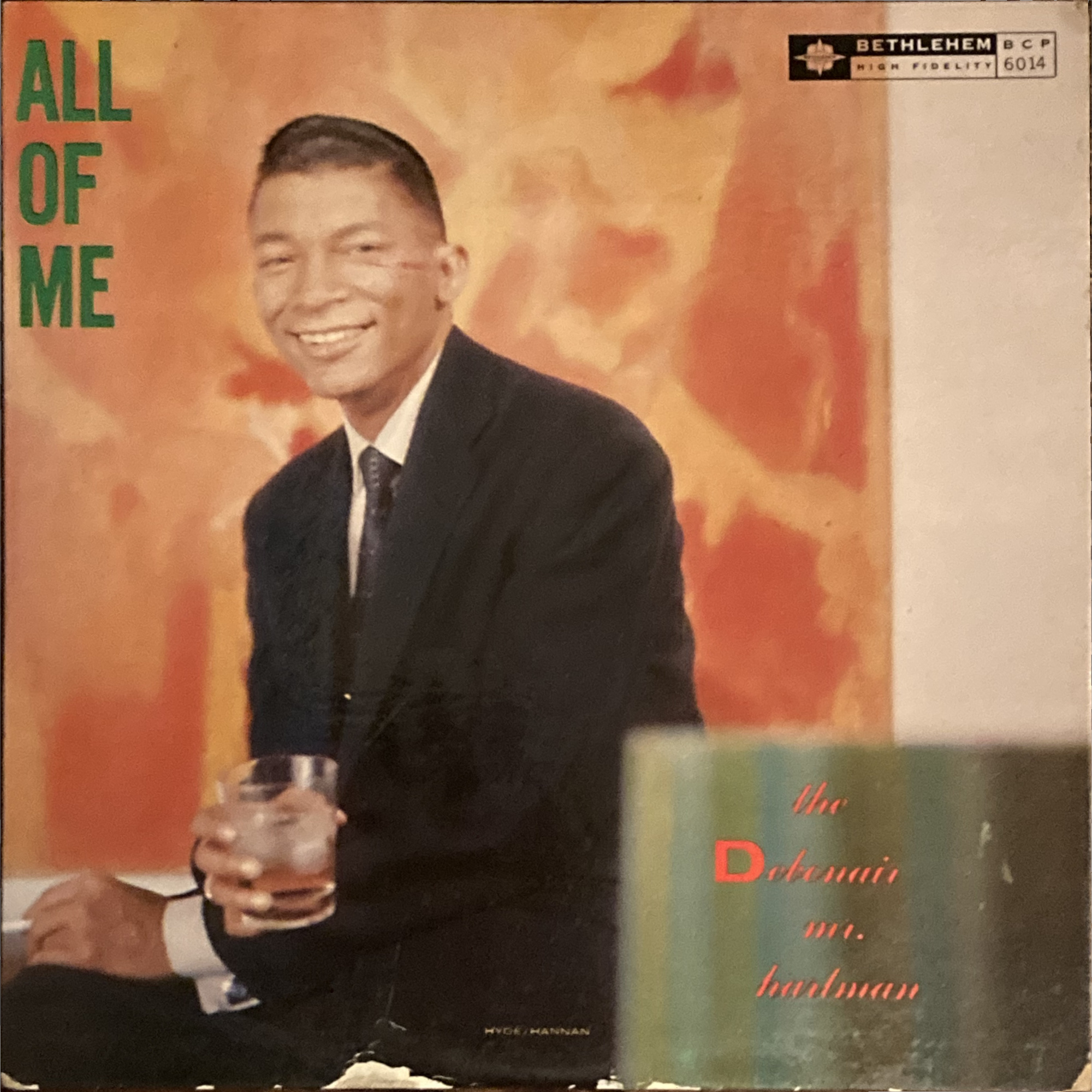
Label: BETHLEHEM
No.: BCP-6014
Title: ALL OF ME- THE DEBONAIR MR. HARTMAN
Musician: JOHNNY HARTMAN
Recorded: 1956/11, 1956
Monaural
Cover address:
Coating無し
Groove Guard
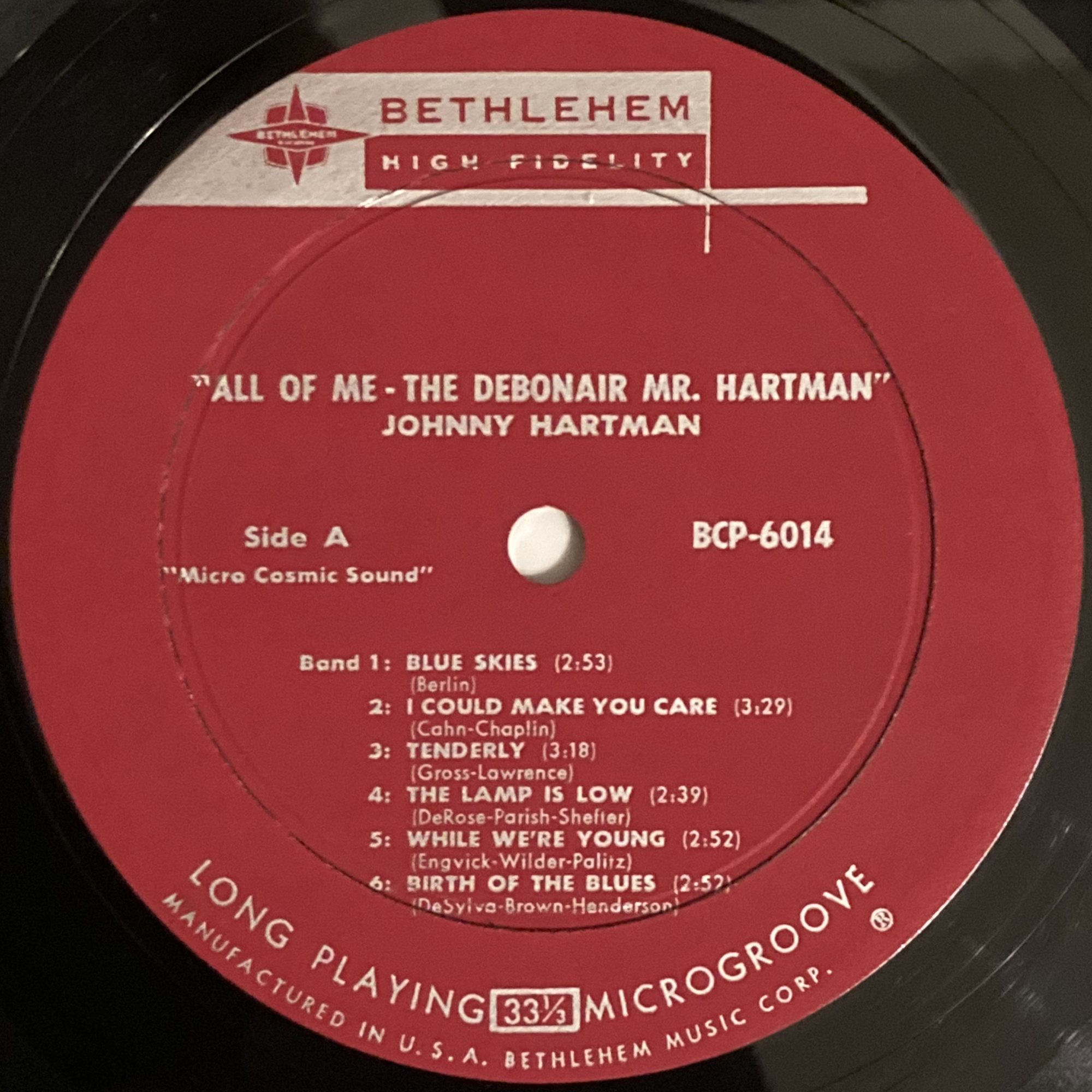
Label Side-A
Red Background
Gold Letter w/o Laurel
Address: None
Deep Groove
Dead Wax Info: BCP-12-6014-A-R1
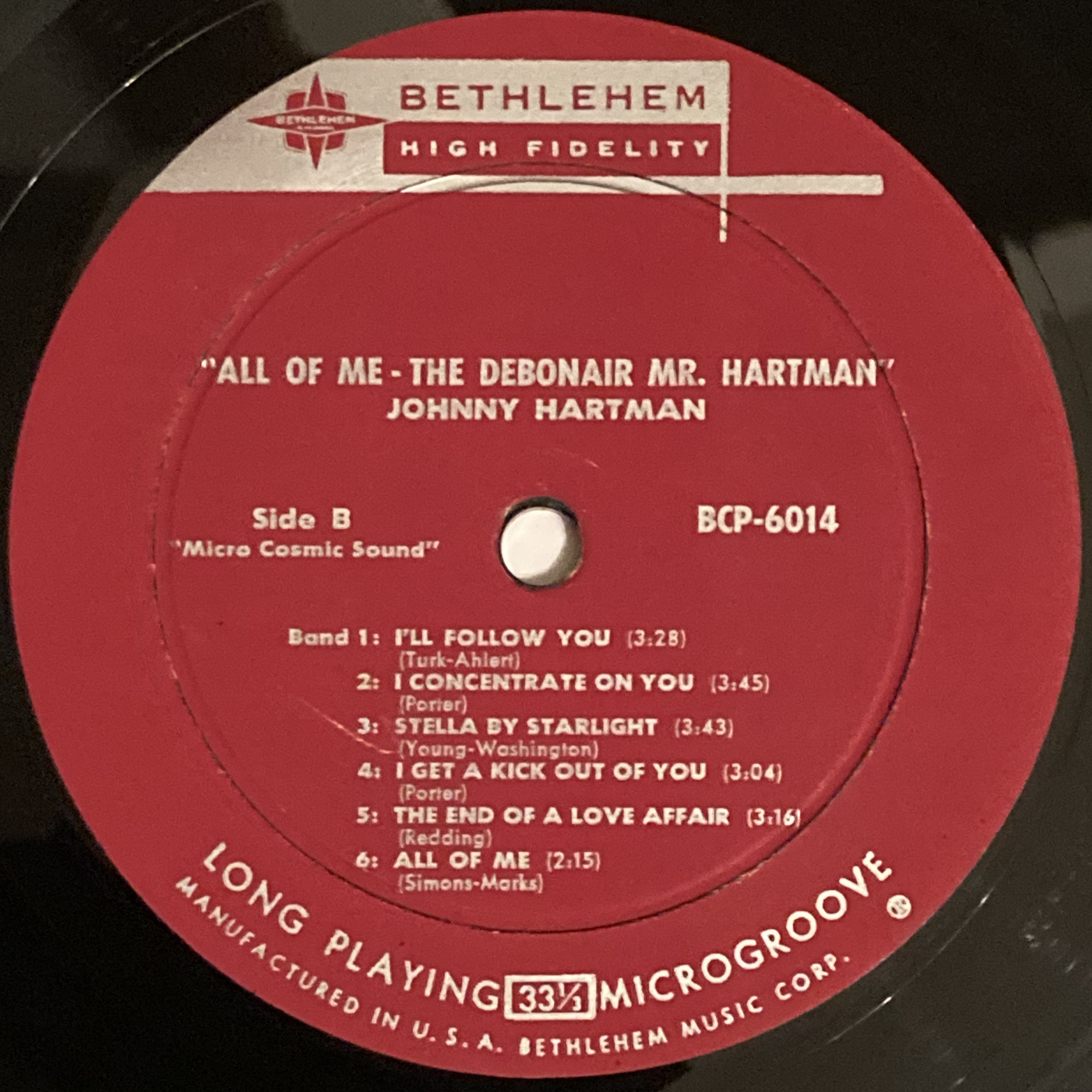
Label Side-B
Red Background
Gold Letter w/o Laurel
Address: None
Deep Groove
Dead Wax Info: BCP-12-6014-B-R1
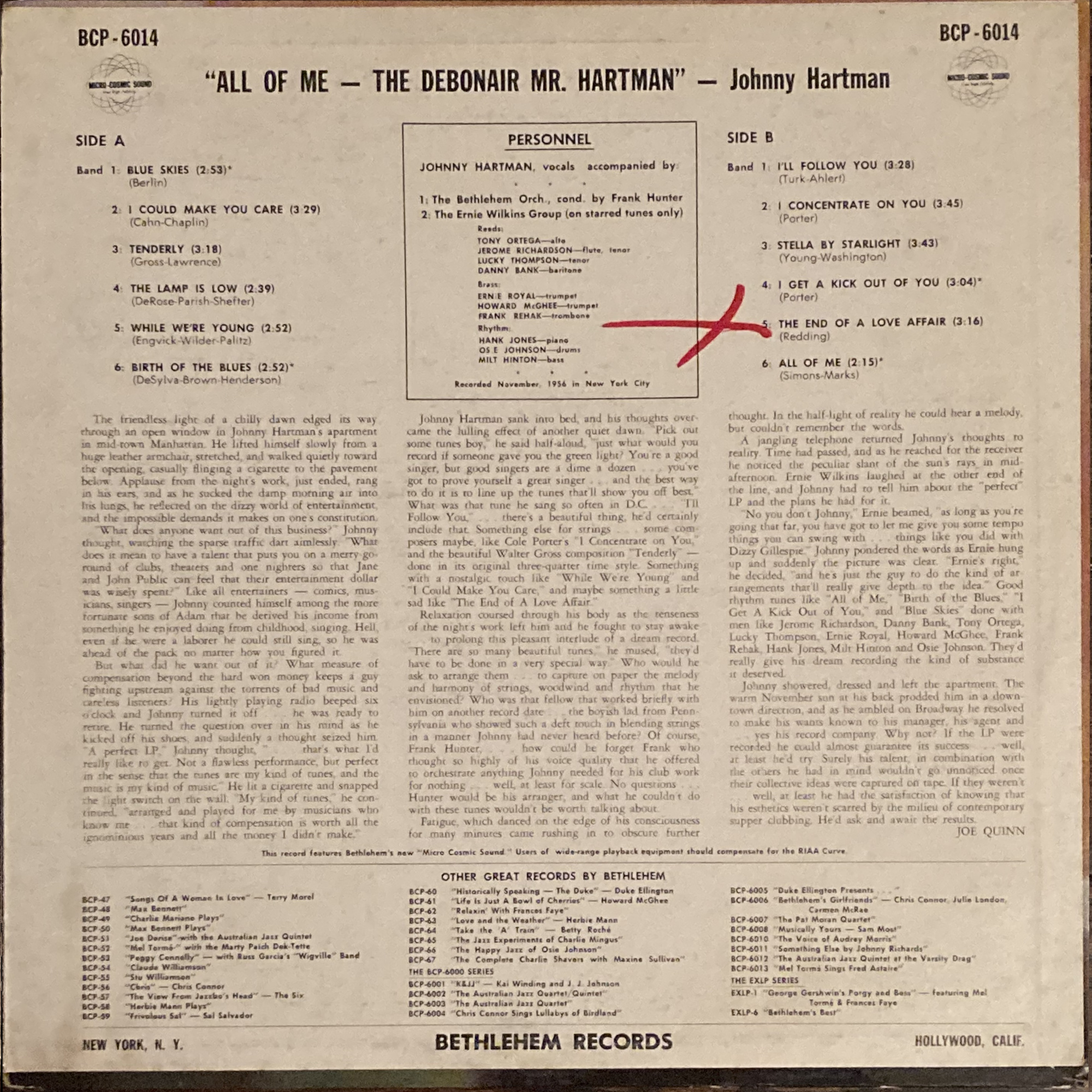
Personnel- Recorded 1956/11 side1-(1),(6), side2-(4),(6)
Drums: Osie Johnson
Bass: Milt Hinton
Piano: Hank Jones
Tenor Sax: Lucky Thompson
Tenor Sax, Flute: Jerome Richardson
Alto Sax: Tony Ortega
Baritone Sax: Danny Bank
Trumpet: Ernie Royal, Howard McGhee
Trombone: Frank Rehak
Vocals: Johnny Hartman
Personnel- Recorded 1956 side1-(2),(3),(4),(5) side2-(1),(2),(3),(5)
Vocals: Johnny Hartman
Conductor: Frank Hunter
The Bethlehem Orchestra
Tracks-
Side-A
1) Blue Skies 2’53”
2) I Could Make You Care 3’29”
3) Tenderly 3’18”
4) The Lamp is Low 2’39”
5) While We’re Young 2’52”
6) Birth of the Blues 2’52”
Side-B
1) I’ll Follow You 3’28”
2) I Concentrate on You 3’45”
3) Stella By Starlight 3’43”
4) I Get A Kick Out of You 3’04”
5) The End of a Love Affair 3’16”
6) All of Me 2’15”
<裏ジャケ原文>
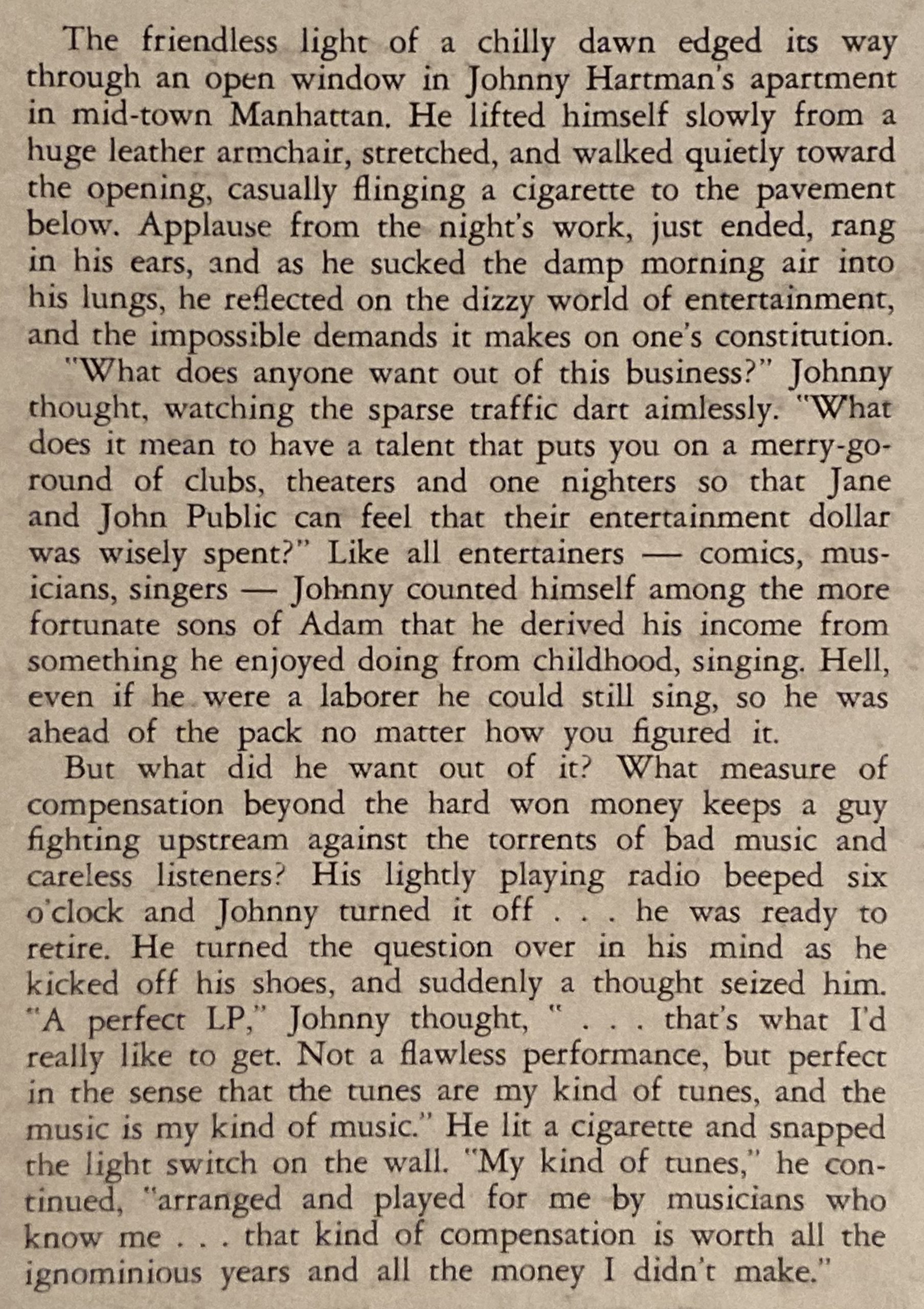
The friendless light of a chilly dawn edged its way through an open window in Johnny Hartman’s apartment in mid-town Manhattan. He lifted himself slowly from a huge leather armchair, stretched, and walked quietly toward the opening, casually flinging a cigarette to the pavement below. Applause from the night’s work, just ended, rang in his ears, and as he sucked the damp morning air into his lungs, he reflected on the dizzy world of entertainment, and the impossible demands it makes on one’s constitution.
“What does anyone want out of this business?” Johnny thought, watching the sparse traffic dart aimlessly. “What does it mean to have a talent that puts you on a merry-go- round of clubs, theaters and one nighters so that Jane and John Public can feel that their entertainment dollar was wisely spent?” Like all entertainers comics, mus- icians, singers – Johnny counted himself among the more fortunate sons of Adam that he derived his income from something he enjoyed doing from childhood, singing. Hell, even if he were a laborer he could still sing, so he was ahead of the pack no matter how you figured it.
But what did he want out of it? What measure of compensation beyond the hard won money keeps a guy fighting upstream against the torrents of bad music and careless listeners? His lightly playing radio beeped six o’clock and Johnny turned it off. . . he was ready to retire. He turned the question over in his mind as he kicked off his shoes, and suddenly a thought seized him. “A perfect LP,” Johnny thought, .. that’s what I’d really like to get. Not a flawless performance, but perfect in the sense that the tunes are my kind of tunes, and the music is my kind of music.” He lit a cigarette and snapped the light switch on the wall. “My kind of tunes,” he con- tinued, “arranged and played for me by musicians who know me that kind of compensation is worth all the ignominious years and all the money I didn’t make.”
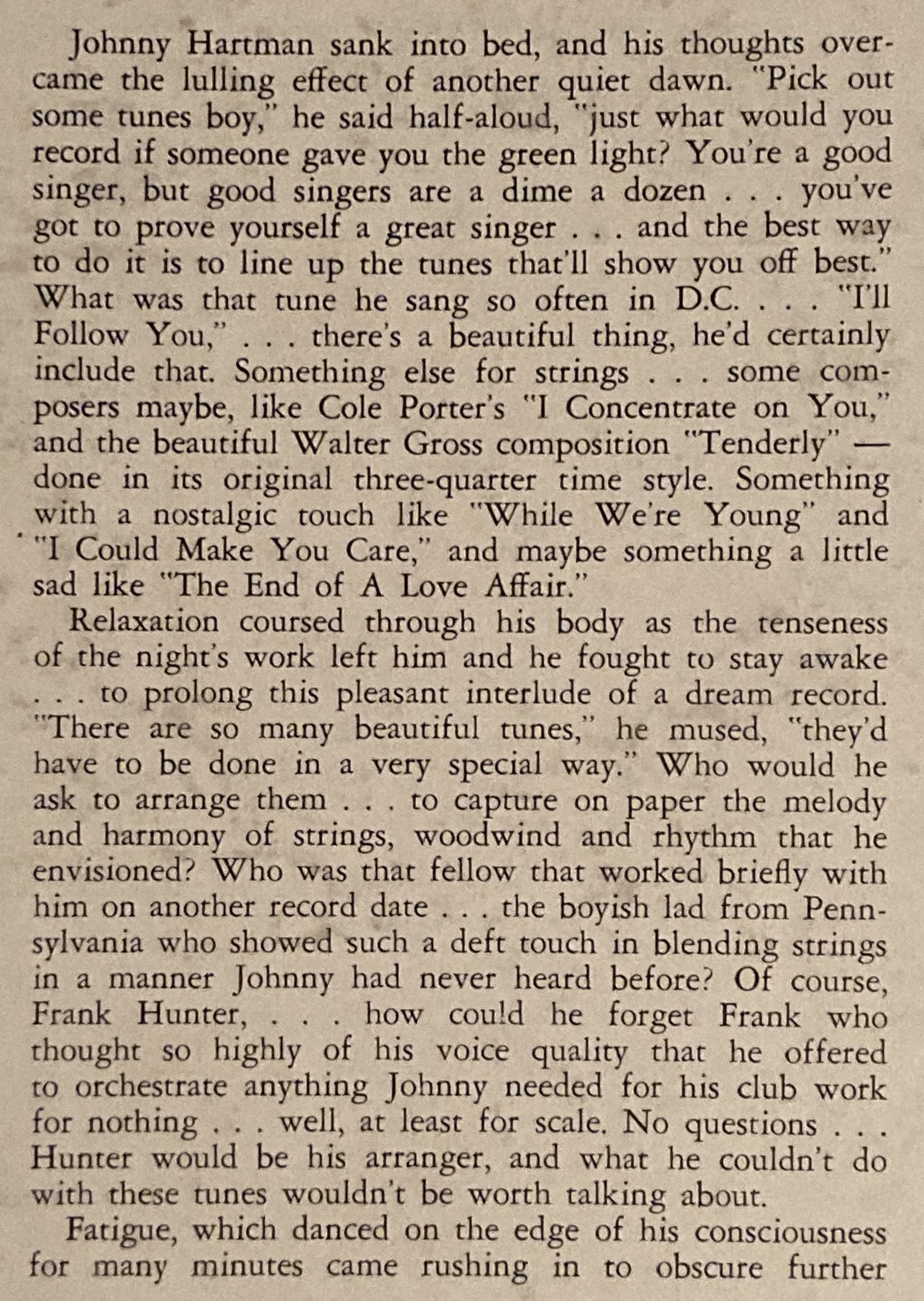
Johnny Hartman sank into bed, and his thoughts over- came the lulling effect of another quiet dawn. “Pick out some tunes boy,” he said half-aloud, “just what would you record if someone gave you the green light? You’re a good singer, but good singers are a dime a dozen . . . you’ve got to prove yourself a great singer . . . and the best way to do it is to line up the tunes that’ll show you off best.” What was that tune he sang so often in D.C. . . . “I’ll Follow You,” . . . there’s a beautiful thing, he’d certainly include that. Something else for strings some com- posers maybe, like Cole Porter’s “I Concentrate on You,” and the beautiful Walter Gross composition “Tenderly” – done in its original three-quarter time style. Something with a nostalgic touch like “While We’re Young” and “I Could Make You Care,” and maybe something a little sad like “The End of A Love Affair.”
Relaxation coursed through his body as the tenseness of the night’s work left him and he fought to stay awake
to prolong this pleasant interlude of a dream record. “There are so many beautiful tunes,” he mused, “they’d have to be done in a very special way.” Who would he ask to arrange them. . . to capture on paper the melody and harmony of strings, woodwind and rhythm that he envisioned? Who was that fellow that worked briefly with him on another record date… the boyish lad from Penn- sylvania who showed such a deft touch in blending strings. in a manner Johnny had never heard before? Of course, Frank Hunter, . . . how could he forget Frank who thought so highly of his voice quality that he offered to orchestrate anything Johnny needed for his club work for nothing… well, at least for scale. No questions… Hunter would be his arranger, and what he couldn’t do with these tunes wouldn’t be worth talking about.
Fatigue, which danced on the edge of his consciousness for many minutes came rushing in to obscure further thought. In the half-light of reality he could hear a melody, but couldn’t remember the words.
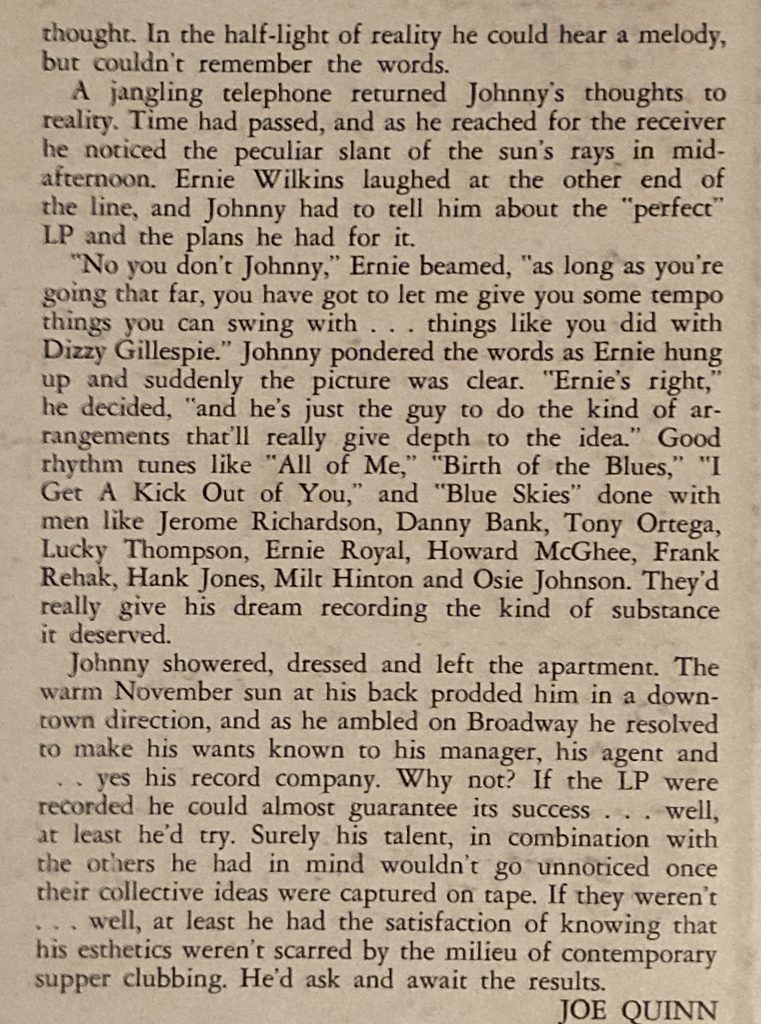
A jangling telephone returned Johnny’s thoughts to reality. Time had passed, and as he reached for the receiver he noticed the peculiar slant of the sun’s rays in mid- afternoon. Ernie Wilkins laughed at the other end of the line, and Johnny had to tell him about the “perfect” LP and the plans he had for it.
“No you don’t Johnny,” Ernie beamed, “as long as you’re going that far, you have got to let me give you some tempo things you can swing with … things like you did with Dizzy Gillespie.” Johnny pondered the words as Ernie hung up and suddenly the picture was clear. “Ernie’s right, he decided, “and he’s just the guy to do the kind of ar- rangements that’ll really give depth to the idea.” Good rhythm tunes like “All of Me,” “Birth of the Blues,” “I Get A Kick Out of You,” and “Blue Skies” done with men like Jerome Richardson, Danny Bank, Tony Ortega, Lucky Thompson, Ernie Royal, Howard McGhee, Frank Rehak, Hank Jones, Milt Hinton and Osie Johnson. They’d really give his dream recording the kind of substance it deserved.
Johnny showered, dressed and left the apartment. The warm November sun at his back prodded him in a down- town direction, and as he ambled on Broadway he resolved to make his wants known to his manager, his agent and .. yes his record company. Why not? If the LP were recorded he could almost guarantee its success . . . well, at least he’d try. Surely his talent, in combination with the others he had in mind wouldn’t go unnoticed once their collective ideas were captured on tape. If they weren’t
well, at least he had the satisfaction of knowing that his esthetics weren’t scarred by the milieu of contemporary supper clubbing. He’d ask and await the results.
JOE QUINN
<裏ジャケ和訳>
マンハッタン・ミッドタウンにあるジョニー・ハートマンのアパート。開け放たれた窓から、冷ややかな夜明けの光が、どこかよそよそしい様子で差し込んでいた。彼は大きな革張りのアームチェアからゆっくりと身を起こして背伸びをすると、音もなく窓辺へと歩み寄り、吸いかけのタバコを何気なく眼下の舗道へと放り投げた。つい先ほど終えたばかりの仕事の拍手喝采がまだ耳に残っていた。湿り気を帯びた朝の空気を肺いっぱいに吸い込みながら、彼はめまぐるしいショービジネスの世界と、そこで人間に強要される過酷な要求について思いを巡らせた。
「一体、誰もこの商売に何を求めているんだろう?」まばらな車が当て所なく行き交うのを眺めながら、ジョニーは考えた。「クラブや劇場、各地を転々とするワンナイト・ギグ(単発公演)といったメリーゴーランドのような日々を回らされる才能……それを持つことに、どんな意味があるというのか。一般の観客に『エンターテインメントに払った金は無駄じゃなかった』と思わせるために?」コメディアン、ミュージシャン、歌手といったあらゆるエンターテイナーと同様、ジョニーもまた、子供の頃から好きだった「歌うこと」で生計を立てているという点で、恵まれた人間の一人だと自覚していた。いや、たとえ肉体労働者だったとしても歌うことはできただろうから、どう考えても自分は人より有利な立場にいるはずだ。
だが、彼はこの仕事に何を求めていたのだろうか? 苦労して手にする報酬以外に、質の低い音楽や無関心な聴衆という激流に逆らって戦い続けさせるものは、一体何なのか? 小さな音で流れていたラジオが6時の時報を告げ、ジョニーはスイッチを切った……もう寝る時間だ。靴を脱ぎ捨てながらその問いを反芻していたとき、ふとある考えが彼の頭をよぎった。「完璧なLP(アルバム)」とジョニーは思った。「……それこそが、俺が本当に手に入れたいものなんだ」 「完璧な演奏とは言えないかもしれない。だが、曲は俺好みのものだし、音楽そのものも俺の肌に合う。そういう意味では完璧さ」。彼はタバコに火をつけ、壁のスイッチをカチリと入れた。「俺好みの曲を、俺をよく知るミュージシャンたちが俺のためにアレンジし、演奏してくれる。その喜びは、屈辱にまみれた歳月や、手に入れ損ねた金銭のすべてを埋め合わせて余りあるものだ」
ジョニー・ハートマンはベッドに身を沈めたが、静かな夜明けがもたらす安らぎも、彼の思考を止めることはできなかった。「曲を選んでみろよ」と、彼は独り言のように呟いた。「もしゴーサインが出たら、一体どんな曲をレコーディングする? お前はいい歌手だ。だが、いい歌手なんて掃いて捨てるほどいる……。偉大な歌手であることを証明しなきゃならないんだ……」 「……そして、そのための最善の方法は、自分の魅力を最大限に引き出してくれる曲を並べることだ」。D.C.(ワシントン)でよく歌っていたあの曲は何だったか……『アイル・フォロー・ユー(I’ll Follow You)』……あれは素晴らしい曲だ、間違いなくあれを入れるだろう。ストリングスを活かした曲も必要だ。例えばコール・ポーターの『アイ・コンセントレイト・オン・ユー(I Concentrate on You)』や、ウォルター・グロスの美しい名曲『テンダリー(Tenderly)』――これはオリジナルの3拍子のスタイルでやるのがいい。『ホワイル・ウィー・アー・ヤング(While We’re Young)』や『アイ・クッド・メイク・ユー・ケア(I Could Make You Care)』のようなノスタルジックな雰囲気の曲もいいし、少し切ない『ジ・エンド・オブ・ア・ラヴ・アフェア(The End of A Love Affair)』なんかもいいかもしれない。
夜の仕事の緊張が解け、心地よいリラックスした気分が体に広がっていく。彼は、夢のようなレコード制作というこの楽しいひとときを少しでも長く味わおうと、眠気に抗っていた。「美しい曲は山ほどある」と彼は思いを巡らせる。「それらをやるなら、特別なやり方でなければならない」。誰にアレンジを頼もうか……彼が頭の中で描いているストリングス、木管楽器、そしてリズム・セクションのメロディとハーモニーを、譜面に書き起こしてもらうために。以前、別のレコーディングで少しだけ一緒に仕事をしたあの男は誰だったか……ペンシルベニア出身の、少年の面影を残したあの若者だ。ストリングスのブレンドにおいて、ジョニーがそれまで聴いたこともないような見事な手腕を見せてくれた……。そう、フランク・ハンターだ。フランクのことを忘れるはずがない。彼はジョニーの歌声を高く評価し、クラブでの仕事に必要なアレンジなら何でも無償で――いや、少なくとも最低賃金(スケール)だけで――引き受けると言ってくれた男なのだから。迷うことはない。ハンターこそがアレンジャーだ。彼がこれらの曲をどう料理するか、それこそが何よりも重要なことなのだ。
長い間、意識の縁(ふち)を漂っていた疲労感が、不意に押し寄せてきて、それ以上の思考を遮った。現実の薄明かりの中で、あるメロディが聞こえてくるが、どうしても歌詞が思い出せない。
電話のけたたましい音が、ジョニーの意識を現実に引き戻した。いつの間にか時は過ぎ、受話器に手を伸ばした彼は、真昼の太陽の光が独特の角度で差し込んでいることに気づいた。電話の向こうでアーニー・ウィルキンスが笑い声を上げ、ジョニーは彼に、あの「完璧な」LPのことや、それに対する構想を話さなければならなくなった。
「いや、ジョニー」とアーニーは満面の笑みで言った。「そこまでやるなら、スウィングできるテンポの曲をいくつか俺に提供させてくれよ……ディジー・ガレスピーとやった時みたいなやつをさ」。アーニーが電話を切った後もジョニーはその言葉を反芻し、やがて不意に、すべてがはっきりと見えてきた。 「アーニーの言う通りだ」と彼は思った。「あのアイデアに真の深みを与えてくれるようなアレンジを任せるなら、彼こそ適任だ」。ジェローム・リチャードソン、ダニー・バンク、トニー・オルテガ、ラッキー・トンプソン、アーニー・ロイヤル、ハワード・マギー、フランク・リハック、ハンク・ジョーンズ、ミルト・ヒントン、オージー・ジョンソンといった面々と共に、「オール・オブ・ミー」、「バース・オブ・ザ・ブルース」、「アイ・ゲット・ア・キック・アウト・オブ・ユー」、「ブルー・スカイズ」といった良質なリズム・ナンバーを演奏する――彼らなら、自身の夢であるそのレコーディングに、それにふさわしい実体と重みを与えてくれるはずだった。
ジョニーはシャワーを浴び、身支度を整えてアパートを出た。背中に感じる11月の暖かい日差しに促されるようにダウンタウン方面へ向かい、ブロードウェイをぶらりと歩きながら、彼は自分の望みをマネージャーやエージェント、そして……そう、レコード会社にもはっきりと伝えようと決心した。やってみる価値はあるはずだ。もしそのLPを録音できれば、成功はほぼ間違いない……いや、少なくとも挑戦はしてみよう。彼自身の才能と、彼が思い描いている他のミュージシャンたちの力が結集し、そのアイデアがテープに収められれば、誰の目にも留まるに違いない。たとえそうでなかったとしても――少なくとも、現代のサパークラブという環境に染まることなく、自身の美学を汚さずにいられたという満足感は残るだろう。彼は提案し、その結果を待つことにした。
ジョー・クイン
※訳文の制作にはGoogleドライブとGoogle翻訳のお世話になりました。


コメント