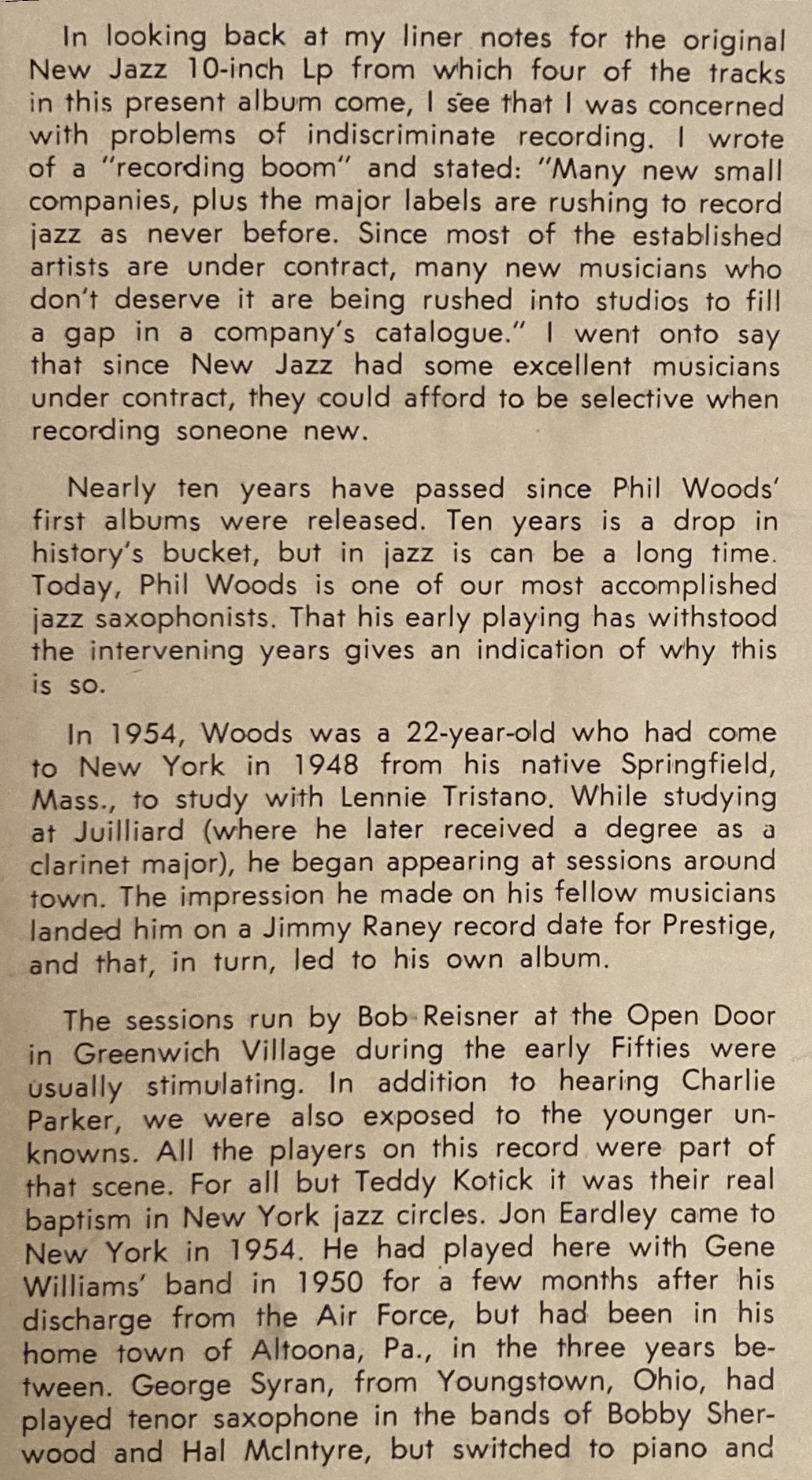
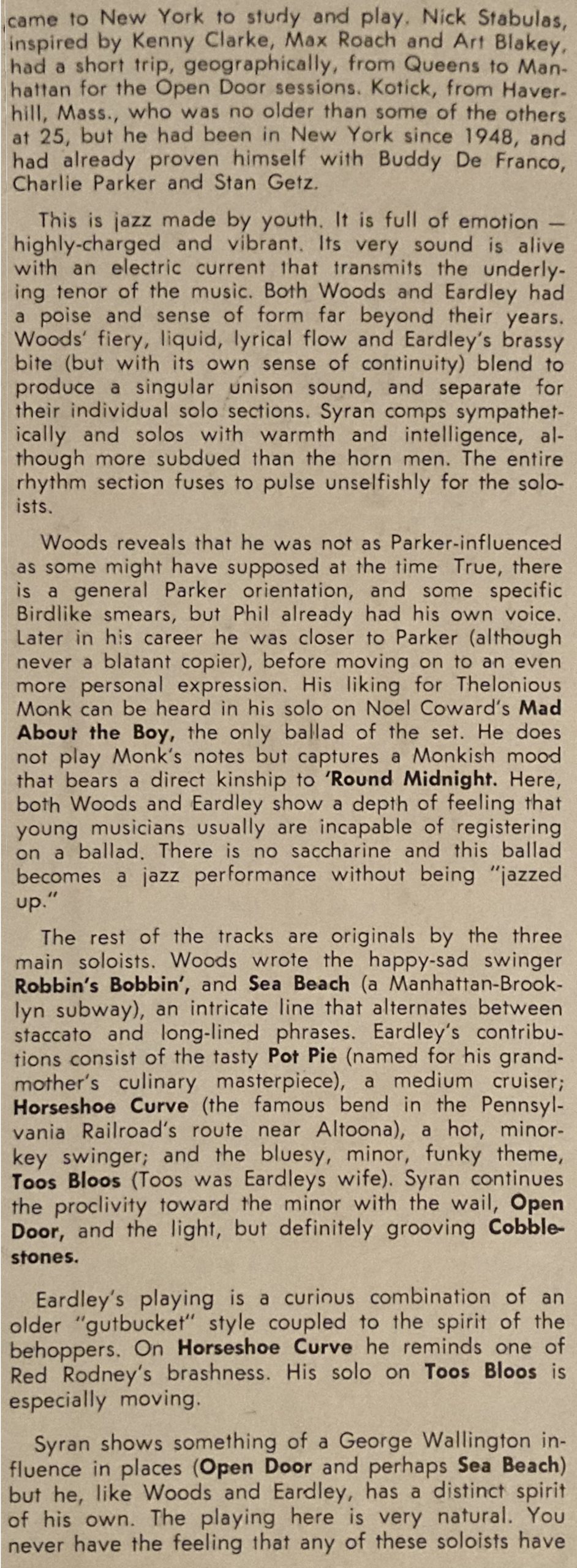
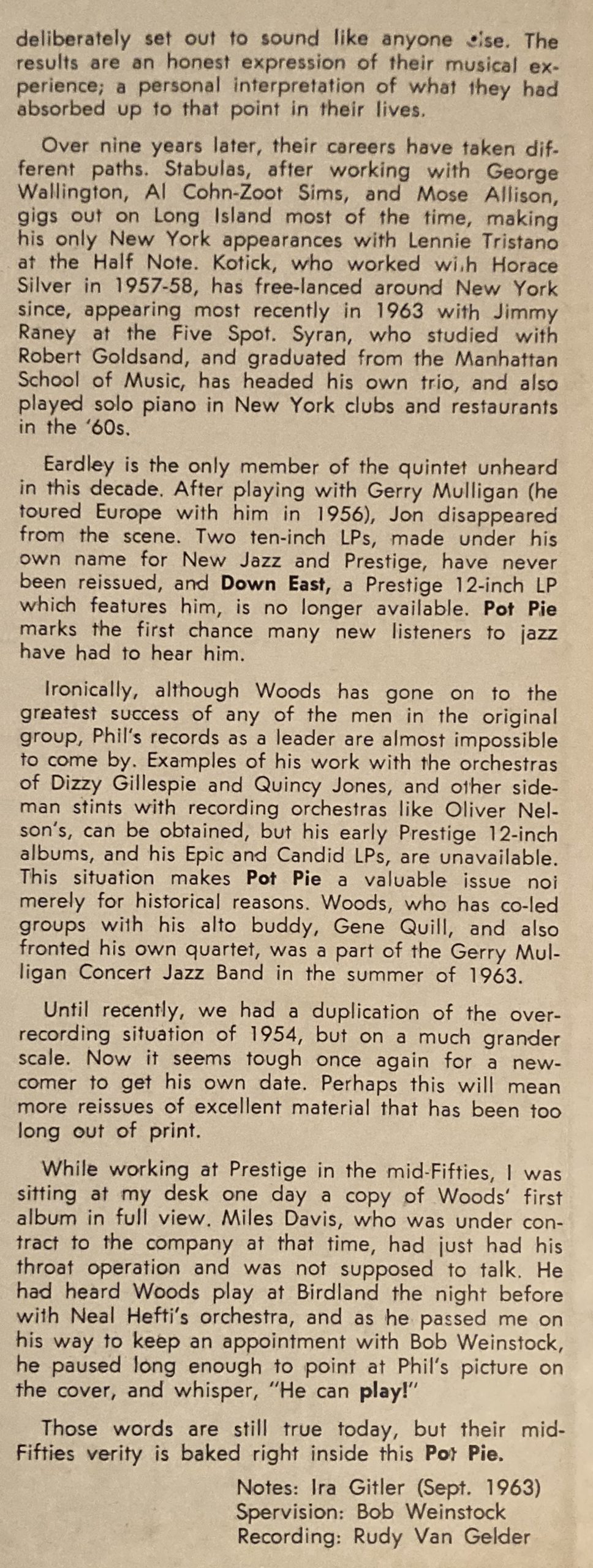
Label: NEW JAZZ
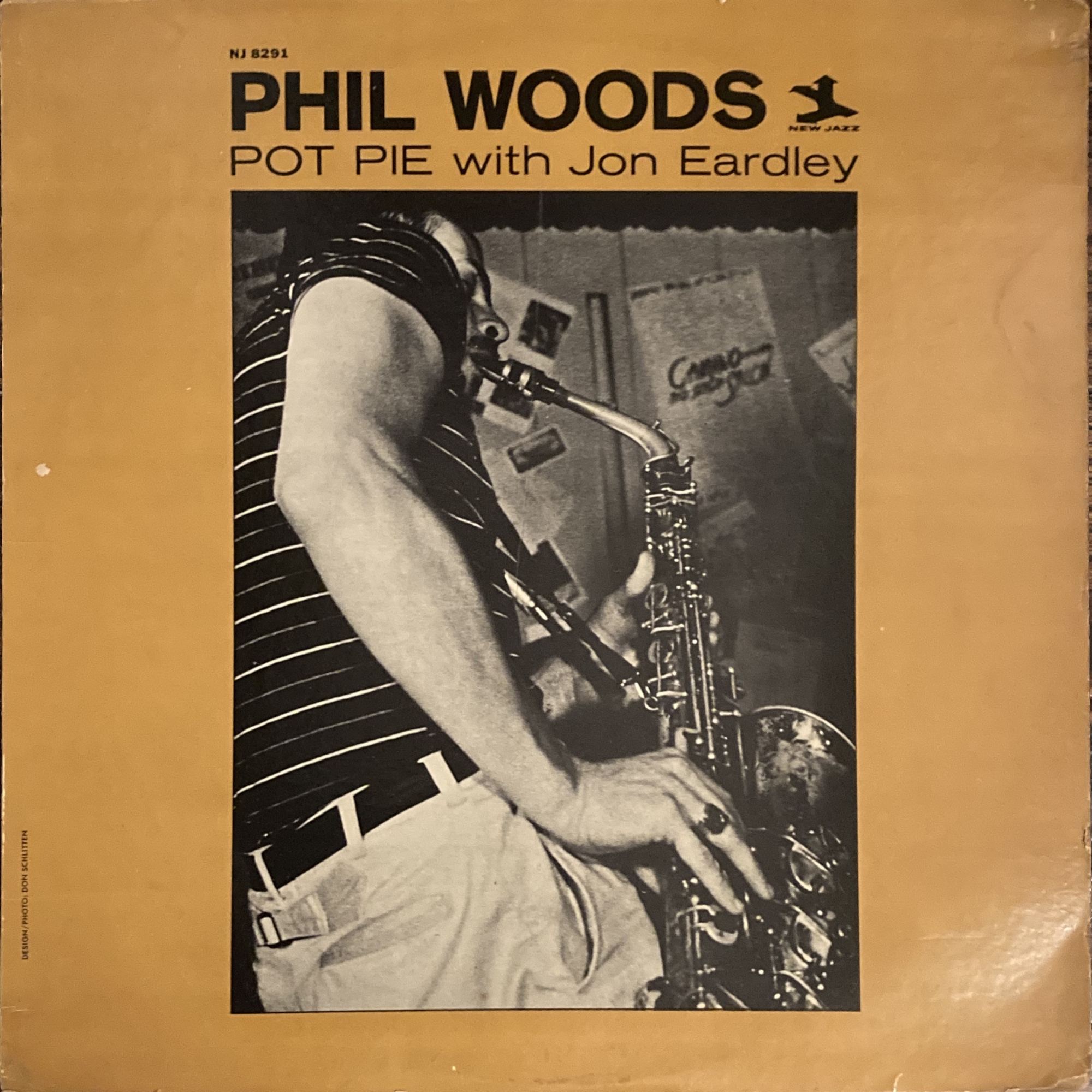
No.: NJLP-8291
Title: POT PIE WITH JON EARDLEY
Musician: PHIL WOODS
Recorded: 1954/10/12 Side-A, 1955/2/4 Side-B
Monaural
Cover address: 203 SO. WASHINGTON AVE. BERGENIFIELD N.J.
Coating
Groove Guard
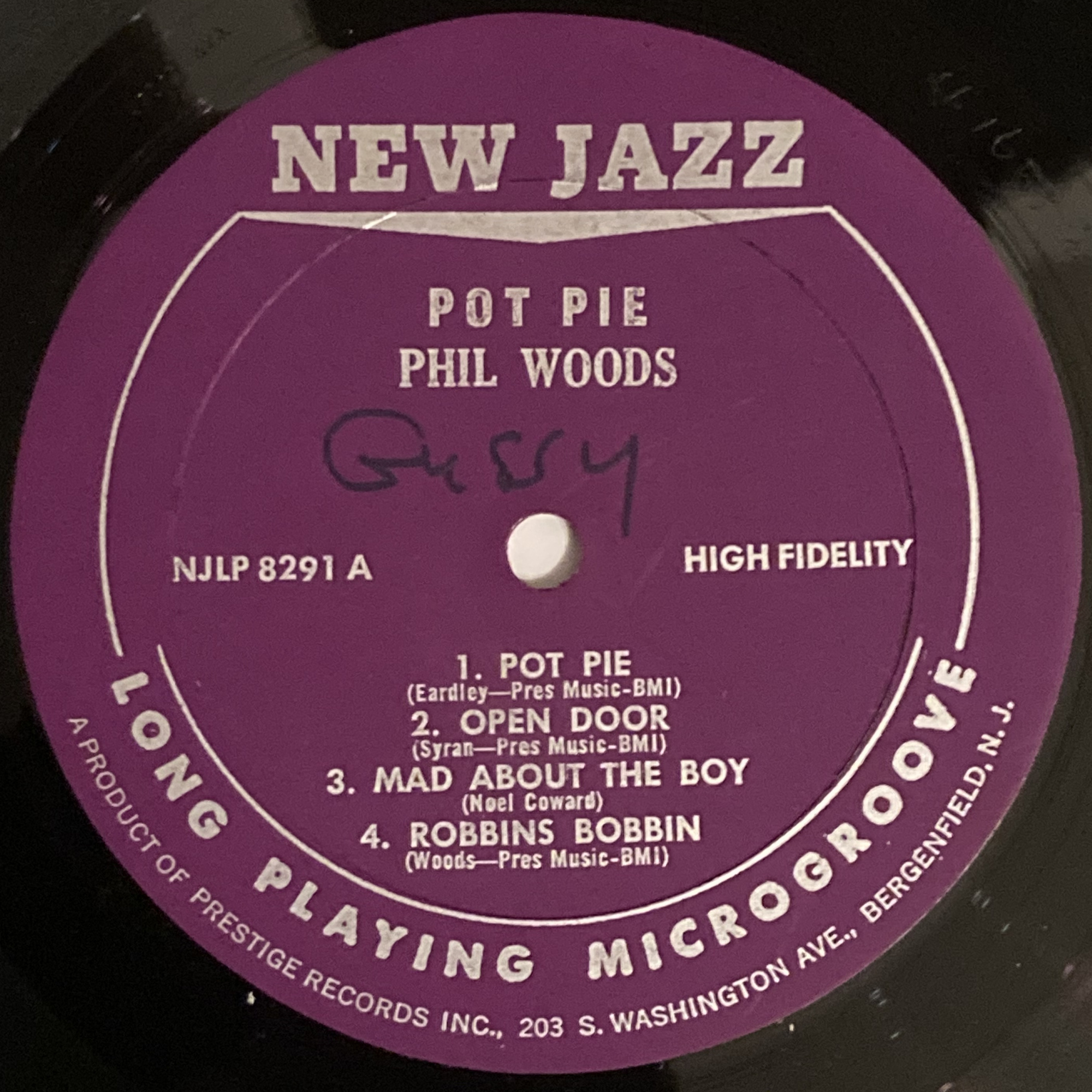
Label Side-A
Purple Background
Silver Letter
Address: 203 S. WASHINGTON AVE. BERGENIFIELD N.J.
Deep Groove無し
Dead Wax Info:VANGELDERスタンプ, NJLP-8291A
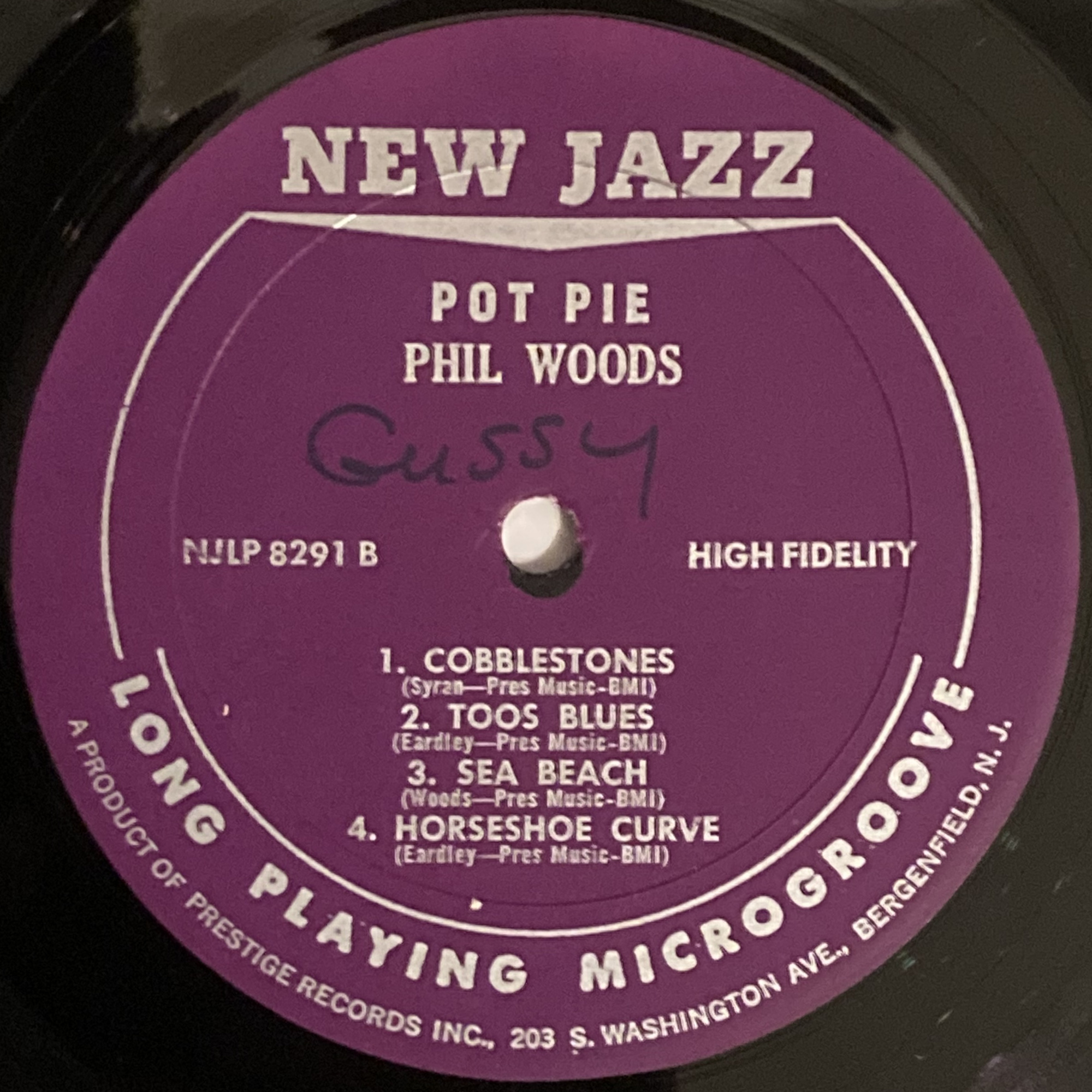
Label Side-B
Purple Background
Silver Letter
Address: 203 S. WASHINGTON AVE. BERGENIFIELD N.J.
Deep Groove無し
Dead Wax Info:VANGELDERスタンプ, NJLP-8291B
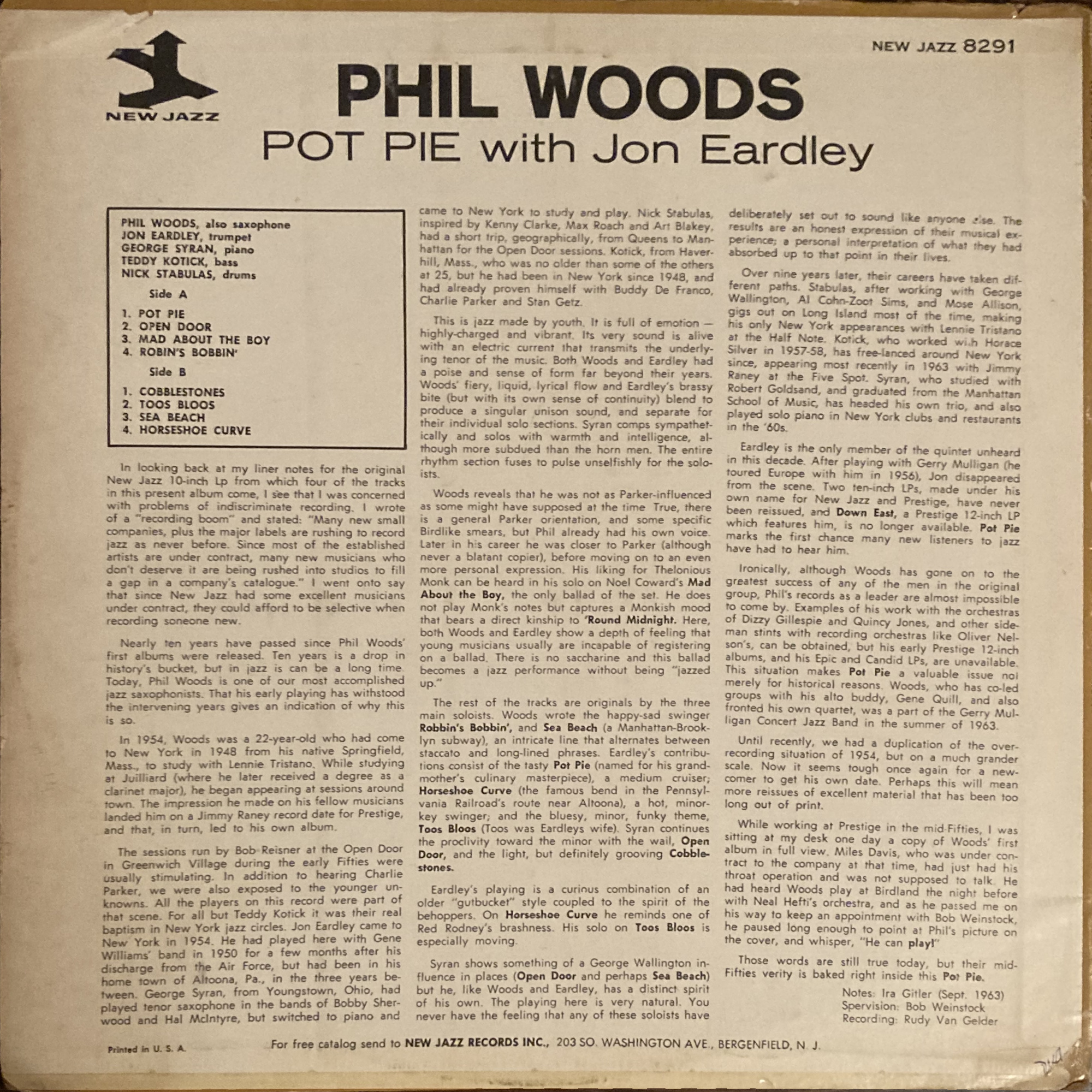
Personnel-
Drums: Nick Stabulas
Bass: Teddy Kotick
Piano: George Syran
Alto Sax: Phil Woods
Trumpet: Jon Eardley
Tracks-
Side-A
1) Pot Pie
2) Open Door
3) Mad About the Boy
4) Robin’s Bobbin’
Side-B
1) Cobblestones
2) Toos Bloos
3) Sea Beach
4) Horseshoe Curve
<裏ジャケ原文>
In looking back at my liner notes for the original New Jazz 10-inch Lp from which four of the tracks in this present album come, I see that I was concerned with problems of indiscriminate recording. I wrote of a “recording boom” and stated: “Many new small companies, plus the major labels are rushing to record jazz as never before. Since most of the established artists are under contract, many new musicians who don’t deserve it are being rushed into studios to fill a gap in a company’s catalogue.” I went onto say that since New Jazz had some excellent musicians under contract, they could afford to be selective when recording soneone new.
Nearly ten years have passed since Phil Woods’ first albums were released. Ten years is a drop in history’s bucket, but in jazz is can be a long time. Today, Phil Woods is one of our most accomplished jazz saxophonists. That his early playing has withstood the intervening years gives an indication of why this is so.
In 1954, Woods was a 22-year-old who had come to New York in 1948 from his native Springfield, Mass., to study with Lennie Tristano. While studying at Juilliard (where he later received a degree as a clarinet major), he began appearing at sessions around town. The impression he made on his fellow musicians landed him on a Jimmy Raney record date for Prestige, and that, in turn, led to his own album.
The sessions run by Bob Reisner at the Open Door in Greenwich Village during the early Fifties were Usually stimulating. In addition to hearing Charlie Parker, we were also exposed to the younger un- knowns. All the players on this record were part of that scene. For all but Teddy Kotick it was their real baptism in New York jazz circles. Jon Eardley came to New York in 1954. He had played here with Gene Williams’ band in 1950 for a few months after his discharge from the Air Force, but had been in his home town of Altoona, Pa., in the three years be- tween. George Syran, from Youngstown, Ohio, had played tenor saxophone in the bands of Bobby Sher- wood and Hal McIntyre, but switched to piano and came to New York to study and play. Nick Stabulas, inspired by Kenny Clarke, Max Roach and Art Blakey, had a short trip, geographically, from Queens to Man- hattan for the Open Door sessions. Kotick, from Haver- hill, Mass., who was no older than some of the others at 25, but he had been in New York since 1948, and had already proven himself with Buddy De Franco, Charlie Parker and Stan Getz.
This is jazz made by youth. It is full of emotion highly-charged and vibrant. Its very sound is alive with an electric current that transmits the underly- ing tenor of the music. Both Woods and Eardley had a poise and sense of form far beyond their years. Woods’ fiery, liquid, lyrical flow and Eardley’s brassy bite (but with its own sense of continuity) blend to produce a singular unison sound, and separate for their individual solo sections. Syran comps sympathet- ically and solos with warmth and intelligence, al- though more subdued than the horn men. The entire rhythm section fuses to pulse unselfishly for the solo- ists.
Woods reveals that he was not as Parker-influenced as some might have supposed at the time True, there is a general Parker orientation, and some specific Birdlike smears, but Phil already had his own voice. Later in his career he was closer to Parker (although never a blatant copier), before moving on to an even more personal expression. His liking for Thelonious Monk can be heard in his solo on Noel Coward’s Mad About the Boy, the only ballad of the set. He does not play Monk’s notes but captures a Monkish mood that bears a direct kinship to ‘Round Midnight. Here, both Woods and Eardley show a depth of feeling that young musicians usually are incapable of registering on a ballad. There is no saccharine and this ballad becomes a jazz performance without being “jazzed up.”
The rest of the tracks are originals by the three main soloists. Woods wrote the happy-sad swinger Robbin’s Bobbin’, and Sea Beach (a Manhattan-Brook- lyn subway), an intricate line that alternates between staccato and long-lined phrases. Eardley’s contribu- tions consist of the tasty Pot Pie (named for his grand- mother’s culinary masterpiece), a medium cruiser; Horseshoe Curve (the famous bend in the Pennsyl- vania Railroad’s route near Altoona), a hot, minor- key swinger; and the bluesy, minor, funky theme, Toos Bloos (Toos was Eardleys wife). Syran continues the proclivity toward the minor with the wail, Open Door, and the light, but definitely grooving Cobble-
stones.
Eardley’s playing is a curious combination of an older “gutbucket” style coupled to the spirit of the behoppers. On Horseshoe Curve he reminds one of Red Rodney’s brashness. His solo on Toos Bloos is especially moving.
Syran shows something of a George Wallington in- fluence in places (Open Door and perhaps Sea Beach) but he, like Woods and Eardley, has a distinct spirit of his own. The playing here is very natural. You never have the feeling that any of these soloists have deliberately set out to sound like anyone cise. The results are an honest expression of their musical ex- perience; a personal interpretation of what they had absorbed up to that point in their lives.
Over nine years later, their careers have taken dif- ferent paths. Stabulas, after working with George Wallington, Al Cohn-Zoot Sims, and Mose Allison, gigs out on Long Island most of the time, making his only New York appearances with Lennie Tristano at the Half Note. Kotick, who worked with Horace Silver in 1957-58, has free-lanced around New York since, appearing most recently in 1963 with Jimmy Raney at the Five Spot. Syran, who studied with Robert Goldsand, and graduated from the Manhattan School of Music, has headed his own trio, and also played solo piano in New York clubs and restaurants in the ’60s.
Eardley is the only member of the quintet unheard in this decade. After playing with Gerry Mulligan (he toured Europe with him in 1956), Jon disappeared from the scene. Two ten-inch LPs, made under his own name for New Jazz and Prestige, have never been reissued, and Down East, a Prestige 12-inch LP which features him, is no longer available. Pot Pie marks the first chance many new listeners to jazz have had to hear him.
Ironically, although Woods has gone on to the greatest success of any of the men in the original group, Phil’s records as a leader are almost impossible to come by. Examples of his work with the orchestras of Dizzy Gillespie and Quincy Jones, and other side- man stints with recording orchestras like Oliver Nel- son’s, can be obtained, but his early Prestige 12-inch albums, and his Epic and Candid LPs, are unavailable. This situation makes Pot Pie a valuable issue noi merely for historical reasons. Woods, who has co-led groups with his alto buddy, Gene Quill, and also fronted his own quartet, was a part of the Gerry Mul- ligan Concert Jazz Band in the summer of 1963.
Until recently, we had a duplication of the over- recording situation of 1954, but on a much grander scale. Now it seems tough once again for a new- comer to get his own date. Perhaps this will mean more reissues of excellent material that has been too long out of print.
While working at Prestige in the mid-Fifties, I was sitting at my desk one day a copy of Woods’ first album in full view. Miles Davis, who was under con- tract to the company at that time, had just had his throat operation and was not supposed to talk. He had heard Woods play at Birdland the night before with Neal Hefti’s orchestra, and as he passed me on his way to keep an appointment with Bob Weinstock, he paused long enough to point at Phil’s picture on the cover, and whisper, “He can play!”
Those words are still true today, but their mid- Fifties verity is baked right inside this Pot Pie.
Notes: Ira Gitler (Sept. 1963)
Spervision: Bob Weinstock Recording: Rudy Van Gelder
<裏ジャケ和訳>
本アルバムに収録されている4曲の出典元である、ニュー・ジャズ(New Jazz)レーベルのオリジナル10インチLP。そのライナーノーツを読み返してみると、当時、私は無節操なレコーディングの横行という問題に懸念を抱いていたことがわかる。私は「レコーディング・ブーム」について触れ、次のように記した。「多くの新しい小規模レーベルやメジャー・レーベルが、かつてないほどの勢いでジャズの録音に殺到している。著名なアーティストのほとんどはすでにどこかと契約を結んでいるため、本来なら録音の機会を得るべきではないような新人ミュージシャンたちが、レーベルのカタログの穴埋めとして、急遽スタジオに送り込まれているのだ」。さらに私は、ニュー・ジャズ・レーベルには優れたミュージシャンが契約下にいたため、新しいアーティストを起用する際にも、慎重に選別を行う余裕があったと付け加えた。
フィル・ウッズの最初のアルバムがリリースされてから、10年近くが経過した。歴史という長い時間の流れから見れば10年はほんの一瞬に過ぎないが、ジャズの世界においては、それは非常に長い期間となり得る。今日、フィル・ウッズは、最も卓越したジャズ・サックス奏者の一人となっている。彼の初期の演奏が、長い年月を経てもなお色褪せていないという事実は、彼がなぜこれほどまでに評価されるに至ったのかを物語っている。
1954年当時、ウッズは22歳だった。彼はマサチューセッツ州スプリングフィールドの出身で、レニー・トリスターノに師事するために1948年にニューヨークへやってきた。ジュリアード音楽院で学びながら(後にクラリネット専攻で学位を取得)、彼は街中のセッションに参加し始めた。共演したミュージシャンたちに強い印象を与えたことで、彼はプレスティッジ・レーベルのジミー・レイニーのレコーディングに参加する機会を得、それがきっかけとなって、彼自身のリーダー・アルバム制作へとつながったのである。
1950年代初頭、グリニッジ・ヴィレッジの「オープン・ドア(Open Door)」でボブ・ライズナーが主催していたセッションは、常に刺激に満ちていた。そこではチャーリー・パーカーの演奏を聴けるだけでなく、まだ無名の若い才能たちに触れることもできた。本作に参加しているミュージシャンたちは皆、そうしたシーンの一部であった。テディ・コティックを除けば、彼らにとって、これがニューヨークのジャズ・シーンにおける本格的な「洗礼」の場となったのである。ジョン・アードリーは1954年にニューヨークへやってきた。彼は空軍を除隊した後の1950年にも、ジーン・ウィリアムズのバンドで数ヶ月間ニューヨークで演奏した経験があるが、その間の3年間は故郷であるペンシルベニア州アルトゥーナで過ごしていた。オハイオ州ヤングスタウン出身のジョージ・サイランは、ボビー・シャーウッドやハル・マッキンタイアのバンドでテナー・サックスを吹いていたが、その後ピアノに転向し、学びと演奏の場を求めてニューヨークへ移ってきた。ケニー・クラーク、マックス・ローチ、アート・ブレイキーに触発されたニック・スタブラスは、クイーンズからマンハッタンへと(地理的には短い距離だが)移動し、「オープン・ドア」でのセッションに参加した。マサチューセッツ州ヘイバーヒル出身のコティックは、他のメンバーと同年代の25歳であったが、1948年からニューヨークで活動しており、すでにバディ・デ・フランコ、チャーリー・パーカー、スタン・ゲッツらとの共演を通じて、その実力を証明済みであった。
本作は、若者たちによって生み出されたジャズである。そこには、非常に感情豊かで、躍動感あふれるエネルギーが満ちている。そのサウンド自体が、音楽の根底にある精神を伝える電流のように、生き生きと脈打っているのだ。ウッズとアードリーは二人とも、若年ながらも非常に落ち着いており、楽曲の構成を捉える感覚に優れていた。ウッズの情熱的で流麗、かつ叙情的なフレージングと、アードリーの(独自の連続性を保ちつつも)鋭く突き刺さるようなトーンが融合し、ユニゾンでは唯一無二の響きを生み出している。一方で、ソロ・パートではそれぞれが個性を発揮している。サイランの伴奏は共感に満ちており、ソロにおいても温かさと知性を感じさせる。ホーン奏者たちに比べると控えめではあるが、リズム・セクション全体が一体となって、ソリストのために献身的なパルスを刻んでいる。
ウッズの演奏を聴くと、当時多くの人が想像したほど、彼がチャーリー・パーカーの影響を強く受けていたわけではないことがわかる。確かに、全体としてパーカー的な方向性は感じられ、「バード(パーカーの愛称)」特有の装飾的なスラー(スミア)も散見されるが、フィル・ウッズはすでに彼自身の「声」を持っていた。キャリアの後半にはパーカーにさらに接近した時期もあった(とはいえ、単なる模倣に留まることは決してなかった)。その後、彼はさらに独自の表現を追求するに至る。セッション唯一のバラードであるノエル・カワード作「マッド・アバウト・ザ・ボーイ」でのソロには、彼がセロニアス・モンクを好んでいたことがうかがえる。彼はセロニアス・モンクの音符をそのままなぞるのではなく、『ラウンド・ミッドナイト』と直接的な親縁性を感じさせるような、モンク特有のムードを見事に捉えている。ここでは、ウッズとアードリーの双方が、若いミュージシャンには通常表現し得ないような、バラードにおける深い感情の機微を提示している。甘ったるさは一切なく、このバラードは、わざとらしく「ジャズっぽく」装うことなしに、真のジャズ・パフォーマンスとして成立している。
その他のトラックは、主要なソリスト3人によるオリジナル曲で構成されている。ウッズは、どこか悲哀を帯びた陽気なスウィング・ナンバー『ロビンズ・ボビン(Robbin’s Bobbin’)』と、スタッカートと長いフレーズが交互に現れる複雑な旋律を持つ『シー・ビーチ(Sea Beach)』(マンハッタンとブルックリンを結ぶ地下鉄に由来)を書き下ろした。アードリーは、祖母の得意料理にちなんで名付けられた味わい深いミディアム・テンポの『ポット・パイ(Pot Pie)』、ペンシルベニア鉄道のアルトゥーナ近郊にある有名なカーブにちなんだ、熱気あふれるマイナー・キーのスウィング曲『ホースシュー・カーブ(Horseshoe Curve)』、そしてブルージーでファンキーなマイナー調のテーマ『トゥース・ブルース(Toos Bloos)』(「トゥース」はアードリーの妻の愛称)を提供している。サイランもまたマイナー・キーの傾向を引き継ぎ、情熱的な『オープン・ドア(Open Door)』や、軽快でありながらもしっかりとグルーヴする『コブルストーンズ(Cobblestones)』といった楽曲を披露している。
アードリーの演奏は、古き良き「ガットバケット(泥臭く力強い)」スタイルと、ビバップの精神が奇妙なほど見事に融合したものだ。『ホースシュー・カーブ(Horseshoe Curve)』での演奏には、レッド・ロドニーを彷彿とさせる大胆さが感じられる。『トゥース・ブルース(Toos Bloos)』でのソロは、とりわけ感動的だ。
サイランの演奏には、随所にジョージ・ウォリントンからの影響がうかがえる(『オープン・ドア(Open Door)』や、おそらく『シー・ビーチ(Sea Beach)』などがそうだ)。しかし彼も、ウッズやアードリーと同様、独自の精神をしっかりと持っている。ここでの演奏は極めて自然体だ。ソロイストたちが、意図的に誰か他のミュージシャンに似せようとしているような印象は微塵もない。彼らの演奏は、自身の音楽的経験を誠実に表現したものであり、それまでの人生で吸収してきたものを、彼らなりに解釈した結果なのである。
それから9年以上が経過し、彼らのキャリアはそれぞれ異なる道を歩むこととなった。スタブラスは、ジョージ・ウォリントン、アル・コーン=ズート・シムズ、モーズ・アリソンらとの共演を経て、主にロングアイランドで活動するようになった。ニューヨークでの演奏は、ハーフ・ノートにおけるレニー・トリスターノとの共演に限られている。コティックは1957年から1958年にかけてホレス・シルバーと活動し、その後はニューヨーク周辺でフリーランスとして活躍。1963年にはファイブ・スポットでジミー・レイニーと共演した。サイランはロバート・ゴールドサンドに師事し、マンハッタン音楽院を卒業。自身のトリオを率いたほか、60年代にはニューヨークのクラブやレストランでソロ・ピアノを演奏した。
このクインテットのメンバーの中で、この10年間(60年代)にその音を耳にする機会が全くなかったのはアードリーだけである。ジェリー・マリガンと共演し(1956年にはマリガンと共にヨーロッパ・ツアーも行った)、その後、ジョン・アードリーはシーンから姿を消してしまった。彼名義で「ニュー・ジャズ」や「プレスティッジ」からリリースされた2枚の10インチLPは一度も再発されておらず、彼が参加したプレスティッジの12インチLP『ダウン・イースト(Down East)』も、現在では入手不可能となっている。『ポット・パイ(Pot Pie)』は、ジャズを聴き始めたばかりの多くのリスナーにとって、彼の演奏に触れる初めての機会となるだろう。皮肉なことに、当時のグループのメンバーの中でウッズは最も大きな成功を収めた人物であるにもかかわらず、彼がリーダーを務めた作品のレコードを入手することは極めて困難だ。ディジー・ガレスピーやクインシー・ジョーンズのオーケストラでの演奏や、オリバー・ネルソン率いるレコーディング・オーケストラ等でのサイドマンとしての仕事は今でも手に入るが、プレスティッジからリリースされた初期の12インチ・アルバムや、エピック、キャンディッドといったレーベルからのLPは、現在では入手不可能となっている。こうした状況を考えると、『ポット・パイ(Pot Pie)』という作品は、単に歴史的な資料価値があるというだけでなく、非常に貴重な一枚と言える。ウッズは、同じアルト・サックス奏者のジーン・クイルと共同でグループを率いたり、自身のカルテットを主宰したりしたほか、1963年の夏にはジェリー・マリガン・コンサート・ジャズ・バンドにも参加していた。
つい最近まで、1954年当時のような「過剰なレコーディング」の状況が、より大規模な形で繰り返されていた。しかし現在では、新人ミュージシャンが自身のリーダー作をレコーディングする機会を得ることは、再び困難になっているようだ。もしかすると、長らく廃盤のままになっていた優れた作品の数々が、今後さらに再発されることになるのかもしれない。
1950年代半ば、私がプレスティッジ社で働いていたある日のこと。デスクにウッズのファースト・アルバムが置かれていた。当時同社と契約していたマイルス・デイヴィスは、喉の手術を受けたばかりで、本来は声を出すことを禁じられていた。彼は前夜、バードランドでニール・ヘフティのオーケストラと共に演奏するウッズを聴いていた。ボブ・ヴァインストックとの約束に向かう途中、私の前を通りかかったマイルスは、ふと足を止めると、ジャケットに写るウッズを指差し、こう囁いた。「こいつは吹けるぞ!」
その言葉は今日でも真実だが、1950年代半ばにおけるその「真実」が、この『ポット・パイ』という作品にはしっかりと刻み込まれている。
ライナーノーツ:アイラ・ギトラー(1963年9月)
スーパーバイザー:ボブ・ヴァインストック 録音:ルディ・ヴァン・ゲルダー
※訳文の制作にはGoogleドライブとGoogle翻訳のお世話になりました。
コメント