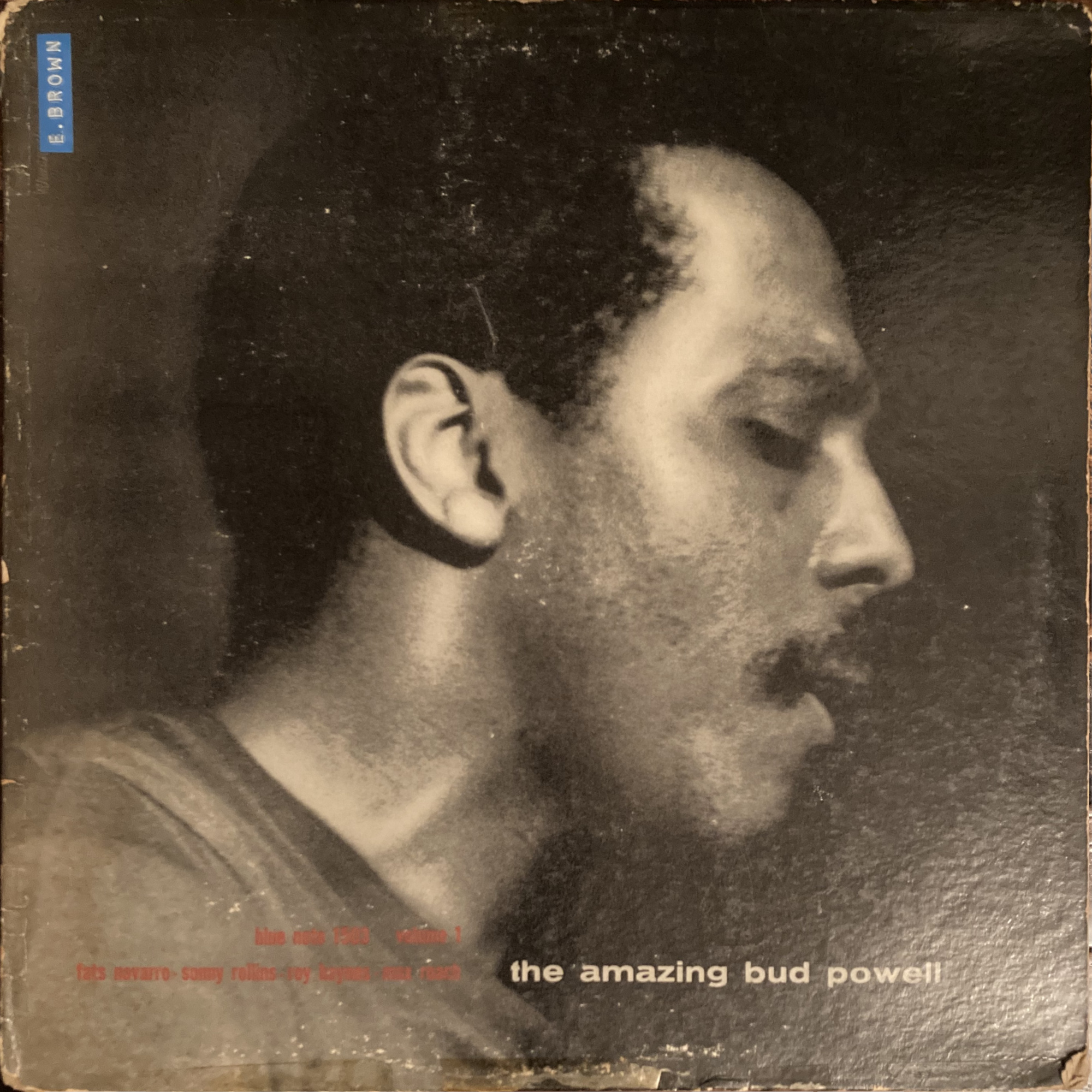
Label: BLUE NOTE
No.: BLP 1504
Title: THE AMAZING BUD POWELL Vol. 2
Musician: BUD POWELL
Recorded: 1949/8/9, 1951/5/1, 1953/8/14
Monaural
Cover address: 43 West 61st St, New York 23, INC
Coating無し
Flat edge(Side2), Groove Guard(Side1) ???
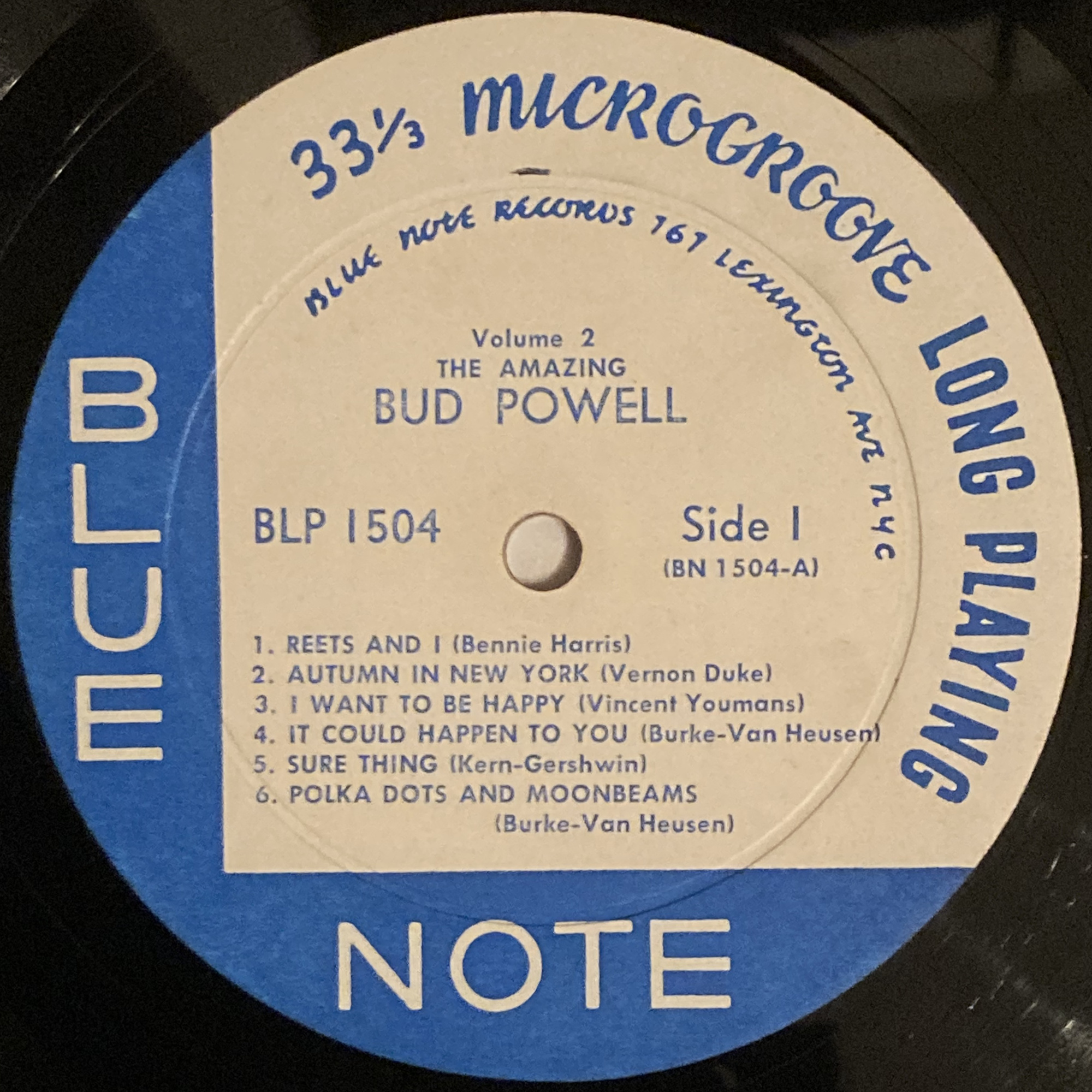
Label Side-1
Blue & White Background
White & Blue Letter, INC&R無し
Address: 767 Lexington Ave NYC
Deep Groove
Dead Wax Info: 手書きRVG, BN-LP-1504-A, P(Ear), 9M, 1dot
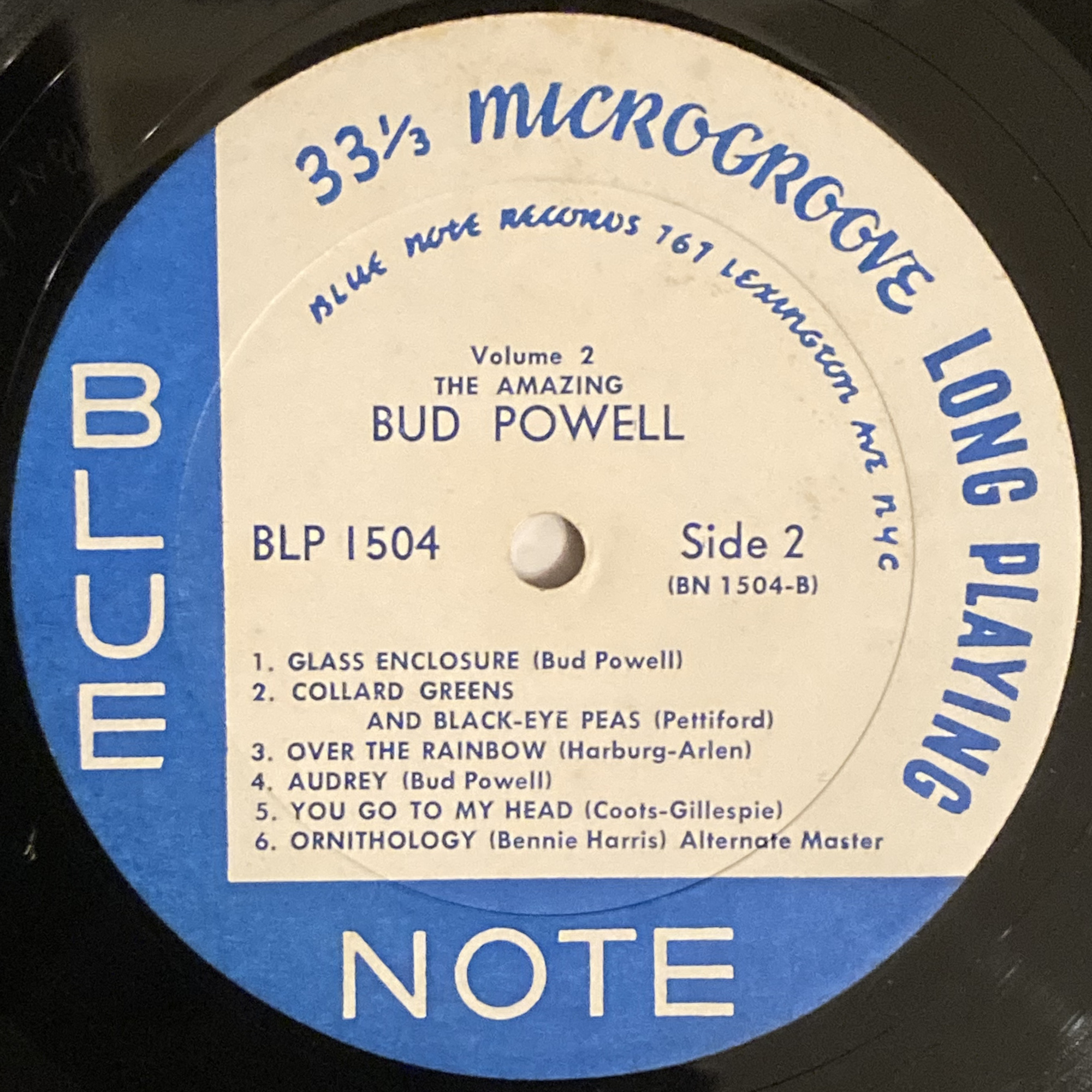
Label Side-2
Blue & White Background
White & Blue Letter, INC&R無し
Address: 767 Lexington Ave NYC
Deep Groove無し
Dead Wax Info: 手書きRVG, BN-LP-1504-B, P(Ear), 9M, 1dot
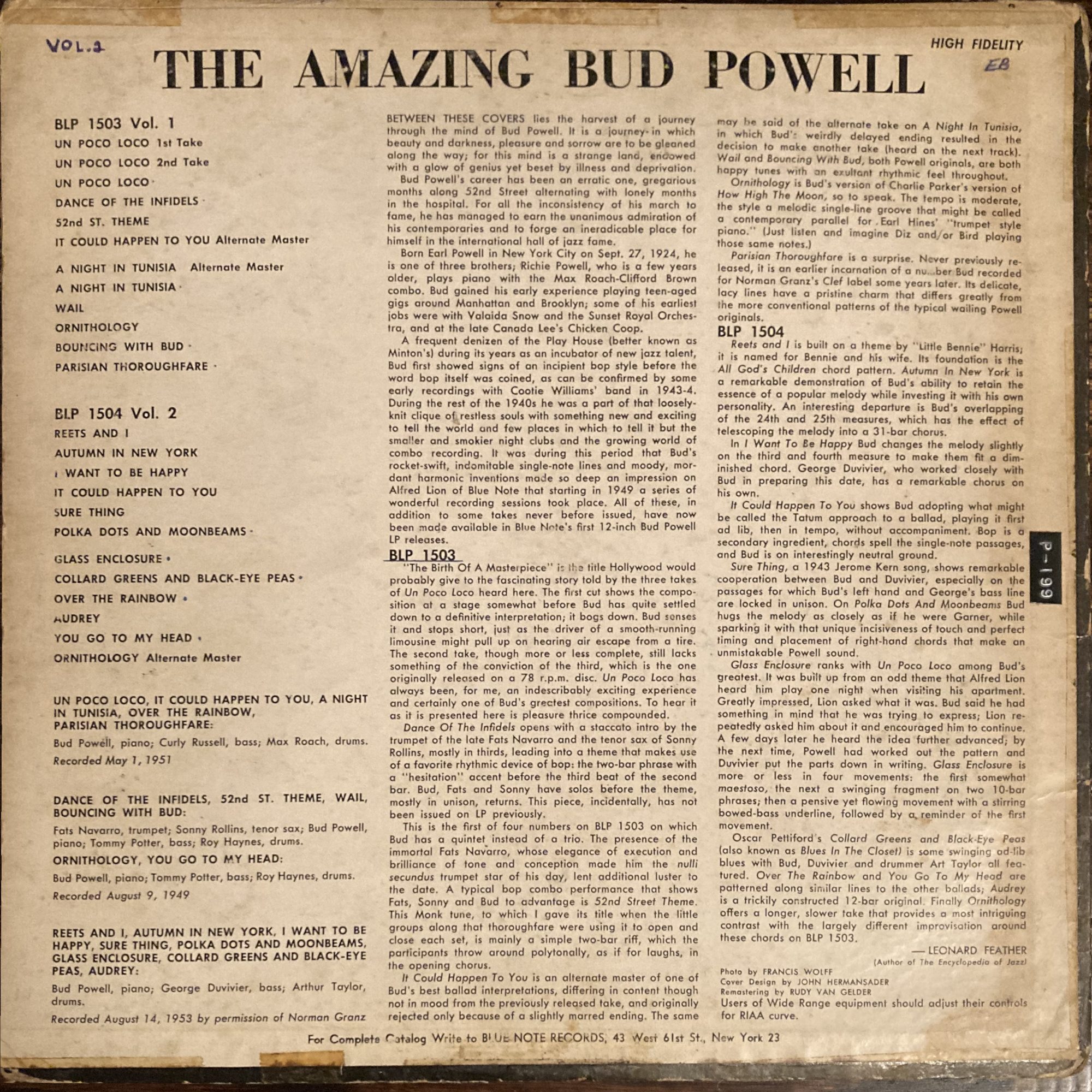
Personnel- 1949/8/9 Side2-(5),(6)
Drums: Roy Haynes
Bass: Tommy Potter
Piano: Bud Powell
Personnel- 1951/5/1 Side1-(4), Side2-(3)
Piano: Bud Powell
Personnel- 1953/8/14 Side1-(1),(2),(3),(5),(6) Side2-(1),(2),(4)
Drums: Art Taylor
Bass: George Duvivier
Piano: Bud Powell
Tracks-
Side-1
1) Reets and I
2) Autumn in New York
3) I Want to be Happy
4) It Could Happen to You
5) Sure Thing
6) Polka Dots and Moonbeams
Side-2
1) Glass Enclosure
2) Collard Greens and Black-Eye Peas
3) Over the Rainbow
4) Audrey
5) You Go to My Head
6) Ornithology
よく判らない部分があるレコードです。
43-61のジャケットにLexingtonのレコードが入っています。写真つきのインナースリーブも入っていますので販売された時期は43-61の時代かと思います。ここまではいいのですが、レコードはデータにもあるようにSide1がDGでSide2がDG無しです。エッジに関してはSide2はフラットでSide1は形状はあまりはっきりしないもののグルーブガードがあります。片面グルーブガードなどという盤はあるものなのでしょうか?43-61の時代に”古いプレスのものの在庫品をつめて販売した”というよりは、”古いラベルを使ったが新しくプレスした”ように思いますが、Side2のフラットエッジは非常にはっきりしています。43-61の時代に新しくプレスしたものがフラットエッジというのがわからない部分です。
またDGがSide1でフラットエッジがSide2, DGなしがSide2でグルーブガードがSide1となっており、DG有無とエッジ形状の時代特徴の組合せが逆(テレコ)になっています。フラットエッジであるSide2をLexingtonの時代にプレスして43-61の時代にSide1をプレスした、それもDGの特徴はプレス面の逆側に現れる なんてことはあるのでしょうか?
<裏ジャケ原文>
BETWEEN THESE COVERS lies the harvest of a journey through the mind of Bud Powell. It is a journey in which beauty and darkness, pleasure and sorrow are to be gleaned along the way; for this mind is a strange land, endowed with a glow of genius yet beset by illness and deprivation. Bud Powell’s career has been an erratic one, gregarious months along 52nd Street alternating with lonely months in the hospital. For all the inconsistency of his march to fame, he has managed to earn the unanimous admiration of his contemporaries and to forge an ineradicable place for himself in the international hall of jazz fame.
Born Earl Powell in New York City on Sept. 27, 1924, he is one of three brothers; Richie Powell, who is a few years older, plays piano with the Max Roach-Clifford Brown combo. Bud gained his early experience playing teen-aged gigs around Manhattan and Brooklyn; some of his earliest jobs were with Valaida Snow and the Sunset Royal Orches- tra, and at the late Canada Lee’s Chicken Coop.
A frequent denizen of the Play House (better known as Minton’s) during its years as an incubator of new jazz talent, Bud first showed signs of an incipient bop style before the word bop itself was coined, as can be confirmed by some early recordings with Cootie Williams’ band in 1943-4. During the rest of the 1940s he was a part of that loosely- knit clique of restless souls with something new and exciting to tell the world and few places in which to tell it but the smaller and smokier night clubs and the growing world of combo recording. It was during this period that Bud’s rocket-swift, indomitable single-note lines and moody, mor- dant harmonic inventions made so deep an impression on Alfred Lion of Blue Note that starting in 1949 a series of wonderful recording sessions took place. All of these, in addition to some takes never before issued, have now been made available in Blue Note’s first 12-inch Bud Powell LP releases.
BLP 1503
“The Birth Of A Masterpiece” is the title Hollywood would probably give to the fascinating story told by the three takes of Un Poco Loco heard here. The first cut shows the compo- sition at a stage somewhat before Bud has quite settled down to a definitive interpretation; it bogs down. Bud senses it and stops short, just as the driver of a smooth-running limousine might pull up on hearing air escape from a tire. The second take, though more or less complete, still lacks something of the conviction of the third, which is the one originally released on a 78 r.p.m. disc. Un Poco Loco has always been, for me, an indescribably exciting experience and certainly one of Bud’s greatest compositions. To hear it as it is presented here is pleasure thrice compounded.
Dance Of The Infidels opens with a staccato intro by the trumpet of the late Fats Navarro and the tenor sax of Sonny Rollins, mostly in thirds, leading into a theme that makes use of a favorite rhythmic device of bop: the two-bar phrase with a “hesitation” accent before the third beat of the second bar. Bud, Fats and Sonny have solos before the theme, mostly in unison, returns. This piece, incidentally, has not been issued on LP previously.
This is the first of four numbers on BLP 1503 on which Bud has a quintet instead of a trio. The presence of the immortal Fats Navarro, whose elegance of execution and brilliance of tone and conception made him the nulli secundus trumpet star of his day, lent additional luster to the date. A typical bop combo performance that shows Fats, Sonny and Bud to advantage is 52nd Street Theme. This Monk tune, to which I gave its title when the little groups along that thoroughfare were using it to open and close each set, is mainly a simple two-bar riff, which the participants throw around polytonally, as if for laughs, in the opening chorus.
It Could Happen To You is an alternate master of one of Bud’s best ballad interpretations, differing in content though. not in mood from the previously released take, and originally rejected only because of a slightly marred ending. The same may be said of the alternate take on A Night In Tunisia, in which Bud’: weirdly delayed ending resulted in the decision to make another take (heard on the next track). Wail and Bouncing With Bud, both Powell originals, are both happy tunes with an exultant rhythmic feel throughout.
Ornithology is Bud’s version of Charlie Parker’s version of How High The Moon, so to speak. The tempo is moderate, the style a melodic single-line groove that might be called a contemporary parallel for. Earl Hines’ “trumpet style piano.” (Just listen and imagine Diz and/or Bird playing those same notes.)
Parisian Thoroughfare is a surprise. Never previously re- leased, it is an earlier incarnation of a nu…ber Bud recorded for Norman Granz’s Clef label some years later. Its delicate, lacy lines have a pristine charm that differs greatly from the more conventional patterns of the typical wailing Powell originals.
BLP 1504
Reets and I is built on a theme by “Little Bennie” Harris; it is named for Bennie and his wife. Its foundation is the All God’s Children chord pattern. Autumn In New York is a remarkable demonstration of Bud’s ability to retain the essence of a popular melody while investing it with his own personality. An interesting departure is Bud’s overlapping of the 24th and 25th measures, which has the effect of telescoping the melody into a 31-bar chorus.
In I Want To Be Happy Bud changes the melody slightly on the third and fourth measure to make them fit a dim- inished chord. George Duvivier, who worked closely with Bud in preparing this date, has a remarkable chorus on his own.
It Could Happen To You shows Bud adopting what might be called the Tatum approach to a ballad, playing it first ad lib, then in tempo, without accompaniment. Bop is a secondary ingredient, chords spell the single-note passages, and Bud is on interestingly neutral ground.
Sure Thing, a 1943 Jerome Kern song, shows remarkable cooperation between Bud and Duvivier, especially on the passages for which Bud’s left hand and George’s bass line are locked in unison. On Polka Dots And Moonbeams Bud hugs the melody as closely as if he were Garner, while sparking it with that unique incisiveness of touch and perfect timing and placement of right-hand chords that make an . unmistakable Powell sound.
Glass Enclosure ranks with Un Poco Loco among Bud’s greatest. It was built up from an odd theme that Alfred Lion heard him play one night when visiting his apartment. Greatly impressed, Lion asked what it was. Bud said he had something in mind that he was trying to express; Lion re- peatedly asked him about it and encouraged him to continue. A few days later he heard the idea further advanced; by the next time, Powell had worked out the pattern and Duvivier put the parts down in writing. Glass Enclosure is
or less in four movements: the first somewhat maestoso, the next a swinging fragment on two 10-bar phrases; then a pensive yet flowing movement with a stirring bowed-bass underline, followed by a, reminder of the first movement.
Oscar Pettiford’s Collard Greens and Black-Eye Peas (also known as Blues In The Closet) is some swinging ad-lib blues with Bud, Duvivier and drummer Art Taylor all fea- tured. Over The Rainbow and You Go To My Head are patterned along similar lines to the other ballads; Audrey is a trickily constructed 12-bar original. Finally Ornithology offers a longer, slower take that provides a most intriguing contrast with the largely different improvisation around these chords on BLP 1503.
Photo by FRANCIS WOLFF
LEONARD FEATHER
(Author of The Encyclopedia of Jazz)
Cover Design by JOHN HERMANSADER
Remastering by RUDY VAN GELDER
Users of Wide Range equipment should adjust their controls
for RIAA curve.
<裏ジャケ和訳>
本書には、バド・パウエルの精神世界を巡る旅の収穫が綴られている。それは、美と闇、喜びと悲しみが道すがら拾い集められるような旅である。なぜなら、彼の精神は、天才の輝きを宿しながらも、病や困窮に見舞われた奇妙な土地のようなものだからだ。バド・パウエルのキャリアは波乱に満ちていた。52丁目で多くの仲間と過ごす華やかな時期もあれば、病院で孤独に過ごす時期もあった。名声への道のりは一貫したものではなかったが、彼は同時代の音楽家たちから満場一致の称賛を勝ち取り、ジャズの殿堂に揺るぎない地位を築き上げた。
1924年9月27日、ニューヨーク市でアール・パウエルとして生まれた彼は、3人兄弟のひとりである。数歳年上の兄リッチー・パウエルは、マックス・ローチとクリフォード・ブラウンのコンボでピアノを弾いていた。バドは10代の頃、マンハッタンやブルックリンの各地で演奏を重ね、経験を積んだ。初期の仕事には、ヴァライダ・スノウやサンセット・ロイヤル・オーケストラでの演奏、そして今は亡きカナダ・リーが経営した「チキン・コープ」でのステージなどがある。
新しいジャズの才能を育む場であった「プレイ・ハウス」(一般には「ミントンズ」の名で知られる)に頻繁に出入りしていたバドは、「バップ」という言葉が生まれる以前から、すでにその萌芽となるスタイルを見せていた。これは、1943年から1944年にかけてクーティ・ウィリアムスのバンドで行った初期の録音からも確認できる。1940年代の残りの期間、彼は、世界に向けて何か新しく刺激的なものを伝えようとしながらも、それを表現する場が、煙の立ち込める小さなナイトクラブや、当時広がりつつあったコンボ形式のレコーディング現場に限られていた、そんな「落ち着きのない魂」を持つ者たちの緩やかな集団の一員であった。この時期、バドの、ロケットのように素早く力強いシングルノートのラインや、情緒的で鋭いハーモニーの創意工夫は、ブルーノート・レーベルのアルフレッド・ライオンに深い感銘を与えた。その結果、1949年から数々の素晴らしいレコーディング・セッションが実現することとなったのである。これらすべてが、これまで未発表だったテイクとともに、ブルーノートからリリースされたバド・パウエルの12インチLPシリーズに収録された。
BLP 1503
ここに収められた「ウン・ポコ・ロコ(Un Poco Loco)」の3つのテイクが物語る魅力的な経緯には、ハリウッド映画なら「傑作の誕生」といったタイトルがつけられることだろう。最初のテイクでは、バドがまだ決定的な解釈にたどり着く前の段階が捉えられており、演奏は途中で行き詰まってしまう。バドはそれに気づいて演奏を止めるのだが、それはまるで、快調に走っていた高級車の運転手が、タイヤから空気が漏れる音を聞いて車を停めるようなものだ。2つ目のテイクはほぼ完成しているものの、3つ目のテイク――かつて78回転のSP盤でリリースされたもの――に見られるような確信に満ちた響きには、まだ一歩及ばない。私にとって「ウン・ポコ・ロコ」は、いつ聴いても言葉にできないほど刺激的な体験であり、間違いなくバドの最高傑作の一つである。今回のように、その制作過程を含めて聴くことができるのは、この上ない喜びだ。
「ダンス・オブ・ザ・インフィデルズ(Dance Of The Infidels)」は、故ファッツ・ナヴァロのトランペットとソニー・ロリンズのテナー・サックスによるスタッカートのイントロで幕を開ける。二人は主に3度のハーモニーを奏で、やがてビバップ特有のリズム技法――2小節フレーズの2小節目、3拍目の直前に「ため(ヘジテーション)」のアクセントを置く手法――を用いたテーマへとつながっていく。テーマが(主にユニゾンで)回帰する前には、バド、ファッツ、ソニーによるソロが展開される。ちなみに、この曲はこれまでLPには収録されていなかった。
本作『BLP 1503』には4曲が収録されているが、そのうちの1曲である本作では、バドはトリオではなくクインテット編成で演奏している。不滅の存在であるファッツ・ナヴァロ――その優雅な演奏技術、輝かしい音色、そして卓越した音楽的構想力により、当時並ぶ者のいないトランペットのスターであった――が参加したことで、このセッションにはさらなる輝きが加わった。ファッツ、ソニー、バドの三者がそれぞれの持ち味を存分に発揮している「52丁目テーマ(52nd Street Theme)」は、ビバップ・コンボによる演奏の典型と言えるだろう。このセロニアス・モンクの曲は、私がタイトルをつけたものだ。当時、あの通り沿いの小さなグループが、セットの開始時や終了時にこの曲を演奏していた。曲の基本はシンプルな2小節のリフだが、演奏者たちは最初のコーラスで、まるで冗談でも飛ばすかのように、そのリフをポリトナル(多調)な響きで互いに投げ合っている。
「It Could Happen To You」は、バド・パウエルによる最高のバラード解釈の一つと言える演奏の別テイクである。先にリリースされたテイクと雰囲気は変わらないものの、内容は異なっている。このテイクが当初採用されなかったのは、終盤にわずかなミスがあったためだ。「A Night In Tunisia」の別テイクについても同様で、バドが終盤で奇妙なタイミングの遅れを見せたため、別のテイク(次のトラックに収録)が採用されることになった。パウエルのオリジナル曲である「Wail」と「Bouncing With Bud」は、どちらも快活な楽曲で、全編を通して高揚感のあるリズムが特徴である。
「Ornithology」は、チャーリー・パーカーが演奏した「How High The Moon」を、バドがさらに解釈し直したものと言える。テンポは中庸で、そのスタイルはメロディアスな単旋律によるグルーヴを生み出しており、アール・ハインズの「トランペット・スタイル・ピアノ」の現代版とも呼べるものだ。(ディジー・ガレスピーやチャーリー・パーカーが同じ音を演奏している姿を想像しながら聴いてみてほしい。)
「Parisian Thoroughfare」は驚きのトラックである。これまで未発表だったこの曲は、バドが数年後にノーマン・グランツの「クレフ(Clef)」レーベルで録音した楽曲の、初期バージョンにあたる。繊細でレースのように緻密な旋律には、パウエルの典型的な激しいオリジナル曲に見られる定型的なパターンとは一線を画す、純粋で新鮮な魅力がある。
BLP 1504
「Reets and I」は、「リトル・ベニー」ことベニー・ハリスが作ったテーマに基づいている。曲名はベニー自身と彼の妻にちなんで名付けられた。この曲のコード進行は「All God’s Children」に基づいている。「Autumn In New York」は、ポピュラーなメロディの本質を保ちつつ、そこにバド自身の個性を吹き込むという、彼の卓越した才能を示す素晴らしい一例だ。興味深い工夫として、バドは24小節目と25小節目を重ね合わせることで、メロディを凝縮し、31小節のコーラスに収めている。
「I Want To Be Happy」では、バドは3小節目と4小節目のメロディをわずかに変更し、ディミニッシュ・コードに適合させている。このセッションの準備段階からバドと密接に関わったジョージ・デュヴィヴィエも、見事なコーラス・ソロを披露している。 『It Could Happen To You』では、バドがバラードに対して、いわば「テイタム・アプローチ」とも呼ぶべき手法をとっている。伴奏なしで、最初はアドリブ的に(自由なテンポで)、続いてイン・テンポで演奏するのだ。ここでのバップはあくまで副次的な要素に過ぎず、コードが単音の旋律を形作っている。バドは、興味深いほど中立的な立ち位置に身を置いていると言える。
1943年のジェローム・カーンの楽曲『Sure Thing』では、バドとデュヴィヴィエの驚くべき連携が聴ける。特に、バドの左手とジョージ(・デュヴィヴィエ)のベースラインが完全にユニゾンする箇所は圧巻だ。『Polka Dots And Moonbeams』では、バドはエロール・ガーナーを彷彿とさせるほどメロディに寄り添いつつ、彼特有の鋭いタッチ、そして完璧なタイミングと配置で繰り出される右手コードによって、楽曲に鮮やかな輝きを与えている。これぞまさに、紛れもない「パウエル・サウンド」である。
『Glass Enclosure』は、『Un Poco Loco』と並び、バドの最高傑作の一つに数えられる。この曲は、ある夜、アルフレッド・ライオンがバドのアパートを訪れた際、彼が弾いていた風変わりなテーマから生まれた。深く感銘を受けたライオンがそれが何かを尋ねると、バドは「頭の中にある何かを表現しようとしている」と答えた。ライオンは繰り返しその曲について尋ね、制作を続けるよう彼を励ました。数日後、そのアイデアがさらに発展した形で聴かれ、その次にはパウエルが楽曲のパターンを完成させており、デュヴィヴィエがそれを譜面に書き起こした。『Glass Enclosure』は、おおよそ4つの楽章から構成されている。第1楽章はどこかマエストーソ(堂々とした)な雰囲気で、続く楽章は10小節のフレーズ2つからなるスウィング調のパート。その次は、アルコ(弓弾き)のベースが心を揺さぶるような下地を作り出す、思索的でありながら流麗な楽章となっている。そして最後に、第1楽章を想起させるパートが続く。
オスカー・ペティフォード作の『Collard Greens and Black-Eye Peas』(別名『Blues In The Closet』)は、バド、デュヴィヴィエ、そしてドラマーのアート・テイラーの全員がフィーチャーされた、スウィング感あふれるアドリブ・ブルースである。『Over The Rainbow』や『You Go To My Head』は他のバラード曲と同様の構成をとっており、『Audrey』は、一筋縄ではいかない構造を持つ12小節のオリジナル曲である。最後を飾る「オーニソロジー(Ornithology)」は、より長く、ゆったりとしたテンポで演奏されており、同じコード進行を用いながらも全く異なるアプローチで即興が展開される『BLP 1503』のバージョンと、非常に興味深い対比を見せている。
写真:フランシス・ウルフ
レナード・フェザー
(『ジャズ百科事典』著者)
カバー・デザイン:ジョン・ハーマンセイダー
リマスタリング:ルディ・ヴァン・ゲルダー
ワイド・レンジ(広帯域)再生機器をお使いの方は、RIAAカーブに合わせて調整を行ってください。
※訳文の制作にはGoogleドライブとGoogle翻訳のお世話になりました。
コメント