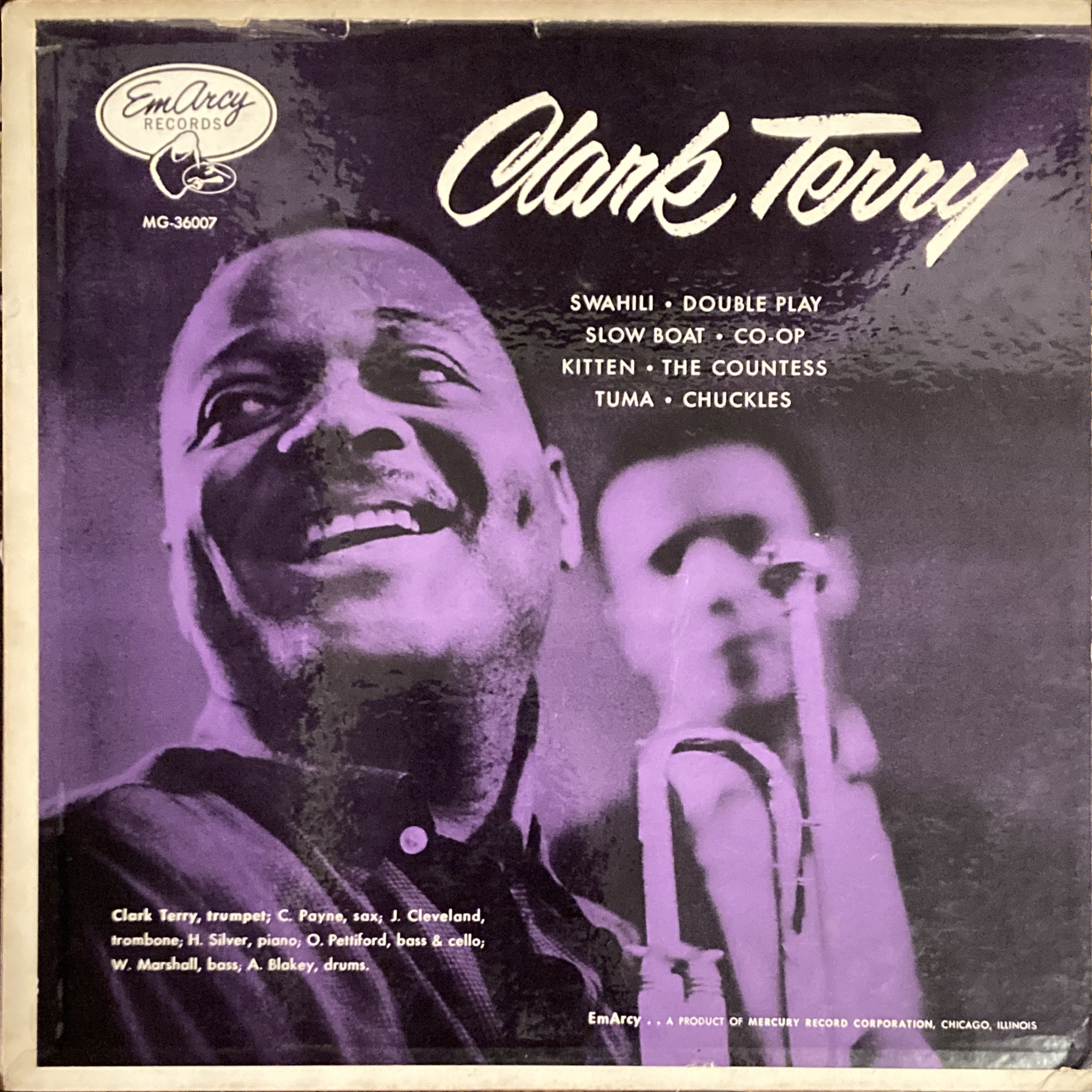
Label: EMARCY (MERCURY RECORD CORPORATION)
No.: MG 36007
Title: CLARK TERRY
Musician: CLARK TERRY
Recorded: 1955/1/3,4
Monaural
Cover address: CHICAGO ILLINOIS
Laminate Coating
Groove Guard
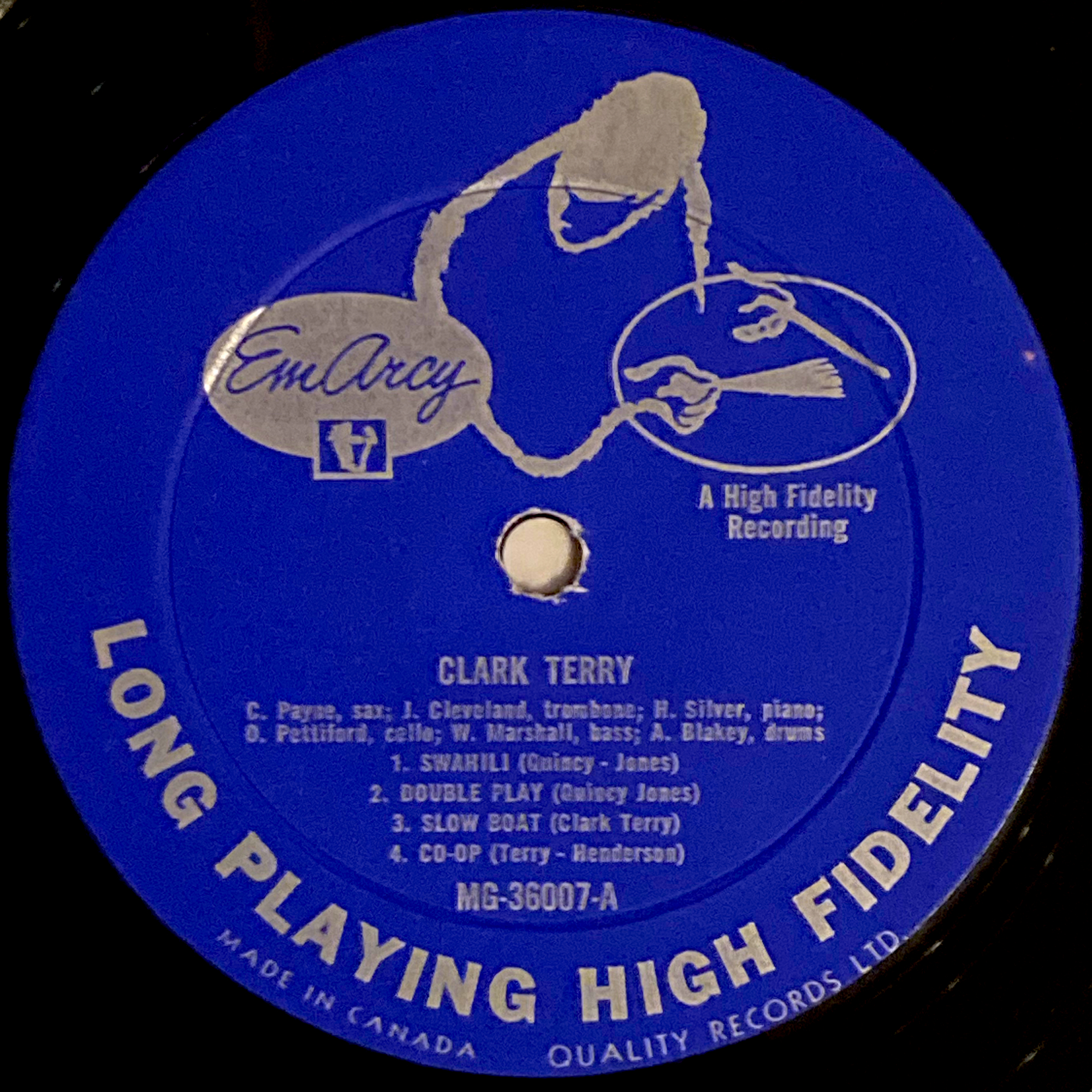
Label Side-1
Blue Background
White Letter with Big Drummer
Address: MADE IN CANADA QUALITY RECORDS LTD.
Deep Groove
Dead Wax Info: MG36007-A
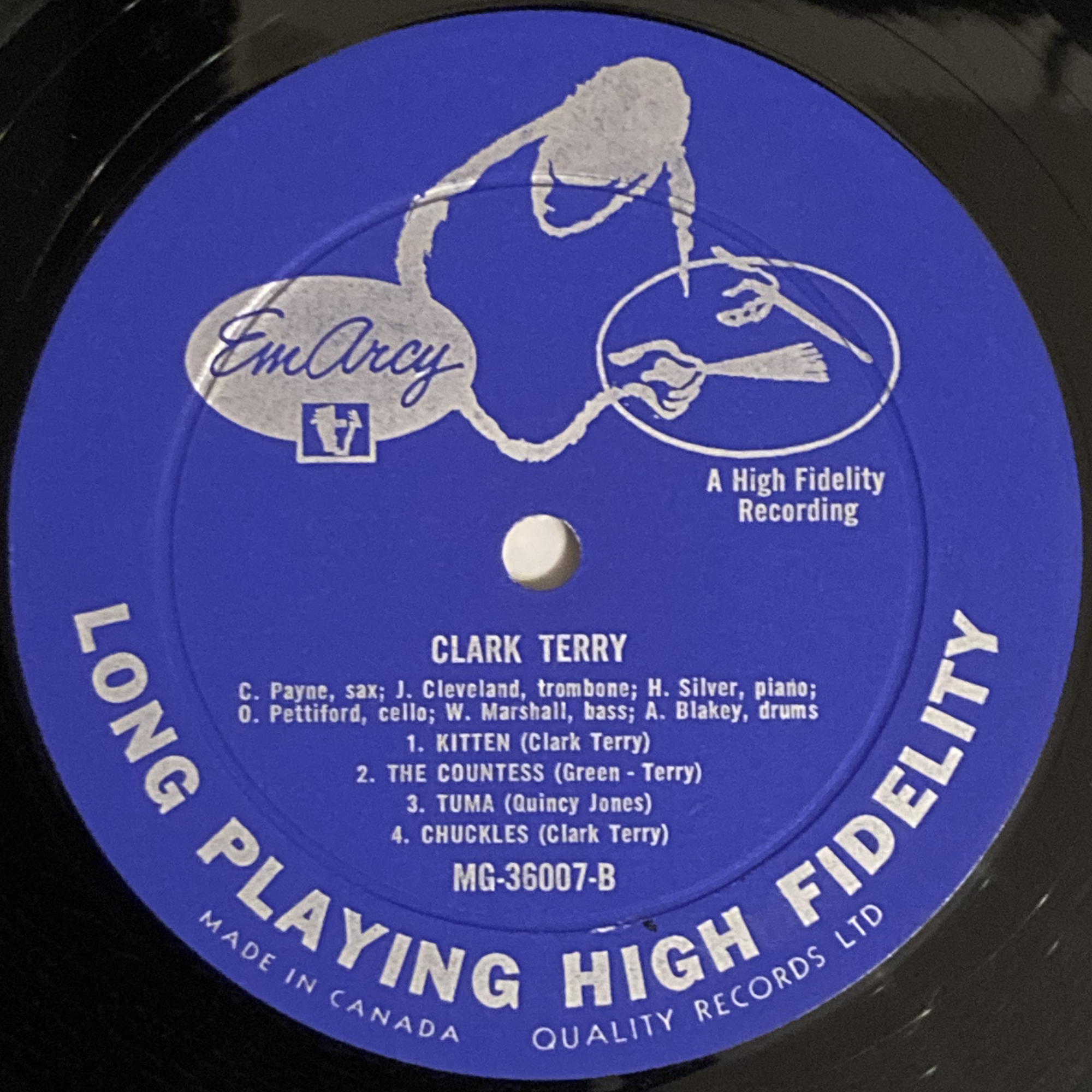
Label Side-2
Blue Background
White Letter with Big Drummer
Address: MADE IN CANADA QUALITY RECORDS LTD.
Deep Groove
Dead Wax Info: MG36007-B, MS-1
Personnel-
Drums: Art Blakey
Bass: Wendell Marshall
Bass, Cello: Oscar Pettiford
Piano: Horace Silver
Trumpet: Clark Terry
Baritone Sax: Cecil Payne
Trombone: Jimmy Cleveland
Arrangement: Quincy Jones
Tracks-
Side-1 Recorded on 1955/1/3
1) Swahili
2) Double Play
3) Slow Boat
4) Co-Op
Side-2 Recorded on 1955/1/4
1) Kitten
2) The Countess
3) Tuma
4) Chuckles
センターレーベルは普通の大ドラマーと思っていましたが、両面ともに外周部にMADE IN CANADA
QUALITY RECORDS LTD.の印刷がありました。規格番号の刻印も通常とは違い、手彫りですが斜体になっています。ジャケットにはカナダの表記はありません。
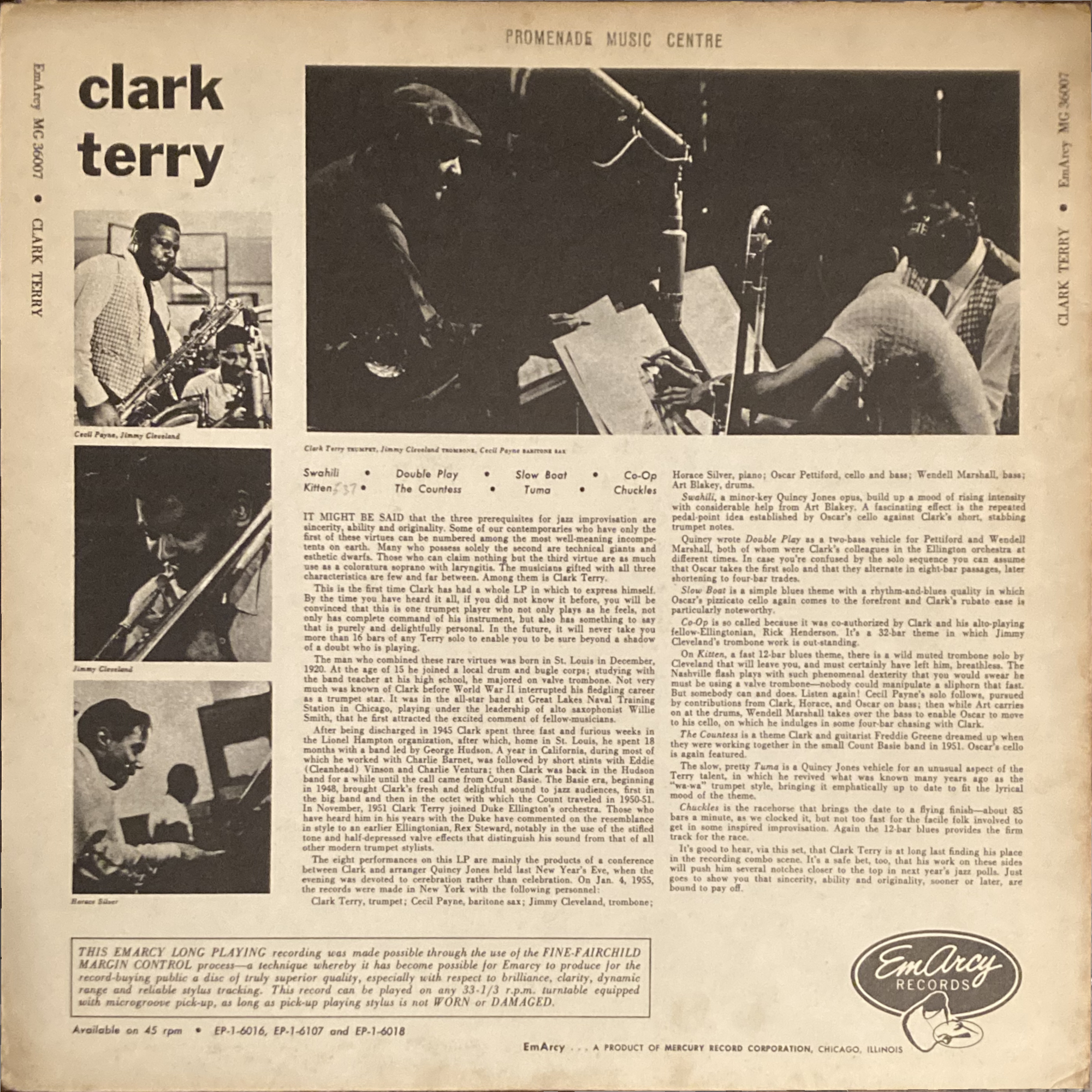
<裏ジャケ原文>
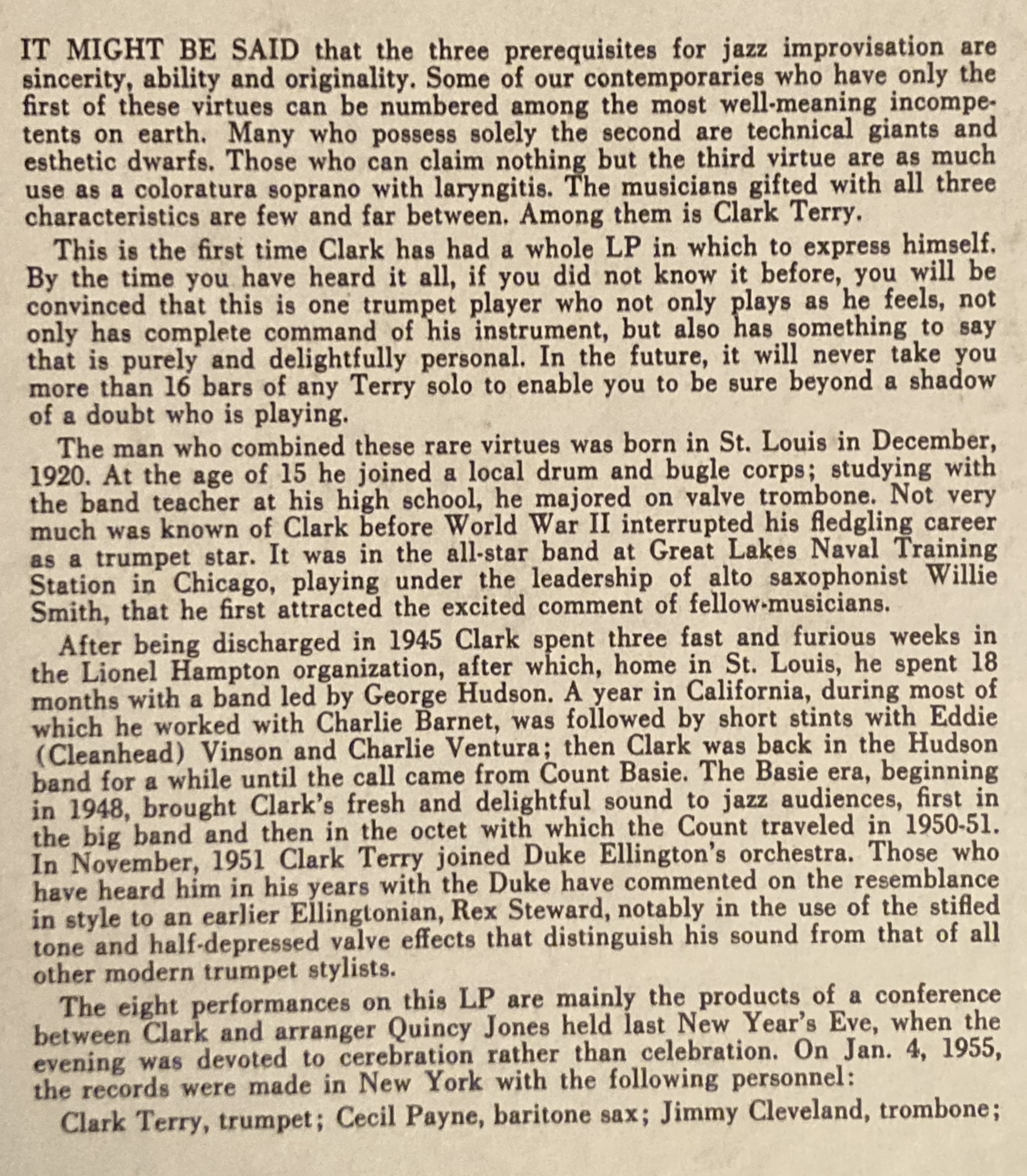
IT MIGHT BE SAID that the three prerequisites for jazz improvisation are sincerity, ability and originality. Some of our contemporaries who have only the first of these virtues can be numbered among the most well-meaning incompe- tents on earth. Many who possess solely the second are technical giants and esthetic dwarfs. Those who can claim nothing but the third virtue are as much use as a coloratura soprano with laryngitis. The musicians gifted with all three characteristics are few and far between. Among them is Clark Terry.
This is the first time Clark has had a whole LP in which to express himself. By the time you have heard it all, if you did not know it before, you will be convinced that this is one trumpet player who not only plays as he feels, not only has complete command of his instrument, but also has something to say that is purely and delightfully personal. In the future, it will never take you more than 16 bars of any Terry solo to enable you to be sure beyond a shadow of a doubt who is playing.
The man who combined these rare virtues was born in St. Louis in December, 1920. At the age of 15 he joined a local drum and bugle corps; studying with the band teacher at his high school, he majored on valve trombone. Not very much was known of Clark before World War II interrupted his fledgling career as a trumpet star. It was in the all-star band at Great Lakes Naval Training Station in Chicago, playing under the leadership of alto saxophonist Willie Smith, that he first attracted the excited comment of fellow-musicians.
After being discharged in 1945 Clark spent three fast and furious weeks in the Lionel Hampton organization, after which, home in St. Louis, he spent 18 months with a band led by George Hudson. A year in California, during most of which he worked with Charlie Barnet, was followed by short stints with Eddie (Cleanhead) Vinson and Charlie Ventura; then Clark was back in the Hudson band for a while until the call came from Count Basie. The Basie era, beginning in 1948, brought Clark’s fresh and delightful sound to jazz audiences, first in the big band and then in the octet with which the Count traveled in 1950-51. In November, 1951 Clark Terry joined Duke Ellington’s orchestra. Those who have heard him in his years with the Duke have commented on the resemblance in style to an earlier Ellingtonian, Rex Steward, notably in the use of the stifled tone and half-depressed valve effects that distinguish his sound from that of all other modern trumpet stylists.
The eight performances on this LP are mainly the products of a conference between Clark and arranger Quincy Jones held last New Year’s Eve, when the evening was devoted to cerebration rather than celebration. On Jan. 4, 1955, the records were made in New York with the following personnel:
Clark Terry, trumpet; Cecil Payne, baritone sax; Jimmy Cleveland, trombone;
Horace Silver, piano; Oscar Pettiford, cello and bass; Wendell Marshall, bass; Art Blakey, drums.
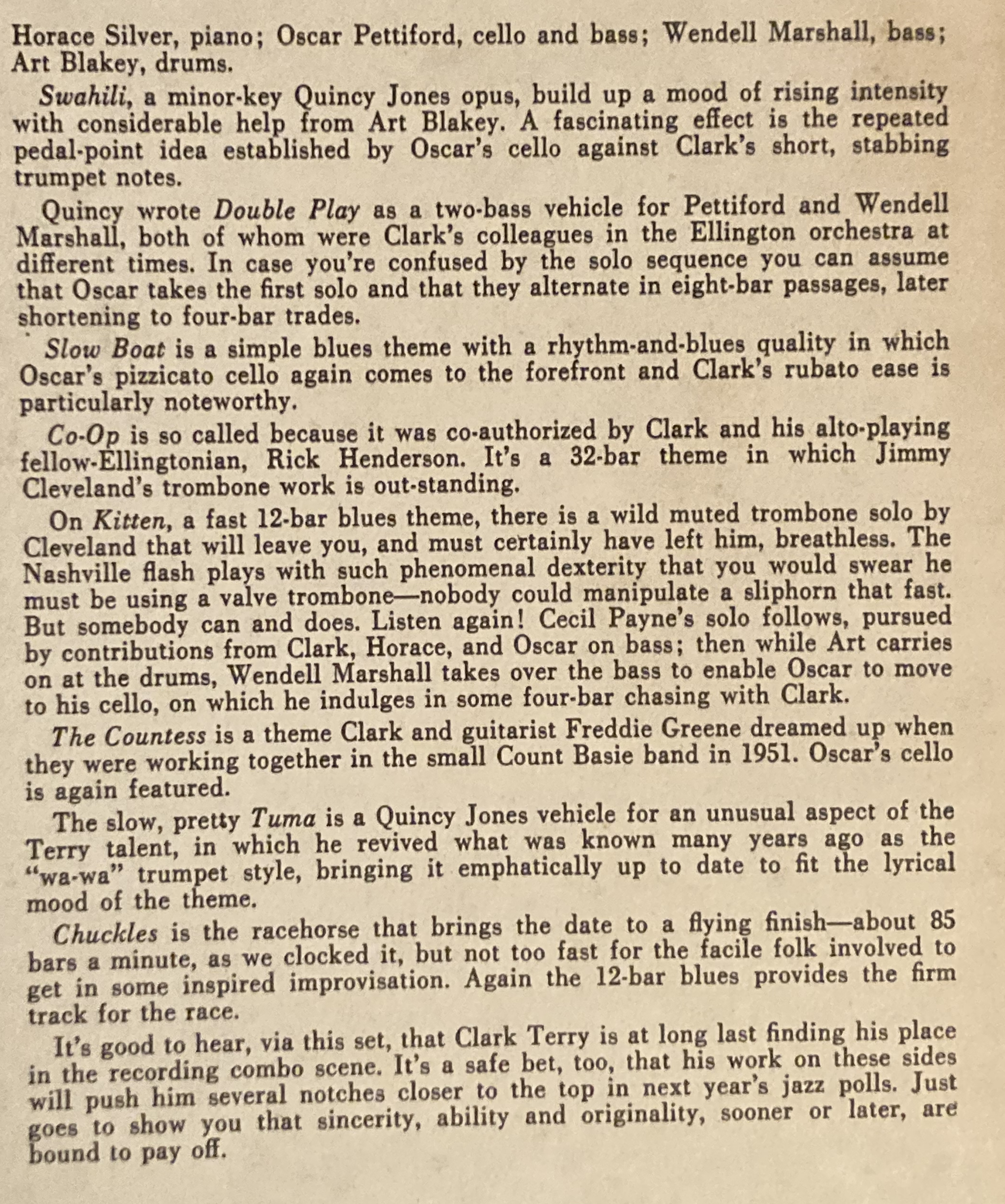
Swahili, a minor-key Quincy Jones opus, build up a mood of rising intensity with considerable help from Art Blakey. A fascinating effect is the repeated pedal-point idea established by Oscar’s cello against Clark’s short, stabbing trumpet notes.
Quincy wrote Double Play as a two-bass vehicle for Pettiford and Wendell Marshall, both of whom were Clark’s colleagues in the Ellington orchestra at different times. In case you’re confused by the solo sequence you can assume that Oscar takes the first solo and that they alternate in eight-bar passages, later shortening to four-bar trades.
Slow Boat is a simple blues theme with a rhythm-and-blues quality in which Oscar’s pizzicato cello again comes to the forefront and Clark’s rubato ease is particularly noteworthy.
Co-Op is so called because it was co-authorized by Clark and his alto-playing fellow-Ellingtonian, Rick Henderson. It’s a 32-bar theme in which Jimmy Cleveland’s trombone work is out-standing.
On Kitten, a fast 12-bar blues theme, there is a wild muted trombone solo by Cleveland that will leave you, and must certainly have left him, breathless. The Nashville flash plays with such phenomenal dexterity that you would swear he must be using a valve trombone-nobody could manipulate a sliphorn that fast. But somebody can and does. Listen again! Cecil Payne’s solo follows, pursued by contributions from Clark, Horace, and Oscar on bass; then while Art carries on at the drums, Wendell Marshall takes over the bass to enable Oscar to move to his cello, on which he indulges in some four-bar chasing with Clark.
The Countess is a theme Clark and guitarist Freddie Greene dreamed up when they were working together in the small Count Basie band in 1951. Oscar’s cello is again featured.
The slow, pretty Tuma is a Quincy Jones vehicle for an unusual aspect of the Terry talent, in which he revived what was known many years ago as the “wa-wa” trumpet style, bringing it emphatically up to date to fit the lyrical mood of the theme.
Chuckles is the racehorse that brings the date to a flying finish-about 85 bars a minute, as we clocked it, but not too fast for the facile folk involved to get in some inspired improvisation. Again the 12-bar blues provides the firm track for the race.
It’s good to hear, via this set, that Clark Terry is at long last finding his place in the recording combo scene. It’s a safe bet, too, that his work on these sides will push him several notches closer to the top in next year’s jazz polls. Just goes to show you that sincerity, ability and originality, sooner or later, are bound to pay off.
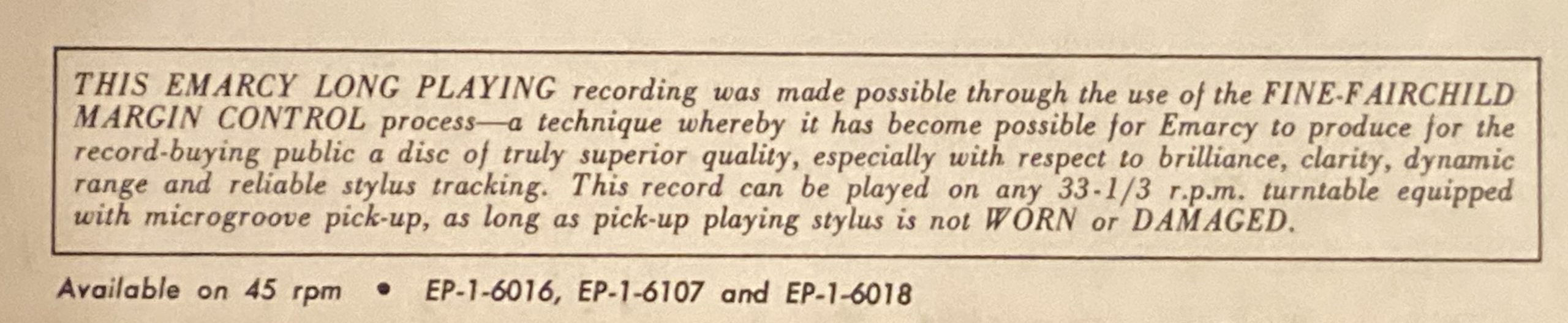
THIS EMARCY LONG PLAYING recording was made possible through the use of the FINE-FAIRCHILD MARGIN CONTROL process-a technique whereby it has become possible for Emarcy to produce for the record-buying public a disc of truly superior quality, especially with respect to brilliance, clarity, dynamic range and reliable stylus tracking. This record can be played on any 33-1/3 r.p.m. turntable equipped with microgroove pick-up, as long as pick-up playing stylus is not WORN or DAMAGED.
Available on 45 rpm
EP-1-6016, EP-1-6107 and EP-1-6018
<裏ジャケ和訳>
ジャズ・インプロヴィゼーション(即興演奏)における3つの必須条件は、誠実さ、技術、そして独創性であると言えるだろう。現代のミュージシャンの中には、このうち「誠実さ」だけを備えている者がいるが、彼らは「善意に満ちた無能者」とでも呼ぶべき存在だ。また、「技術」だけを備えた者は、演奏テクニックは超一流でも、芸術的な感性は未熟というケースが多い。そして「独創性」しか持たない者は、喉を痛めたコロラトゥーラ・ソプラノ歌手のように、全く役に立たない。これら3つの資質をすべて兼ね備えたミュージシャンは極めて稀だが、クラーク・テリーはその一人である。
本作は、クラーク・テリーが自身の音楽を存分に表現できる、初のフル・アルバムである。全編を聴き終える頃には、それまで彼を知らなかった人であっても、クラーク・テリーというトランペット奏者が、単に感情のままに吹くだけでなく、楽器を完全に掌握し、さらに彼ならではの、純粋で魅力的な「語るべき何か」を持っていることに確信を抱くはずだ。今後、彼のソロを聴けば、わずか16小節もあれば、誰が演奏しているのか疑いようもなく分かるようになるだろう。
こうした稀有な資質を併せ持つ彼は、1920年12月、セントルイスに生まれた。15歳の時に地元のドラム・アンド・ビューグル・コー(鼓笛隊)に参加し、高校の音楽教師のもとでバルブ・トロンボーンを専門に学んだ。第二次世界大戦によってトランペット奏者としての初期のキャリアが中断されるまで、クラークについて広く知られていたことはほとんどなかった。彼が初めて他のミュージシャンたちから熱い注目を集めたのは、シカゴのグレート・レイクス海軍訓練基地におけるオールスター・バンドでのことである。そこでは、アルト・サックス奏者のウィリー・スミスがリーダーを務めていた。
1945年に除隊した後、クラークはライオネル・ハンプトンの楽団で3週間という短くも激しい期間を過ごした。その後、故郷のセントルイスに戻り、ジョージ・ハドソン率いるバンドで18ヶ月間活動した。カリフォルニアで1年間を過ごし(その大半はチャーリー・バーネットのバンドで活動)、続いてエディ・“クリーンヘッド”・ヴィンソンやチャーリー・ヴェンチュラのバンドに短期間在籍した。その後、再びハドソンのバンドに戻っていたところへ、カウント・ベイシーから声がかかったのである。 1948年に始まったベイシー時代、クラーク・テリーは自身の新鮮で快活なサウンドをジャズ・ファンに届けた。それはまずビッグ・バンドにおいて、続いて1950年から1951年にかけてカウント・ベイシーが率いたオクテット(8人編成の楽団)において発揮された。1951年11月、クラーク・テリーはデューク・エリントン・オーケストラに加わった。デュークのもとで活動していた当時の彼の演奏を聴いた人々は、そのスタイルが、かつてエリントン楽団に在籍したレックス・スチュワートと似ていると指摘している。特に、ミュート(弱音器)を用いた音色や、バルブを半押しにする奏法は、他の現代のトランペット奏者たちとは一線を画す、彼ならではのサウンドを形作っている。
本LPに収録された8曲は、昨年の大晦日、クラークとアレンジャーのクインシー・ジョーンズが話し合いを重ねた末に生まれたものである。その夜、彼らは祝宴に興じるのではなく、音楽的な思索に没頭していた。1955年1月4日、ニューヨークにて以下のメンバーによってレコーディングが行われた。
クラーク・テリー(トランペット)、セシル・ペイン(バリトン・サックス)、ジミー・クリーヴランド(トロンボーン)、ホレス・シルヴァー(ピアノ)、オスカー・ペティフォード(チェロ、ベース)、ウェンデル・マーシャル(ベース)、アート・ブレイキー(ドラムス)。
クインシー・ジョーンズ作の「スワヒリ(Swahili)」は短調の楽曲で、アート・ブレイキーの大きな貢献もあり、次第に熱を帯びていくような雰囲気が作り上げられている。オスカーのチェロによるペダル・ポイント(持続音)が繰り返される中、クラークが短く鋭いトランペットの音を突き刺すように重ねていく手法は、非常に興味深い効果を生んでいる。
「ダブル・プレイ(Double Play)」は、オスカー・ペティフォードとウェンデル・マーシャルの二人のベーシストのためにクインシーが書き下ろした曲である。二人とも、かつてエリントン・オーケストラでクラークと同僚だったミュージシャンだ。ソロの順番が分かりにくいかもしれないが、最初はオスカーがソロを取り、その後は8小節単位で交互にソロを回し、終盤には4小節単位の掛け合い(トレード)へと短縮されていく。
「スロウ・ボート(Slow Boat)」は、リズム・アンド・ブルースの要素を含んだシンプルなブルース・テーマである。ここでもオスカーのピチカート奏法によるチェロが前面に出ており、クラークのルバートを交えた余裕のある演奏が特に際立っている。
「コ・オプ(Co-Op)」というタイトルは、クラークと、同じくエリントン・オーケストラに在籍していたアルト・サックス奏者リック・ヘンダーソンが共同で作曲したことに由来する。32小節のテーマで構成されており、ジミー・クリーヴランドのトロンボーン・プレイが素晴らしい。
「キトゥン(Kitten)」はテンポの速い12小節のブルース・テーマ。ここで聴けるクリーヴランドのワイルドなミュート・トロンボーン・ソロは、聴き手はもちろん、演奏した本人でさえ息を切らしてしまうほどの熱演だ。ナッシュビル出身のこの名手は驚異的な器用さを見せており、まるでバルブ・トロンボーンを使っているのではないかと疑いたくなるほどだ――スライド・トロンボーン(スリップホーン)でこれほど速く演奏できる人間など、普通はいないはずだからだ。だが、実際にそれをやってのける人物がいる。ぜひ、もう一度聴いてみてほしい!続いてセシル・ペインのソロがあり、クラーク、ホレス、そしてベースのオスカーが続く。その後、アート・ブレイキーがドラムを叩き続ける中、ウェンデル・マーシャルがベースを引き継ぎ、オスカーはチェロに持ち替えて、クラークと4小節単位の掛け合いを繰り広げる。
「ザ・カウンテス(The Countess)」は、1951年にカウント・ベイシーの小編成バンドで共演していた際、クラークとギタリストのフレディ・グリーンが一緒に作り上げたテーマである。ここでもオスカーのチェロがフィーチャーされている。ゆったりとした美しい「Tuma」は、クインシー・ジョーンズがクラーク・テリーの才能のユニークな一面を引き出した一曲です。ここでは、かつて「ワワ・トランペット」奏法と呼ばれたスタイルが現代風に蘇らされており、楽曲の叙情的なムードに見事に溶け込んでいます。
「Chuckles」は、このセッションを勢いよく締めくくる疾走感あふれるナンバーです。計測したところ1分間に約85小節というテンポですが、参加した名手たちにとっては、インスピレーションに満ちた即興演奏を繰り広げるのに決して速すぎることはありません。ここでも12小節のブルース形式が、演奏の確かな土台となっています。
本作を聴くと、クラーク・テリーがレコーディング・コンボのシーンにおいて、ついに自身の居場所を確立しつつあることが分かります。今回の演奏によって、来年のジャズ・人気投票における彼の順位は、さらに上位へと押し上げられることでしょう。誠実さ、実力、そして独創性というものは、遅かれ早かれ必ず報われるものなのです。
本Emarcy(エマーシー)のLPレコードは、「ファイン・フェアチャイルド・マージン・コントロール(FINE-FAIRCHILD MARGIN CONTROL)」プロセスを用いて制作されました。この技術により、Emarcyはレコード愛好家の皆様へ、輝き、明瞭さ、ダイナミック・レンジ、そして優れたトラッキング性能(針の追従性)を兼ね備えた、極めて高品質なレコードをお届けすることが可能となりました。本レコードは、マイクログルーブ対応のピックアップ(カートリッジ)を備えた33 1/3回転のターンテーブルで再生可能です。ただし、再生用の針が摩耗したり損傷したりしていないことをご確認ください。
45回転盤(EP)もございます。
EP-1-6016、EP-1-6107、EP-1-6018
※訳文の制作にはGoogleドライブとGoogle翻訳のお世話になりました。
コメント