Label: COLPIX
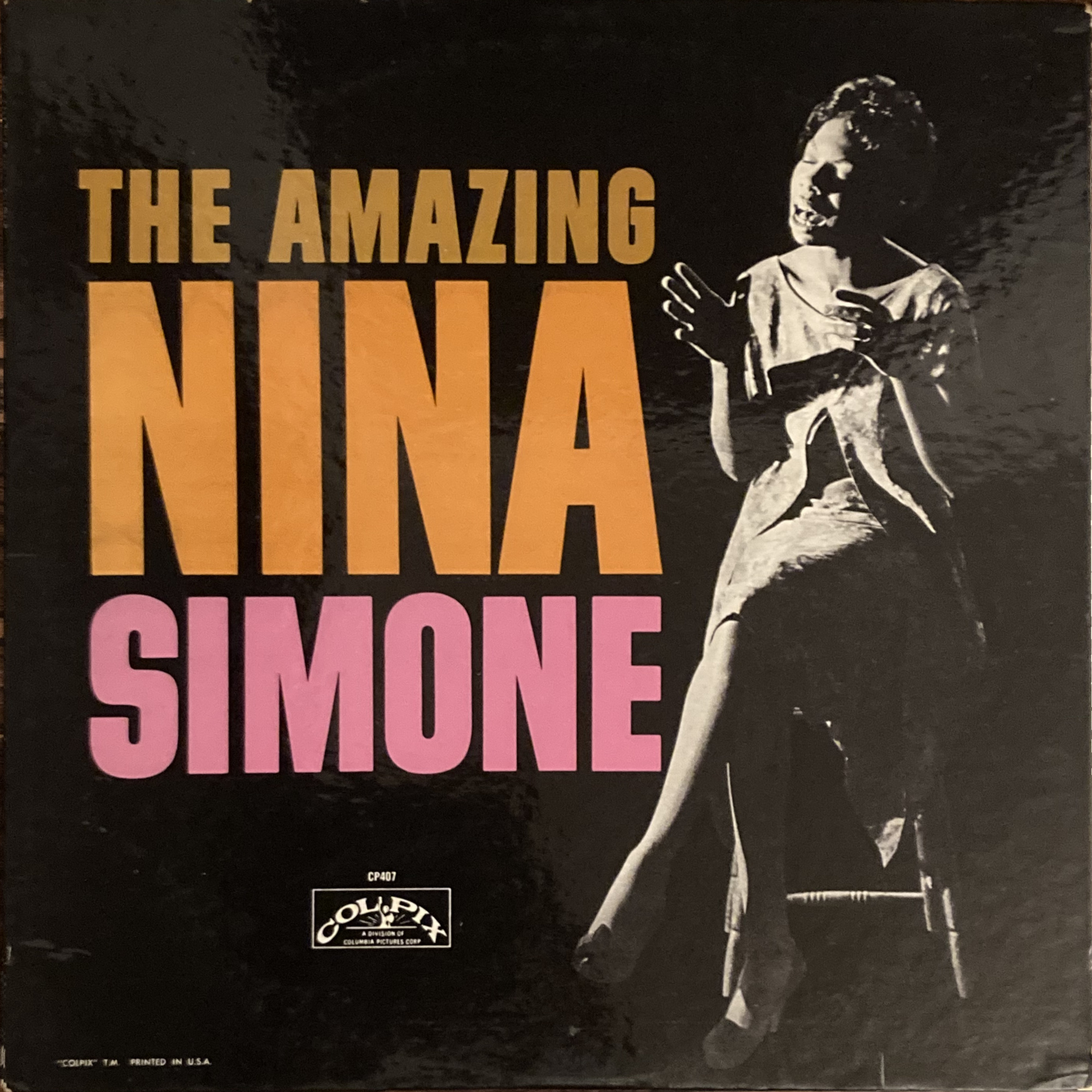
No.: CP-407
Title: THE AMAZING NINA SIMONE
Musician: Nina Simone
Recorded: 1959
Mono
Cover address:
Coating
Groove Guard
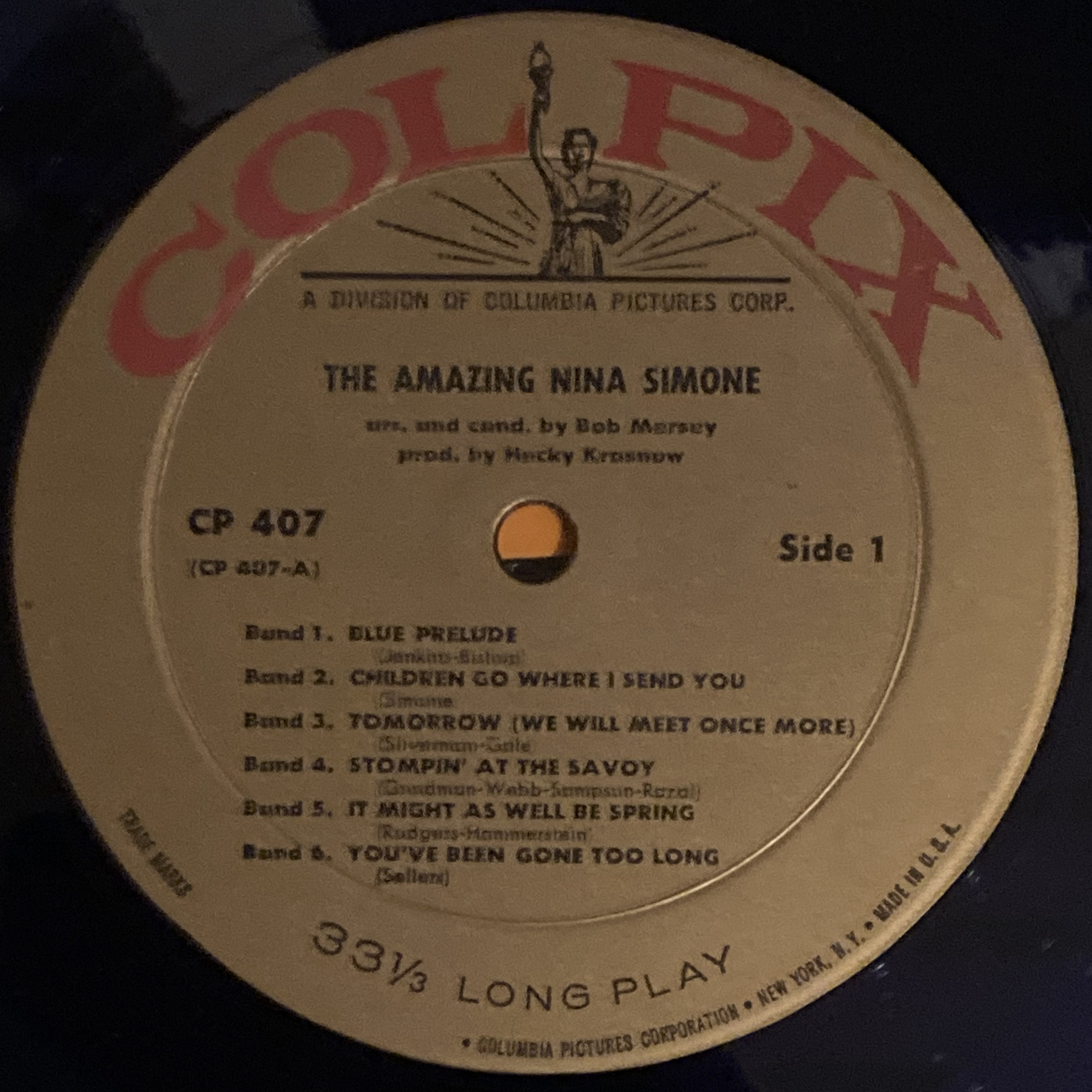
Label Side-1
Gold Background
Black Letter
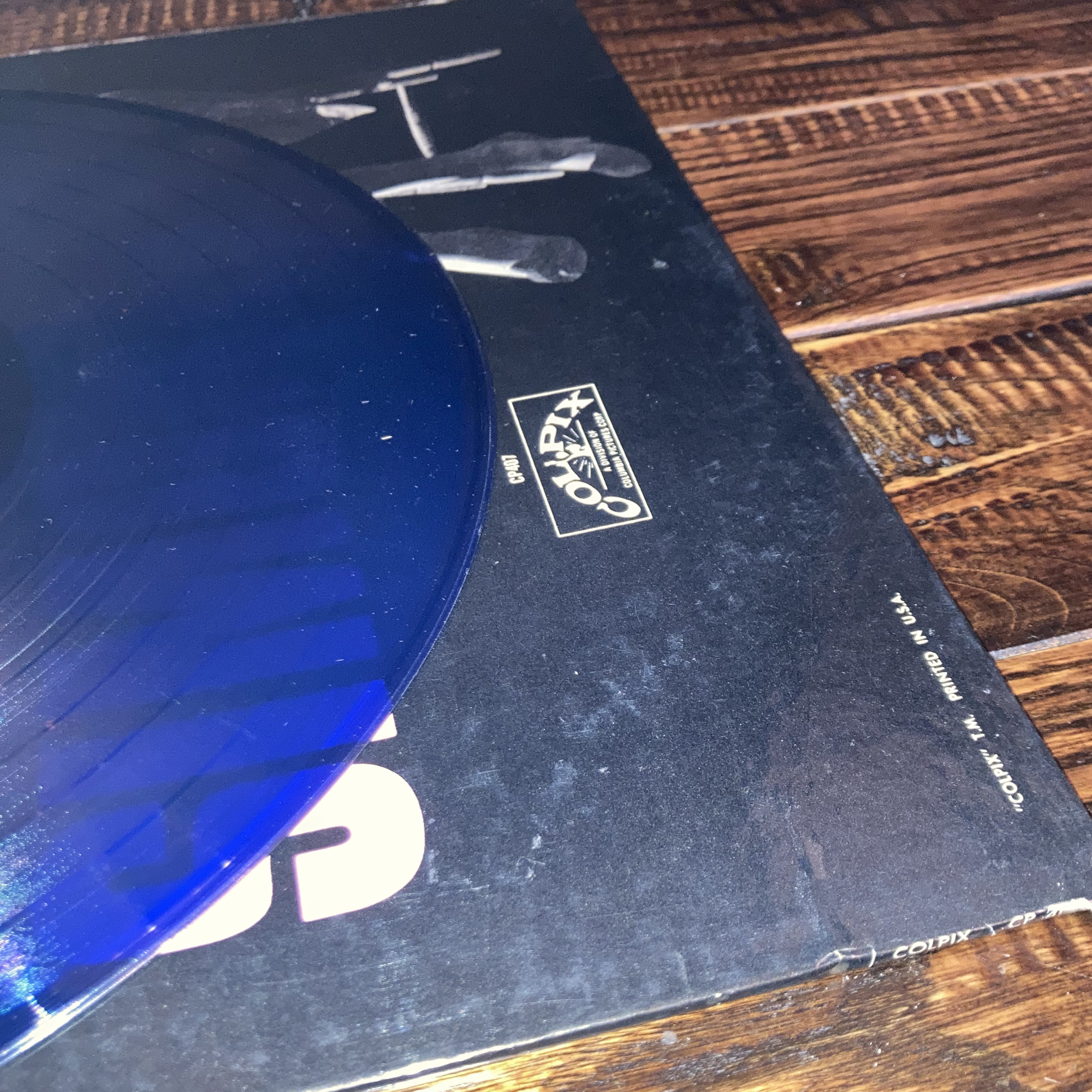
Blue Wax
Address: New York, N. Y.
Deep Groove
Dead Wax Info: 刻印RVG, CP407A, B21386, 6-25-59, Δ2181
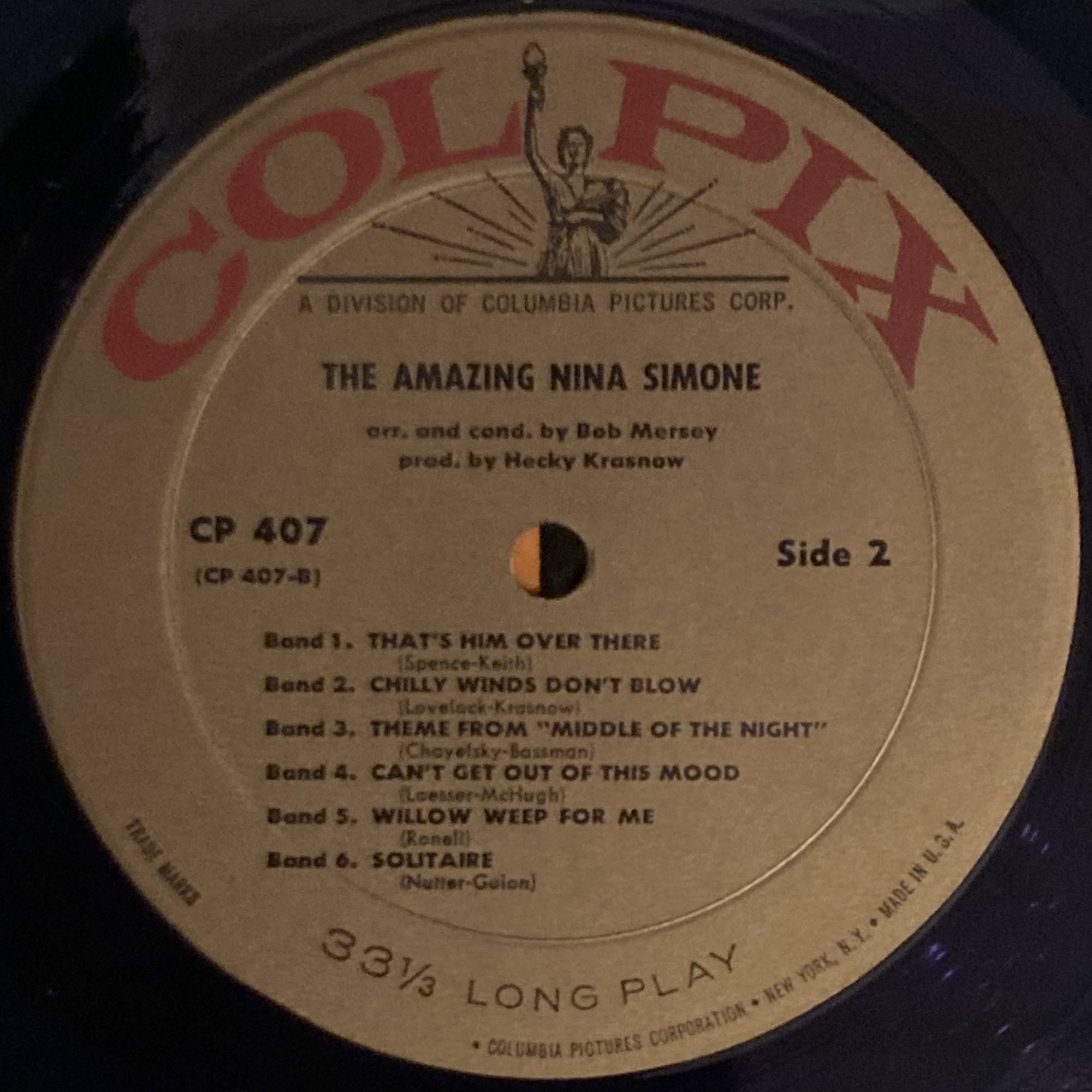
Label Side-2
Gold Background
Black Letter
Blue Wax
Address: New York, N. Y.
Deep Groove
Dead Wax Info: 刻印RVG, CP407B, B21387a, 6-25-59, Δ2182
Personnel-
Vocal: Nina Simone
Tracks-
Side-1
1) Blue Prelude 3’15”
2) Children Go Where I Send You 2’45”
3) Tomorrow 2’56”
4) Stompin’ at the Savoy 2’05”
5) It Might as Well be Spring 3’50”
6) You’ve Been Gone too Long 2’08”
Side-2
1) That’s him Over There 2’28”
2) Chilly Winds Don’t Blow 2’40”
3) Theme From ” Middle of the Night ” 2’25”
4) Can’t Get out of This Mood 2’30”
5) Willow Weep for Me 3’10”
6) Solitaire 3’20”
青色のカラーWAXがわかりにくいため別の写真も掲載します。
<裏ジャケ原文>
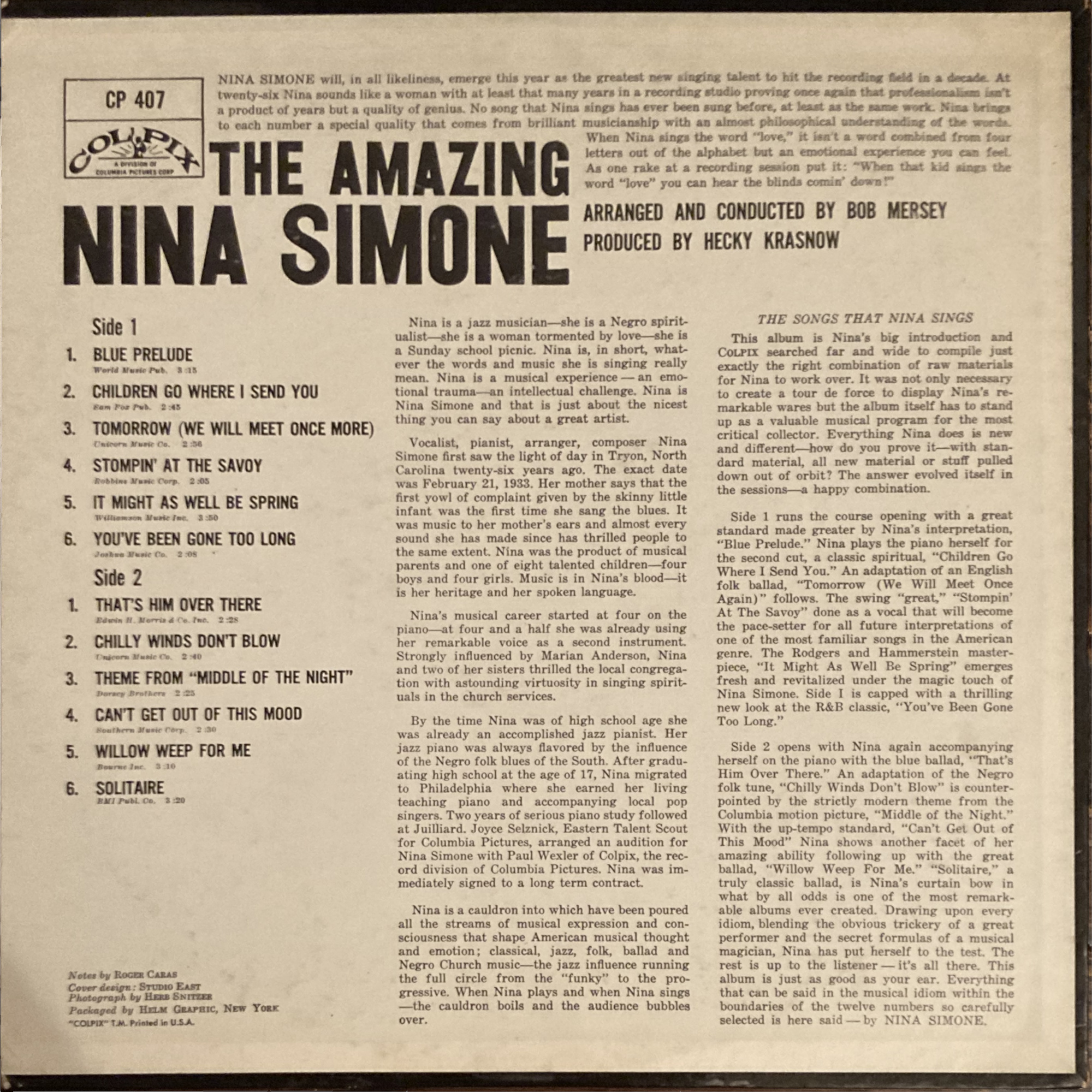
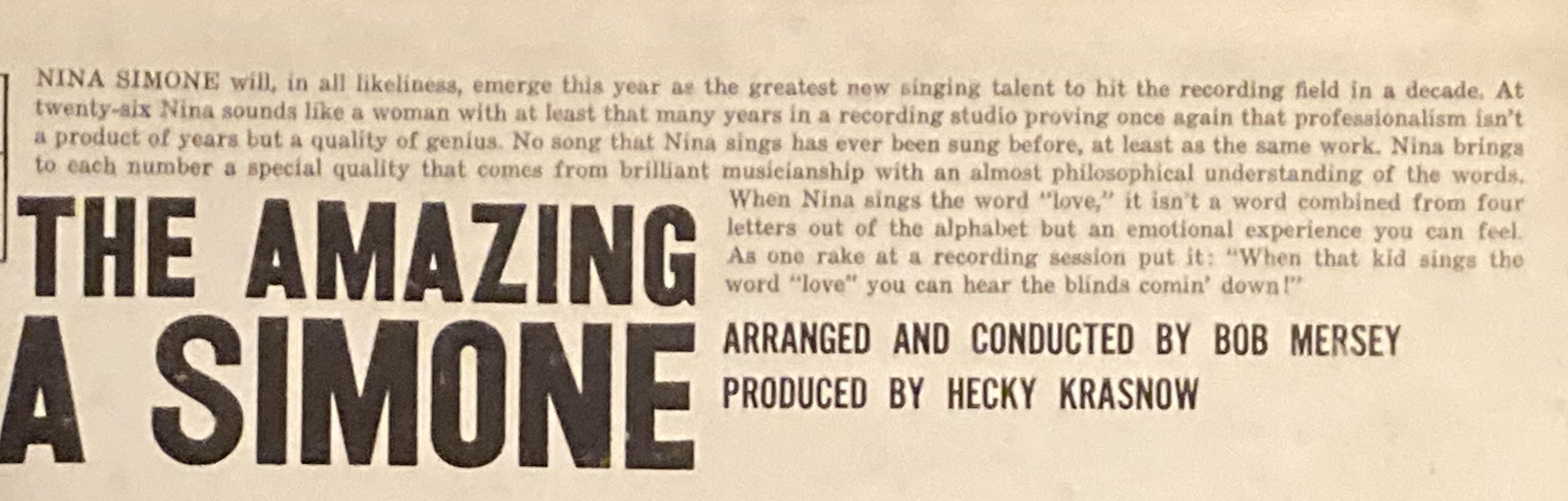
NINA SIMONE will, in all likeliness, emerge this year as the greatest new singing talent to hit the recording field in a decade. At twenty-six Nina sounds like a woman with at least that many years in a recording studio proving once again that professionalism isn’t a product of years but a quality of genius. No song that Nina sings has ever been sung before, at least as the same work. Nina bringa to each number a special quality that comes from brilliant musicianship with an almost philosophical understanding of the words. When Nina sings the word “love,” it isn’t a word combined from four letters out of the alphabet but an emotional experience you can feel. As one rake at a recording session put it: “When that kid sings the word “love” you can hear the blinds comin’ down!”
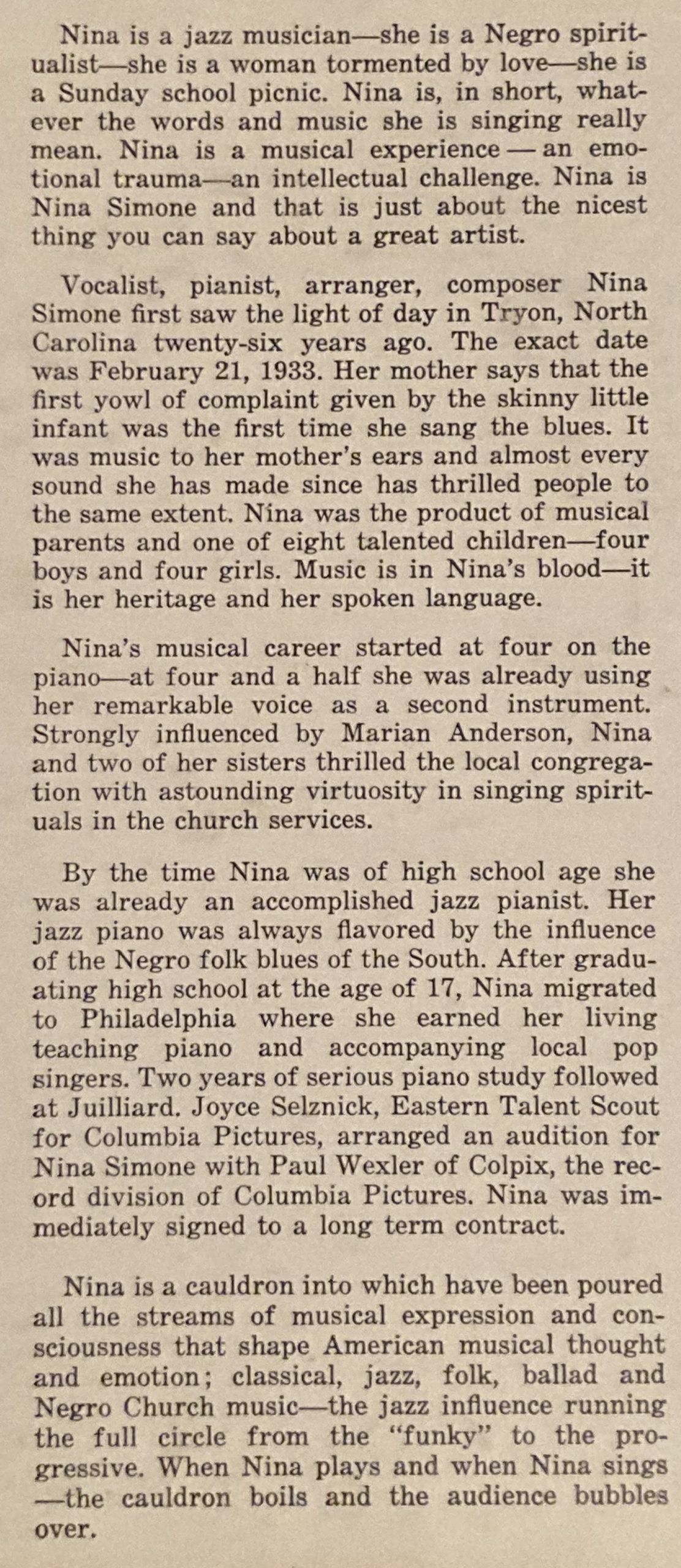
Nina is a jazz musician-she is a Negro spirit- ualist-she is a woman tormented by love- she is a Sunday school picnic. Nina is, in short, whatever the words and music she is singing really mean. Nina is a musical experience- tional trauma-an intellectual challenge. Nina is Nina Simone and that is just about the nicest thing you can say about a great artist.
Vocalist, pianist, arranger, composer Nina Simone first saw the light of day in Tryon, North Carolina twenty-six years ago. The exact date was February 21, 1933. Her mother says that the first yowl of complaint given by the skinny little infant was the first time she sang the blues. It was music to her mother’s ears and almost every sound she has made since has thrilled people to the same extent. Nina was the product of musical parents and one of eight talented children-four boys and four girls. Music is in Nina’s blood-it is her heritage and her spoken language.
Nina’s musical career started at four on the piano at four and a half she was already using her remarkable voice as a second instrument. Strongly influenced by Marian Anderson, Nina and two of her sisters thrilled the local congrega- tion with astounding virtuosity in singing spirit- uals in the church services.
By the time Nina was of high school age she was already an accomplished jazz pianist. Her jazz piano was always flavored by the influence of the Negro folk blues of the South. After gradu- ating high school at the age of 17, Nina migrated to Philadelphia where she earned her living teaching piano and accompanying local pop singers. Two years of serious piano study followed at Juilliard. Joyce Selznick, Eastern Talent Scout for Columbia Pictures, arranged an audition for Nina Simone with Paul Wexler of Colpix, the rec- ord division of Columbia Pictures. Nina was im- mediately signed to a long term contract.
Nina is a cauldron into which have been poured all the streams of musical expression and con- sciousness that shape American musical thought and emotion; classical, jazz, folk, ballad and Negro Church music-the jazz influence running the full circle from the “funky” to the pro- gressive. When Nina plays and when Nina sings -the cauldron boils and the audience bubbles
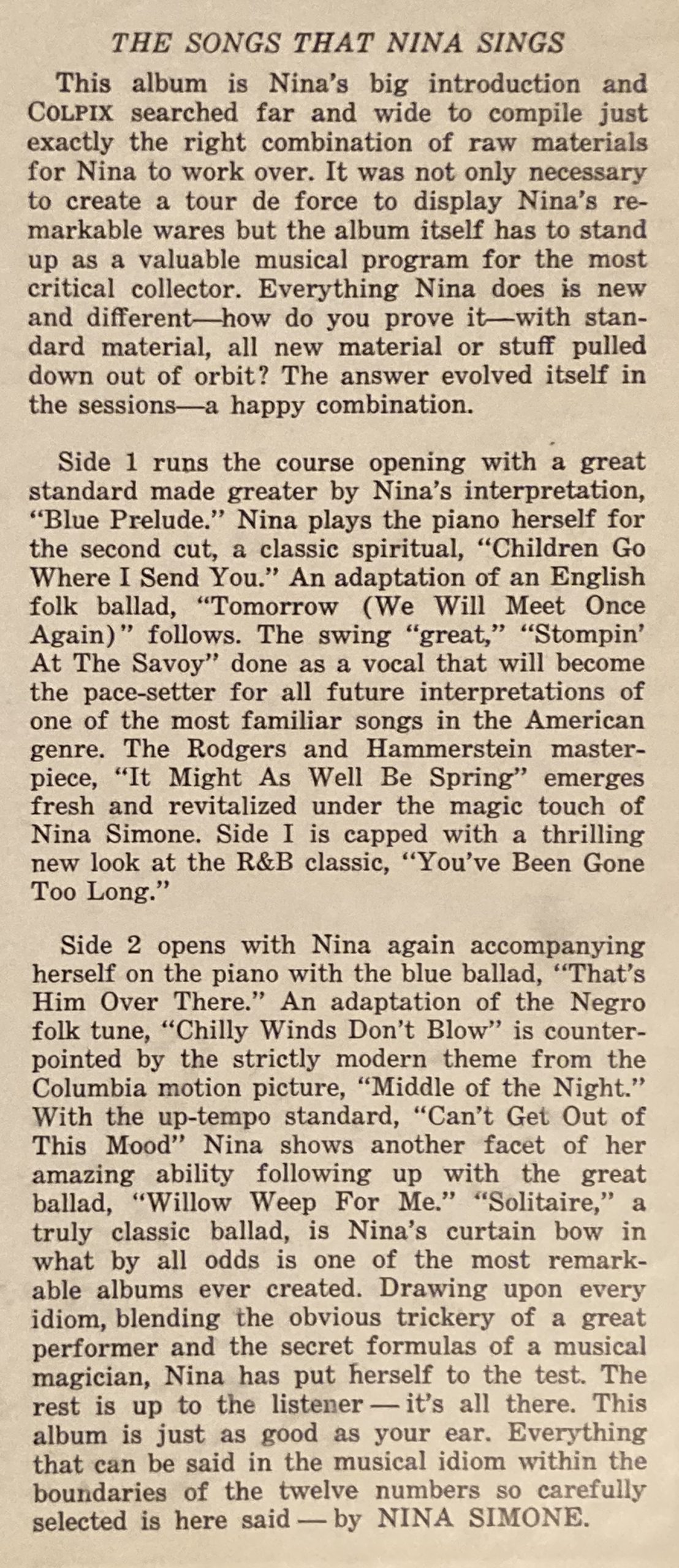
THE SONGS THAT NINA SINGS
This album is Nina’s big introduction and COLPIX searched far and wide to compile just exactly the right combination of raw materials for Nina to work over. It was not only necessary to create a tour de force to display Nina’s re- markable wares but the album itself has to stand up as a valuable musical program for the most critical collector. Everything Nina does is new and different-how do you prove it-with stan- dard material, all new material or stuff pulled down out of orbit? The answer evolved itself in the sessions-a happy combination.
Side 1 runs the course opening with a great standard made greater by Nina’s interpretation, “Blue Prelude.” Nina plays the piano herself for the second cut, a classic spiritual, “Children Go Where I Send You.” An adaptation of an English folk ballad, “Tomorrow (We Will Meet Once Again)” follows. The swing “great,” “Stompin’ At The Savoy” done as a vocal that will become the pace-setter for all future interpretations of one of the most familiar songs in the American genre. The Rodgers and Hammerstein master- piece, “It Might As Well Be Spring” emerges fresh and revitalized under the magic touch of Nina Simone. Side I is capped with a thrilling new look at the R&B classic, “You’ve Been Gone Too Long.”
Side 2 opens with Nina again accompanying herself on the piano with the blue ballad, “That’s Him Over There.” An adaptation of the Negro folk tune, “Chilly Winds Don’t Blow” is counter- pointed by the strictly modern theme from the Columbia motion picture, “Middle of the Night.” With the up-tempo standard, “Can’t Get Out of This Mood” Nina shows another facet of her amazing ability following up with the great ballad, “Willow Weep For Me.” “Solitaire,” a truly classic ballad, is Nina’s curtain bow in what by all odds is one of the most remark- able albums ever created. Drawing upon every idiom, blending the obvious trickery of a great performer and the secret formulas of a musical magician, Nina has put herself to the test. The rest is up to the listener-it’s all there. This album is just as good as your ear. Everything that can be said in the musical idiom within the boundaries of the twelve numbers so carefully selected is here said – by NINA SIMONE.
<裏ジャケ和訳>
※訳文の制作にはGoogleドライブとGoogle翻訳のお世話になりました。
ニーナ・シモンは、おそらくこの10年間でレコーディング界に登場した最も偉大な新人歌手となるだろう。26歳という若さながら、彼女の歌声はまるで何十年もスタジオで経験を積んできたかのような深みがあり、プロフェッショナリズムとは単なる年月の積み重ねではなく、天才的な資質によるものだということを改めて証明している。彼女が歌う曲はどれも、それまで歌われてきたものとは全く別物のように響く。ニーナは、卓越した音楽的才能と、歌詞に対する哲学的とも言える深い理解から生まれる特別な質感を、どの曲にも吹き込むのだ。彼女が「愛(ラブ)」という言葉を歌うとき、それは単なるアルファベット4文字の組み合わせではなく、聴き手が肌で感じ取れる感情そのものとなる。あるレコーディング・セッションの場にいた人物はこう表現した。「あの娘が『愛』と歌うと、まるで(親密な時間の訪れを告げるように)ブラインドが下りてくるのが聞こえるようだ」と。
ニーナはジャズ・ミュージシャンであり、黒人霊歌の歌い手であり、愛に苦しむ女性であり、日曜学校のピクニックのような無邪気さも持ち合わせている。要するにニーナは、その時歌っている歌詞や音楽が真に意味するそのものになりきるのだ。彼女は音楽的体験であり、感情を揺さぶる衝撃であり、知的な挑戦でもある。ニーナはニーナ・シモンであり、偉大なアーティストに対してこれ以上の賛辞はないだろう。
ボーカリスト、ピアニスト、アレンジャー、そして作曲家であるニーナ・シモンは、26年前、ノースカロライナ州トライオンで生を受けた。正確な生年月日は1933年2月21日である。母親によれば、その痩せた赤ん坊が最初に上げた不満の泣き声こそが、彼女が初めて歌ったブルースだったという。それは母親にとって心地よい響きであり、それ以来彼女が発するあらゆる音が、同じように人々の心を震わせてきた。ニーナは音楽家の両親のもとに生まれ、4人の男の子と4人の女の子からなる才能豊かな8人きょうだいの一人として育った。音楽はニーナの血に流れており、彼女の遺産であり、そして彼女の「言葉」そのものなのだ。
ニーナの音楽キャリアは4歳でピアノを始めたことから始まった。4歳半になる頃には、その素晴らしい歌声を「第二の楽器」として使いこなしていた。マリアン・アンダーソンに強く影響を受けたニーナは、2人の姉妹と共に、教会の礼拝でスピリチュアル(黒人霊歌)を驚くべき技巧で歌い上げ、地元の信徒たちを感動させた。
高校生になる頃には、彼女はすでに熟練したジャズ・ピアニストとなっていた。彼女のジャズ・ピアノには、常に南部黒人のフォーク・ブルースの影響が色濃く反映されていました。17歳で高校を卒業した後、ニーナはフィラデルフィアへ移り、ピアノを教えたり地元のポップ歌手の伴奏を務めたりして生計を立てていました。その後、ジュリアード音楽院で2年間にわたり本格的なピアノの研鑽を積みます。コロンビア・ピクチャーズの東部担当タレント・スカウトであったジョイス・セルズニックが、同社のレコード部門であるコルピックス(Colpix)のポール・ウェクスラーとのオーディションをセッティングし、ニーナ・シモンは即座に長期契約を勝ち取りました。
ニーナという存在は、アメリカの音楽的思考や感情を形作るあらゆる音楽表現と意識の流れ――クラシック、ジャズ、フォーク、バラード、そして黒人教会の音楽――が注ぎ込まれた「るつぼ」のようなものです。そこには、「ファンキー」なものからプログレッシブなものまで、ジャズのあらゆる要素が巡っています。彼女が演奏し、歌うとき、その「るつぼ」は沸き立ち、聴衆の心も熱くたぎるのです。
『ニーナの歌う歌(The Songs That Nina Sings)』
本作はニーナの本格的なデビュー作であり、コルピックス(Colpix)は彼女の才能を最大限に引き出すための楽曲を求めて、広範囲にわたり入念な選曲を行いました。ニーナの卓越した資質を披露する傑作を作り上げるだけでなく、アルバム自体が、目の肥えたコレクターをも唸らせる価値ある音楽作品でなければならなかったのです。ニーナの表現は常に斬新で独創的ですが、それをどう証明するのでしょうか?スタンダード・ナンバーか、完全な新曲か、それとも意外性のある選曲か。その答えはレコーディング・セッションの中で自然と導き出され、素晴らしい組み合わせが実現しました。
サイド1は、ニーナの解釈によってさらなる輝きを放つ名スタンダード「Blue Prelude」で幕を開けます。2曲目では、ニーナ自身がピアノを弾きながら、黒人霊歌の古典「Children Go Where I Send You」を歌い上げます。続いて、イギリスのフォーク・バラードをアレンジした「Tomorrow (We Will Meet Once Again)」が流れます。スウィングの名曲「Stompin’ At The Savoy」はボーカル・ナンバーとして披露され、アメリカ音楽を代表するこの曲の今後の解釈における新たな指標となるでしょう。ロジャース&ハマースタインの傑作「It Might As Well Be Spring」は、ニーナ・シモンの魔法のようなタッチによって、新鮮で生き生きとした響きを帯びて蘇ります。サイド1の最後を飾るのは、R&Bの古典「You’ve Been Gone Too Long」をスリリングに再構築した一曲です。
サイド2の冒頭では、再びニーナ自身のピアノ伴奏で、ブルージーなバラード「That’s Him Over There」が歌われます。黒人民謡をアレンジした「Chilly Winds Don’t Blow」に続き、コロンビア映画『真夜中の恋(Middle of the Night)』の極めて現代的なテーマ曲が対照的な彩りを添えます。アップテンポなスタンダード「Can’t Get Out of This Mood」でニーナはその驚くべき才能の新たな一面を見せ、続く名バラード「Willow Weep For Me」へとつなぎます。真の古典的バラードである「Solitaire」が、間違いなく歴史に残る傑作アルバムの最後を締めくくります。あらゆる音楽的語法を駆使し、偉大なパフォーマーとしての巧みな技と、音楽の魔術師だけが知る秘伝の術を融合させ、ニーナは自らの可能性を試しました。あとはリスナーの判断に委ねられています――ここにはすべてが詰まっているのですから。このアルバムの良さは、聴き手の耳次第です。厳選された全12曲という枠組みの中で、音楽的表現として語り得るすべてのことが、ここには語り尽くされています――ニーナ・シモンによって。
※訳文の制作にはGoogleドライブとGoogle翻訳のお世話になりました。
コメント