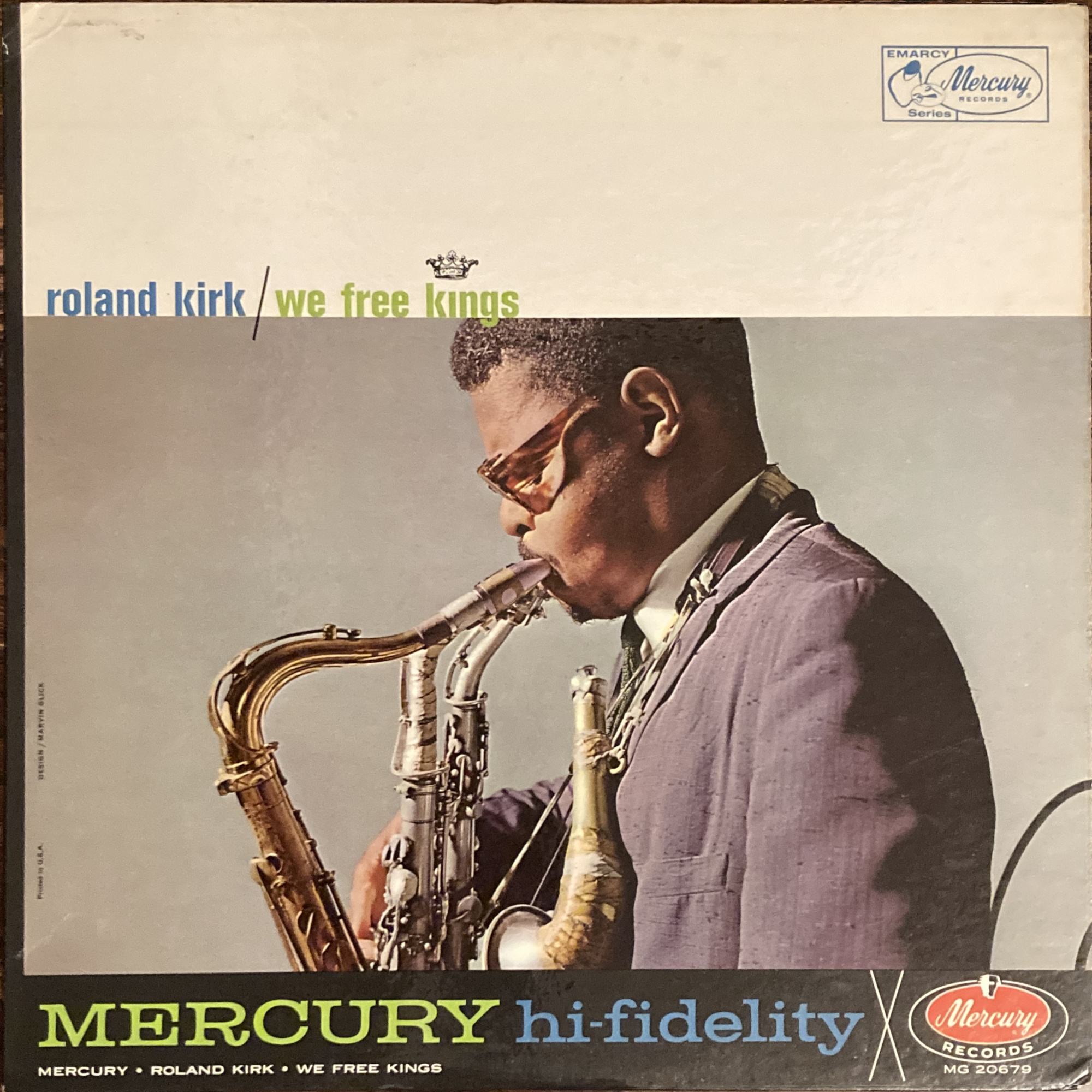
Label: MERCURY
No.: MG 20679
Title: WE FREE KINGS
Musician: ROLAND KIRK
Recorded: 1961/8/16, 1961/8/17
Monaural
Cover address: None
Coating有り
Groove Guard
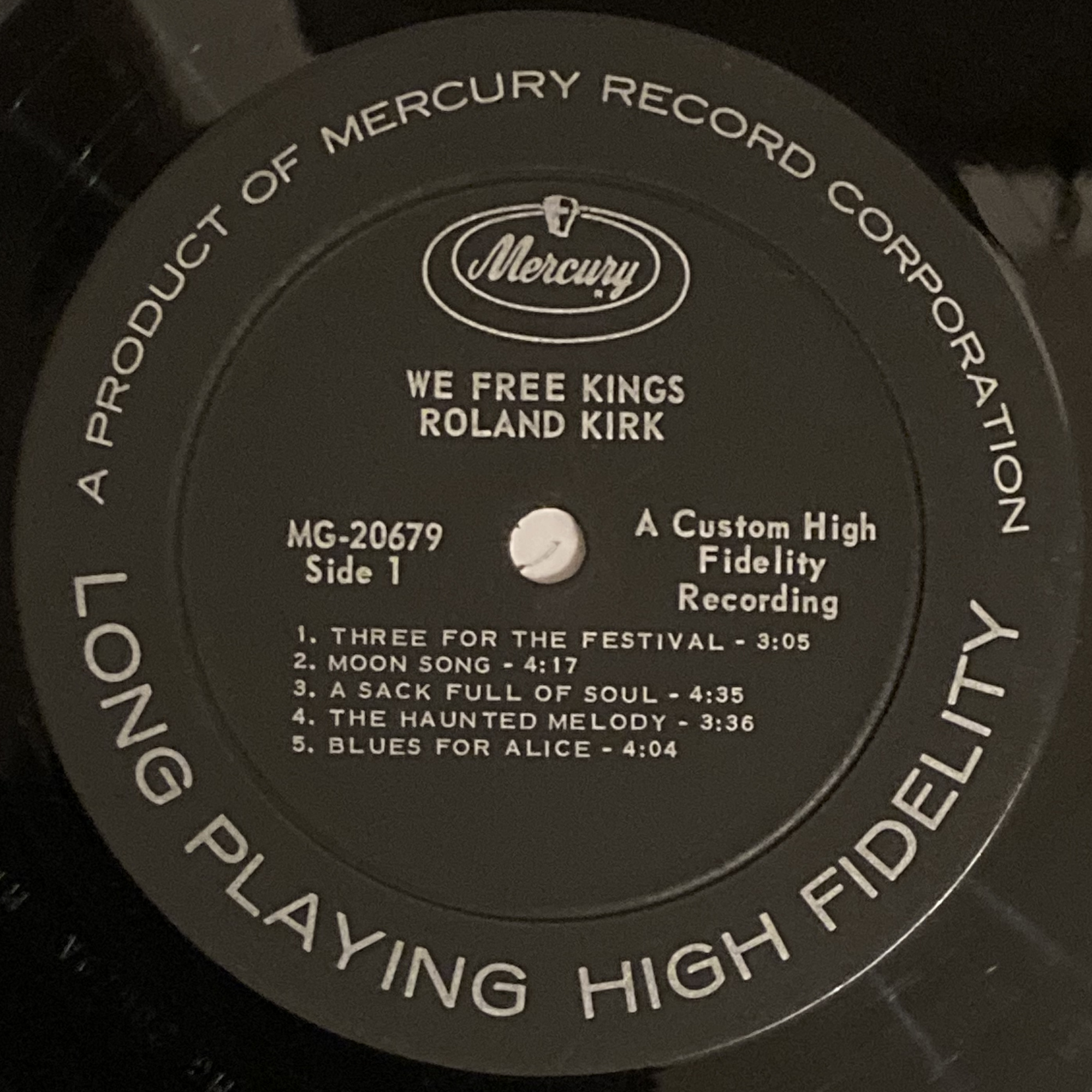
Label Side-1
Black Background
Silver Letter
Address:
Deep Groove
Dead Wax Info: MG20679A, M1, F
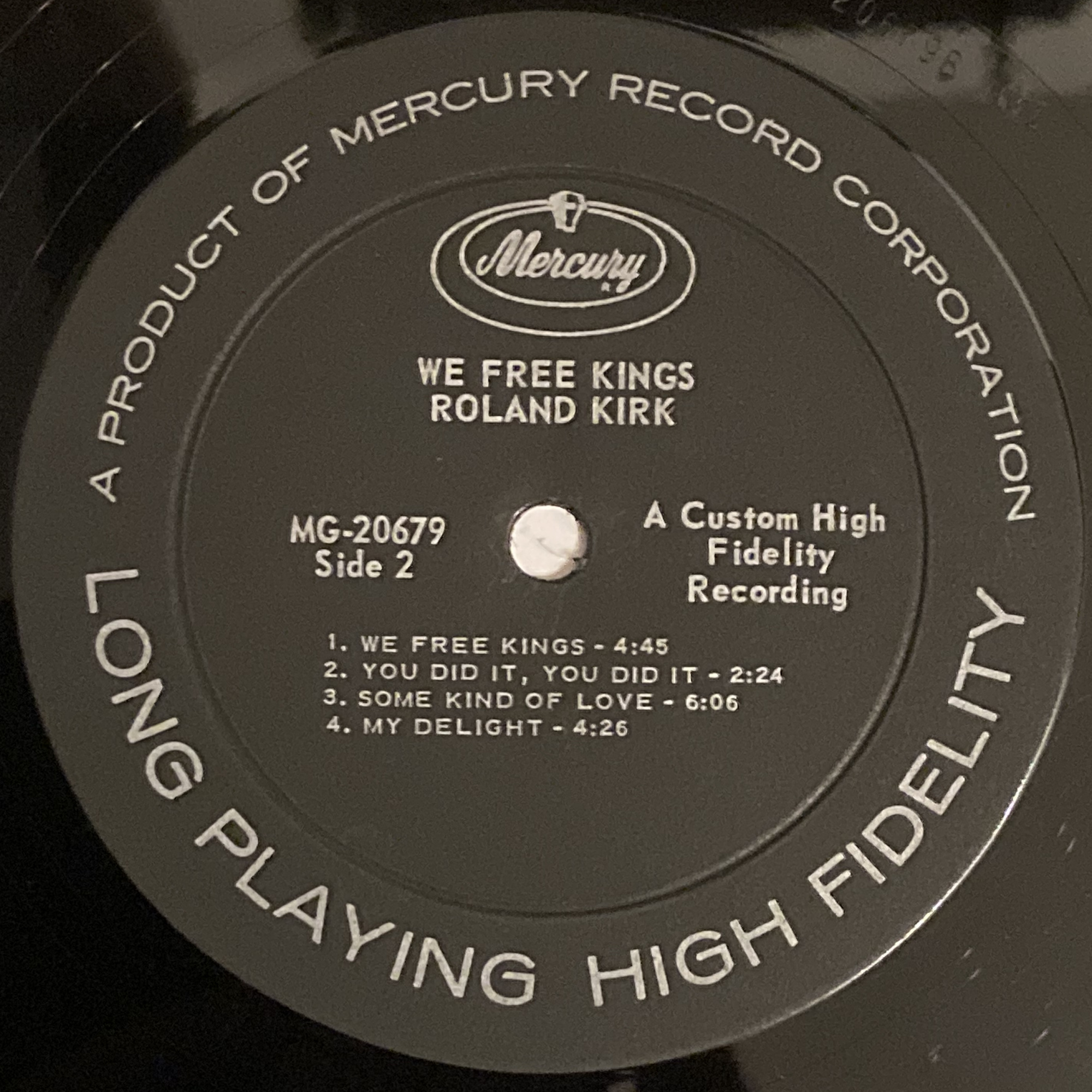
Label Side-2
Black Background
Silver Letter
Address:
Deep Groove
Dead Wax Info: MG20679B, M1, F
Personnel- (Side1-(3),(3),(5),Side2-(4))
Drums: Charles Persip
Bass: Art Davis
Piano: Richard Wyands
Tenor Sax, manzello, flute, stritch : Roland Kirk
Personnel- (Side1-(1),(2), Side2-(1),(2),(3))
Drums: Charles Persip
Bass: Wendell Marshall
Piano: Hank Jones
Tenor Sax, manzello, flute, stritch : Roland Kirk
Tracks-
Side-1
1) Three For the Festival 3’05”
2) Moon Song 4’17”
3) A Sack Full of Soul 4’35”
4) The Haunted Melody 3’36”
5) Blues for Alice 4’04”
Side-2
1) We Free Kings 4’45”
2) You Did it, You Did it 2’24”
3) Some Kind of Love 6’06”
4) My Delight 4’26”
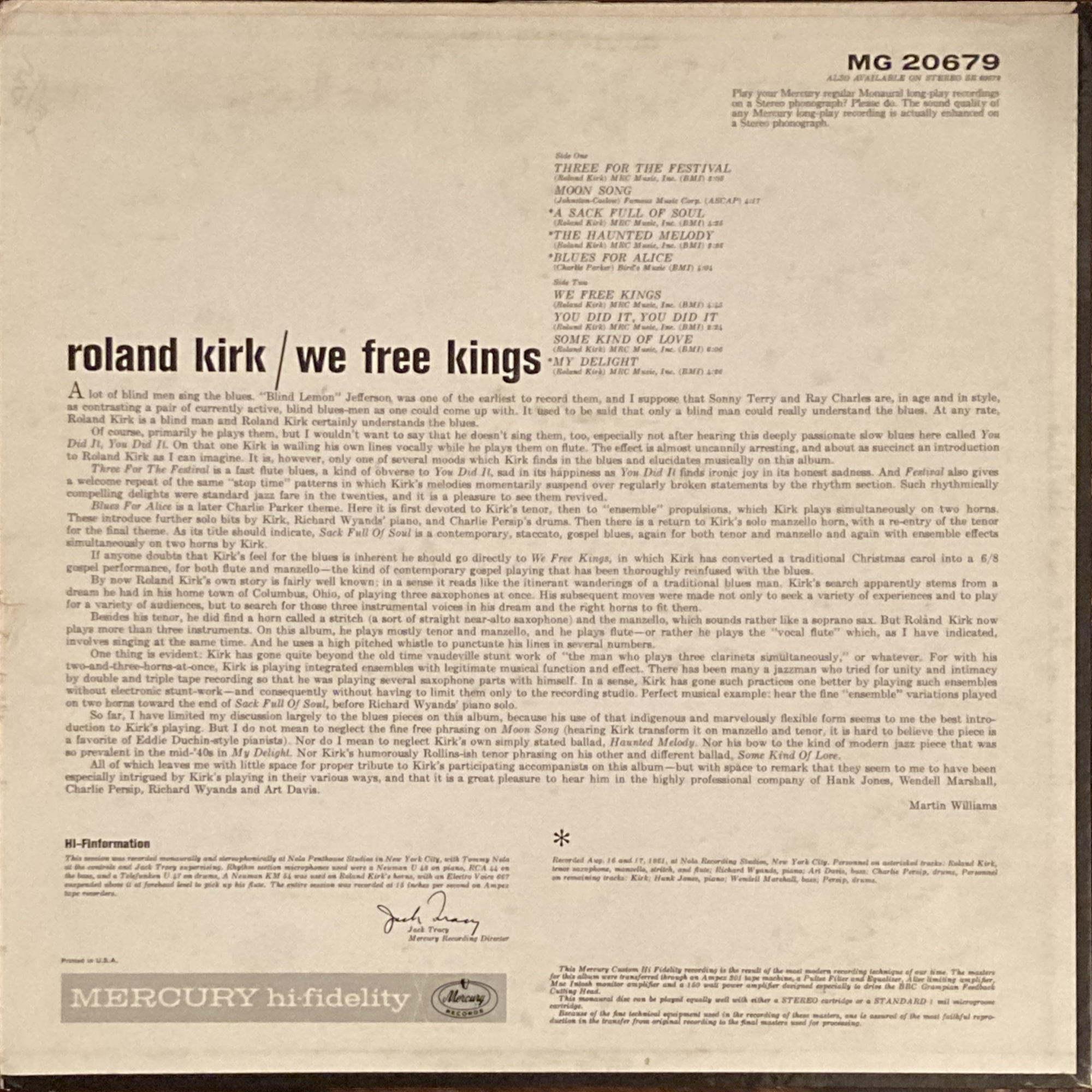
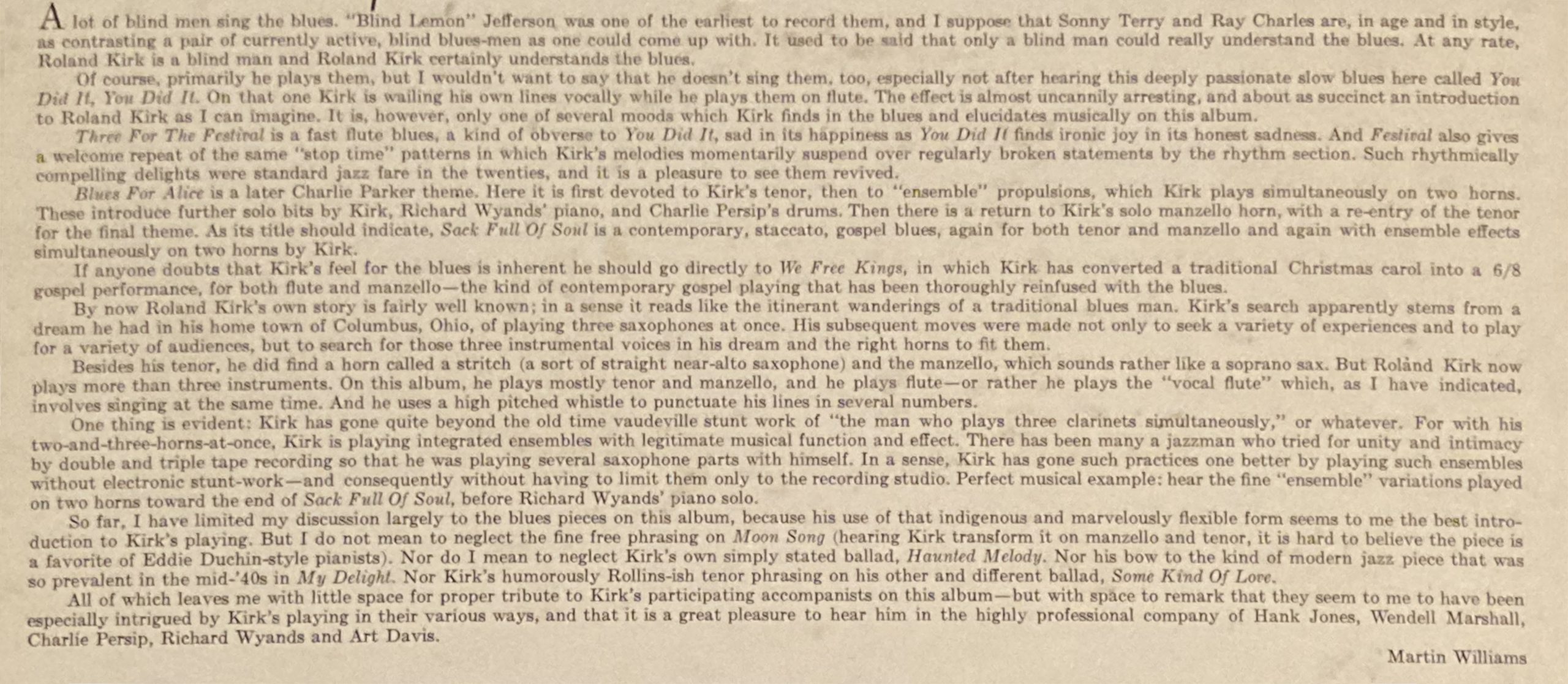
<裏ジャケ原文>
A lot of blind men sing the blues. “Blind Lemon” Jefferson was one of the earliest to record them, and I suppose that Sonny Terry and Ray Charles are, in age and in style,
as contrasting a pair of currently active, blind blues-men as one could come up with. It used to be said that only a blind man could really understand the blues. At any rate, Roland Kirk is a blind man and Roland Kirk certainly understands the blues.
Of course, primarily he plays them, but I wouldn’t want to say that he doesn’t sing them, too, especially not after hearing this deeply passionate slow blues here called You Did It, You Did It. On that one Kirk is wailing his own lines vocally while he plays them on flute. The effect is almost uncannily arresting, and about as succinct an introduction to Roland Kirk as I can imagine. It is, however, only one of several moods which Kirk finds in the blues and elucidates musically on this album.
Three For The Festival is a fast flute blues, a kind of obverse to You Did It, sad in its happiness as You Did It finds ironic joy in its honest sadness. And Festival also gives a welcome repeat of the same “stop time” patterns in which Kirk’s melodies momentarily suspend over regularly broken statements by the rhythm section. Such rhythmically compelling delights were standard jazz fare in the twenties, and it is a pleasure to see them revived.
Blues For Alice is a later Charlie Parker theme. Here it is first devoted to Kirk’s tenor, then to “ensemble” propulsions, which Kirk plays simultaneously on two horns. These introduce further solo bits by Kirk, Richard Wyands’ piano, and Charlie Persip’s drums. Then there is a return to Kirk’s solo manzello horn, with a re-entry of the tenor for the final theme. As its title should indicate, Sack Full Of Soul is a contemporary, staccato, gospel blues, again for both tenor and manzello and again with ensemble effects simultaneously on two horns by Kirk.
If anyone doubts that Kirk’s feel for the blues is inherent he should go directly to We Free Kings, in which Kirk has converted a traditional Christmas carol into a 6/8 gospel performance, for both flute and manzello-the kind of contemporary gospel playing that has been thoroughly reinfused with the blues.
By now Roland Kirk’s own story is fairly well known; in a sense it reads like the itinerant wanderings of a traditional blues man. Kirk’s search apparently stems from a dream he had in his home town of Columbus, Ohio, of playing three saxophones at once. His subsequent moves were made not only to seek a variety of experiences and to play for a variety of audiences, but to search for those three instrumental voices in his dream and the right horns to fit them.
Besides his tenor, he did find a horn called a stritch (a sort of straight near-alto saxophone) and the manzello, which sounds rather like a soprano sax. But Roland Kirk now plays more than three instruments. On this album, he plays mostly tenor and manzello, and he plays flute-or rather he plays the “vocal flute” which, as I have indicated, involves singing at the same time. And he uses a high pitched whistle to punctuate his lines in several numbers.
One thing is evident: Kirk has gone quite beyond the old time vaudeville stunt work of “the man who plays three clarinets simultaneously,” or whatever. For with his two-and-three-horns-at-once, Kirk is playing integrated ensembles with legitimate musical function and effect. There has been many a jazzman who tried for unity and intimacy by double and triple tape recording so that he was playing several saxophone parts with himself. In a sense, Kirk has gone such practices one better by playing such ensembles without electronic stunt-work-and consequently without having to limit them only to the recording studio. Perfect musical example: hear the fine “ensemble” variations played on two horns toward the end of Sack Full Of Soul, before Richard Wyands’ piano solo.
So far, I have limited my discussion largely to the blues pieces on this album, because his use of that indigenous and marvelously flexible form seems to me the best intro- duction to Kirk’s playing. But I do not mean to neglect the fine free phrasing on Moon Song (hearing Kirk transform it on manzello and tenor, it is hard to believe the piece is a favorite of Eddie Duchin-style pianists). Nor do I mean to neglect Kirk’s own simply stated ballad, Haunted Melody. Nor his bow to the kind of modern jazz piece that was so prevalent in the mid-’40s in My Delight. Nor Kirk’s humorously Rollins-ish tenor phrasing on his other and different ballad, Some Kind Of Love.
All of which leaves me with little space for proper tribute to Kirk’s participating accompanists on this album-but with space to remark that they seem to me to have been especially intrigued by Kirk’s playing in their various ways, and that it is a great pleasure to hear him in the highly professional company of Hank Jones, Wendell Marshall, Charlie Persip, Richard Wyands and Art Davis.
Martin Williams
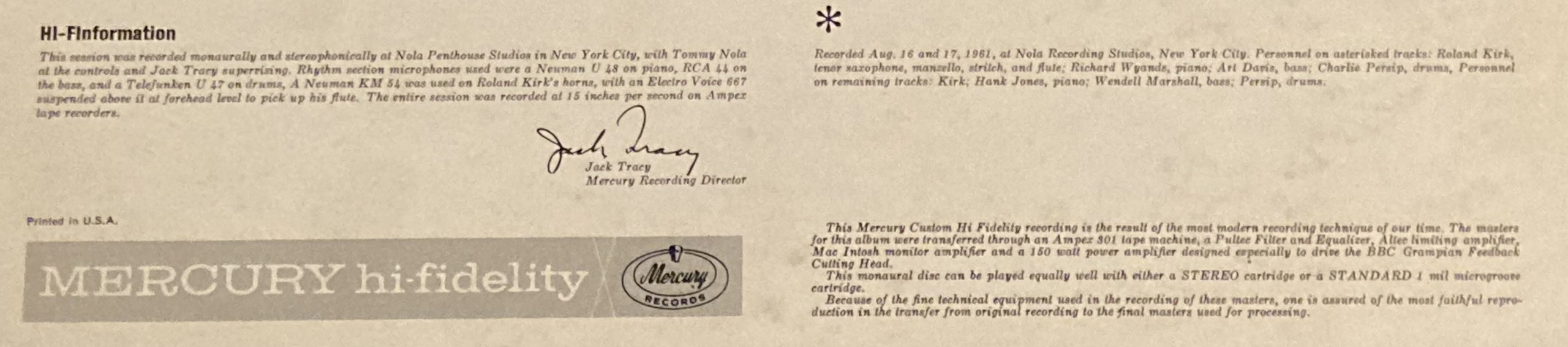
HI-Finformation
This session was recorded monaurally and stereophonically at Nola Penthouse Studios in New York City, with Tommy Nola at the controls and Jack Trary supervising. Rhythm section microphones used were a Neuman U 48 on piano, RCA 44 on the bass, and a Telefunken U 47 on drums, A Neuman KM 54 was used on Roland Kirk’s horns, with an Electro Voice 667 suspended abore it at forehead level to pick up his flute. The entire session was recorded at 15 inches per second on Amper lape recorders.
Printed in U.S.A.
Jack Tracy
MERCURY hi-fidelity
Jack Tracy
Mercury Recording Director
Mercury
RECORDS
Recorded Aug. 16 and 17, 1961, at Nola Recording Studios, New York City. Personnel on asterisked tracks: Roland Kirk, tenor saxophone, mansello, stritch, and flute; Richard Wyands, piano, Arl Davis, bass; Charlie Persip, drums, Personnel on remaining tracks: Kirk; Hank Jones, piano; Wendell Marshall, bass; Persip, druma.
This Mercury Custom Hi Fidelity recording is the result of the most modern recording technique of our time. The mastera for this album were transferred through an Amper 301 lape machine, a Pultee Filter and Equalizer, Allee limiting amplifier, Mac Intosh monitor amplifier and a 150 watt power amplifier designed especially to drive the BBC Grampian Feedback Culling Head. This monaural disc can be played equally well with either a STEREO cartridge or a STANDARD 1 mil microgroote cartridge.
Because of the fine technical equipment used in the recording of these masters, one is assured of the most faithful repro- duction in the transfer from original recording to the final masters used for processing.
<裏ジャケ和訳>
ブルースを歌う盲目のミュージシャンは少なくない。「ブラインド・レモン」ジェファーソンはその先駆的な録音を残した一人だが、現在も活動している盲目のブルース・ミュージシャンという括りで言えば、ソニー・テリーとレイ・チャールズは、年齢やスタイルの面で対照的な二人と言えるだろう。かつて「ブルースを真に理解できるのは盲目の者だけだ」と言われたものだが、いずれにせよ、ローランド・カークは盲目であり、間違いなくブルースを理解している。
もちろん、彼は主にブルースを演奏するのだが、歌わないとは言い切れない。特に、本作に収録された「You Did It, You Did It」という、極めて情熱的なスロー・ブルースを聴けばなおさらだ。この曲でカークは、フルートを吹きながら、それと重なるように自身の声でメロディを歌い上げている。その効果は、不思議なほど強烈で、ローランド・カークという人物を紹介するにあたって、これ以上ないほど的確な例と言えるだろう。もっとも、これはカークがブルースの中に見出し、本作で音楽的に表現している数あるムードの一つに過ぎない。
「Three For The Festival」は、フルートによるアップテンポなブルースで、「You Did It, You Did It」の裏返しのような存在だ。後者が「素直な悲しみの中に皮肉な喜び」を見出しているのに対し、前者は「幸福感の中に悲しみ」を宿している。またこの曲では、「ストップ・タイム」という手法が再び効果的に使われている。これは、リズム・セクションが刻むリズムの合間に、カークのメロディがふわりと宙に浮くように中断されるというものだ。こうしたリズムの妙は1920年代のジャズでは定番の手法であり、それが現代に蘇ったことは喜ばしい。
「Blues For Alice」は、チャーリー・パーカーが後年に手がけたテーマ曲である。ここではまずカークのテナー・サックスが主役となり、続いて二本の管楽器を同時に操るカークによる「アンサンブル」的な推進力が加わる。そこから、カーク自身、ピアニストのリチャード・ワイアンズ、ドラマーのチャーリー・パーシップによるソロが展開される。その後、再びカークのマンゼロ(管楽器の一種)によるソロに戻り、最後にはテナー・サックスが加わってテーマが奏でられる。タイトルが示す通り、「Sack Full Of Soul」は現代的なスタッカートの効いたゴスペル・ブルースであり、ここでもカークはテナーとマンゼロを駆使し、二本の楽器を同時に操るアンサンブル効果を披露している。カークのブルースに対する感覚が天性のものかどうか疑う人がいるなら、アルバム『ウィー・フリー・キングス(We Free Kings)』を聴いてみるといい。この作品で彼は、伝統的なクリスマス・キャロルを6/8拍子のゴスペル風の演奏へと昇華させている。フルートとマンゼロを駆使したそのサウンドは、ブルースの息吹が再び深く吹き込まれた、現代的なゴスペル演奏の好例と言える。
ローランド・カークの歩みは、今や広く知られている。ある意味、それは伝統的なブルースマンの放浪の旅にも似ている。彼が音楽を追求する原点は、故郷オハイオ州コロンバスで見た「3本のサックスを同時に演奏する」という夢にあるようだ。その後の彼の旅路は、単に多様な経験を積み、様々な聴衆の前で演奏するためだけのものではなかった。それは、夢の中に現れた3つの楽器の「声」と、それを体現するのにふさわしい楽器を探し求める旅でもあったのだ。
彼はテナー・サックスに加え、「ストリッチ」(アルト・サックスに近いストレート型の楽器)や、ソプラノ・サックスに近い響きを持つ「マンゼロ」を見つけ出した。しかし、現在のローランド・カークは3種類以上の楽器を操る。本作では主にテナー・サックスとマンゼロを演奏しているほか、フルート――正確には、前述したように演奏しながら歌う「ヴォーカル・フルート」――も披露している。さらに、いくつかの楽曲では、フレーズの合間に高音のホイッスルを吹き込み、アクセントを加えている。
一つ確かなことがある。カークの演奏は、かつてのヴォードヴィルで見られた「3本のクラリネットを同時に吹く」といった単なる見世物芸の域をはるかに超えているということだ。彼は2本、あるいは3本の楽器を同時に操ることで、音楽的に正当な機能と効果を伴う、統合されたアンサンブルを構築しているのだ。これまでにも、多重録音を駆使してサックスのパートを重ね、自分自身とのアンサンブルによって一体感や親密な響きを生み出そうとしたジャズ・ミュージシャンは数多くいた。ある意味、カークはそうした手法をさらに一歩進めたと言える。彼は電子的な仕掛けに頼ることなく、生演奏でこうしたアンサンブルを実現しており、それゆえに、レコーディング・スタジオという枠に縛られることもない。その完璧な音楽的実例として、『サック・フル・オブ・ソウル(Sack Full Of Soul)』の終盤、リチャード・ワイアンズのピアノ・ソロに入る前に行われる、2本の楽器による見事な「アンサンブル」・ヴァリエーションを聴いてみてほしい。
これまで、私は主にこのアルバムに収録されたブルース・ナンバーに焦点を当てて論じてきた。というのも、この土着でありながら驚くほど柔軟な形式を彼がどう扱っているかを知ることが、カークの演奏を理解するための最良の入り口になると思われるからだ。とはいえ、『ムーン・ソング』で見せた見事なフリー・フレージング(マンゼロやテナー・サックスを駆使してこの曲を変幻自在に操るカークの演奏を聴くと、これがエディ・デューチン風のピアニストたちに好まれる曲だとは信じがたいほどだ)を無視するつもりはない。カーク自身がシンプルに綴ったバラード『ホーンテッド・メロディ』や、1940年代半ばに広く親しまれたモダン・ジャズのスタイルに敬意を表した『マイ・ディライト』、あるいはもう一つのバラード『サム・カインド・オブ・ラヴ』で聴かせる、どこかロリンズを彷彿とさせるユーモラスなテナー・サックスのフレージングについても同様である。
紙面の都合上、本作でカークを支えた共演者たちに十分な賛辞を捧げる余裕はないが、彼ら一人ひとりがカークの演奏にそれぞれ異なる形で強く惹きつけられていたことは特筆しておきたい。ハンク・ジョーンズ、ウェンデル・マーシャル、チャーリー・パーシップ、リチャード・ワイアンズ、そしてアート・デイヴィスといった、極めてプロフェッショナルな面々を従えたカークの演奏を聴くのは、この上ない喜びである。
マーティン・ウィリアムズ
録音情報
本セッションは、ニューヨークのノラ・ペントハウス・スタジオ(Nola Penthouse Studios)にて、モノラルおよびステレオで録音されました。トミー・ノラが録音操作を担当し、ジャック・トレイシーが監修を務めました。リズム・セクションの録音には、ピアノにノイマンU48、ベースにRCA44、ドラムにテレフンケンU47というマイクが使用されました。ローランド・カークの管楽器にはノイマンKM54を使用し、その上方の額の高さにエレクトロボイス667を吊るしてフルートの音を拾いました。セッション全体は、アンペックス(Ampex)社製のテープレコーダーを用い、テープスピード15インチ/秒で録音されています。
米国製
ジャック・トレイシー
マーキュリー・ハイ・フィデリティ
ジャック・トレイシー
マーキュリー・レコーディング・ディレクター
マーキュリー・レコード
1961年8月16日および17日、ニューヨークのノラ・レコーディング・スタジオにて録音。アスタリスク(*)が付いたトラックの参加メンバー:ローランド・カーク(テナー・サックス、マンゼロ、ストリッチ、フルート)、リチャード・ワイアンズ(ピアノ)、アート・デイヴィス(ベース)、チャーリー・パーシップ(ドラム)。その他のトラックの参加メンバー:カーク、ハンク・ジョーンズ(ピアノ)、ウェンデル・マーシャル(ベース)、パーシップ(ドラム)。
この「マーキュリー・カスタム・ハイ・フィデリティ」録音は、当時の最先端の録音技術を駆使して制作されました。本アルバムのマスター音源は、アンペックス301テープレコーダー、パルテック(Pultec)製フィルターおよびイコライザー、アルテック(Altec)製リミッティング・アンプ、マッキントッシュ(McIntosh)製モニター・アンプ、そしてBBCグランピアン(BBC Grampian)社製フィードバック・カッティング・ヘッドを駆動するために特別設計された150ワット・パワーアンプを経由して作成されています。本モノラル盤は、ステレオ用カートリッジ、あるいは標準的な1ミル・マイクログルーブ用カートリッジのいずれを使用しても、同様に良好な再生が可能です。
マスター音源の録音に優れた技術機材が使用されているため、オリジナル録音から最終的なマスターへの転送工程においても、極めて忠実な再現が保証されています。
※訳文の制作にはGoogleドライブとGoogle翻訳のお世話になりました。
コメント