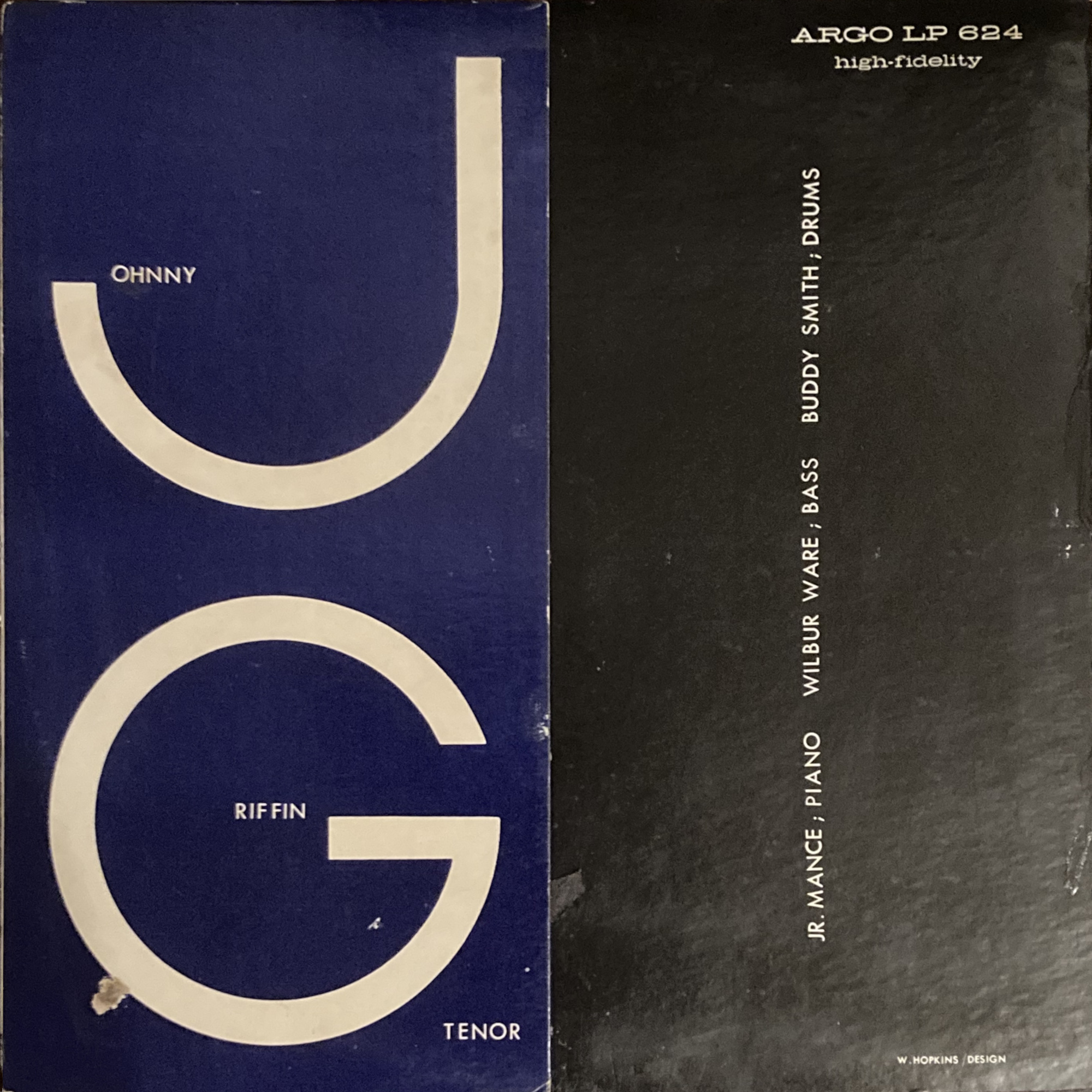
Label: ARGO
No.:LP-624
Title: J.G.TENOR
Musician: JOHNNY GRIFFIN (4)
Recorded: 1956
Monaural
Cover address: 2120 S. Michigan Av. CHICAGO 16, ILL.
Coating無し
Groove Guard
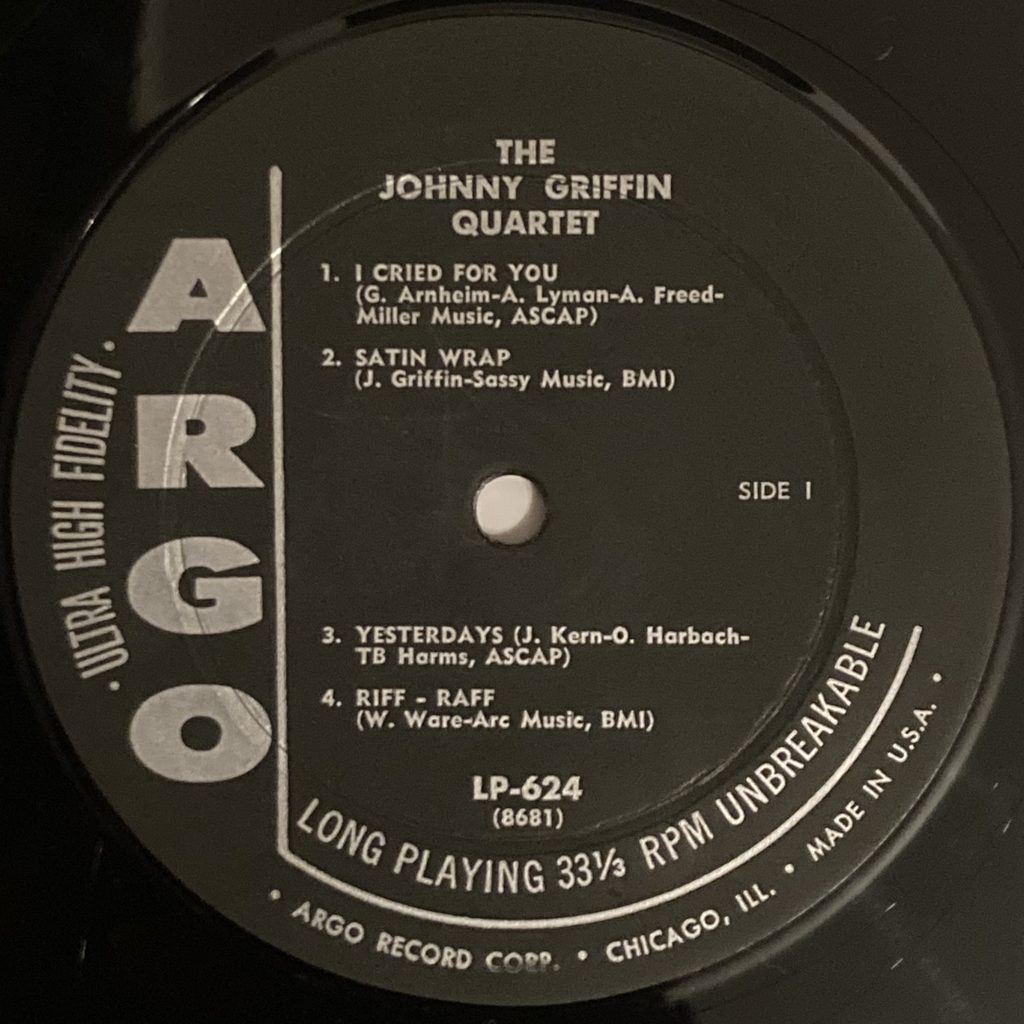
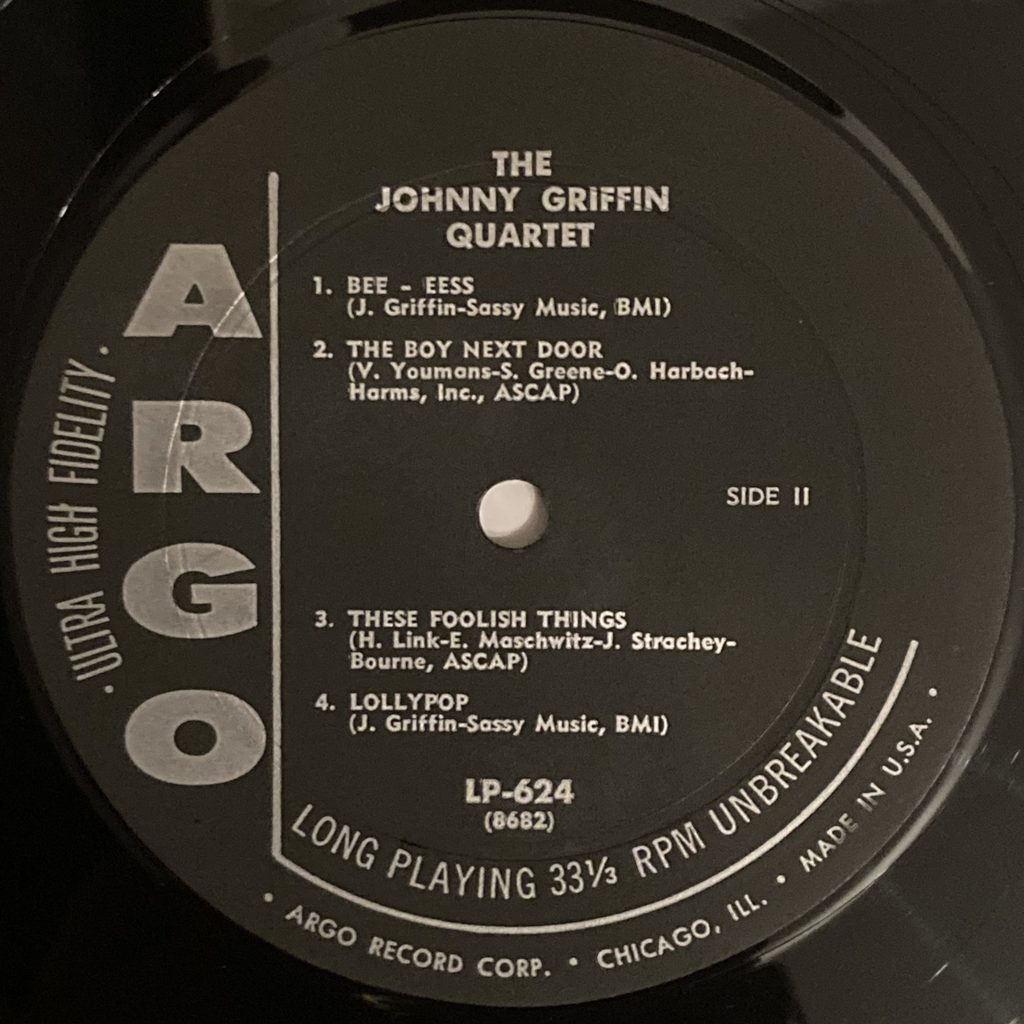
Label Side-1
Black Background
Silver Letter
Address: CHICAGO ILL
Deep Groove
Dead Wax Info: CHESS-LP-8681
Label Side-2
Black Background
Silver Letter
Address: CHICAGO ILL
Deep Groove
Dead Wax Info: CHESS-LP-8682
Personnel-
Drums: Buddy Smith
Bass: Wilbur Ware
Piano: Junior Mance
Tenor Sax: Johnny Griffin
Tracks-
Side-1
1) I Cried For You 3’30”
2) Satin Wrap 3’00”
3) Yesterdays 2’30”
4) Riff-Raff 3’00”
Side-2
1) Bee-Ees 3’50”
2) The Boy Next Door 3’15”
3) These Foolish Things 3’35”
4) Lollypop 3’05”
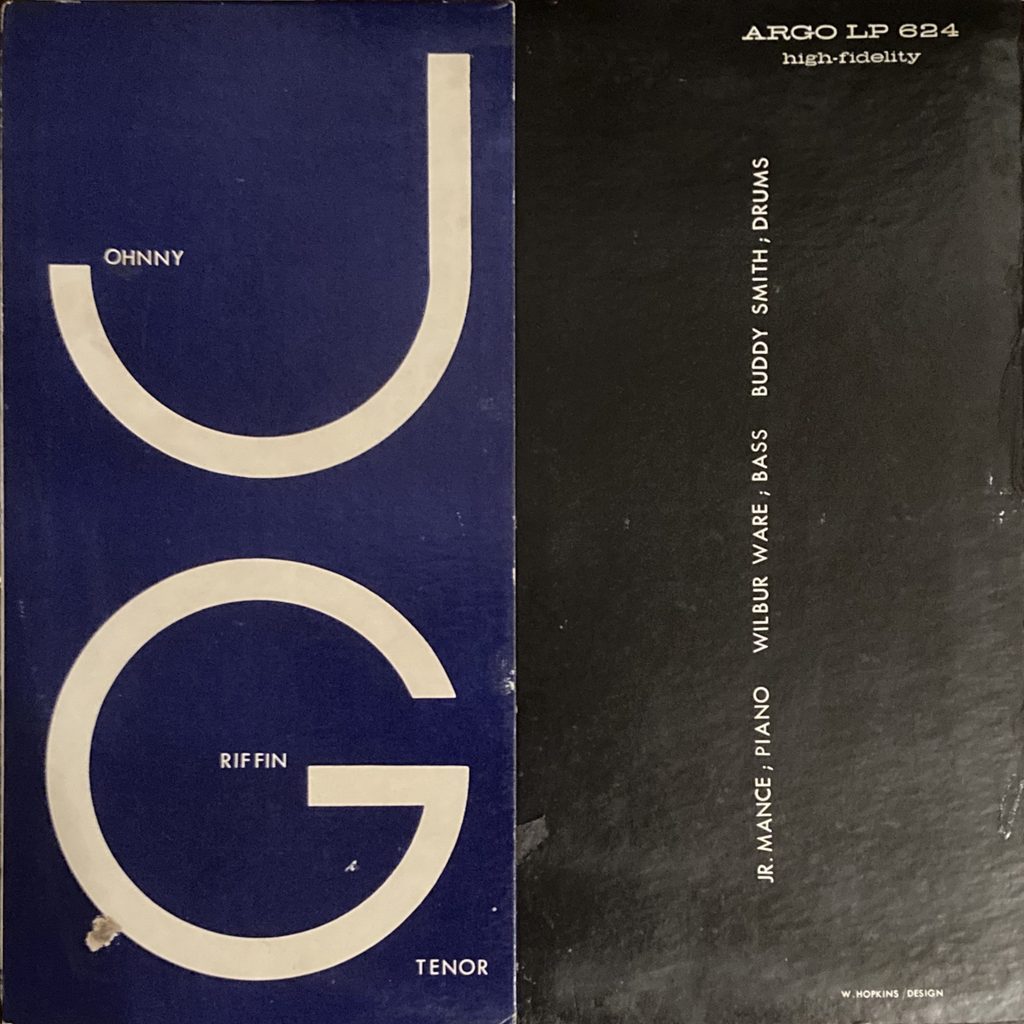
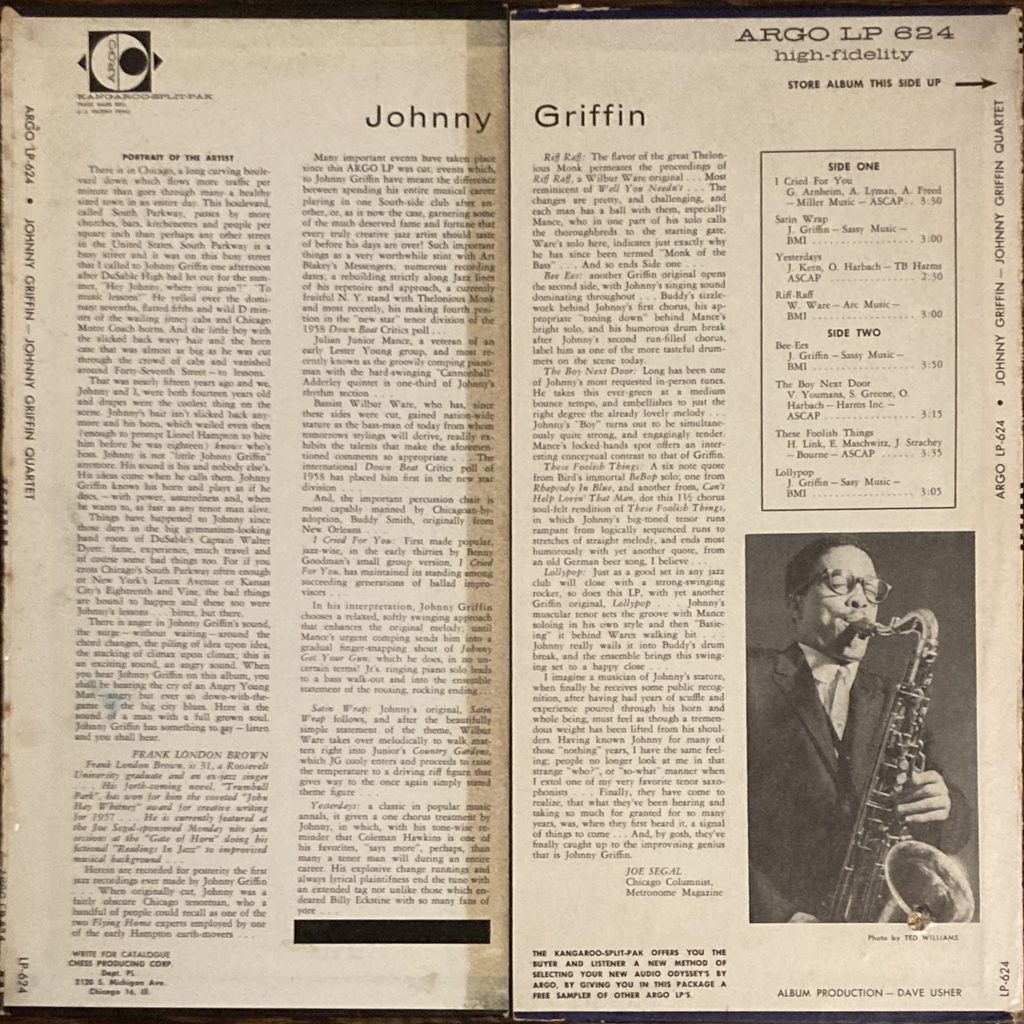
本盤のジャケットは真中から左右に分かれるタイプです。(カンガルー・スプリット・パック)
ジャケット写真の中央に縦に入っている白いラインは切れ目の部分です。
本盤はいわゆるオリジナルですが、残念なことに最初の販売時に安売りセールにかかったことを示す穴が左下に貫通状態で空いています。
<裏ジャケ原文>
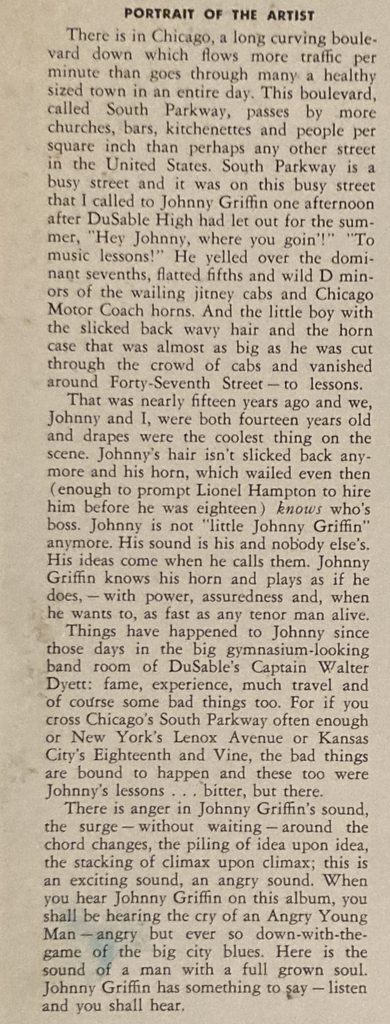
PORTRAIT OF THE ARTIST
There is in Chicago, a long curving boule- vard down which flows more traffic per minute than goes through many a healthy sized town in an entire day. This boulevard, called South Parkway, passes by more churches, bars, kitchenettes and people per square inch than perhaps any other street in the United States. South Parkway is a busy street and it was on this busy street that I called to Johnny Griffin one afternoon after DuSable High had let out for the sum- mer, “Hey Johnny, where you goin’!” “To music lessons!” He yelled over the domi- nant sevenths, flatted fifths and wild D min- ors of the wailing jitney cabs and Chicago Motor Coach horns. And the little boy with the slicked back wavy hair and the horn case that was almost as big as he was cut through the crowd of cabs and vanished around Forty-Seventh Street – to lessons.
That was nearly fifteen years ago and we, Johnny and I, were both fourteen years old and drapes were the coolest thing on the scene. Johnny’s hair isn’t slicked back any- more and his horn, which wailed even then (enough to prompt Lionel Hampton to hire him before he was eighteen) knows who’s boss. Johnny is not “little Johnny Griffin” anymore. His sound is his and nobody else’s. His ideas come when he calls them. Johnny Griffin knows his horn and plays as if he does, – with power, assuredness and, when he wants to, as fast as any tenor man alive.
Things have happened to Johnny since those days in the big gymnasium-looking band room of DuSable’s Captain Walter Dyett: fame, experience, much travel and of course some bad things too. For if you cross Chicago’s South Parkway often enough or New York’s Lenox Avenue or Kansas City’s Eighteenth and Vine, the bad things are bound to happen and these too were Johnny’s lessons.. bitter, but there.
There is anger in Johnny Griffin’s sound, the surge – without waiting – around the chord changes, the piling of idea upon idea, the stacking of climax upon climax; this is an exciting sound, an angry sound. When you hear Johnny Griffin on this album, you shall be hearing the cry of an Angry Young Man angry but ever so down-with-the- game of the big city blues. Here is the sound of a man with a full grown soul. Johnny Griffin has something to say -listen and you shall hear.
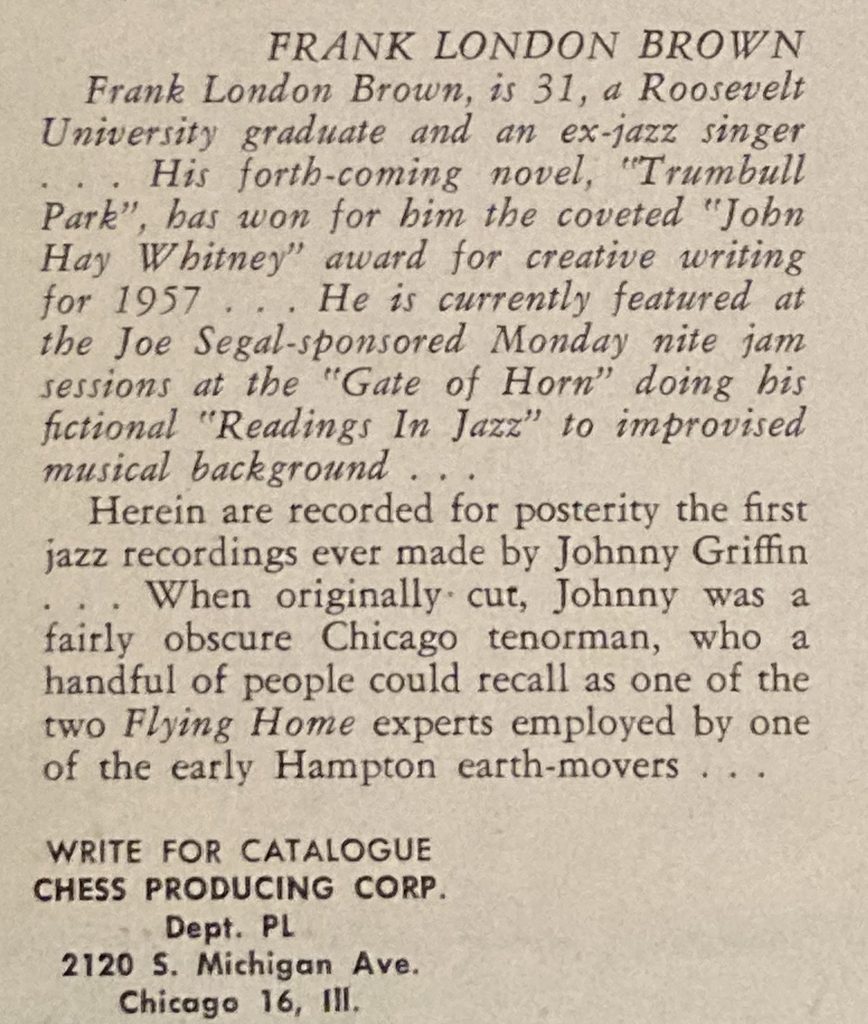
FRANK LONDON BROWN
Frank London Brown, is 31, a Roosevelt University graduate and an ex-jazz singer His forth-coming novel, “Trumbull Park”, has won for him the coveted “John Hay Whitney” award for creative writing for 1957. He is currently featured at the Joe Segal-sponsored Monday nite jam sessions at the “Gate of Horn” doing his fictional “Readings In Jazz” to improvised musical background.
Herein are recorded for posterity the first jazz recordings ever made by Johnny Griffin When originally cut, Johnny was a fairly obscure Chicago tenorman, who a handful of people could recall as one of the two Flying Home experts employed by one of the early Hampton earth-movers
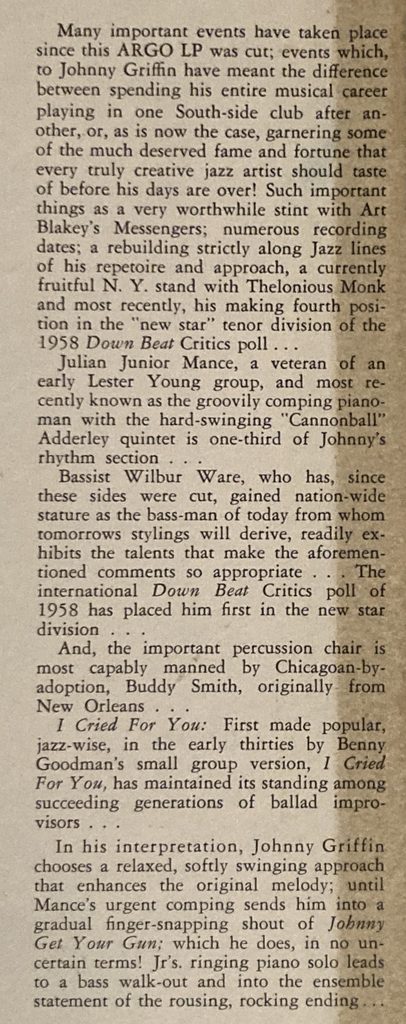
Many important events have taken place. since this ARGO LP was cut; events which, to Johnny Griffin have meant the difference between spending his entire musical career playing in one South-side club after an- other, or, as is now the case, garnering some of the much deserved fame and fortune that every truly creative jazz artist should taste of before his days are over! Such important things as a very worthwhile stint with Art Blakey’s Messengers; numerous recording dates; a rebuilding strictly along Jazz lines of his repetoire and approach, a currently fruitful N. Y. stand with Thelonious Monk and most recently, his making fourth posi- tion in the “new star” tenor division of the 1958 Down Beat Critics poll…
Julian Junior Mance, a veteran of an early Lester Young group, and most re- cently known as the groovily comping piano- man with the hard-swinging “Cannonball” Adderley quintet is one-third of Johnny’s rhythm section..
Bassist Wilbur Ware, who has, since these sides were cut, gained nation-wide stature as the bass-man of today from whom tomorrows stylings will derive, readily ex- hibits the talents that make the aforemen- tioned comments so appropriate . . . The international Down Beat Critics poll of 1958 has placed him first in the new star division .
And, the important percussion chair is most capably manned by Chicagoan-by- adoption, Buddy Smith, originally from New Orleans.
I Cried For You: First made popular, jazz-wise, in the early thirties by Benny Goodman’s small group version, I Cried For You, has maintained its standing among succeeding generations of ballad impro- visors.
In his interpretation, Johnny Griffin chooses a relaxed, softly swinging approach that enhances the original melody; until Mance’s urgent comping sends him into a gradual finger-snapping shout of Johnny Get Your Gun; which he does, in no un- certain terms! Jr’s. ringing piano solo leads to a bass walk-out and into the ensemble statement of the rousing, rocking ending.
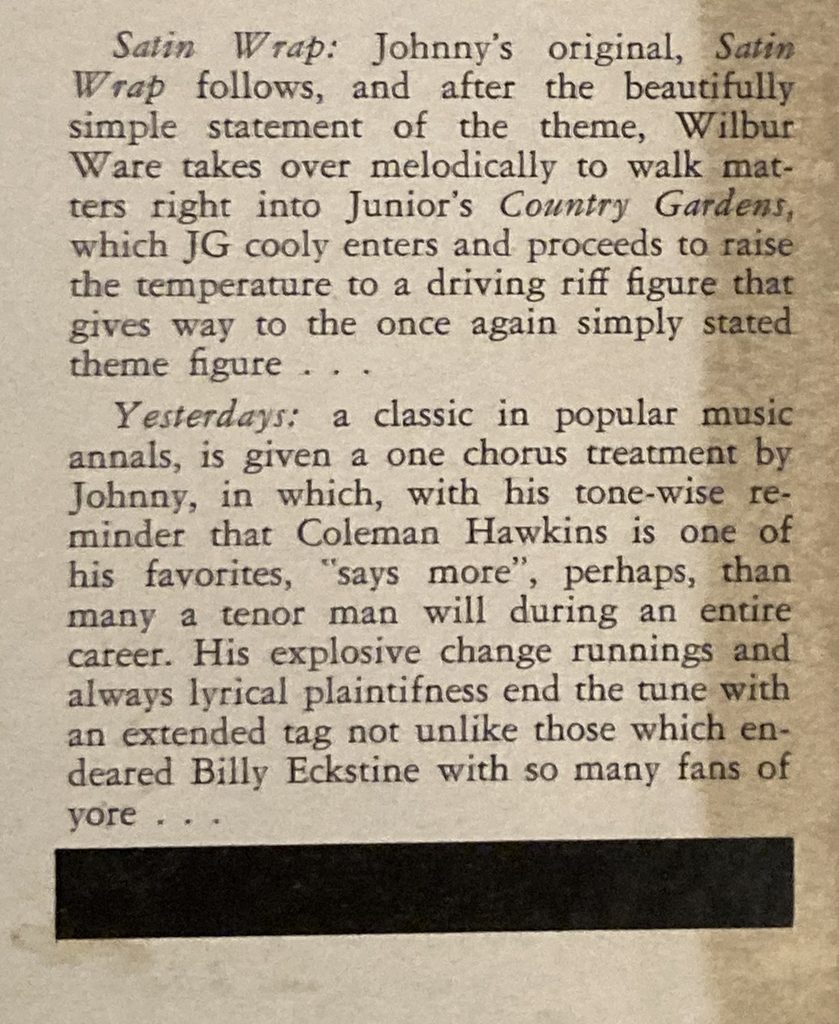
Satin Wrap: Johnny’s original, Satin
Wrap follows, and after the beautifully simple statement of the theme, Wilbur Ware takes over melodically to walk mat- ters right into Junior’s Country Gardens, which JG cooly enters and proceeds to raise the temperature to a driving riff figure that gives way to the once again simply stated theme figure..
Yesterdays: a classic in popular music annals, is given a one chorus treatment by Johnny, in which, with his tone-wise re- minder that Coleman Hawkins is one of his favorites, “says more”, perhaps, than many a tenor man will during an entire career. His explosive change runnings and always lyrical plaintifness end the tune with an extended tag not unlike those which en- deared Billy Eckstine with so many fans of yore.
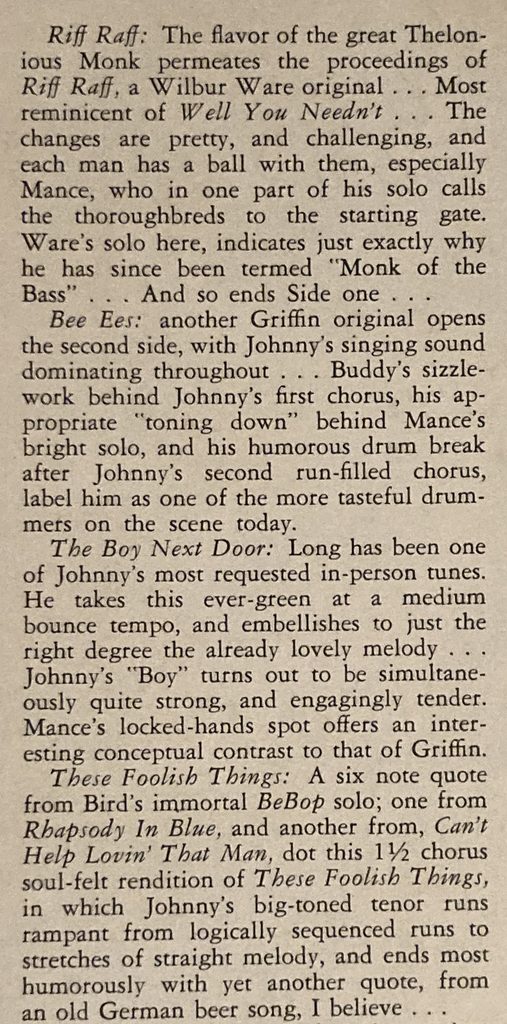
Riff Raff: The flavor of the great Thelon- ious Monk permeates the proceedings of Riff Raff, a Wilbur Ware original… Most reminicent of Well You Needn’t… The changes are pretty, and challenging, and each man has a ball with them, especially Mance, who in one part of his solo calls the thoroughbreds to the starting gate. Ware’s solo here, indicates just exactly why he has since been termed “Monk of the Bass” … And so ends Side one . . .
Bee Ees: another Griffin original opens the second side, with Johnny’s singing sound dominating throughout… Buddy’s sizzle- work behind Johnny’s first chorus, his ap- propriate “toning down” behind Mance’s bright solo, and his humorous drum break after Johnny’s second run-filled chorus, label him as one of the more tasteful drum- mers on the scene today.
The Boy Next Door: Long has been one of Johnny’s most requested in-person tunes. He takes this ever-green at a medium bounce tempo, and embellishes to just the right degree the already lovely melody . . . Johnny’s “Boy” turns out to be simultane- ously quite strong, and engagingly tender. Mance’s locked-hands spot offers an inter- esting conceptual contrast to that of Griffin.
These Foolish Things: A six note quote from Bird’s immortal BeBop solo; one from Rhapsody In Blue, and another from, Can’t Help Lovin’ That Man, dot this 11⁄2 chorus soul-felt rendition of These Foolish Things, in which Johnny’s big-toned tenor runs rampant from logically sequenced runs to stretches of straight melody, and ends most humorously with yet another quote, from an old German beer song, I believe.
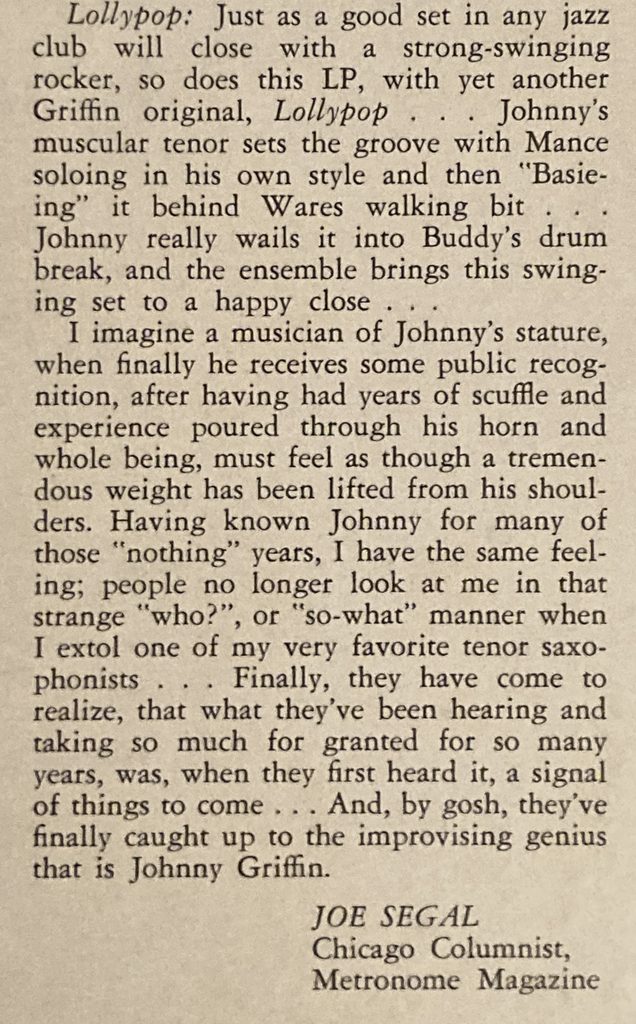
Lollypop: Just as a good set in any jazz club will close with a strong-swinging rocker, so does this LP, with yet another Griffin original, Lollypop . . . Johnny’s muscular tenor sets the groove with Mance soloing in his own style and then “Basie- ing” it behind Wares walking bit . . . Johnny really wails it into Buddy’s drum break, and the ensemble brings this swing- ing set to a happy close.
I imagine a musician of Johnny’s stature, when finally he receives some public recog- nition, after having had years of scuffle and experience poured through his horn and whole being, must feel as though a tremen- dous weight has been lifted from his shoul- ders. Having known Johnny for many of those “nothing” years, I have the same feel- ing; people no longer look at me in that strange “who?”, or “so-what” manner when I extol one of my very favorite tenor saxo- phonists . . . Finally, they have come to realize, that what they’ve been hearing and taking so much for granted for so many years, was, when they first heard it, a signal of things to come… And, by gosh, they’ve finally caught up to the improvising genius that is Johnny Griffin.
JOE SEGAL
Chicago Columnist,
Metronome Magazine
WRITE FOR CATALOGUE
CHESS PRODUCING CORP. Dept. PL
2120 S. Michigan Ave. Chicago 16, III.
THE KANGAROO-SPLIT-PAK OFFERS YOU THE BUYER AND LISTENER A NEW METHOD OF SELECTING YOUR NEW AUDIO ODYSSEY’S BY ARGO, BY GIVING YOU IN THIS PACKAGE A FREE SAMPLER OF OTHER ARGO LP’S
<裏ジャケ和訳>
あるアーティストの肖像
シカゴには、長くカーブを描く大通りがある。そこを1分間に流れる交通量は、中規模の町全体で1日に通過する車の数をも上回るほどだ。「サウス・パークウェイ」と呼ばれるこの通りは、おそらく全米のどの通りよりも、単位面積あたりに多くの教会、バー、簡易アパート、そして人々がひしめき合う場所である。サウス・パークウェイは活気あふれる通りだ。デュセーブル高校が夏休みに入ったある日の午後、私はこの賑やかな通りでジョニー・グリフィンに声をかけた。「おい、ジョニー、どこへ行くんだい?」「音楽のレッスンさ!」彼は叫び返した。その声は、ジトニー・キャブ(乗り合いタクシー)やシカゴ・モーター・コーチのバスが鳴らす、ドミナント・セブンスやフラット・フィフス、あるいは荒々しいDマイナーの響きを思わせるクラクションの音にかき消されそうになりながら響いた。ウェーブのかかった髪を後ろに撫でつけ、自分と同じくらいの大きさがある楽器ケースを抱えたその少年は、タクシーの群れを縫うように進み、47丁目の角を曲がって消えていった――レッスンのために。
あれからもう15年近くが経つ。当時、ジョニーと私は共に14歳で、「ドレープス(当時流行した長めのジャケットやゆったりしたズボンなどのファッション)」が最高にクールだとされていた時代だった。今のジョニーはもう髪を後ろに撫でつけてはいないし、当時からすでに(ライオネル・ハンプトンが彼を18歳になる前に雇い入れたほど)激しく鳴り響いていた彼の楽器も、今や完全に彼の手中に収まっている。ジョニーはもはや「リトル・ジョニー・グリフィン」ではない。彼のサウンドは彼独自のものであり、誰の模倣でもない。彼が求めれば、アイデアは自然と湧き上がってくる。ジョニー・グリフィンは自分の楽器を熟知しており、その知識を裏付けるような演奏をする――力強く、確信に満ち、そして望めば、現役のテナー・サックス奏者の中で誰よりも速く吹くことさえできるのだ。
デュセーブル高校のキャプテン・ウォルター・ダイエットが率いる、まるで体育館のような広いバンド・ルームで過ごしたあの日々以来、ジョニーには様々なことがあった。名声、経験、数多くの旅、そしてもちろん、辛い出来事も。シカゴのサウス・パークウェイやニューヨークのレノックス・アベニュー、あるいはカンザスシティの18番街とヴァイン・ストリートの交差点といった場所を頻繁に行き来していれば、悪い出来事に遭遇するのは避けられないことだからだ。それらもまたジョニーにとっての「レッスン」だった――苦い経験ではあったが、確かにそこにあったレッスンなのだ。
ジョニー・グリフィンのサウンドには怒りが宿っている。コード進行に合わせて待ったなしに押し寄せるうねり、次々と積み重ねられるアイデア、そしてクライマックスにクライマックスを重ねていく構成。それはエキサイティングなサウンドであり、怒りに満ちたサウンドなのだ。このアルバムでジョニー・グリフィンの演奏を聴けば、都会のブルースを熟知しつつも、ある種の怒りを抱えた「アングリー・ヤング・マン(怒れる若者)」の叫びが聞こえてくるはずだ。ここにあるのは、成熟した魂を持つ男のサウンドである。ジョニー・グリフィンには語るべきことがある――耳を傾ければ、それが聞こえてくるだろう。
フランク・ロンドン・ブラウン
フランク・ロンドン・ブラウンは31歳、ルーズベルト大学の卒業生であり、元ジャズ・シンガーでもある。彼の近刊小説『トランブル・パーク(Trumbull Park)』は、1957年度の栄誉ある「ジョン・ヘイ・ホイットニー賞(創作部門)」を受賞した。現在は、ジョー・シーガルが主催する「ゲート・オブ・ホーン(Gate of Horn)」での月曜夜のジャム・セッションに出演し、即興演奏をバックに自身の小説を朗読する「ジャズ・リーディング(Readings In Jazz)」を披露している。
本作には、ジョニー・グリフィンにとって初となるジャズ・レコーディングが後世のために記録されている。当初録音された際、ジョニーはシカゴのテナー・サックス奏者としてはまだ無名に近く、ライオネル・ハンプトンの初期の強力なバンドで「フライング・ホーム(Flying Home)」を演奏していた二人の名手の一人として、ごく一部の人々に記憶されているに過ぎなかった。
このARGOレーベルのLPが録音されて以来、多くの重要な出来事があった。それらの出来事は、ジョニー・グリフィンにとって、シカゴ・サウスサイドのクラブを転々として音楽人生を終えるか、あるいは現在のように、真に創造的なジャズ・アーティストなら誰もがその生涯を終える前に味わうべき、当然の評価と成功を手にできるか、という分かれ道となるものだった。アート・ブレイキーの「メッセンジャーズ」での極めて有意義な活動や、数多くのレコーディング・セッションといった重要な出来事が、そこには含まれている。自身のレパートリーとアプローチを徹底してジャズの流儀に沿って再構築し、セロニアス・モンクとの共演でニューヨークのステージを成功させ、さらには1958年の『ダウン・ビート』誌批評家投票のテナー・サックス部門「ニュースター(新人)」で4位に選出されるなど、目覚ましい活躍を見せています……。
レスター・ヤングの初期グループでの活動歴を持ち、最近では強烈なスウィング感を誇る「キャノンボール」・アダレイ・クインテットでグルーヴィーなバッキング(コンピング)を聴かせるピアニスト、ジュリアン・“ジュニア”・マンスが、ジョニーのリズム・セクションの一翼を担っています。
ベーシストのウィルバー・ウェアは、本作の録音後、次世代のスタイルを形作る現代の重要ベーシストとして全国的な名声を博すことになりますが、彼にはそうした評価を裏付ける才能がすでに遺憾なく発揮されています……。実際、1958年の『ダウン・ビート』誌批評家投票では、ニュースター部門の1位に選ばれています。
そして、重要なパーカッション(ドラムス)の座には、ニューオーリンズ出身でシカゴを拠点に活動するバディ・スミスが就き、見事な手腕を披露しています。
「アイ・クライド・フォー・ユー(I Cried For You)」:1930年代初頭、ベニー・グッドマンの小編成グループによる演奏でジャズ・ナンバーとして人気を博して以来、バラードの即興演奏を行う後進のミュージシャンたちの間でも、その地位を保ち続けている名曲です。
ジョニー・グリフィンはここで、原曲のメロディの良さを引き立てるような、リラックスした柔らかなスウィング・アプローチをとっています。しかし、マンスの切迫感のあるコンピングに促され、やがて指を鳴らしたくなるような高揚感あふれる「ジョニー・ゲット・ユア・ガン(Johnny Get Your Gun)」的なシャウト・スタイルへと展開していきます――まさに、迷いのない力強いプレイです! ジュニアの鮮やかなピアノ・ソロからベースのウォーキング・ラインへと続き、最後はアンサンブルによる熱狂的でロックなエンディングで締めくくられます。
Satin Wrap:ジョニーのオリジナル曲「Satin Wrap」が続きます。美しくシンプルなテーマの提示に続き、ウィルバー・ウェアがメロディアスな演奏で「Junior’s Country Gardens」へと展開を導きます。そこへジョニーがクールに登場し、ドライビングなリフ・フレーズで熱気を高めた後、再びシンプルなテーマへと戻ります。
Yesterdays:ポピュラー音楽史に残る名曲を、ジョニーが1コーラスで演奏します。その音色からは、彼がコールマン・ホーキンスを敬愛していることが伝わってきますが、それ以上に、多くのテナー奏者がキャリア全体をかけて表現する以上のものを、この短い演奏で語り尽くしていると言えるでしょう。爆発的なコード進行の展開と、常にリリカルで哀愁を帯びた響き。そして曲の終わりには、かつてビリー・エクスタインが多くのファンを魅了したような、長めのエンディング・フレーズ(タグ)が添えられています。
Riff Raff:ウィルバー・ウェアのオリジナル曲「Riff Raff」には、偉大なセロニアス・モンクの雰囲気が色濃く漂っています……特に「Well, You Needn’t」を彷彿とさせる曲調です。コード進行は美しくも難易度が高いものですが、各メンバーはそれを楽しんで演奏しています。中でもマンスは、ソロの一節で、まるでサラブレッドをスタートゲートに呼び寄せるようなフレーズを聴かせます。ここでのウェアのソロは、彼が後に「ベース界のモンク」と呼ばれるようになった理由を如実に物語っています……こうしてサイド1が終了します。
Bee Ees:サイド2の幕開けは、再びグリフィンのオリジナル曲「Bee Ees」です。全編を通してジョニーの歌うような音色が際立っています……ジョニーの最初のコーラスの背後で見せるバディのシンバル・ワーク(シズル音を活かしたプレイ)、マンスの明るいソロの背後での絶妙な音量コントロール、そしてジョニーの2回目のコーラス(音符を詰め込んだ流麗なフレーズが満載)の後に続くユーモラスなドラム・ブレイク。これらは彼が現代のシーンにおいて、極めてセンスの良いドラマーの一人であることを証明しています。
The Boy Next Door:長年にわたり、ジョニーのライブでリクエストの絶えない曲の一つです。彼はこの不朽の名曲をミディアム・バウンスのテンポで取り上げ、元来美しいメロディに絶妙な装飾を加えています……ジョニーが描く「Boy(少年)」は、力強さと、心を惹きつけるような優しさを兼ね備えたものとなっています。マンスの「ロックド・ハンズ(両手奏法)」によるパートは、グリフィンのアプローチとは対照的な、興味深い音楽的コントラストを生み出しています。 「These Foolish Things」:この曲の魂のこもった1コーラス半の演奏には、「バード」(チャーリー・パーカー)の不朽のビバップ・ソロからの6音の引用や、『ラプソディ・イン・ブルー』、そして『Can’t Help Lovin’ That Man』からのフレーズが散りばめられています。ジョニーの太い音色のテナー・サックスは、論理的に構成された速いパッセージからストレートなメロディのフレーズまで縦横無尽に駆け巡り、最後は――確かドイツの古いビールを飲む歌だったと思いますが――ユーモアたっぷりの引用で締めくくられます。
「Lollypop」:ジャズクラブでの素晴らしいセットが力強くスウィングするアップテンポな曲で締めくくられるのと同様に、このLPもグリフィンのオリジナル曲「Lollypop」で幕を閉じます……。ジョニーの力強いテナーがグルーヴを作り出し、マンスは彼自身のスタイルでソロをとった後、ウェアのウォーキング・ベースの背後で「ベイシー・スタイル(カウント・ベイシー風のバッキング)」を披露します……。ジョニーはバディのドラム・ブレイクに向かって熱のこもったブロウを聴かせ、アンサンブルがこのスウィング感あふれるセットをハッピーな雰囲気で締めくくります。
長年の苦闘と経験を自身のホーンと全身に注ぎ込んできたジョニーのような大物ミュージシャンが、ついに世間に認められたとき、肩の荷が大きく下りたような気分を味わっているに違いないと私は想像します。彼がまだ「何者でもなかった」時代から彼を知る私としても、同じような感慨を覚えます。私のお気に入りのテナー・サックス奏者の一人である彼を称賛しても、人々はもう「誰それ?」とか「だから何?」といった奇妙な目で見たりはしなくなりました……。彼らはついに気づいたのです。長年耳にしながらも当たり前のように受け止めていたその音が、実は彼らが最初にそれを聴いたときから、来るべき未来を告げる合図だったのだと……。そして、本当に、彼らはついにジョニー・グリフィンという即興演奏の天才に追いついたのです。
ジョー・シーガル
シカゴ担当コラムニスト
『メトロノーム』誌
カタログをご希望の方はこちらへ
CHESS PRODUCING CORP. Dept. PL
2120 S. Michigan Ave. Chicago 16, III.
「カンガルー・スプリット・パック(Kangaroo-Split-Pak)」は、ARGOレーベルの新たなオーディオ体験を選びたいとお考えのリスナーの皆様に、新しい選択肢をご提案します。本パッケージには、ARGOの他のLP作品を収録した無料のサンプラーが同梱されています。
※訳文の制作にはGoogleドライブとGoogle翻訳のお世話になりました。


コメント