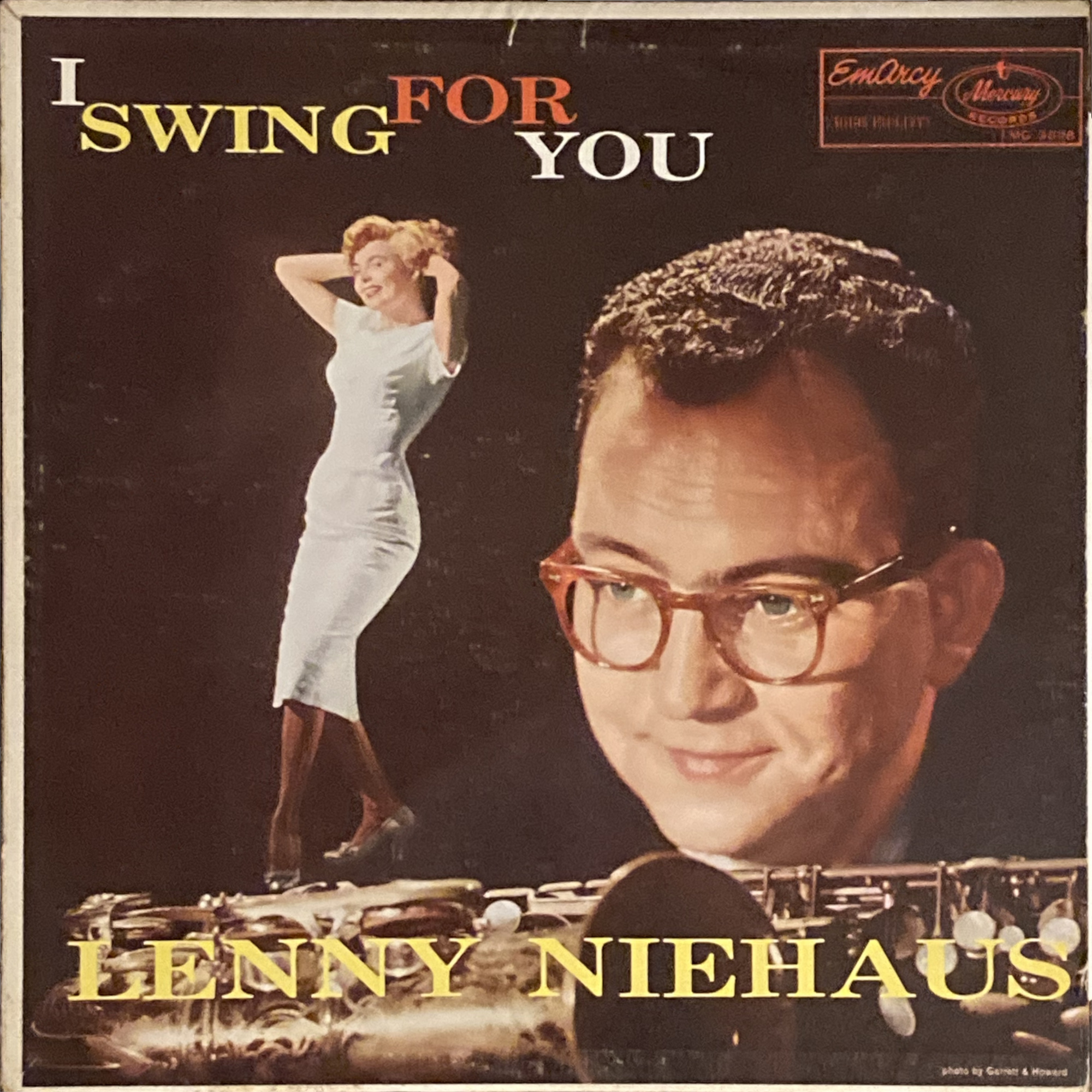
Label: EMARCY (MERCURY RECORD CORPORATION)
No.: MG 36118
Title: I SWING FOR YOU
Musician: LENNIE NIEHAUS
Recorded: 1957/10/1
Monaural
Cover address: CHICAGO ILLINOIS
Coating
Groove Guard
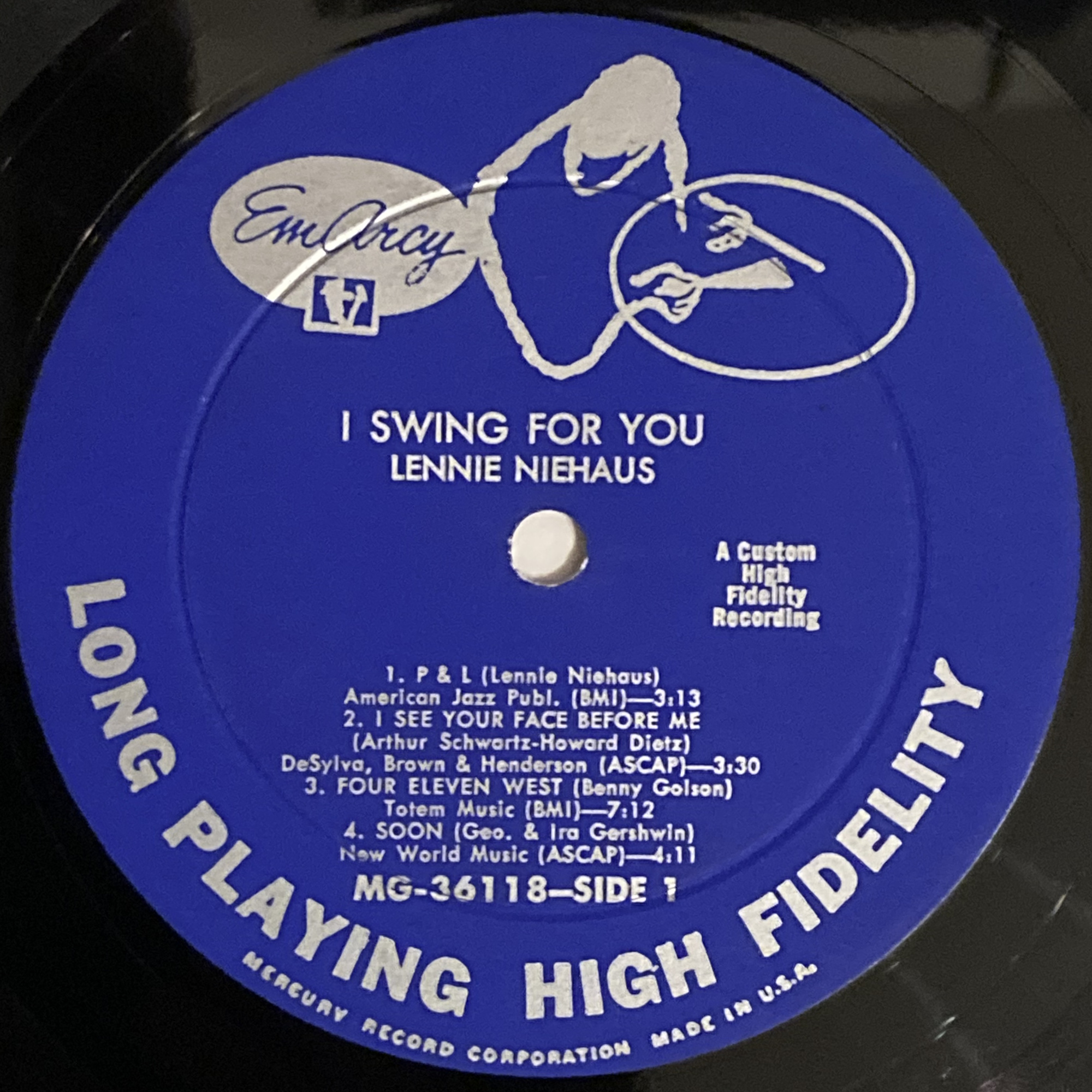
Label Side-1
Blue Background
White Letter
Big Drummer
Address: None
Deep Groove
Dead Wax Info: MG36118A-2, A, MI, N1S11
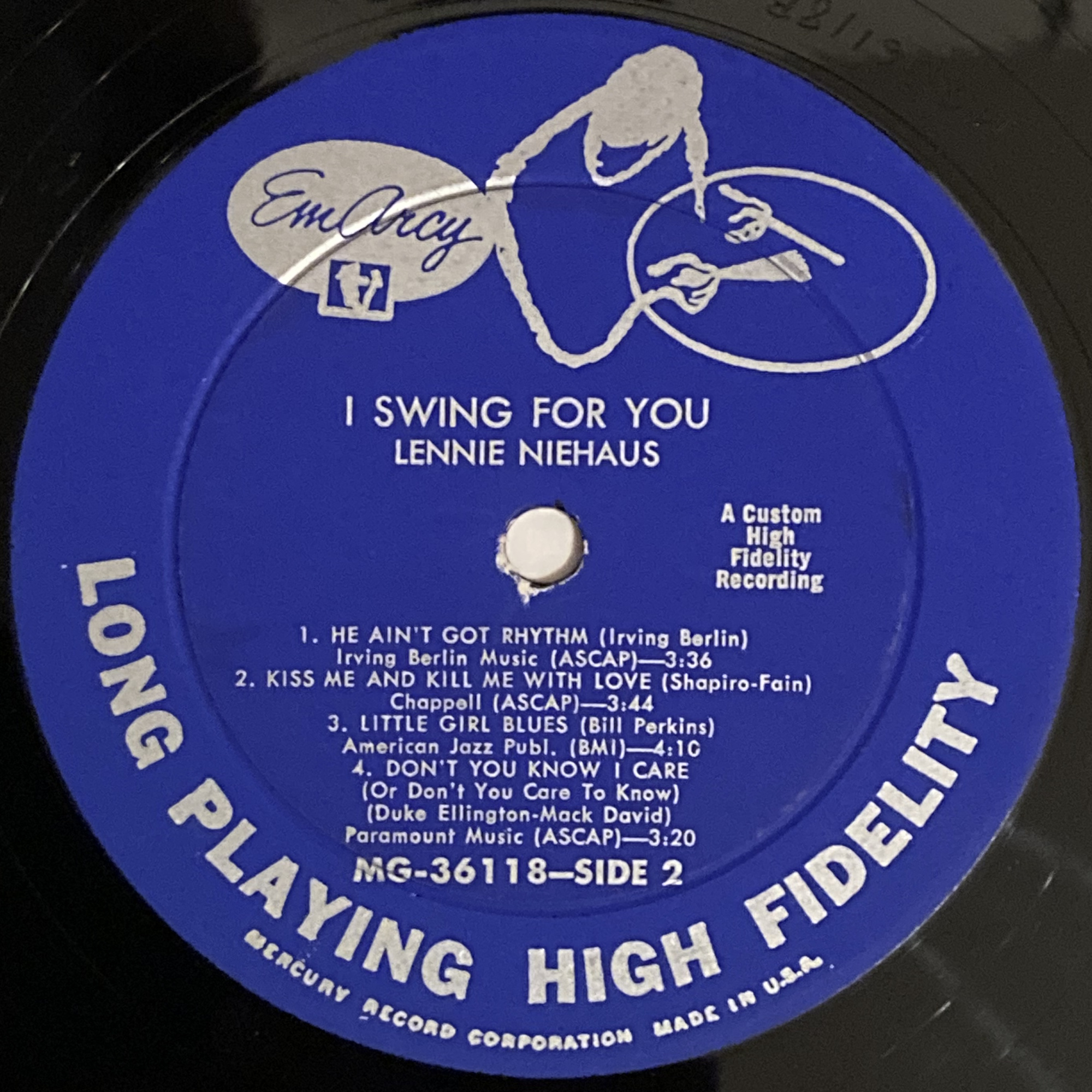
Label Side-2
Blue Background
White Letter
Big Drummer
Address: None
Deep Groove
Dead Wax Info: MG36118B-1, A, MI, NS1
Personnel-
Lennie Niehaus
Tracks-
Side-1
1) P & L
2) I See Your Face Before Me
3) Four Eleven West
4) Soon
Side-2
1) He Ain’t Got Rhythm
2) Kiss Me and Kill Me
3) Little Girl Blues
4) Don’t You Know I Care
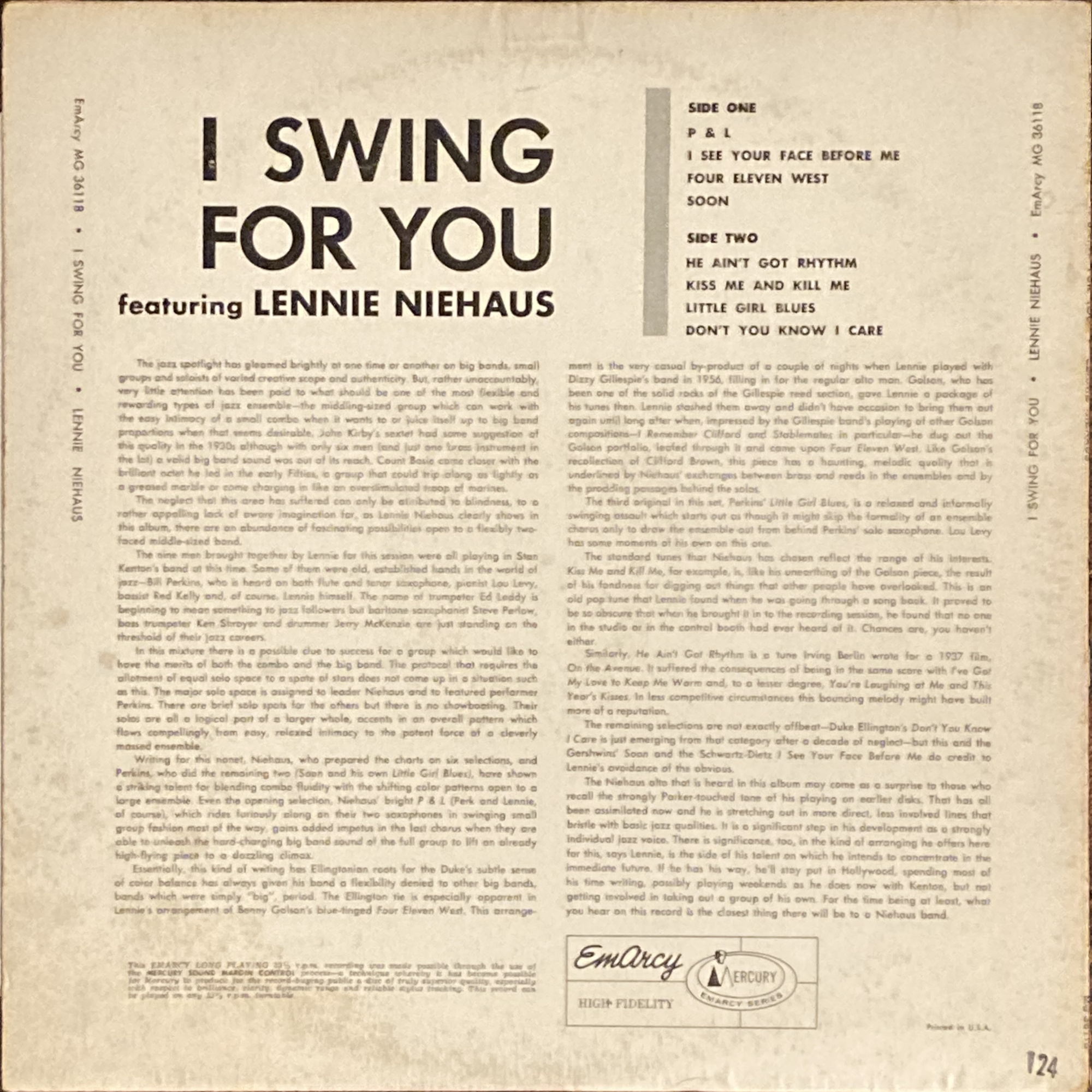
<裏ジャケ原文>
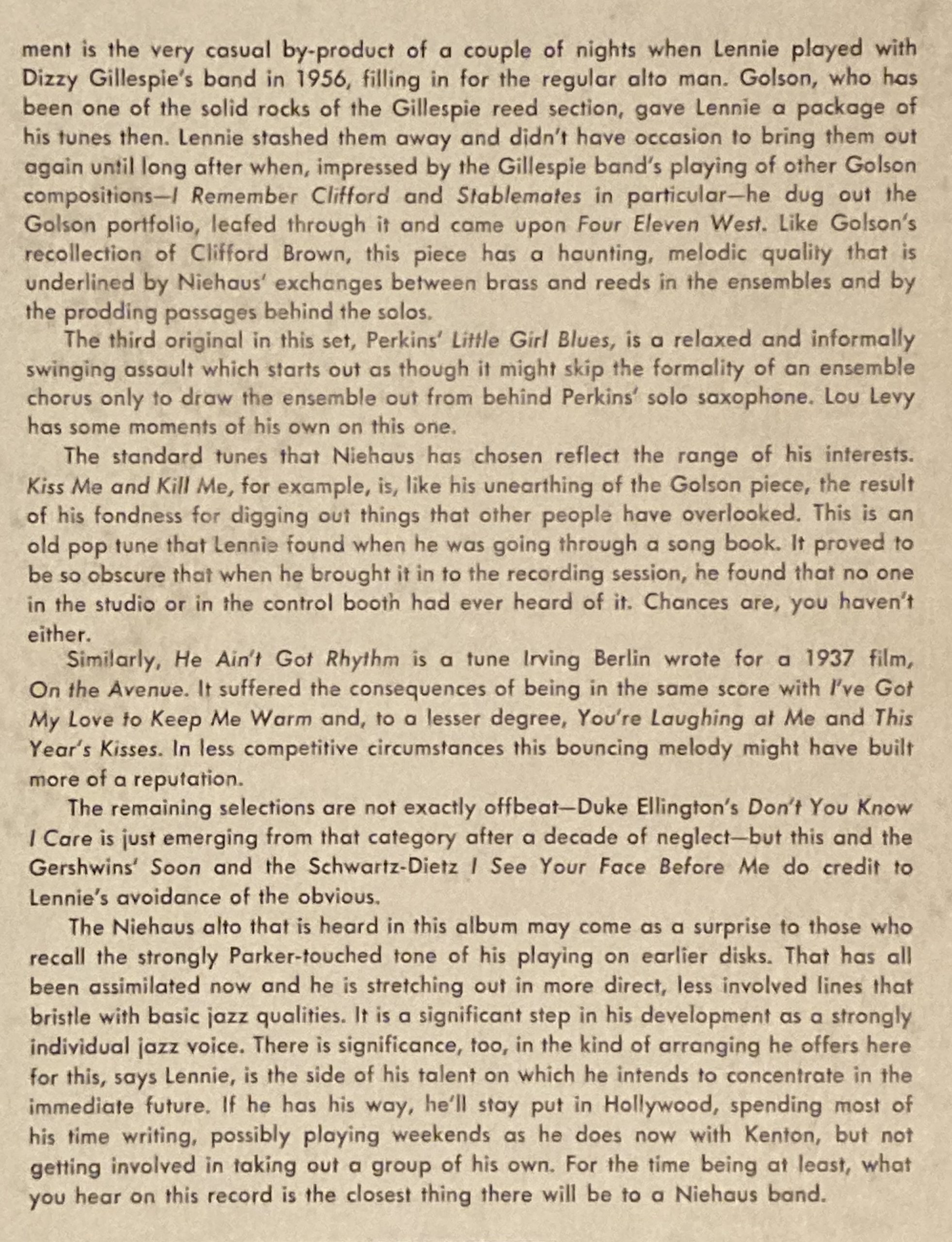
The jazz spotlight has gleamed brightly at one time or another on big bands, small groups and soloists of varied creative scope and authenticity. But, rather unaccountably, very little attention has been paid to what should be one of the most flexible and rewarding types of jazz ensemble-the middling-sized group which can work with the easy intimacy of a small combo when it wants to or juice itself up to big band proportions when that seems desirable. John Kirby’s sextet had some suggestion of this quality in the 1930s although with only six men (and just one brass instrument in the lot) a valid big band sound was out of its reach. Count Basie came closer with the brilliant octet he led in the early Fifties, a group that could trip along as lightly as a greased marble or come charging in like an overstimulated troop of marines.
The neglect that this area has suffered can only be attributed to blindness, to a rather appalling lack of aware imagination for, as Lennie Niehaus clearly shows in this album, there are an abundance of fascinating possibilities open to a flexibly two- faced middle-sized band.
The nine men brought together by Lonnie for this session were all playing in Stan Kenton’s band at this time. Some of them were old, established hands in the world of jazz-Bill Perkins, who is heard on both flute and tenor saxophone, pianist Lou Levy, bassist Red Kelly and, of course, Lennie himself. The name of trumpeter Ed Leddy is beginning to mean something to jazz followers but baritone saxophonist Steve Perlow, bass trumpeter Ken Shroyer and drummer Jerry McKenzie are just standing on the threshold of their Jazz careers.
In this mixture there is a possible clue to success for a group which would like to have the merits of both the combo and the big band. The protocol that requires the allotment of equal solo space to a spate of stars does not come up in a situation such as this. The major solo space is assigned to leader Niehaus and to featured performer Perkins. There are brief solo spots for the others but there is no showboating. Their solos are all a logical part of a larger whole, accents in an overall pattern which flows compellingly from easy, relaxed intimacy to the potent force of a cleverly massed ensemble,
Writing for this nonet, Niehaus, who prepared the charts on six selections, and Perkins, who did the remaining two (Soon and his own Little Girl Blues), have shown a striking talent for blending combo fluidity with the shifting color patterns open to a large ensemble. Even the opening selection, Niehaus’ bright P & L (Perk and Lennie, of course), which rides furiously along on their two saxophones in swinging small group fashion most of the way, gains added impetus in the last chorus when they are able to unleash the hard-charging big band sound of the full group to lift an already high-flying piece to a dazzling climax.
Essentially, this kind of writing has Ellingtonian roots for the Duke’s subtle sense of color balance has always given his band a flexibility denied to other big bands, bands which were simply “big”, period. The Ellington tie is especially apparent in Lennie’s arrangement of Benny Golson’s blue-tinged Four Eleven West. This arrangement is the very casual by-product of a couple of nights when Lennie played with Dizzy Gillespie’s band in 1956, filling in for the regular alto man. Golson, who has been one of the solid rocks of the Gillespie reed section, gave Lennie a package of his tunes then. Lennie stashed them away and didn’t have occasion to bring them out again until long after when, impressed by the Gillespie band’s playing of other Golson compositions-/ Remember Clifford and Stablemates in particular-he dug out the Golson portfolio, leafed through it and came upon Four Eleven West. Like Golson’s recollection of Clifford Brown, this piece has a haunting, melodic quality that is underlined by Niehaus’ exchanges between brass and reeds in the ensembles and by the prodding passages behind the solos.
The third original in this set, Perkins’ Little Girl Blues, is a relaxed and informally swinging assault which starts out as though it might skip the formality of an ensemble chorus only to draw the ensemble out from behind Perkins’ solo saxophone. Lou Levy has some moments of his own on this one.
The standard tunes that Niehaus has chosen reflect the range of his interests. Kiss Me and Kill Me, for example, is, like his unearthing of the Golson piece, the result of his fondness for digging out things that other people have overlooked. This is an old pop tune that Lennie found when he was going through a song book. It proved to be so obscure that when he brought it in to the recording session, he found that no one in the studio or in the control booth had ever heard of it. Chances are, you haven’t either.
Similarly, He Ain’t Got Rhythm is a tune Irving Berlin wrote for a 1937 film, On the Avenue. It suffered the consequences of being in the same score with I’ve Got My Love to Keep Me Warm and, to a lesser degree, You’re Laughing at Me and This Year’s Kisses. In less competitive circumstances this bouncing melody might have built more of a reputation.
The remaining selections are not exactly offbeat-Duke Ellington’s Don’t You Know I Care is just emerging from that category after a decade of neglect-but this and the Gershwins’ Soon and the Schwartz-Dietz I See Your Face Before Me do credit to Lennie’s avoidance of the obvious.
The Niehaus alto that is heard in this album may come as a surprise to those who recall the strongly Parker-touched tone of his playing on earlier disks. That has all been assimilated now and he is stretching out in more direct, less involved lines that bristle with basic jazz qualities. It is a significant step in his development as a strongly individual jazz voice. There is significance, too, in the kind of arranging he offers here for this, says Lennie, is the side of his talent on which he intends to concentrate in the immediate future. If he has his way, he’ll stay put in Hollywood, spending most of his time writing, possibly playing weekends as he does now with Kenton, but not getting involved in taking out a group of his own. For the time being at least, what you hear on this record is the closest thing there will be to a Niehaus band.
This EMARCY LONG PLAYING 33 rpm recording ipas made possible through the use of the MERCURY SOUND MARGIN CONTROL process a technique whereby it has become possible Joy Mercury to produce for the record-buging public a disc of truly superior quality, especially with respect to brilliance, clarity, dynamic range and reliable atplus tracking. This record can be ginged on any 33’s rpm. Turntable.
<裏ジャケ和訳>
ジャズの世界では、これまで様々な創造的領域や音楽的真価を持つビッグ・バンド、小編成グループ、そしてソリストたちにスポットライトが当てられてきました。しかし、不思議なことに、最も柔軟かつ充実した成果を生み出しうるジャズ・アンサンブルの形態の一つである「中規模編成のグループ」には、ほとんど注目が集まってきませんでした。こうした中規模編成は、望めば小編成コンボのような親密で軽やかな演奏もできれば、必要に応じてビッグ・バンドさながらの迫力あるサウンドを展開することも可能なのです。1930年代のジョン・カービー・セクステット(6人編成)にもそうした資質の片鱗は見られましたが、わずか6人(金管楽器は1本のみ)という構成では、本格的なビッグ・バンド・サウンドを再現するには至りませんでした。カウント・ベイシーが1950年代初頭に率いた素晴らしいオクテット(8人編成)は、その理想形により近づいたと言えるでしょう。彼らは、滑らかなビー玉のように軽快に転がるような演奏もできれば、興奮した海兵隊の部隊が突進してくるような力強い演奏もできたのです。
この領域がこれまで軽視されてきたのは、ひとえに「見る目」のなさ、つまり想像力の欠如という嘆かわしい事態によるものと言わざるをえません。なぜなら、レニー・ニーハウスがこのアルバムで鮮やかに示しているように、柔軟に二つの顔を使い分けられる中規模バンドには、魅力的な可能性が数多く秘められているからです。
今回のセッションのためにレニーが集めた9人のメンバーは、当時全員がスタン・ケントン・オーケストラに在籍していました。その中には、ビル・パーキンス(フルートとテナー・サックスを担当)、ピアニストのルー・レヴィ、ベーシストのレッド・ケリー、そしてもちろんレニー自身といった、ジャズ界ですでに確固たる地位を築いていたベテランも含まれていました。トランペット奏者のエド・レディの名もジャズ・ファンの間で知られ始めていましたが、バリトン・サックスのスティーヴ・パーロウ、バス・トランペットのケン・シュロイヤー、ドラムスのジェリー・マッケンジーといった面々は、まさにジャズ・キャリアの入り口に立ったばかりでした。
こうしたメンバー構成の中に、コンボとビッグ・バンド双方の長所を兼ね備えたグループが成功するためのヒントがあるかもしれません。多くのスター奏者に平等にソロの機会を割り当てなければならないといった「お決まりのルール」は、このような状況下では適用されないからです。ここでは、リーダーであるニーハウスと、フィーチャーされた奏者であるパーキンスに、ソロの大部分が割り当てられています。他のメンバーにも短いソロの場面はありますが、これ見よがしな誇示(ショーボーティング)は一切ありません。彼らのソロはすべて、より大きな全体像の中の必然的な一部であり、リラックスした親密な雰囲気から、巧みに構成されたアンサンブルの力強い響きへと説得力を持って流れていく全体的なパターンの中で、効果的なアクセントの役割を果たしています。
この9人編成(ノネット)のために曲を書くにあたり、6曲の譜面を手がけたニーハウスと、残りの2曲(「Soon」と自身の「Little Girl Blues」)を担当したパーキンスは、コンボならではの流麗さと、大人数編成だからこそ可能な色彩豊かな音色の変化を融合させる、際立った才能を発揮しました。オープニングを飾るニーハウス作の軽快な「P & L」(もちろん「Perk and Lennie」の意)でさえ、その好例です。この曲は、大半が2本のサックスを軸にしたスウィンギーな小編成スタイルで猛烈な勢いで進みますが、最後のコーラスではフルメンバーによるビッグバンド・サウンドが炸裂し、すでに高揚していた演奏をさらに加速させ、鮮烈なクライマックスへと導いています。
本質的に、こうした作風はエリントンにルーツを持っています。デューク・エリントンの持つ繊細な色彩バランスの感覚は、単に「大きい」だけの他のビッグバンドにはない柔軟性を、彼のバンドにもたらしていたからです。エリントンとのつながりは、ベニー・ゴルソン作のブルージーな「Four Eleven West」に対するレニーの編曲に特に顕著に表れています。このアレンジは、1956年にレニーがディジー・ガレスピーのバンドでレギュラーのアルト奏者の代役を務めた際、数晩の共演から生まれた何気ない副産物でした。当時、ガレスピー・バンドのリード・セクションの要であったゴルソンは、レニーに自身の楽曲の譜面をいくつか渡していました。レニーはそれらをしまい込み、長い間取り出す機会がありませんでしたが、後にガレスピー・バンドがゴルソンの他の作品(特に「I Remember Clifford」や「Stablemates」)を演奏するのを聴いて感銘を受け、ゴルソンの譜面を掘り起こしてページをめくる中で「Four Eleven West」に出会ったのです。ゴルソンがクリフォード・ブラウンを偲んで書いた曲と同様、この曲も心に残るメロディアスな特質を備えています。その特質は、アンサンブルにおける金管とリード楽器の掛け合いや、ソロの背後で演奏を鼓舞するフレーズによって、より一層際立たされています。
本作に収録されたオリジナル曲の3曲目「パーキンス・リトル・ガール・ブルース(Perkins’ Little Girl Blues)」は、リラックスした雰囲気の中で非公式なスウィング感が弾けるような一曲です。冒頭ではアンサンブルによるコーラス(合奏)を省略するかのように始まりますが、やがてパーキンスのサックス・ソロの背後からアンサンブルが姿を現します。この曲では、ルー・レヴィも自身の見せ場を作っています。
ニーハウスが選んだスタンダード・ナンバーには、彼の幅広い関心が反映されています。例えば「キス・ミー・アンド・キル・ミー(Kiss Me and Kill Me)」は、彼がゴルソンの曲を発掘したのと同様に、他人が見落としていた楽曲を掘り起こすことを好む彼の姿勢から生まれたものです。これはレニーが歌集を眺めていた際に見つけた古いポップ・ソングでした。あまりに無名な曲だったため、レコーディング・セッションに持ち込んだ際、スタジオやコントロール・ブースにいる誰もがその曲を聴いたことがないという状況でした。おそらく、あなたも耳にしたことはないでしょう。
同様に、「ヒー・エイント・ガット・リズム(He Ain’t Got Rhythm)」は、アーヴィング・バーリンが1937年の映画『オン・ザ・アベニュー(On the Avenue)』のために書いた曲です。この曲は、同じ映画の劇中歌である「アイヴ・ガット・マイ・ラヴ・トゥ・キープ・ミー・ウォーム(I’ve Got My Love to Keep Me Warm)」や、それほどではないにせよ「ユーアー・ラフィング・アット・ミー(You’re Laughing at Me)」や「ディス・イヤーズ・キッシーズ(This Year’s Kisses)」といった強力な楽曲と同じスコアに含まれていたために、不遇な扱いを受けることになりました。もし競合する曲がそれほど強力でなければ、この弾むようなメロディはもっと高い評価を得ていたかもしれません。
残りの選曲も、決して「奇をてらった」ものではありません――例えばデューク・エリントンの「ドント・ユー・ノウ・アイ・ケア(Don’t You Know I Care)」は、10年もの間顧みられなかった曲ですが、ようやくその状況から抜け出しつつあります――しかし、この曲やガーシュウィン兄弟の「スーン(Soon)」、そしてシュワルツ&ディーツの「アイ・シー・ユア・フェイス・ビフォー・ミー(I See Your Face Before Me)」といった選曲は、ありきたりなものを避けるレニーの姿勢を如実に表しており、高く評価されるべきでしょう。
本作で聴かれるニーハウスのアルト・サックスの音色は、彼の初期の作品におけるパーカーの影響を強く受けたトーンを記憶している人々にとっては、驚きかもしれません。そうした影響は今や完全に消化・吸収されており、彼はよりストレートで、複雑さを抑えつつも、ジャズの根源的な資質に満ちたフレージングを展開しています。これは、強烈な個性を持つジャズ・ミュージシャンとしての彼の成長において、重要な一歩と言えるでしょう。彼がここで披露しているアレンジ・スタイルにも大きな意義があります。というのも、これこそが彼が近い将来、自身の才能を注ぎ込もうと考えている分野だからです。本人の希望が叶うなら、彼はハリウッドに腰を落ち着け、大半の時間を作曲に費やすことになるでしょう。週末には現在のようにケントン・バンドで演奏するかもしれませんが、自分自身のバンドを率いてツアーに出るようなことはしないはずです。少なくとも当面の間は、このレコードで聴けるサウンドこそが、「ニーハウス・バンド」に最も近いものとなるでしょう。
このEMARCY(エマーシー)の33回転LPレコードは、マーキュリー社の「サウンド・マージン・コントロール」プロセスを用いて制作されました。この技術により、輝き、明瞭さ、ダイナミック・レンジ、そして確実なトラッキング性能において真に優れた品質のレコードを、音楽ファンの皆様にお届けすることが可能になりました。本盤は、あらゆる33回転ターンテーブルで再生可能です。
※訳文の制作にはGoogleドライブとGoogle翻訳のお世話になりました。
コメント