Label: UNITED ARTISTS
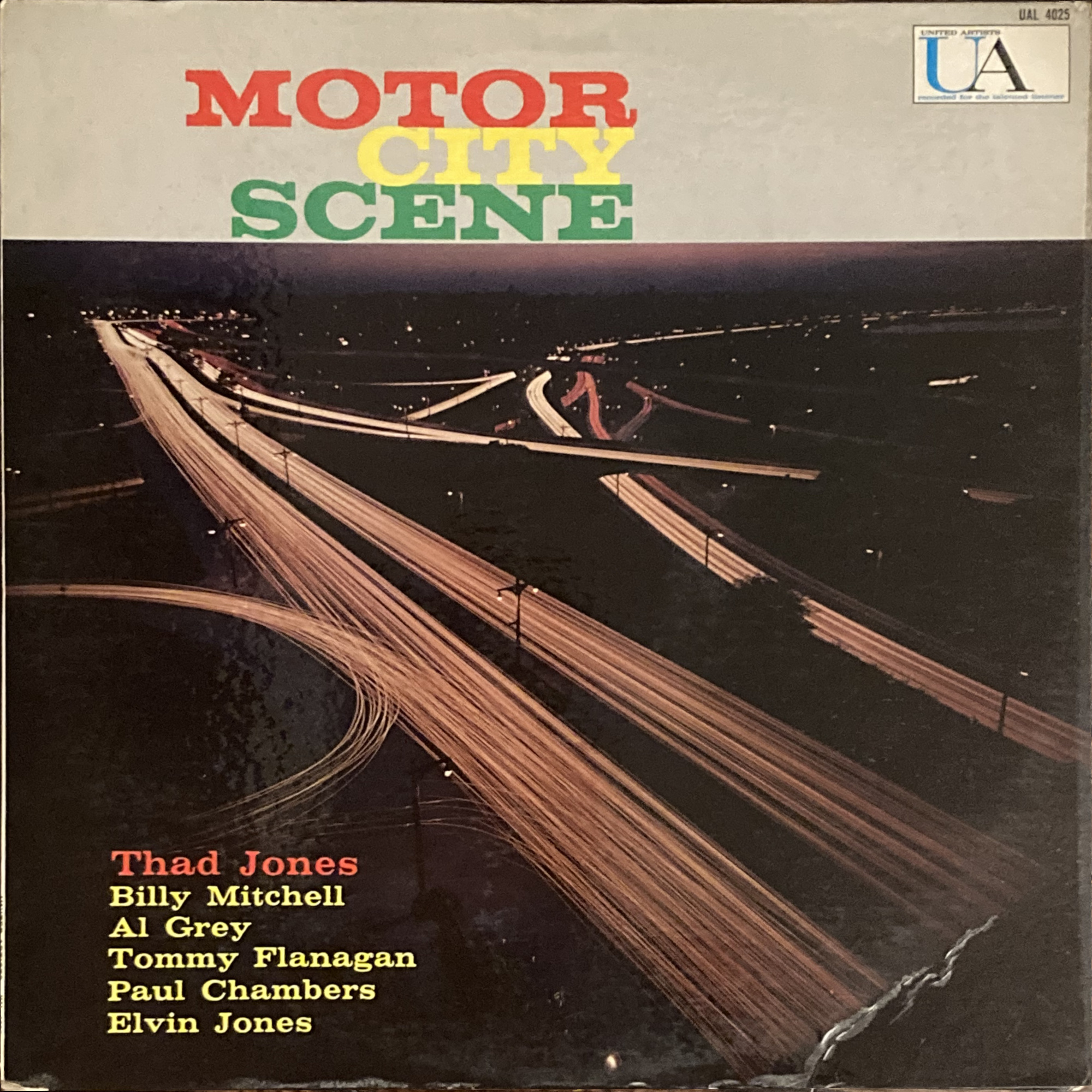
No.: UAL 4025
Title: MOTOR CITY SCENE
Musician: THAD JONES
Recorded: 1959/10/24, 1959/10/31
Monaural
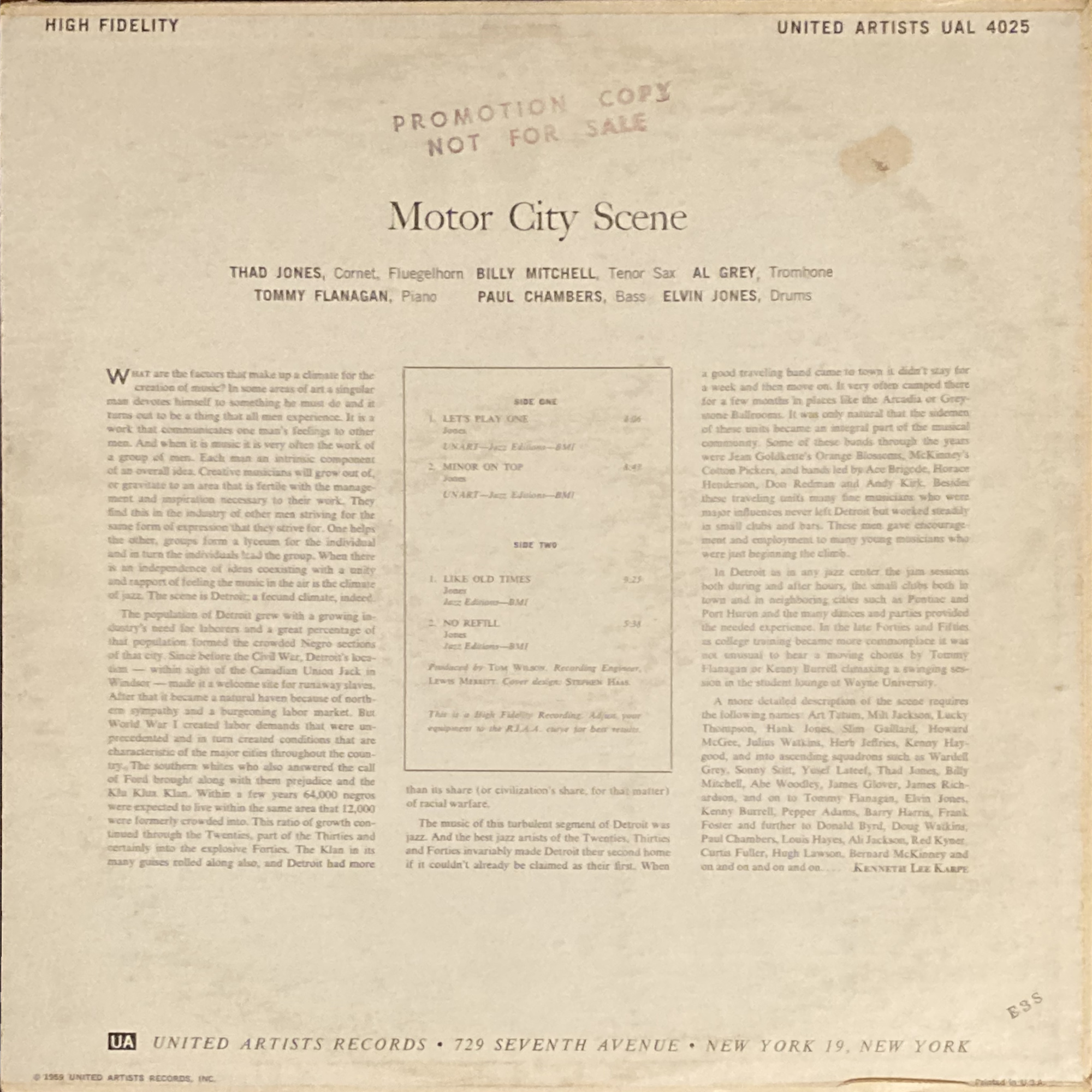
Cover address: 729 SEVENTH AVENUE, NEW YORK 19, NEW YORK
Coating無し
Groove Guard
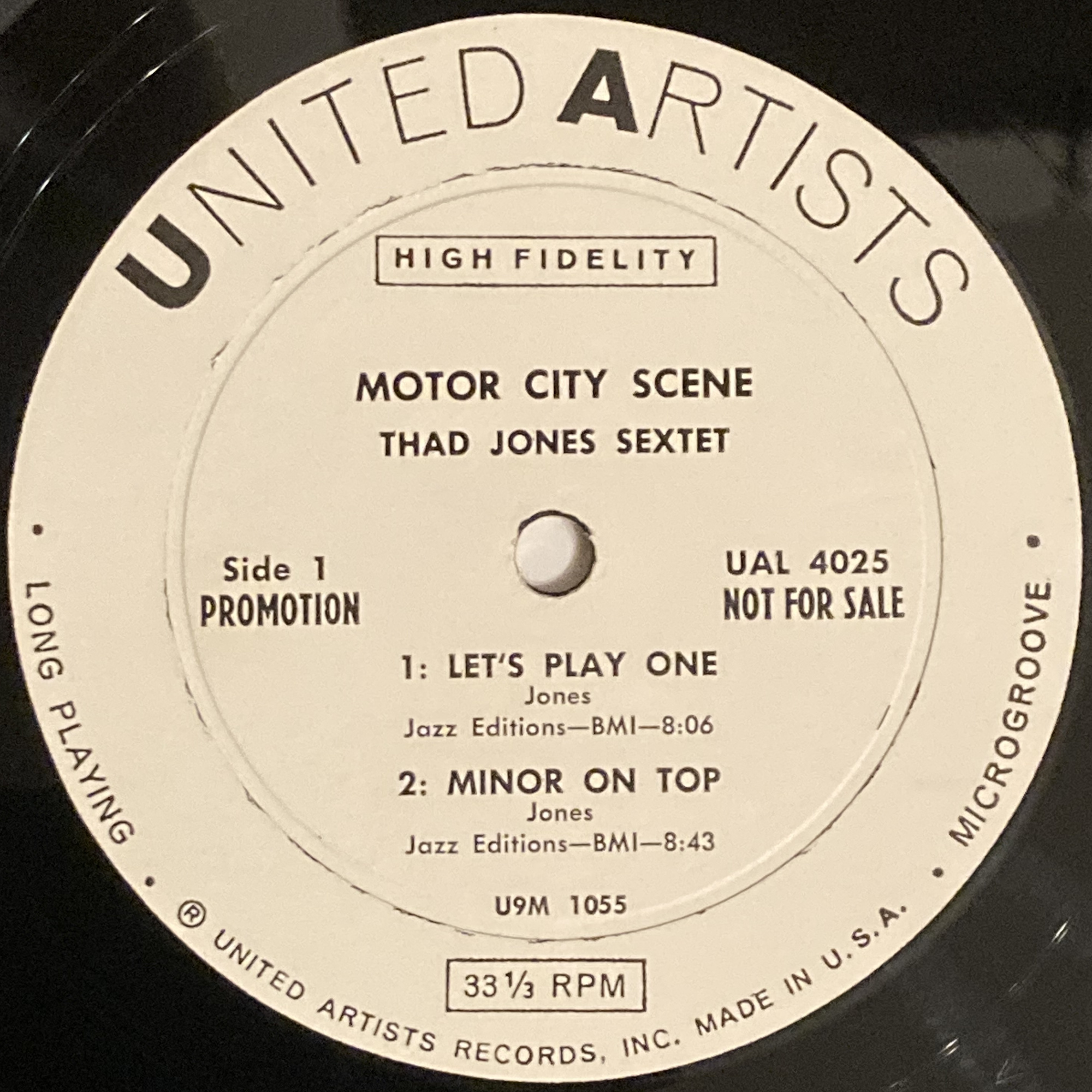
Label Side-1
White Background
Black Letter (Promotion label)
Address: None
Deep Groove
Dead Wax Info: U9M-1055, A, UA
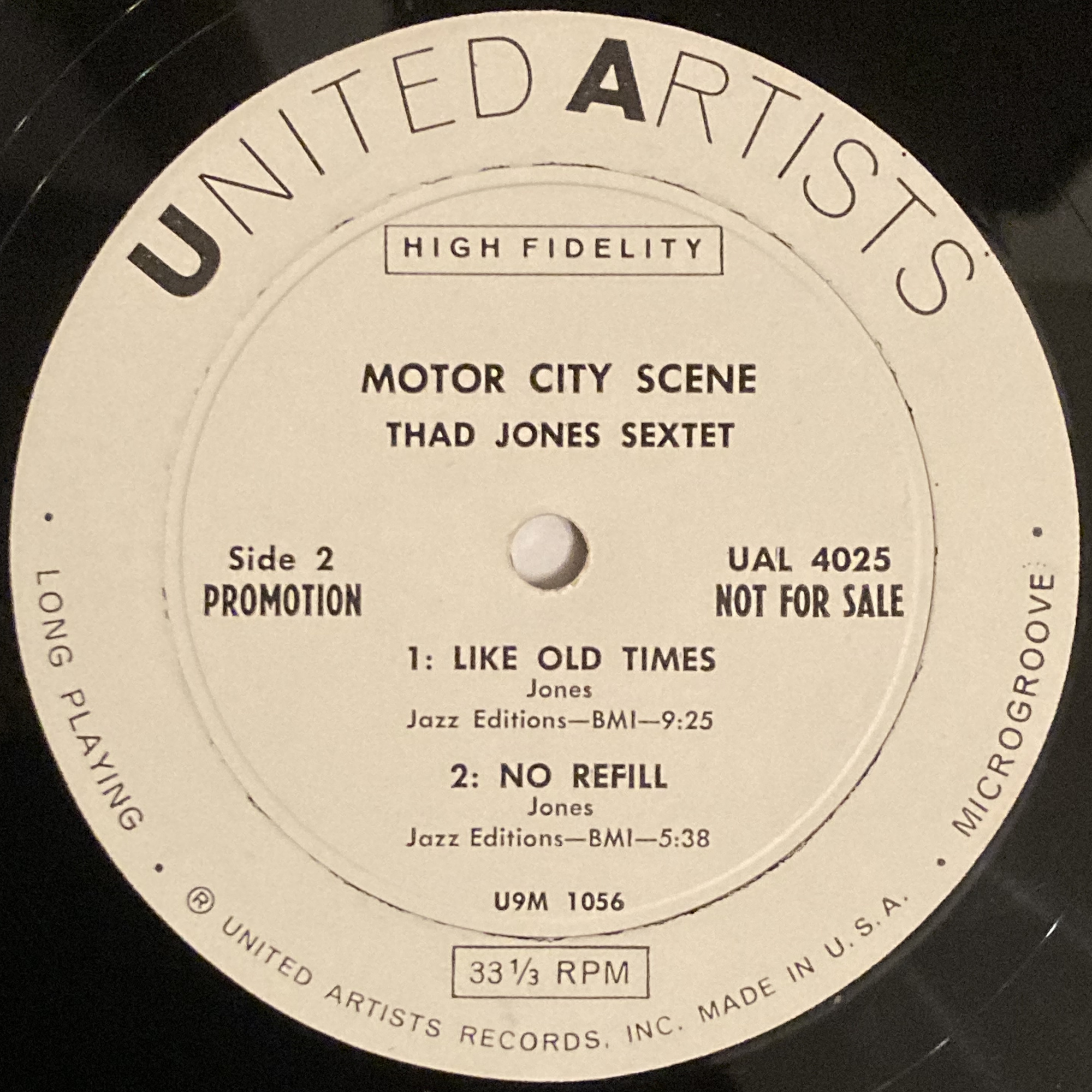
Label Side-2
White Background
Black Letter (Promotion label)
Address: None
Deep Groove
Dead Wax Info: U9M-1056, A, UA
Personnel-
Drums: Elvin Jones
Bass: Paul Chambers
Piano: Tommy Flanagan
Tenor Sax: Billy Mitchell
Flugelhorn, Cornet: Thad Jones
Trombone: Al Grey
Tracks-
Side-1
1) Let’s Play One 8’06”
2) Minor on Top 8’43”
Side-2
1) Like Old Times 9’25”
2) No Refill 5’38”
<裏ジャケ原文>
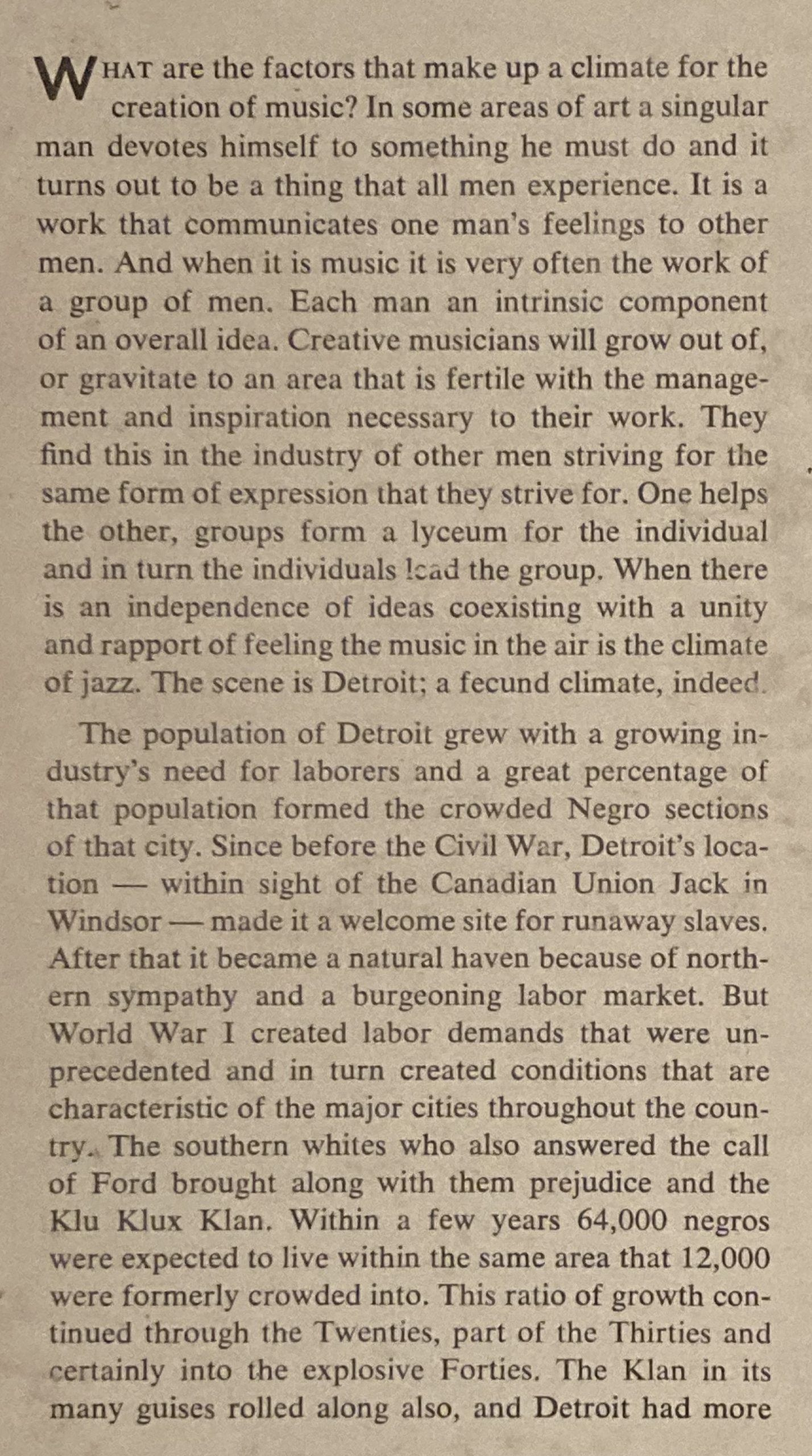
WHAT are the factors that make up a climate for the creation of music? In some areas of art a singular man devotes himself to something he must do and it turns out to be a thing that all men experience. It is a work that communicates one man’s feelings to other men. And when it is music it is very often the work of a group of men. Each man an intrinsic component of an overall idea. Creative musicians will grow out of, or gravitate to an area that is fertile with the manage- ment and inspiration necessary to their work. They find this in the industry of other men striving for the same form of expression that they strive for. One helps the other, groups form a lyceum for the individual and in turn the individuals lcad the group. When there is an independence of ideas coexisting with a unity and rapport of feeling the music in the air is the climate of jazz. The scene is Detroit; a fecund climate, indeed.
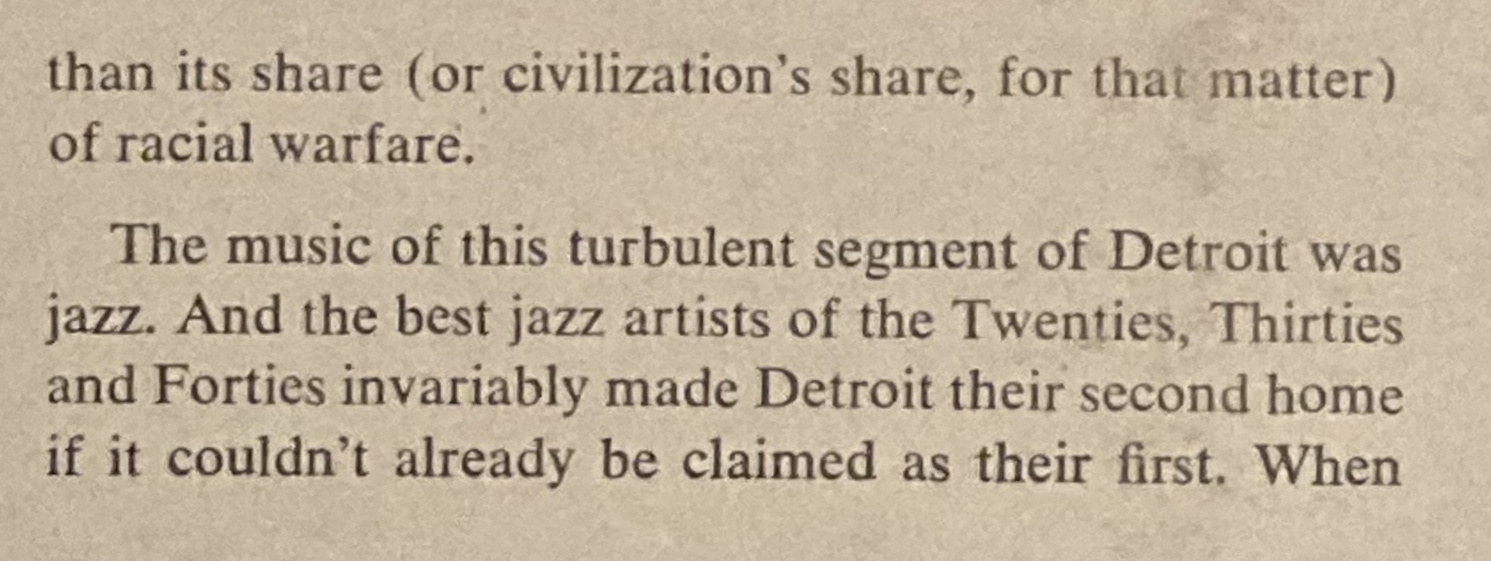
The population of Detroit grew with a growing in- dustry’s need for laborers and a great percentage of that population formed the crowded Negro sections of that city. Since before the Civil War, Detroit’s loca- tion within sight of the Canadian Union Jack in Windsor -made it a welcome site for runaway slaves. After that it became a natural haven because of north- ern sympathy and a burgeoning labor market. But World War I created labor demands that were un- precedented and in turn created conditions that are characteristic of the major cities throughout the coun- try. The southern whites who also answered the call of Ford brought along with them prejudice and the Klu Klux Klan. Within a few years 64,000 negros were expected to live within the same area that 12,000 were formerly crowded into. This ratio of growth con- tinued through the Twenties, part of the Thirties and certainly into the explosive Forties. The Klan in its many guises rolled along also, and Detroit had more than its share (or civilization’s share, for that matter) of racial warfare.
The music of this turbulent segment of Detroit was jazz. And the best jazz artists of the Twenties, Thirties and Forties invariably made Detroit their second home if it couldn’t already be claimed as their first. When a good traveling band came to town it didn’t stay for a week and then move on. It very often camped there for a few months in places like the Arcadia or Grey- stone Ballrooms. It was only natural that the sidemen of these units became an integral part of the musical community. Some of these bands through the years were Jean Goldkette’s Orange Blossoms, McKinney’s Cotton Pickers, and bands led by Ace Brigode, Horace Henderson, Don Redman and Andy Kirk. Besides these traveling units many fine musicians who were major influences never left Detroit but worked steadily in small clubs and bars. These men gave encourage- ment and employment to many young musicians who were just beginning the climb.
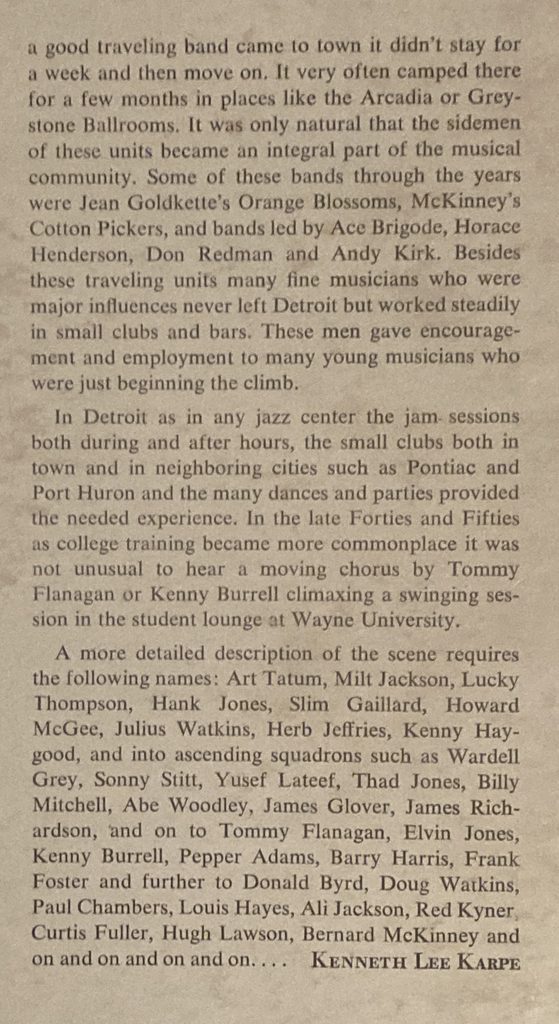
In Detroit as in any jazz center the jam sessions both during and after hours, the small clubs both in town and in neighboring cities such as Pontiac and Port Huron and the many dances and parties provided the needed experience. In the late Forties and Fifties as college training became more commonplace it was not unusual to hear a moving chorus by Tommy Flanagan or Kenny Burrell climaxing a swinging ses- sion in the student lounge at Wayne University.
A more detailed description of the scene requires the following names: Art Tatum, Milt Jackson, Lucky Thompson, Hank Jones, Slim Gaillard, Howard McGee, Julius Watkins, Herb Jeffries, Kenny Hay- good, and into ascending squadrons such as Wardell Grey, Sonny Stitt, Yusef Lateef, Thad Jones, Billy Mitchell, Abe Woodley, James Glover, James Rich- ardson, and on to Tommy Flanagan, Elvin Jones, Kenny Burrell, Pepper Adams, Barry Harris, Frank Foster and further to Donald Byrd, Doug Watkins, Paul Chambers, Louis Hayes, Ali Jackson, Red Kyner, Curtis Fuller, Hugh Lawson, Bernard McKinney and on and on and on and on…. KENNETH LEE KARPE
<裏ジャケ和訳>
音楽が生まれる土壌、その「気風」を形作る要因とは何だろうか。芸術の分野によっては、一人の人間が自らの使命として何かに打ち込み、その結果として、それが万人に通じるものとなることがある。それは、一人の人間の感情を他者へと伝える作品である。しかし、それが音楽である場合、多くは集団による営みとなる。そこでは、個々の人間が全体的な構想を構成する不可欠な要素となるのだ。創造的な音楽家たちは、自身の活動に必要な運営体制やインスピレーションに満ちた環境から生まれ、あるいはそうした環境へと引き寄せられていく。彼らは、自分たちと同じ表現形式を追求する人々が集まる業界の中に、その環境を見出す。互いに助け合い、集団は個人のための学びの場(ライセウム)となり、やがて個人が集団を牽引していく。思想の独立性と、感情の統一や共鳴とが共存するとき、そこに漂う音楽こそが「ジャズの気風」なのである。舞台はデトロイト――実に豊かな土壌を持つ街であった。
デトロイトの人口は、産業の拡大に伴う労働力需要の増大とともに増加し、その大部分は市内の過密な黒人居住区を形成した。南北戦争以前から、ウィンザー(カナダ側)に翻るユニオン・ジャックを望めるその立地ゆえに、デトロイトは逃亡奴隷にとって歓迎すべき場所であった。その後も、北部の同情的な空気と拡大する労働市場のおかげで、この街は自然と安息の地となっていった。しかし、第一次世界大戦がかつてない労働力需要を生み出すと、全米の主要都市に共通するような状況がこの街にも生まれた。フォードの呼びかけに応じた南部白人たちが、偏見やクー・クラックス・クラン(KKK)をも持ち込んだからである。わずか数年のうちに、かつて1万2000人がひしめき合っていた同じ地域に、6万4000人の黒人が暮らすことになると予測された。こうした人口増加のペースは、1920年代、30年代の一部、そして爆発的な変化を遂げた40年代へと続いていった。KKKもまた様々な姿で勢力を拡大し、デトロイトは人種間の抗争に、その街の分(あるいは文明社会全体が負うべき分)以上に苛まれることとなった。
デトロイトのこうした激動の一角から生まれた音楽、それこそがジャズであった。 1920年代から40年代にかけて、最高のジャズ・アーティストたちは、デトロイトを「第二の故郷」と見なすか、あるいはすでに「第一の故郷」と呼べるほどに、こぞってこの街を拠点としました。優れた巡業バンドが街を訪れても、単に1週間滞在して立ち去るようなことはありませんでした。彼らは「アルカディア」や「グレイストーン」といったダンスホールを拠点に、数ヶ月間腰を据えて活動することが多かったのです。そうしたバンドのサイドマン(伴奏者)たちが、現地の音楽コミュニティに欠かせない存在となっていくのは自然な流れでした。長年にわたり活躍したバンドには、ジーン・ゴールドケットの「オレンジ・ブロッサムズ」、マッキニーズ・コットン・ピッカーズのほか、エース・ブリゴード、ホレス・ヘンダーソン、ドン・レッドマン、アンディ・カークらが率いるバンドなどがありました。こうした巡業バンドに加え、多大な影響力を持ちながらデトロイトを離れず、地元の小さなクラブやバーで着実に活動を続けた優れたミュージシャンも数多く存在しました。彼らは、キャリアを歩み始めたばかりの多くの若きミュージシャンたちを励まし、活躍の場を提供したのです。
他の主要なジャズの街と同様、デトロイトでも、営業時間中や閉店後に行われるジャム・セッション、市内やポンティアック、ポート・ヒューロンといった近隣都市の小さなクラブ、そして数多くのダンス・パーティーなどが、ミュージシャンに必要な経験を積む場となっていました。40年代後半から50年代にかけて、大学で音楽教育を受けることが一般的になると、ウェイン州立大学の学生ラウンジで繰り広げられるスウィング感あふれるセッションのクライマックスにおいて、トミー・フラナガンやケニー・バレルによる感動的なソロ演奏を耳にすることも珍しくありませんでした。
当時のシーンをより詳細に語るには、次のような名前を挙げる必要があります。アート・テイタム、ミルト・ジャクソン、ラッキー・トンプソン、ハンク・ジョーンズ、スリム・ゲイラード、ハワード・マギー、ジュリアス・ワトキンス、ハーブ・ジェフリーズ、ケニー・ヘイグッド。さらに、頭角を現しつつあった面々として、ワーデル・グレイ、ソニー・スティット、ユセフ・ラティーフ、サド・ジョーンズ、ビリー・ミッチェル、エイブ・ウッドリー、ジェームズ・グローヴァー、ジェームズ・リチャードソン。そして、トミー・フラナガン、エルヴィン・ジョーンズ、ケニー・バレル、ペッパー・アダムス、バリー・ハリス、フランク・フォスター。さらにはドナルド・バード、ダグ・ワトキンス、ポール・チェンバース、ルイス・ヘイズ、アリ・ジャクソン、レッド・カイナー、カーティス・フラー、ヒュー・ローソン、バーナード・マッキニー……と、その名は限りなく続いていくのです。――ケネス・リー・カープ
※訳文の制作にはGoogleドライブとGoogle翻訳のお世話になりました。
コメント