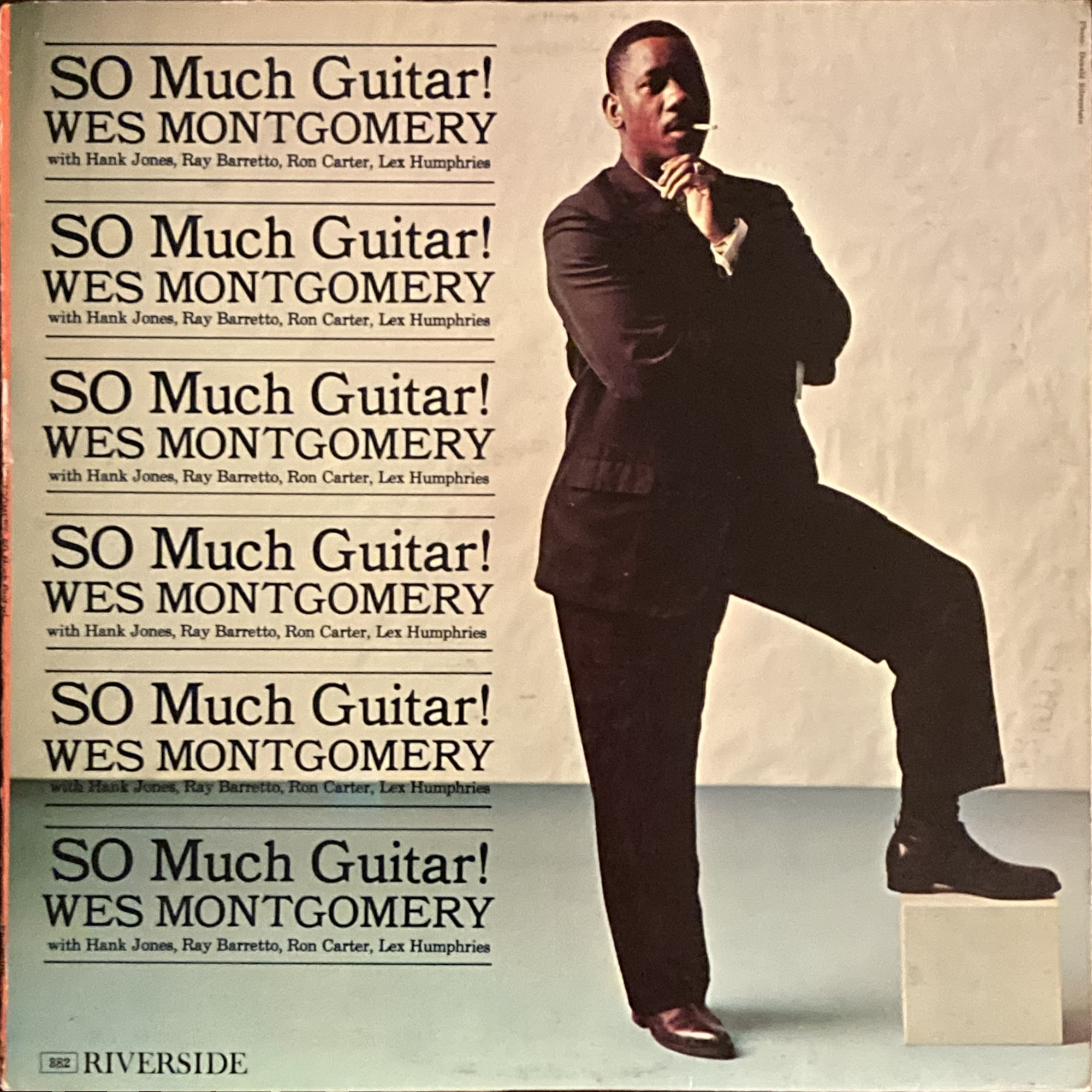
Label: RIVERSIDE
No.: RLP 382
Title: SO MUCH GUITAR!
Musician: WES MONTGOMERY
Recorded: 1961/8/4
Monaural
Cover address: 235 West 46th Street New York 36, N.Y.
Coating無し
Groove Guard
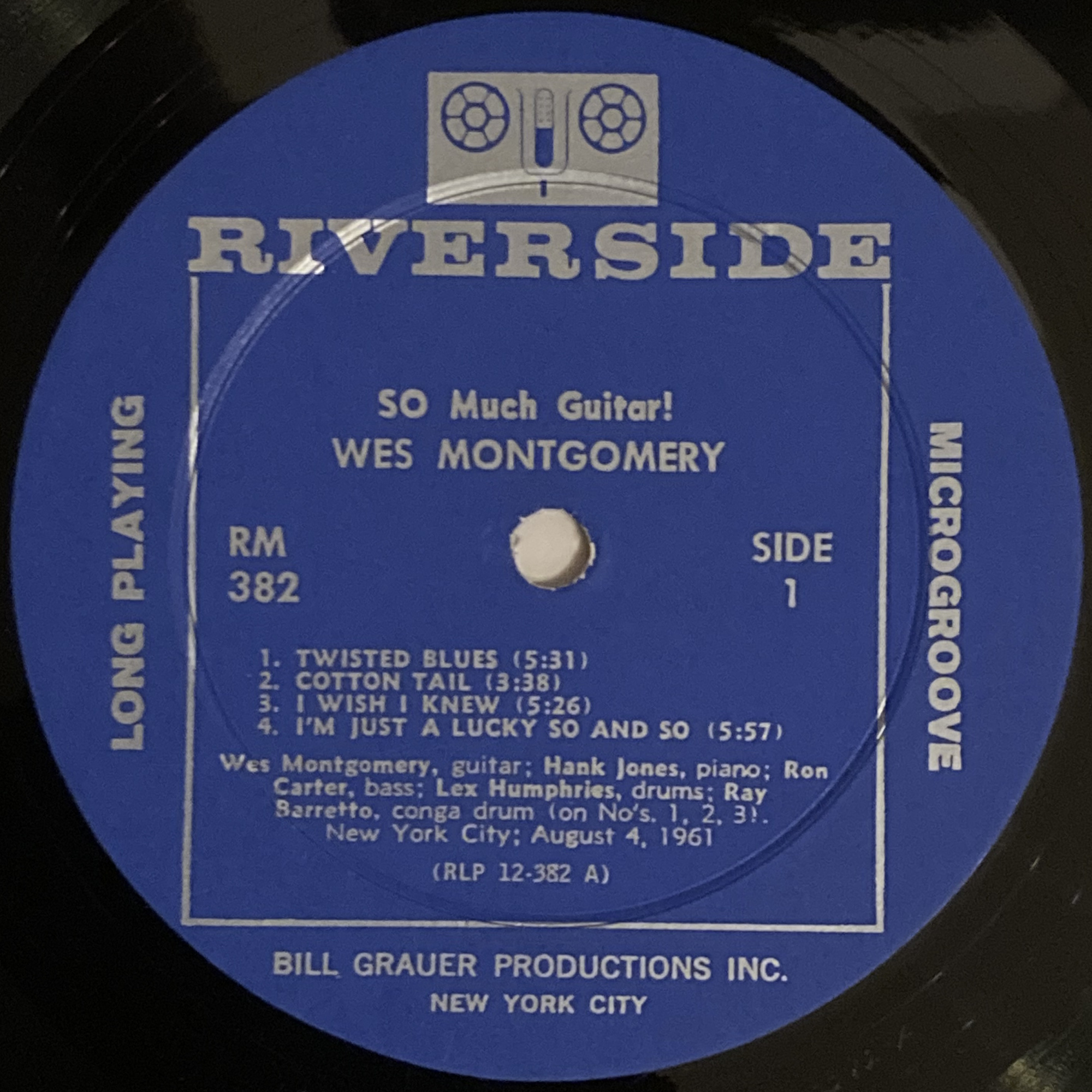
Label Side-1
Large Blue Background
Silver Letter with INC
Address: None
Deep Groove
Dead Wax Info: RLP12-382-A
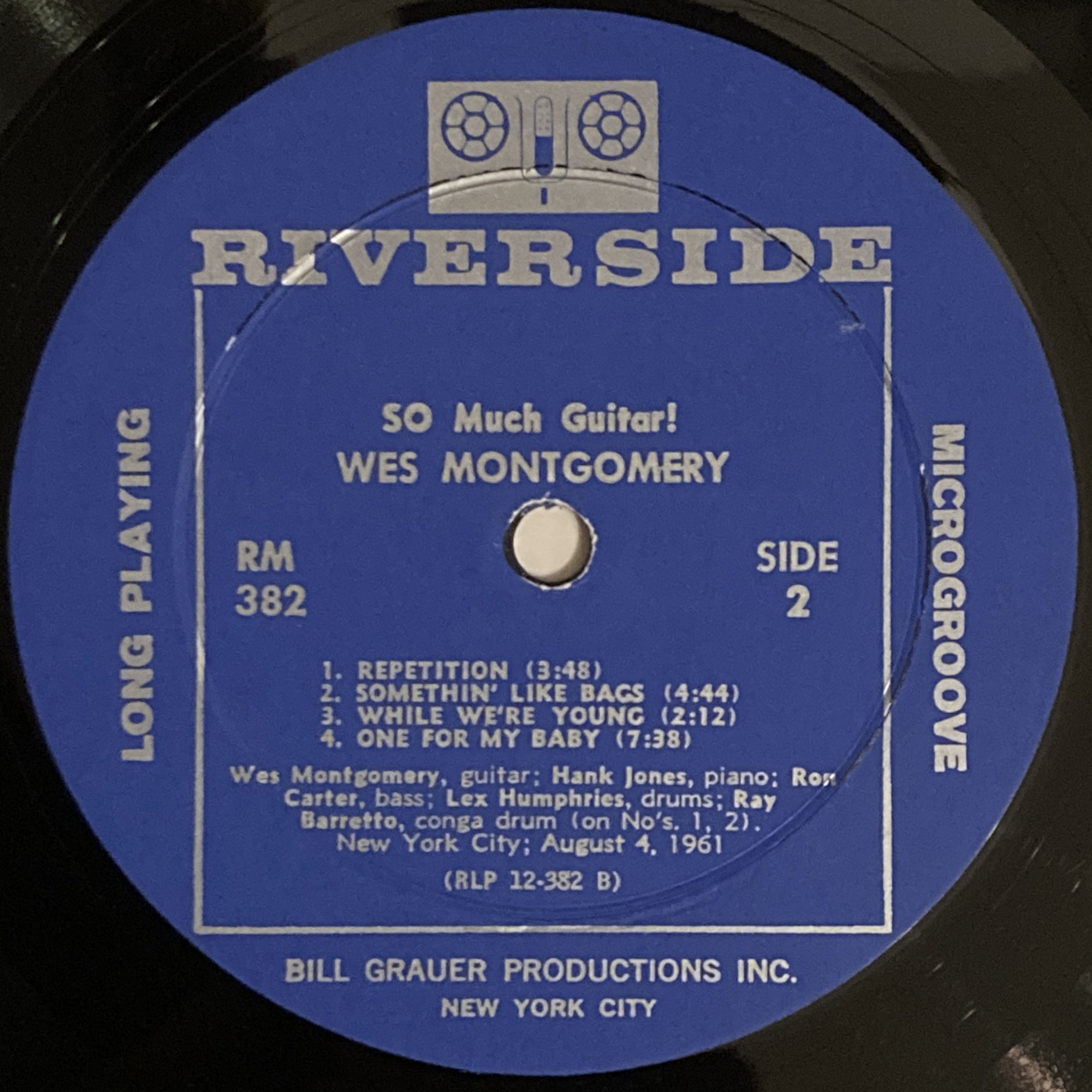
Label Side-2
Large Blue Background
Silver Letter with INC
Address: None
Deep Groove
Dead Wax Info: RLP12-382-B
Personnel-
Drums: Lex Humphries
Bass: Ron Carter
Piano: Hank Jones
Guitar: Wes Montgomery
Conga Drums: Ray Barretto
Tracks-
Side-1
1) Twisted Blues 5’31”
2) Cotton Tail 3’38”
3) I Wish I Knew 5’26”
4) I’m Just a Lucky So and So 5’57”
Side-2
1) Repetition 3’48”
2) Somethin’ Like Bags 4’44”
3) While We’re Young 2’12”
4) One for My Baby 7’38”
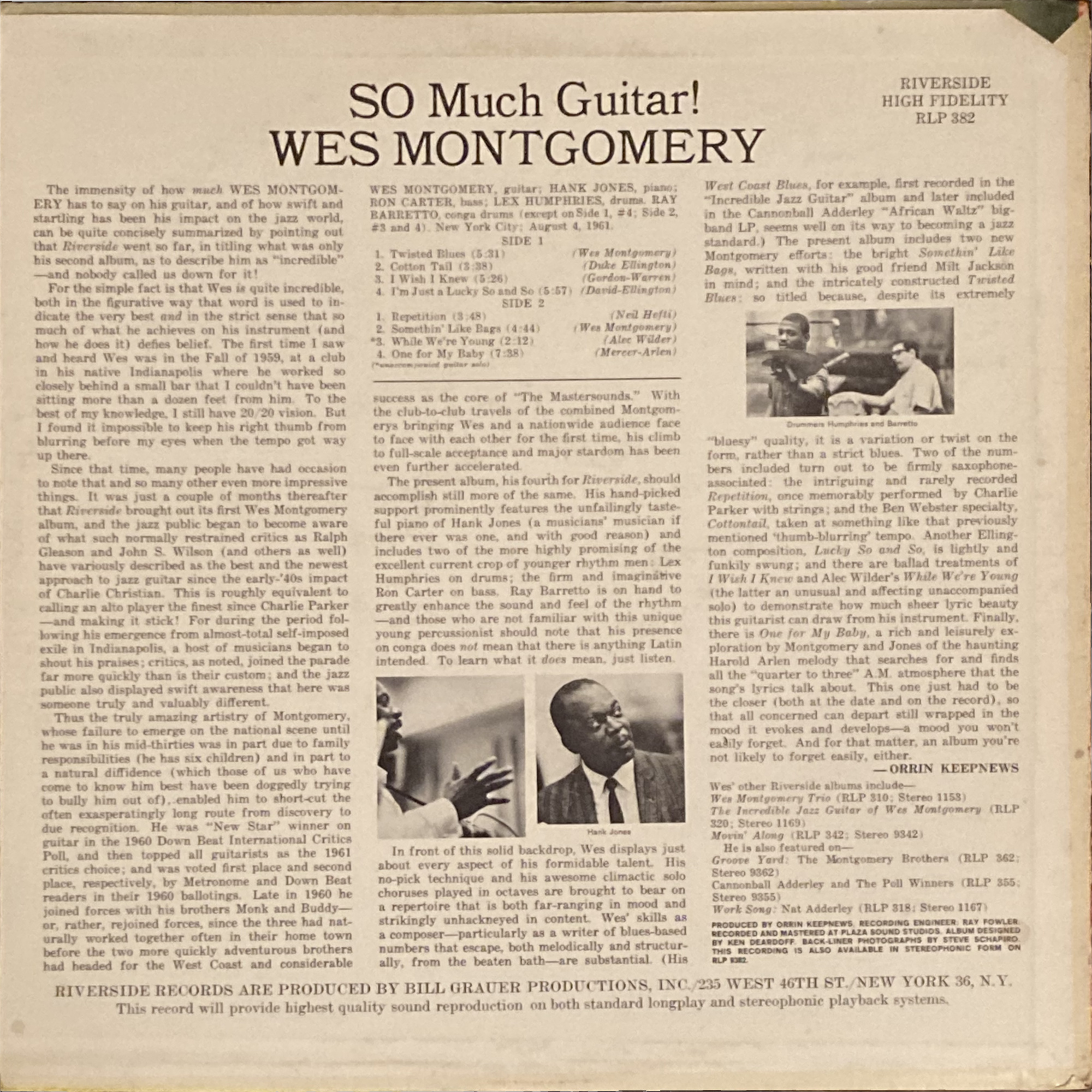
<裏ジャケ原文>
The immensity of how much WES MONTGOM- ERY has to say on his guitar, and of how swift and startling has been his impact on the jazz world, can be quite concisely summarized by pointing out that Riverside went so far, in titling what was only his second album, as to describe him as “incredible” –and nobody called us down for it!
For the simple fact is that Wes is quite incredible, both in the figurative way that word is used to in- dicate the very best and in the strict sense that so much of what he achieves on his instrument (and how he does it) defies belief. The first time I saw and heard Wes was in the Fall of 1959, at a club in his native Indianapolis where he worked so closely behind a small bar that I couldn’t have been sitting more than a dozen feet from him. To the best of my knowledge, I still have 20/20 vision. But I found it impossible to keep his right thumb from blurring before my eyes when the tempo got way up there.
Since that time, many people have had occasion to note that and so many other even more impressive things. It was just a couple of months thereafter that Riverside brought out its first Wes Montgomery album, and the jazz public began to become aware of what such normally restrained critics as Ralph Gleason and John S. Wilson (and others as well) have variously described as the best and the newest approach to jazz guitar since the early-’40s impact of Charlie Christian. This is roughly equivalent to calling an alto player the finest since Charlie Parker -and making it stick! For during the period fol- lowing his emergence from almost-total self-imposed exile in Indianapolis, a host of musicians began to shout his praises; critics, as noted, joined the parade far more quickly than is their custom; and the jazz public also displayed swift awareness that here was someone truly and valuably different.
Thus the truly amazing artistry of Montgomery, whose failure to emerge on the national scene until he was in his mid-thirties was in part due to family responsibilities (he has six children) and in part to a natural diffidence (which those of us who have come to know him best have been doggedly trying to bully him out of),.enabled him to short-cut the often exasperatingly long route from discovery to due recognition. He was “New Star” winner on guitar in the 1960 Down Beat International Critics Poll, and then topped all guitarists as the 1961 critics choice; and was voted first place and second place, respectively, by Metronome and Down Beat readers in their 1960 ballotings. Late in 1960 he joined forces with his brothers Monk and Buddy- or, rather, rejoined forces, since the three had nat- urally worked together often in their home town before the two more quickly adventurous brothers had headed for the West Coast and considerable success as the core of “The Mastersounds.” With the club-to-club travels of the combined Montgom- erys bringing Wes and a nationwide audience face to face with each other for the first time, his climb to full-scale acceptance and major stardom has been even further accelerated.
The present album, his fourth for Riverside, should accomplish still more of the same. His hand-picked support prominently features the unfailingly taste- ful piano of Hank Jones (a musicians’ musician if there ever was one, and with good reason) and includes two of the more highly promising of the excellent current crop of younger rhythm men: Lex Humphries on drums; the firm and imaginative Ron Carter on bass. Ray Barretto is on hand to greatly enhance the sound and feel of the rhythm -and those who are not familiar with this unique young percussionist should note that his presence on conga does not mean that there is anything Latin intended. To learn what it does mean, just listen.
In front of this solid backdrop, Wes displays just about every aspect of his formidable talent. His no-pick technique and his awesome climactic solo choruses played in octaves are brought to bear on a repertoire that is both far-ranging in mood and strikingly unhackneyed in content. Wes’ skills as a composer-particularly as a writer of blues-based numbers that escape, both melodically and structur- ally, from the beaten bath-are substantial. (His West Coast Blues, for example, first recorded in the “Incredible Jazz Guitar” album and later included in the Cannonball Adderley “African Waltz” big- band LP, seems well on its way to becoming a jazz standard.) The present album includes two new Montgomery efforts: the bright Somethin’ Like Bags, written with his good friend Milt Jackson in mind; and the intricately constructed Tristed Blues: so titled because, despite its extremely “blaesy” quality, it is a variation or twist on the form, rather than a strict blues. Two of the num- bers included turn out to be firmly saxophone- associated: the intriguing and rarely recorded Repetition, once memorably performed by Charlie Parker with strings; and the Ben Webster specialty, Cottontail, taken at something like that previously mentioned thumb-blurring’ tempo. Another Elling- ton composition, Lucky So and So, is lightly and funkily swung; and there are ballad treatments of I Wish I Knew and Alec Wilder’s While We’re Young (the latter an unusual and affecting unaccompanied solo) to demonstrate how much sheer lyric beauty this guitarist can draw from his instrument. Finally, there is One for My Baby, a rich and leisurely ex- ploration by Montgomery and Jones of the haunting Harold Arlen melody that searches for and finds all the “quarter to three” A.M. atmosphere that the song’s lyrics talk about. This one just had to be the closer (both at the date and on the record), so that all concerned can depart still wrapped in the mood it evokes and develops-a mood you won’t eadily forget. And for that matter, an album you’re not likely to forget easily, either.
-ORRIN KEEPNEWS
Wes’ other Riverside albums include-
Wes Montgomery Trio (RLP 310: Stereo 1158)
The Incredible Jazz Guitar of Wes Montgomery (RLP 320; Stereo 1169)
Movin’ Along (RLP 342; Stereo 9342)
He is also featured on-
Groove Yard: The Montgomery Brothers (RLP 362: Stereo 9362)
Cannonball Adderley and The Poll Winners (RLP 355: Stereo 9355)
Work Song: Nat Adderley (RLP 318: Stereo 1167)
PRODUCED BY ORRIN KEEPNEWS RECORDING ENGINEER RAY FOWLER RECORDED AND MASTERED AT PLAZA SOUND STUDIOS. ALBUM DESIGNED BY KEN DEARDOFF BACK-LINER PHOTOGRAPHS BY STEVE SCHAPIRO THIS RECORDING IS ALSO AVAILABLE IN STEREOPHONIC FORM ON RUP 1382
<裏ジャケ和訳>
ウェス・モンゴメリーがギターを通じて語りかける内容の深遠さと、彼がジャズ界に与えた衝撃の凄まじさ――その両方を端的に物語る事実があります。それは、リバーサイド・レコードが彼のわずか2枚目のアルバムに「インクレディブル(信じられないほど素晴らしい)」という言葉を冠したこと、そして誰もそれに異議を唱えなかったことです。
というのも、ウェスはまさに「インクレディブル」な存在だからです。最高の才能を指す比喩的な意味でも、また、彼が楽器で成し遂げること(そしてその演奏手法)の多くが信じがたいほど驚異的であるという厳密な意味でも、彼は並外れているのです。私が初めてウェスの演奏を目にし、耳にしたのは1959年の秋、彼の故郷インディアナポリスのクラブでのことでした。彼は小さなバーカウンターのすぐ裏で演奏しており、私は彼から3〜4メートルと離れていない場所に座っていました。私の視力は今でも良好ですが、テンポが極めて速くなると、彼の右手の親指の動きが速すぎて、目の前で残像のようにぼやけて見えてしまうほどでした。
それ以来、多くの人々がその点や、さらに驚くべき数々の特徴に注目してきました。リバーサイドがウェスの初アルバムをリリースしたのは、そのわずか数ヶ月後のことです。やがてジャズ・ファンや批評家の間でも、彼の存在が広く認識されるようになりました。ラルフ・グリーソンやジョン・S・ウィルソンといった、普段は評価に慎重な批評家たちでさえ、彼のスタイルを「1940年代初頭のチャーリー・クリスチャンの登場以来、最も優れ、かつ斬新なジャズ・ギターへのアプローチ」と評したほどです。これは、あるアルト・サックス奏者を「チャーリー・パーカー以来の最高傑作」と呼び、かつその評価を世間に認めさせることに等しいほどの称賛でした。実際、インディアナポリスで自ら課していた長い「隠遁生活」から彼が表舞台に姿を現すと、数多くのミュージシャンがこぞって彼を絶賛し始めました。前述の通り、批評家たちも普段の慎重な姿勢を捨てていち早く彼を支持し、ジャズ・ファンもまた、彼が真に、そして極めて価値ある「特別な存在」であることを即座に見抜いたのです。モンゴメリーの芸術性は実に驚くべきものでした。彼が全国的な舞台に登場するのが30代半ばまで遅れたのは、一つには家庭の事情(彼には6人の子供がいました)があり、もう一つは生来の控えめな性格(彼をよく知る私たちは、その性格を何とかして変えようと粘り強く働きかけてきたのですが)によるものでした。しかし、その圧倒的な才能のおかげで、彼は「発見」から「正当な評価」に至るまでの、往々にしてじれったいほど長い道のりを一気に飛び越えることができたのです。彼は1960年の『ダウン・ビート』誌国際批評家投票でギター部門の「ニュースター(新人賞)」に選ばれ、翌1961年には批評家が選ぶギタリストのトップに輝きました。また、1960年の読者投票でも、『メトロノーム』誌と『ダウン・ビート』誌の双方でそれぞれ1位と2位に選出されています。1960年後半、彼は兄弟であるモンクやバディと再び手を組むことになりました――もっとも、正確には「再結成」と言うべきでしょう。というのも、彼ら3人は故郷ですでに頻繁に共演していたからです。その後、より大胆に行動した二人の兄弟は西海岸へ渡り、「ザ・マスターサウンズ」の中核として大きな成功を収めていました。モンゴメリー兄弟が揃って各地のクラブを巡るツアーを行ったことで、ウェスと全国の聴衆が初めて直接顔を合わせる機会が生まれ、彼が広く受け入れられ、大スターへと駆け上がっていく勢いはさらに加速することとなったのです。
リバーサイド・レーベルでの4作目となる本作も、同様の成功を収めることだろう。彼が自ら選んだ共演陣には、常に洗練されたピアノを聴かせるハンク・ジョーンズ(まさに「ミュージシャンズ・ミュージシャン」と呼ぶにふさわしい人物だ)を筆頭に、若手リズム・セクションの中でも特に将来を嘱望される二人が名を連ねている。ドラムスのレックス・ハンフリーズ、そして堅実かつ独創的なベース・プレイを見せるロン・カーターである。さらにレイ・バレットが加わり、リズムの響きとグルーヴに厚みを与えている。このユニークな若きパーカッショニストをまだ知らない人のために言っておくと、彼がコンガを演奏しているからといって、必ずしもラテン・ミュージックを意図しているわけではない。その真意を知りたければ、ただ聴いてみればいい。
こうした盤石なバックを従え、ウェスはその圧倒的な才能を遺憾なく発揮している。ピックを使わない独特の奏法や、オクターブ奏法で繰り出される圧巻のクライマックス・ソロといった技が、ムードも内容も実に多彩で、ありきたりではないレパートリーの中で存分に活かされているのだ。作曲家としてのウェスの手腕もまた見事なもので、特にブルースを基調としながらも、メロディや構成の面で既存の型にとらわれない楽曲を書く才能には目を見張るものがある。(例えば、アルバム『Incredible Jazz Guitar』で初録音され、後にキャノンボール・アダレイのビッグバンド・アルバム『African Waltz』にも収録された「West Coast Blues」などは、ジャズ・スタンダードの地位を確立しつつあると言えるだろう。)本作には、モンゴメリーによる新曲が2曲収録されている。親友ミルト・ジャクソンをイメージして書かれた明るい雰囲気の「Somethin’ Like Bags」と、複雑な構成を持つ「Twisted Blues」だ。後者は、極めて「ブルースらしい」曲調でありながら、厳密なブルース形式そのものではなく、その形式にひねり(ツイスト)を加えた変奏曲であることからそう名付けられた。収録された曲の中には、サックス奏者との結びつきが強い曲も2つある。一つは、かつてチャーリー・パーカーがストリングスをバックに印象的な演奏を残した「Repetition」で、興味深い楽曲でありながら録音されることは稀な一曲だ。もう一つはベン・ウェブスターの十八番である「Cottontail」で、前述したような、親指がブレて見えるほどの高速テンポで演奏されている。さらに、エリントン作品からは「Lucky So and So」が取り上げられ、軽快かつファンキーなスウィング感で演奏されている。さらに、「I Wish I Knew」やアレック・ワイルダーの「While We’re Young」(後者は珍しい、かつ心に響く無伴奏ソロ)のバラード演奏も収録されており、このギタリストが楽器からいかに純粋で美しい旋律を引き出せるかを示しています。そして最後を飾るのは「One for My Baby」です。モンゴメリーとジョーンズがハロルド・アーレンの心に残る名曲を豊かに、そしてゆったりと探求し、歌詞が描く「午前2時45分」のあの独特な雰囲気を余すところなく表現しています。この曲は、セッションにおいてもアルバムにおいても、まさに締めくくりにふさわしい一曲でした。演奏が醸し出し、深めていくあのムード――容易には忘れられないその余韻に浸ったまま、誰もがその場を後にできるのです。そして、このアルバム自体もまた、決して忘れられない一枚となることでしょう。
―オリン・キープニュース
ウェスのその他のリバーサイド・アルバムは以下の通りです。
Wes Montgomery Trio (RLP 310: Stereo 1158)
The Incredible Jazz Guitar of Wes Montgomery (RLP 320; Stereo 1169)
Movin’ Along (RLP 342; Stereo 9342)
また、以下の作品にも参加しています。
Groove Yard: The Montgomery Brothers (RLP 362: Stereo 9362)
Cannonball Adderley and The Poll Winners (RLP 355: Stereo 9355)
Work Song: Nat Adderley (RLP 318: Stereo 1167)
プロデュース:オリン・キープニュース 録音エンジニア:レイ・ファウラー 録音・マスタリング:プラザ・サウンド・スタジオ アルバム・デザイン:ケン・ディアドーフ 裏ジャケット写真:スティーヴ・シャピロ 本録音はステレオ盤(RLP 1382)でも入手可能です。
※訳文の制作にはGoogleドライブとGoogle翻訳のお世話になりました。

コメント