Label: VERVE RECORDS
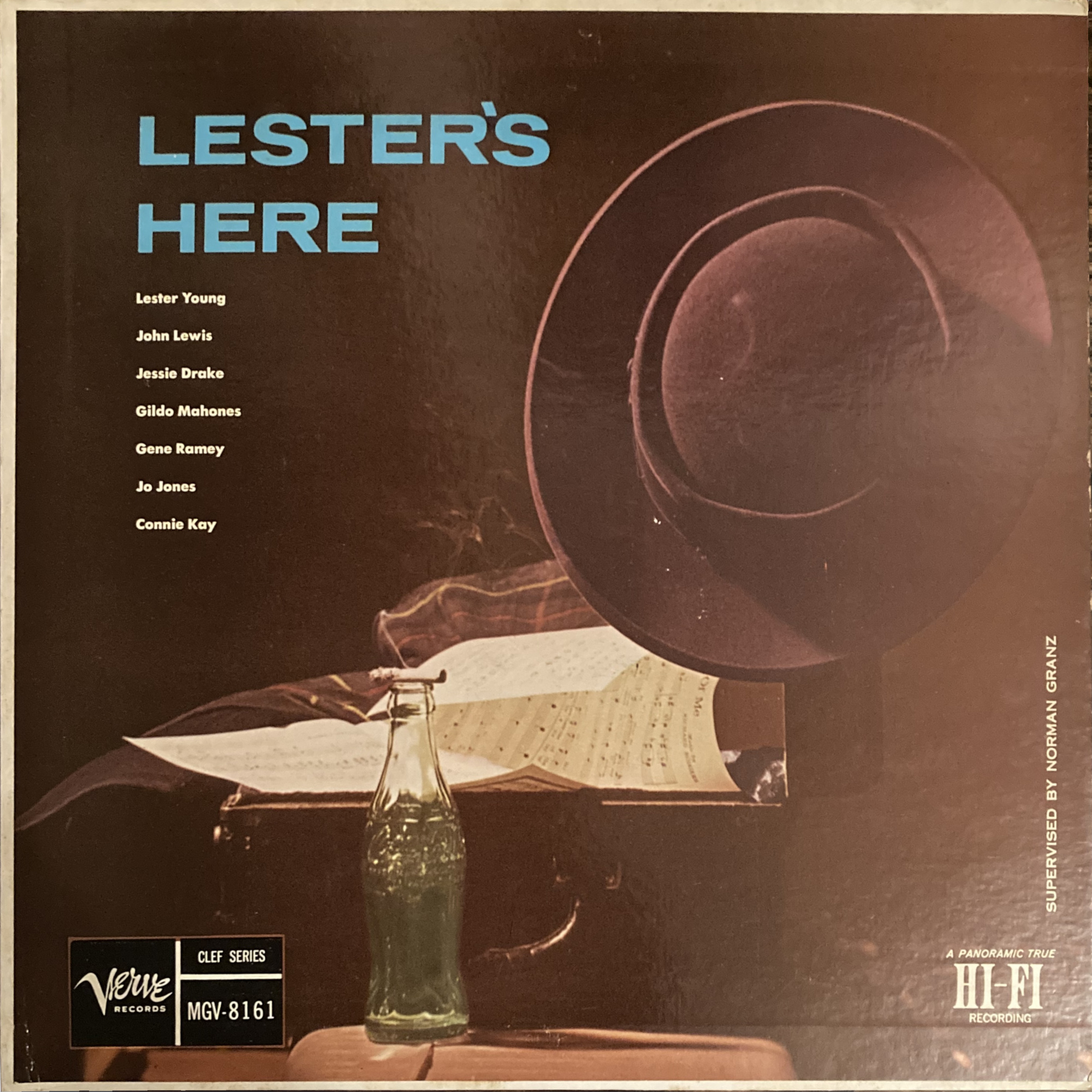
No.: MG V-8161
Title: LESTER’S HERE
Musician: LESTER YOUNG
Recorded: 1951/3/8
Monaural
Cover address:
Coating
Groove Guard
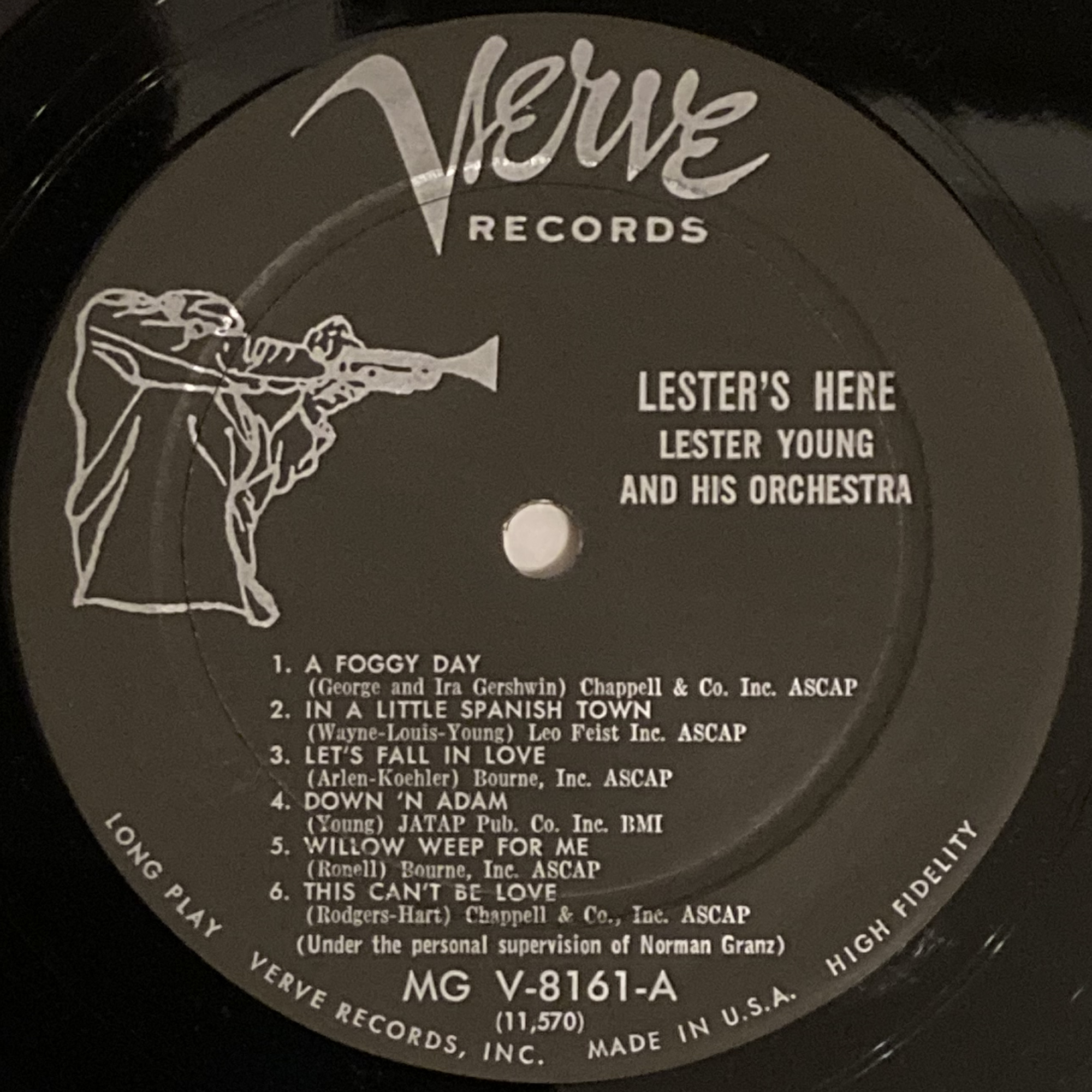
Label Side-A
Black Background
Silver Letter with Trumpet
Address:
Deep Groove
Dead Wax Info: MGV-8161-A, 11.570,
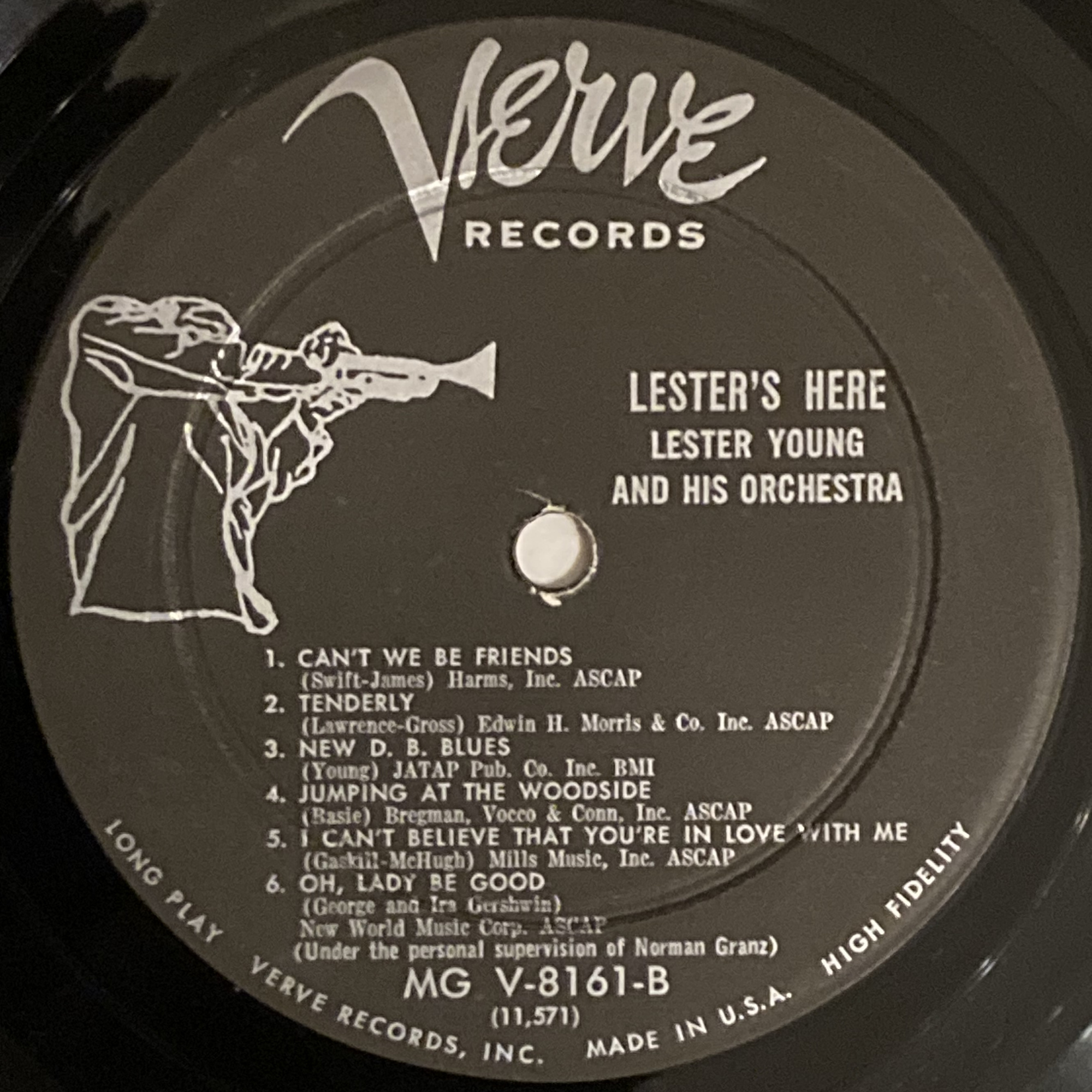
Label Side-B
Black Background
Silver Letter with Trumpet
Address:
Deep Groove
Dead Wax Info: MGV-8161-B, 11.571, (Rc)
Personnel-
Side-B Truck 1 to 4
Drums: Jo Jones
Bass: Gene Ramey
Piano: John Lewis
Tenor Sax: Lester Young
Other Tracks
Drums: Connie Kay
Bass: Gene Ramey
Piano: Gildo Mahones
Tenor Sax: Lester Young
Trumpet: Jessie Drakes
Tracks-
Side-A
1) Can’t We be Friends
2) Tenderly
3) New D. B. Blues
4) Jumping at the Woodside
5) I Can’t Believe that You’re in Love with Me
6) Oh, Lady be Good
Side-B
1) A Foggy Day
2) In a Little Spanish Town
3) Let’s Fall in Love
4) Down ‘N Adam
5) Willow Weep for Me
6) This Can’t be Love
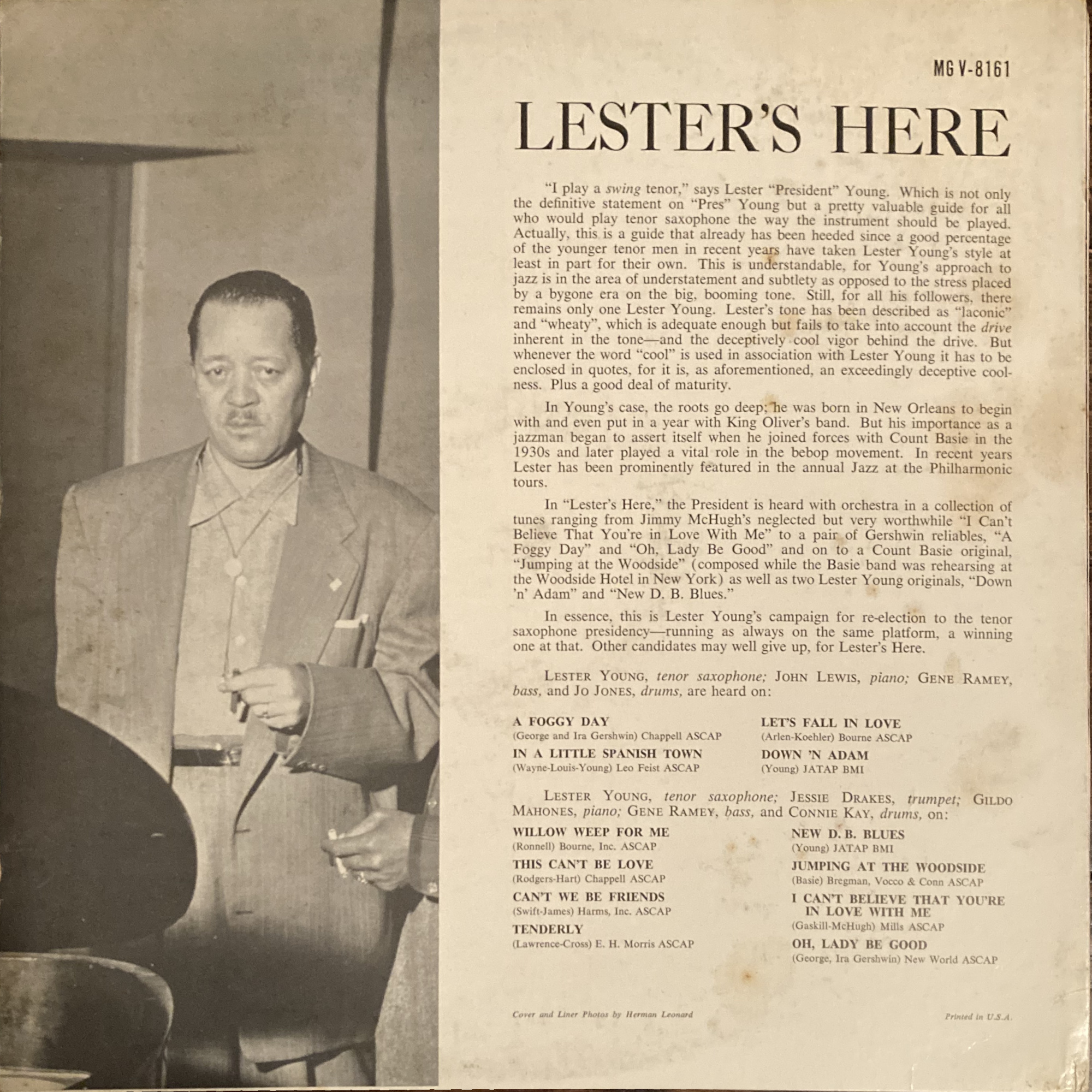
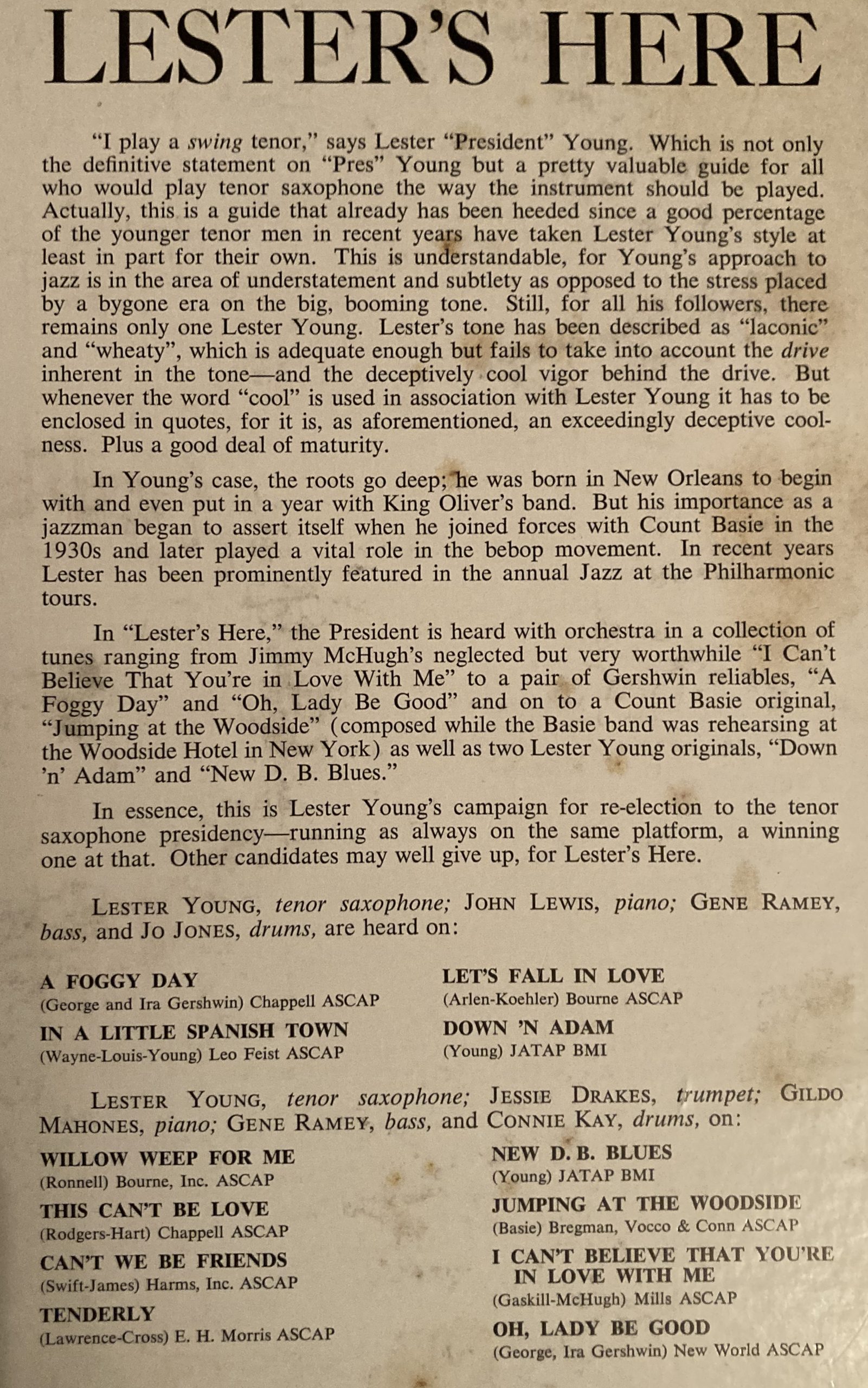
<裏ジャケ原文>
LESTER’S HERE
“I play a swing tenor,” says Lester “President” Young. Which is not only the definitive statement on “Pres” Young but a pretty valuable guide for all who would play tenor saxophone the way the instrument should be played. Actually, this is a guide that already has been heeded since a good percentage of the younger tenor men in recent years have taken Lester Young’s style at least in part for their own. This is understandable, for Young’s approach to jazz is in the area of understatement and subtlety as opposed to the stress placed by a bygone era on the big, booming tone. Still, for all his followers, there remains only one Lester Young. Lester’s tone has been described as “laconic” and “wheaty”, which is adequate enough but fails to take into account the drive inherent in the tone-and the deceptively cool vigor behind the drive. But whenever the word “cool” is used in association with Lester Young it has to be enclosed in quotes, for it is, as aforementioned, an exceedingly deceptive cool- ness. Plus a good deal of maturity.
In Young’s case, the roots go deep; he was born in New Orleans to begin with and even put in a year with King Oliver’s band. But his importance as a jazzman began to assert itself when he joined forces with Count Basie in the 1930s and later played a vital role in the bebop movement. In recent years Lester has been prominently featured in the annual Jazz at the Philharmonic
tours.
In “Lester’s Here,” the President is heard with orchestra in a collection of tunes ranging from Jimmy McHugh’s neglected but very worthwhile “I Can’t Believe That You’re in Love With Me” to a pair of Gershwin reliables, “A Foggy Day” and “Oh, Lady Be Good” and on to a Count Basie original, “Jumping at the Woodside” (composed while the Basie band was rehearsing at the Woodside Hotel in New York) as well as two Lester Young originals, “Down ‘n’ Adam” and “New D. B. Blues.”
In essence, this is Lester Young’s campaign for re-election to the tenor saxophone presidency-running as always on the same platform, a winning one at that. Other candidates may well give up, for Lester’s Here.
LESTER YOUNG, tenor saxophone; JOHN LEWIS, piano; GENE RAMEY, bass, and Jo JONES, drums, are heard on:
A FOGGY DAY
(George and Ira Gershwin) Chappell ASCAP
IN A LITTLE SPANISH TOWN
(Wayne-Louis-Young) Leo Feist ASCAP
LET’S FALL IN LOVE
(Arlen-Koehler) Bourne ASCAP
DOWN ‘N ADAM
(Young) JATAP BMI
LESTER YOUNG, tenor saxophone; JESSIE DRAKES, trumpet; GILDO MAHONES, piano; GENE RAMEY, bass, and CONNIE KAY, drums, on:
WILLOW WEEP FOR ME
(Ronnell) Bourne, Inc. ASCAP
THIS CAN’T BE LOVE
(Rodgers-Hart) Chappell ASCAP
CAN’T WE BE FRIENDS
(Swift-James) Harms, Inc. ASCAP
TENDERLY
(Lawrence-Cross) E. H. Morris ASCAP
NEW D. B. BLUES
(Young) JATAP BMI
JUMPING AT THE WOODSIDE
(Basie) Bregman, Vocco & Conn ASCAP
I CAN’T BELIEVE THAT YOU’RE IN LOVE WITH ME
(Gaskill-McHugh) Mills ASCAP
OH, LADY BE GOOD
(George, Ira Gershwin) New World ASCAP
<裏ジャケ和訳>
レスターの登場
「俺はスウィング・テナーを吹くんだ」と、レスター・“プレジデント”・ヤングは語る。この言葉は、「プレズ(大統領)」ことヤングを端的に表しているだけでなく、テナー・サックスを本来あるべき姿で演奏しようとするすべての人にとって、極めて有益な指針ともなっている。実際、近年の若手テナー奏者の多くがレスター・ヤングのスタイルを少なくとも部分的に取り入れていることからもわかるように、この指針はすでに多くの人々に受け入れられていると言えるだろう。それももっともな話だ。かつての時代が大きく響き渡るような豪快なトーンを重視していたのに対し、ヤングのジャズへのアプローチは、控えめな表現や繊細なニュアンスを大切にするものだったからだ。とはいえ、彼に続くフォロワーがどれほどいようとも、レスター・ヤングという存在は唯一無二であることに変わりはない。レスターのトーンは「簡潔(ラコニック)」や「小麦のような(ウィーティ)」と形容されることがある。それらの表現も的を射てはいるが、そのトーンに本来備わっている推進力や、その推進力の背後にある、一見クールに見えて実は力強いエネルギーといった側面までは捉えきれていない。もっとも、レスター・ヤングに関して「クール」という言葉を使う際には、必ず引用符で囲まなければならないだろう。なぜなら、前述の通り、それは極めて「見かけとは裏腹な」クールさだからだ。そこには、大人の成熟した味わいも多分に含まれている。
ヤングの場合、その音楽的ルーツは深いところにある。そもそも彼はニューオーリンズの生まれであり、キング・オリヴァーのバンドに在籍していた時期さえある。しかし、ジャズマンとしての彼の重要性が際立つようになったのは、1930年代にカウント・ベイシーと手を組んでからであり、その後、彼はビバップ・ムーブメントにおいても重要な役割を果たすことになった。近年では、毎年恒例の「ジャズ・アット・ザ・フィルハーモニック」のツアーにおいて、レスターは主要な出演者として大きく取り上げられている。 『Lester’s Here』では、レスター・ヤング(“プレジデント”の愛称で知られる)がオーケストラをバックに、多彩な楽曲を披露しています。そのレパートリーは、ジミー・マクヒュー作ながら不当に忘れられがちだが聴く価値の高い「I Can’t Believe That You’re in Love With Me」から、ガーシュウィンの定番曲「A Foggy Day」や「Oh, Lady Be Good」、カウント・ベイシー・オーケストラがニューヨークのウッドサイド・ホテルでリハーサル中に作曲した「Jumping at the Woodside」、さらにはレスター自身のオリジナル曲である「Down ‘n’ Adam」や「New D. B. Blues」にまで及びます。
要するに本作は、テナー・サックス界の“プレジデント(大統領)”の座をかけたレスター・ヤングの再選キャンペーンなのです。彼はいつものように、勝利を約束された不変の公約を掲げて戦いに挑んでいます。他の候補者たちは、もう諦めたほうがいいかもしれません――何しろ、レスターがここにいる(Lester’s Here)のですから。
レスター・ヤング(テナー・サックス)、ジョン・ルイス(ピアノ)、ジーン・レイミー(ベース)、ジョー・ジョーンズ(ドラムス)が参加している楽曲:
A FOGGY DAY
(George and Ira Gershwin) Chappell ASCAP
IN A LITTLE SPANISH TOWN
(Wayne-Louis-Young) Leo Feist ASCAP
LET’S FALL IN LOVE
(Arlen-Koehler) Bourne ASCAP
DOWN ‘N ADAM
(Young) JATAP BMI
レスター・ヤング(テナー・サックス)、ジェシー・ドレイクス(トランペット)、ギルド・マホーンズ(ピアノ)、ベース:ジーン・レイミー、ドラムス:コニー・ケイ
収録楽曲:
WILLOW WEEP FOR ME(ウィロー・ウィープ・フォー・ミー)
THIS CAN’T BE LOVE(ディス・キャント・ビー・ラブ)
CAN’T WE BE FRIENDS(キャント・ウィ・ビー・フレンズ)
TENDERLY(テンダリー)
NEW D. B. BLUES(ニュー・D.B.ブルース)
JUMPING AT THE WOODSIDE(ジャンピング・アット・ザ・ウッドサイド)
I CAN’T BELIEVE THAT YOU’RE IN LOVE WITH ME(アイ・キャント・ビリーヴ・ザット・ユーアー・イン・ラブ・ウィズ・ミー)
OH, LADY BE GOOD(オー・レディ・ビー・グッド)
※訳文の制作にはGoogleドライブとGoogle翻訳のお世話になりました。

コメント