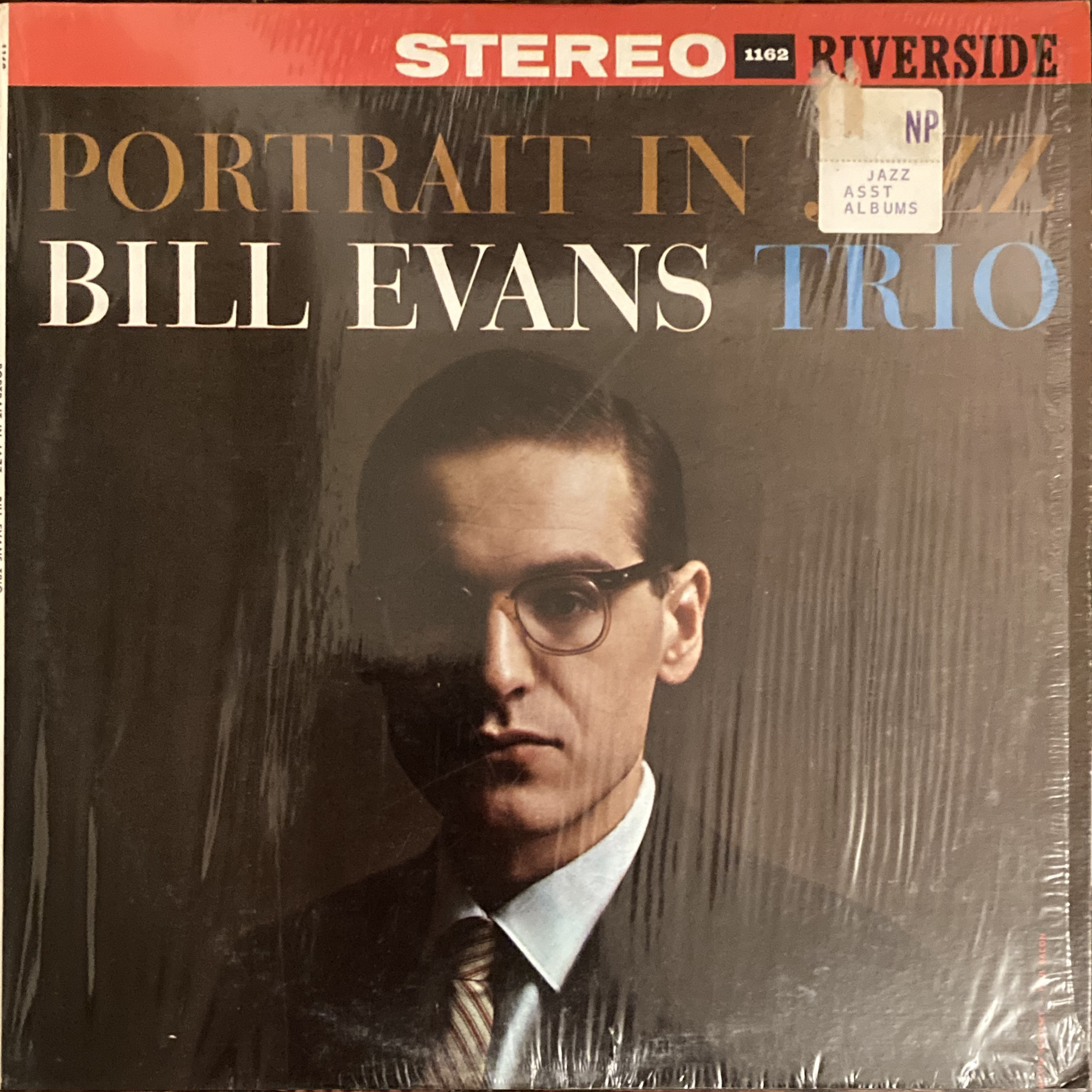
Label: RIVERSIDE
No.: RS-1162
Title: PORTRAIT IN JAZZ
Musician: BILL EVANS
Recorded: 1959/12/28
Stereo
Cover address: 無し
Coating 無し(シュリンク残っている)
Groove Guard
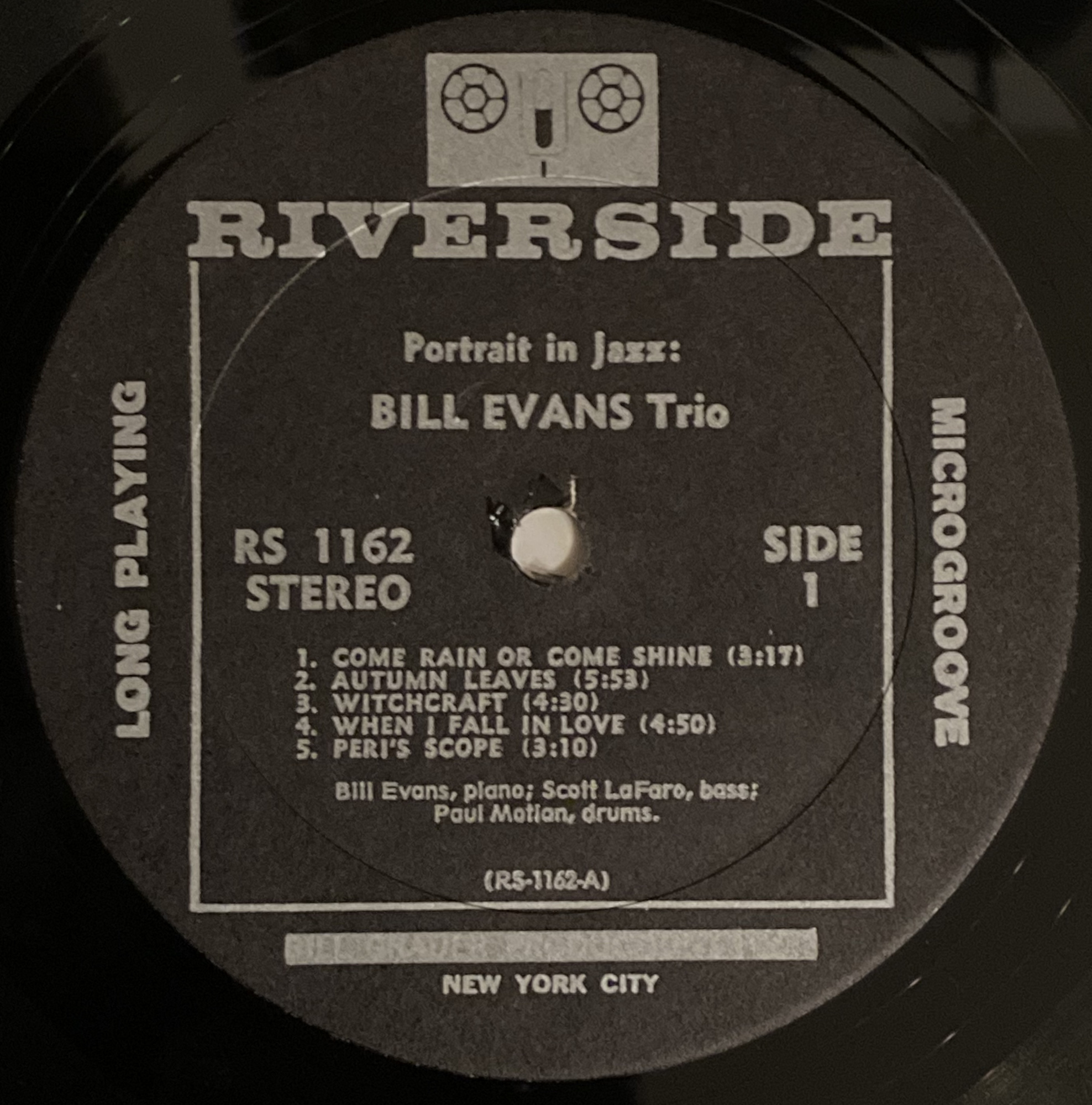
Label Side-1
Large Black Background
Silver Letter
Address: NEW YORK CITY
Deep Groove無し
Dead Wax Info: RS-1162A, 4-1571
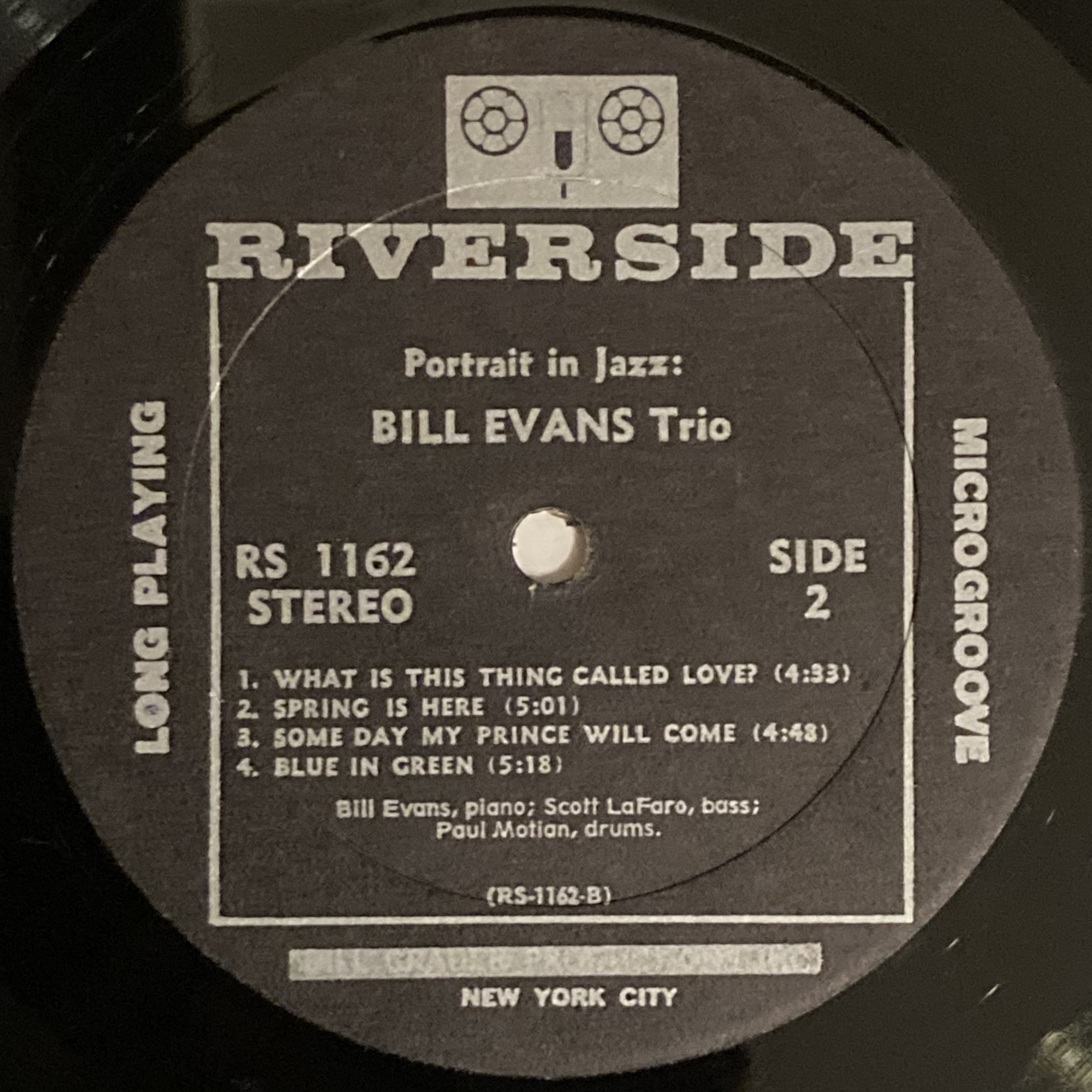
Label Side-2
Large Black Background
Silver Letter
Address: NEW YORK CITY
Deep Groove無し
Dead Wax Info: RS-1162B, 4-1571
Personnel-
Drums: Paul Motian
Bass: Scott LaFaro
Piano: Bill Evans
Tracks-
Side-1
1) Come Rain or Come Shine 3’17”
2) Autumn Leaves 5’22”
3) Witchcraft 4’30”
4) When I Fall in Love 4’50”
5) Peri’s Scope 3’11”
Side-2
1) What Is This Thing Called Love? 4’33”
2) Spring Is Here 5’01”
3) Someday My Prince Will Come 4’48”
4) Blue in Green 5’18”
センターレーベルの通常BILL GRAUER PRODUCTIONS INC. と印刷されている部分が
四角く塗りつぶされています。
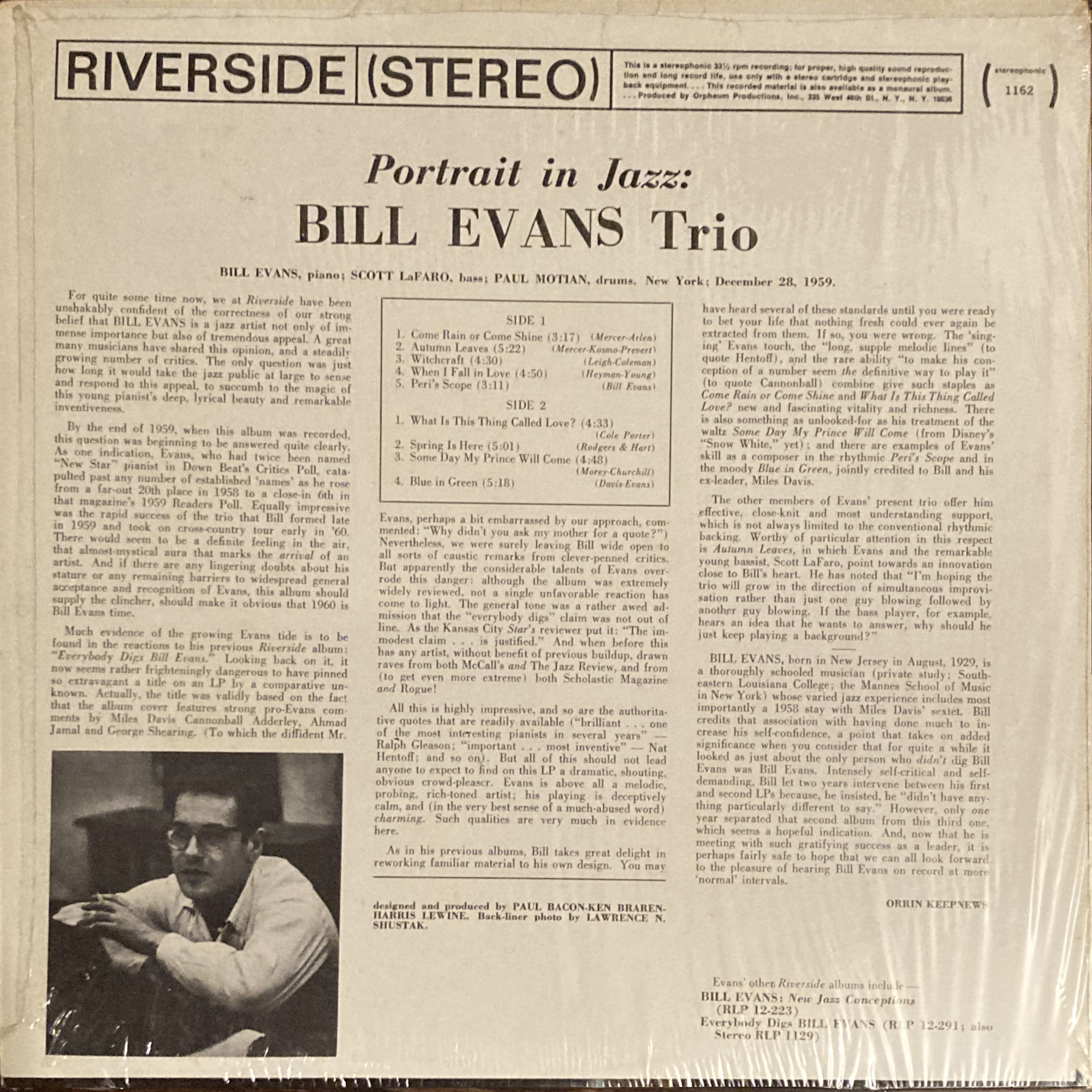
<裏ジャケ原文>
For quite some time now, we at Riverside have been unshakably confident of the correctness of our strong belief that BILL EVANS is a jazz artist not only of im- mense importance but also of tremendous appeal. A great many musicians have shared this opinion, and a steadily growing number of critics. The only question was just how long it would take the jazz public at large to sense and respond to this appeal, to succumb to the magic of this young pianist’s deep, lyrical beauty and remarkable
inventiveness.
By the end of 1959, when this album was recorded, this question was beginning to be answered quite clearly. As one indication, Evans, who had twice been named “New Star” pianist in Down Beat’s Critics Poll, cata- pulted past any number of established ‘names’ as he rose from a far-out 20th place in 1958 to a close-in 6th in that magazine’s 1959 Readers Poll. Equally impressive was the rapid success of the trio that Bill formed late in 1959 and took on cross-country tour early in ’60. There would seem to be a definite feeling in the air, that almost-mystical aura that marks the arrival of an artist. And if there are any lingering doubts about his stature or any remaining barriers to widespread general acceptance and recognition of Evans, this album should supply the clincher, should make it obvious that 1960 is Bill Evans time.
Much evidence of the growing Evans tide is to be found in the reactions to his previous Riverside album: “Everybody Digs Bill Evans.” Looking back on it, it now seems rather frighteningly dangerous to have pinned so extravagant a title on an LP by a comparative un- known. Actually, the title was validly based on the fact that the album cover features strong pro-Evans com- ments by Miles Davis Cannonball Adderley, Ahmad Jamal and George Shearing. (To which the diffident Mr.Evans, perhaps a bit embarrassed by our approach, com- mented: “Why didn’t you ask my mother for a quote?”) Nevertheless, we were surely leaving Bill wide open to all sorts of caustic remarks from clever-penned critics. But apparently the considerable talents of Evans over- rode this danger: although the album was extremely widely reviewed, not a single unfavorable reaction has come to light. The general tone was a rather awed ad- mission that the “everybody digs” claim was not out of line. As the Kansas City Star’s reviewer put it: “The im- modest claim… is justified.” And when before this has any artist, without benefit of previous buildup, drawn raves from both McCall’s and The Jazz Review, and from (to get even more extreme) both Scholastic Magazine and Rogue!
All this is highly impressive, and so are the authorita- tive quotes that are readily available (“brilliant . . . one of the most interesting pianists in several years” Ralph Gleason; “important… most inventive” Nat Hentoff; and so on). But all of this should not lead anyone to expect to find on this LP a dramatic, shouting, obvious crowd-pleaser. Evans is above all a melodic, probing. rich-toned artist; his playing is deceptively calm, and (in the very best sense of a much-abused word) charming. Such qualities are very much in evidence here.
As in his previous albums, Bill takes great delight in reworking familiar material to his own design. You may have heard several of these standards until you were ready to bet your life that nothing fresh could ever again be extracted from them. If so, you were wrong. The ‘sing- ing’ Evans touch, the “long, supple melodic lines” (to quote Hentoff), and the rare ability “to make his con- ception of a number seem the definitive way to play it” (to quote Cannonball) combine give such staples as Come Rain or Come Shine and What Is This Thing Called Love? new and fascinating vitality and richness. There is also something as unlooked-for as his treatment of the waltz Some Day My Prince Will Come (from Disney’s “Snow White,” yet); and there are examples of Evans’ skill as a composer in the rhythmic Peri’s Scope and in the moody Blue in Green, jointly credited to Bill and his ex-leader, Miles Davis.
The other members of Evans’ present trio offer him effective, close-knit and most understanding support, which is not always limited to the conventional rhythmic backing. Worthy of particular attention in this respect is Autumn Leaves, in which Evans and the remarkable young bassist, Scott LaFaro, point towards an innovation close to Bill’s heart. He has noted that “I’m hoping the trio will grow in the direction of simultaneous improvi- sation rather than just one guy blowing followed by another guy blowing. If the bass player, for example, hears an idea that he wants to answer, why should he just keep playing a background?”
BILL EVANS, born in New Jersey in August, 1929, is a thoroughly schooled musician (private study; South- eastern Louisiana College; the Mannes School of Music in New York) whose varied jazz experience includes most importantly a 1958 stay with Miles Davis’ sextet. Bill credits that association with having done much to in- crease his self-confidence, a point that takes on added significance when you consider that for quite a while it looked as just about the only person who didn’t dig Bill Evans was Bill Evans. Intensely self-critical and self- demanding, Bill let two years intervene between his first and second LPs because, he insisted, he “didn’t have any- thing particularly different to say. However, only one year separated that second album from this third one, which seems a hopeful indication. And, now that he is meeting with such gratifying success as a leader, it is perhaps fairly safe to hope that we can all look forward to the pleasure of hearing Bill Evans on record at more ‘normal’ intervals.
ORRIN KEEP NEWS
<裏ジャケ和訳>
リバーサイド・レコードの我々は、ビル・エヴァンスが極めて重要かつ圧倒的な魅力を持つジャズ・アーティストであるという確信を、長い間揺るぎなく抱き続けてきました。多くのミュージシャンや、着実に増え続ける評論家たちもまた、この意見を共有しています。唯一の疑問は、一般のジャズ・ファンがこの魅力に気づき、反応し、この若きピアニストが持つ深く叙情的な美しさと驚くべき独創性の魔法に魅了されるまでに、どれほどの時間がかかるかということでした。
このアルバムが録音された1959年の終わり頃には、その疑問に対する答えがかなり明確になり始めていました。その一つの証拠として、ダウン・ビート誌の批評家投票で二度「ニュースター(新人)」ピアニストに選ばれたエヴァンスは、同誌の1959年読者投票において、1958年には20位という低い順位だったにもかかわらず、一気に6位へと躍進し、数多くの著名なアーティストたちを追い抜いてみせたのです。同様に印象的だったのは、ビルが1959年後半に結成し、1960年初頭に全米ツアーを行ったトリオの急速な成功です。そこには、ある種の確かな気配、すなわちアーティストの本格的な到来を告げる、あの神秘的とも言えるオーラが漂っていました。もし彼の才能や実力についてまだ疑念が残っていたり、一般に広く受け入れられ認知される上での障壁があったりしたとしても、このアルバムが決定打となるはずです。そして、1960年こそがビル・エヴァンスの時代であることを明白にするでしょう。
エヴァンスへの支持が高まっている証拠は、リバーサイドでの前作『Everybody Digs Bill Evans(エヴリバディ・ディグス・ビル・エヴァンス)』への反応にも数多く見られます。今振り返ってみると、当時まだ比較的名の知られていなかったアーティストのLPに、あれほど大胆なタイトルを付けたことは、ある意味で恐ろしいほどの賭けだったように思えます。しかし実際には、そのタイトルは正当な根拠に基づいたものでした。アルバム・ジャケットには、マイルス・デイヴィス、キャノンボール・アダレイ、アーマッド・ジャマル、ジョージ・シアリングといった面々による、エヴァンスを強く支持するコメントが掲載されていたからです。 (これに対し、控えめな性格のエヴァンス氏は、我々のこうしたアプローチに少し気まずさを感じたのか、「なぜ母にコメントを求めなかったんですか?」と口にしたほどでした。)とはいえ、我々はビルを、辛辣な筆致で知られる批評家たちからのあらゆる批判にさらす危険を冒していたのも確かです。しかし、エヴァンスの卓越した才能がそのリスクを凌駕したようです。このアルバムは極めて多くの媒体で取り上げられましたが、否定的な反応は一つとして見当たりませんでした。「誰もが気に入る(everybody digs)」という謳い文句が決して大げさではなかったことを、誰もが畏敬の念を込めて認めるような論調だったのです。『カンザスシティ・スター』紙の批評家が「あの不遜とも言える謳い文句は……正当なものだ」と評した通りです。これまでに、事前の大掛かりな宣伝なしに、『マッコールズ』誌と『ジャズ・レビュー』誌の双方から、さらには(極端な例を挙げれば)『スコラスティック・マガジン』と『ローグ』誌からも絶賛を浴びたアーティストがいたでしょうか!
こうした事実は実に印象的であり、すぐに引用できる権威ある言葉の数々も同様です(ラルフ・グリーソンによる「見事……ここ数年で最も興味深いピアニストの一人」、ナット・ヘントフによる「重要……極めて独創的」など)。しかし、だからといって、このLPに劇的で、声を張り上げるような、いかにも大衆受けを狙った演奏が収録されていると期待してはいけません。エヴァンスは何よりもまず、旋律を重視し、探求心に富み、豊かな音色を持つアーティストです。彼の演奏は一見穏やかですが、その実、(乱用されがちな言葉ではありますが、最良の意味で)実に魅力的なのです。そして、そうした資質が本作には如実に表れています。
これまでのアルバムと同様、ビルは馴染み深い楽曲を自分なりの解釈で作り変えることに大きな喜びを見出しています。中には、もうこれ以上新しい要素など引き出せないと確信してしまうほど、何度も耳にしてきたスタンダード・ナンバーもあるかもしれません。しかし、もしそう思っていたなら、それは間違いです。エヴァンス特有の「歌うような」タッチ、ヘントフが評した「長くしなやかな旋律線」、そしてキャノンボールが「その曲に対する彼自身の解釈こそが決定的な演奏法だと思わせる」と称賛した稀有な才能。これらが融合することで、「Come Rain or Come Shine(降っても晴れても)」や「What Is This Thing Called Love?(恋とは何でしょう?)」といった定番曲に、魅力的で新鮮な生命力と豊かさが吹き込まれています。さらに、ディズニー映画『白雪姫』のワルツ曲「Some Day My Prince Will Come(いつか王子様が)」を彼がどう料理したかという、予想外のアプローチも見られます。また、作曲家としてのエヴァンスの才能を示す例として、リズミカルな「Peri’s Scope」や、ビルとかつてのリーダーであるマイルス・デイヴィスとの共作による情緒豊かな「Blue in Green」も挙げられます。
現在のトリオのメンバーは、効果的かつ緊密で、彼の意図を深く理解したサポートを行っています。それは単なる従来のリズム・セクションとしての伴奏にとどまるものではありません。この点で特に注目すべきは「Autumn Leaves(枯葉)」です。この曲では、エヴァンスと若き名ベーシスト、スコット・ラファロが、ビルが大切にしている革新的な演奏スタイルを提示しています。彼は次のように語っています。「単に一人がソロを吹いた後に別の人が吹くのではなく、トリオ全体が同時進行で即興演奏を行う方向へ発展していけばと願っています。例えば、ベーシストが反応したいと思うアイデアを耳にしたとき、なぜ単にバッキングを弾き続けなければならないのでしょうか?」
1929年8月にニュージャージー州で生まれたビル・エヴァンスは、徹底した音楽教育(個人レッスン、サウスイースタン・ルイジアナ・カレッジ、ニューヨークのマネス音楽院)を受けたミュージシャンです。その多彩なジャズ・キャリアの中でも特筆すべきは、1958年にマイルス・デイヴィスのセクステット(六重奏団)に在籍したことでしょう。ビルは、その活動が自身の自信を深める上で大きな役割を果たしたと語っています。ビル・エヴァンスという人物を振り返ると、長い間、彼を評価していなかった唯一の人間はビル・エヴァンス自身だったようにさえ見えただけに、この点は特に重要な意味を持ちます。極めて自己批判的で、自分に厳しい完璧主義者だった彼は、1枚目のLPと2枚目のLPの間に2年の歳月を置きました。その理由は、「特に新しい表現や主張がなかったから」というものでした。しかし、2枚目のアルバムから3枚目まではわずか1年しか空いておらず、これは希望の持てる兆候と言えるでしょう。リーダーとしてこれほど素晴らしい成功を収めている今、私たちは今後、より「標準的な」ペースでビル・エヴァンスのレコードを楽しめるようになることを期待してもよさそうです。
オリン・キープニュース
※訳文の制作にはGoogleドライブとGoogle翻訳のお世話になりました。
コメント