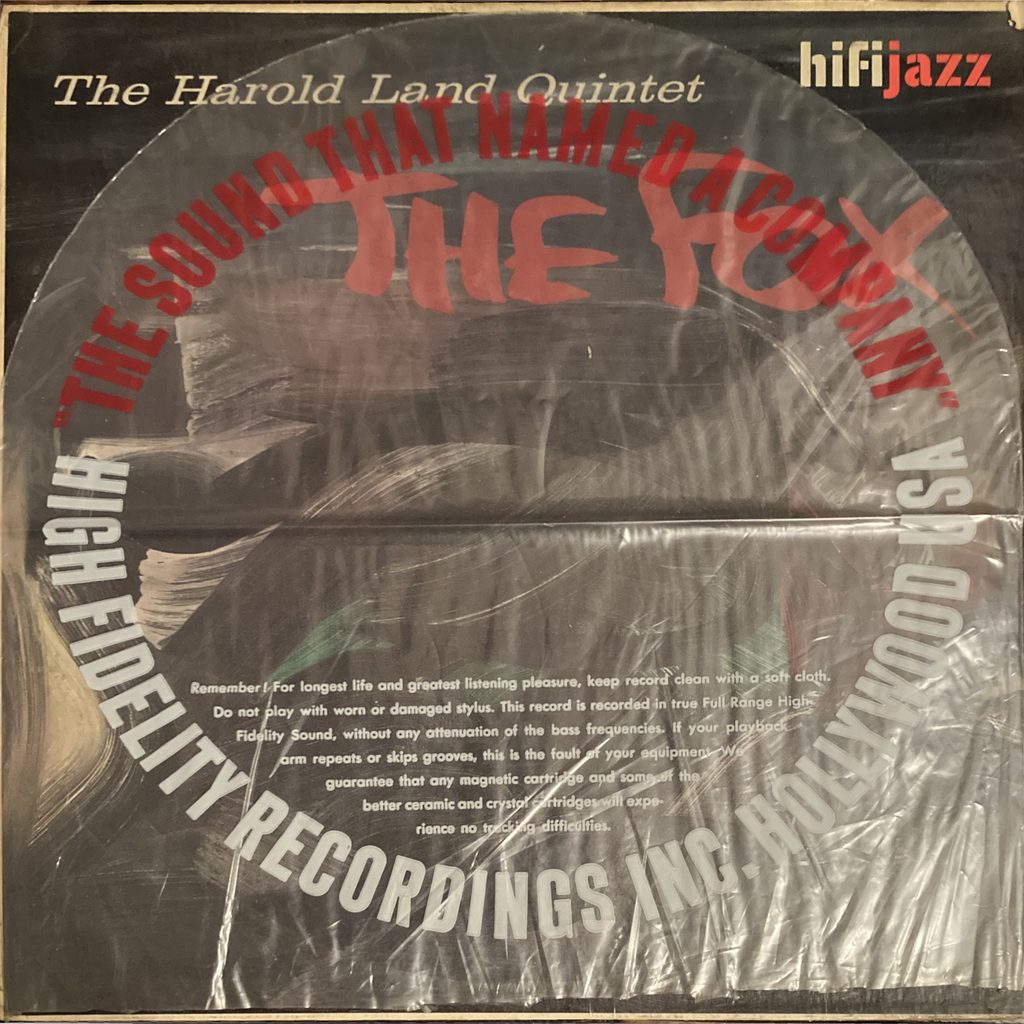
使用してはいませんが、透明のロゴ付きビニール内袋がついていました。
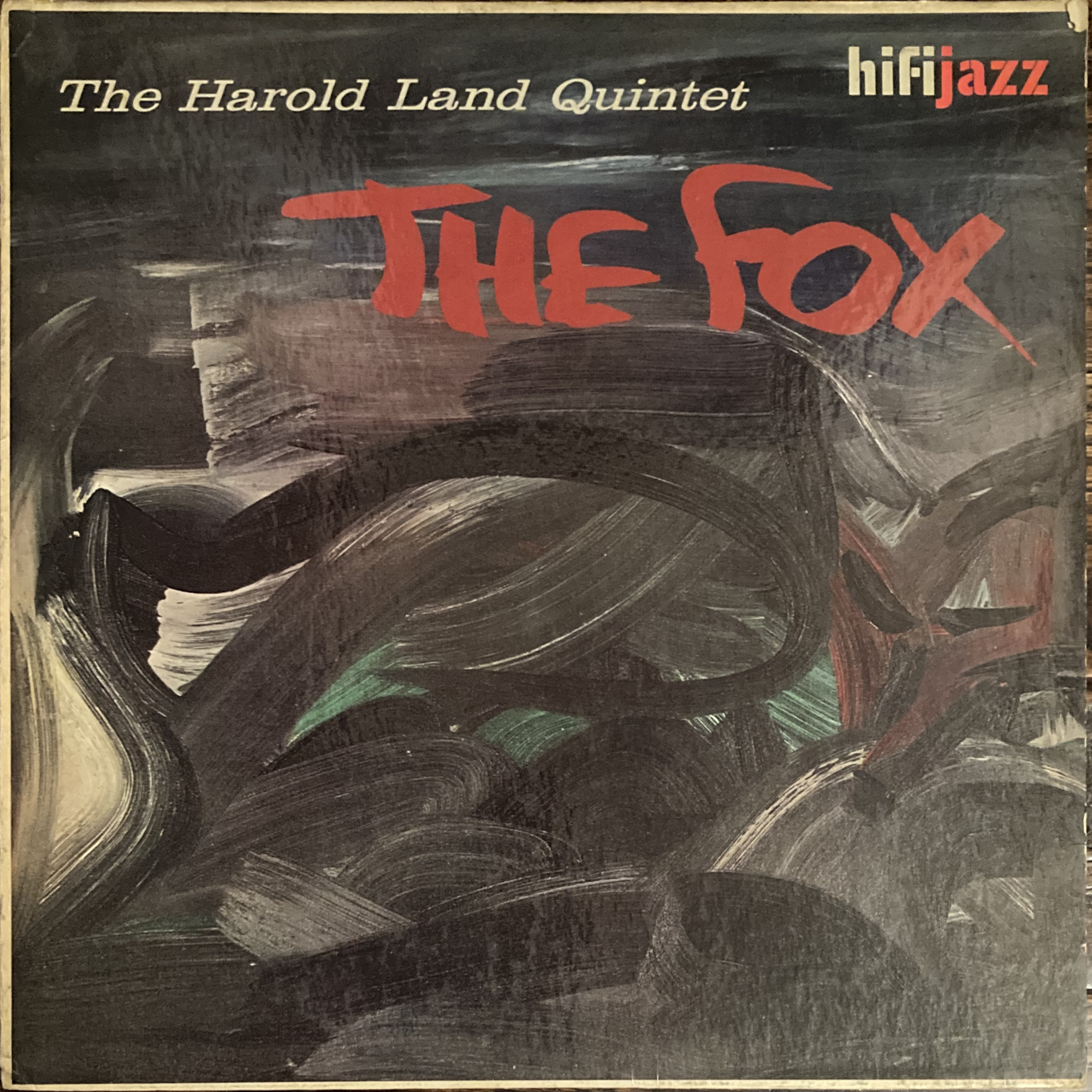
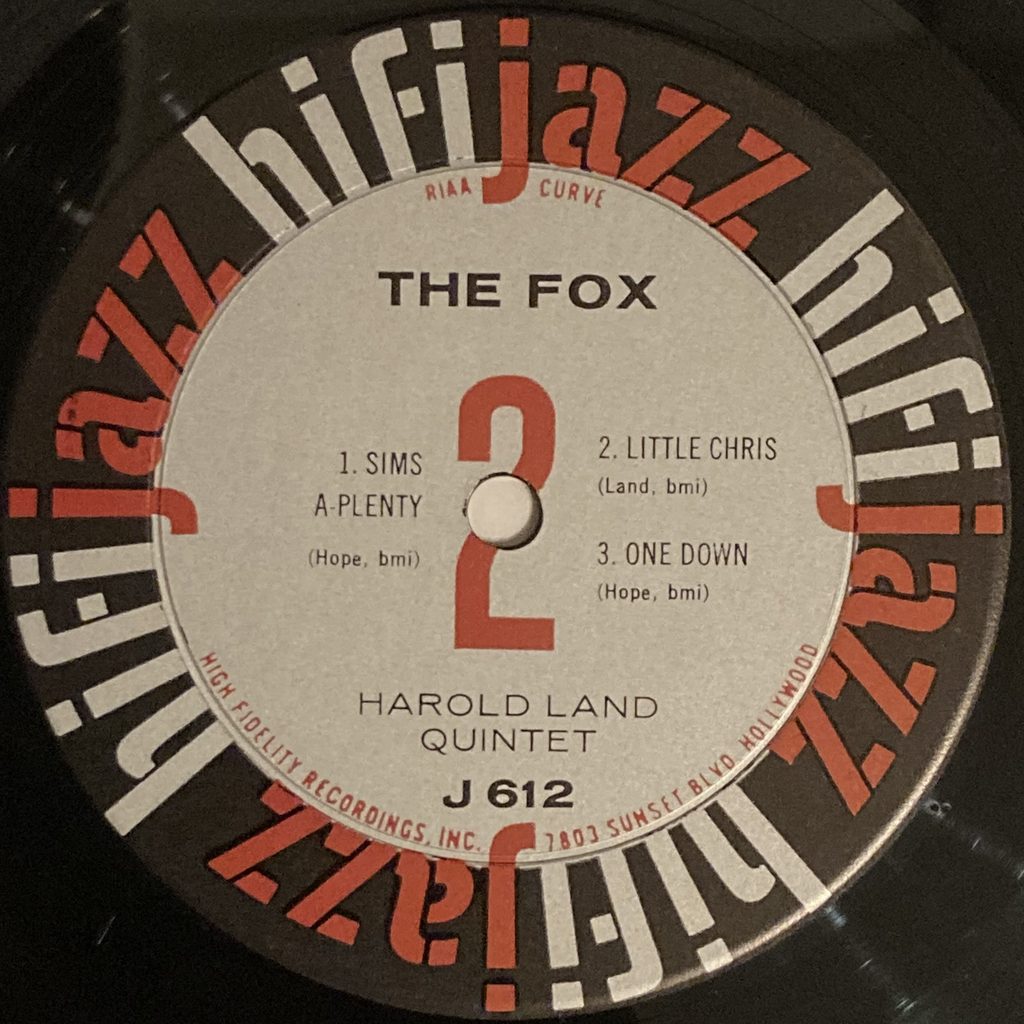
Label: hifi-jazz
No.: J612
Title: THE FOX
Musician: HAROLD LAND
Recorded: 1960
Monaural
Cover address: Hollywood, Calif.
Coating 無し
Groove Guard
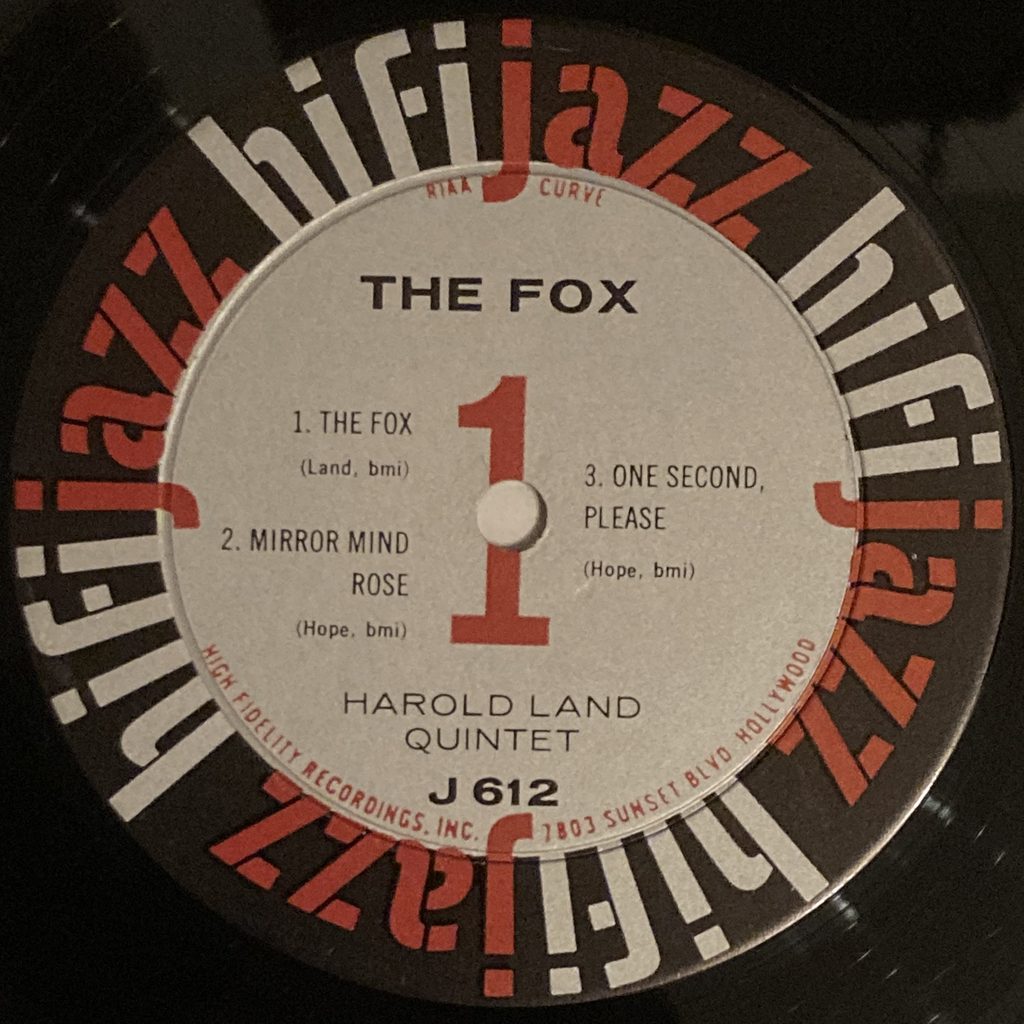
Label Side-1
Gray Background
Black Letter
Address: 7803 Sunset Blvd, Hollywood
Deep Groove
Dead Wax Info: J612A, D3
Label Side-2
Gray Background
Black Letter
Address: 7803 Sunset Blvd, Hollywood
Deep Groove
Dead Wax Info: J612B, D3
Personnel-
Drums: Frank Butler
Bass: Herbie Lewis
Piano: Elmo Hope
Tenor Sax: Harold Land
Alto Sax: Dupree Bolton
Tracks-
Side-1
1) The Fox
2) Mirror-Mind Rose
3) One Second, Please
Side-2
1) Sims A-Plenty
2) Little Chris
3) One Down
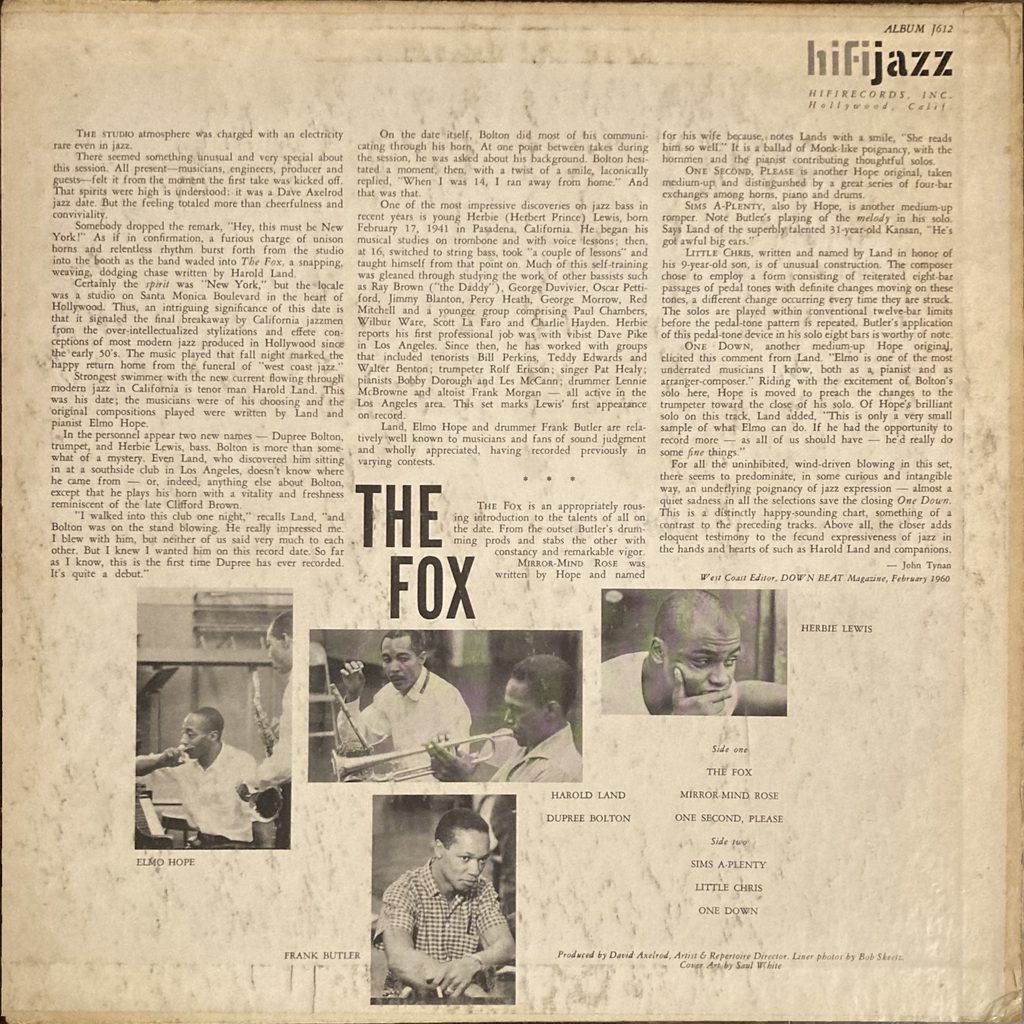
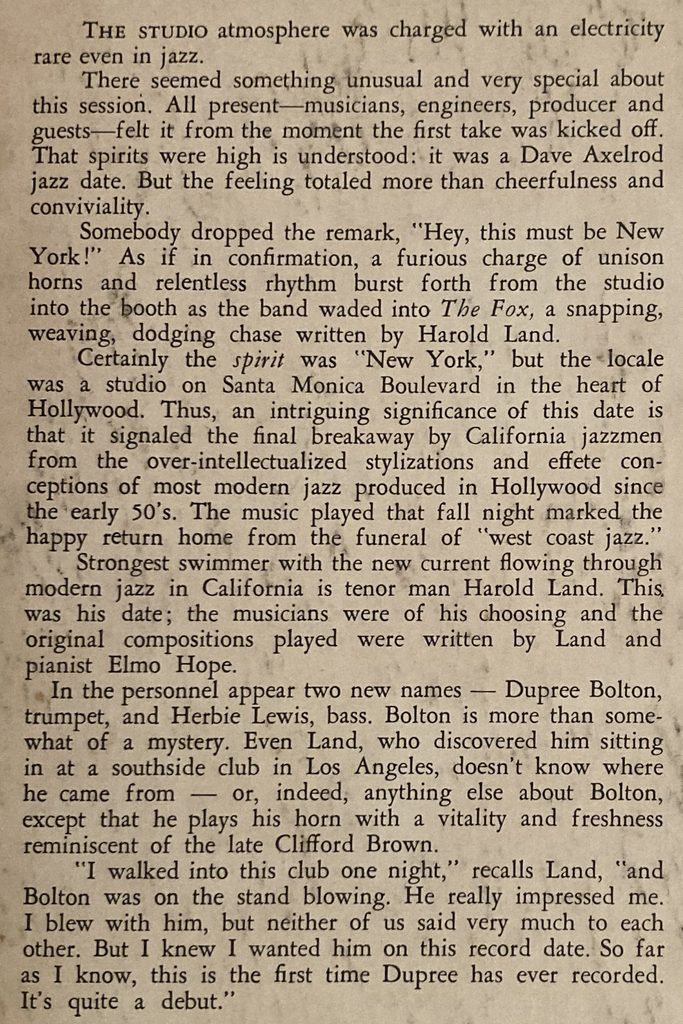
<裏ジャケ原文>
THE STUDIO atmosphere was charged with an electricity rare even in jazz.
There seemed something unusual and very special about this session. All present-musicians, engineers, producer and guests felt it from the moment the first take was kicked off. That spirits were high is understood: it was a Dave Axelrod jazz date. But the feeling totaled more than cheerfulness and conviviality.
Somebody dropped the remark, “Hey, this must be New York!” As if in confirmation, a furious charge of unison horns and relentless rhythm burst forth from the studio into the booth as the band waded into The Fox, a snapping, weaving, dodging chase written by Harold Land.
Certainly the spirit was “New York,” but the locale was a studio on Santa Monica Boulevard in the heart of Hollywood. Thus, an intriguing significance of this date is that it signaled the final breakaway by California jazzmen from the over-intellectualized stylizations and effete con- ceptions of most modern jazz produced in Hollywood since the early 50’s. The music played that fall night marked the happy return home from the funeral of “west coast jazz.”
Strongest swimmer with the new current flowing through modern jazz in California is tenor man Harold Land. This was his date; the musicians were of his choosing and the original compositions played were written by Land and pianist Elmo Hope.
In the personnel appear two new names – Dupree Bolton, trumpet, and Herbie Lewis, bass. Bolton is more than some- what of a mystery. Even Land, who discovered him sitting in at a southside club in Los Angeles, doesn’t know where he came from or, indeed, anything else about Bolton, except that he plays his horn with a vitality and freshness reminiscent of the late Clifford Brown.
“I walked into this club one night,” recalls Land, “and Bolton was on the stand blowing. He really impressed me. I blew with him, but neither of us said very much to each other. But I knew I wanted him on this record date. So far as I know, this is the first time Dupree has ever recorded. It’s quite a debut.”
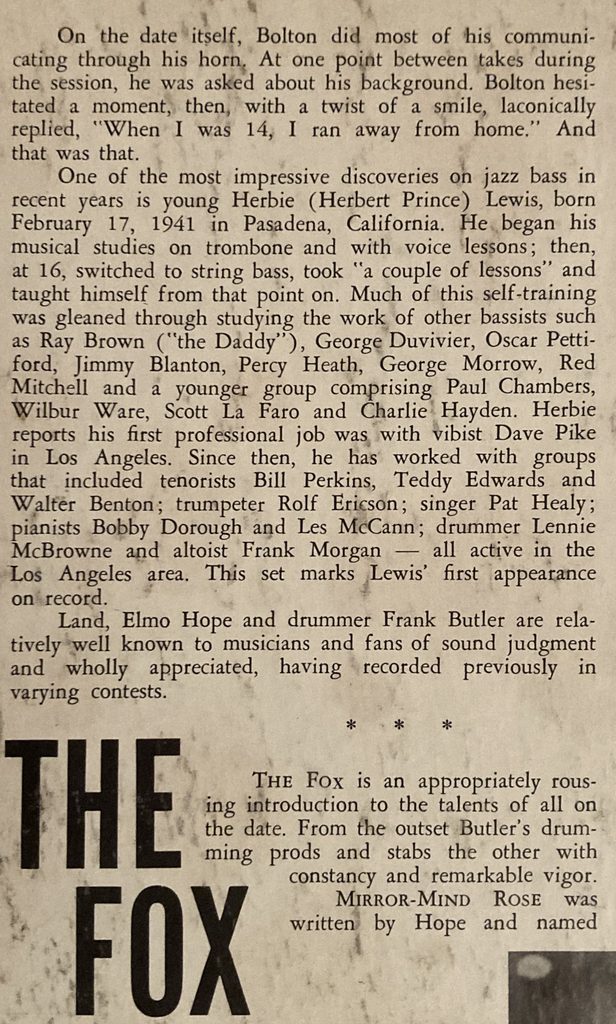
On the date itself, Bolton did most of his communi- cating through his horn. At one point between takes during the session, he was asked about his background. Bolton hesi- tated a moment, then, with a twist of a smile, laconically replied, “When I was 14, I ran away from home.” And
that was that.
One of the most impressive discoveries on jazz bass in recent years is young Herbie (Herbert Prince) Lewis, born February 17, 1941 in Pasadena, California. He began his musical studies on trombone and with voice lessons; then, at 16, switched to string bass, took “a couple of lessons” and taught himself from that point on. Much of this self-training was gleaned through studying the work of other bassists such as Ray Brown (“the Daddy”), George Duvivier, Oscar Petti- ford, Jimmy Blanton, Percy Heath, George Morrow, Red Mitchell and a younger group comprising Paul Chambers, Wilbur Ware, Scott La Faro and Charlie Hayden. Herbie reports his first professional job was with vibist Dave Pike in Los Angeles. Since then, he has worked with groups that included tenorists Bill Perkins, Teddy Edwards and Walter Benton; trumpeter Rolf Ericson; singer Pat Healy; pianists Bobby Dorough and Les McCann; drummer Lennie McBrowne and altoist Frank Morgan all active in the Los Angeles area. This set marks Lewis’ first appearance on record.
Land, Elmo Hope and drummer Frank Butler are rela- tively well known to musicians and fans of sound judgment and wholly appreciated, having recorded previously in varying contests.
THE FOX is an appropriately rous- ing introduction to the talents of all on the date. From the outset Butler’s drum- ming prods and stabs the other with constancy and remarkable vigor. MIRROR-MIND ROSE was written by Hope and named
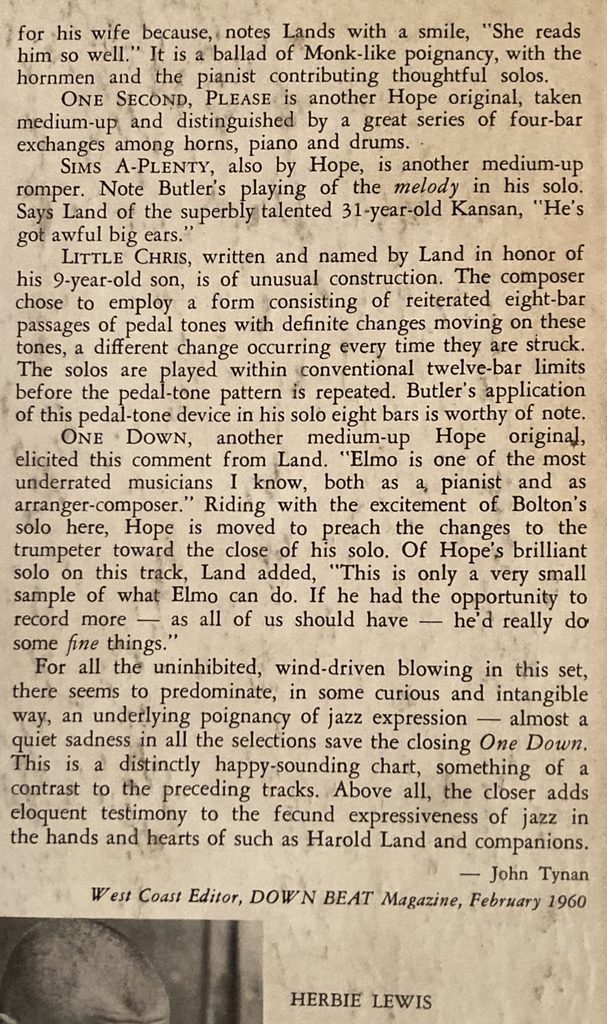
for his wife because, notes Lands with a smile, “She reads him so well.” It is a ballad of Monk-like poignancy, with the hornmen and the pianist contributing thoughtful solos.
ONE SECOND, PLEASE is another Hope original, taken medium-up and distinguished by a great series of four-bar exchanges among horns, piano and drums.
SIMS A-PLENTY, also by Hope, is another medium-up romper. Note Butler’s playing of the melody in his solo. Says Land of the superbly talented 31-year-old Kansan, “He’s got awful big ears.”
LITTLE CHRIS, written and named by Land in honor of his 9-year-old son, is of unusual construction. The composer chose to employ a form consisting of reiterated eight-bar passages of pedal tones with definite changes moving on these tones, a different change occurring every time they are struck. The solos are played within conventional twelve-bar limits before the pedal-tone pattern is repeated. Butler’s application of this pedal-tone device in his solo eight bars is worthy of note.
ONE DOWN, another medium-up Hope original, elicited this comment from Land. “Elmo is one of the most underrated musicians I know, both as a, pianist and as arranger-composer.” Riding with the excitement of Bolton’s solo here, Hope is moved to preach the changes to the trumpeter toward the close of his solo. Of Hope’s brilliant solo on this track, Land added, “This is only a very small sample of what Elmo can do. If he had the opportunity to record more -as all of us should have – he’d really do some fine things.”For all the uninhibited, wind-driven blowing in this set, there seems to predominate, in some curious and intangible way, an underlying poignancy of jazz expression quiet sadness in all the selections save the closing One Down, This is a distinctly happy-sounding chart, something of a contrast to the preceding tracks. Above all, the closer adds eloquent testimony to the fecund expressiveness of jazz in the hands and hearts of such as Harold Land and companions.
John Tynan
West Coast Editor, DOWN BEAT Magazine, February 1960
HERBIE LEWIS
<裏ジャケ和訳>
スタジオの空気は、ジャズの世界においてさえ稀なほどの熱気に満ちていた。
このセッションには、何か並外れた、非常に特別なものが漂っていた。ミュージシャン、エンジニア、プロデューサー、そしてゲストに至るまで、その場にいた全員が、最初のテイクが始まった瞬間からそれを感じ取っていた。士気が高かったのは当然のことだ。何しろ、デイヴ・アクセルロッドが手がけるジャズのレコーディングなのだから。しかし、その場の空気は、単に陽気で和気あいあいとしていたという言葉だけでは言い尽くせないものがあった。
誰かが「おい、これぞニューヨークって感じだな!」と口にした。それを裏付けるかのように、スタジオからブースへと、激しいユニゾン・ホーンと容赦ないリズムが雪崩れ込んできた。バンドが演奏し始めたのは、ハロルド・ランドが書き下ろした『ザ・フォックス(The Fox)』。目まぐるしく動き回り、縦横無尽に駆け抜けるような楽曲だった。
確かにその精神は「ニューヨーク」的だったが、場所はハリウッドの中心部、サンタモニカ・ブルバード沿いにあるスタジオだった。このセッションが持つ興味深い意義は、カリフォルニアのジャズ・ミュージシャンたちが、50年代初頭からハリウッドで制作されてきたモダン・ジャズの多くに見られた、過度に知的で様式化された、あるいは生気のないコンセプトから、ついに脱却したことを示した点にある。あの秋の夜に奏でられた音楽は、「ウェスト・コースト・ジャズ」というものの葬儀を終え、そこから無事に「帰還」を果たしたことを告げるものだった。
カリフォルニアのモダン・ジャズ界に流れる新たな潮流の中で、最も力強く泳ぎ進んでいるのが、テナー・サックス奏者のハロルド・ランドである。今回のセッションは彼が主導したものであり、参加ミュージシャンも彼が選んだ。演奏されたオリジナル曲は、ランド自身とピアニストのエルモ・ホープが書き下ろしたものだ。
メンバーの中には、デュプリー・ボルトン(トランペット)とハービー・ルイス(ベース)という、新たな名前が二つ見られる。ボルトンは、ある種「謎」に包まれた人物だ。ロサンゼルスのサウスサイドにあるクラブで彼が飛び入り演奏しているのを見出したランドでさえ、彼がどこから来たのか、あるいは彼について他に何一つ知らないという。ただ一つ確かなのは、彼が、亡きクリフォード・ブラウンを彷彿とさせるような活力と新鮮さに満ちた演奏を聴かせるということだけである。 「ある夜、クラブに入ってみると、ボルトンがステージで演奏していたんだ」とランドは振り返る。「すっかり感銘を受けたよ。一緒に演奏もしたけれど、お互い言葉を交わすことはほとんどなかった。それでも、今回のレコーディングには彼を呼びたいと確信したんだ。僕の知る限り、デュプリー(ボルトン)にとってこれが初めてのレコーディングだよ。見事なデビューだね」
レコーディング当日、ボルトンは自身の楽器を通じてほとんどのコミュニケーションをとっていた。セッションの合間、テイクの合間に、彼の経歴について尋ねられる場面があった。ボルトンは一瞬ためらってから、少し口元を歪めて、ぶっきらぼうにこう答えた。「14歳のとき、家出したんだ」。それだけのことだった。
近年、ジャズ・ベース界における最も印象的な発見の一つが、ハービー(ハーバート・プリンス)・ルイスである。彼は1941年2月17日、カリフォルニア州パサデナに生まれた。音楽の学習はトロンボーンと声楽のレッスンから始まったが、16歳の時にストリング・ベースに転向。数回のレッスンを受けた後は、独学で技術を習得していった。この独学の過程において、彼はレイ・ブラウン(「ザ・ダディ」と称される)、ジョージ・デュヴィヴィエ、オスカー・ペティフォード、ジミー・ブレントン、パーシー・ヒース、ジョージ・モロー、レッド・ミッチェルといった先達のベーシストに加え、ポール・チェンバース、ウィルバー・ウェア、スコット・ラファロ、チャーリー・ヘイデンといった、当時若手だったベーシストたちの演奏を研究することで多くを学んだ。ハービーによれば、彼のプロとしての初仕事は、ロサンゼルスで活動していたヴィブラフォン奏者デイヴ・パイクのグループでのことだった。それ以来、彼はロサンゼルス周辺で活躍するテナー・サックス奏者のビル・パーキンス、テディ・エドワーズ、ウォルター・ベントン、トランペット奏者のロルフ・エリクソン、歌手のパット・ヒーリー、ピアニストのボビー・ドロウやレス・マッキャン、ドラマーのレニー・マクブラウン、アルト・サックス奏者のフランク・モーガンらと共演を重ねてきた。本作は、ルイスにとって初のレコーディング作品となる。
ハロルド・ランド、エルモ・ホープ、そしてドラマーのフランク・バトラーは、確かな耳を持つミュージシャンやファンから高く評価されており、これまでにも様々なセッションで録音を残している。
『ザ・フォックス(THE FOX)』は、このセッションに参加した全員の才能を鮮やかに示す、実に刺激的なオープニング・ナンバーだ。冒頭から、バトラーのドラミングが驚くべき活力をもって、他のメンバーを絶えず鼓舞し、刺激を与えている。『ミラー・マインド・ローズ(MIRROR-MIND ROSE)』はホープが作曲した曲で、彼の妻にちなんで名付けられた。ランドによれば、「彼女は彼のことを実によく理解しているから」だという。モンクを彷彿とさせる哀愁を帯びたバラードであり、ホーン奏者たちとピアニストが、それぞれ思慮深いソロを披露している。
『ワン・セカンド・プリーズ(ONE SECOND, PLEASE)』もホープのオリジナル曲で、ミディアム・アップのテンポで演奏される。ホーン、ピアノ、ドラムの間で繰り広げられる4小節ごとの見事な掛け合いが聴きどころだ。
同じくホープ作の『シムズ・ア・プレンティ(SIMS A-PLENTY)』も、ミディアム・アップの快活なナンバーである。ソロの中でバトラーがメロディを叩いている点に注目してほしい。カンザス州出身、31歳にして卓越した才能を誇るハロルド・ランドは、こう語る。「彼(エルモ・ホープ)は、とてつもなく大きな耳をしているんだよ」。
ランドが9歳の息子にちなんで名付けた楽曲「リトル・クリス(Little Chris)」は、一風変わった構成をとっている。作曲者は、ペダル・トーン(持続音)を伴う8小節のフレーズを繰り返す形式を採用しており、そのペダル・トーンの上でコード進行が明確に変化していく。しかも、ペダル・トーンが鳴らされるたびに、異なるコード進行が現れる仕組みだ。このペダル・トーンの手法を、自身のソロの8小節間で展開したバトラーの演奏は特筆に値する。
同じくホープのオリジナル曲で、ミディアム・アップのテンポを持つ「ワン・ダウン(One Down)」について、ランドはこう評した。「エルモは、ピアニストとしても、アレンジャー/作曲家としても、僕が知る中で最も過小評価されているミュージシャンのひとりだよ」。ボルトンの熱気あふれるソロに触発されたホープは、ソロの終盤、トランペット奏者であるボルトンに向けて、コード進行を(掛け声のように)伝えていく。この曲でのホープの鮮やかなソロについて、ランドはこう付け加えた。「これはエルモの持つ能力の、ほんのさわりでしかない。もし彼にもっとレコーディングの機会があれば――僕ら全員がそうであるべきように――本当に素晴らしい作品を残せるはずさ」。
本作全体を通して、奔放で力強い管楽器のブロウが繰り広げられているが、どこか不思議で捉えどころのない、ジャズ特有の哀愁――静かな悲しみ――が底流に漂っている。ただし、ラストの「ワン・ダウン」だけは例外だ。この曲は明らかに幸福感に満ちた響きを持っており、それまでのトラックとは対照的である。何より、このラスト・ナンバーは、ハロルド・ランドやその仲間たちのような音楽家の手と心を通じて、ジャズがいかに豊かな表現力を持ち得るかということを、雄弁に物語っている。
ジョン・タイナン
『ダウン・ビート』誌 ウェスト・コースト担当編集者、1960年2月
ハービー・ルイス
※訳文の制作にはGoogleドライブとGoogle翻訳のお世話になりました。
コメント