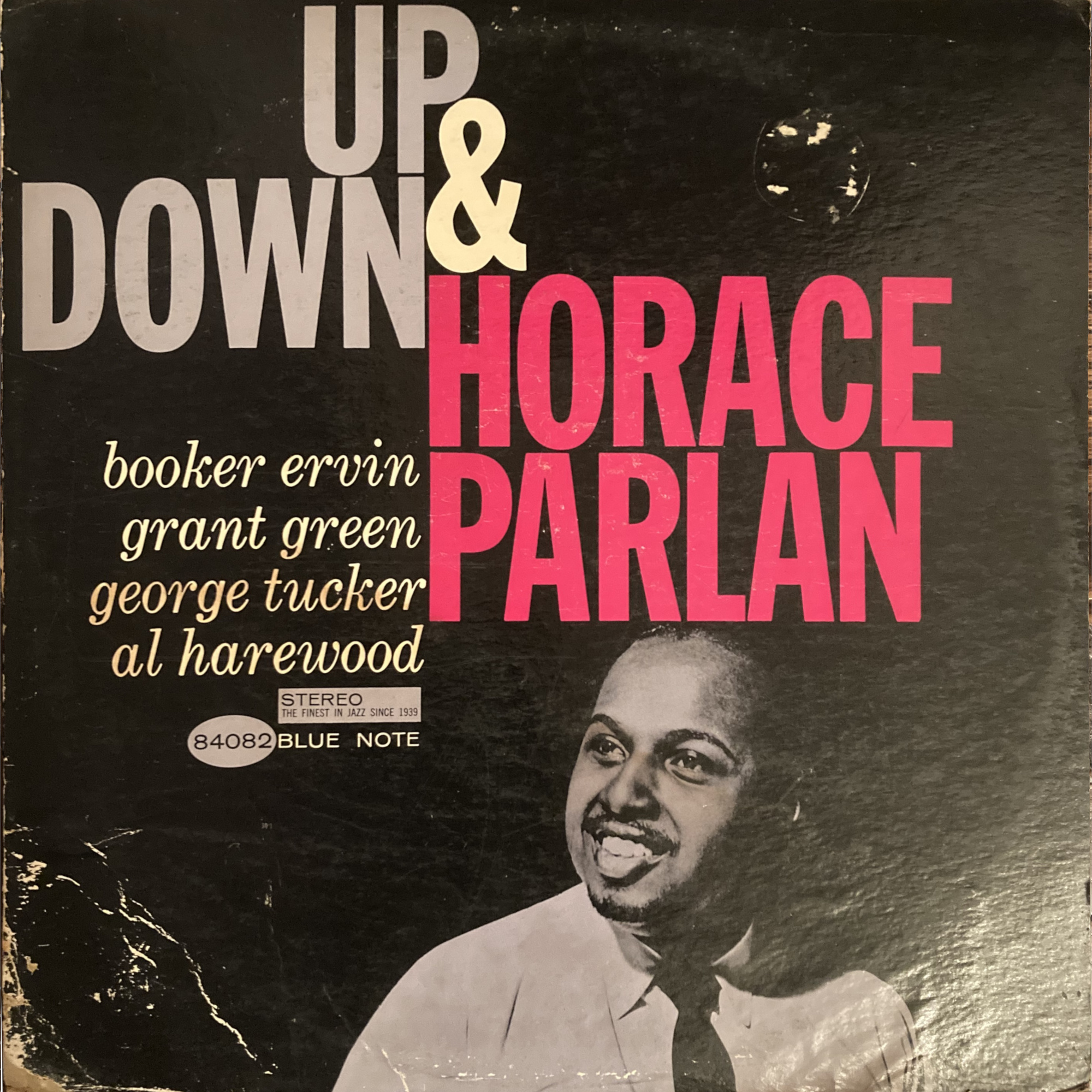
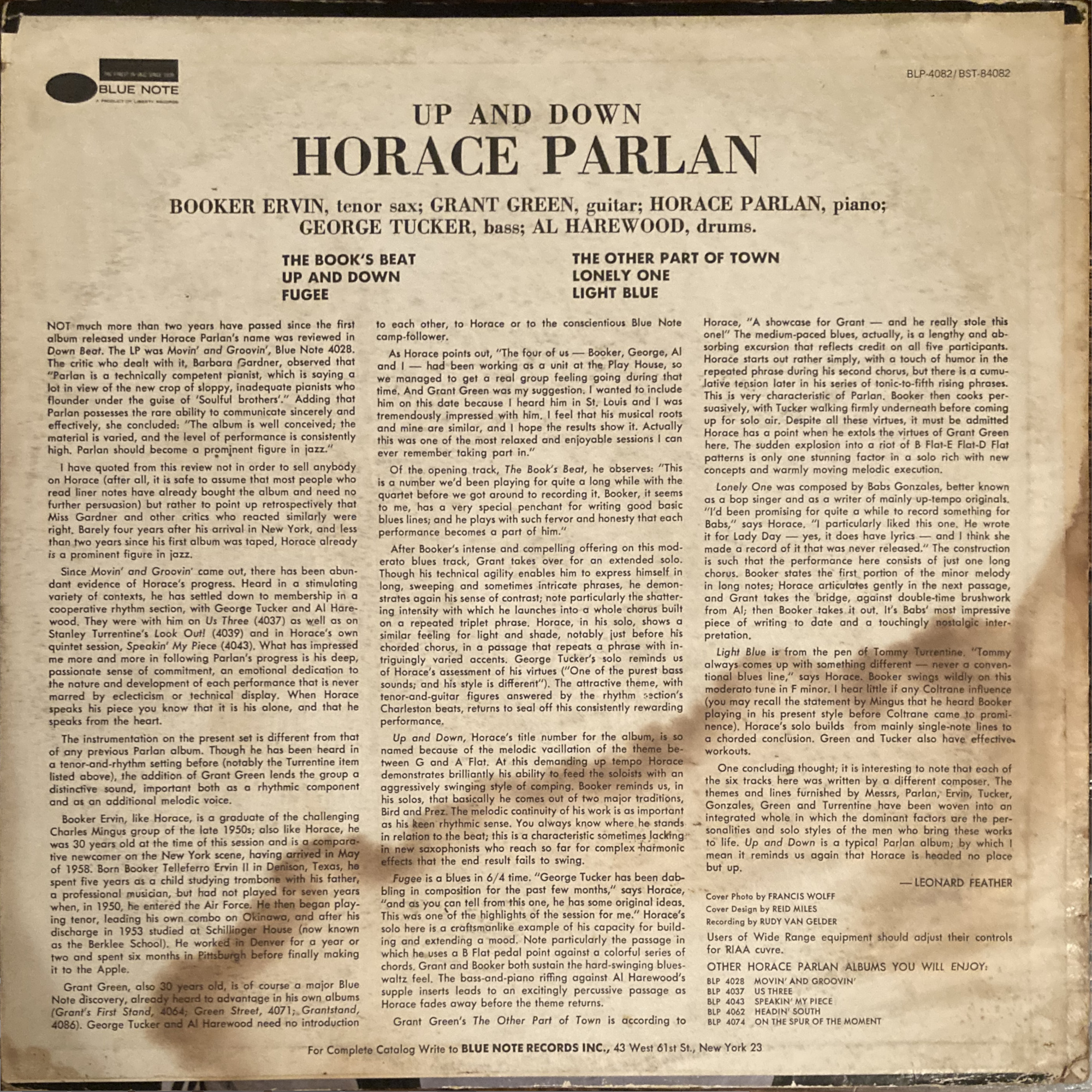
ジャケット裏面に酷いウォーターダメージがありますが、盤については全く問題ありません。
Label: BLUE NOTE
No.: BST 84082
Title: UP AND DOWN
Musician: HORACE PARLAN
Recorded: 1961/6/18
Stereo
Cover address: 43 West 61st St, New York 23, INC
Coating無し
Groove Guard
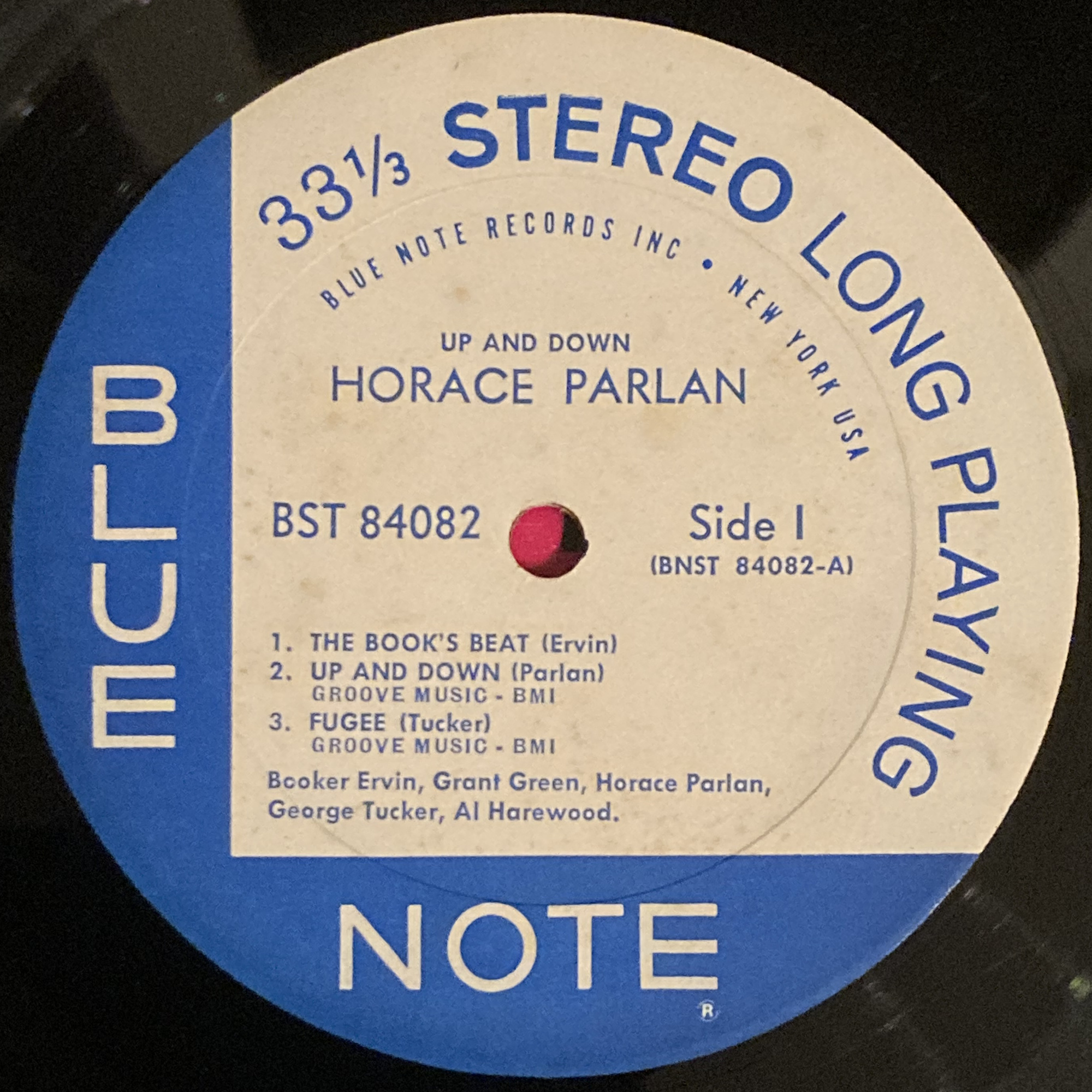
Label Side-1
Blue & White Background
White & Blue Letter, INC&R
Address: NEW YORK USA
Deep Groove無し
Dead Wax Info: RVG STEREO, BN-ST-84082-A-1, No dot
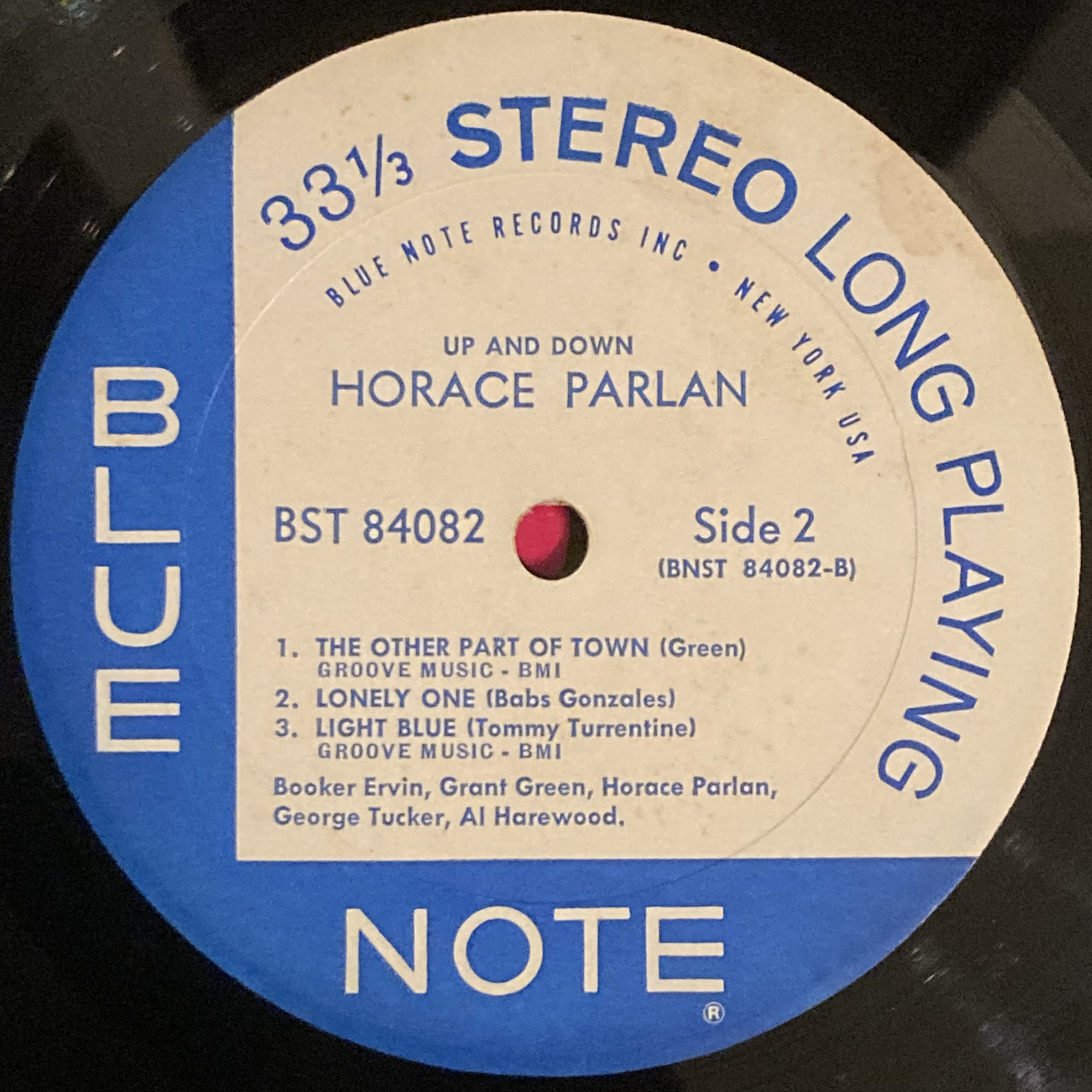
Label Side-2
Blue & White Background
White & Blue Letter, INC&R
Address: NEW YORK USA
Deep Groove無し
Dead Wax Info: RVG STEREO, BN-ST-84082-B, 1dot
Personnel-
Drums: Al Harewood
Bass: George Tucker
Piano: Horace Parlan
Tenor Sax: Booker Ervin
Guitar: Grant Green
Tracks-
Side-1
1) The Book’s Beat
2) Up and Down
3) Fugee
Side-2
1) The Other Part of Town
2) Lonely One
3) Light Blue
<裏ジャケ原文>
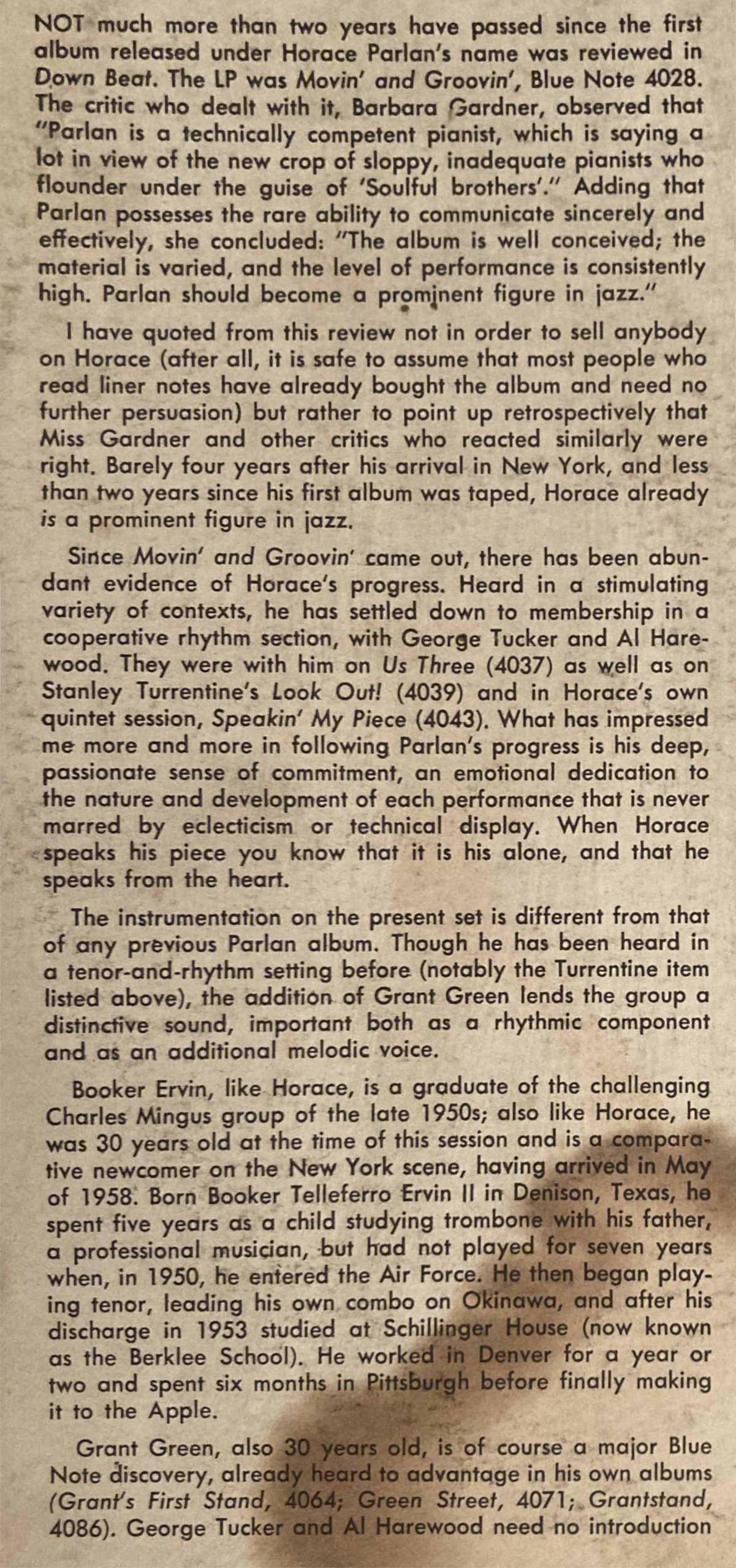
NOT much more than two years have passed since the first album released under Horace Parlan’s name was reviewed in Down Beat. The LP was Movin’ and Groovin’, Blue Note 4028. The critic who dealt with it, Barbara Gardner, observed that “Parlan is a technically competent pianist, which is saying a lot in view of the new crop of sloppy, inadequate pianists who flounder under the guise of ‘Soulful brothers’.” Adding that Parlan possesses the rare ability to communicate sincerely and effectively, she concluded: “The album is well conceived; the material is varied, and the level of performance is consistently high. Parlan should become a prominent figure in jazz.”
I have quoted from this review not in order to sell anybody on Horace (after all, it is safe to assume that most people who read liner notes have already bought the album and need no further persuasion) but rather to point up retrospectively that Miss Gardner and other critics who reacted similarly were right. Barely four years after his arrival in New York, and less than two years since his first album was taped, Horace already is a prominent figure in jazz.
Since Movin’ and Groovin’ came out, there has been abun- dant evidence of Horace’s progress. Heard in a stimulating variety of contexts, he has settled down to membership in a cooperative rhythm section, with George Tucker and Al Hare- wood. They were with him on Us Three (4037) as well as on Stanley Turrentine’s Look Out! (4039) and in Horace’s own quintet session, Speakin’ My Piece (4043). What has impressed me more and more in following Parlan’s progress is his deep, passionate sense of commitment, an emotional dedication to the nature and development of each performance that is never marred by eclecticism or technical display. When Horace speaks his piece you know that it is his alone, and that he speaks from the heart.
The instrumentation on the present set is different from that of any previous Parlan album. Though he has been heard in a tenor-and-rhythm setting before (notably the Turrentine item listed above), the addition of Grant Green lends the group a distinctive sound, important both as a rhythmic component and as an additional melodic voice.
Booker Ervin, like Horace, is a graduate of the challenging Charles Mingus group of the late 1950s; also like Horace, he was 30 years old at the time of this session and is a compara- tive newcomer on the New York scene, having arrived in May of 1958. Born Booker Telleferro Ervin II in Denison, Texas, he spent five years as a child studying trombone with his father, a professional musician, but had not played for seven years when, in 1950, he entered the Air Force. He then began play- ing tenor, leading his own combo on Okinawa, and after his discharge in 1953 studied at Schillinger House (now known as the Berklee School). He worked in Denver for a year or two and spent six months in Pittsburgh before finally making it to the Apple.
Grant Green, also 30 years old, is of course a major Blue Note discovery, already heard to advantage in his own albums (Grant’s First Stand, 4064; Green Street, 4071; Grantstand, 4086). George Tucker and Al Harewood need no introduction to each other, to Horace or to the conscientious Blue Note camp-follower.
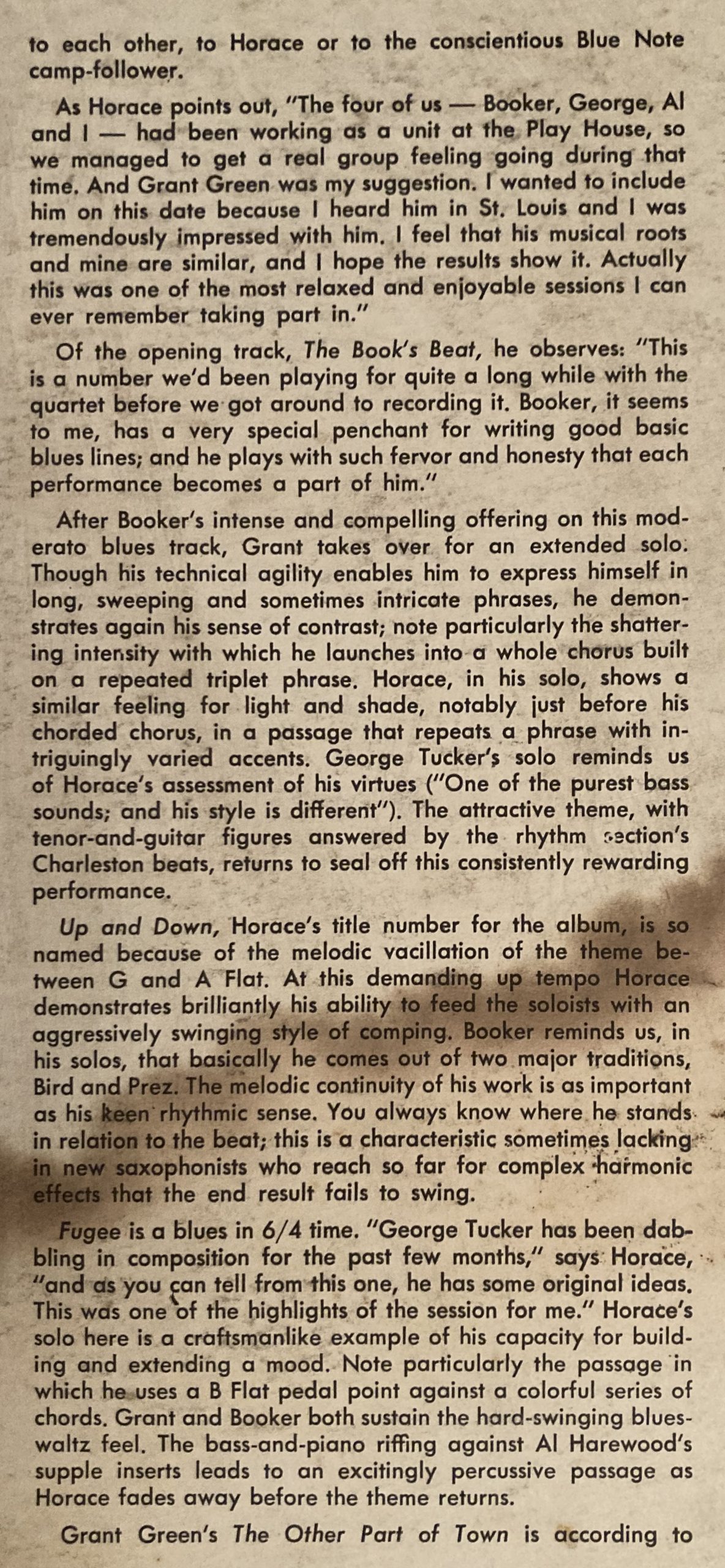
As Horace points out, “The four of us – Booker, George, Al and I had been working as a unit at the Play House, so we managed to get a real group feeling going during that time. And Grant Green was my suggestion. I wanted to include him on this date because I heard him in St. Louis and I was tremendously impressed with him. I feel that his musical roots and mine are similar, and I hope the results show it. Actually this was one of the most relaxed and enjoyable sessions I can ever remember taking part in.”
Of the opening track, The Book’s Beat, he observes: “This is a number we’d been playing for quite a long while with the quartet before we got around to recording it. Booker, it seems to me, has a very special penchant for writing good basic blues lines; and he plays with such fervor and honesty that each performance becomes a part of him.”
After Booker’s intense and compelling offering on this mod- erato blues track, Grant takes over for an extended solo. Though his technical agility enables him to express himself in long, sweeping and sometimes intricate phrases, he demon- strates again his sense of contrast; note particularly the shatter- ing intensity with which he launches into a whole chorus built on a repeated triplet phrase. Horace, in his solo, shows a similar feeling for light and shade, notably just before his chorded chorus, in a passage that repeats a phrase with in- triguingly varied accents. George Tucker’s solo reminds us of Horace’s assessment of his virtues (“One of the purest bass sounds; and his style is different”). The attractive theme, with tenor-and-guitar figures answered by the rhythm section’s Charleston beats, returns to seal off this consistently rewarding performance.
Up and Down, Horace’s title number for the album, is so named because of the melodic vacillation of the theme be- tween G and A Flat. At this demanding up tempo Horace demonstrates brilliantly his ability to feed the soloists with an aggressively swinging style of comping. Booker reminds us, in his solos, that basically he comes out of two major traditions, Bird and Prez. The melodic continuity of his work is as important as his keen rhythmic sense. You always know where he stands in relation to the beat; this is a characteristic sometimes lacking in new saxophonists who reach so far for complex harmonic effects that the end result fails to swing.
Fugee is a blues in 6/4 time. “George Tucker has been dab- bling in composition for the past few months,” says Horace, “and as you can tell from this one, he has some original ideas. This was one of the highlights of the session for me.” Horace’s solo here is a craftsmanlike example of his capacity for build- ing and extending a mood. Note particularly the passage in which he uses a B Flat pedal point against a colorful series of chords. Grant and Booker both sustain the hard-swinging blues- waltz feel. The bass-and-piano riffing against Al Harewood’s supple inserts leads to an excitingly percussive passage as Horace fades away before the theme returns.
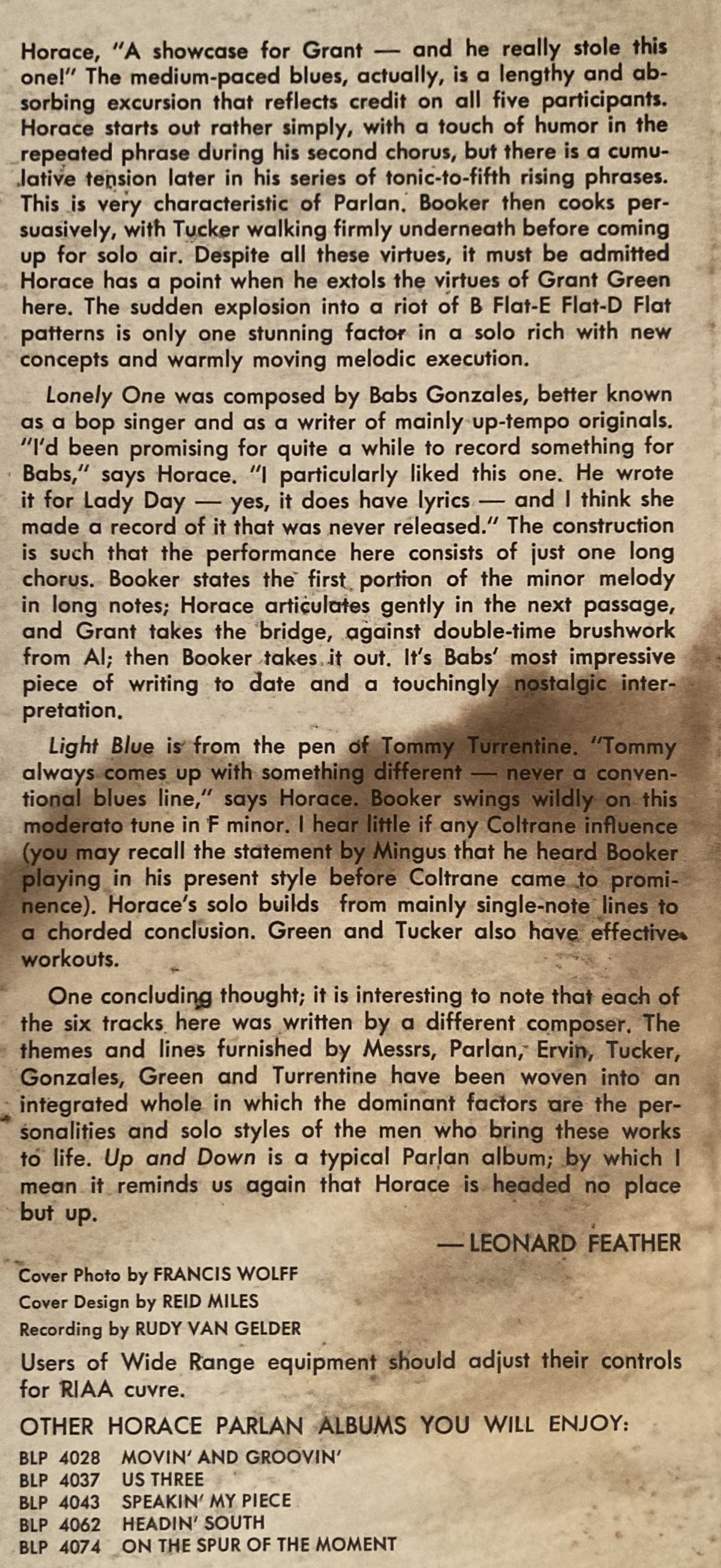
Grant Green’s The Other Part of Town is according to Horace, “A showcase for Grant and he really stole this one!” The medium-paced blues, actually, is a lengthy and ab- sorbing excursion that reflects credit on all five participants. Horace starts out rather simply, with a touch of humor in the repeated phrase during his second chorus, but there is a cumu- lative tension later in his series of tonic-to-fifth rising phrases. This is very characteristic of Parlan, Booker then cooks per- suasively, with Tucker walking firmly underneath before coming up for solo air. Despite all these virtues, it must be admitted Horace has a point when he extols the virtues of Grant Green here. The sudden explosion into a riot of B Flat-E Flat-D Flat patterns is only one stunning factor in a solo rich with new concepts and warmly moving melodic execution.
Lonely One was composed by Babs Gonzales, better known as a bop singer and as a writer of mainly up-tempo originals. “I’d been promising for quite a while to record something for Babs,” says Horace. “I particularly liked this one. He wrote it for Lady Day – yes, it does have lyrics – and I think she made a record of it that was never released.” The construction is such that the performance here consists of just one long chorus. Booker states the first portion of the minor melody in long notes; Horace articulates gently in the next passage, and Grant takes the bridge, against double-time brushwork from Al; then Booker takes it out. It’s Babs’ most impressive piece of writing to date and a touchingly nostalgic inter- pretation.
Light Blue is from the pen of Tommy Turrentine. “Tommy always comes up with something different never a conven- tional blues line,” says Horace. Booker swings wildly on this moderato tune in F minor. I hear little if any Coltrane influence (you may recall the statement by Mingus that he heard Booker playing in his present style before Coltrane came to promi- nence). Horace’s solo builds from mainly single-note lines to a chorded conclusion. Green and Tucker also have effectives workouts.
One concluding thought; it is interesting to note that each of the six tracks here was written by a different composer. The themes and lines furnished by Messrs, Parlan, Ervin, Tucker, Gonzales, Green and Turrentine have been woven into an integrated whole in which the dominant factors are the per- sonalities and solo styles of the men who bring these works to life. Up and Down is a typical Parlan album; by which I mean it reminds us again that Horace is headed no place but up.
Cover Photo by FRANCIS WOLFF
Cover Design by REID MILES
Recording by RUDY VAN GELDER
-LEONARD FEATHER
Users of Wide Range equipment should adjust their controls for RIAA cuvre.
OTHER HORACE PARLAN ALBUMS YOU WILL ENJOY: BLP 4028
MOVIN’ AND GROOVIN’
BLP 4037 US THREE
BLP 4043
BLP 4062
SPEAKIN’ MY PIECE
HEADIN’ SOUTH
BLP 4074 ON THE SPUR OF THE MOMENT
<裏ジャケ和訳>
ホレス・パーラン名義の最初のアルバムが『ダウン・ビート』誌で取り上げられてから、まだ2年余りしか経っていない。そのLPとは、ブルーノート4028番の『ムーヴィン・アンド・グルーヴィン(Movin’ and Groovin’)』である。このアルバムを評したバーバラ・ガードナーは、「パーランは技術的に確かなピアニストである。昨今、『ソウルフルな兄弟(ソウルフル・ブラザーズ)』を気取りながら、実際には粗雑で力不足なピアニストが次々と現れていることを考えれば、これは大きな称賛に値する」と記した。さらに彼女は、パーランには誠実かつ効果的に音楽を伝えるという稀有な才能があると付け加え、次のように締めくくった。「このアルバムは構成が巧みで、収録曲も多彩であり、演奏の質も一貫して高い。パーランはジャズ界の重要な人物になるはずだ」。
私がこの批評を引用したのは、ホレスを誰かに売り込むためではない(ライナーノーツを読んでいるような人なら、すでにアルバムを購入済みであり、これ以上の説得など必要ないはずだからだ)。そうではなく、バーバラ・ガードナーをはじめ、同じような反応を示した批評家たちの見解が正しかったことを、今改めて指摘しておきたかったからである。ニューヨークに到着してわずか4年、最初のアルバムを録音してから2年も経たないうちに、ホレスはすでにジャズ界の重要な人物となっている。
『ムーヴィン・アンド・グルーヴィン』のリリース以来、ホレスの成長を示す証拠は数多くある。彼はさまざまな刺激的なシチュエーションで演奏を重ねる中で、ジョージ・タッカー、アル・ヘアウッドと共に、協調性の高いリズム・セクションの一員として定着した。彼らは『アス・スリー(Us Three)』(4037番)や、スタンリー・タレンタインの『ルック・アウト!(Look Out!)』(4039番)、そしてホレス自身のクインテット作品である『スピーキン・マイ・ピース(Speakin’ My Piece)』(4043番)でも、ホレスと共演している。パーランの歩みを追う中で、私がますます感銘を受けているのは、彼が音楽に対して抱く深く情熱的な献身の姿勢である。それは、演奏の本質や展開に対する感情的なまでの真摯さであり、単なる折衷主義や技巧の誇示によって損なわれることは決してない。ホレスが自身の音楽を語るとき、それが彼独自のものであり、心からの言葉であることが伝わってくる。
本作における楽器編成は、これまでのパーランのどのアルバムとも異なっている。彼がテナー・サックスとリズム・セクションという編成で演奏する姿は、これまでにも(特に前述のタレンタインの作品などで)耳にすることができたが、グラント・グリーンが加わったことで、このグループには独特のサウンドが生まれている。グリーンは、リズム面での要素としてだけでなく、もう一つの旋律を奏でる声としても重要な役割を果たしているのだ。
ブッカー・アーヴィンは、ホレスと同様、1950年代後半のチャールズ・ミンガス・グループという、非常に厳しい環境で研鑽を積んだ人物である。またホレスと同じく、このセッション当時30歳だった彼は、1958年5月にニューヨークへやって来たばかりの、このシーンにおける比較的新参者であった。テキサス州デニソンでブッカー・テレフェロ・アーヴィン2世として生まれた彼は、幼少期にプロのミュージシャンであった父親から5年間トロンボーンを学んだが、1950年に空軍に入隊した時点では、すでに7年間楽器から離れていた。その後、彼はテナー・サックスを手にし、沖縄で自身のコンボを率いて演奏した。1953年に除隊した後は、シリンガー・ハウス(現在のバークリー音楽大学)で学び、デンバーで1〜2年、ピッツバーグで6ヶ月間活動した後、ついにニューヨークへとたどり着いたのである。
同じく30歳のグラント・グリーンは、言うまでもなくブルーノートが発掘した重要な才能であり、すでに自身のリーダー・アルバム(『Grant’s First Stand』4064番、『Green Street』4071番、『Grantstand』4086番)でその実力を遺憾なく発揮している。ジョージ・タッカーとアル・ヘアウッドについては、彼ら自身の間柄はもちろん、ホレス・シルバーとの関係、あるいはブルーノートの熱心なファンであれば、改めて紹介するまでもないだろう。
ホレスは次のように語っている。「ブッカー、ジョージ、アル、そして私の4人は、『プレイ・ハウス』で一つのユニットとして活動していたので、その期間を通じて、まさに『グループ』と呼べる一体感を築くことができました。グラント・グリーンを呼ぶことを提案したのは私です。セントルイスで彼の演奏を聴いて非常に感銘を受けたので、今回のレコーディングに参加してもらいたいと思ったのです。彼の音楽的ルーツは私と近いものがあると感じており、それが今回の作品にも表れていればいいなと思っています。実際、これまでのセッションの中でも、最もリラックスして楽しめたものの一つでした」
オープニング・トラックの「ザ・ブックス・ビート(The Book’s Beat)」について、ホレスはこう述べている。「この曲は、レコーディングするずっと前から、カルテットで演奏し続けていたナンバーです。ブッカーは、優れたベーシックなブルース・ラインを書くことに特別な才能を持っていると思います。彼は非常に情熱的かつ誠実に演奏するため、どのパフォーマンスも彼自身の一部となっているのです」
このモデラートのブルース・ナンバーでは、ブッカーが強烈で説得力のある演奏を披露した後、グラント・グリーンが長いソロを引き継ぐ。彼は卓越したテクニックを駆使して、長く伸びやかで、時には複雑なフレーズを紡ぎ出すが、ここでも対比を生み出すセンスの良さを発揮している。特に、3連符のフレーズを繰り返しながらコーラス全体へと突入していく際の、圧倒的な激しさに注目してほしい。ホレスもまた、自身のソロの中で同様の明暗の感覚を見せている。とりわけ、コード弾きによるコーラスに入る直前のパッセージでは、アクセントを巧みに変化させながらフレーズを繰り返す手法が印象的だ。ジョージ・タッカーのソロを聴くと、彼に対するホレスの評価――「極めて純粋なベースの音色を持っており、そのスタイルも独特だ」――が思い出される。テナー・サックスとギターが奏でるフレーズに、リズム・セクションが「チャールストン・ビート」で応えるという魅力的なテーマが再び現れ、終始充実した内容のこの演奏を締めくくっている。
アルバムのタイトル曲でもある「アップ・アンド・ダウン(Up and Down)」は、テーマのメロディがG(ト長調の主音)とAフラット(変イ音)の間を行き来することから名付けられた。この難易度の高いアップ・テンポの曲において、ホレスは、ソロイストを力強くスウィングさせる伴奏(コンピング)の手腕を鮮やかに発揮している。ブッカーはソロの中で、自身が「バード(チャーリー・パーカー)」と「プレズ(レスター・ヤング)」という二つの大きな伝統に根ざしていることを改めて示している。彼の演奏におけるメロディの連続性は、鋭いリズム感覚と同じくらい重要な要素だ。彼は常にビートに対して自分がどこに位置しているかを明確に把握している。これは、複雑なハーモニーを追求するあまり、結果としてスウィング感を失ってしまうような近年のサックス奏者たちには、時に欠けている資質である。
「フージー(Fugee)」は、6/4拍子のブルースだ。ホレスはこう語る。「ジョージ・タッカーはここ数ヶ月、作曲に挑戦していてね。この曲を聴けばわかる通り、彼は独創的なアイデアを持っている。今回のセッションにおけるハイライトの一つだよ」。ここでのホレスのソロは、ムードを構築し、それを発展させていく彼の卓越した職人技を示す好例だ。特に、多彩なコード進行を背景に、Bフラットのペダル・ポイント(持続音)を用いたパッセージに注目してほしい。グラントとブッカーは、力強くスウィングするブルース・ワルツの感覚を終始維持している。ベースとピアノによるリフに、アル・ヘアウッドのしなやかなフィルインが絡み合い、やがて刺激的でパーカッシブな展開へと発展する。そして、テーマが戻る直前、ホレスの演奏は静かに収束していく。
グラント・グリーン作の「ザ・アザー・パート・オブ・タウン(The Other Part of Town)」について、ホレスは「グラントのための見せ場であり、彼が完全に主役をさらってしまったね!」と評している。ミディアム・テンポのこのブルースは、じっくりと聴き込める長尺の演奏であり、参加した5人全員の力量が遺憾なく発揮されている。ホレスは比較的シンプルなアプローチでソロを開始し、2コーラス目には繰り返しのフレーズにユーモアを滲ませているが、その後、トニックから5度へと上昇するフレーズを重ねることで、緊張感を徐々に高めていく。これはパーランの非常に典型的なスタイルだ。ブッカーが説得力のある演奏を繰り広げる中、タッカーがしっかりとボトムを支え、やがてソロへと顔を出す。こうした数々の美点があるとはいえ、ホレスが本作におけるグラント・グリーンの素晴らしさを称賛したのも、もっともなことだと言わざるを得ない。B♭-E♭-D♭といった音型が奔流のように炸裂する瞬間は、斬新なコンセプトと、温かく心を揺さぶるメロディ表現に満ちたこのソロにおける、驚くべき要素の一つに過ぎない。
「ロンリー・ワン」はバブス・ゴンザレスが作曲したものだ。彼はバップ・シンガーとして、また主にアップテンポなオリジナル曲の作者としてよく知られている。「以前から、バブスの曲を何かレコーディングしようと約束していたんだ」とホレスは語る。「特にこの曲が気に入っていた。彼はレディ・デイ(ビリー・ホリデイ)のためにこの曲を書いたんだ――そう、歌詞もついている。彼女もレコーディングしたはずだが、結局リリースはされなかったと思う」。構成は、一つの長いコーラスで成り立っている。まずブッカーがマイナー調のメロディの冒頭をロングトーンで提示し、続くパッセージではホレスが優しく旋律を紡ぐ。ブリッジではグラントが登場し、アルがブラシでダブルタイムのビートを刻む中、最後はブッカーが締めくくる。これはバブスのこれまでの作品の中で最も印象的な一曲であり、心に深く響く、ノスタルジックな解釈となっている。
「ライト・ブルー(Light Blue)」はトミー・タレンタインの作品だ。ホレスは「トミーはいつも一風変わったものを持ち込んでくる。決してありきたりなブルースのフレーズにはならないんだ」と語っている。Fマイナーのモデラートなこの曲で、ブッカーは実にダイナミックなスウィングを聴かせる。ここにはコルトレーンの影響はほとんど、あるいは全く感じられない(ミンガスが、コルトレーンが台頭する以前からブッカーがすでに現在のスタイルで演奏していたと語っていたことを思い出す読者もいるだろう)。ホレスのソロは、単音のフレーズを中心に展開し、最後はコード奏法で締めくくられる。グリーンとタッカーも、それぞれ見事なプレイを披露している。
最後に一つ。本作に収録された6曲すべてが、それぞれ異なる作曲家によって書かれているという点は興味深い。パーラン、アーヴィン、タッカー、ゴンザレス、グリーン、そしてタレンタインが提供したテーマやフレーズは、一つのまとまった作品として見事に統合されている。その中で際立っているのは、各楽曲に命を吹き込んだ演奏者たちの個性と、それぞれのソロ・スタイルである。『アップ・アンド・ダウン(Up and Down)』は、いかにもホレス・パーランらしいアルバムだ。つまり、ホレスがこれからもひたすら高みを目指して進んでいくことを、改めて確信させてくれる一枚である。
カバー写真:フランシス・ウルフ
カバー・デザイン:リード・マイルス
録音:ルディ・ヴァン・ゲルダー
―レナード・フェザー
ワイドレンジ再生機器をご使用の際は、RIAAカーブに合わせて調整してください。
ホレス・パーランのその他のアルバム(おすすめ):
BLP 4028『ムーヴィン・アンド・グルーヴィン(Movin’ and Groovin’)』
BLP 4037『アス・スリー(Us Three)』
BLP 4043『スピーキン・マイ・ピース(Speakin’ My Piece)』
BLP 4062『ヘディン・サウス(Headin’ South)』
BLP 4074『オン・ザ・スパー・オブ・ザ・モーメント(On the Spur of the Moment)』
※訳文の制作にはGoogleドライブとGoogle翻訳のお世話になりました。

コメント