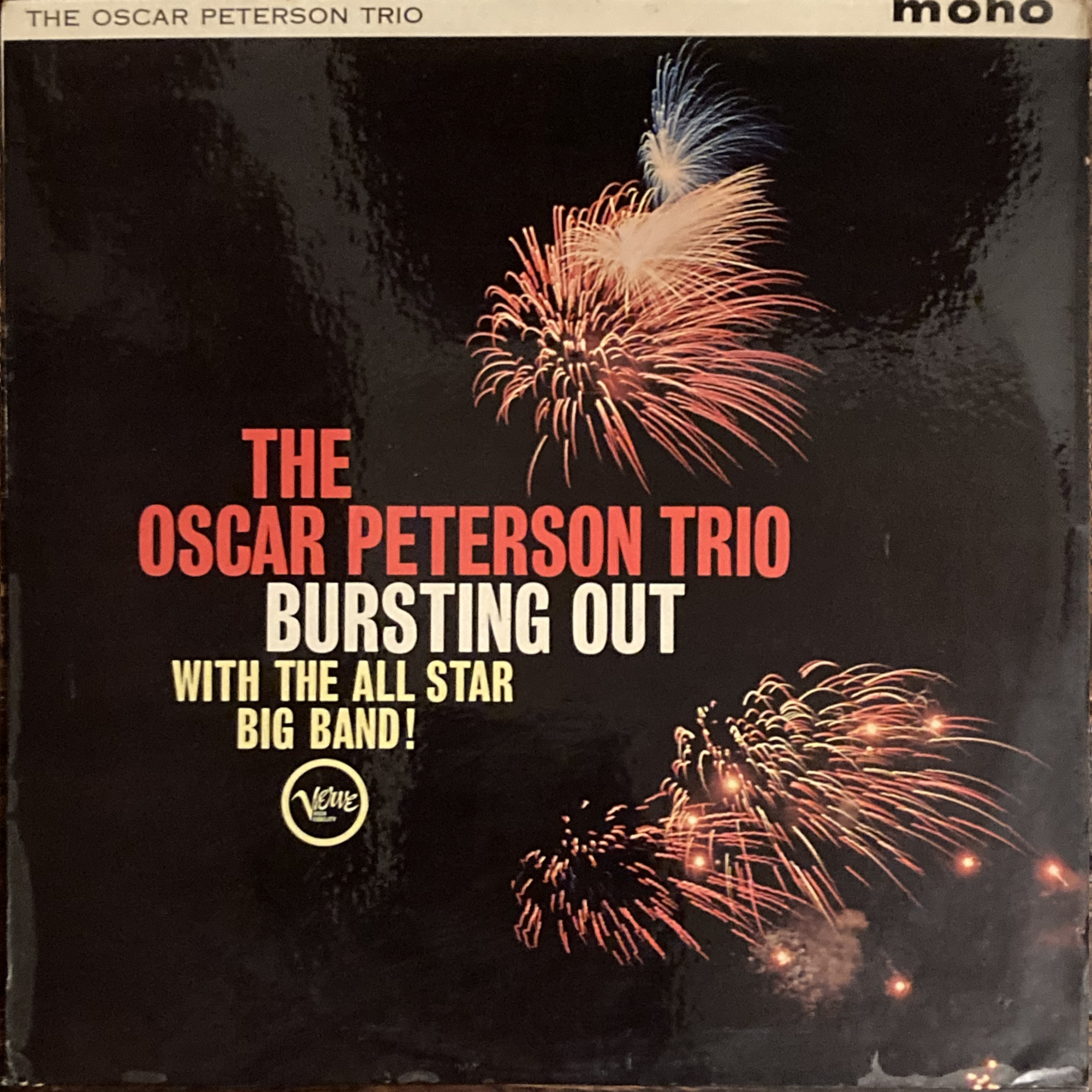
Label: E. M. I. Records (VERVE)
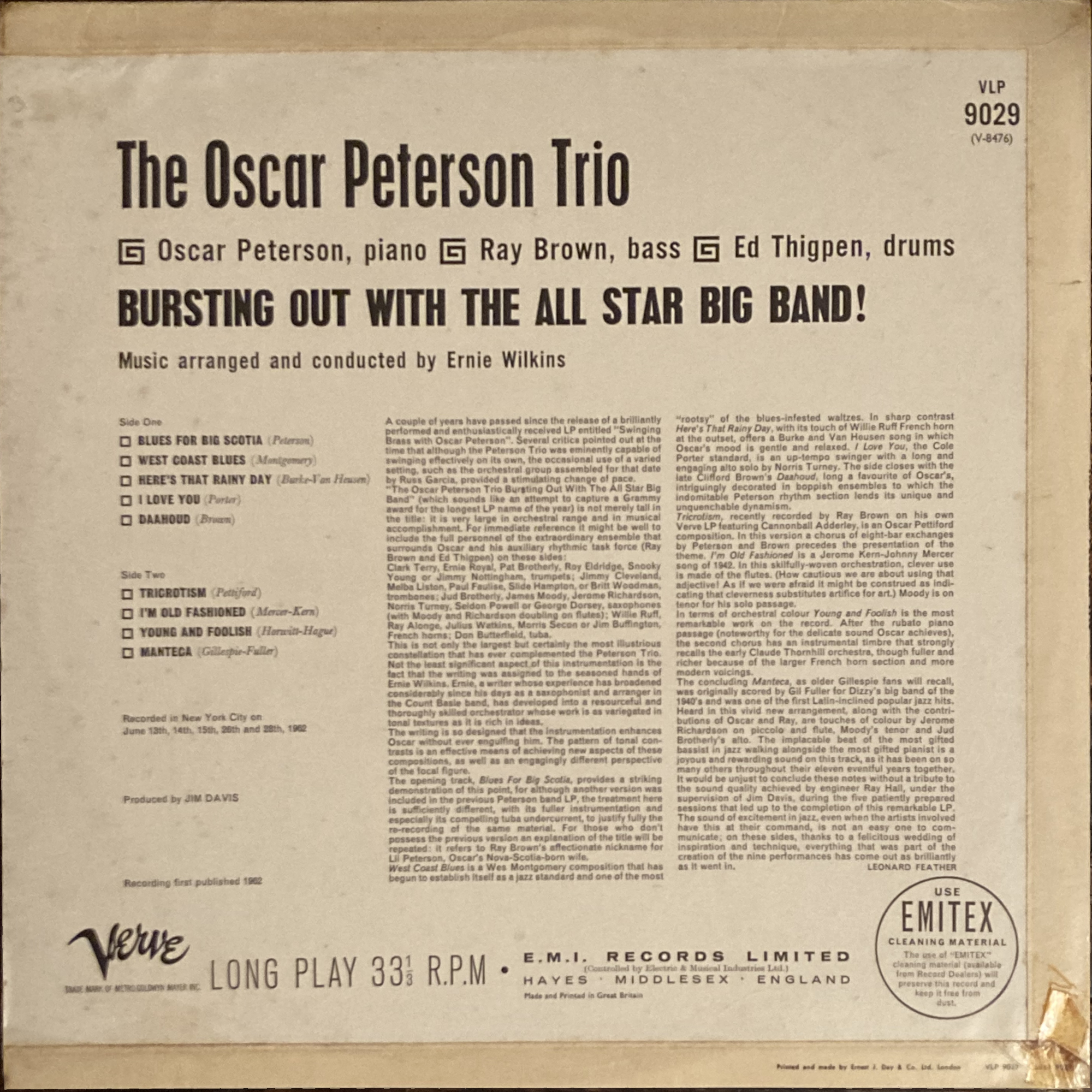
No.: VLP 9029 (V/V6 8476)
Title: BURSTING OUT WITH THE ALL STAR BIG BAND !
Musician: OSCAR PETERSON
Recorded: 1962/6/13
Monaural
Cover address: HAYES MIDDLESEX ENGLAND
Coating無し ペラジャケ
Groove Guard
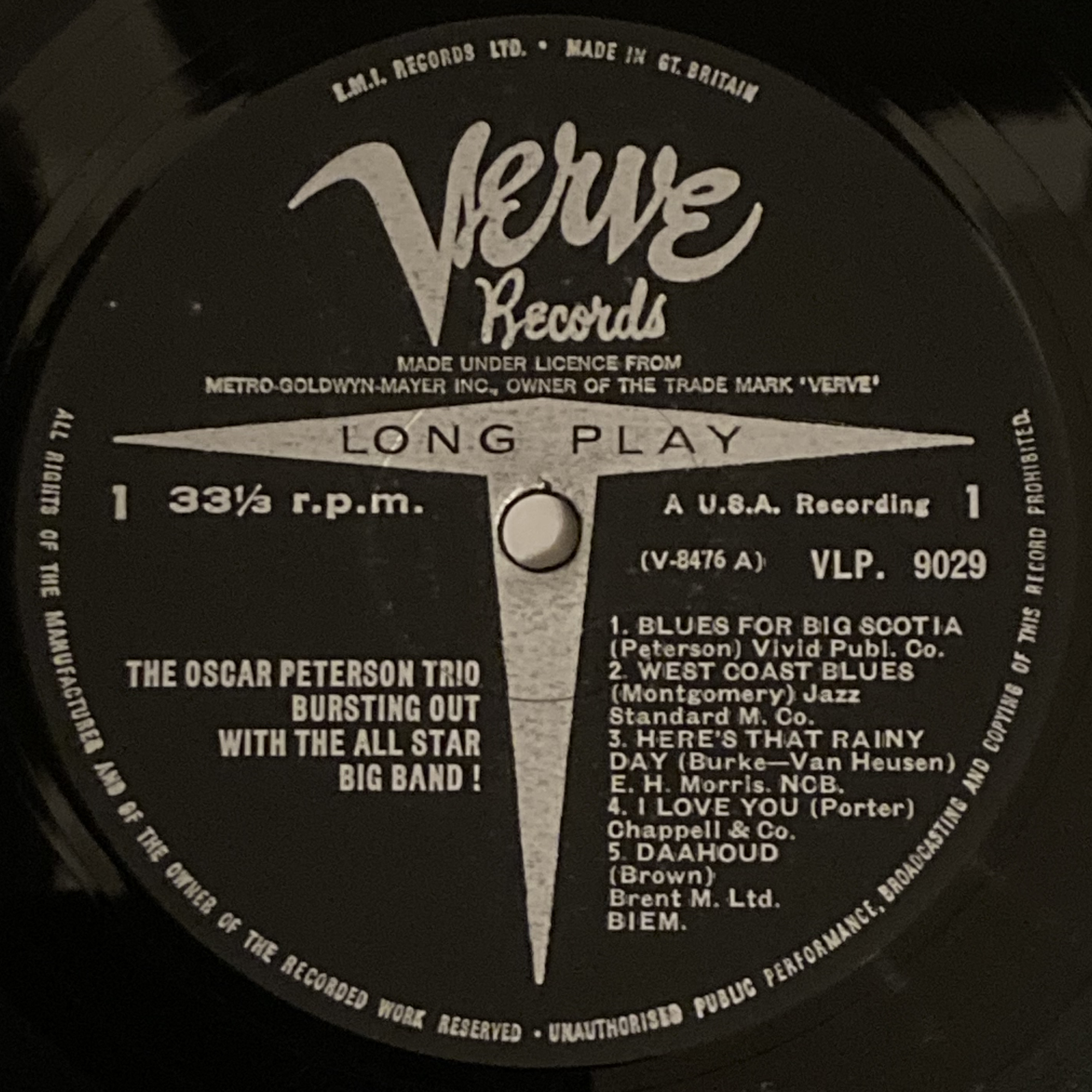
Label Side-A
Black Background
Silver Letter with “T” logo
Address:
Deep Groove無し
Dead Wax Info: V8476A-1S
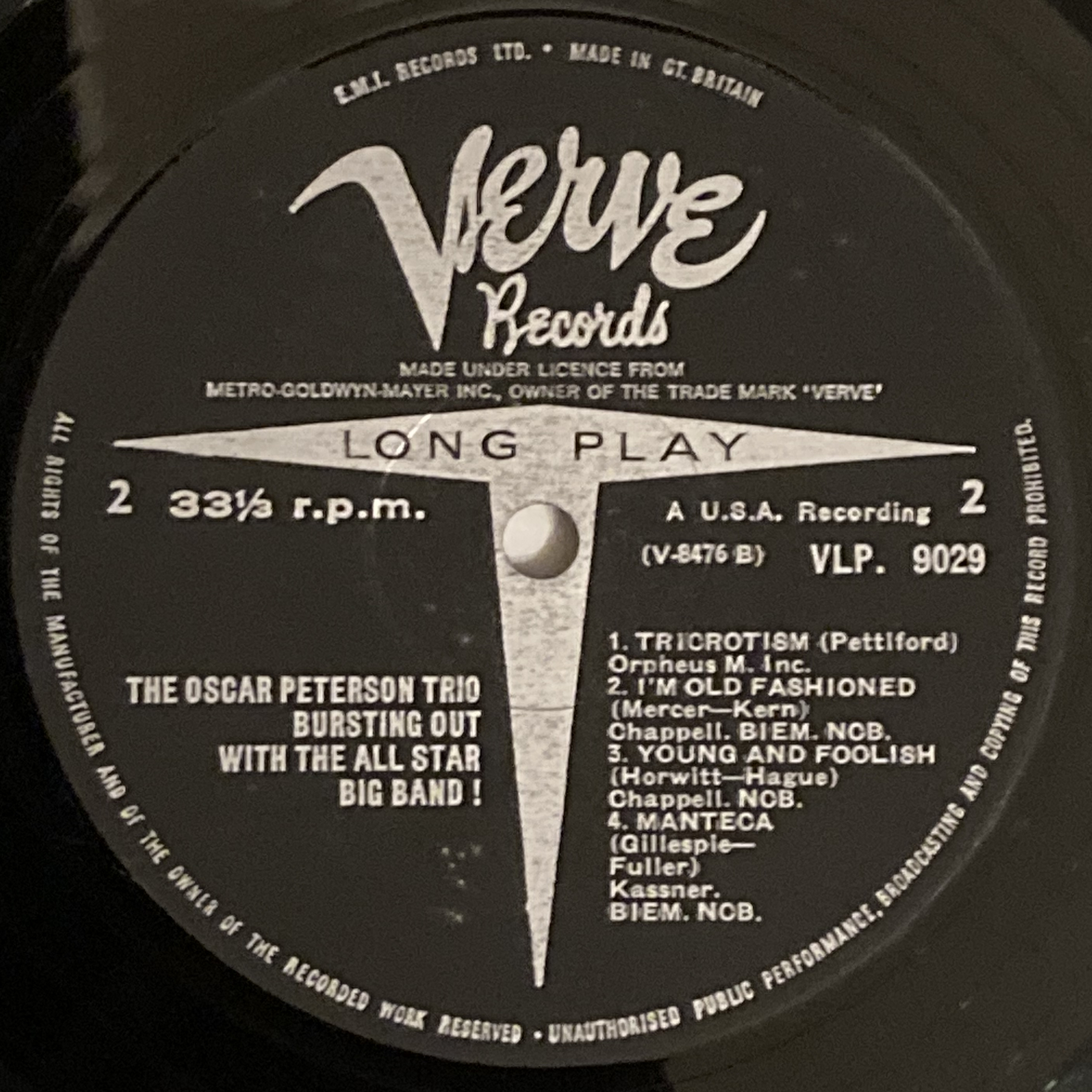
Label Side-B
Black Background
Silver Letter with “T” logo
Address:
Deep Groove無し
Dead Wax Info: V8476B-1S
Personnel-
Drums: Ed Thigpen
Bass: Ray Brown
Piano: Oscar Peterson
Tracks-
Side-A
1) Blues for Big Scotia
2) West Coast Blues
3) Here’s That Rainy Day
4) I Love You
5) Daahoud
Side-B
1) Tricrotism
2) I’m Old Fashioned
3) Young and Foolish
4) Manteca
<裏ジャケ原文>
A couple of years have passed since the release of a brilliantly performed and enthusiastically received LP entitled “Swinging Brass with Oscar Peterson”. Several critics pointed out at the time that although the Peterson Trio was eminently capable of swinging effectively on its own, the occasional use of a varied setting, such as the orchestral group assembled for that date by Russ Garcia, provided a stimulating change of pace. “The Oscar Peterson Trio Bursting Out With The All Star Big Band” (which sounds like an attempt to capture a Grammy award for the longest LP name of the year) is not merely tall in the title: it is very large in orchestral range and in musical accomplishment. For immediate reference it might be well to include the full personnel of the extraordinary ensemble that surrounds Oscar and his auxiliary rhythmic task force (Ray Brown and Ed Thigpen) on these sides:
Clark Terry, Ernie Royal, Pat Brotherly, Roy Eldridge, Snooky Young or Jimmy Nottingham, trumpets; Jimmy Cleveland, Melba Liston, Paul Faulise, Slide Hampton, or Britt Woodman, trombones; Jud Brotherly, James Moody, Jerome Richardson, Norris Turney, Seldon Powell or George Dorsey, saxophones (with Moody and Richardson doubling on flutes); Willie Ruff, Ray Alonge, Julius Watkins, Morris Secon or Jim Buffington, French horns; Don Butterfield, tuba.
This is not only the largest but certainly the most illustrious constellation that has ever complemented the Peterson Trio. Not the least significant aspect of this instrumentation is the fact that the writing was assigned to the seasoned hands of Ernie Wilkins. Ernie, a writer whose experience has broadened considerably since his days as a saxophonist and arranger in the Count Basie band, has developed into a resourceful and thoroughly skilled orchestrator whose work is as variegated in tonal textures as it is rich in ideas.
The writing is so designed that the instrumentation enhances Oscar without ever engulfing him. The pattern of tonal con- trasts is an effective means of achieving new aspects of these compositions, as well as an engagingly different perspective of the focal figure.
The opening track, Blues For Big Scotia, provides a striking demonstration of this point, for although another version was included in the previous Peterson band LP, the treatment here is sufficiently different, with its fuller instrumentation and especially its compelling tuba undercurrent, to justify fully the re-recording of the same material. For those who don’t possess the previous version an explanation of the title will be repeated: it refers to Ray Brown’s affectionate nickname for Lil Peterson, Oscar’s Nova-Scotia-born wife.
West Coast Blues is a Wes Montgomery composition that has begun to establish itself as a jazz standard and one of the most “rootsy” of the blues-infested waltzes. In sharp contrast Here’s That Rainy Day, with its touch of Willie Ruff French horn at the outset, offers a Burke and Van Heusen song in which Oscar’s mood is gentle and relaxed. / Love You, the Cole Porter standard, is an up-tempo swinger with a long and engaging alto solo by Norris Turney. The side closes with the late Clifford Brown’s Daahoud, long a favourite of Oscar’s, intriguingly decorated in boppish ensembles to which the indomitable Peterson rhythm section lends its unique and unquenchable dynamism.
Tricrotism, recently recorded by Ray Brown on his own Verve LP featuring Cannonball Adderley, is an Oscar Pettiford composition. In this version a chorus of eight-bar exchanges by Peterson and Brown precedes the presentation of the theme. I’m Old Fashioned is a Jerome Kern-Johnny Mercer song of 1942. In this skilfully-woven orchestration, clever use is made of the flutes. (How cautious we are about using that adjective! As if we were afraid it might be construed as indi- cating that cleverness substitutes artifice for art.) Moody is on tenor for his solo passage.
In terms of orchestral colour Young and Foolish is the most remarkable work on the record. After the rubato piano passage (noteworthy for the delicate sound Oscar achieves), the second chorus has an instrumental timbre that strongly recalls the early Claude Thornhill orchestra, though fuller and richer because of the larger French horn section and more modern voicings.
The concluding Manteca, as older Gillespie fans will recall, was originally scored by Gil Fuller for Dizzy’s big band of the 1940’s and was one of the first Latin-inclined popular jazz hits. Heard in this vivid new arrangement, along with the contri- butions of Oscar and Ray, are touches of colour by Jerome Richardson on piccolo and flute, Moody’s tenor and Jud Brotherly’s alto. The implacable beat of the most gifted bassist in jazz walking alongside the most gifted pianist is a joyous and rewarding sound on this track, as it has been on so many others throughout their eleven eventful years together. It would be unjust to conclude these notes without a tribute to the sound quality achieved by engineer Ray Hall, under the supervision of Jim Davis, during the five patiently prepared sessions that led up to the completion of this remarkable LP. The sound of excitement in jazz, even when the artists involved have this at their command, is not an easy one to com- municate; on these sides, thanks to a felicitous wedding of inspiration and technique, everything that was part of the creation of the nine performances has come out as brilliantly as it went in. LEONARD FEATHER
<裏ジャケ和訳>
『スウィンギング・ブラス・ウィズ・オスカー・ピーターソン(Swinging Brass with Oscar Peterson)』と題されたLPがリリースされてから数年が経った。当時、何人かの批評家が指摘していたように、ピーターソン・トリオはそれ単体でも十分にスウィングできる実力を備えているものの、ラス・ガルシアがこのセッションのために編成したオーケストラのような、変化に富んだ環境を取り入れることは、刺激的なアクセントとなっていた。『ザ・オスカー・ピーターソン・トリオ・バースティング・アウト・ウィズ・ザ・オール・スター・ビッグ・バンド(The Oscar Peterson Trio Bursting Out With The All Star Big Band)』――まるで「その年で最も長いタイトルのLP」としてグラミー賞を狙ったかのような名称だが――は、単にタイトルが長いだけではない。オーケストラの規模も大きく、音楽的な完成度も非常に高い作品である。参考までに、オスカーと彼を支えるリズム・セクション(レイ・ブラウン、エド・シグペン)を囲む、この並外れたアンサンブルの全メンバーを挙げておこう。
トランペット:クラーク・テリー、アーニー・ロイヤル、パット・ブラザリー、ロイ・エルドリッジ、スヌーキー・ヤング(またはジミー・ノッティンガム)。トロンボーン:ジミー・クリーヴランド、メルバ・リストン、ポール・フォーリース、スライド・ハンプトン(またはブリット・ウッドマン)。サックス:ジャド・ブラザリー、ジェームズ・ムーディ、ジェローム・リチャードソン、ノリス・ターニー、セルドン・パウエル(またはジョージ・ドーシー)※ムーディとリチャードソンはフルートも兼任。フレンチ・ホルン:ウィリー・ラフ、レイ・アロンジ、ジュリアス・ワトキンス、モリス・セコン(またはジム・バフィントン)。チューバ:ドン・バターフィールド。
これは、ピーターソン・トリオをサポートした編成の中で最大規模であるだけでなく、間違いなく最も豪華な顔ぶれと言えるだろう。この楽器編成において特筆すべきは、アレンジを経験豊富なアーニー・ウィルキンスが担当しているという点だ。カウント・ベイシー・オーケストラでサックス奏者兼アレンジャーとして活躍していた頃から、その経験を大きく広げてきたアーニーは、今や多彩な音色を操り、アイデアに満ちた、極めて有能で熟練したオーケストレーターへと成長を遂げている。
ここでのアレンジは、オスカーの演奏を引き立てつつ、決して彼を飲み込んでしまわないよう巧みに設計されている。音色の対比を活かした構成は、楽曲の新たな側面を引き出すだけでなく、中心人物であるオスカー・ピーターソンに対して、これまでとは一味違う魅力的な視点をもたらしている。オープニング・トラックの「ブルース・フォー・ビッグ・スコシア(Blues For Big Scotia)」は、この点を鮮やかに物語っている。ピーターソンのバンドによる前作のLPにも同曲は収録されていたが、本作では楽器編成がより充実しており、とりわけチューバが魅力的な低音の支えとなっていることから、同じ楽曲を再録音する十分な意義が感じられる。前作を所有していない読者のためにタイトルについて補足しておくと、これはレイ・ブラウンが、オスカーの妻でありノバスコシア州出身のリル・ピーターソンを親しみを込めて呼んでいた愛称に由来している。
「ウェスト・コースト・ブルース(West Coast Blues)」はウェス・モンゴメリーの作曲によるもので、ジャズ・スタンダードとしての地位を確立しつつある。ブルースの要素を色濃く含んだワルツの中でも、とりわけ「ルーツ(根源的)」な響きを持つ一曲だ。対照的に「ヒアズ・ザット・レイニー・デイ(Here’s That Rainy Day)」は、冒頭にウィリー・ラフのフレンチ・ホルンがフィーチャーされており、バーク&ヴァン・ヒューゼン作のこの曲で、オスカーは穏やかでリラックスした雰囲気を聴かせている。コール・ポーターのスタンダード「アイ・ラヴ・ユー(I Love You)」はアップテンポなスウィング・ナンバーで、ノリス・ターニーによる長く魅力的なアルト・サックスのソロが聴きどころだ。この面は、オスカーが長年愛奏してきたクリフォード・ブラウン作の「ダーウッド(Daahoud)」で締めくくられる。ここでは、ビバップ風のアンサンブルが興味深い彩りを添えており、そこにピーターソン・リズム・セクションが、揺るぎなく尽きることのないダイナミズムを注ぎ込んでいる。
「トライクロティズム(Tricrotism)」はオスカー・ペティフォードの作曲によるもので、レイ・ブラウンがキャノンボール・アダレイをフィーチャーした自身のVerve盤LPでも最近取り上げていた。本作では、テーマが提示される前に、ピーターソンとブラウンによる8小節ずつの掛け合いが展開される。「アイム・オールド・ファッションド(I’m Old Fashioned)」は、1942年にジェローム・カーンとジョニー・マーサーによって書かれた楽曲である。巧みに構成されたオーケストレーションの中で、フルートが実に「巧みに(cleverly)」使われている。(「巧みに」という形容詞を使うのには、ずいぶん慎重になってしまうものだ!まるで、それが「芸術の代わりに技巧(artifice)を弄している」と受け取られかねないことを恐れているかのように。)ソロ・パートではムーディがテナー・サックスを吹いている。
オーケストレーションの色彩という点では、「ヤング・アンド・フーリッシュ(Young and Foolish)」が本作で最も際立った一曲と言える。ルバートのピアノパッセージ(オスカーが奏でる繊細な音色が特筆に値する)の後、第2合唱の楽器の音色は、初期のクロード・ソーンヒル楽団を強く彷彿とさせるが、ホルンセクションの規模が大きく、より現代的な音色構成になっているため、より豊かで深みのある響きとなっている。
締めくくりを飾る「マンテカ(Manteca)」は、ディジー・ガレスピーの古くからのファンならご存知の通り、もともと1940年代のディジーのビッグ・バンドのためにギル・フラーが編曲したもので、ラテンの要素を取り入れたジャズのヒット曲の先駆けとなった作品である。本作では、鮮やかな新アレンジのもと、オスカー(・ペティフォード)とレイ(・ブラウン)の貢献に加え、ジェローム・リチャードソンがピッコロとフルートで彩りを添え、さらにムーディがテナー・サックスを、ジャド・ブラザリーがアルト・サックスを聴かせている。ジャズ界屈指の才能を持つベーシストが、同じく傑出したピアニストと歩調を合わせて刻む揺るぎないビートは、聴く者に喜びと充実感をもたらす。これは、彼らが共に過ごした波乱万丈の11年間、数多くの演奏で繰り返されてきた光景そのものだ。この素晴らしいLPを完成させるために行われた5回の入念なセッションにおいて、ジム・デイヴィスの監修のもと、エンジニアのレイ・ホールが実現した音質について触れずに、このライナーノーツを終えるのは不公平というものだろう。ジャズにおける「興奮」という感覚は、たとえ演奏者たちがそれを自在に操れる力量を持っていたとしても、レコードを通じて伝えるのは決して容易なことではない。しかし本作では、インスピレーションとテクニックが見事に融合したおかげで、9つの演奏が生まれた瞬間のすべてが、何一つ損なわれることなく、鮮やかに再現されている。――レナード・フェザー
※訳文の制作にはGoogleドライブとGoogle翻訳のお世話になりました。
コメント