Label: VOGUE
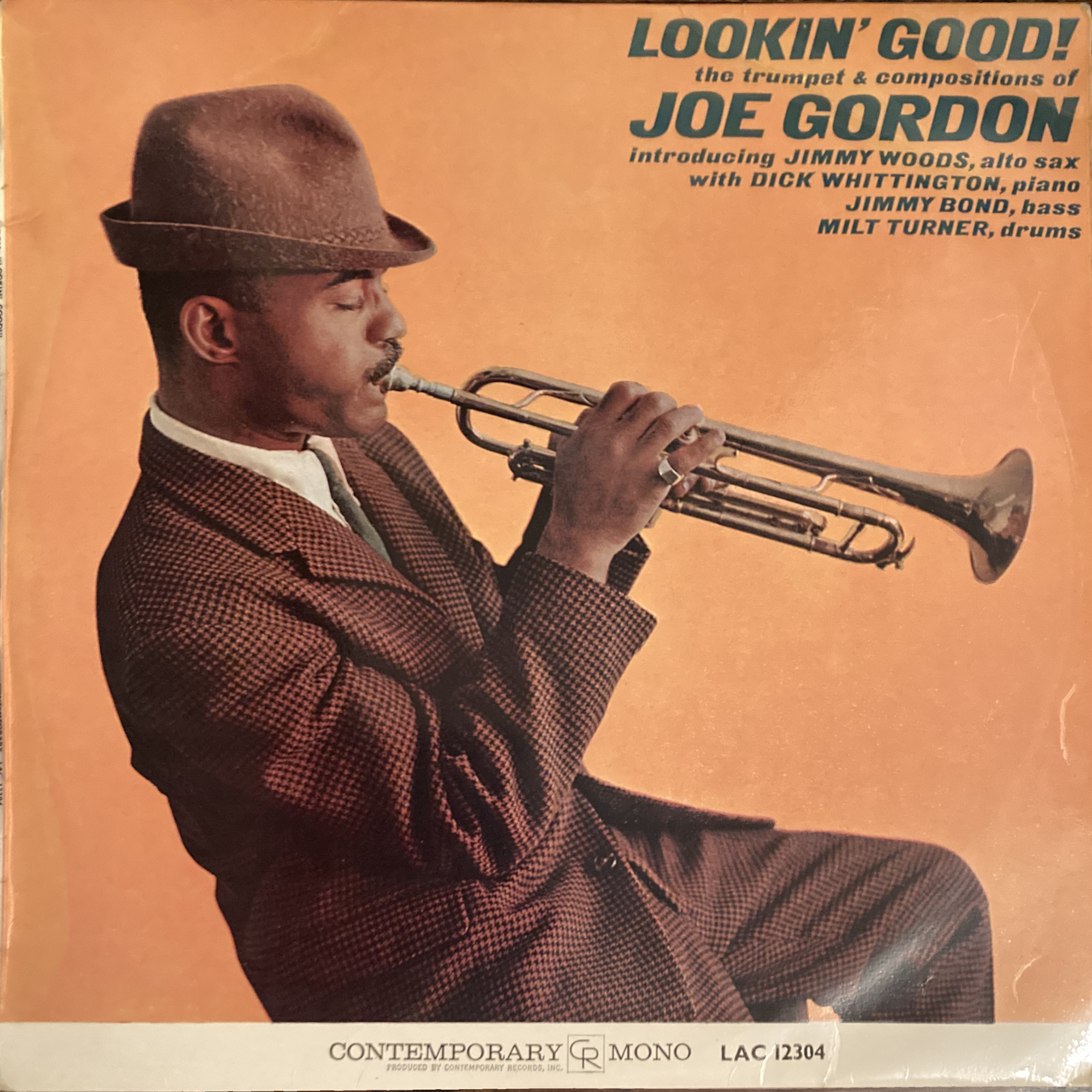
No.: LAC 12304 (CONTEMPORARY M 3597)
Title: LOOKIN’ GOOD!
Musician: JOE GORDON
Recorded: 1961/7/11
Monaural
Cover address:
Coating ペラジャケ
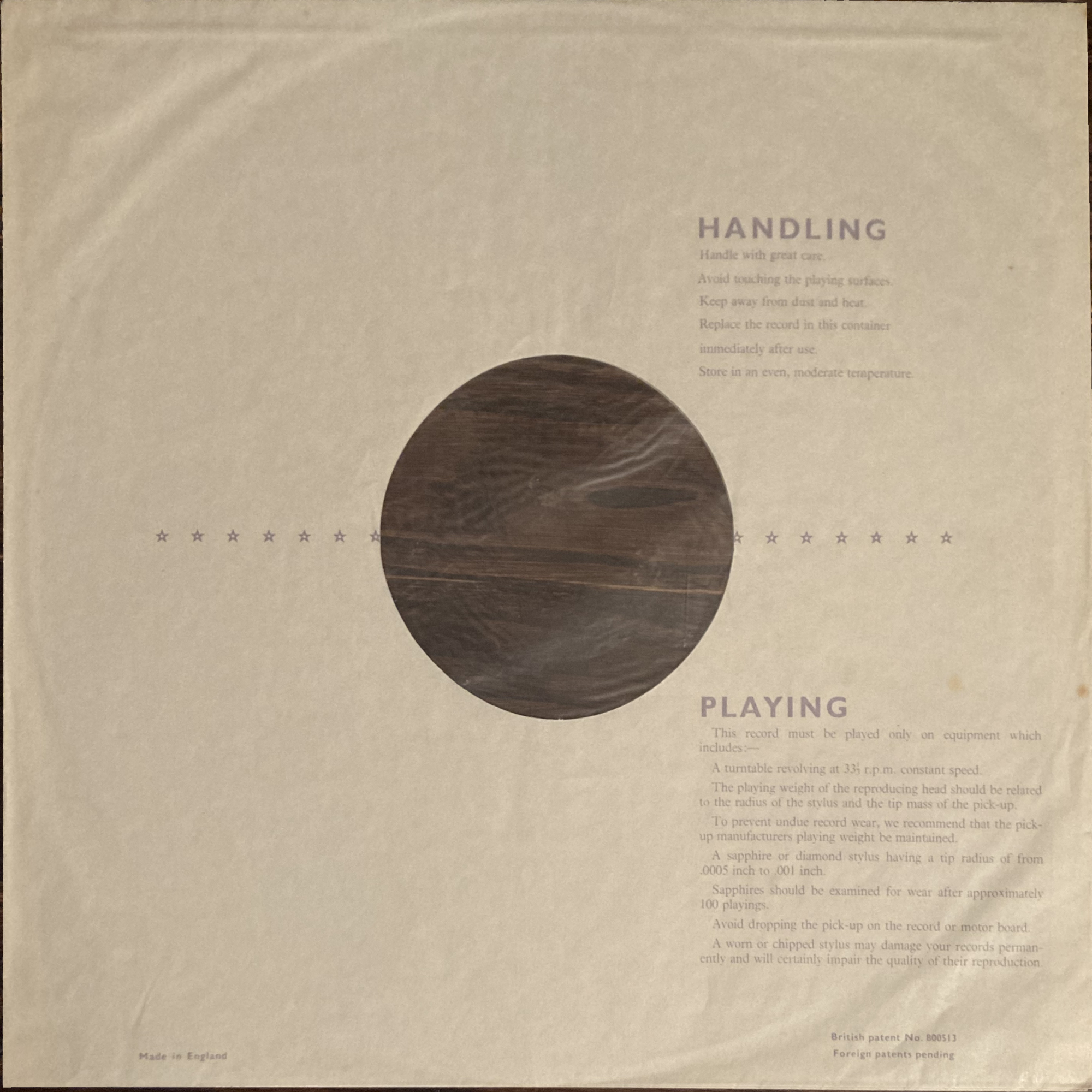
Groove Guard
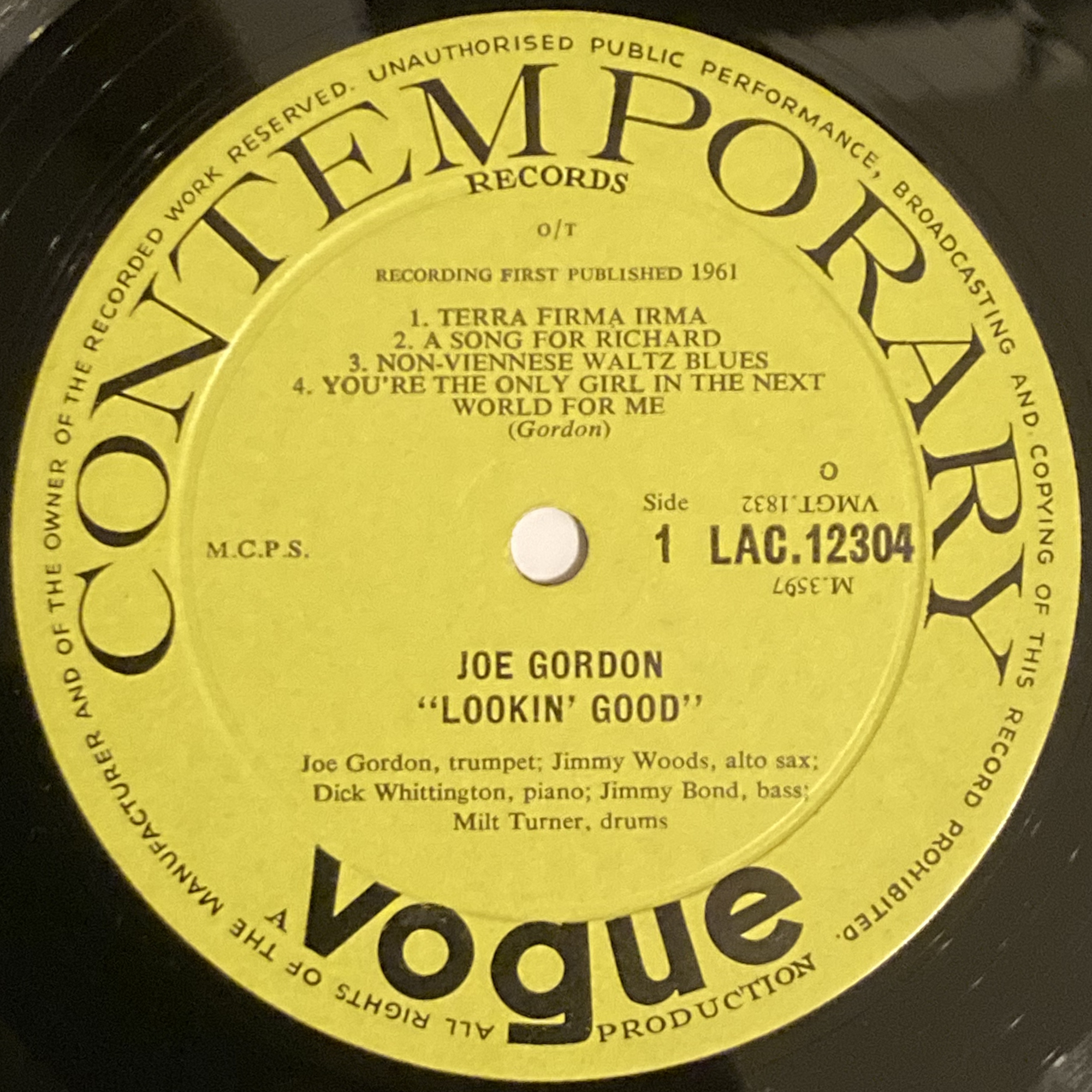
Label Side-A
Lemon Yellow Background
Black Letter
Address: None
Deep Groove
Dead Wax Info: VMGT-1832-1B
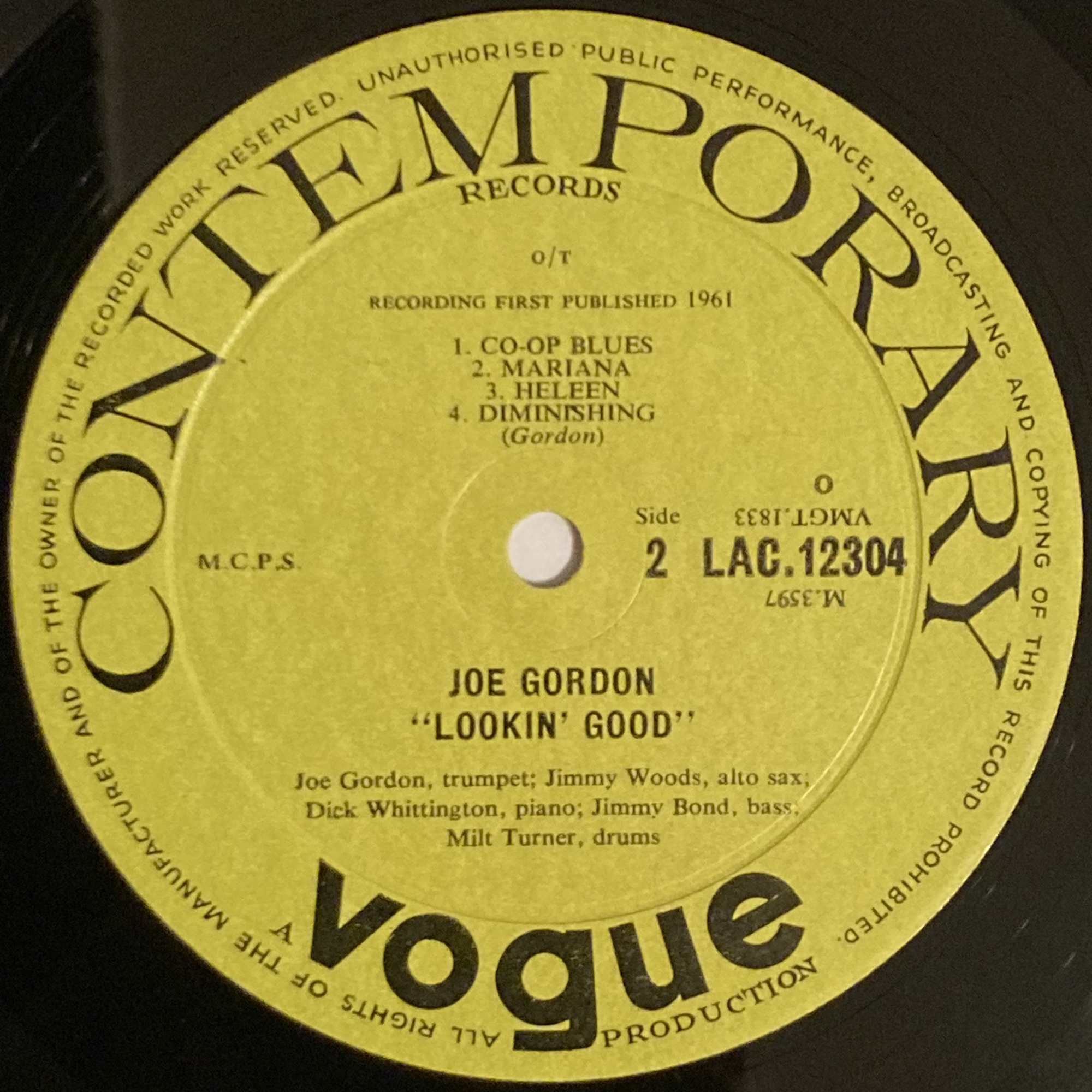
Label Side-B
Lemon Yellow Background
Black Letter
Address: None
Deep Groove
Dead Wax Info: VMGT-1833-1B
Personnel-
Drums: Milt Turner
Bass: Jimmy Bond
Piano: Dick Whittington
Alto Sax: Jimmy Woods
Trumpet: Joe Gordon
Guitar: Johnny Smith
Tracks-
Side-A
1) Terra Firma Irma 7’42”
2) A Song For Richard 5’02”
3) Non-Viennese Waltz Blues 4’20”
4) You’re the Only Girl in the Next World for Me 4’30”
Side-B
1) Co-op Blues 5’55”
2) Mariana 4’09”
3) Heleen 4’00”
4) Diminishing 5’40”
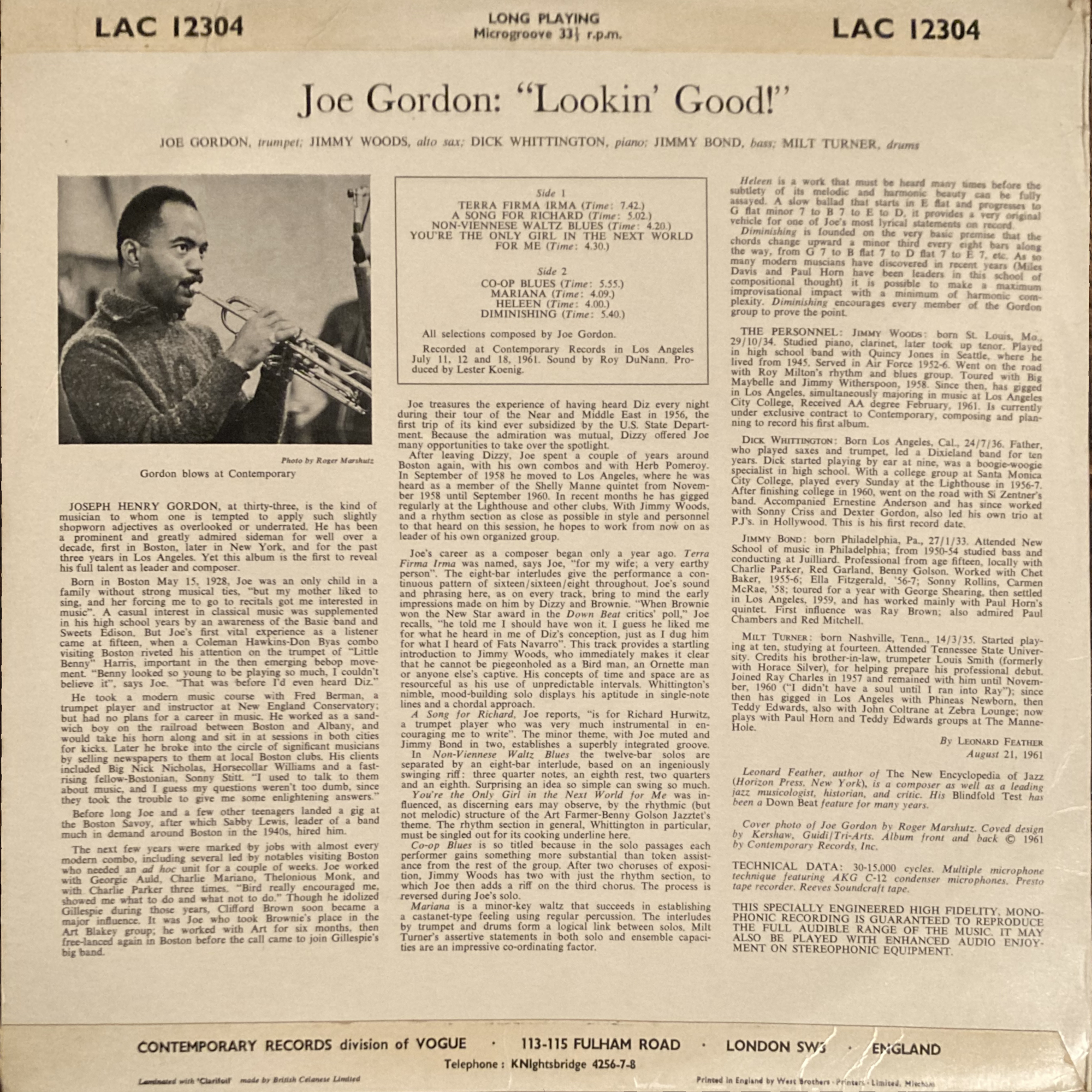
<裏ジャケ原文>
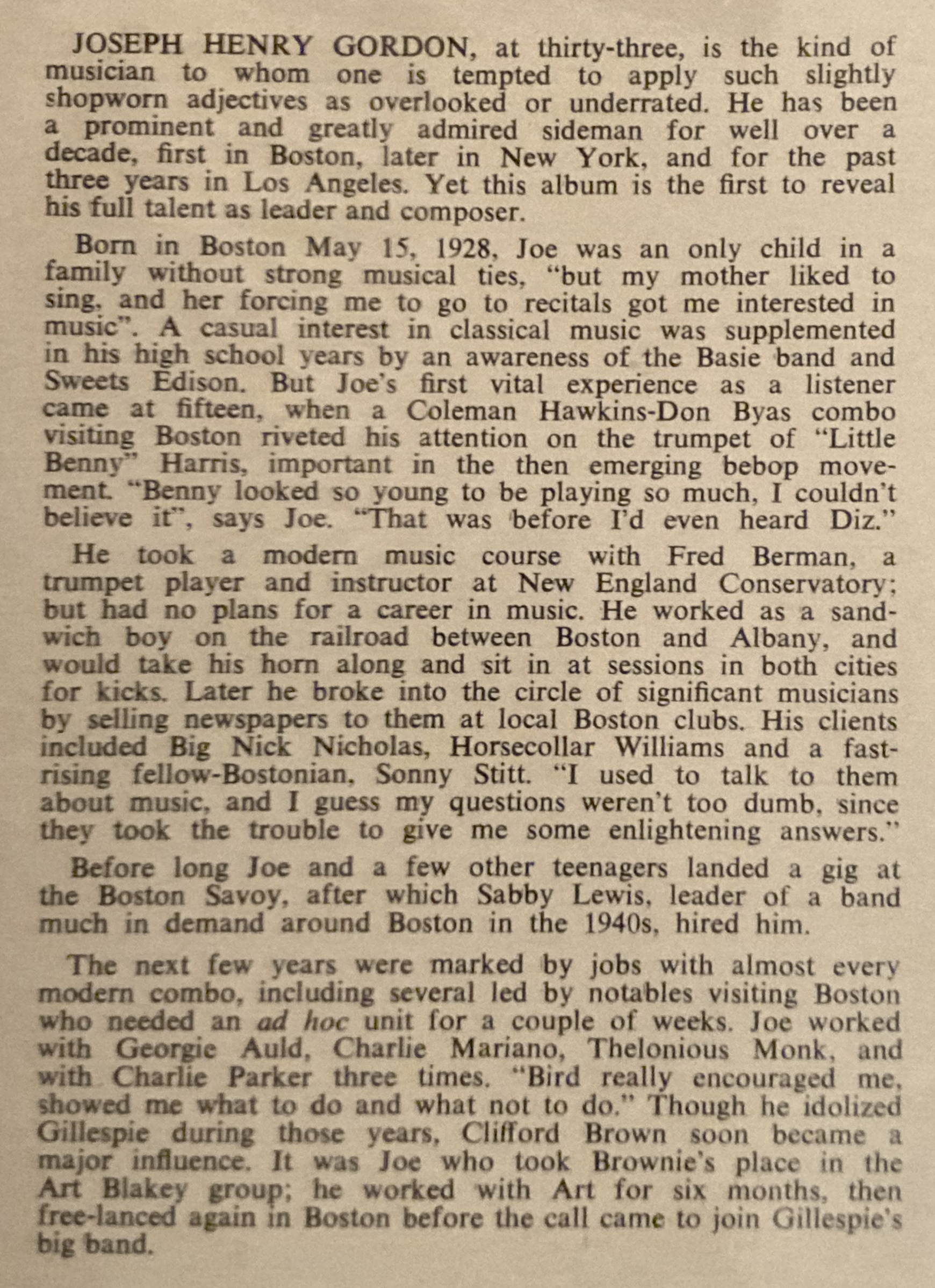
JOSEPH HENRY GORDON, at thirty-three, is the kind of musician to whom one is tempted to apply such slightly shopworn adjectives as overlooked or underrated. He has been a prominent and greatly admired sideman for well over a decade, first in Boston, later in New York, and for the past three years in Los Angeles. Yet this album is the first to reveal his full talent as leader and composer.
Born in Boston May 15, 1928, Joe was an only child in a family without strong musical ties, “but my mother liked to sing, and her forcing me to go to recitals got me interested in music”. A casual interest in classical music was supplemented in his high school years by an awareness of the Basie band and Sweets Edison. But Joe’s first vital experience as a listener came at fifteen, when a Coleman Hawkins-Don Byas combo visiting Boston riveted his attention on the trumpet of “Little Benny” Harris, important in the then emerging bebop move- ment. “Benny looked so young to be playing so much, I couldn’t believe it”, says Joe. “That was before I’d even heard Diz.” He took a a modern music course with Fred Berman, a trumpet player and instructor at New England Conservatory; but had no plans for a career in music. He worked as a sand- wich boy on the railroad between Boston and Albany, and would take his horn along and sit in at sessions in both cities for kicks. Later he broke into the circle of significant musicians by selling newspapers to them at local Boston clubs. His clients included Big Nick Nicholas, Horsecollar Williams and a fast- rising fellow-Bostonian, Sonny Stitt. “I used to talk to them about music, and I guess my questions weren’t too dumb, since they took the trouble to give me some enlightening answers.”
Before long Joe and a few other teenagers landed a gig at the Boston Savoy, after which Sabby Lewis, leader of a band much in demand around Boston in the 1940s, hired him.
The next few years were marked by jobs with almost every modern combo, including several led by notables visiting Boston who needed an ad hoc unit for a couple of weeks. Joe worked with Georgie Auld, Charlie Mariano, Thelonious Monk, and with Charlie Parker three times. “Bird really encouraged me, showed me what to do and what not to do.” Though he idolized Gillespie during those years, Clifford Brown soon became a major influence. It was Joe who took Brownie’s place in the Art Blakey group; he worked with Art for six months, then free-lanced again in Boston before the call came to join Gillespie’s big band.
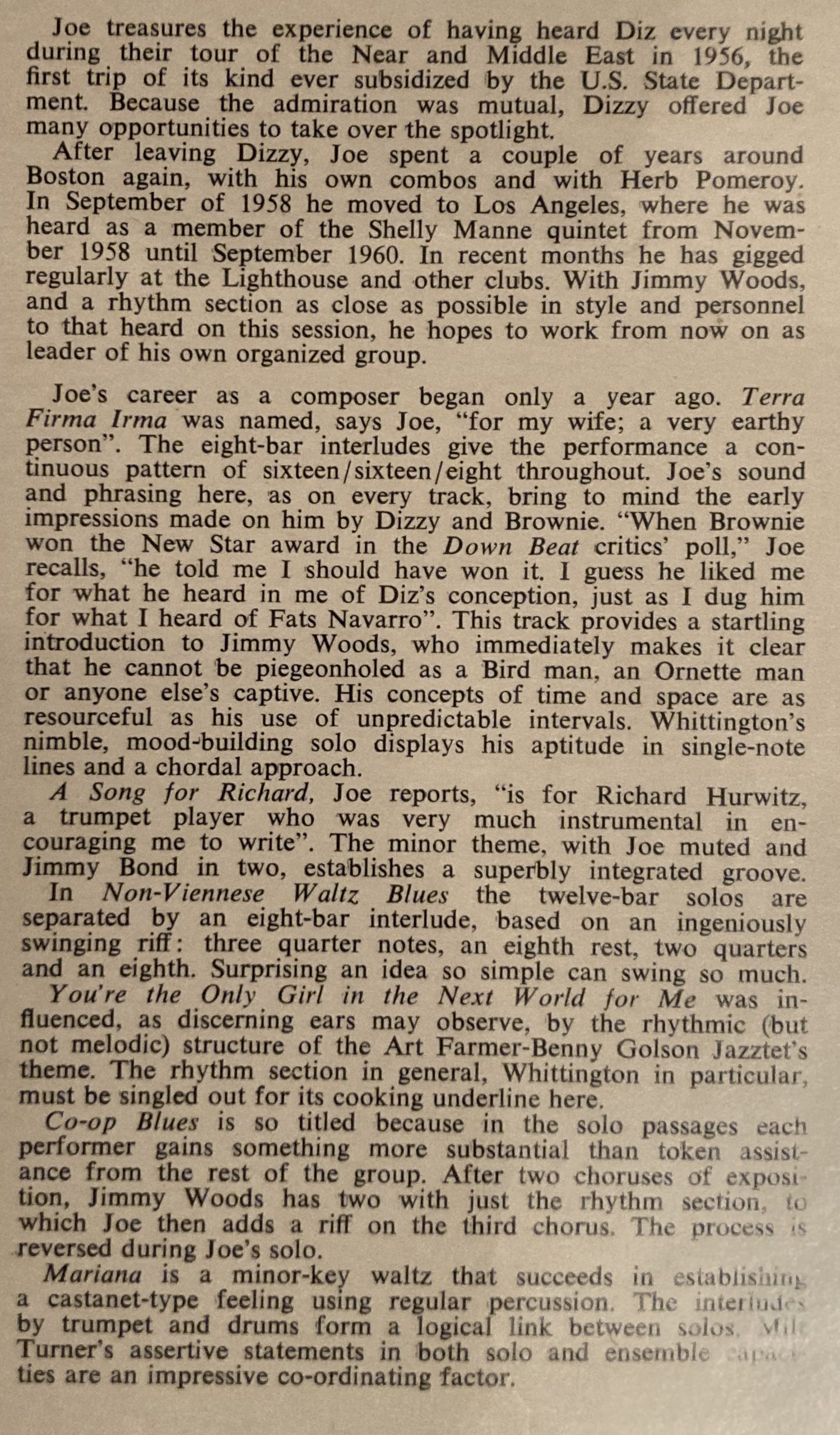
Joe treasures the experience of having heard Diz every night during their tour of the Near and Middle East in 1956, the first trip of its kind ever subsidized by the U.S. State Depart- ment. Because the admiration was mutual, Dizzy offered Joe many opportunities to take over the spotlight.
After leaving Dizzy, Joe spent a couple of years around Boston again, with his own combos and with Herb Pomeroy. In September of 1958 he moved to Los Angeles, where he was heard as a member of the Shelly Manne quintet from Novem- ber 1958 until September 1960. In recent months he has gigged regularly at the Lighthouse and other clubs. With Jimmy Woods, and a rhythm section as close as possible in style and personnel to that heard on this session, he hopes to work from now on as leader of his own organized group.
Joe’s career as a composer began only a year ago. Terra Firma Irma was named, says Joe, “for my wife; a very earthy person”. The eight-bar interludes give the performance a con- tinuous pattern of sixteen/sixteen/eight throughout. Joe’s sound and phrasing here, as on every track, bring to mind the early impressions made on him by Dizzy and Brownie. “When Brownie won the New Star award in the Down Beat critics’ poll,” Joe recalls, “he told me I should have won it. I guess he liked me for what he heard in me of Diz’s conception, just as I dug him for what I heard of Fats Navarro”. This track provides a startling introduction to Jimmy Woods, who immediately makes it clear that he cannot be piegeonholed as a Bird man, an Ornette man or anyone else’s captive. His concepts of time and space are as resourceful as his use of unpredictable intervals. Whittington’s nimble, mood-building solo displays his aptitude in single-note lines and a chordal approach.
A Song for Richard, Joe reports, “is for Richard Hurwitz, a trumpet player who was very much instrumental in en- couraging me to write”. The minor theme, with Joe muted and Jimmy Bond in two, establishes a superbly integrated groove. In Non-Viennese Waltz Blues the twelve-bar solos are separated by an eight-bar interlude, based on an ingeniously swinging riff: three quarter notes, an eighth rest, two quarters and an eighth. Surprising an idea so simple can swing so much. You’re the Only Girl in the Next World for Me was in- fluenced, as discerning ears may observe, by the rhythmic (but not melodic) structure of the Art Farmer-Benny Golson Jazztet’s theme. The rhythm section in general, Whittington in particular, must be singled out for its cooking underline here.
Co-op Blues is so titled because in the solo passages each performer gains something more substantial than token assist- ance from the rest of the group. After two choruses of exposi- tion, Jimmy Woods has two with just the rhythm section, to which Joe then adds a riff on the third chorus. The process is reversed during Joe’s solo.
Mariana is a minor-key waltz that succeeds in establishing a castanet-type feeling using regular percussion. The interludes by trumpet and drums form a logical link between solos. Mile Turner’s assertive statements in both solo and ensemble capaci ties are an impressive co-ordinating factor.
Heleen is a work that must be heard many times before the subtlety of its melodic and harmonic beauty can be fully assayed. A slow ballad that starts in E flat and progresses to G flat minor 7 to B 7 to E to D, it provides a very original vehicle for one of Joe’s most lyrical statements on record.
Diminishing is founded on the very basic premise that the chords change upward a minor third every eight bars along the way, from G 7 to B flat 7 to D flat 7 to Ě 7, etc. As so many modern muscians have discovered in recent years (Miles Davis and Paul Horn have been leaders in this school of compositional thought) it is possible to make a make a maximum improvisational impact with a minimum of harmonic com- plexity. Diminishing encourages every member of the Gordon group to prove the point.
THE PERSONNEL: JIMMY WOODS: born St. Louis, Mo., 29/10/34. Studied piano, clarinet, later took up tenor. Played in high school band with Quincy Jones in Seattle, where he lived from 1945. Served in Air Force 1952-6. Went on the road with Roy Milton’s rhythm and blues group. Toured with Big Maybelle and Jimmy Witherspoon, 1958. Since then, has gigged in Los Angeles, simultaneously majoring in music at Los Angeles City College, Received AA degree February, 1961. Is currently under exclusive contract to Contemporary, composing and plan- ning to record his first album.
DICK WHITTINGTON: Born Los Angeles, Cal., 24/7/36. Father, who played saxes and trumpet, led a Dixieland band for ten years. Dick started playing by ear at nine, was a boogie-woogie specialist in high school. With a college group at Santa Monica City College, played every Sunday at the Lighthouse in 1956-7. After finishing college in 1960, went on the road with Si Zentner’s band. Accompanied Ernestine Anderson and has since worked with Sonny Criss and Dexter Gordon, also led his own trio at P.J’s. in Hollywood. This is his first record date.
JIMMY BOND: born Philadelphia, Pa., 27/1/33. Attended New School of music in Philadelphia; from 1950-54 studied bass and conducting at Juilliard. Professional from age fifteen, locally with Charlie Parker, Red Garland, Benny Golson. Worked with Chet Baker, 1955-6; Ella Fitzgerald, ’56-7; Sonny Rollins, Carmen McRae, ’58; toured for a year with George Shearing, then settled in Los Angeles, 1959, and has worked mainly with Paul Horn’s quintet. First influence was Ray Brown; also admired Paul Chambers and Red Mitchell.
MILT TURNER: born Nashville, Tenn., 14/3/35. Started play- ing at ten, studying at fourteen. Attended Tennessee State Univer- sity. Credits his brother-in-law, trumpeter Louis Smith (formerly with Horace Silver), for helping prepare his professional debut. Joined Ray Charles in 1957 and remained with him until Novem- ber, 1960 (“I didn’t have a soul until I ran into Ray”); since then has gigged in Los Angeles with Phineas Newborn, then Teddy Edwards, also with John Coltrane at Zebra Lounge; now plays with Paul Horn and Teddy Edwards groups at The Manne- Hole.
By LEONARD FEATHER August 21, 1961
Leonard Feather, author of The New Encyclopedia of Jazz (Horizon Press, New York), is a composer as well as a leading jazz musicologist, historian, and critic. His Blindfold Test ha been a Down Beat feature for many years.
Cover photo of Joe Gordon by Roger Marshutz. Coved design by Kershaw, Guidi/Tri-Arts. Album front and back © 1961 by Contemporary Records, Inc.
TECHNICAL DATA: 30-15,000 cycles. Multiple microphone technique featuring AKG C-12 condenser microphones. Presto tape recorder. Reeves Soundcraft tape.
THIS SPECIALLY ENGINEERED HIGH FIDELITY, MONO- PHONIC RECORDING IS GUARANTEED TO REPRODUCE THE FULL AUDIBLE RANGE OF THE MUSIC, IT MAY ALSO BE PLAYED WITH ENHANCED AUDIO ENJOY MENT ON STEREOPHONIC EQUIPMENT.
<裏ジャケ和訳>
ジョセフ・ヘンリー・ゴードン(33歳)は、「見過ごされてきた」あるいは「過小評価されている」といった、少々使い古された形容詞を当てはめたくなるようなミュージシャンである。彼は10年以上にわたり、ボストン、ニューヨーク、そしてここ3年はロサンゼルスを拠点に、高く評価されるサイドマンとして活躍してきた。しかし、リーダーかつ作曲家としての彼の才能を余すところなく示したのは、このアルバムが初めてである。
1928年5月15日、ボストンに生まれたジョーは一人っ子で、音楽とは縁の薄い家庭で育った。「でも、母が歌うのが好きで、リサイタルに無理やり連れて行かれたことがきっかけで、音楽に興味を持つようになったんだ」。高校時代には、クラシック音楽への何気ない関心に加え、カウント・ベイシー楽団や「スウィーツ」・エディソンといった存在を知るようになった。しかし、リスナーとして彼にとって決定的な体験となったのは15歳の時である。ボストンを訪れたコールマン・ホーキンスとドン・バイアスのコンボを聴いた際、当時台頭しつつあったビバップ・ムーブメントの重要人物の一人、「リトル・ベニー」・ハリスのトランペット演奏に心を奪われたのだ。「ベニーはすごく若かったのに、あんなに素晴らしい演奏をするなんて信じられなかった」とジョーは語る。「ディジー(・ガレスピー)の演奏を聴くよりも前のことだよ」。彼はニューイングランド音楽院のトランペット奏者兼講師であるフレッド・バーマンのもとでモダン・ミュージックのコースを受けたが、当時は音楽を職業にしようとは考えていなかった。ボストンとオールバニを結ぶ鉄道でサンドイッチを売る仕事をしていた彼は、楽器を持ち歩いては、両都市のセッションに飛び入り参加して楽しんでいた。その後、ボストンのクラブでミュージシャンたちに新聞を売ることを通じて、彼らの輪の中に入り込んでいった。顧客の中には、ビッグ・ニック・ニコラス、ホースカラー・ウィリアムズ、そして同じボストン出身で急速に頭角を現していたソニー・スティットらがいた。「彼らと音楽についてよく話をしたものさ。僕の質問もそれほど的外れではなかったんだろうね、彼らはわざわざ、ためになる答えを返してくれたんだから」。
やがてジョーは、数人の10代の仲間と共にボストンのサヴォイで演奏する機会を得た。その後、1940年代のボストン周辺で絶大な人気を誇ったバンドのリーダー、サビー・ルイスにスカウトされたのである。その後の数年間、彼はボストンを訪れる著名なミュージシャンたちの即席バンドを含め、当時存在したほぼすべてのモダン・ジャズ・コンボで演奏する機会に恵まれた。ジョーはジョージー・オールド、チャーリー・マリアーノ、セロニアス・モンクらと共演し、チャーリー・パーカーとは3度にわたって演奏を共にした。「バード(チャーリー・パーカー)は本当に僕を励ましてくれて、何をするべきか、何をしてはいけないのかを教えてくれたんだ」。当時、彼はディジー・ガレスピーを崇拝していたが、やがてクリフォード・ブラウンからも大きな影響を受けるようになった。アート・ブレイキーのグループでクリフォード・ブラウンの後任を務めたのはジョーであり、彼はアートのもとで6か月間活動した。その後、再びボストンでフリーランスとして活動していたところ、ディジー・ガレスピーのビッグ・バンドへの参加要請が届いた。
1956年、米国務省の助成を受けた初の海外ツアーとして、ディジー・ガレスピーと共に中近東を巡った際、毎晩ディジーの演奏を聴くことができた経験を、ジョーは今も大切にしている。二人は互いに認め合う仲であり、ディジーはジョーに、スポットライトを浴びる機会を何度も与えてくれた。
ディジーのもとを離れた後、ジョーは再びボストン周辺で数年間を過ごし、自身のコンボを率いたり、ハーブ・ポメロイのグループで活動したりした。1958年9月にはロサンゼルスへ移り、1958年11月から1960年9月まで、シェリー・マン・クインテットのメンバーとして演奏した。ここ数か月は、「ザ・ライトハウス」をはじめとするクラブで定期的に演奏を行っている。今後はジミー・ウッズを迎え、今回のセッションに近いスタイルとメンバー構成のリズム・セクションを擁する自身のグループを率いて、活動していくことを目指している。
ジョーの作曲家としてのキャリアはわずか1年前に始まったばかりだ。「テラ・フィルマ・イルマ」というタイトルは、「妻にちなんで名付けたんだ。とても地に足の着いた人だから」とジョーは言う。8小節の間奏が、演奏全体を通して16/16/8の連続したパターンを生み出している。ここでのジョーのサウンドとフレージングは、他のどのトラックでもそうであるように、ディジーとブラウニーから受けた初期の印象を思い起こさせる。「ブラウニーがダウンビート誌の批評家投票でニュースター賞を受賞したとき、彼は僕が受賞すべきだったと言ったんだ」とジョーは回想する。「僕がファッツ・ナバロから聞いたものを彼が気に入ったように、彼は僕の中にディジーのコンセプトを感じ取ってくれたんだろう」。このトラックは、ジミー・ウッズへの驚くべき紹介となっている。彼は、バードマン、オーネットマン、あるいは他の誰かの囚われ人として型にはめられることはないことをすぐに明らかにする。彼の時間と空間の概念は、予測不可能なインターバルの使用と同じくらい独創的だ。ウィッティントンの軽快で雰囲気作りに長けたソロは、単音ラインとコードアプローチにおける彼の才能を如実に示している。
「A Song for Richard」は、ジョー曰く「私が作曲を始める上で大きな励みとなったトランペット奏者、リチャード・ハーウィッツに捧げた曲」だという。ジョーがミュート、ジミー・ボンドがツー・ディレイで演奏するマイナー・テーマは、見事に調和したグルーヴを生み出している。「Non-Viennese Waltz Blues」では、12小節のソロの間に8小節の間奏が挟まれている。この間奏は、3つの四分音符、8分休符、2つの四分音符、そして8分音符という、独創的なスウィング感あふれるリフに基づいている。これほどシンプルなアイデアが、これほどスウィング感を生み出すとは驚きだ。「You’re the Only Girl in the Next World for Me」は、耳の肥えたリスナーなら気づくかもしれないが、アート・ファーマー=ベニー・ゴルソン・ジャズテットのテーマのリズム構造(メロディー構造ではない)に影響を受けている。リズムセクション全体、特にウィッティントンの演奏は、この曲の根幹を成す重要な要素として特筆すべきである。
「Co-op Blues」というタイトルは、ソロパートにおいて各演奏者が、他のメンバーから単なる形式的なサポート以上の、より実質的な何かを得ていることを示している。 2コーラスの提示部の後、ジミー・ウッズがリズム・セクションのみをバックに2コーラスを演奏し、3コーラス目からジョーがリフを重ねていく。ジョーのソロでは、この役割が逆転する。
「マリアナ(Mariana)」は短調のワルツで、通常のパーカッションを用いながら、カスタネットのような雰囲気をうまく作り出している。トランペットとドラムによる間奏が、各ソロの間を自然につないでいる。マイル・ターナーは、ソロにおいてもアンサンブルにおいても力強いプレイを見せており、全体をまとめる重要な役割を果たしている。
「ヘリーン(Heleen)」は、その旋律と和声の美しさに潜む繊細さを十分に味わうために、何度も聴き返す必要がある作品だ。変ホ長調(E♭)で始まり、G♭マイナー7、B7、E、Dへと進行するスロー・バラードであり、ジョーがレコードで見せた最も叙情的なプレイの一つを引き出す、極めて独創的な楽曲となっている。
「ディミニッシング(Diminishing)」は、8小節ごとにコードが短3度ずつ上昇していく(G7→B♭7→D♭7→E7……といった具合に)という、非常にシンプルな構成に基づいている。近年、多くの現代ミュージシャン(マイルス・デイヴィスやポール・ホーンがこの作曲手法の先駆者である)が気づいたように、和声的な複雑さを最小限に抑えつつ、即興演奏において最大限のインパクトを生み出すことは可能だ。「ディミニッシング」は、ゴードン・グループのメンバー全員に、その可能性を証明する機会を与えている。
メンバー紹介:ジミー・ウッズ(1934年10月29日、ミズーリ州セントルイス生まれ)。ピアノとクラリネットを学び、後にテナー・サックスに転向。1945年から住んでいたシアトルでは、高校のバンドでクインシー・ジョーンズと共に演奏した。1952年から1956年まで空軍に所属。その後、ロイ・ミルトンのR&Bグループでツアーに参加。1958年にはビッグ・メイベルやジミー・ウィザースプーンのツアーに同行した。それ以降はロサンゼルスで演奏活動を行う傍ら、ロサンゼルス・シティ・カレッジで音楽を専攻し、1961年2月に準学士号(AA)を取得した。現在はコンテンポラリー・レコードと専属契約を結んでおり、作曲を行いながら、自身の初アルバムのレコーディングを計画している。ディック・ウィッティントン:1936年7月24日、カリフォルニア州ロサンゼルス生まれ。サックスとトランペットを演奏した父親が、10年間にわたりディキシーランド・バンドを率いていた。9歳の頃から耳で覚えた演奏を始め、高校時代にはブギウギを得意としていた。サンタモニカ・シティ・カレッジ在学中は、カレッジのグループの一員として、1956年から1957年にかけて毎週日曜日に「ライトハウス」で演奏した。1960年に大学を卒業後、サイ・ゼントナーのバンドに参加し、ツアーを回った。アーネスティン・アンダーソンの伴奏を務めたほか、ソニー・クリスやデクスター・ゴードンとも共演。また、ハリウッドの「P.J.’s」では自身のトリオを率いた。本作が彼にとって初のレコーディングとなる。
ジミー・ボンド:1933年1月27日、ペンシルベニア州フィラデルフィア生まれ。フィラデルフィアのニュー・スクール・オブ・ミュージックで学び、1950年から1954年にかけてはジュリアード音楽院でベースと指揮を学んだ。15歳でプロとしての活動を開始し、地元ではチャーリー・パーカー、レッド・ガーランド、ベニー・ゴルソンらと共演した。1955年から1956年にはチェット・ベイカーと、1956年から1957年にはエラ・フィッツジェラルドと、1958年にはソニー・ロリンズやカーメン・マクレエと共演。ジョージ・シアリングのツアーに1年間参加した後、1959年にロサンゼルスへ拠点を移し、主にポール・ホーンのクインテットで活動している。最初の影響を受けたのはレイ・ブラウンで、ポール・チェンバースやレッド・ミッチェルも高く評価している。
ミルト・ターナー:1935年3月14日、テネシー州ナッシュビル生まれ。10歳で演奏を始め、14歳から本格的に音楽を学んだ。テネシー州立大学で学ぶ。プロ・デビューの準備にあたっては、義兄であり、トランペット奏者のルイス・スミス(元ホレス・シルバー・バンド在籍)の助けが大きかったと語っている。1957年にレイ・チャールズのバンドに加わり、1960年11月まで在籍した(「レイに出会うまで、俺には『ソウル(魂)』なんてなかった」と彼は述べている)。その後はロサンゼルスで、フィニアス・ニューボーンやテディ・エドワーズらと共演したほか、「ゼブラ・ラウンジ」ではジョン・コルトレーンとも演奏した。現在は「ザ・マン・ホール」にて、ポール・ホーンやテディ・エドワーズのグループで活動している。
レナード・フェザー執筆(1961年8月21日)
レナード・フェザーは、『ニュー・ジャズ百科事典』(ニューヨーク、ホライズン・プレス刊)の著者であり、作曲家であると同時に、ジャズ音楽学の第一人者、歴史家、そして評論家としても知られる。彼が長年手がけてきた企画「ブラインドフォールド・テスト」は、ジャズ専門誌『ダウン・ビート』の看板コーナーとなっている。
表紙写真:ジョー・ゴードン(撮影:ロジャー・マーシュッツ)。表紙デザイン:カーショウ、グイディ/トライ・アーツ。アルバムの表・裏ジャケット © 1961 Contemporary Records, Inc.
技術データ:周波数特性30〜15,000サイクル。AKG C-12コンデンサー・マイクロフォンを使用したマルチ・マイク録音方式を採用。録音機材にはプレスト(Presto)社製テープレコーダー、テープにはリーブス・サウンドクラフト(Reeves Soundcraft)社製テープを使用。
本盤は、高度な技術を駆使して制作されたハイ・フィデリティ(高忠実度)なモノラル録音であり、音楽の可聴帯域全域を完全に再現することを保証します。また、ステレオ再生機器でお聴きいただくことで、より豊かな音響体験をお楽しみいただけます。
※訳文の制作にはGoogleドライブとGoogle翻訳のお世話になりました。
コメント