Label: COLUMBIA RECORDS
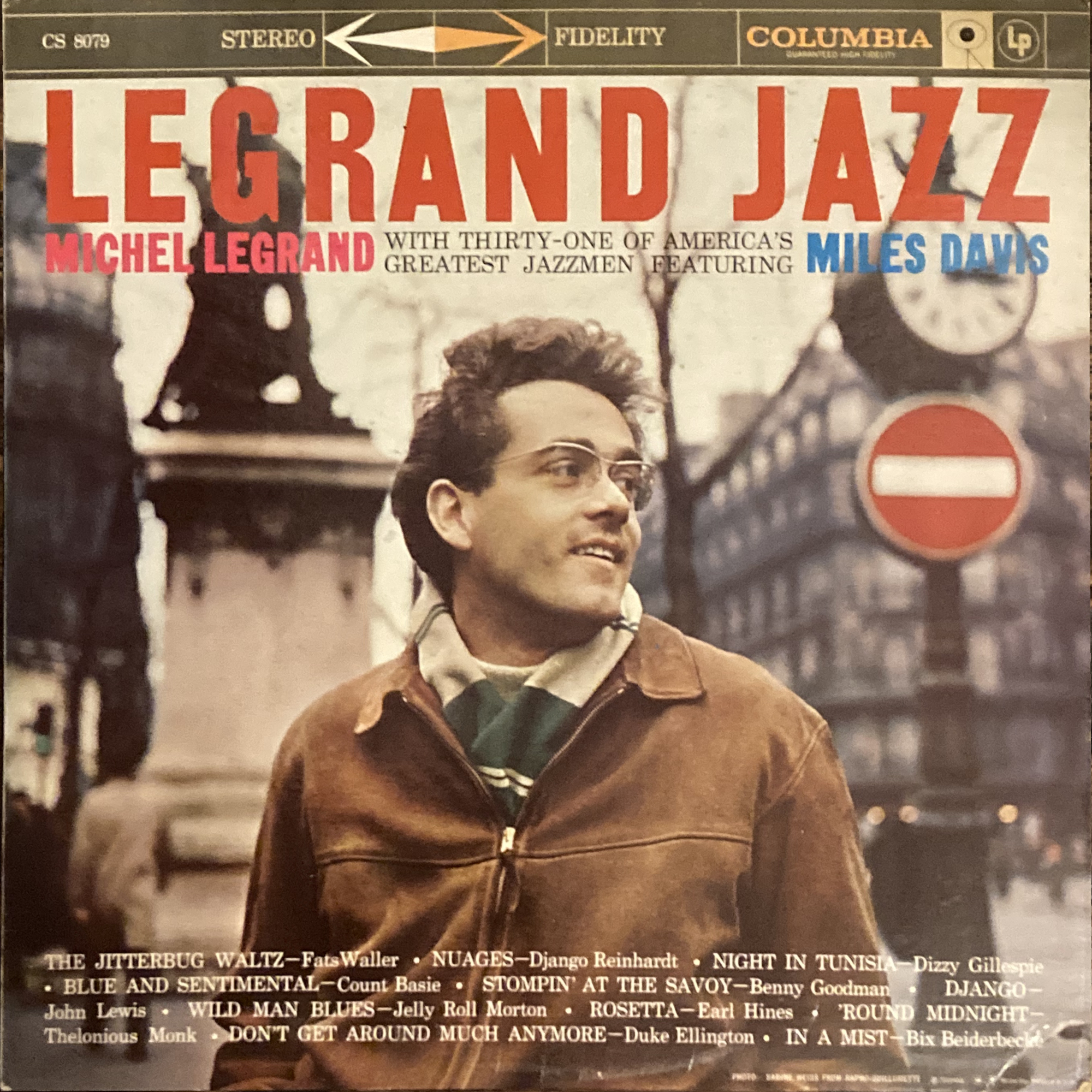
No.: CS 8079
Title: LEGRAND JAZZ
Musician: MICHEL LEGRAND
Recorded: 1958/6/25
Stereo
Cover address: None
Coating 無し
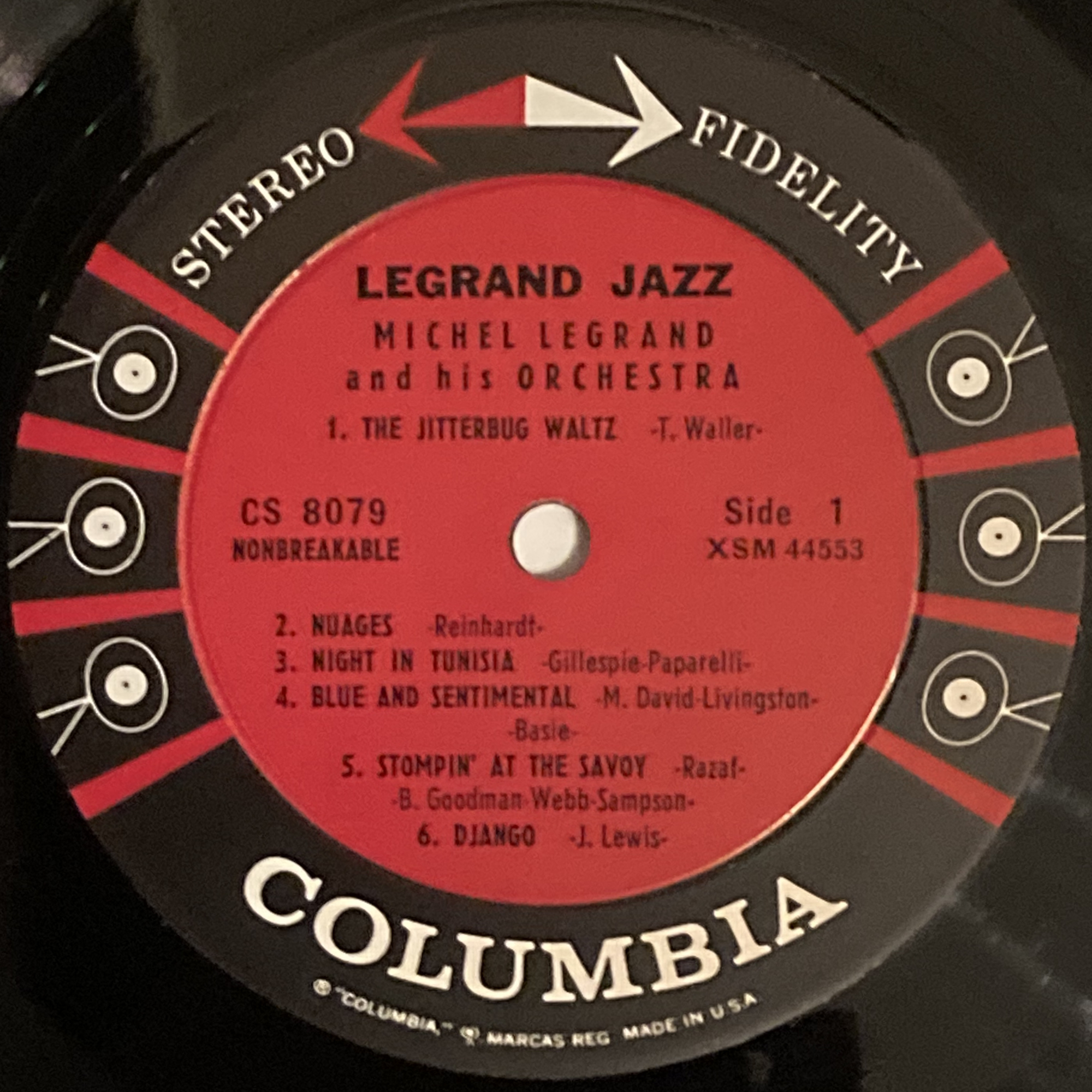
Groove Guard
Label Side-1
Red Background
Black Letter
6 Eyes stereo w/o CBS
Address: None
Deep Groove
Dead Wax Info: XSM44553-1C, H1
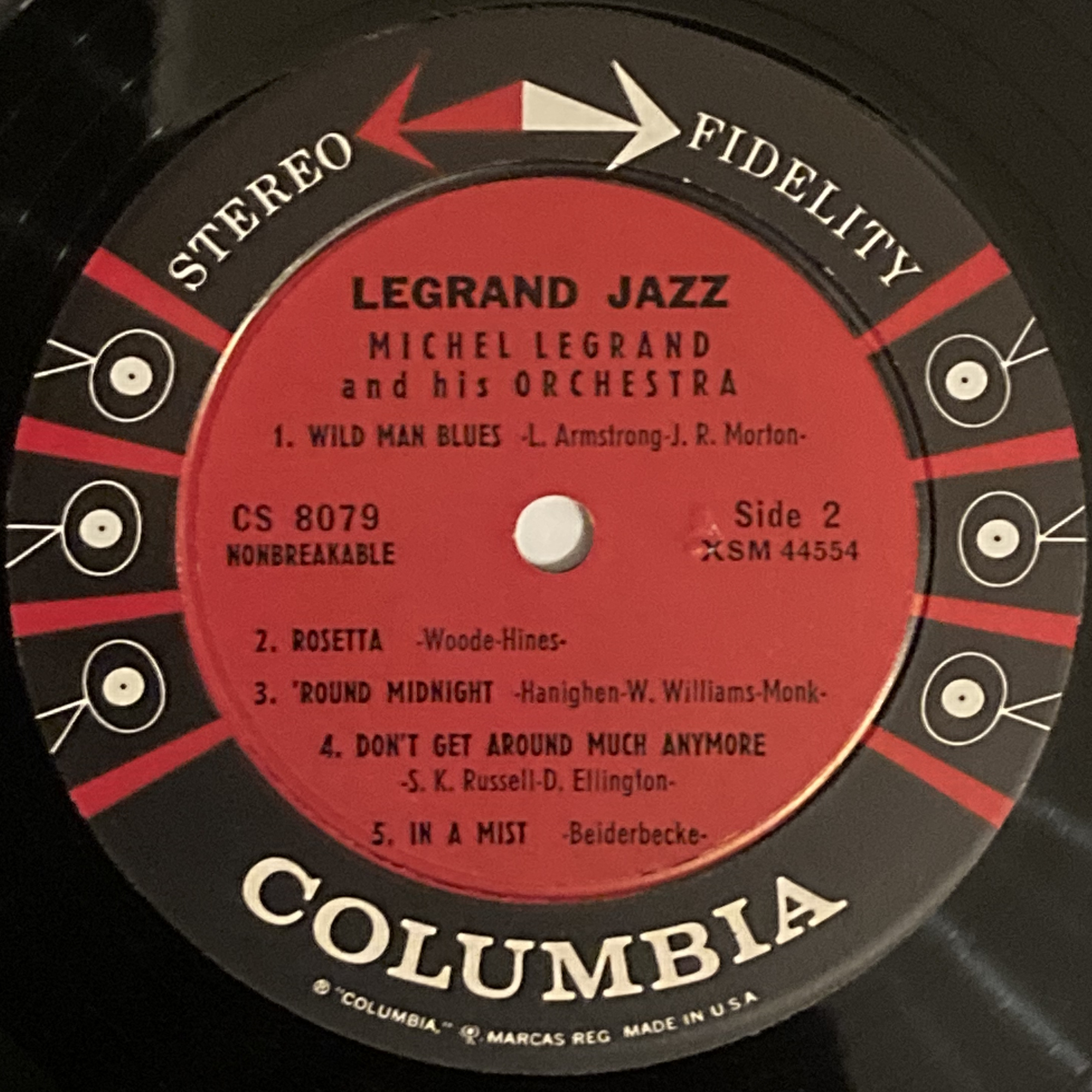
Label Side-2
Red Background
Black Letter
6 Eyes stereo w/o CBS
Address: None
Deep Groove
Dead Wax Info: XSM44554-1D, H1
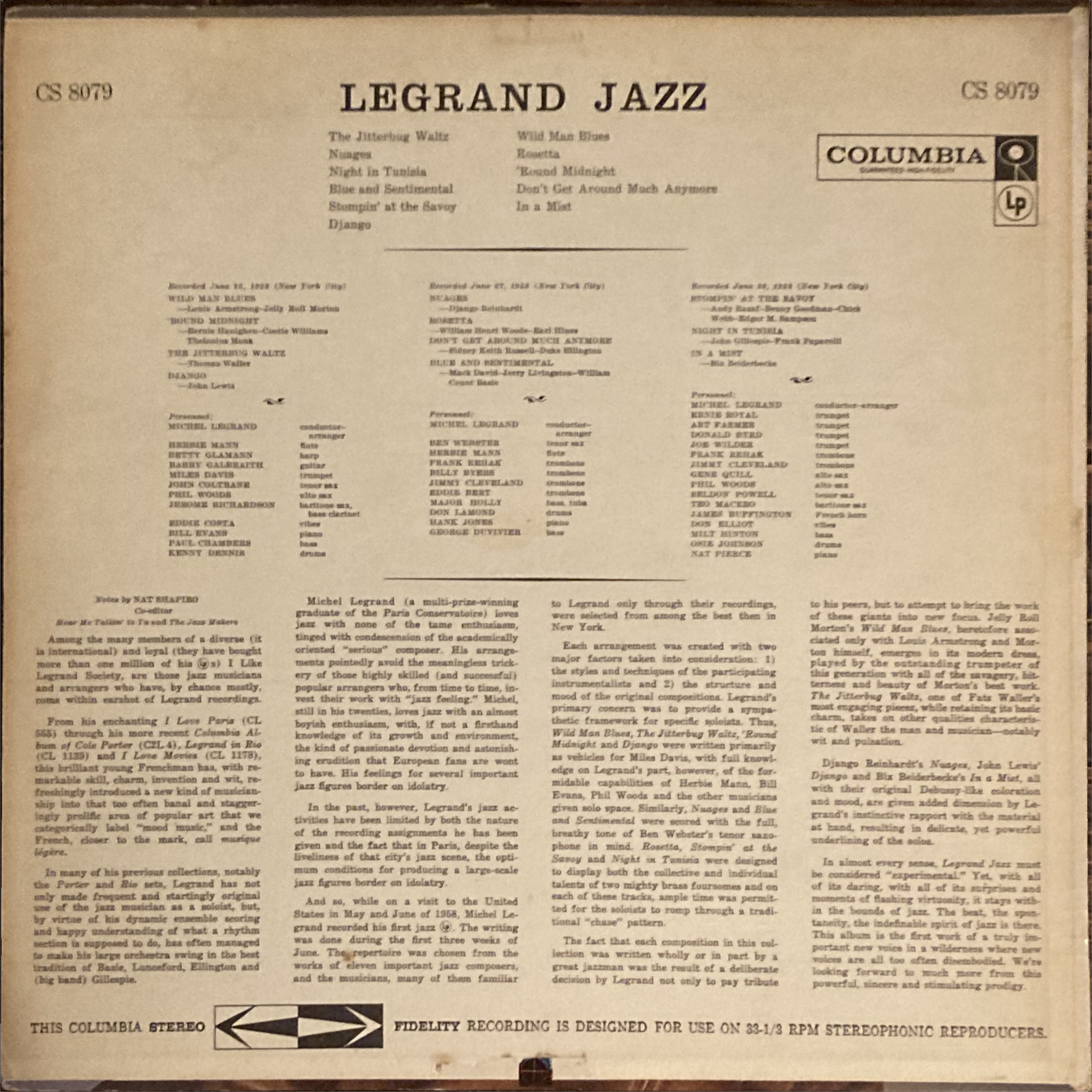
Personnel- Recorded on 1958/6/25 Side1-(1),(6), Side2-(1),(3)
Conductor-Arranger: Michel Legrand
Flute: Herbie Mann
Harp: Betty Glamann
Guitar: Barry Galbraith
Trumpet: Miles Davis
Tenor Sax: John Coltrane
Alto Sax: Phil Woods
Baritone Sax & Bass Clarinet: Jerome Richardson
Vibes: Eddie Costa
Piano: Bill Evans
Bass: Paul Chambers
Drums: Kenny Dennis
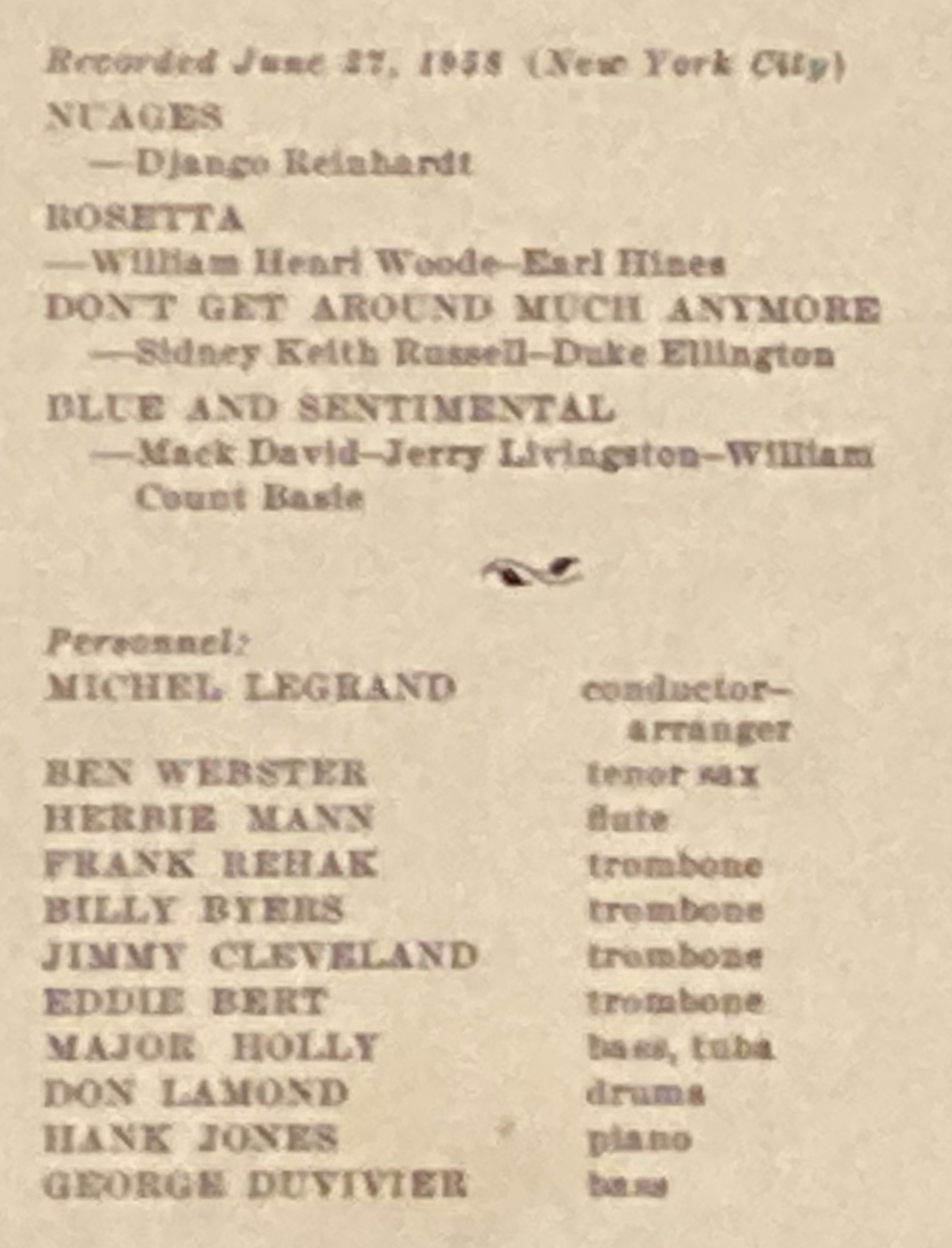
Personnel- Recorded on 1958/6/27 Side1-(2),(4), Side2-(2),(4)
Conductor-Arranger: Michel Legrand
Tenor Sax: Ben Webster
Flute: Herbie Mann
Trombone: Frank Rehak, Billy Byers, Jimmy Cleveland, Eddie Bert
Bass & Tuba: Major Holly
Drums: Don Lamond
Piano: Hank Jones
Bass: George Duvivier
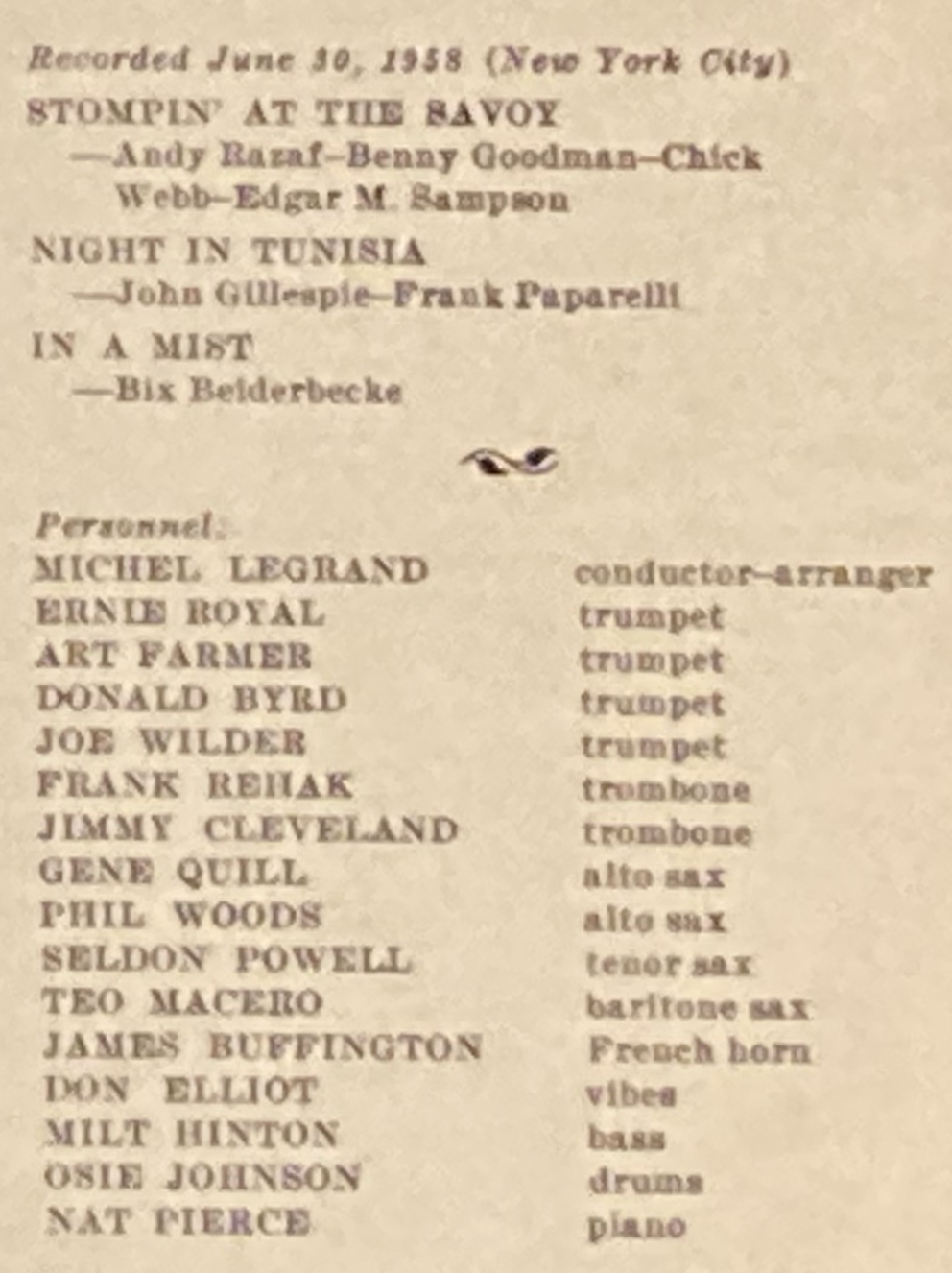
Personnel- Recorded on 1958/6/30 Side1-(3),(5), Side2-(5)
Conductor-Arranger: Michel Legrand
Trumpet: Ernie Royal, Art Farmer, Donald Byrd, Joe Wilder
Trombone: Frank Rehak, Jimmy Cleveland
Alto Sax: Gene Quill, Phil Woods
Tenor Sax: Seldon Powell
Baritone Sax: Teo Macero
French horn: James Buffington
Vibes: Don Elliot
Bass: Milt Hinton
Drums: Osie Johnson
Piano: Nat Pierce
Tracks-
Side-1
1) The Jitterbug Waltz
2) Nuages
3) Night in Tunisia
4) Blue and Sentimental
5) Stompin’ at the Savoy
6) Django
Side-2
1) Wild Man Blues
2) Rosetta
3) ‘Round Midnight
4) Don’t Get Around Much Anymore
5) In a Mist
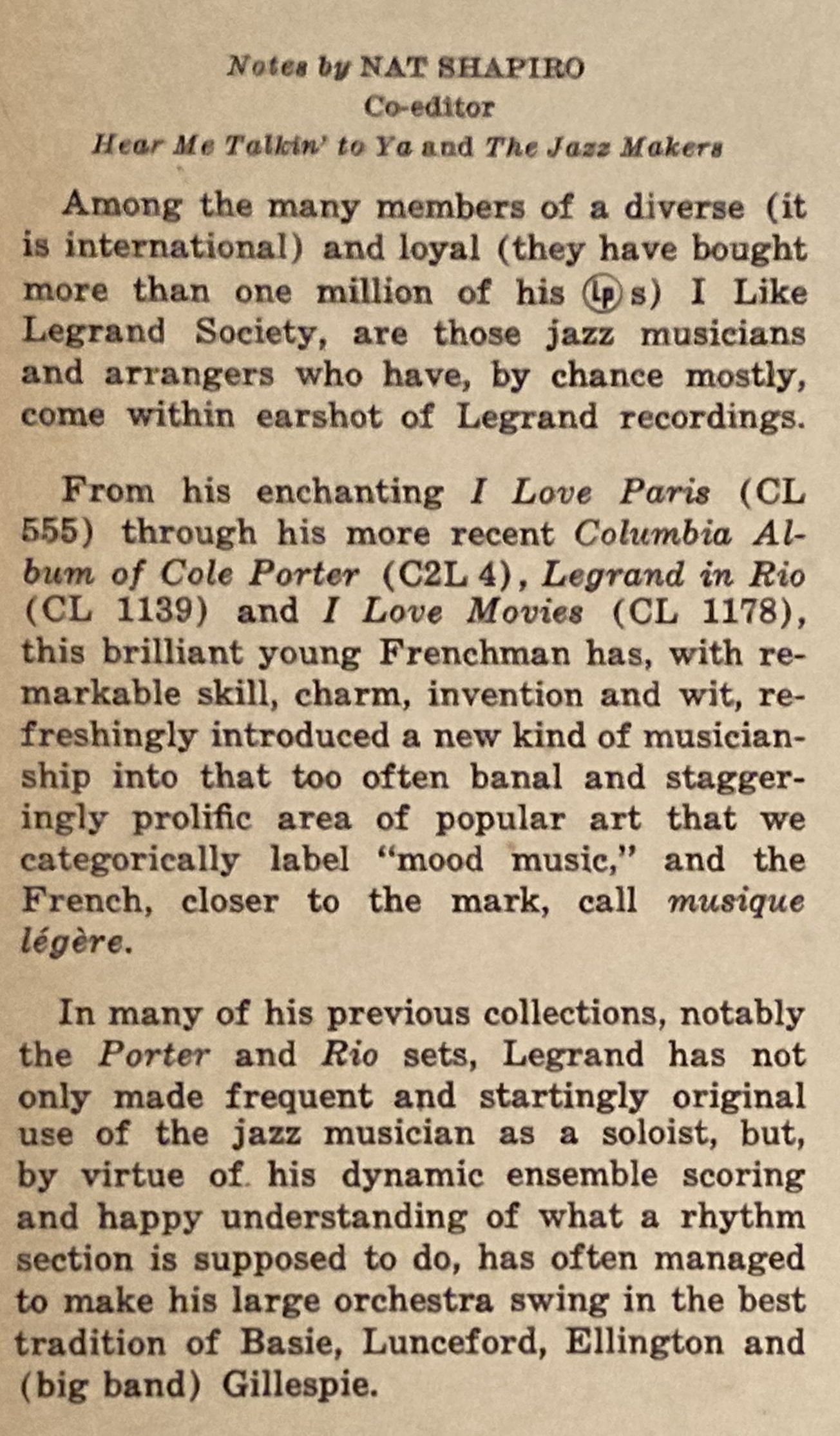
<裏ジャケ原文>
Notes by NAT SHAPIRO
Co-editor
Hear Me Talkin’ to Ya and The Jazz Makers
Among the many members of a diverse (it is international) and loyal (they have bought more than one million of his ps) I Like Legrand Society, are those jazz musicians and arrangers who have, by chance mostly, come within earshot of Legrand recordings.
From his enchanting I Love Paris (CL 555) through his more recent Columbia Al- bum of Cole Porter (C2L 4), Legrand in Rio (CL 1139) and I Love Movies (CL 1178), this brilliant young Frenchman has, with re- markable skill, charm, invention and wit, re- freshingly introduced a new kind of musician- ship into that too often banal and stagger- ingly prolific area of popular art that we categorically label “mood music,” and the French, closer to the mark, call musique légère.
In many of his previous collections, notably the Porter and Rio sets, Legrand has not only made frequent and startingly original use of the jazz musician as a soloist, but, by virtue of. his dynamic ensemble scoring and happy understanding of what a rhythm section is supposed to do, has often managed to make his large orchestra swing in the best tradition of Basie, Lunceford, Ellington and (big band) Gillespie.
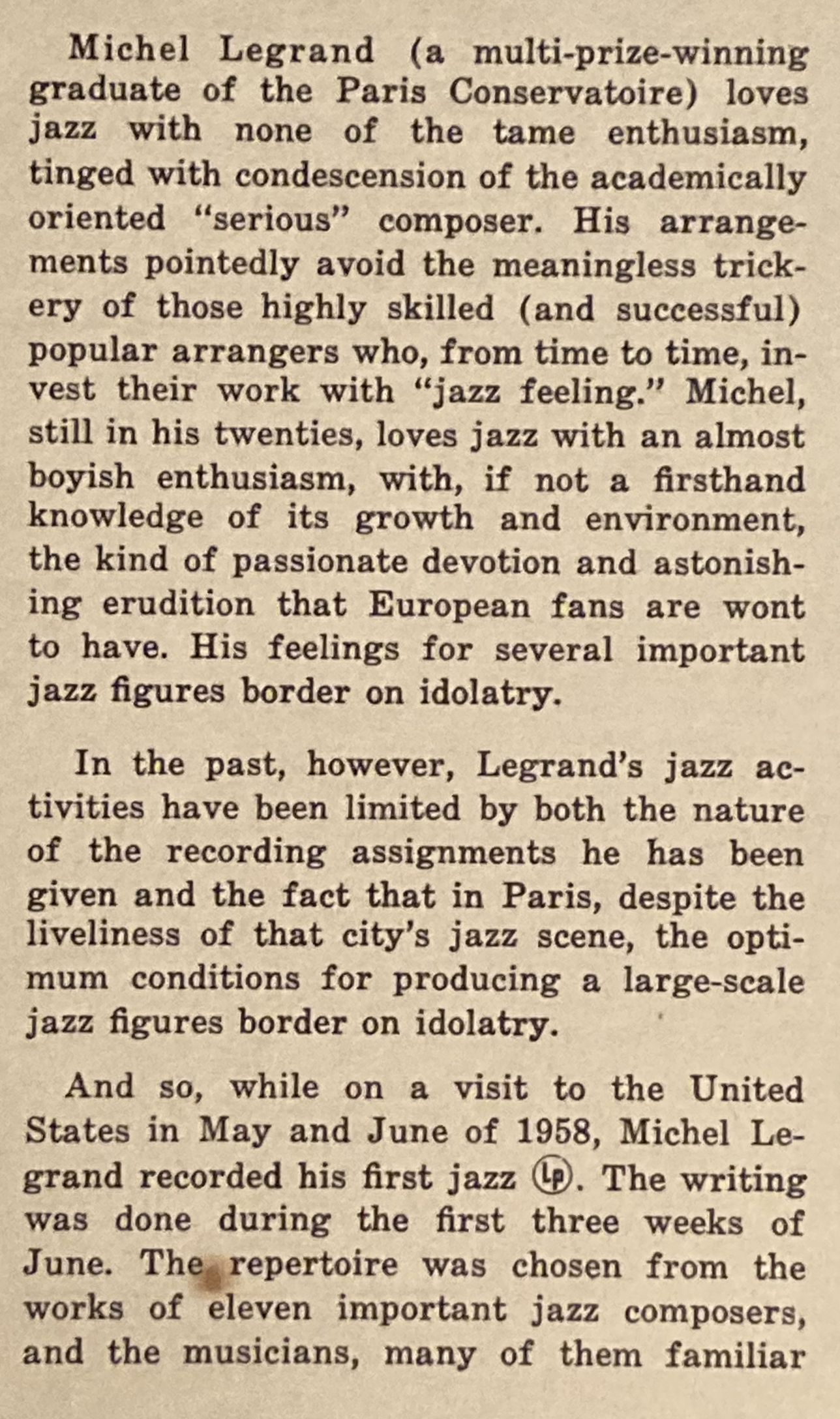
Michel Legrand (a multi-prize-winning graduate of the Paris Conservatoire) loves jazz with none of the tame enthusiasm, tinged with condescension of the academically oriented “serious” composer. His arrange- ments pointedly avoid the meaningless trick- ery of those highly skilled (and successful) popular arrangers who, from time to time, in- vest their work with “jazz feeling.” Michel, still in his twenties, loves jazz with an almost boyish enthusiasm, with, if not a firsthand knowledge of its growth and environment, the kind of passionate devotion and astonish- ing erudition that European fans are wont to have. His feelings for several important jazz figures border on idolatry.
In the past, however, Legrand’s jazz ac- tivities have been limited by both the nature of the recording assignments he has been given and the fact that in Paris, despite the liveliness of that city’s jazz scene, the opti- mum conditions for producing a large-scale jazz figures border on idolatry.
And so, while on a visit to the United States in May and June of 1958, Michel Le- grand recorded his first jazz . The writing was done during the first three weeks of June. The repertoire was chosen from the works of eleven important jazz composers, and the musicians, many of them familiar to Legrand only through their recordings, were selected from among the best then in New York.
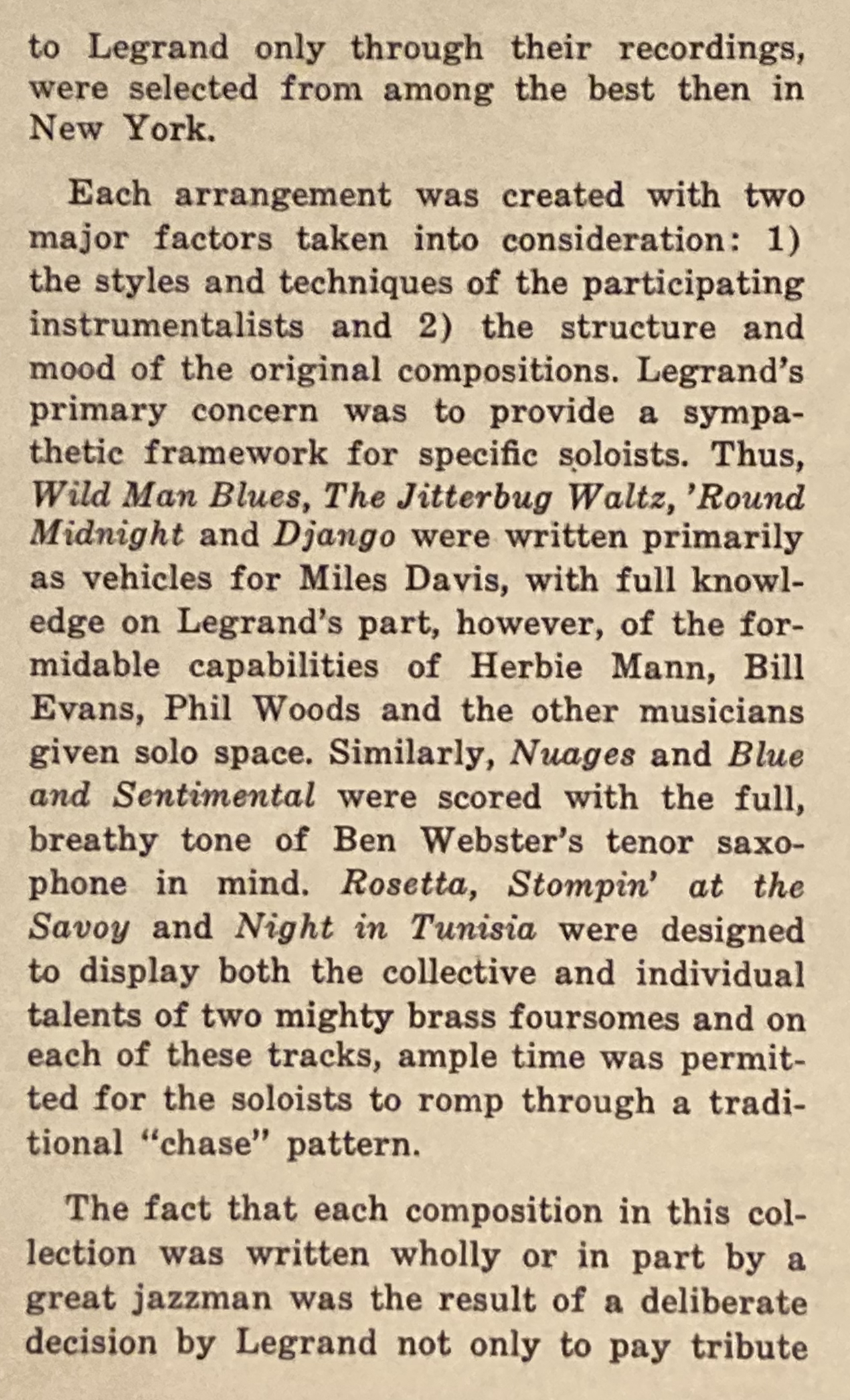
Each arrangement was created with two major factors taken into consideration: 1) the styles and techniques of the participating instrumentalists and 2) the structure and mood of the original compositions. Legrand’s primary concern was to provide a sympa- thetic framework for specific soloists. Thus, Wild Man Blues, The Jitterbug Waltz, ‘Round Midnight and Django were written primarily as vehicles for Miles Davis, with full knowl- edge on Legrand’s part, however, of the for- midable capabilities of Herbie Mann, Bill Evans, Phil Woods and the other musicians given solo space. Similarly, Nuages and Blue and Sentimental were scored with the full, breathy tone of Ben Webster’s tenor saxo- phone in mind. Rosetta, Stompin’ at the Savoy and Night in Tunisia were designed to display both the collective and individual talents of two mighty brass foursomes and on each of these tracks, ample time was permit- ted for the soloists to romp through a tradi- tional “chase” pattern.
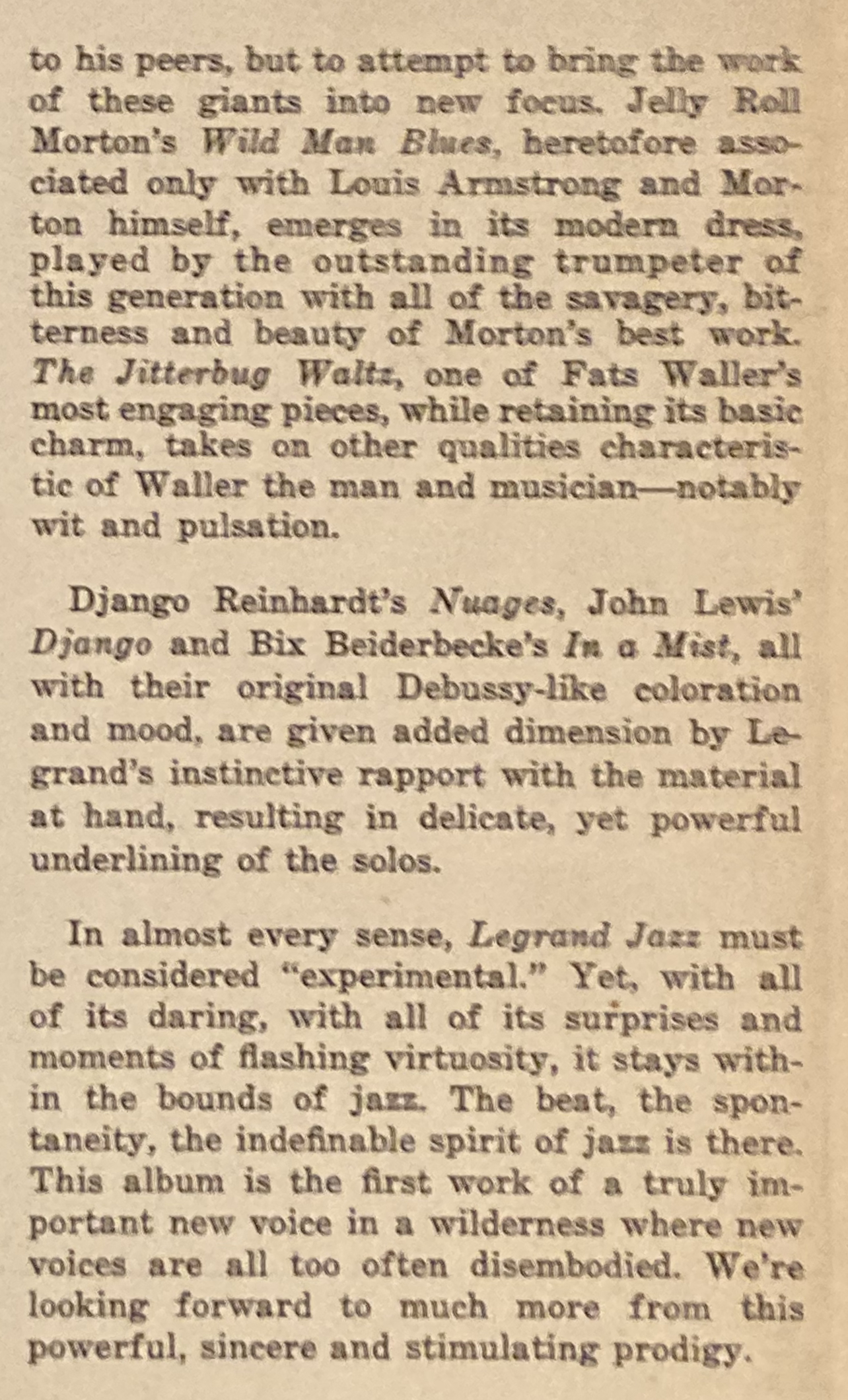
The fact that each composition in this col- lection was written wholly or in part by a great jazzman was the result of a deliberate decision by Legrand not only to pay tribute to his peers, but to attempt to bring the work of these giants into new focus. Jelly Roll Morton’s Wild Man Blues, heretofore asso- ciated only with Louis Armstrong and Mor- ton himself, emerges in its modern dress, played by the outstanding trumpeter of this generation with all of the savagery, bit- terness and beauty of Morton’s best work. The Jitterbug Waltz, one of Fats Waller’s most engaging pieces, while retaining its basic charm, takes on other qualities characteris- tic of Waller the man and musician-notably wit and pulsation.
Django Reinhardt’s Nuages, John Lewis’ Django and Bix Beiderbecke’s In a Mist, all with their original Debussy-like coloration and mood, are given added dimension by Le grand’s instinctive rapport with the material at hand, resulting in delicate, yet powerful underlining of the solos.
In almost every sense, Legrand Jazz must be considered “experimental.” Yet, with all of its daring, with all of its surprises and moments of flashing virtuosity, it stays with- in the bounds of jazz. The beat, the spon- taneity, the indefinable spirit of jazz is there. This album is the first work of a truly im- portant new voice in a wilderness where new voices are all too often disembodied. We’re looking forward to much more from this powerful, sincere and stimulating prodigy.
Recorded June 25, 1958 (New York City)
WILD MAN BLUES
Louis Armstrong-Jelly Roll Morton
ROUND MIDNIGHT
Bernie Hanighen-Cootie Williams Thelonlus Monk
THE JITTERBUG WALTZ
Thomas Waller
DJANGO
John Lewis
Personnel:
MICHEL LEGRAND conductor-arranger
HERBIE MANN flute
BETTY GLAMANN harp
BARRY GALBRAITH guitar
MILES DAVIS trumpet
PHIL WOODS alto sax
JOHN COLTRANE tenor sax
JEROME RICHARDSON baritone sax,bass clarinet
EDDIE COSTA vibes
BILL EVANS plano
PAUL CHAMBERS bass
KENNY DENNIS drums
Recorded June 27, 1958 (New York City)
NUAGES
Django Reinhardt
ROSETTA
William Heari Woode-Earl Hines
DON’T GET AROUND MUCH ANYMORE -Sidney Keith Russell-Duke Ellington BLUE AND SENTIMENTAL
Mack David-Jerry Livingston-William Count Basie
Personnel:
MICHEL LEGRAND conductor-arranger
BEN WEBSTER tenor sax
HERBIE MANN Flute
FRANK REHAK trombone
BILLY BYERS trombone
JIMMY CLEVELAND trombone
EDDIE BERT trombone
MAJOR HOLLY bass, tuba
DON LAMOND drums
HANK JONES plano
GEORGE DUVIVIER bass,
Recorded June 30, 1958 (New York City)
STOMPIN’ AT THE SAVOY
Andy Razaf-Benny Goodman-Chick Webb-Edgar M. Sampson
NIGHT IN TUNISIA
John Gillespie-Frank Paparelli
IN A MIST
Bix Beiderbecke
Personnel.
MICHEL LEGRAND conductor arranger
ERNIE ROYAL trumpet
ART FARMER trumpet
DONALD BYRD trumpet
JOE WILDER trumpet
FRANK REHAK trombone
JIMMY CLEVELAND trombone
GENE QUILL alto sax
PHIL WOODS alto sax
SELDON POWELL tenor sax
TEO MACERO baritone sax
JAMES BUFFINGTON French horn
DON ELLIOT vibes
MILT HINTON bass
OSIE JOHNSON drums
NAT PIERCE piano
<裏ジャケ和訳>
解説:ナット・シャピロ
(『Hear Me Talkin’ to Ya』および『The Jazz Makers』共同編集者)
「I Like Legrand Society(ルグランを愛する会)」は、国際色豊かで、100万枚以上のレコードを購入してきた熱心なファンを擁するコミュニティです。その中には、偶然ルグランの録音を耳にしたことをきっかけにファンとなったジャズ・ミュージシャンやアレンジャーたちも含まれています。
魅惑的な『I Love Paris』(CL 555)から、近年の『Cole Porter』(C2L 4)、『Legrand in Rio』(CL 1139)、『I Love Movies』(CL 1178)に至るまで、この才能あふれる若きフランス人は、卓越した技術、魅力、独創性、そしてウィットを駆使して、ある種の音楽に新たな息吹を吹き込みました。それは、往々にして陳腐になりがちでありながら、驚くほど大量に生産されてきたポピュラー音楽のジャンル――英語圏では「ムード・ミュージック」と総称されるものですが、フランス語ではより的確に「ミュジック・レジェール(軽音楽)」と呼ばれるものです。
これまでの作品群、とりわけコール・ポーター集やリオをテーマにしたアルバムにおいて、ルグランはジャズ・ミュージシャンをソリストとして頻繁に、かつ驚くほど独創的に起用してきました。それだけでなく、ダイナミックなアンサンブル・スコアリングと、リズム・セクションの役割に対する的確な理解によって、自身のビッグ・オーケストラを、ベイシー、ランスフォード、エリントン、そして(ビッグバンド時代の)ガレスピーといった巨匠たちの伝統に連なるような、見事なスウィング感で鳴らしてみせたのです。
パリ音楽院を優秀な成績で卒業したミシェル・ルグランは、ジャズを心から愛しています。それは、アカデミックな「シリアス」な作曲家が抱きがちな、どこか上から目線で、生ぬるい熱意とは全く異なるものです。彼のアレンジには、ポピュラー音楽界で成功を収めた高度な技術を持つアレンジャーたちが、時折作品に付け加えるような、無意味な「ジャズっぽい」小細工は一切見られません。まだ20代のミシェルは、まるで少年のように純粋な情熱でジャズを愛しています。ジャズの発展の歴史やその背景にある環境を、当事者として直接体験したわけではないかもしれませんが、ヨーロッパのファン特有の、情熱的な献身と驚くべき博識さを彼は備えています。彼が抱く、ジャズ界の重要な人物たちへの敬愛の念は、もはや崇拝に近いものがあると言えるでしょう。しかし、これまでのルグランのジャズ活動は、彼に与えられたレコーディングの仕事の性質によって制約を受けていた。また、パリのジャズ・シーンは活気に満ちているとはいえ、そこには、ジャズの巨匠たちをほとんど偶像崇拝に近い形で祭り上げてしまうような環境があり、それもまた、彼が本格的なジャズ作品を手がける上での障壁となっていた。
こうした背景から、ミシェル・ルグランは1958年の5月から6月にかけてアメリカを訪れた際、自身初となるジャズ・アルバムをレコーディングした。楽曲の執筆は6月の最初の3週間で行われた。レパートリーには重要なジャズ作曲家11名の作品が選ばれ、参加ミュージシャンは、当時ニューヨークで最高の実力を誇る面々から選ばれた。その多くは、ルグランにとってレコードを通じてしか知らない存在であった。
各楽曲のアレンジにあたっては、主に2つの要素が考慮された。1つは参加した演奏家たちのスタイルやテクニックであり、もう1つは原曲の構成やムードである。ルグランが何よりも重視したのは、特定のソリストたちが存分に力を発揮できるような、共感に満ちた枠組みを用意することだった。例えば、「ワイルド・マン・ブルース」、「ザ・ジターバグ・ワルツ」、「ラウンド・ミッドナイト」、「ジャンゴ」は、主にマイルス・デイヴィスをフィーチャーすることを念頭に書かれた。もちろんルグランは、ハービー・マン、ビル・エヴァンス、フィル・ウッズといった、ソロのパートを与えられた他のミュージシャンたちの驚異的な実力も十分に把握していた。同様に、「ニュアージュ」や「ブルー・アンド・センチメンタル」は、ベン・ウェブスターがテナー・サックスで聴かせる、豊かで息遣いを感じさせる音色を想定してスコアが書かれた。「ロゼッタ」、「ストンピン・アット・ザ・サヴォイ」、「ナイト・イン・チュニジア」は、2組の強力なブラス・カルテットが持つ集団的、そして個々の才能を披露できるように構成されており、各トラックでは、ソリストたちが伝統的な「チェイス(掛け合い)」の形式で思い切り演奏できるよう、十分な時間が割かれた。
本作に収録された楽曲がすべて、あるいは一部、偉大なジャズ・ミュージシャンたちによって書かれたものであるという点は、ルグランの意図的な選択によるものだ。それは単に同業者たちに敬意を表すためだけでなく、こうした巨匠たちの作品に新たな光を当てようという試みでもあった。ジェリー・ロール・モートンの「ワイルド・マン・ブルース」は、これまでルイ・アームストロングやモートン自身の演奏としか結びつけられてこなかったが、現代的な装いをまとって登場した。今世代屈指のトランペット奏者によるその演奏には、モートンの最高傑作に見られる野性味、苦味、そして美しさが余すところなく表現されている。ファッツ・ウォーラーの最も魅力的な楽曲の一つである「ジッターバグ・ワルツ」は、その根底にある魅力を保ちつつも、ウォーラーという人物、そして音楽家としての特徴――とりわけ機知と躍動感――を新たに帯びている。
ジャンゴ・ラインハルトの「ニュアージュ」、ジョン・ルイスの「ジャンゴ」、そしてビックス・バイダーベックの「イン・ア・ミスト」。これらはいずれも、ドビュッシーを彷彿とさせる原曲の色彩や雰囲気を備えているが、ルグランが楽曲の本質を直感的に捉えて共鳴したことで、さらなる深みが加わった。その結果、ソロ演奏を繊細かつ力強く際立たせる仕上がりとなっている。
『ルグラン・ジャズ』は、ほぼあらゆる意味において「実験的」な作品と見なすべきだろう。しかし、その大胆さや数々の驚き、そして閃光のような超絶技巧の瞬間がありながらも、本作はしっかりとジャズの枠内に留まっている。そこには、ビート、即興性、そして言葉では言い表せないジャズの精神が息づいている。本作は、新たな才能がしばしば実体を伴わずに現れては消えていくこの荒野において、真に重要な「新しい声」による最初の作品である。力強く、誠実で、刺激に満ちたこの天才の、今後のさらなる活躍を大いに期待したい。
※訳文の制作にはGoogleドライブとGoogle翻訳のお世話になりました。
コメント