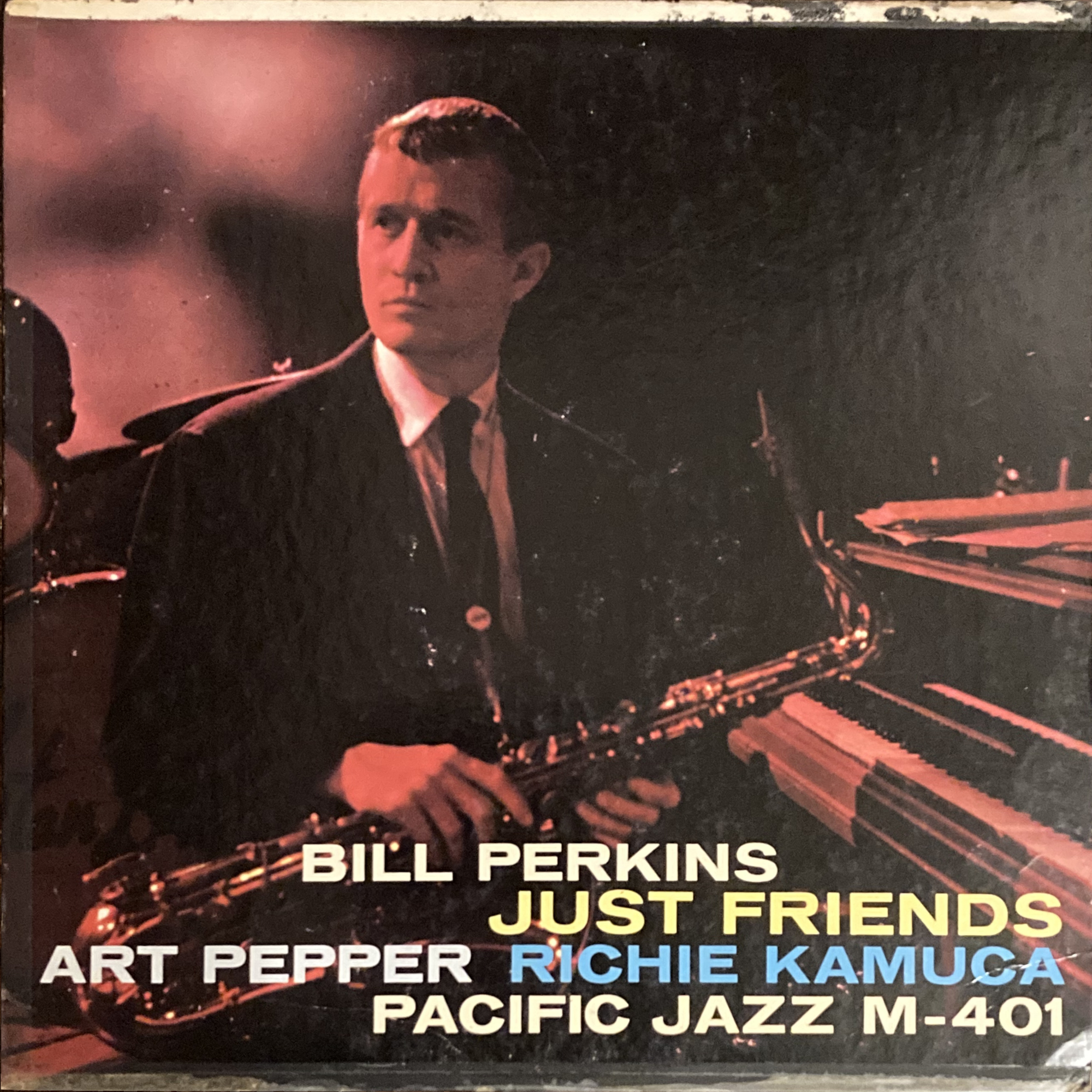
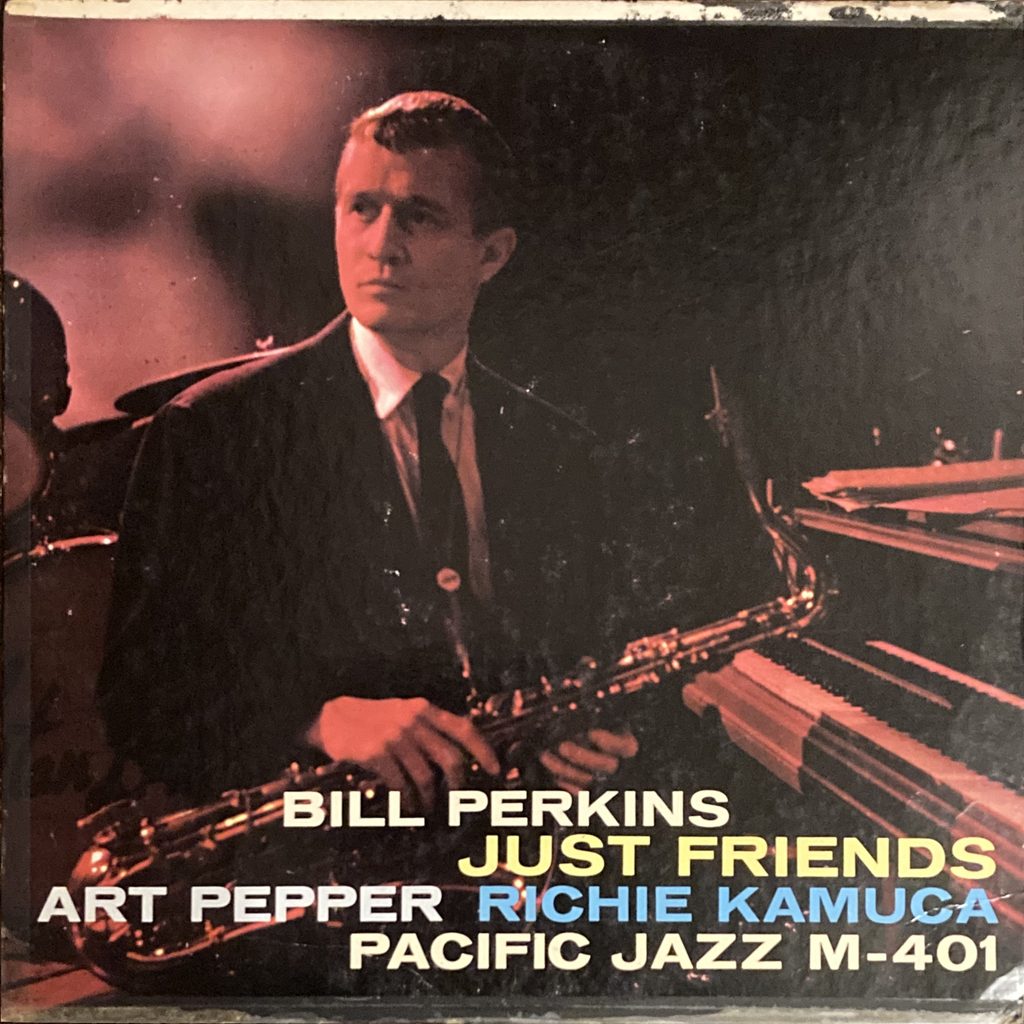
Label: PACIFIC JAZZ
No.: M-401
Title: JUST FRIENDS: BILL PERKINS, ART PEPPER & RICHIE KAMUCA
Musician: BILL PERKINS
Recorded: 1956/12/11
Monaural
Cover address: Hollywood, California
Coating 無し
Groove Guard
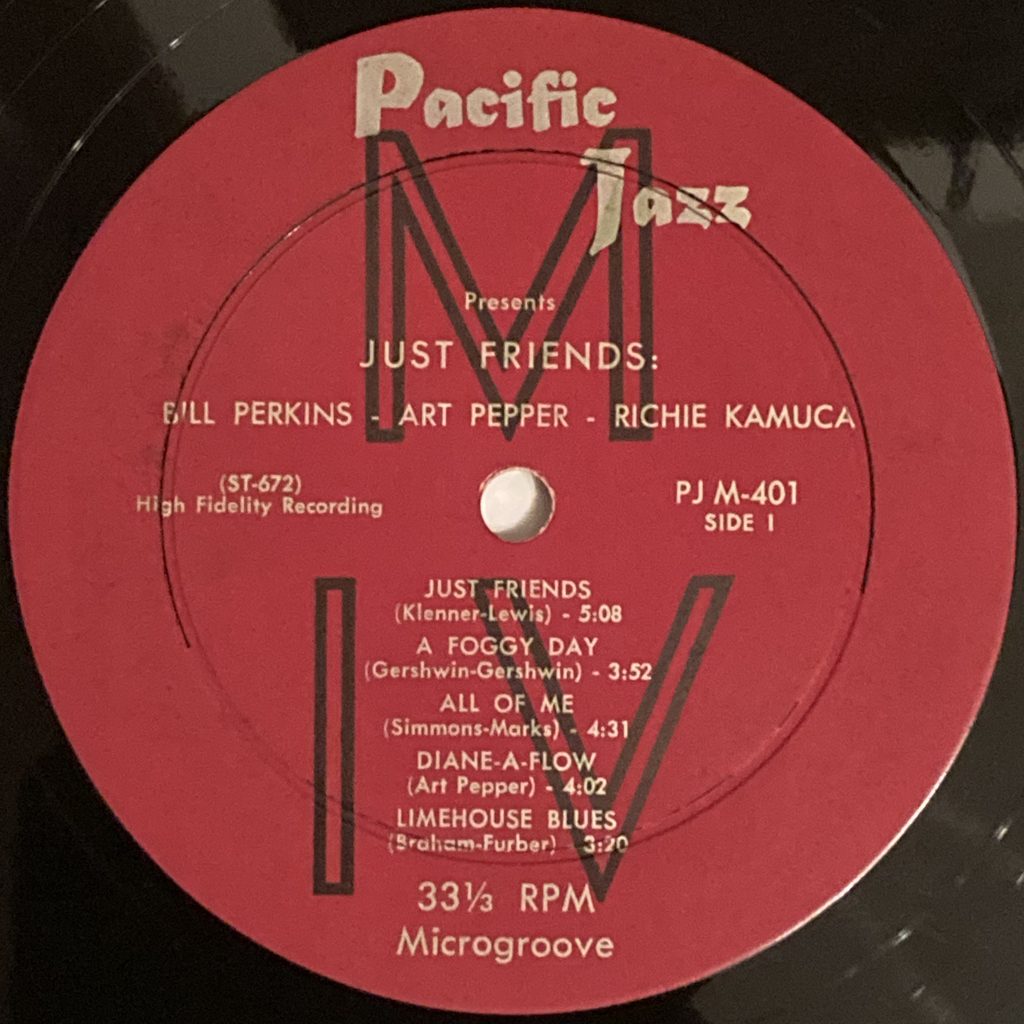
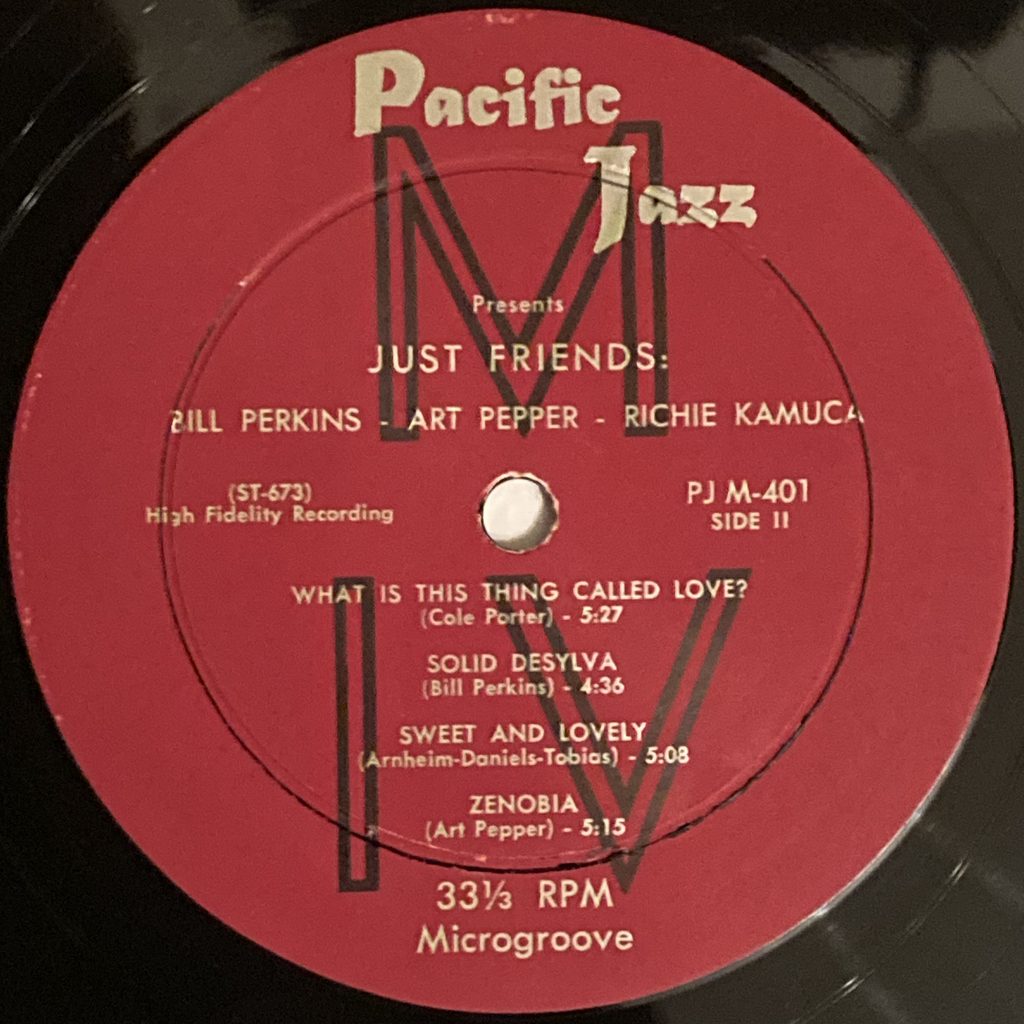
Label Side-1
Red Background
Silver Letter with M-IV
Address:
Deep Groove
Dead Wax Info: PJ 672 D1, H
Label Side-2
Red Background
Silver Letter with M-IV
Address:
Deep Groove
Dead Wax Info: PJ 673 D2, H
Personnel- Side1-(1),(3), Side2-(2),(3)
Drums: Mel Lewis
Bass: Red Mitchell
Piano: Hampton Hawes
Tenor Sax: Richie Kamuca
Tenor Sax, Flute, Bass Clarinet: Bill Perkins
Personnel- Side1-(2),(4), Side2-(1),(4)
Drums: Mel Lewis
Bass: Ben Tucker
Piano: Jimmy Rowles
Tenor Sax: Bill Perkins
Alto Sax: Art Pepper
Tracks-
Side-1
1) Just Friends 5’08”
2) A Foggy Day 3’52”
3) All of Me 4’31”
4) Diane -A-Flow 4’02”
5) Limehouse Blues 3’20”
Side-2
1) What is This Thing Called Love 5’27”
2) Solid De Sylva 4’36”
3) Sweet and Lovelr 5’08”
4) Zenobia 5’15”
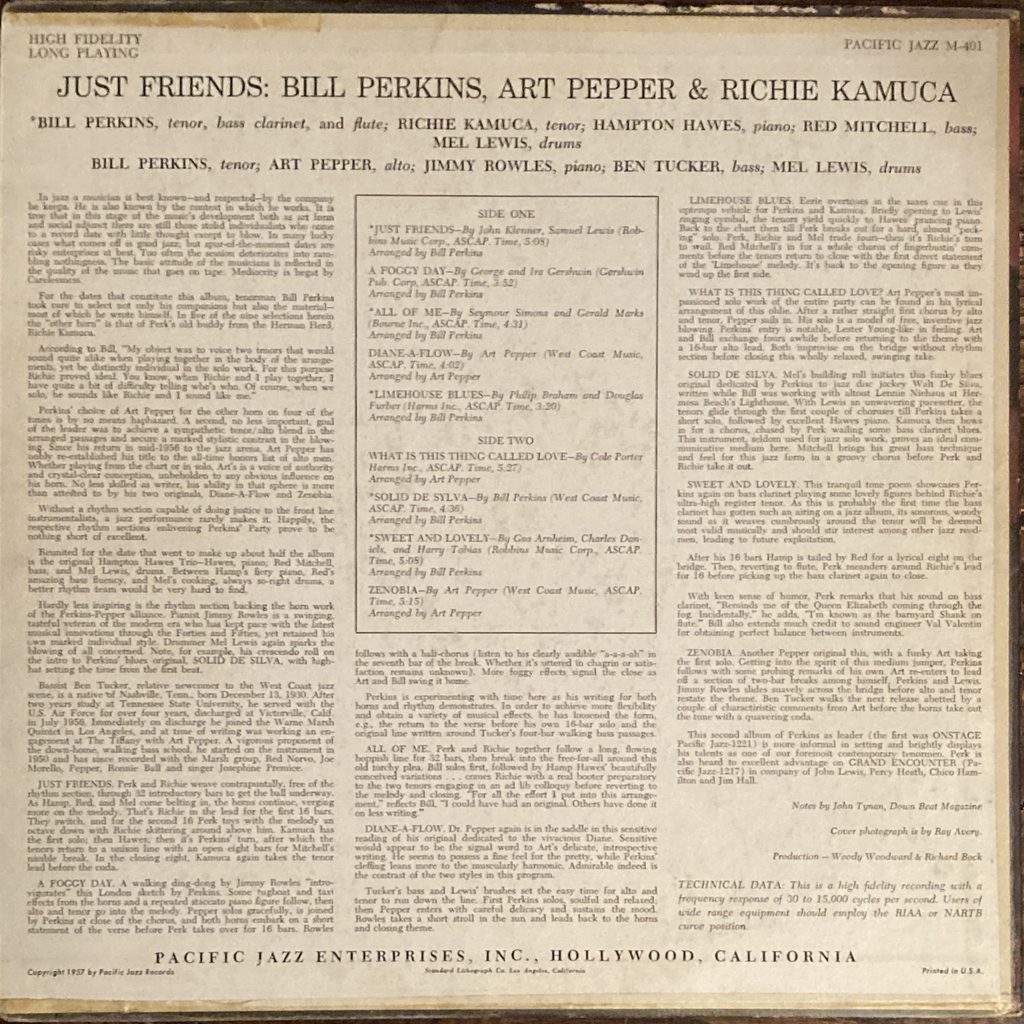
<裏ジャケ原文>
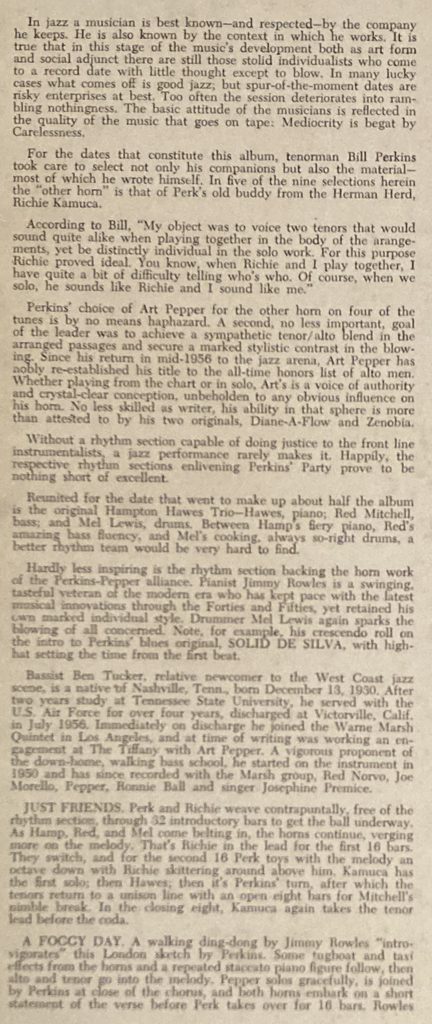
In jazz a musician is best known-and respected-by the company he keeps. He is also known by the context in which he works. It is true that in this stage of the music’s development both as art form and social adjunct there are still those stolid individualists who come to a record date with little thought except to blow. In many lucky cases what comes off is good jazz, but spur-of-the-moment dates are risky enterprises at best. Too often the session deteriorates into ram- bling nothingness. The basic attitude of the musicians is reflected in the quality of the music that goes on tape: Mediocrity is begat by Carelessness.
For the dates that constitute this album, tenorman Bill Perkins took care to select not only his companions but also the material- most of which he wrote himself. In five of the nine selections herein the “other horn” is that of Perk’s old buddy from the Herman Herd, Richie Kamuca.
According to Bill, “My object was to voice two tenors that would sound quite alike when playing together in the body of the arange- ments, yet be distinctly individual in the solo work. For this purpose Richie proved ideal. You know, when Richie and I play together, I have quite a bit of difficulty telling who’s who. Of course, when we solo, he sounds like Richie and I sound like me.”
Perkins’ choice of Art Pepper for the other horn on four of the tunes is by no means haphazard. A second, no less important, goal of the leader was to achieve a sympathetic tenor/alto blend in the arranged passages and secure a marked stylistic contrast in the blow- ing. Since his return in mid-1956 to the jazz arena, Art Pepper has nobly re-established his title to the all-time honors list of alto men. Whether playing from the chart or in solo, Art’s is a voice of authority and crystal-clear conception, unbeholden to any obvious influence on his horn. No less skilled as writer, his ability in that sphere is more than attested to by his two originals, Diane-A-Flow and Zenobia.
Without a rhythm section capable of doing justice to the front line instrumentalists, a jazz performance rarely makes it. Happily, the respective rhythm sections enlivening Perkins’ Party prove to be nothing short of excellent.
Reunited for the date that went to make up about half the album is the original Hampton Hawes Trio-Hawes, piano; Red Mitchell, bass; and Mel Lewis, drums. Between Hamp’s fiery piano, Red’s amazing bass fluency, and Mel’s cooking, always so-right drums, a better rhythm team would be very hard to find.
Hardly less inspiring is the rhythm section backing the horn work of the Perkins-Pepper alliance. Pianist Jimmy Rowles is a swinging. tasteful veteran of the modern era who has kept pace with the latest musical innovations through the Forties and Fifties, yet retained his own marked individual style. Drummer Mel Lewis again sparks the blowing of all concerned. Note, for example, his crescendo roll on the intro to Perkins’ blues original, SOLID DE SILVA, with high- hat setting the time from the first beat.
Bassist Ben Tucker, relative newcomer to the West Coast jazz scene, is a native of Nashville, Tenn., born December 13, 1930. After two years study at Tennessee State University, he served with the US Air Force for over four years, discharged at Victorville, Calif. in July 1956. Immediately on discharge he joined the Warne Marsh Quintet in Los Angeles, and at time of writing was working an en- gagement at The Tiffany with Art Pepper. A vigorous proponent of the down-home, walking bass school, he started on the instrument in 1950 and has since recorded with the Marsh group, Red Norvo, Joe Morello, Pepper, Ronnie Ball and singer Josephine Premice.
JUST FRIENDS. Perk and Richie weave contrapuntally, free of the rhythm section, through 32 introductory bars to get the ball underway. As Hamp, Red, and Mel come belting in, the horns continue, verging more on the melody. That’s Richie in the lead for the first 16 bars. They switch, and for the second 16 Perk toys with the melody an octave down with Richie skittering around above him, Kamuca has the first solo; then Hawes, then it’s Perkins’ turn, after which the tenors return to a unison line with an open eight bars for Mitchell’s nimble break. In the closing eight, Kamuca again takes the tenor lead before the coda.
A FOGGY DAY. A walking ding-dong by Jimmy Rowles “intro- vigorates this London sketch by Perkins. Some tugboat and taxi effects from the horns and a repeated staccato piano figure follow, then alto and tenor go into the melody. Pepper solos gracefully, is joined by Perkins at close of the chorus, and both horns embark on a short statement of the verse before Perk takes over for 16 bars. Rowles follows with a half-chorus (listen to his clearly audible “a-a-a-ah” in the seventh bar of the break. Whether it’s uttered in chagrin or satis- faction remains unknown). More foggy effects signal the close as Art and Bill swing it home.
Perkins is experimenting with time here as his writing for both horns and rhythm demonstrates. In order to achieve more flexibility and obtain a variety of musical effects, he has loosened the form, e.g., the return to the verse before his own 16-bar solo and the original line written around Tucker’s four-bar walking bass passages.
ALL OF ME. Perk and Richie together follow a long, flowing boppish line for 32 bars, then break into the free-for-all around this old torchy plea. Bill solos first, followed by Hamp Hawes’ beautifully conceived variations … comes Richie with a real booter preparatory to the two tenors engaging in an ad lib colloquy before reverting to the melody and closing. “For all the effort I put into this arrange- ment,” reflects Bill, “I could have had an original. Others have done it on less writing.”
DIANE-A-FLOW. Dr. Pepper again is in the saddle in this sensitive reading of his original dedicated to the vivacious Diane. Sensitive would appear to be the signal word to Art’s delicate, introspective writing. He seems to possess a fine feel for the pretty, while Perkins’ cleffing leans more to the muscularly harmonic. Admirable indeed is the contrast of the two styles in this program.
Tucker’s bass and Lewis’ brushes set the easy time for alto and tenor to run down the line. First Perkins solos, soulful and relaxed; then Pepper enters with careful delicacy and sustains the mood. Rowles takes a short stroll in the sun and leads back to the horns and closing theme.
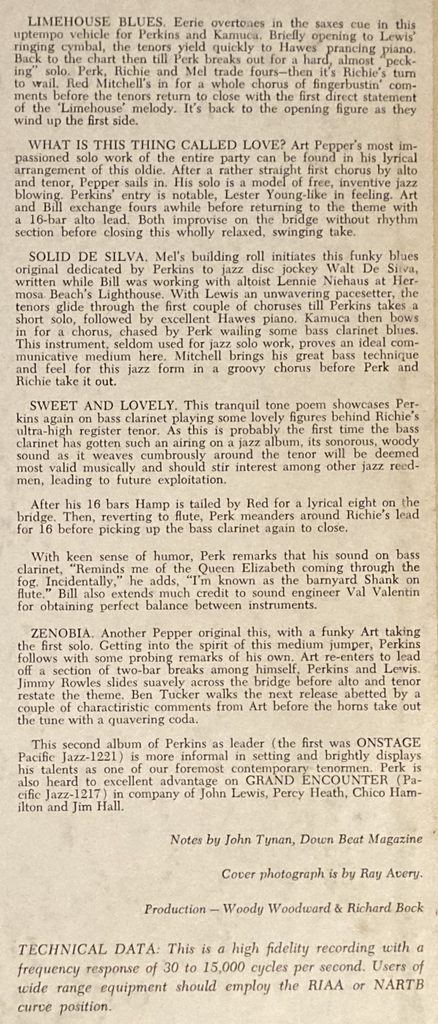
LIMEHOUSE BLUES. Eerie overtones in the saxes cue in this uptempo vehicle for Perkins and Kamuca. Briefly opening to Lewis’ ringing cymbal, the tenors yield quickly to Hawes prancing piano. Back to the chart then till Perk breaks out for a hard, almost “peck- ing” solo. Perk, Richie and Mel trade fours-then it’s Richie’s turn to wail. Red Mitchell’s in for a whole chorus of fingerbustin’ com- ments before the tenors return to close with the first direct statement of the ‘Limehouse’ melody. It’s back to the opening figure as they wind up the first side.
WHAT IS THIS THING CALLED LOVE? Art Pepper’s most im- passioned solo work of the entire party can be found in his lyrical arrangement of this oldie. After a rather straight first chorus by alto and tenor, Pepper sails in. His solo is a model of free, inventive jazz blowing. Perkins’ entry is notable, Lester Young-like in feeling. Art and Bill exchange fours awhile before returning to the theme with a 16-bar alto lead. Both improvise on the bridge without rhythm section before closing this wholly relaxed, swinging take.
SOLID DE SILVA. Mel’s building roll initiates this funky blues original dedicated by Perkins to jazz disc jockey Walt De Silva, written while Bill was working with altoist Lennie Niehaus at Her- mosa Beach’s Lighthouse. With Lewis an unwavering pacesetter, the tenors glide through the first couple of choruses till Perkins takes a short solo, followed by excellent Hawes piano. Kamuca then bows in for a chorus, chased by Perk wailing some bass clarinet blues. This instrument, seldom used for jazz solo work, proves an ideal com- municative medium here. Mitchell brings his great bass technique and feel for this jazz form in a groovy chorus before Perk and Richie take it out.
SWEET AND LOVELY. This tranquil tone poem showcases Per- kins again on bass clarinet playing some lovely figures behind Richie’s ultra-high register tenor. As this is probably the first time the bass clarinet has gotten such an airing on a jazz album, its sonorous, woody sound as it weaves cumbrously around the tenor will be deemed most valid musically and should stir interest among other jazz reed- men, leading to future exploitation.
After his 16 bars Hamp is tailed by Red for a lyrical eight on the bridge. Then, reverting to flute, Perk meanders around Richie’s lead for 16 before picking up the bass clarinet again to close.
With keen sense of humor, Perk remarks that his sound on bass clarinet, “Reminds me of the Queen Elizabeth coming through the fog. Incidentally,” he adds, “I’m known as the barnyard Shank on flute.” Bill also extends much credit to sound engineer Val Valentin for obtaining perfect balance between instruments.
ZENOBIA. Another Pepper original this, with a funky Art taking the first solo. Getting into the spirit of this medium jumper, Perkins follows with some probing remarks of his own. Art re-enters to lead off a section of two-bar breaks among himself, Perkins and Lewis. Jimmy Rowles slides suavely across the bridge before alto and tenor restate the theme. Ben Tucker walks the next release abetted by a couple of charactiristic comments from Art before the horns take out the tune with a quavering coda.
This second album of Perkins as leader (the first was ONSTAGE Pacific Jazz-1221) is more informal in setting and brightly displays his talents as one of our foremost contemporary tenormen. Perk is also heard to excellent advantage on GRAND ENCOUNTER (Pa- cific Jazz-1217) in company of John Lewis, Percy Heath, Chico Ham- ilton and Jim Hall.
Notes by John Tynan, Down Beat Magazine
Cover photograph is by Ray Avery.
Production – Woody Woodward & Richard Bock
TECHNICAL DATA: This is a high fidelity recording with a frequency response of 30 to 15,000 cycles per second. Users of wide range equipment should employ the RIAA or NARTB curve position.
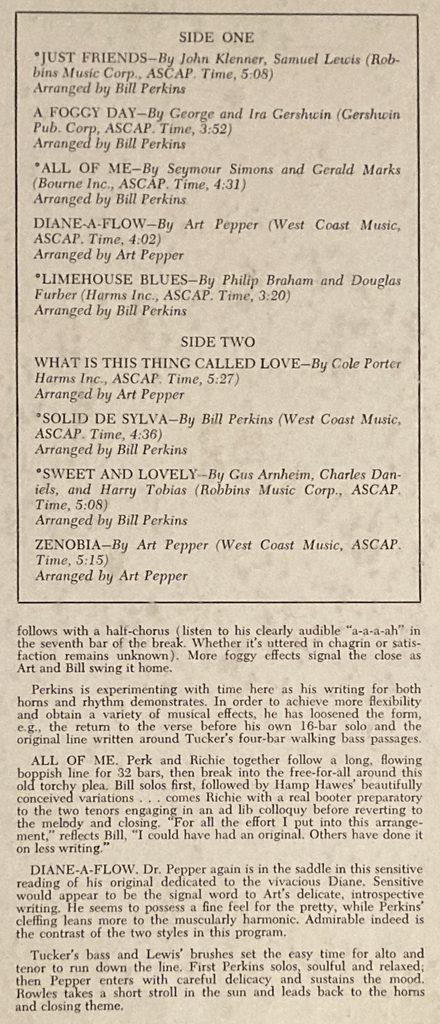
SIDE ONE
JUST FRIENDS-By John Klenner, Samuel Lewis (Rob- bins Music Corp., ASCAP. Time, 5:08)
Arranged by Bill Perkins
A FOGGY DAY-By George and Ira Gershwin (Gershwin Pub. Corp, ASCAP. Time, 3:52)
Arranged by Bill Perkins
ALL OF ME-By Seymour Simons and Gerald Marks (Bourne Inc., ASCAP. Time, 4:31)
Arranged by Bill Perkins
DIANE-A-FLOW-By Art Pepper (West Coast Music, ASCAP. Time, 4:02)
Arranged by Art Pepper
LIMEHOUSE BLUES-By Philip Braham and Douglas Furber (Harms Inc., ASCAP. Time, 3:20) Arranged by Bill Perkins
SIDE TWO
WHAT IS THIS THING CALLED LOVE-By Cole Porter Harms Inc., ASCAP. Time, 5:27)
Arranged by Art Pepper
SOLID DE SYLVA-By Bill Perkins (West Coast Music, ASCAP. Time, 4:36)
Arranged by Bill Perkins
SWEET AND LOVELY–By Gus Arnheim, Charles Dan- iels, and Harry Tobias (Robbins Music Corp., ASCAP. Time, 5:08)
Arranged by Bill Perkins
ZENOBIA-By Art Pepper (West Coast Music, ASCAP. Time, 5:15)
Arranged by Art Pepper
<裏ジャケ和訳>
ジャズの世界において、ミュージシャンがどのような評価を受け、尊敬を集めるかは、彼が誰と共演しているかによって大きく左右される。また、どのような文脈で演奏しているかという点も、そのミュージシャンを知る手がかりとなる。ジャズが芸術形式として、あるいは社会的な営みの一部として発展を遂げている今日においても、何の準備もなしに、ただ「吹く」ことだけを考えてレコーディングに臨むような、無頓着な個人主義者が依然として存在する。幸運にも素晴らしいジャズが生まれることもあるが、即興的で準備不足なセッションは、往々にしてリスクを伴うものだ。実際、セッションが収拾のつかない、中身のないものに成り下がってしまうことも少なくない。ミュージシャンの基本的な姿勢は、録音される音楽の質にそのまま反映される。つまり、不注意からは凡庸な音楽しか生まれないということだ。
本作のレコーディングにあたり、テナー・サックス奏者のビル・パーキンスは、共演者だけでなく、演奏する楽曲の選定にも細心の注意を払った。収録された楽曲のほとんどは、彼自身が書き下ろしたものだ。全9曲のうち5曲で、もう一本の管楽器を担当しているのは、ウディ・ハーマン楽団(ハーマン・ハード)時代からの旧友、リッチー・カミュカである。
ビルはこう語る。「僕の狙いは、アレンジされたパートでは二本のテナーがよく溶け合って似た響きを生み出しつつ、ソロではそれぞれがはっきりと個性を発揮できるようにすることだった。その点、リッチーは理想的な相手だったよ。彼と僕が一緒に吹いていると、どちらがどちらなのか自分でも分からなくなることがあるくらいさ。もちろん、ソロになれば、リッチーはリッチーらしく、僕は僕らしく聞こえるんだけどね」
また、4曲でアート・ペッパーを起用したのも、決して偶然ではない。ビルが目指したもう一つの重要な目標は、アレンジされたパートではテナーとアルトが心地よく調和し、ソロでは明確なスタイルの対比が生まれるようにすることだった。1956年半ばにジャズ・シーンへ復帰して以来、アート・ペッパーは、史上最高のアルト・サックス奏者の一人としての地位を再び確固たるものにした。譜面通りに演奏する時も、ソロを吹く時も、アートの演奏には確かな説得力と極めて明晰なコンセプトが宿っている。彼は、特定の誰かからあからさまな影響を受けるようなことはなく、独自のスタイルを貫いているのだ。作曲家としての手腕も演奏家としてのそれと遜色なく、彼が手掛けたオリジナル曲『ダイアン・ア・フロー(Diane-A-Flow)』と『ゼノビア(Zenobia)』が、その才能を如実に物語っている。
ジャズの演奏において、フロントの楽器陣の魅力を十分に引き出せるリズム・セクションの存在は不可欠であり、それがなければ成功は難しい。幸いなことに、『パーキンス・パーティー(Perkins’ Party)』を彩る各リズム・セクションは、いずれも極めて優秀である。
アルバムの約半分を占めるセッションでは、ハンプトン・ホーズ・トリオ(ハンプトン・ホーズ:ピアノ、レッド・ミッチェル:ベース、メル・ルイス:ドラムス)が再結集した。ハンプの情熱的なピアノ、レッドの驚くほど流麗なベース、そして常に的確でノリの良いメル・ルイスのドラミング――これ以上ないほど素晴らしいリズム・チームと言えるだろう。
パーキンスとペッパーという管楽器奏者コンビを支えるリズム・セクションも、負けず劣らず刺激的だ。ピアニストのジミー・ロウルズは、モダン・ジャズの時代を通じて常に最先端の音楽的革新を取り入れながらも、確固たる独自のスタイルを保ち続けてきた、スウィング感あふれる洗練されたベテランである。ここでもドラマーのメル・ルイスが、参加者全員の演奏に火をつけている。例えば、パーキンスのオリジナル・ブルース曲『ソリッド・デ・シルヴァ(SOLID DE SILVA)』のイントロに注目してほしい。ハイハットでしっかりとビートを刻みつつ、クレッシェンドを伴うロールを繰り出している。
ベーシストのベン・タッカーは、ウェスト・コーストのジャズ・シーンでは比較的新しい顔ぶれだ。1930年12月13日、テネシー州ナッシュビル生まれ。テネシー州立大学で2年間学んだ後、4年以上にわたりアメリカ空軍に所属し、1956年7月にカリフォルニア州ヴィクターヴィルで除隊した。除隊後すぐにロサンゼルスでウォーン・マーシュ・クインテットに加わり、本稿執筆時点では、アート・ペッパーと共に「ザ・ティファニー(The Tiffany)」に出演していた。彼は、地に足のついた「ウォーキング・ベース」のスタイルを力強く体現する奏者である。1950年にベースを始め、これまでにウォーン・マーシュのグループのほか、レッド・ノーヴォ、ジョー・モレロ、アート・ペッパー、ロニー・ボール、そして歌手のジョセフィン・プレミスのレコーディングに参加している。
『ジャスト・フレンズ(JUST FRIENDS)』。パークとリッチーが、リズム・セクションを伴わずに、対位法的な絡み合いを見せながら32小節の導入部を奏で、演奏の幕を開ける。ハンプ、レッド、メルが力強く加わると、ホーン陣はそのまま演奏を続け、よりメロディに近いラインを奏でていく。最初の16小節はリッチーがリードをとる。続く16小節では役割が入れ替わり、パークが1オクターブ下でメロディを自在に操る一方、リッチーはその上を軽やかに駆け巡る。続いてカムカが最初のソロをとり、ホーズ、そしてパーキンスへとソロが受け継がれる。その後、テナー・サックスの二人はユニゾンに戻り、8小節の自由なスペースが設けられ、ミッチェルが軽妙なブレイクを披露する。終盤の8小節では、再びカムカがテナーのリードをとり、そのままコーダへと突入する。
「A Foggy Day」。ジミー・ロールズによる「ウォーキング・ディンドン(鐘の音を模したフレーズ)」のイントロが、パーキンスが描くロンドンの情景に活気を与えている。ホーンセクションによるタグボートやタクシーを思わせる効果音、そして繰り返されるスタッカートのピアノ・フレーズを経て、アルトとテナーがメロディを奏で始める。ペッパーが優雅にソロを取り、コーラスの終わりにはパーキンスが加わる。続いて両ホーンがヴァースを短く提示し、その後パーキンスが16小節のソロを引き継ぐ。次にロールズがハーフ・コーラスを担当する(ブレイクの7小節目で、彼が発する「あー、あー、あー」という声がはっきりと聞こえる。それが悔しさによるものか、満足感によるものかは定かではない)。再び霧を思わせる効果音が鳴り響き、アートとビルがスウィング感たっぷりに曲を締めくくる。
パーキンスはこの作品で、タイム(拍子やリズムの捉え方)に関する実験的な試みを行っている。ホーンセクションとリズムセクション双方の書き方にそれが表れている。より柔軟性を高め、多彩な音楽的効果を生み出すために、彼は楽曲の構成をあえて緩やかにしている。例えば、自身の16小節のソロの前にヴァースへ戻る構成や、タッカーによる4小節のウォーキング・ベース・パッセージを軸に構築されたオリジナルのラインなどがその好例だ。
「All of Me」。パーキンスとリッチーが、バップの香りを漂わせる流麗なラインを32小節にわたって展開し、その後、この哀愁漂う名曲を舞台に、自由闊達なアンサンブルへと突入する。まずはビルがソロを取り、続いてハンプ・ホーズが見事な構成のバリエーションを披露する。その後、リッチーが力強いプレイで場を盛り上げ、2本のテナーサックスによる即興的な対話が繰り広げられる。そして再びメロディに戻り、曲は幕を閉じる。「これだけ苦労してアレンジするくらいなら、いっそオリジナル曲を書いたほうが早かったかもしれないよ」と、ビルは振り返る。 「Diane-A-Flow」。活発なダイアンに捧げられたこの曲で、アート・ペッパーが再び本領を発揮している。アートの繊細で内省的な作風を表現するなら、「繊細(センシティブ)」という言葉がまさにふさわしい。彼は美しい旋律を捉える優れた感性を持っているが、一方のパーキンスの編曲は、より力強く重厚なハーモニーを志向している。このプログラムにおける二人のスタイルの対比は、実に素晴らしい。
タッカーのベースとルイスのブラシが心地よいテンポを刻む中、アルトとテナーが軽やかに駆け抜ける。まずはパーキンスが、ソウルフルかつリラックスしたソロを披露。続いてペッパーが登場し、細やかな繊細さをもってそのムードを維持する。ロールズが陽気なピアノ・ソロを挟み、再びホーン陣へとバトンを渡してテーマの締めくくりへと向かう。
「Limehouse Blues」。サックスが醸し出すどこか神秘的な響きを合図に、パーキンスとカムカをフィーチャーしたアップテンポな演奏が始まる。ルイスの鮮やかに響くシンバルから、テナー・サックスがホーズの躍動感あふれるピアノへとバトンを渡す。その後、再びアンサンブルに戻るが、パーキンスが力強く、まるで「突き刺すような」ソロで飛び出してくる。パーキンス、リッチー、メルが4小節ずつソロを回し、続いてリッチーが熱のこもったプレイを聴かせる。レッド・ミッチェルが超絶技巧を駆使したコーラスを披露した後、テナー・サックスが戻ってきて、「ライムハウス」のメロディをストレートに提示して締めくくる。冒頭のフレーズに戻り、A面が幕を閉じる。
「What Is This Thing Called Love?」。このスタンダード・ナンバーに対する叙情的なアレンジの中で、アート・ペッパーが本作で最も情熱的なソロを聴かせている。アルトとテナーによるストレートな最初のコーラスの後、ペッパーが颯爽と登場する。彼のソロは、自由で独創的なジャズ・アドリブの模範といえるものだ。続くパーキンスの登場も印象的で、レスター・ヤングを彷彿とさせる雰囲気がある。アートとビルが4小節ずつソロを交わした後、16小節のアルト・リードでテーマへと戻る。ブリッジ部分ではリズム・セクションが休み、二人が即興演奏を繰り広げる。全体を通して非常にリラックスした、スウィング感あふれるテイクとなっている。
「SOLID DE SILVA」。メル(・ルイス)のドラム・ロールで幕を開けるこのファンキーなブルース・ナンバーは、パーキンスがジャズ・ディスクジョッキーのウォルト・デ・シルヴァに捧げたオリジナル曲である。ビル(・パーキンス)がハモサ・ビーチの「ライトハウス」でアルト奏者レニー・ニーハウスと共演していた時期に書かれた。ルイスが揺るぎないテンポを刻む中、テナー・サックスの二人が最初の数コーラスを軽やかに吹き進め、続いてパーキンスが短いソロを披露。その後にはホーウズの素晴らしいピアノ・ソロが続く。続いてカムカが1コーラスを担当し、そのあとをパーキンスがバスクラリネットでブルージーに吹き鳴らす。ジャズのソロ楽器としてはあまり使われないバスクラリネットだが、ここでは実に理想的な表現手段となっている。ミッチェルが卓越したベース・テクニックとジャズに対する深い理解をもってグルーヴィーなコーラスを聴かせ、最後はパーキンスとリッチーが締めくくる。
「SWEET AND LOVELY」。この穏やかなトーン・ポエムでは、再びパーキンスがバスクラリネットを手に、リッチーが吹く超高音域のテナー・サックスの背後で美しいフレーズを奏でている。ジャズ・アルバムでバスクラリネットがこれほど大きくフィーチャーされるのはおそらく初めてのことだろう。テナー・サックスの周囲を重厚に、かつ巧みに絡み合うその豊かで木の温もりを感じさせる音色は、音楽的に非常に価値が高い。他のジャズ・リード奏者たちの関心を引き、今後さらに活用されるきっかけになるはずだ。
16小節のソロを終えたハンプ(・ホーズ)に続き、レッド(・ミッチェル)がブリッジで叙情的な8小節を奏でる。その後、パーキンスはフルートに持ち替え、リッチーのリードの周囲を16小節にわたって自由に舞うように吹き、最後は再びバスクラリネットを手にして曲を締めくくる。
パーキンスはユーモアを交えて、自身のバスクラリネットの音色について「霧の中を進むクイーン・エリザベス号を彷彿とさせるね」と語っている。さらに「ちなみに、フルートを吹くときは『納屋のシャンク(Barnyard Shank)』なんて呼ばれているんだ」と付け加えた。またビルは、各楽器間の完璧なバランスを実現したサウンド・エンジニアのヴァル・ヴァレンティンを高く評価している。
「ZENOBIA」。これもペッパー(・パーキンス)のオリジナル曲で、ファンキーなアート(・ペッパー)が最初のソロをとる。ミディアム・テンポのこの曲の雰囲気に乗って、パーキンスも探求心あふれるソロを展開する。再びアートが登場し、彼自身とパーキンス、ルイスによる2小節のブレイクが続く。ブリッジではジミー・ロウルズが滑らかにピアノを聴かせ、その後、アルトとテナーがテーマを再び提示する。ベン・タッカーが次の演奏を先導し、そこにアートによる特徴的なコメントがいくつか挟まれる。やがてホーンセクションが加わり、震えるようなコーダで楽曲が締めくくられる。
パーキンスにとってリーダー作としては2枚目となる本作(1枚目は『ONSTAGE』Pacific Jazz-1221)は、よりリラックスした雰囲気の中で制作されており、現代屈指のテナー・サックス奏者としての彼の才能が鮮やかに発揮されている。パーキンスは、ジョン・ルイス、パーシー・ヒース、チコ・ハミルトン、ジム・ホールと共演した『GRAND ENCOUNTER』(Pacific Jazz-1217)でも、その卓越した実力を存分に披露している。
ライナーノーツ:ジョン・タイナン(『ダウン・ビート』誌)
カバー写真:レイ・エイヴリー
制作:ウッディ・ウッドワード&リチャード・ボック
技術データ:本盤は、30〜15,000サイクル/秒(Hz)の周波数特性を持つ高忠実度(ハイ・フィデリティ)録音です。ワイドレンジ対応の再生機器をご使用の際は、RIAAまたはNARTBカーブの設定を選択してください。
※訳文の制作にはGoogleドライブとGoogle翻訳のお世話になりました。
コメント