Label: BETHLEHEM MUSIC CORP.
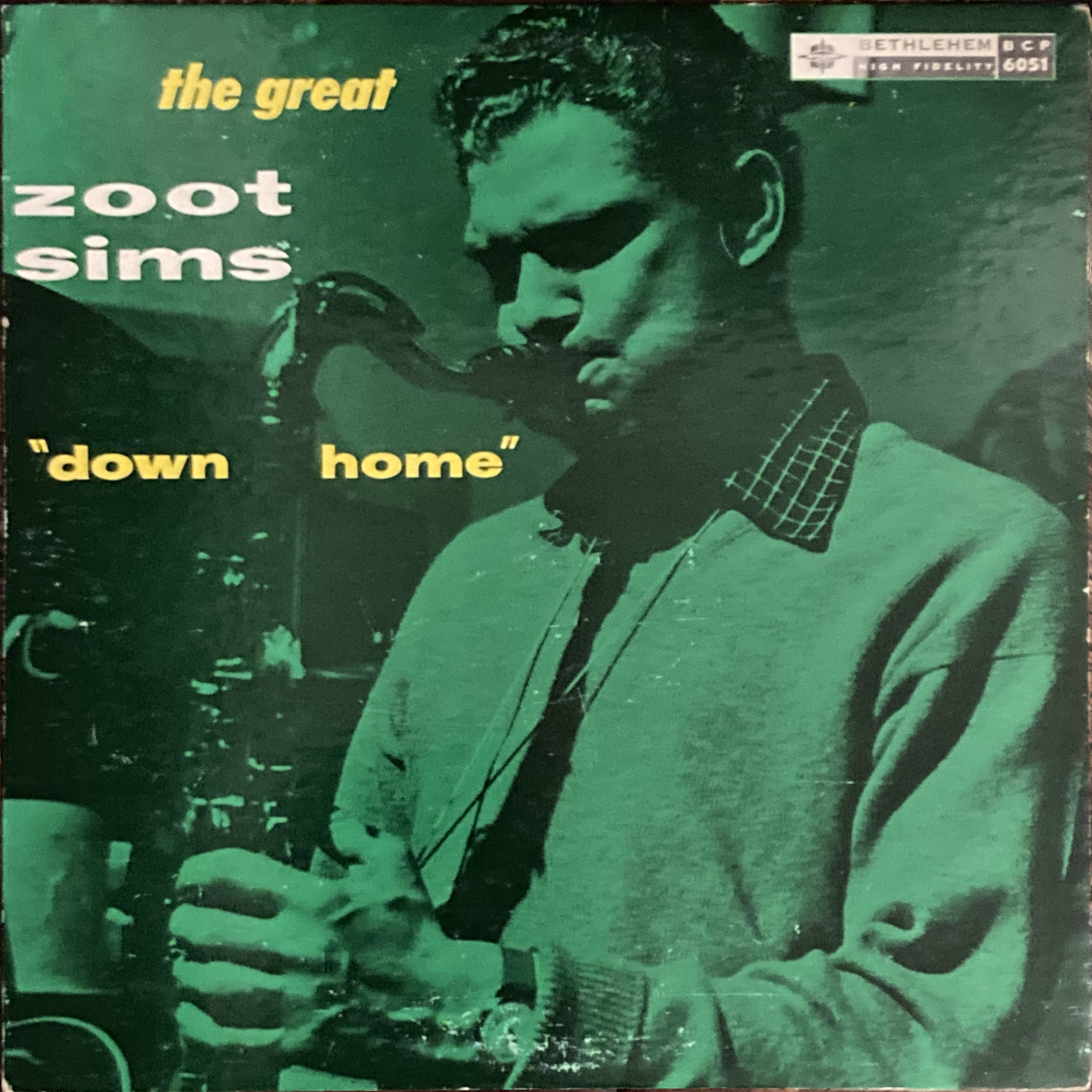
No.: BCP-6051
Title: DOWN HOME
Musician: ZOOT SIMS (4)
Recorded: 1960/6/7
Monaural
Cover address: NEW YORK, N.Y. , HOLLYWOOD CALIF.
Coating
Groove Guard
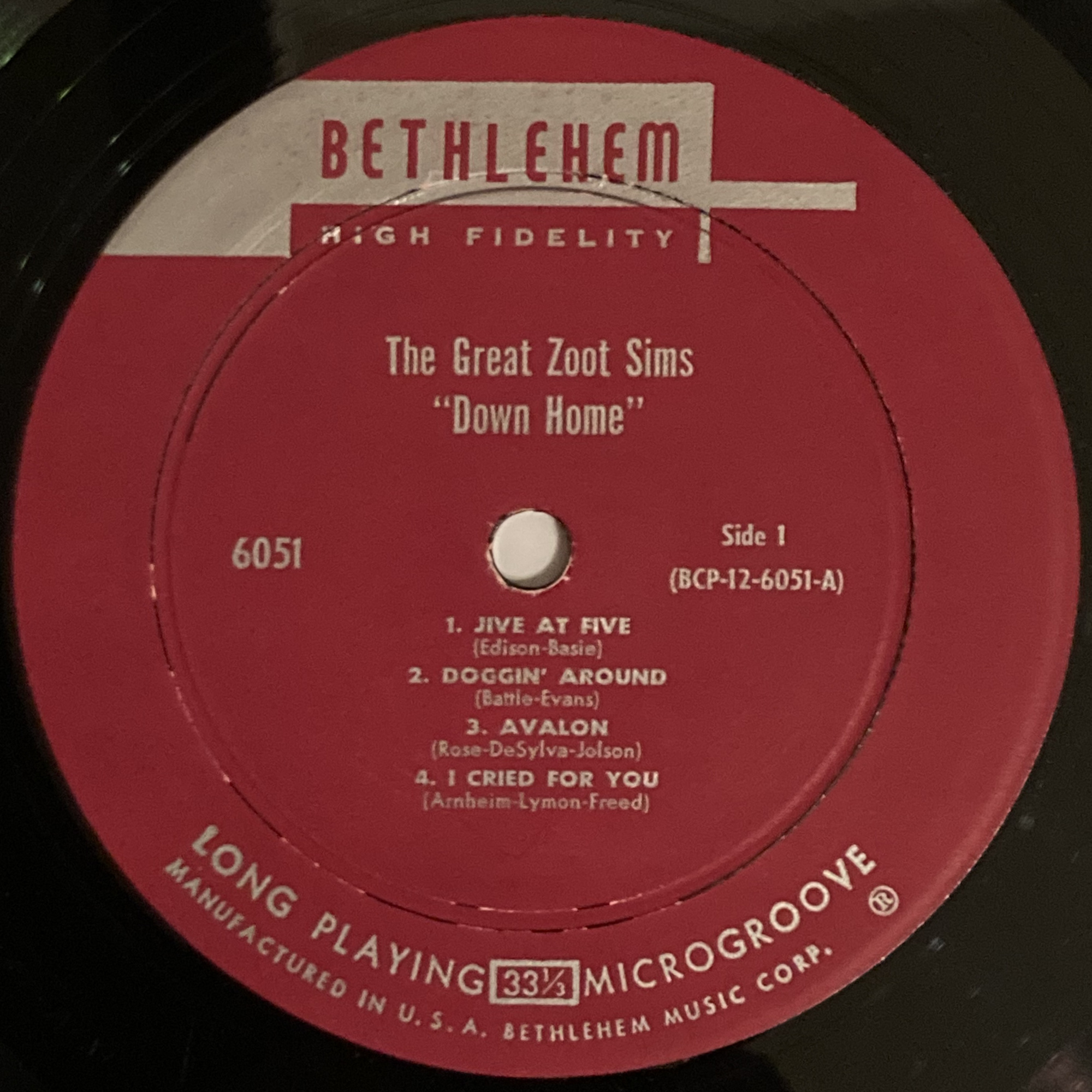
Label Side-A
Red Background
Silver Letter without Laurel
Address: None
Deep Groove
Dead Wax Info: BCP-12-6051-A-X1
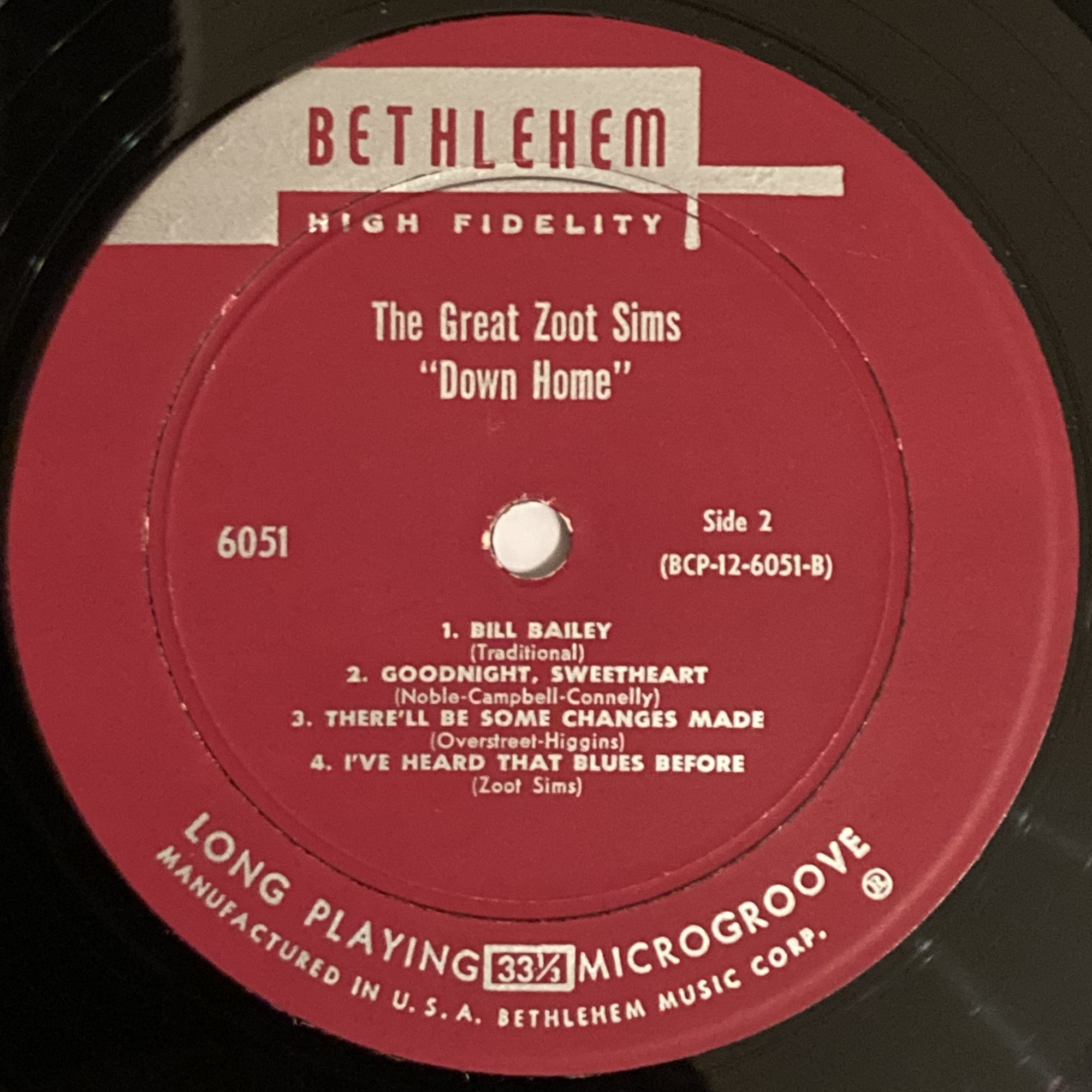
Label Side-B
Red Background
Silver Letter without Laurel
Address: None
Deep Groove
Dead Wax Info: BCP-12-6051-B-1
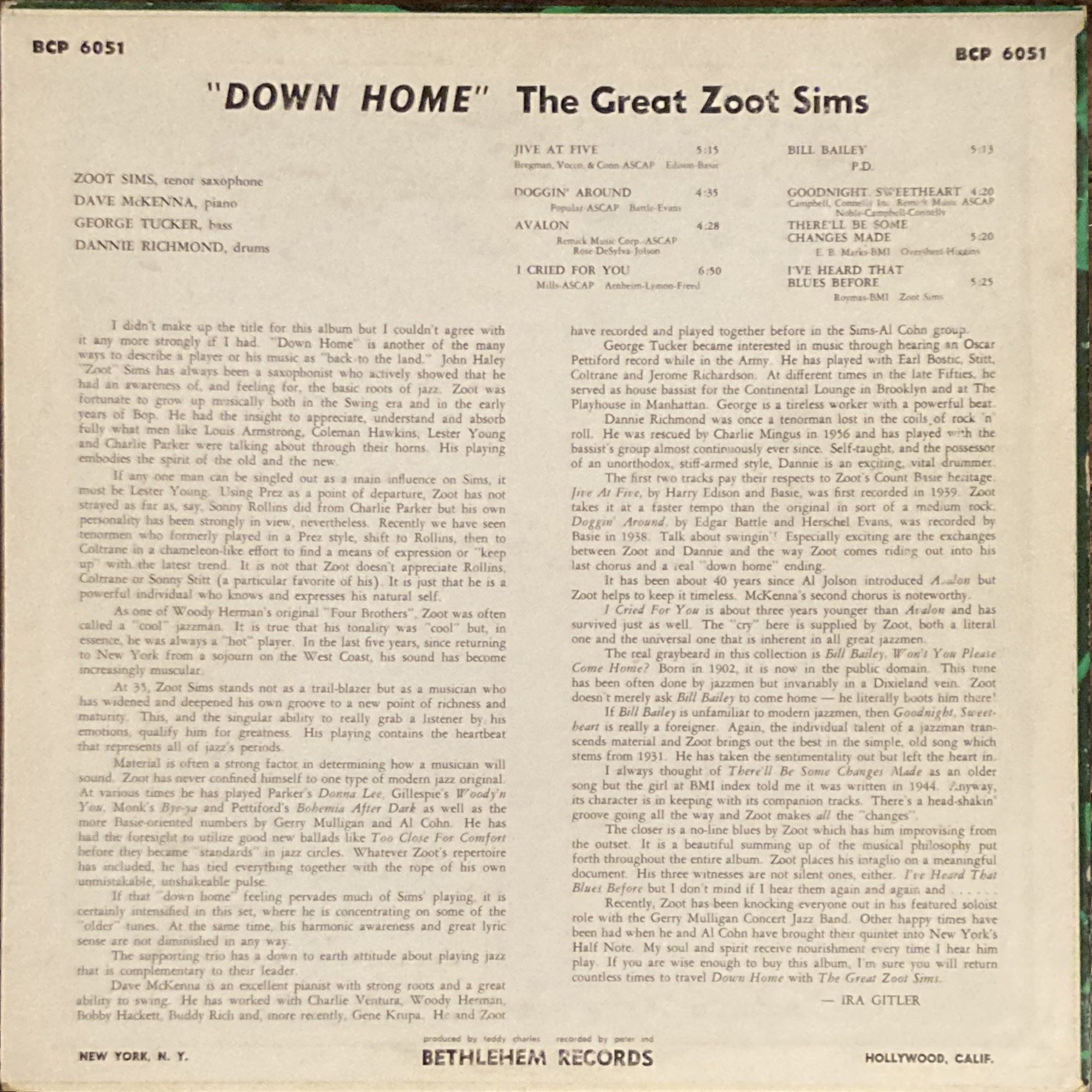
Personnel-
Drums: Dannie Richmond
Bass: George Tucker
Piano: Dave McKenna
Tenor Sax: Zoot Sims
Tracks-
Side-A
1) Jive at Five 5’15”
2) Doggin’ Around 4’35”
3) Avalon 4’28”
4) I Cried For You 6’50”
Side-B
1) Bill Bailey P.D. 5’13”
2) Goodnight, Sweetheart 4’20”
3) There’ll be Some Changes Made 5’20”
4) I’ve Heard That Blues Before 5’25”
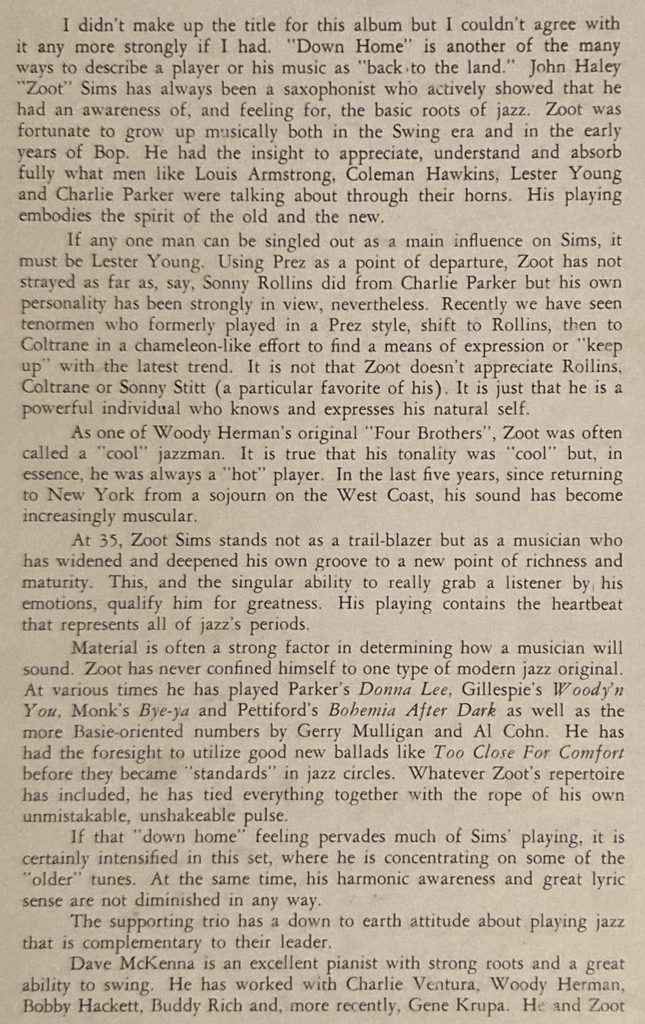
<裏ジャケ原文>
I didn’t make up the title for this album but I couldn’t agree with it any more strongly if I had. “Down Home” is another of the many ways to describe a player or his music as “back to the land.” John Haley “Zoot” Sims has always been a saxophonist who actively showed that he had an awareness of, and feeling for, the basic roots of jazz. Zoot was fortunate to grow up musically both in the Swing era and in the early years of Bop. He had the insight to appreciate, understand and absorb fully what men like Louis Armstrong, Coleman Hawkins, Lester Young and Charlie Parker were talking about through their horns. His playing embodies the spirit of the old and the new.
If any one man can be singled out as a main influence on Sims, it must be Lester Young. Using Prez as a point of departure, Zoot has not strayed as far as, say, Sonny Rollins did from Charlie Parker but his own personality has been strongly in view, nevertheless. Recently we have seen tenormen who formerly played in a Prez style, shift to Rollins, then to Coltrane in a chameleon-like effort to find a means of expression or “keep up” with the latest trend. It is not that Zoot doesn’t appreciate Rollins, Coltrane or Sonny Stitt (a particular favorite of his). It is just that he is a powerful individual who knows and expresses his natural self.
As one of Woody Herman’s original “Four Brothers”, Zoot was often called a “cool” jazzman. It is true that his tonality was “cool” but, in essence, he was always a “hot” player. In the last five years, since returning to New York from a sojourn on the West Coast, his sound has become increasingly muscular.
At 35, Zoot Sims stands not as a trail-blazer but as a musician who has widened and deepened his own groove to a new point of richness and maturity. This, and the singular ability to really grab a listener by his emotions, qualify him for greatness. His playing contains the heartbeat that represents all of jazz’s periods.
Material is often a strong factor in determining how a musician will sound. Zoot has never confined himself to one type of modern jazz original. At various times he has played Parker’s Donna Lee, Gillespie’s Woody’n You, Monk’s Bye-ya and Pettiford’s Bohemia After Dark as well as the more Basie-oriented numbers by Gerry Mulligan and Al Cohn. He has had the foresight to utilize good new ballads like Too Close For Comfort before they became “standards” in jazz circles. Whatever Zoot’s repertoire has included, he has tied everything together with the rope of his own unmistakable, unshakeable pulse.
If that “down home” feeling pervades much of Sims’ playing, it is certainly intensified in this set, where he is concentrating on some of the “older” tunes. At the same time, his harmonic awareness and great lyric sense are not diminished in any way.
The supporting trio has a down to earth attitude about playing jazz that is complementary to their leader.
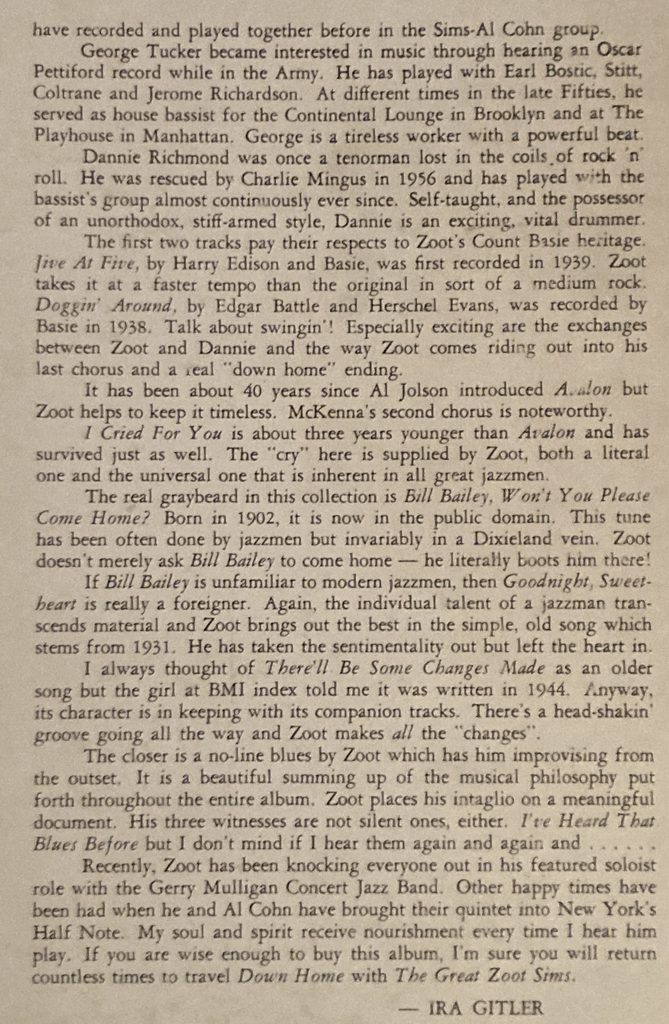
Dave McKenna is an excellent pianist with strong roots and a great ability to swing. He has worked with Charlie Ventura, Woody Herman, Bobby Hackett, Buddy Rich and, more recently, Gene Krupa. He and Zoot have recorded and played together before in the Sims-Al Cohn group. George Tucker became interested in music through hearing an Oscar Pettiford record while in the Army. He has played with Earl Bostic, Stitt, Coltrane and Jerome Richardson. At different times in the late Fifties, he served as house bassist for the Continental Lounge in Brooklyn and at The Playhouse in Manhattan. George is a tireless worker with a powerful beat. Dannie Richmond was once a tenorman lost in the coils of rock ‘n’ roll. He was rescued by Charlie Mingus in 1956 and has played with the bassist’s group almost continuously ever since. Self-taught, and the possessor of an unorthodox, stiff-armed style, Dannie is an exciting, vital drummer.
The first two tracks pay their respects to Zoot’s Count Basie heritage. Jive At Five, by Harry Edison and Basie, was first recorded in 1939. Zoot takes it at a faster tempo than the original in sort of a medium rock. Doggin’ Around, by Edgar Battle and Herschel Evans, was recorded by Basie in 1938. Talk about swingin’! Especially exciting are the exchanges between Zoot and Dannie and the way Zoot comes riding out into his last chorus and a real “down home” ending.
It has been about 40 years since Al Jolson introduced Avalon but Zoot helps to keep it timeless. McKenna’s second chorus is noteworthy.
I Cried For You is about three years younger than Avalon and has survived just as well. The “cry” here is supplied by Zoot, both a literal one and the universal one that is inherent in all great jazzmen.
The real graybeard in this collection is Bill Bailey, Won’t You Please Come Home? Born in 1902, it is now in the public domain. This tune has been often done by jazzmen but invariably in a Dixieland vein. Zoot doesn’t merely ask Bill Bailey to come home – he literally boots him there!
If Bill Bailey is unfamiliar to modern jazzmen, then Goodnight, Sweet- heart is really a foreigner. Again, the individual talent of a jazzman tran- scends material and Zoot brings out the best in the simple, old song which stems from 1931. He has taken the sentimentality out but left the heart in.
I always thought of There’ll Be Some Changes Made as an older song but the girl at BMI index told me it was written in 1944. Anyway, its character is in keeping with its companion tracks. There’s a head-shakin’ groove going all the way and Zoot makes all the “changes”.
The closer is a no-line blues by Zoot which has him improvising from the outset. It is a beautiful summing up of the musical philosophy put forth throughout the entire album. Zoot places his intaglio on a meaningful document. His three witnesses are not silent ones, either. I’ve Heard That Blues Before but I don’t mind if I hear them again and again and.
Recently, Zoot has been knocking everyone out in his featured soloist role with the Gerry Mulligan Concert Jazz Band. Other happy times have been had when he and Al Cohn have brought their quintet into New York’s Half Note. My soul and spirit receive nourishment every time I hear him play. If you are wise enough to buy this album, I’m sure you will return countless times to travel Down Home with The Great Zoot Sims.
IRA GITLER
<裏ジャケ和訳>
このアルバムのタイトルを私が付けたわけではありませんが、もし自分で付けたとしても、これほど強く賛成したことでしょう。「ダウン・ホーム(Down Home)」という言葉は、ある演奏家やその音楽を「土着的な(back to the land)」ものとして表現する数ある言い回しの一つです。ジョン・ヘイリー・“ズート”・シムズは、常にジャズの基本的なルーツに対する意識と感覚を持ち合わせていることを積極的に示してきたサックス奏者でした。ズートは幸運にも、スウィング・ジャズの時代とビバップの初期という両方の時代の中で、音楽的に成長することができました。彼は、ルイ・アームストロング、コールマン・ホーキンス、レスター・ヤング、チャーリー・パーカーといった巨匠たちが、その楽器を通じて語りかけていたものを正当に評価し、理解し、完全に吸収する洞察力を備えていました。彼の演奏は、新旧の精神を体現しているのです。
シムズに最も大きな影響を与えた人物を一人挙げるとすれば、それは間違いなくレスター・ヤングでしょう。「プレズ(レスター・ヤングの愛称)」を出発点としつつ、ズートはチャーリー・パーカーからソニー・ロリンズが離れていったほどの極端な変化は遂げませんでしたが、それでも彼自身の個性ははっきりと表れていました。最近では、表現手段を模索したり最新の流行に「ついていこう」としたりするあまり、カメレオンのようにプレズ・スタイルからロリンズ・スタイルへ、さらにはコルトレーン・スタイルへと移行するテナー奏者も見受けられます。ズートがロリンズやコルトレーン、あるいは(彼が特にお気に入りだった)ソニー・スティットを評価していないわけではありません。単に彼が、ありのままの自分を理解し表現する、強固な個性を持った人物だというだけのことなのです。
ウディ・ハーマン楽団のオリジナル・メンバーである「フォー・ブラザーズ」の一人として、ズートはしばしば「クール」なジャズマンと呼ばれました。確かに彼の音色は「クール」でしたが、本質的には常に「ホット」な演奏家でした。西海岸での滞在を終えてニューヨークに戻ってからの5年間で、彼のサウンドはますます力強さを増しています。
35歳になったズート・シムズは、単なる開拓者としてではなく、自身のグルーヴを広げ、深め、新たな豊かさと成熟の境地へと到達した音楽家としてそこにいます。その点と、聴き手の感情を強く揺さぶる類まれな能力こそが、彼を偉大な存在にしているのです。彼の演奏には、ジャズのあらゆる時代を象徴する鼓動が息づいています。
演奏する楽曲(マテリアル)は、音楽家のサウンドを決定づける大きな要因となることがよくあります。ズートは、特定のタイプのモダン・ジャズ・オリジナル曲だけを演奏することに固執してきませんでした。彼はこれまでに、パーカーの「ドナ・リー」、ガレスピーの「ウディン・ユー」、モンクの「バイ・ヤ」、ペティフォードの「ボヘミア・アフター・ダーク」といった曲に加え、ジェリー・マリガンやアル・コーンによるベイシー・スタイルの楽曲も取り上げてきました。また、「トゥー・クロース・フォー・コンフォート」のような優れた新曲を、それらがジャズ界の「スタンダード」となる前からいち早く取り上げる先見の明も持ち合わせていました。ズートのレパートリーがどのようなものであれ、彼はそのすべてを、彼特有の揺るぎない「パルス(鼓動)」という一本の糸でしっかりと結びつけてきたのです。
シムズの演奏には「ダウン・ホーム(素朴で親しみやすい)」な雰囲気が色濃く漂っていますが、とりわけ「古き良き」楽曲に焦点を当てた本作では、その持ち味がより一層際立っています。同時に、和声に対する鋭い感覚や卓越した叙情性も、いささかも損なわれてはいません。
バックを務めるトリオもまた、ジャズ演奏に対して地に足のついた姿勢で臨んでおり、リーダーであるシムズの演奏を実に見事に引き立てています。
デイヴ・マッケンナは、確固たるルーツを持ち、素晴らしいスウィング感あふれる演奏をする優れたピアニストです。彼はこれまでにチャーリー・ヴェンチュラ、ウディ・ハーマン、ボビー・ハケット、バディ・リッチ、そして近年ではジーン・クルーパらと共演してきました。ズートとは以前、シムズ=アル・コーン・グループで共演・録音した経験があります。ジョージ・タッカーは、陸軍在籍中にオスカー・ペティフォードのレコードを聴いたことがきっかけで音楽に目覚めました。彼はアール・ボスティック、スティット、コルトレーン、ジェローム・リチャードソンらと共演しています。1950年代後半には、ブルックリンのコンチネンタル・ラウンジやマンハッタンのプレイハウスでハウス・ベーシストを務めた時期もありました。ジョージは力強いビートを刻む、精力的で勤勉なミュージシャンです。ダニー・リッチモンドはかつて、ロックンロールの渦に飲み込まれていたテナー・サックス奏者でした。1956年にチャーリー・ミンガスに救い出されて以来、ほぼ一貫してミンガスのグループで演奏を続けています。独学で身につけた、腕をあまり使わない独特な奏法を持つダニーは、エキサイティングで生命力あふれるドラマーです。
最初の2曲は、ズートが受け継ぐカウント・ベイシーの音楽的遺産へのオマージュとなっています。ハリー・エジソンとベイシーによる「Jive At Five」は、1939年に初めて録音されました。ズートはオリジナルよりも速いテンポで、ミディアム・ロック調に演奏しています。エドガー・バトルとハーシェル・エヴァンスによる「Doggin’ Around」は、1938年にベイシーによって録音された曲です。まさにスウィングの真骨頂と言えるでしょう!特に、ズートとダニーの掛け合いや、ズートが最後のコーラスへと力強く突入していく様子、そして実に「ダウン・ホーム(素朴で温かみのある)」な雰囲気で終わるエンディングは圧巻です。
アル・ジョルソンが「Avalon」を世に送り出してから約40年が経ちましたが、ズートの演奏によってこの曲は時代を超えた魅力を保ち続けています。マッケンナが担当する2コーラス目の演奏も注目に値します。
「I Cried For You」は「Avalon」より3年ほど新しい曲ですが、同様に長く愛され続けています。ここで「泣き(cry)」を表現しているのはズートです。それは文字通りの泣き声であると同時に、偉大なジャズマンなら誰もが内に秘めている普遍的な「泣き」でもあります。
このアルバムの中で最も古い曲は「Bill Bailey, Won’t You Please Come Home?」です。1902年に生まれたこの曲は、現在ではパブリック・ドメイン(著作権保護期間満了)となっています。多くのジャズマンに取り上げられてきた曲ですが、そのほとんどはディキシーランド・ジャズのスタイルで演奏されてきました。ズートは単に「ビル・ベイリー(Bill Bailey)」に帰宅を促すだけではありません。文字通り、彼をそこへ蹴り飛ばす(ブートする)ような勢いで演奏しているのです!
もし現代のジャズマンにとって「ビル・ベイリー」が馴染みの薄い曲だとしたら、「グッドナイト・スウィートハート(Goodnight, Sweetheart)」はまさに異邦人のような存在でしょう。しかしここでも、ジャズマン個人の才能が楽曲そのものを超越しています。ズートは1931年生まれのこの素朴で古い歌から、感傷的な要素を削ぎ落としつつも、その「心」はしっかりと残しているのです。
私はずっと「ゼア・ビー・サム・チェンジズ・メイド(There’ll Be Some Changes Made)」を古い曲だと思っていましたが、BMIの資料室の女性に尋ねたところ、1944年に書かれたものだと教えられました。いずれにせよ、その曲調はアルバムの他の収録曲と見事に調和しています。全編を通して思わず体が動き出すようなグルーヴがあり、ズートは巧みに「チェンジ(コード進行)」を乗りこなしています。
最後の曲はズートによるブルースで、冒頭から即興演奏が繰り広げられます。これはアルバム全体を通して提示された音楽的哲学を見事に総括する一曲です。ズートは、この意義深い作品に自らの確かな刻印を残しています。彼を支える3人の共演者たちも、決して控えめな存在ではありません。「アイヴ・ハード・ザット・ブルース・ビフォー(I’ve Heard That Blues Before)」――何度繰り返し聴いたとしても、私は一向に構いません。
最近、ズートはジェリー・マリガン・コンサート・ジャズ・バンドのソリストとして、聴衆を圧倒するような素晴らしい演奏を披露しています。また、アル・コーンとのクインテットでニューヨークの「ハーフ・ノート」に出演した際も、最高の時間を生み出しました。彼の演奏を聴くたびに、私の魂と精神は豊かな栄養を受け取るような心地になります。もしあなたが賢明にもこのアルバムを手に取ったなら、きっと「偉大なるズート・シムズ」と共に「ダウン・ホーム(Down Home)」の旅をするために、幾度となくこの作品に立ち返ることになるでしょう。
アイラ・ギトラー
※訳文の制作にはGoogleドライブとGoogle翻訳のお世話になりました。


コメント