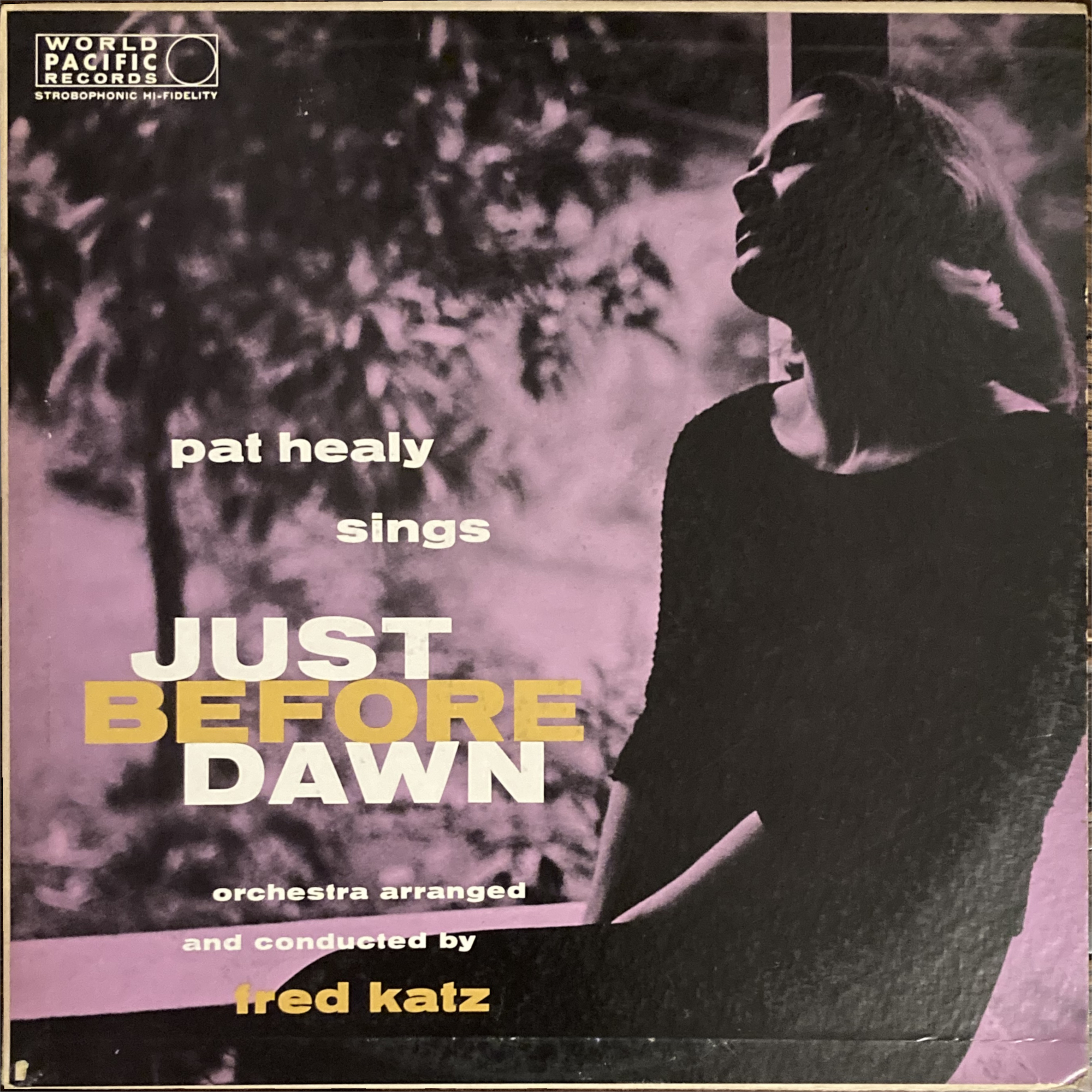
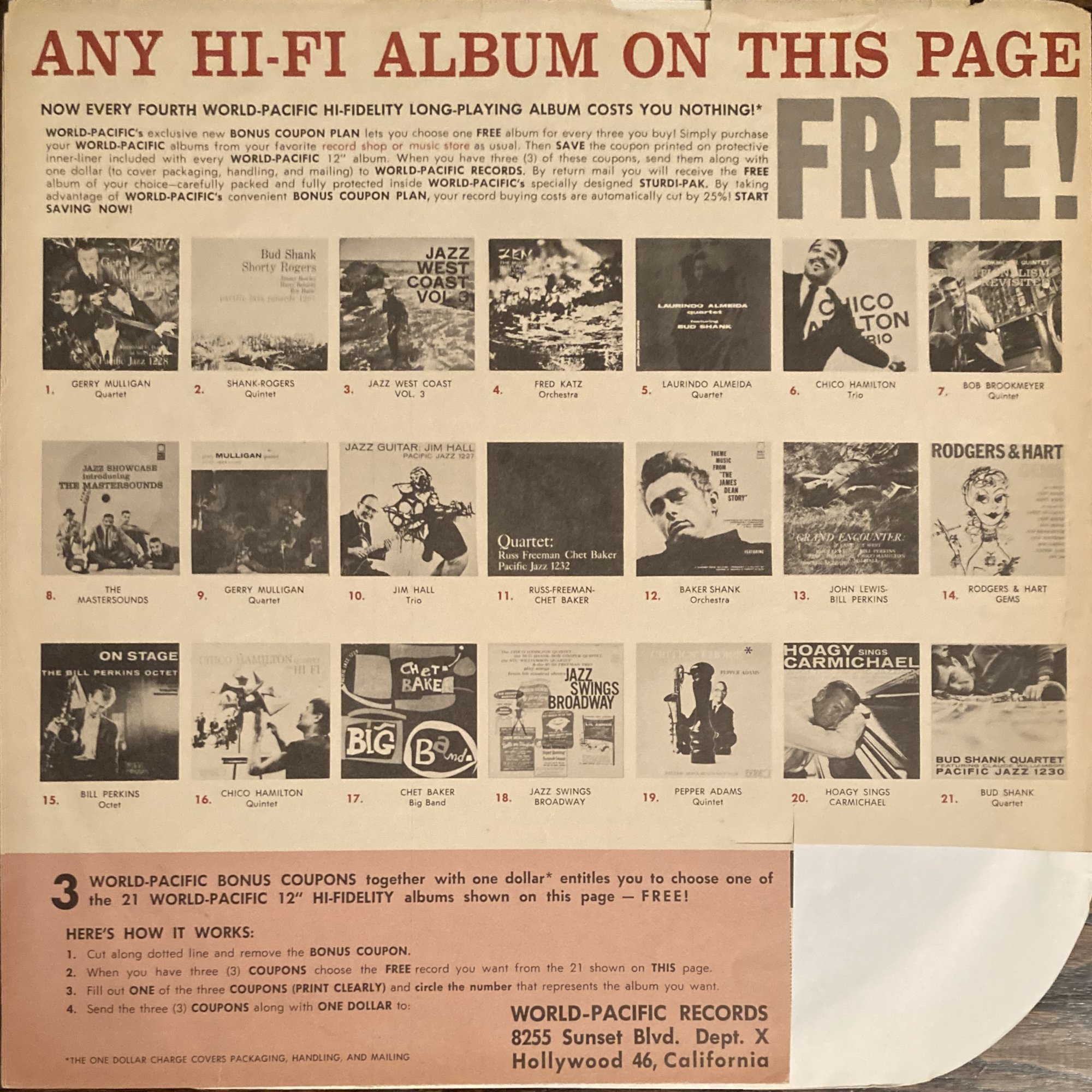
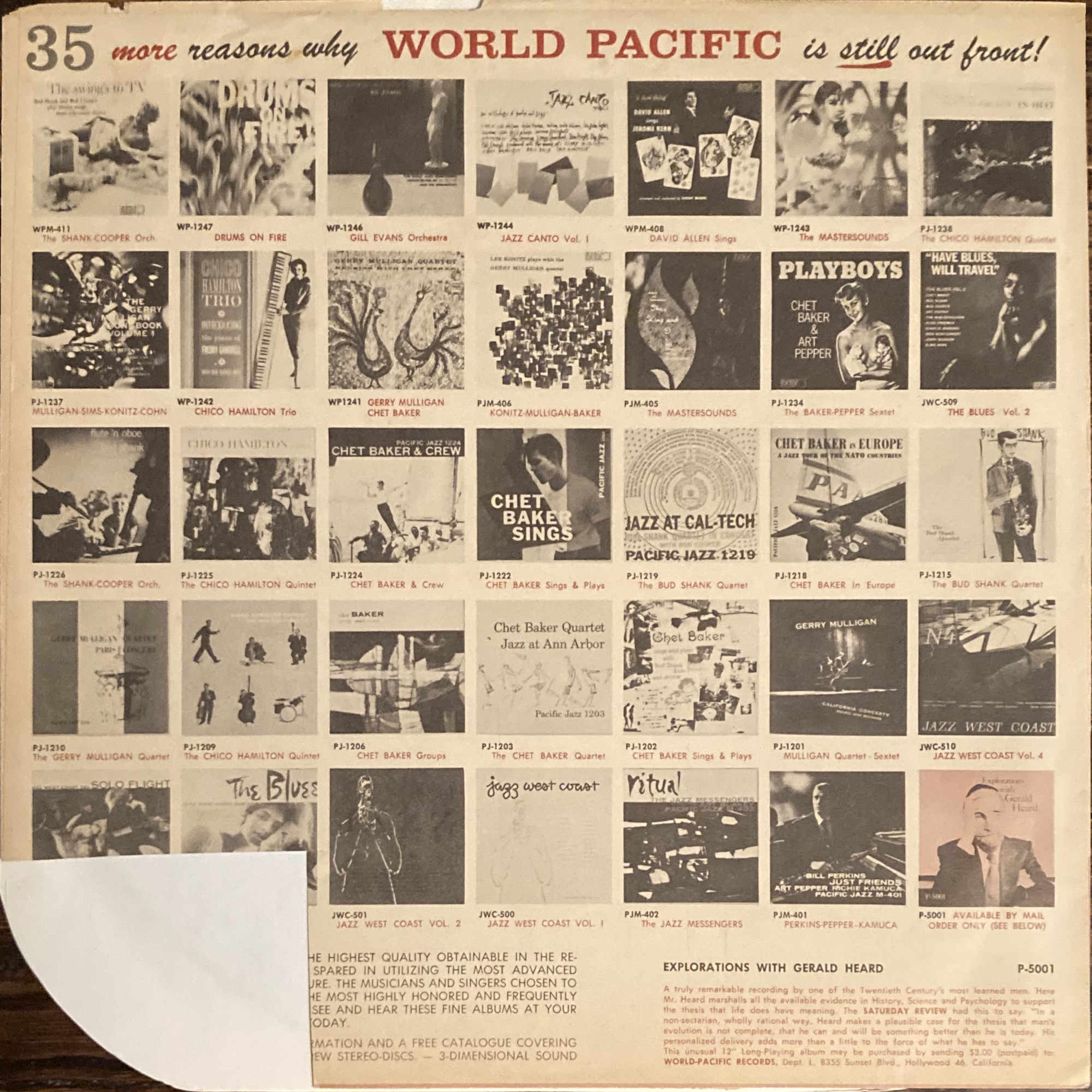
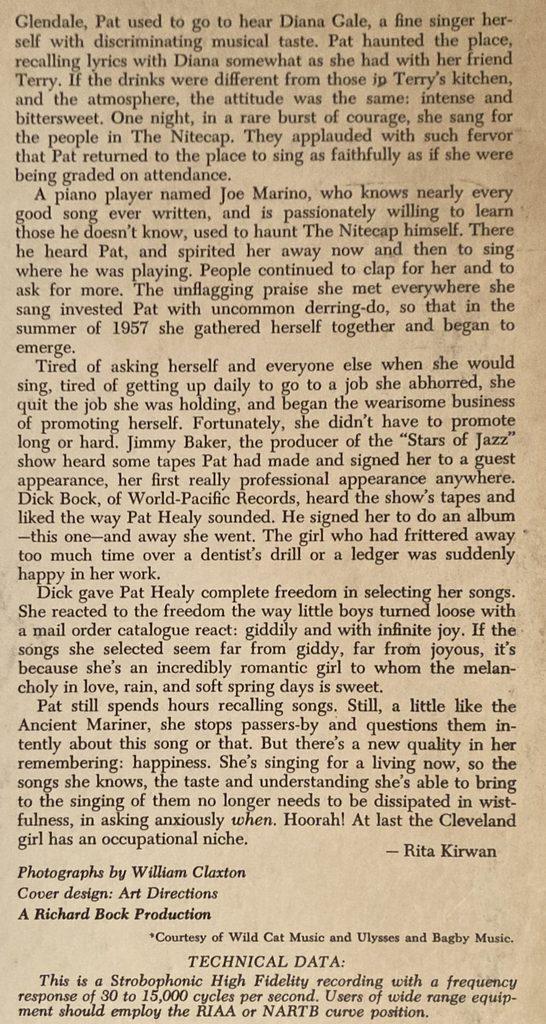
Label: WORLD PACIFIC
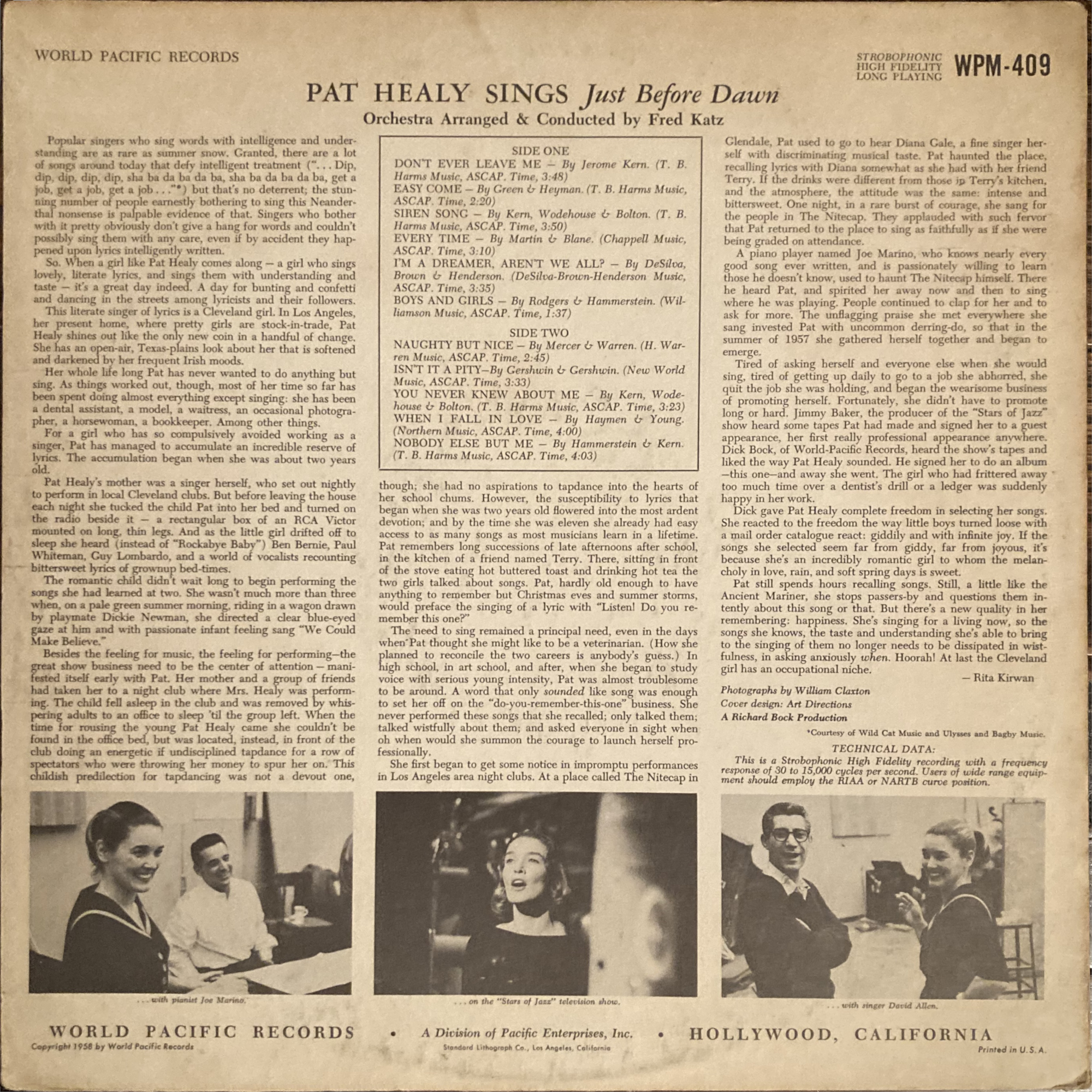
No.: WPM-409
Title: JUST BEFORE DAWN
Musician: PAT HEALY
Recorded:
Monaural
Cover address: HOLLYWOOD, CALIFORNIA
Coating
Groove Guard
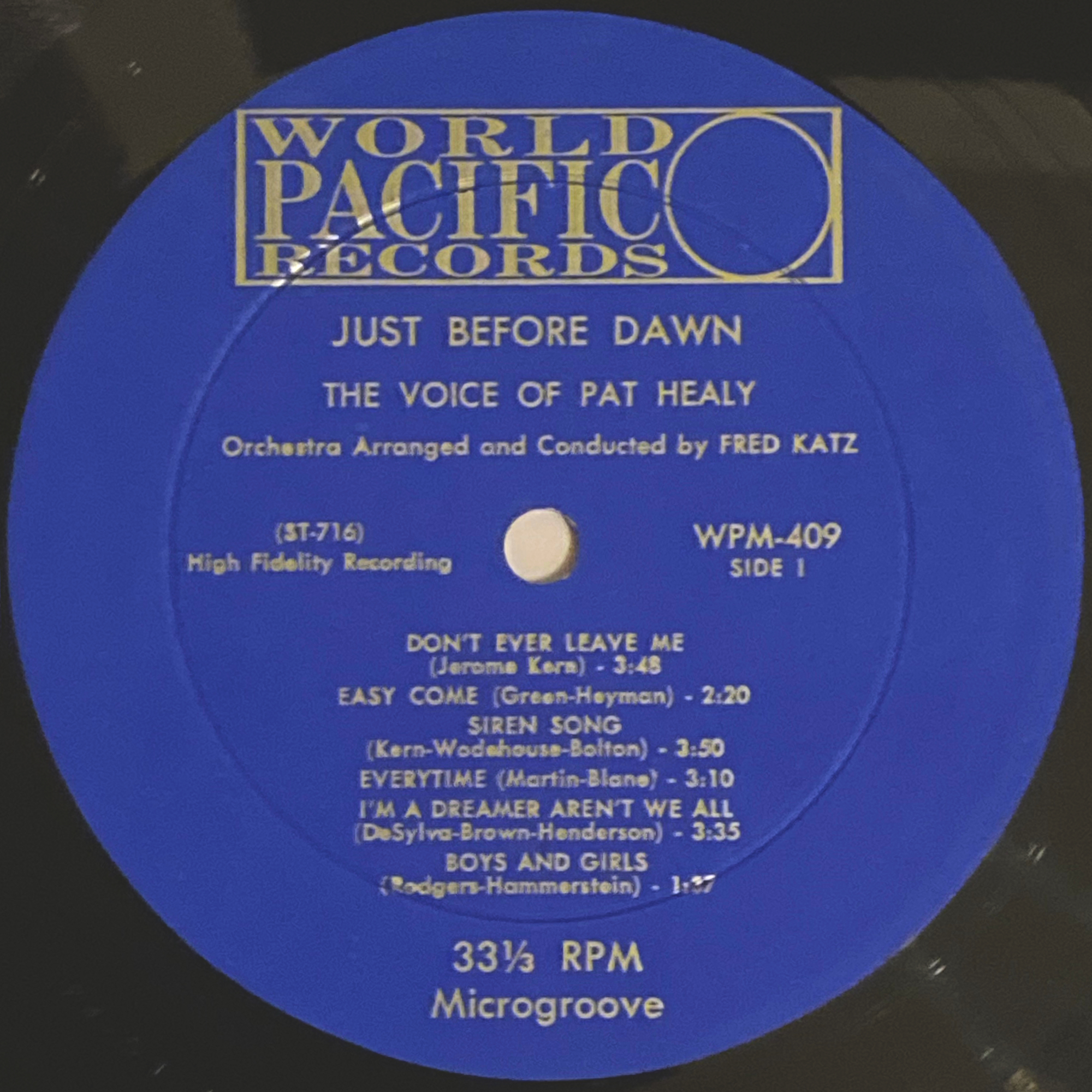
Label Side-1
Blue Background
Silver Letter
Address: None
Deep Groove
Dead Wax Info: PJ-ST-716, H
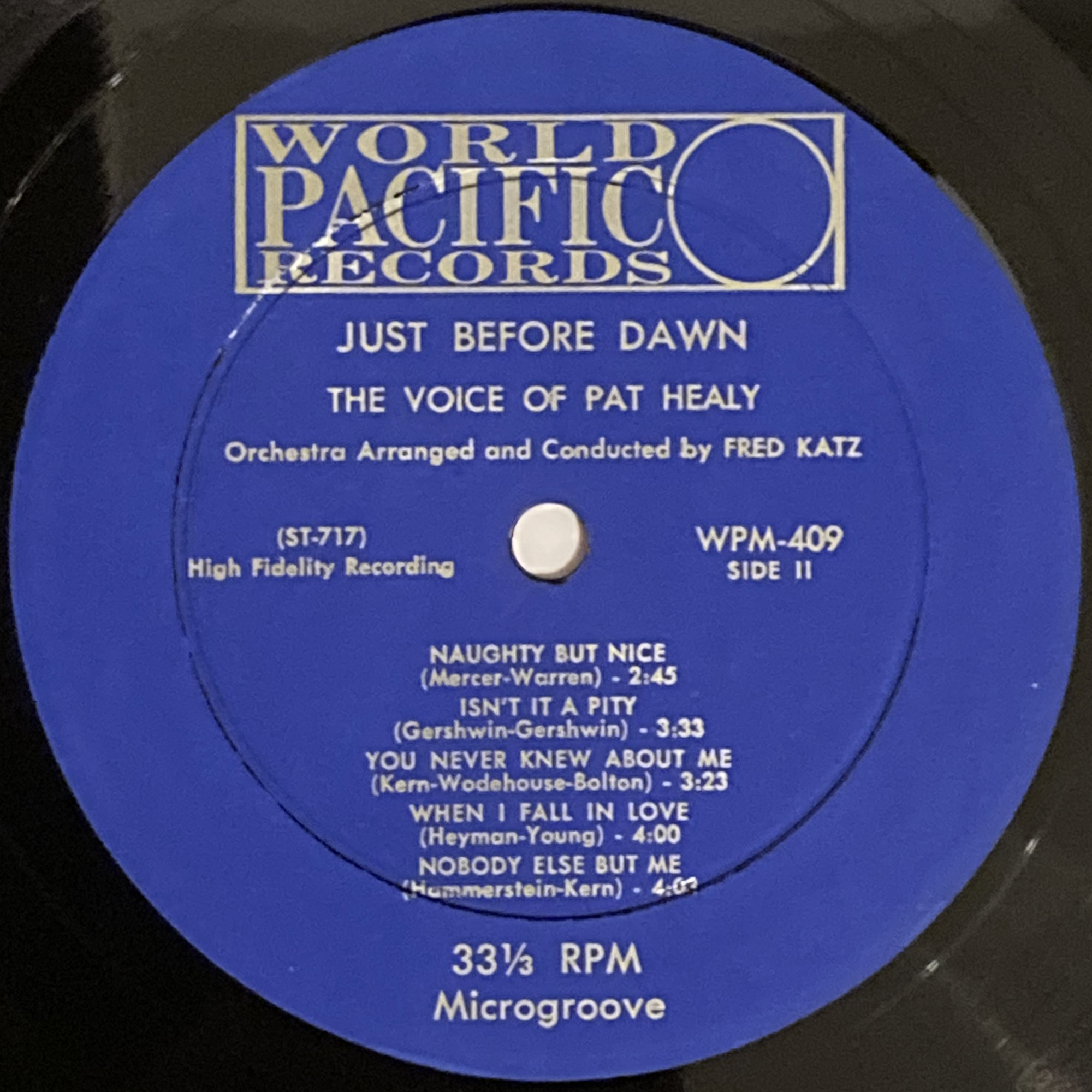
Label Side-2
Blue Background
Silver Letter
Address: None
Deep Groove
Dead Wax Info: PJ-ST-717, H
Personnel-
Vocal: Pat Healy
Orchestra Arranged and Conducted by Fred Katz
Tracks-
Side-1
1) Don’t Ever Leave ME 3’48”
2) Easy Come 2’20”
3) Siren Song 3’50”
4) Every Time 3’10”
5) I’m a Dreamer, Aren’t We All ? 3’35”
6) Boys and Girls 1’37”
Side-2
1) Naughty But Nice 2’45”
2) Isn’t it a Pity 3’33”
3) You Never Knew About ME 3’23”
4) When I Fall in Love 4’00”
5) Nobody Else But Me 4’03”
<裏ジャケ原文>
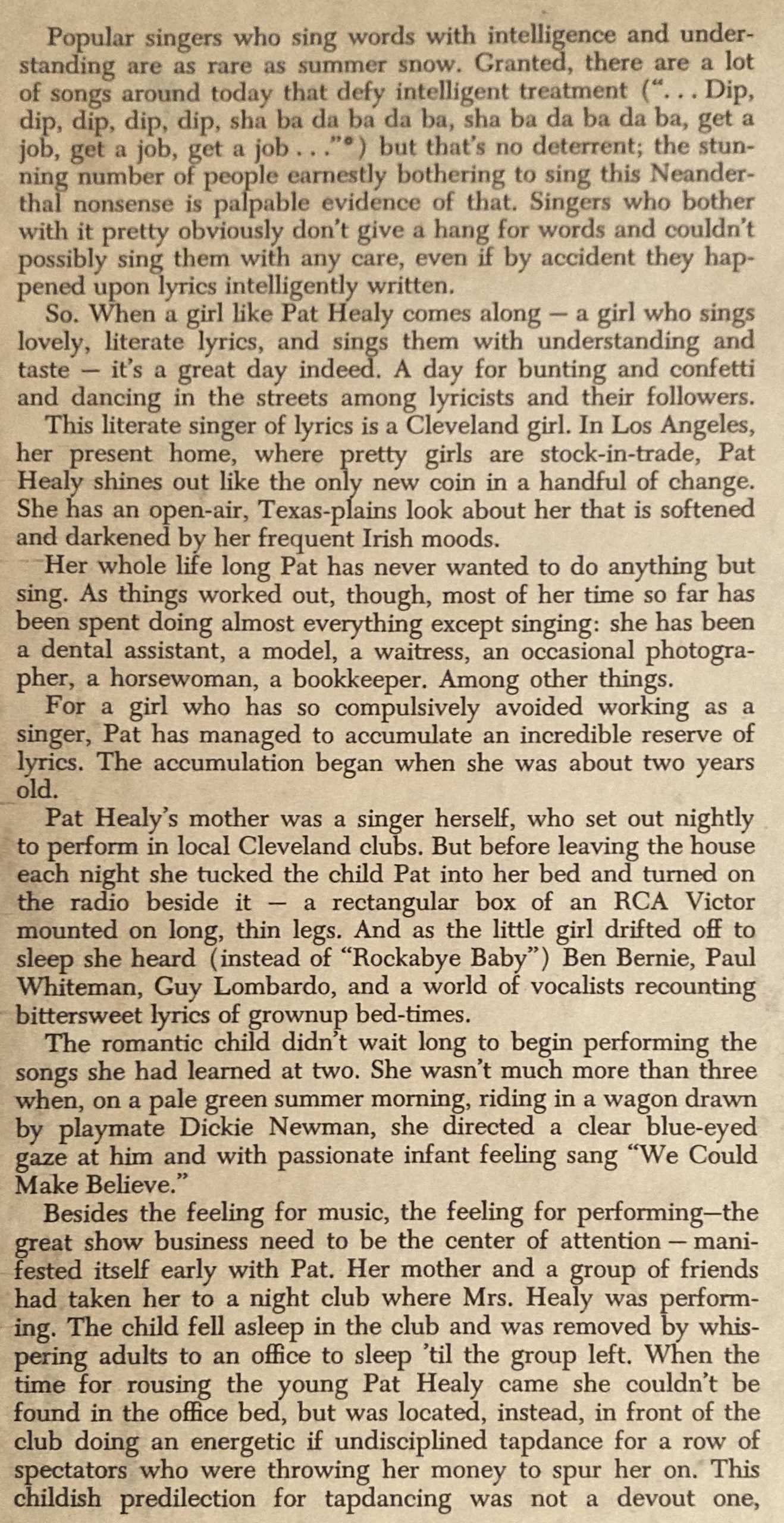
Popular singers who sing words with intelligence and under- standing are as rare as summer snow. Granted, there are a lot of songs around today that defy intelligent treatment (“… Dip, dip, dip, dip, dip, sha ba da ba da ba, sha ba da ba da ba, get a job, get a job, get a job…”) but that’s no deterrent; the stun- ning number of people earnestly bothering to sing this Neander- thal nonsense is palpable evidence of that. Singers who bother with it pretty obviously don’t give a hang for words and couldn’t possibly sing them with any care, even if by accident they hap- pened upon lyrics intelligently written.
So. When a girl like Pat Healy comes along – a girl who sings lovely, literate lyrics, and sings them with understanding and taste it’s a great day indeed. A day for bunting and confetti and dancing in the streets among lyricists and their followers. This literate singer of lyrics is a Cleveland girl. In Los Angeles, her present home, where pretty girls are stock-in-trade, Pat Healy shines out like the only new coin in a handful of change. She has an open-air, Texas-plains look about her that is softened and darkened by her frequent Irish moods.
Her whole life long Pat has never wanted to do anything but sing. As things worked out, though, most of her time so far has been spent doing almost everything except singing: she has been a dental assistant, a model, a waitress, an occasional photogra- pher, a horsewoman, a bookkeeper. Among other things.
For a girl who has so compulsively avoided working as a singer, Pat has managed to accumulate an incredible reserve of lyrics. The accumulation began when she was about two years old.
Pat Healy’s mother was a singer herself, who set out nightly to perform in local Cleveland clubs. But before leaving the house each night she tucked the child Pat into her bed and turned on the radio beside it – a rectangular box of an RCA Victor mounted on long, thin legs. And as the little girl drifted off to sleep she heard (instead of “Rockabye Baby”) Ben Bernie, Paul Whiteman, Guy Lombardo, and a world of vocalists recounting bittersweet lyrics of grownup bed-times.
The romantic child didn’t wait long to begin performing the songs she had learned at two. She wasn’t much more than three when, on a pale green summer morning, riding in a wagon drawn by playmate Dickie Newman, she directed a clear blue-eyed gaze at him and with passionate infant feeling sang “We Could Make Believe.”
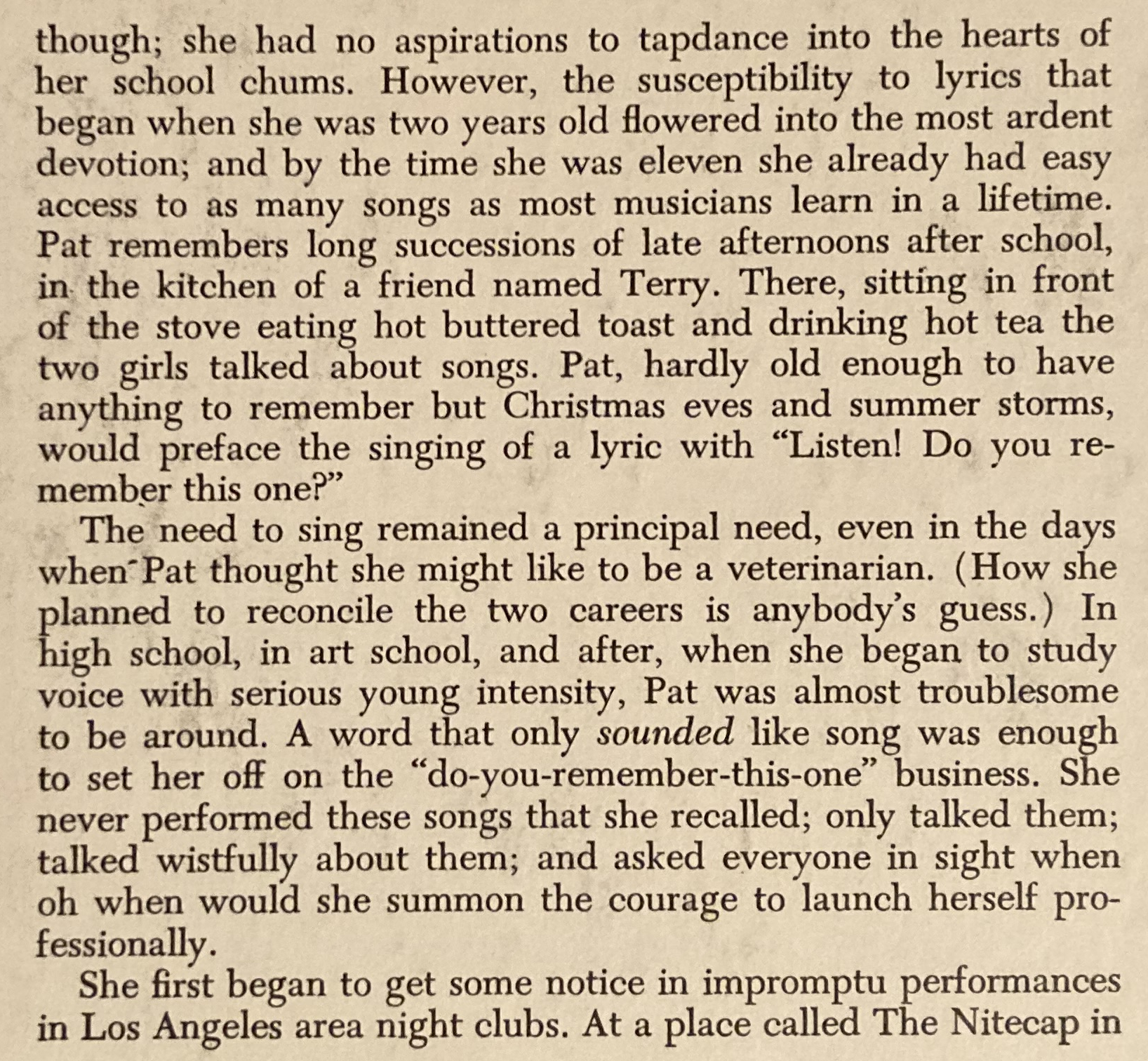
Besides the feeling for music, the feeling for performing-the great show business need to be the center of attention – mani- fested itself early with Pat. Her mother and a group of friends had taken her to a night club where Mrs. Healy was perform- ing. The child fell asleep in the club and was removed by whis- pering adults to an office to sleep ‘til the group left. When the time for rousing the young Pat Healy came she couldn’t be found in the office bed, but was located, instead, in front of the club doing an energetic if undisciplined tapdance for a row of spectators who were throwing her money to spur her on. This childish predilection for tapdancing was not a devout one,
though; she had no aspirations to tapdance into the hearts of her school chums. However, the susceptibility to lyrics that began when she was two years old flowered into the most ardent devotion; and by the time she was eleven she already had easy access to as many songs as most musicians learn in a lifetime. Pat remembers long successions of late afternoons after school, in the kitchen of a friend named Terry. There, sitting in front of the stove eating hot buttered toast and drinking hot tea the two girls talked about songs. Pat, hardly old enough to have anything to remember but Christmas eves and summer storms, would preface the singing of a lyric with “Listen! Do you re- member this one?”
The need to sing remained a principal need, even in the days when Pat thought she might like to be a veterinarian. (How she planned to reconcile the two careers is anybody’s guess.) In high school, in art school, and after, when she began to study voice with serious young intensity, Pat was almost troublesome to be around. A word that only sounded like song was enough to set her off on the “do-you-remember-this-one” business. She never performed these songs that she recalled; only talked them; talked wistfully about them; and asked everyone in sight when oh when would she summon the courage to launch herself pro- fessionally.
She first began to get some notice in impromptu performances in Los Angeles area night clubs. At a place called The Nitecap in Glendale, Pat used to go to hear Diana Gale, a fine singer her- self with discriminating musical taste. Pat haunted the place, recalling lyrics with Diana somewhat as she had with her friend Terry. If the drinks were different from those ip Terry’s kitchen, and the atmosphere, the attitude was the same: intense and bittersweet. One night, in a rare burst of courage, she sang for the people in The Nitecap. They applauded with such fervor that Pat returned to the place to sing as faithfully as if she were being graded on attendance.
A piano player named Joe Marino, who knows nearly every good song ever written, and is passionately willing to learn those he doesn’t know, used to haunt The Nitecap himself. There he heard Pat, and spirited her away now and then to sing where he was playing. People continued to clap for her and to ask for more. The unflagging praise she met everywhere she sang invested Pat with uncommon derring-do, so that in the summer of 1957 she gathered herself together and began to emerge.
Tired of asking herself and everyone else when she would sing, tired of getting up daily to go to a job she abhorred, she quit the job she was holding, and began the wearisome business of promoting herself. Fortunately, she didn’t have to promote long or hard. Jimmy Baker, the producer of the “Stars of Jazz” show heard some tapes Pat had made and signed her to a guest appearance, her first really professional appearance anywhere. Dick Bock, of World-Pacific Records, heard the show’s tapes and liked the way Pat Healy sounded. He signed her to do an album -this one-and away she went. The girl who had frittered away too much time over a dentist’s drill or a ledger was suddenly happy in her work.
Dick gave Pat Healy complete freedom in selecting her songs. She reacted to the freedom the way little boys turned loose with a mail order catalogue react: giddily and with infinite joy. If the songs she selected seem far from giddy, far from joyous, it’s because she’s an incredibly romantic girl to whom the melan- choly in love, rain, and soft spring days is sweet.
Pat still spends hours recalling songs. Still, a little like the Ancient Mariner, she stops passers-by and questions them in- tently about this song or that. But there’s a new quality in her remembering: happiness. She’s singing for a living now, so the songs she knows, the taste and understanding she’s able to bring to the singing of them no longer needs to be dissipated in wist- fulness, in asking anxiously when. Hoorah! At last the Cleveland girl has an occupational niche. – Rita Kirwan
Photographs by William Claxton Cover design: Art Directions
A Richard Bock Production
*Courtesy of Wild Cat Music and Ulysses and Bagby Music.
TECHNICAL DATA:
This is a Strobophonic High Fidelity recording with a frequency response of 30 to 15,000 cycles per second. Users of wide range equip- ment should employ the RIAA or NARTB curve position.
<裏ジャケ和訳>
歌詞を理解し、知性をもって歌うポピュラー歌手というのは、まるで「夏の雪」のように珍しい存在だ。確かに、今日世にあふれる歌の中には、知的な解釈など受け付けないようなものも多い(「……ディップ、ディップ、ディップ、ディップ、ディップ、シャ・バ・ダ・バ・ダ・バ、シャ・バ・ダ・バ・ダ・バ、ゲット・ア・ジョブ、ゲット・ア・ジョブ、ゲット・ア・ジョブ……」といった具合に)。だが、そんなことは何の障害にもなっていない。ネアンデルタール人レベルのナンセンスな歌詞を、わざわざ真剣に歌っている人々の驚くべき多さが、その何よりの証拠だ。こうした歌を歌う連中は、歌詞などどうでもいいと考えているのが明白であり、たとえ偶然、知的な歌詞に出くわしたとしても、それを丁寧に歌うことなど到底できないだろう。
だからこそ、パット・ヒーリーのような女性が現れると、本当に素晴らしい日だと言いたくなる。作詞家やそのファンたちが、街中で旗を掲げ、紙吹雪を撒き散らし、踊り出したくなるような日だ。この「歌詞を大切に歌う歌手」は、クリーブランド出身の女性である。現在暮らしているロサンゼルスは、美しい女性がいくらでもいる街だが、その中でパット・ヒーリーは、小銭の山に紛れ込んだ、たった一枚の真新しい硬貨のように際立っている。彼女には、テキサスの大平原を思わせる開放的な雰囲気があり、そこにアイルランド系特有の気質が加わって、どこか柔らかく、陰影のある表情を醸し出している。
パットは幼い頃から、歌うこと以外は何もしたくないと願ってきた。ところが実際には、これまでの人生の大半を、歌うこと以外のあらゆる仕事に費やしてきた。歯科助手、モデル、ウェイトレス、時折カメラマン、乗馬、簿記係……といった具合に。
歌手として働くことをこれほどまでに避けてきたにもかかわらず、パットは驚くほど膨大な歌詞を蓄積してきた。その蓄積は、彼女がまだ2歳くらいの頃から始まっていた。
パット・ヒーリーの母親も歌手で、毎晩クリーブランドの地元のクラブに出演していた。母親は家を出る前、幼いパットをベッドに寝かせると、その脇に置かれたラジオのスイッチを入れていった。それはRCAビクター製の、細長い脚がついた箱型のラジオだった。小さな女の子が眠りに落ちていくとき、彼女の耳には(「ロッカバイ・ベイビー」のような子守唄の代わりに)ベン・バーニー、ポール・ホワイトマン、ガイ・ロンバード、そして数多くの歌手たちが歌う、大人の夜の情景を綴った、ほろ苦くも甘い歌詞の数々が響いていた。
ロマンチックな感性を持つその子は、2歳のときに覚えた歌を披露するようになるまで、そう長くはかからなかった。まだ3歳を過ぎたばかりのある淡い緑色の夏の朝、遊び友達のディッキー・ニューマンが引く荷車に乗っていた彼女は、澄んだ青い瞳で彼を見つめると、幼いながらも情熱を込めて「ウィ・クッド・メイク・ビリーブ(We Could Make Believe)」を歌った。
音楽への感性に加え、パフォーマンスへの衝動――つまり、ショービジネスの世界で不可欠な「注目を集めたい」という欲求――も、パットの場合は早くから現れていた。あるとき、母親と友人たちが彼女をナイトクラブへ連れて行った。そこではヒーリー夫人がステージに立っていた。パットはその店で眠ってしまい、大人たちにそっと抱え上げられて事務所のベッドへ運ばれ、一行が帰るまでそこで眠ることになった。ところが、いざパット・ヒーリーを起こそうとしたとき、彼女は事務所のベッドにはいなかった。なんと彼女は店の前にいて、観客を前に、型破りながらもエネルギッシュなタップダンスを披露していたのだ。観客たちは、彼女をさらに盛り上げようと、次々にお金を投げ与えていた。とはいえ、このタップダンスに対する子供らしい熱中ぶりは、それほど真剣なものではなかった。学校の友達の心をタップダンスで掴もうなどという野心は、彼女にはなかったのだ。しかし、2歳の頃から芽生えていた「歌詞」に対する感受性は、やがて非常に熱烈な情熱へと花開いた。11歳になる頃には、彼女は、多くのミュージシャンが一生かかって習得するほどの膨大な数の歌を、すでに自分のものにしていた。パットは、放課後の長い午後を、テリーという友人の家のキッチンで過ごしたことをよく覚えている。ストーブの前に座り、バターを塗った熱々のトーストをかじりながら、温かいお茶を飲む。そんなふうにして、二人の少女は歌について語り合った。まだクリスマス・イブや夏の嵐くらいしか記憶に残るような出来事を知らないはずのパットが、歌を披露する前には決まってこう言ったものだ。「ねえ、聞いて! この歌、覚えてる?」
パットは、獣医になりたいと考えていた時期でさえ、歌うことへの欲求を根源的なものとして抱え続けていた。(その二つの道をどう両立させるつもりだったのかは、誰にもわからない。)高校時代、美術学校時代、そしてその後、若さゆえの真剣さで本格的に声楽を学び始めた頃のパットは、周囲にとって少々厄介な存在ですらあった。歌の一節を思わせるような言葉を誰かが口にするだけで、彼女はすぐに「これ、覚えてる?」と話を切り出すのだ。もっとも、彼女は思い出した歌を実際に歌うことはなく、ただ言葉で語り、懐かしそうにその歌について話し、出会う人ごとに「一体いつになったら、プロとして踏み出す勇気を持てるのかしら」と問いかけていた。
彼女が初めて注目を集め始めたのは、ロサンゼルス近郊のナイトクラブでの即興的なパフォーマンスがきっかけだった。グレンデールにある「ザ・ナイトキャップ(The Nitecap)」という店に、パットはよく通っていた。そこには、優れた音楽的センスを持つ素晴らしい歌手、ダイアナ・ゲイルが出演していたからだ。パットは足繁くその店に通い、かつて友人テリーとそうしたように、ダイアナと一緒に歌詞を思い起こしては語り合っていた。テリーのキッチンで飲んだものとは飲み物の種類こそ違えど、そこに漂う雰囲気や姿勢は同じだった。それは、情熱的でありながら、どこかほろ苦いものだった。ある夜、珍しく勇気を振り絞ったパットは、「ザ・ナイトキャップ」の客たちの前で歌を披露した。客たちは熱烈な拍手を送り、それ以来パットは、まるで出席状況を採点されているかのように、足繁くその店に通って歌うようになった。
ジョー・マリノという名のピアニストもまた、「ザ・ナイトキャップ」の常連だった。彼は、これまでに書かれた優れた楽曲のほとんどを知り尽くしており、知らない曲があれば熱心に覚えようとする人物だった。彼はそこでパットの歌声を耳にし、時折彼女を連れ出しては、自分が演奏する場所で歌わせるようになった。聴衆は彼女に拍手を送り続け、さらなる歌を求めた。どこで歌っても絶賛されることで、パットには並外れた大胆さが備わっていった。そして1957年の夏、彼女はついに決意を固め、本格的に表舞台へと歩み出し始めた。
「いつになったら歌うのか」と自分自身や周囲に問い続けることにも、嫌でたまらない仕事へ毎日出向くことにも疲れ果てていた彼女は、その仕事を辞め、自分自身を売り込むという骨の折れる作業に取り掛かったのである。幸いなことに、彼女は長い間、懸命に売り込み活動をする必要はなかった。テレビ番組『スターズ・オブ・ジャズ(Stars of Jazz)』のプロデューサー、ジミー・ベーカーがパットの録音テープを耳にし、彼女をゲストとして出演させたのだ。これが彼女にとって、本格的なプロとしての初仕事となった。さらに、ワールド・パシフィック・レコードのディック・ボックがその番組のテープを聴いてパット・ヒーリーの歌声を気に入り、アルバム(本作)の制作契約を持ちかけた。こうして彼女のキャリアが始まった。かつて歯科医院のドリル音や帳簿の数字を相手に、あまりにも多くの時間を無為に過ごしてしまった彼女は、今、ようやく自分の仕事に心からの喜びを見出している。
ディック・ボックは、パット・ヒーリーに選曲の全権を委ねた。この自由を与えられた彼女の反応は、まるで通信販売のカタログを渡された少年が歓喜に沸くかのように、実に生き生きとして、この上なく楽しげなものだった。もし彼女が選んだ曲が、決して浮かれたり楽しげだったりするものではないように思えるとしても、それは彼女が非常にロマンチックな感性の持ち主だからだ。彼女にとって、恋に伴う憂鬱や、雨、そして穏やかな春の日差しといったものは、すべて甘美なものとして感じられるのである。
パットは今でも、時間をかけて過去の歌を思い起こそうとする。まるで「老水夫」のように、通りがかりの人を呼び止めては、この曲やあの曲について熱心に尋ねたりもする。しかし、彼女が記憶をたどるその姿には、以前とは違う新しい要素が加わっている。それは「幸福感」だ。彼女は今、歌うことを生業としている。だからこそ、彼女が知っている数々の歌や、それらを歌う際に発揮されるセンスや深い理解は、もはや「いつになったら歌えるのだろう」といった切ない思いや不安の中に消えてしまうことはない。やったね!クリーブランド出身の彼女は、ついに自分にぴったりの居場所を見つけたのだ。――リタ・カーワン
写真:ウィリアム・クラクストン カバー・デザイン:アート・ディレクションズ
プロデュース:リチャード・ボック
*音源提供:ワイルド・キャット・ミュージック(Wild Cat Music)、ユリシーズ・アンド・バグビー・ミュージック(Ulysses and Bagby Music)
技術データ:
本作は「ストロボフォニック・ハイ・フィデリティ(Strobophonic High Fidelity)」方式で録音されており、周波数特性は30〜15,000サイクル/秒(Hz)をカバーしています。ワイドレンジ対応の再生機器をご使用の際は、RIAAまたはNARTBカーブの設定を選択してください。
※訳文の制作にはGoogleドライブとGoogle翻訳のお世話になりました。
コメント