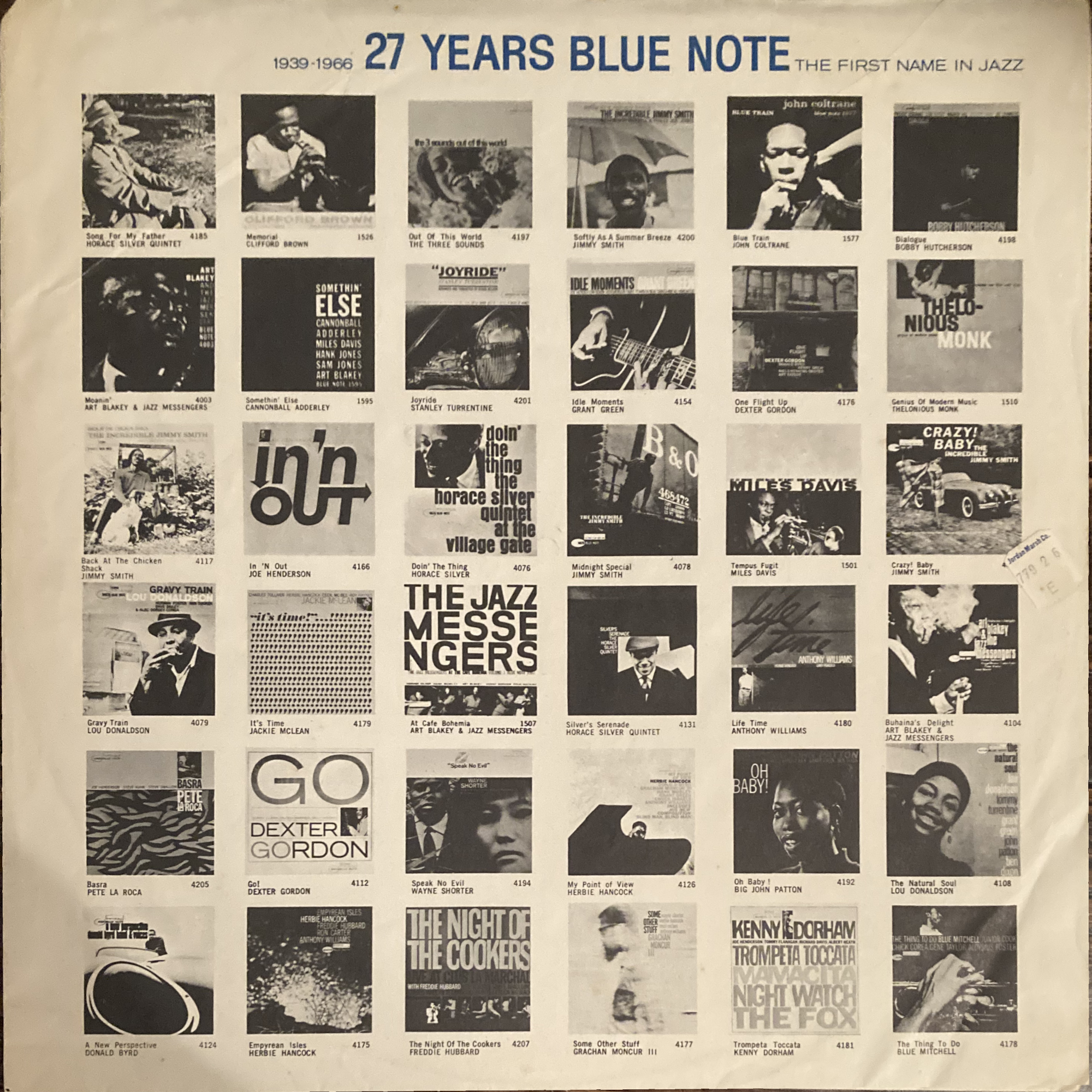
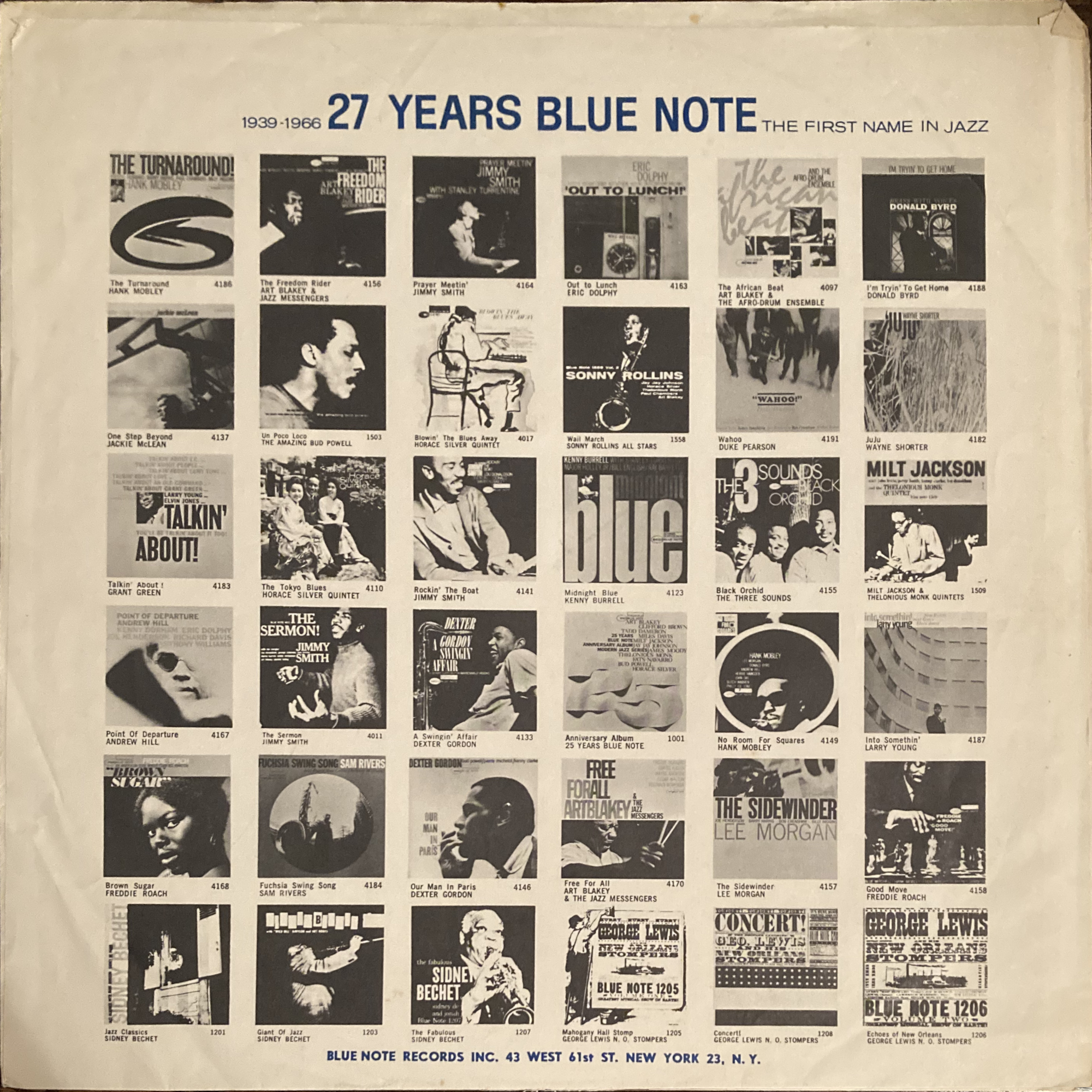
Label: BLUE NOTE
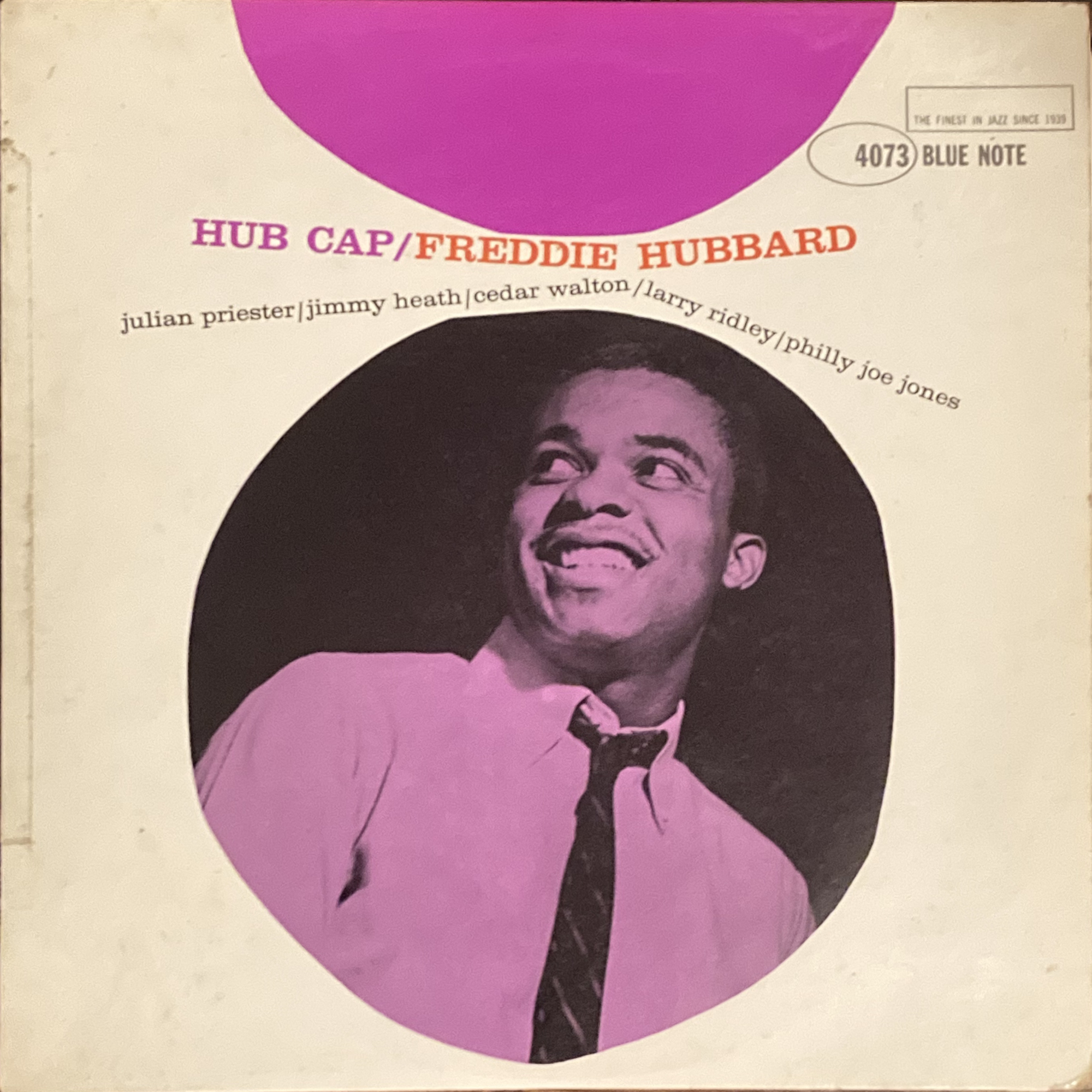
No.: BLP 4073
Title: HUB CAP
Musician: FREDDIE HUBBARD
Recorded: 1961/4/9
Monaural
Cover address: 43 West 61st St, New York 23, INC
Laminate Coating
Groove Guard
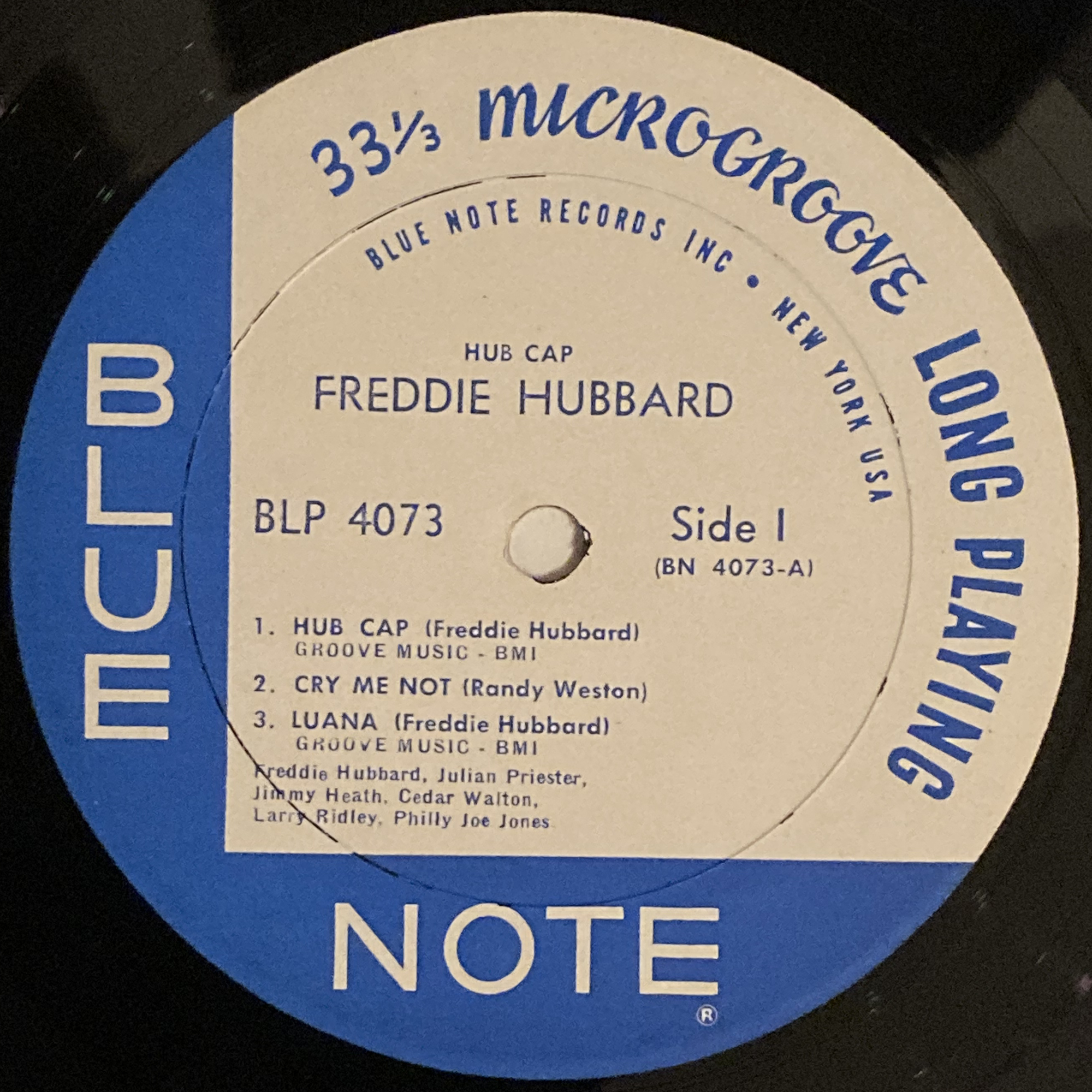
Label Side-1
Blue & White Background
White & Blue Letter, INC&R
Address: NEW YORK USA
Deep Groove無し
Dead Wax Info: RVGスタンプ, BN-LP-4073-A, 2dot
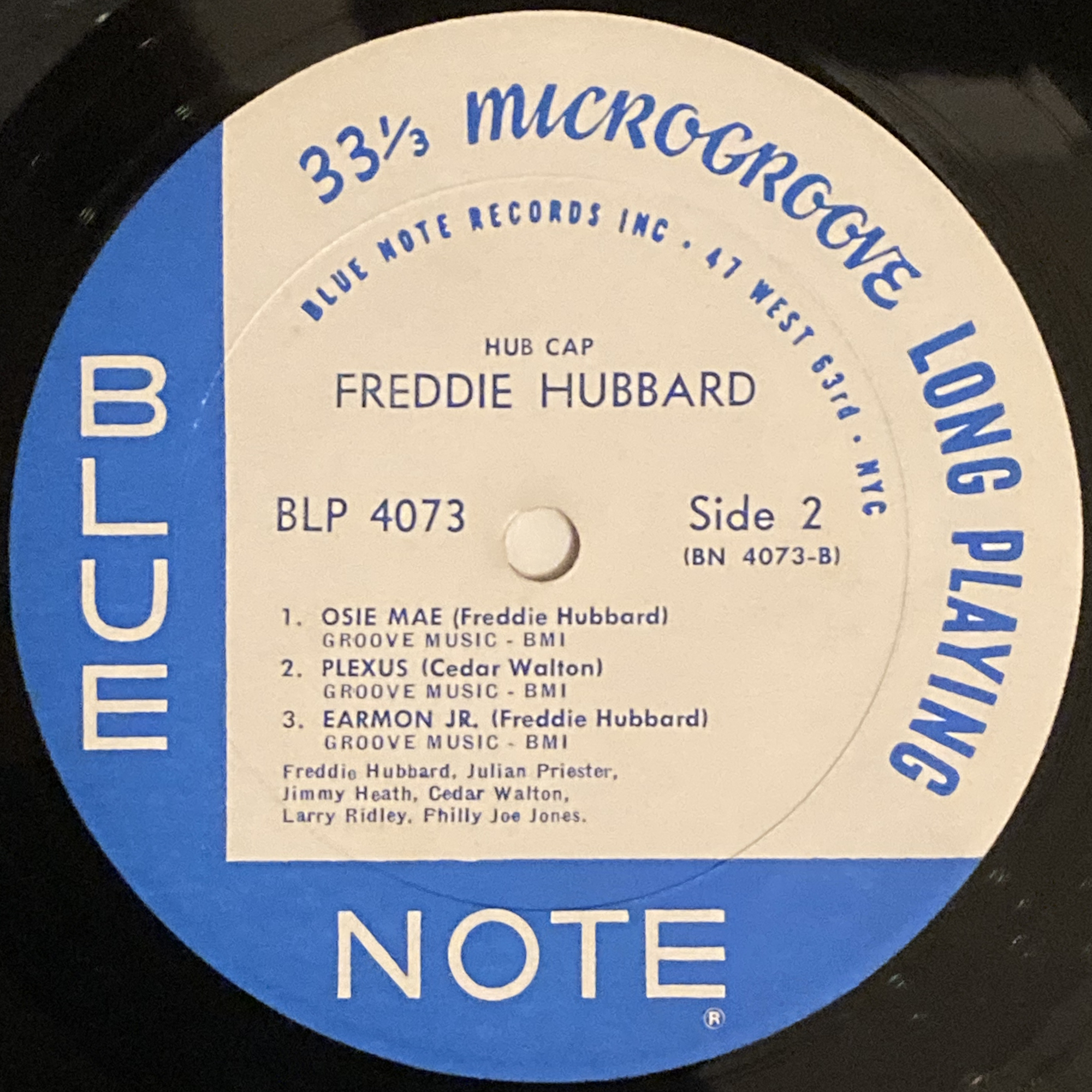
Label Side-2
Blue & White Background
White & Blue Letter, No INC&R
Address: 47 WEST 63rd, NYC
Deep Groove無し
Dead Wax Info: RVGスタンプ, BN-LP-4073-B, 1dot
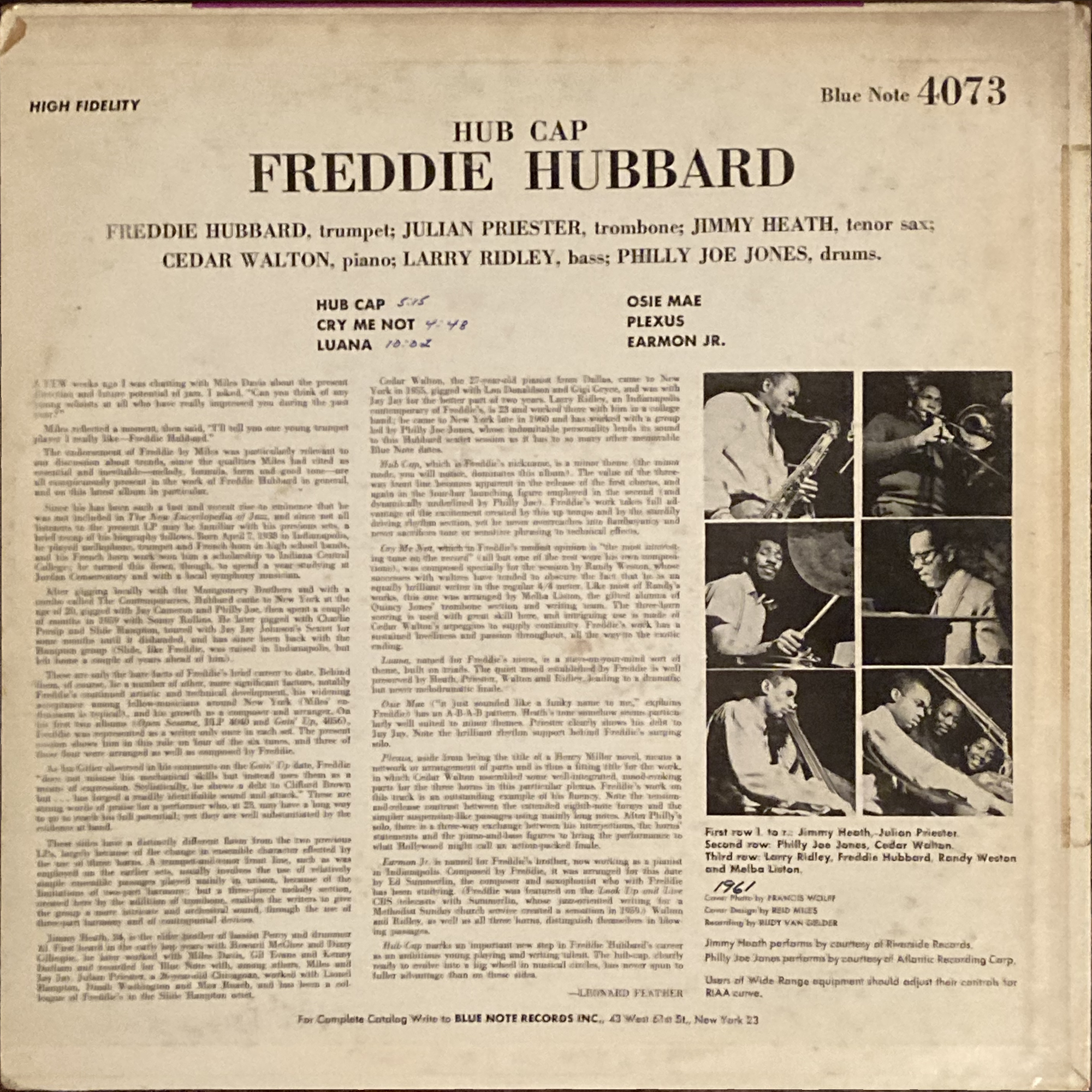
Personnel-
Drums: Philly Joe Jones
Bass: Larry Ridley
Piano: Cedar Walton
Tenor Sax: Jimmy Heath
Trumpet: Freddie Hubbard
Trombone: Julian Priester
Tracks-
Side-1
1) Hub Cap
2) Cry Me Not
3) Luana
Side-2
1) Osie Mae
2) Plexus
3) Earmon Jr.
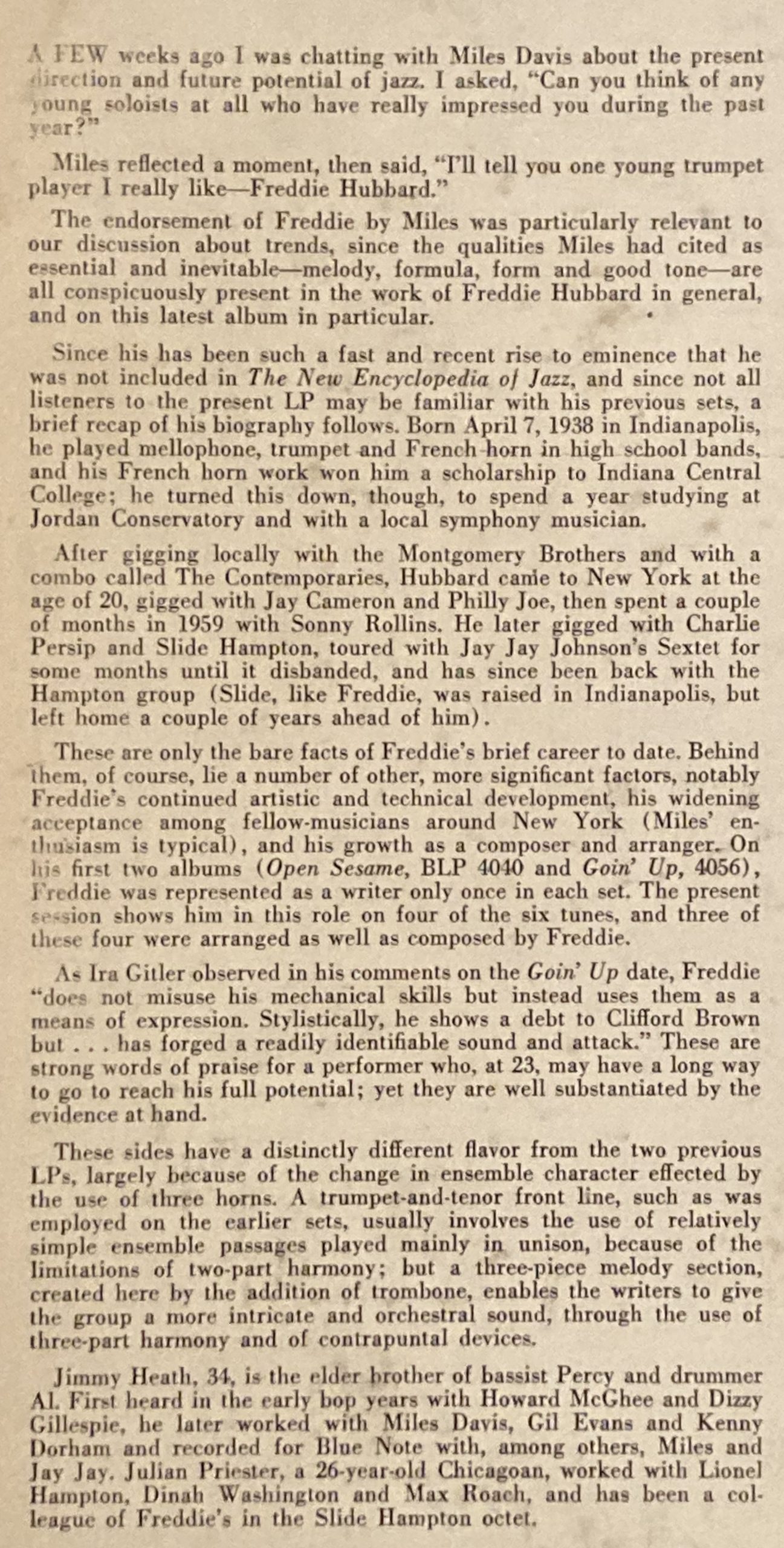
<裏ジャケ原文>
A FEW weeks ago I was chatting with Miles Davis about the present direction and future potential of jazz. I asked, “Can you think of any young soloists at all who have really impressed you during the past year?”
Miles reflected a moment, then said, “I’ll tell you one young trumpet player I really like-Freddie Hubbard.”
The endorsement of Freddie by Miles was particularly relevant to our discussion about trends, since the qualities Miles had cited as essential and inevitable-melody, formula, form and good tone-are all conspicuously present in the work of Freddie Hubbard in general, and on this latest album in particular.
Since his has been such a fast and recent rise to eminence that he was not included in The New Encyclopedia of Jazz, and since not all listeners to the present LP may be familiar with his previous sets, a brief recap of his biography follows. Born April 7, 1938 in Indianapolis, he played mellophone, trumpet and French horn in high school bands, and his French horn work won him a scholarship to Indiana Central College; he turned this down, though, to spend a year studying at Jordan Conservatory and with a local symphony musician.
After gigging locally with the Montgomery Brothers and with a combo called The Contemporaries, Hubbard came to New York at the age of 20, gigged with Jay Cameron and Philly Joe, then spent a couple of months in 1959 with Sonny Rollins. He later gigged with Charlie Persip and Slide Hampton, toured with Jay Jay Johnson’s Sextet for some months until it disbanded, and has since been back with the Hampton group (Slide, like Freddie, was raised in Indianapolis, but left home a couple of years ahead of him).
These are only the bare facts of Freddie’s brief career to date. Behind them, of course, lie a number of other, more significant factors, notably Freddie’s continued artistic and technical development, his widening acceptance among fellow-musicians around New York (Miles’ en- thusiasm is typical), and his growth as a composer and arranger. On his first two albums (Open Sesame, BLP 4040 and Goin’ Up, 4056), Freddie was represented as a writer only once in each set. The present session shows him in this role on four of the six tunes, and three of these four were arranged as well as composed by Freddie.
As Ira Gitler observed in his comments on the Goin’ Up date, Freddie “does not misuse his mechanical skills but instead uses them as a means of expression. Stylistically, he shows a debt to Clifford Brown but… has forged a readily identifiable sound and attack.” These are strong words of praise for a performer who, at 23, may have a long way to go to reach his full potential; yet they are well substantiated by the evidence at hand.
These sides have a distinctly different flavor from the two previous LPs, largely because of the change in ensemble character effected by the use of three horns. A trumpet-and-tenor front line, such as was employed on the earlier sets, usually involves the use of relatively simple ensemble passages played mainly in unison, because of the limitations of two-part harmony; but a three-piece melody section, created here by the addition of trombone, enables the writers to give the group a more intricate and orchestral sound, through the use of three-part harmony and of contrapuntal devices.
Jimmy Heath, 34, is the elder brother of bassist Percy and drummer Al. First heard in the early bop years with Howard McGhee and Dizzy Gillespie, he later worked with Miles Davis, Gil Evans and Kenny Dorham and recorded for Blue Note with, among others, Miles and Jay Jay, Julian Priester, a 26-year-old Chicagoan, worked with Lionel Hampton, Dinah Washington and Max Roach, and has been a col- league of Freddie’s in the Slide Hampton octet.
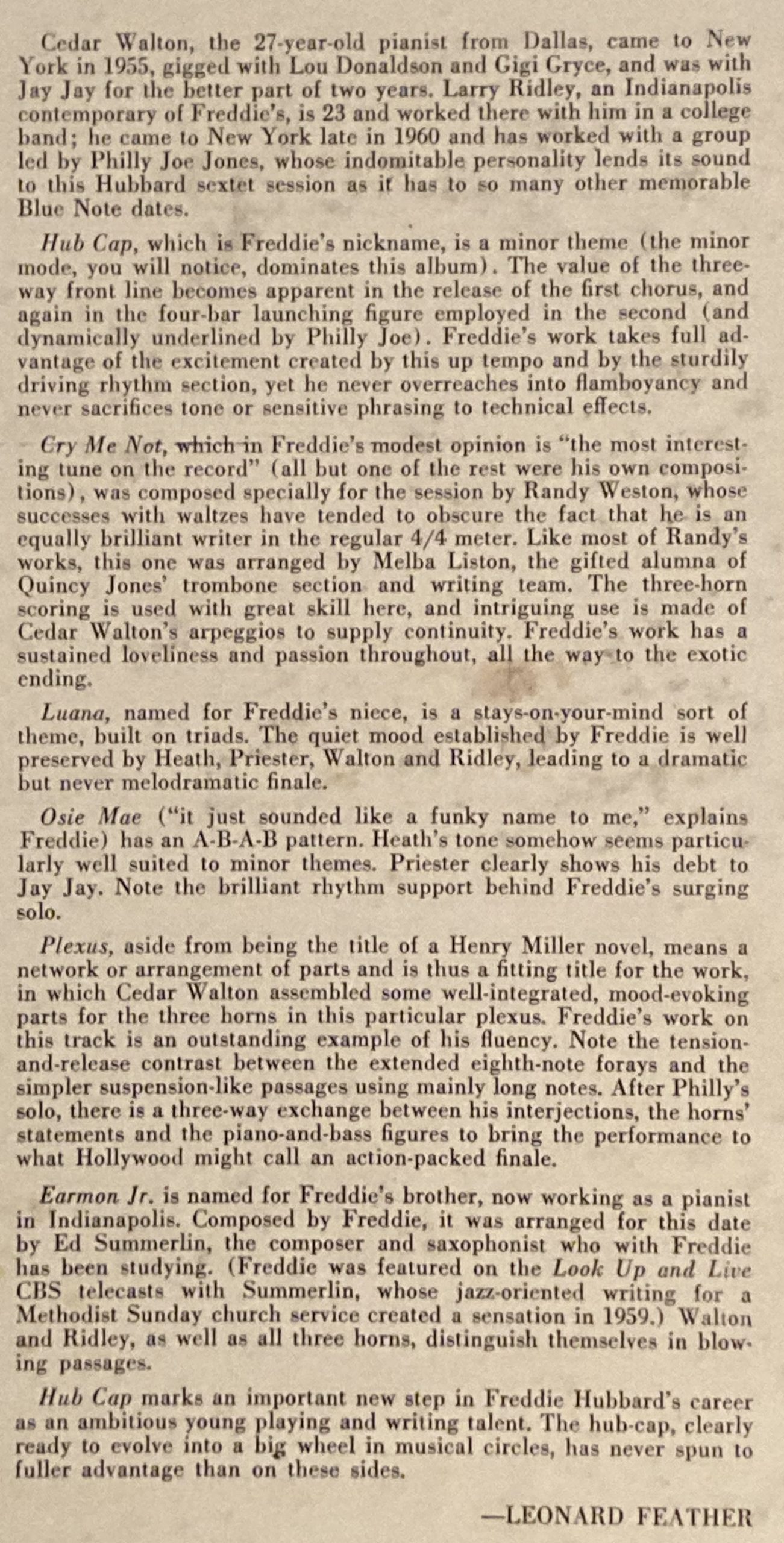
Cedar Walton, the 27-year-old pianist from Dallas, came to New York in 1955, gigged with Lou Donaldson and Gigi Gryce, and was with Jay Jay for the better part of two years. Larry Ridley, an Indianapolis contemporary of Freddie’s, is 23 and worked there with him in a college band; he came to New York late in 1960 and has worked with a group led by Philly Joe Jones, whose indomitable personality lends its sound to this Hubbard sextet session as it has to so many other memorable Blue Note dates.
Hub Cap, which is Freddie’s nickname, is a minor theme (the minor mode, you will notice, dominates this album). The value of the three- way front line becomes apparent in the release of the first chorus, and again in the four-bar launching figure employed in the second (and dynamically underlined by Philly Joe). Freddie’s work takes full ad- vantage of the excitement created by this up tempo and by the sturdily driving rhythm section, yet he never overreaches into flamboyancy and never sacrifices tone or sensitive phrasing to technical effects.
Cry Me Not, which in Freddie’s modest opinion is “the most interest- ing tune on the record” (all but one of the rest were his own composi- tions), was composed specially for the session by Randy Weston, whose successes with waltzes have tended to obscure the fact that he is an equally brilliant writer in the regular 4/4 meter. Like most of Randy’s works, this one was arranged by Melba Liston, the gifted alumna of Quincy Jones’ trombone section and writing team. The three-horn scoring is used with great skill here, and intriguing use is made of Cedar Walton’s arpeggios to supply continuity. Freddie’s work has a sustained loveliness and passion throughout, all the way to the exotic ending.
Luana, named for Freddie’s niece, is a stays-on-your-mind sort of theme, built on triads. The quiet mood established by Freddie is well preserved by Heath, Priester, Walton and Ridley, leading to a dramatic but never melodramatic finale.
Osie Mae (“it just sounded like a funky name to me,” explains Freddie) has an A-B-A-B pattern. Heath’s tone somehow seems particu larly well suited to minor themes. Priester clearly shows his debt to Jay Jay. Note the brilliant rhythm support behind Freddie’s surging solo.
Plexus, aside from being the title of a Henry Miller novel, means a network or arrangement of parts and is thus a fitting title for the work, in which Cedar Walton assembled some well-integrated, mood-evoking parts for the three horns in this particular plexus. Freddie’s work on this track is an outstanding example of his fluency. Note the tension- and-release contrast between the extended eighth-note forays and the simpler suspension-like passages using mainly long notes. After Philly’s solo, there is a three-way exchange between his interjections, the horns’ statements and the piano-and-bass figures to bring the performance to what Hollywood might call an action-packed finale.
Earmon Jr. is named for Freddie’s brother, now working as a pianist in Indianapolis. Composed by Freddie, it was arranged for this date by Ed Summerlin, the composer and saxophonist who with Freddie. has been studying. (Freddie was featured on the Look Up and Live CBS telecasts with Summerlin, whose jazz-oriented writing for a Methodist Sunday church service created a sensation in 1959.) Walton and Ridley, as well as all three horns, distinguish themselves in blow- ing passages.
Hub Cap marks an important new step in Freddie Hubbard’s career as an ambitious young playing and writing talent. The hub-cap, clearly ready to evolve into a big wheel in musical circles, has never spun to fuller advantage than on these sides.
-LEONARD FEATHER
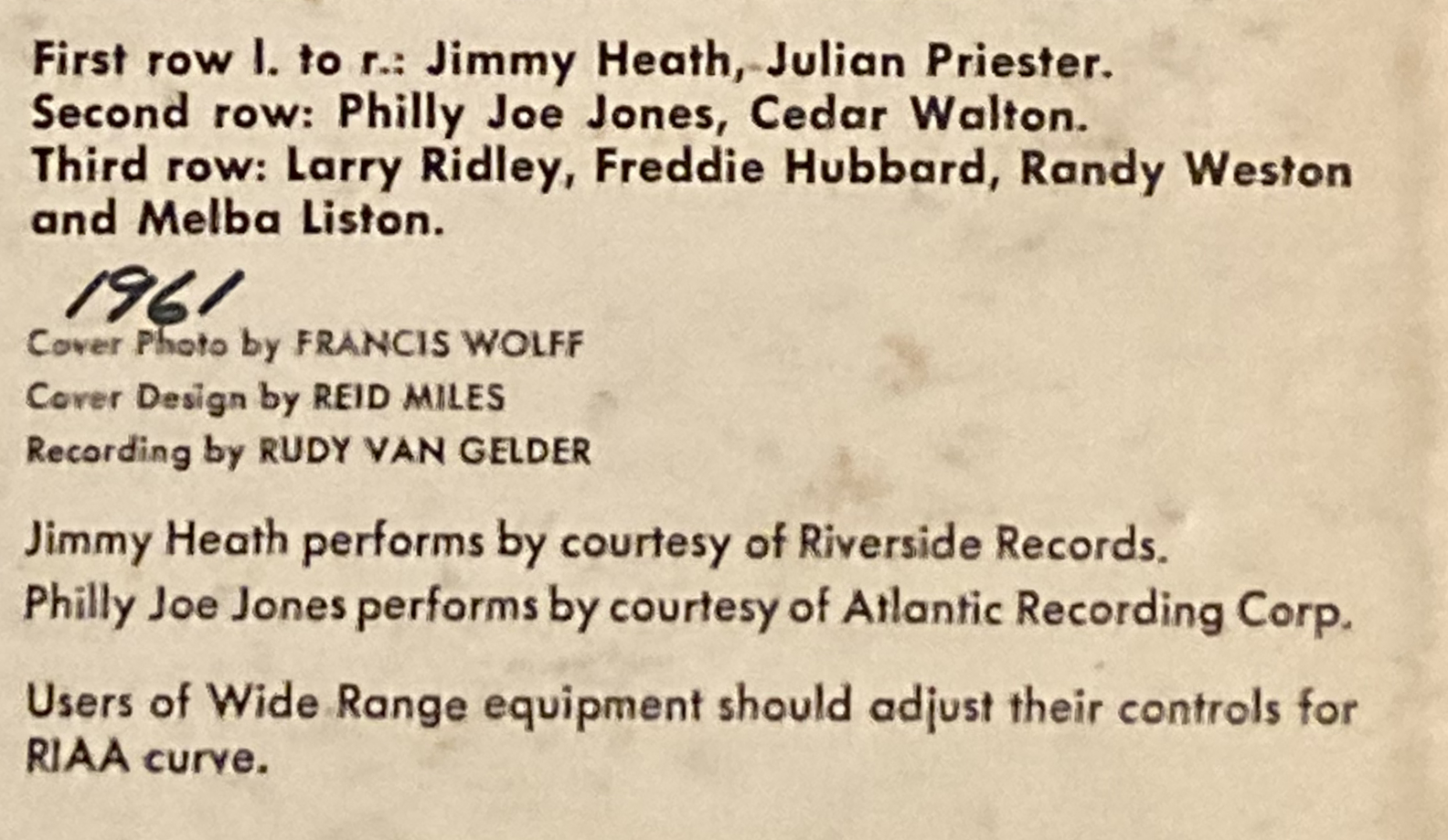
First row I. to r.: Jimmy Heath, Julian Priester. Second row: Philly Joe Jones, Cedar Walton. Third row: Larry Ridley, Freddie Hubbard, Randy Weston and Melba Liston.
Cover Photo by FRANCIS WOLFF
Cover Design by REID MILES
Recording by RUDY VAN GELDER
Jimmy Heath performs by courtesy of Riverside Records.
Philly Joe Jones performs by courtesy of Atlantic Recording Corp.
Users of Wide Range equipment should adjust their controls for RIAA curve.
<裏ジャケ和訳>
数週間前、私はマイルス・デイヴィスと、ジャズの現在の方向性と将来の可能性について語り合っていた。その際、私は彼にこう尋ねてみた。「この1年で、本当に感銘を受けた若いソリストはいますか?」
マイルスは少し考えた末にこう言った。「一人、すごく気に入っている若いトランペット奏者がいるよ。フレディ・ハバードだ」
マイルスがフレディを高く評価したことは、我々が議論していた「ジャズの潮流」というテーマにおいて、非常に重要な意味を持っていた。というのも、マイルスがジャズに不可欠かつ必然的な要素として挙げた「メロディ、定型(フォーミュラ)、形式、そして優れた音色」といった資質が、フレディ・ハバードの演奏には顕著に表れているからだ。それは彼の全般的な作品において言えることだが、特にこの最新アルバムではそれが際立っている。
フレディがスターダムにのし上がったのはごく最近のことであり、非常に急速なものだったため、『ニュー・ジャズ百科事典(The New Encyclopedia of Jazz)』には掲載されていない。また、このLPを聴くリスナー全員が彼の過去の作品を知っているとは限らないだろう。そこで、彼の経歴を簡単に振り返っておこう。1938年4月7日、インディアナポリス生まれ。高校のバンドではメロフォン、トランペット、フレンチ・ホルンを担当し、フレンチ・ホルンの腕前が評価されてインディアナ・セントラル・カレッジへの奨学金を獲得した。しかし彼はそれには進まず、ジョーダン音楽院で1年間学び、地元の交響楽団の奏者からも指導を受けた。
地元でモンゴメリー・ブラザーズや「ザ・コンテンポラリーズ」といったコンボで演奏した後、20歳でニューヨークへ進出。ジェイ・キャメロンやフィリー・ジョー・ジョーンズらと共演し、1959年にはソニー・ロリンズのグループで数ヶ月間活動した。その後、チャーリー・パーシップやスライド・ハンプトンと共演し、J・J・ジョンソンのセクステットが解散するまで数ヶ月間ツアーに参加した。その後は再びスライド・ハンプトンのグループに戻っている(スライドもフレディと同じくインディアナポリス出身だが、フレディより数年早く故郷を離れている)。
これらは、フレディのこれまでの短いキャリアにおける単なる事実の羅列に過ぎない。もちろん、その背後には、より重要な要素がいくつも存在する。例えば、芸術面および技術面における絶え間ない成長、ニューヨークのミュージシャン仲間からの評価の高まり(マイルスの熱烈な評価がその好例だ)、そして作曲家・編曲家としての飛躍などが挙げられるだろう。フレディは、自身の最初の2枚のアルバム(『Open Sesame』BLP 4040、および『Goin’ Up』4056)において、それぞれ1曲ずつ作曲者として名を連ねていた。今回のセッションでは、全6曲中4曲で彼が作曲を手がけており、そのうち3曲については編曲も彼自身が行っている。
アイラ・ギトラーは『Goin’ Up』のライナーノーツの中で、フレディについて次のように指摘している。「彼は自身の卓越した演奏技術を単なる技巧の誇示に使うのではなく、表現の手段として用いている。スタイル面ではクリフォード・ブラウンの影響が見られるものの……彼独自の、すぐにそれとわかるサウンドとアタックを確立している」。23歳という若さで、今後さらなる飛躍の可能性を秘めた彼に対する非常に高い評価だが、本作を聴けば、その言葉が十分に裏付けられていることがわかるだろう。
本作に収録された楽曲は、前述の2枚のLPとは明らかに異なる趣を持っている。その大きな理由は、3本の管楽器を導入したことによるアンサンブルの性質の変化にある。以前の作品で見られたトランペットとテナー・サックスというフロント編成では、2声ハーモニーの制約上、主にユニゾンを中心とした比較的シンプルなアンサンブル・パートにならざるを得なかった。しかし、本作ではトロンボーンが加わって3管編成となったことで、3声ハーモニーや対位法的な手法を駆使し、より複雑でオーケストラのようなサウンドを構築することが可能となった。
ジミー・ヒース(34歳)は、ベーシストのパーシー・ヒースとドラマーのアル・ヒースの兄にあたる人物である。初期のバップ・シーンにおいてハワード・マギーやディジー・ガレスピーのバンドで頭角を現し、その後マイルス・デイヴィス、ギル・エヴァンス、ケニー・ドーハムらと共演した。また、ブルーノート・レーベルではマイルス・デイヴィスやJ・J・ジョンソンらと共にレコーディングを行っている。シカゴ出身のジュリアン・プリースター(26歳)は、ライオネル・ハンプトン、ダイナ・ワシントン、マックス・ローチらと共演した経歴を持ち、スライド・ハンプトン・オクテットではフレディと共に活動していた。ダラス出身の27歳のピアニスト、シダー・ウォルトンは1955年にニューヨークへやって来た。彼はルー・ドナルドソンやジジ・グライスらと共演し、その後2年近くにわたってJ・J(J・J・ジョンソン)のバンドに在籍した。フレディ・ハバードと同郷(インディアナポリス出身)で同世代のラリー・リドリー(23歳)は、地元でフレディと共にカレッジ・バンドで活動していた。1960年後半にニューヨークへ進出した彼は、フィリー・ジョー・ジョーンズ率いるグループで活動してきた。フィリー・ジョーの不屈の個性は、これまで数々の記憶に残るブルーノートのセッションに貢献してきたのと同様、ここハバードのセクステットによるセッションのサウンドにも色濃く反映されている。
「ハブ・キャップ(Hub Cap)」――これはフレディの愛称でもある――は、マイナー・キーのテーマ曲である(本アルバム全体を通して、マイナー・モードが支配的であることに気づくだろう)。フロントの3管編成が持つ価値は、最初のコーラスが終わる箇所で明らかになる。続く第2コーラスでは4小節の導入フレーズが用いられており、ここでもフィリー・ジョーがダイナミクスを強調するような演奏で楽曲を牽引している。フレディは、アップテンポな曲調と、力強くドライブするリズム・セクションが生み出す興奮を最大限に活かしつつも、決して派手さに走りすぎることはない。また、テクニックを誇示するために、自身のトーンや繊細なフレージングを犠牲にすることも決してない。
「クライ・ミー・ノット(Cry Me Not)」は、フレディいわく「このアルバムの中で最も興味深い曲」(他の収録曲は1曲を除き、すべて彼自身の作曲である)。この曲は、このセッションのためにランディ・ウェストンが書き下ろしたものだ。ランディはワルツの名手として知られているが、それゆえに、彼が4/4拍子の楽曲においても極めて優れた作曲家であるという事実が見過ごされがちである。ランディの作品の多くと同様、本作の編曲を手がけたのはメルバ・リストンだ。彼女はクインシー・ジョーンズのトロンボーン・セクションおよび作編曲チームの出身であり、類まれな才能の持ち主である。ここでは3管編成が実に巧みに活かされており、シーダー・ウォルトンによるアルペジオが、楽曲に連続性をもたらす興味深い役割を果たしている。フレディの演奏は、エキゾチックな結末に至るまで、終始一貫して美しさと情熱に満ちている。
「ルアナ(Luana)」は、フレディの姪の名を冠した楽曲で、トライアド(三和音)を基調とした、一度聴くと耳から離れないテーマが特徴だ。フレディが作り出した静謐なムードは、ヒース、プリースター、ウォルトン、そしてリドリーによって見事に維持され、ドラマチックでありながらも、決して大げさになりすぎないフィナーレへとつながっていく。
「オージー・メイ(Osie Mae)」(フレディいわく「ファンキーな響きの名前だと思ったから」とのこと)は、A-B-A-Bという構成をとっている。ヒースの音色は、なぜかマイナー調のテーマに特によく馴染むようだ。プリースターの演奏からは、J.J.(ジョンソン)からの影響がはっきりと見て取れる。フレディが勢いよく繰り広げるソロの背後で、見事なリズム・サポートが展開されている点にも注目してほしい。
「プレクサス(Plexus)」というタイトルは、ヘンリー・ミラーの小説の題名でもあるが、本来は「網状組織」や「要素の組み合わせ」を意味する。この曲にふさわしいタイトルと言えるだろう。シーダー・ウォルトンは、3管編成のために、ムードを喚起する要素を巧みに統合し、一つの「網状組織(プレクサス)」を構築した。このトラックにおけるフレディの演奏は、彼の流麗なフレージングを示す傑出した例である。8分音符を多用した躍動感あふれるフレーズと、ロングトーンを中心とした、サスペンション(保留音)のようなシンプルなパッセージとの間にある、緊張と緩和の対比に注目してほしい。フィリー(・ジョー・ジョーンズ)のソロの後には、彼の合いの手、ホーン・セクションのフレーズ、そしてピアノとベースによるモチーフが三つ巴となって交錯し、ハリウッド映画さながらの、アクション満載のフィナーレへと向かっていく。 「Earmon Jr.」という曲名は、フレディの兄弟の名にちなんでいる。その兄弟は現在、インディアナポリスでピアニストとして活動している。フレディが作曲し、彼が師事している作曲家兼サックス奏者のエド・サマーリンが、本作のために編曲を手がけた。(フレディは、サマーリンと共にCBSのテレビ番組『Look Up and Live』に出演した経験がある。サマーリンは1959年、メソジスト教会の礼拝のためにジャズの要素を取り入れた楽曲を書き上げ、大きな話題を呼んだ。)ウォルトンとリドリー、そして3人のホーン奏者たちは、それぞれソロ・パートで見事な演奏を披露している。
『Hub Cap』は、演奏家としても作曲家としても野心的な若き才能、フレディ・ハバードのキャリアにおける重要な新たな一歩を記す作品である。音楽界という大きな舞台で、やがて大きな車輪(ビッグ・ホイール)となって回転していくであろう「ハブ・キャップ(車輪のキャップ)」――本作ほど、その才能が存分に発揮された瞬間はないだろう。
――レナード・フェザー
前列(左から):ジミー・ヒース、ジュリアン・プリースター。2列目:フィリー・ジョー・ジョーンズ、シダー・ウォルトン。3列目:ラリー・リドリー、フレディ・ハバード、ランディ・ウェストン、メルバ・リストン。
カバー写真:フランシス・ウルフ
カバー・デザイン:リード・マイルス
録音:ルディ・ヴァン・ゲルダー
ジミー・ヒースはリヴァーサイド・レコードの厚意により参加。
フィリー・ジョー・ジョーンズはアトランティック・レコーディング・コーポレーションの厚意により参加。
ワイド・レンジ(Wide Range)仕様の再生機器をお使いの場合は、RIAAカーブに合わせて調整してください。
※訳文の制作にはGoogleドライブとGoogle翻訳のお世話になりました。
コメント