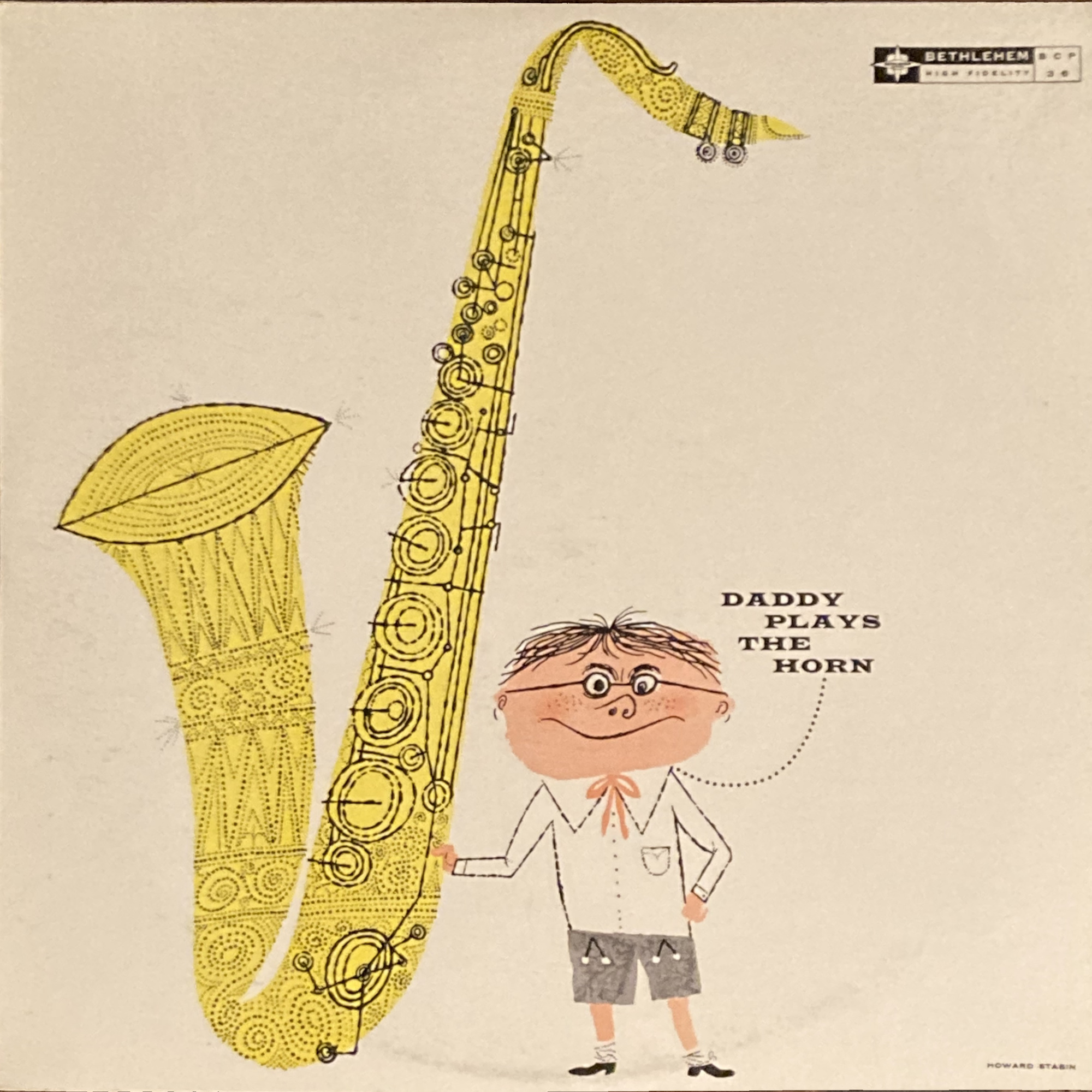
Label: BETHLEHEM MUSIC CORP.
No.: BCP-36
Title: DADDY PLAYS THE HORN
Musician: DEXTER GORDON (4)
Recorded: 1955/9/18
Monaural
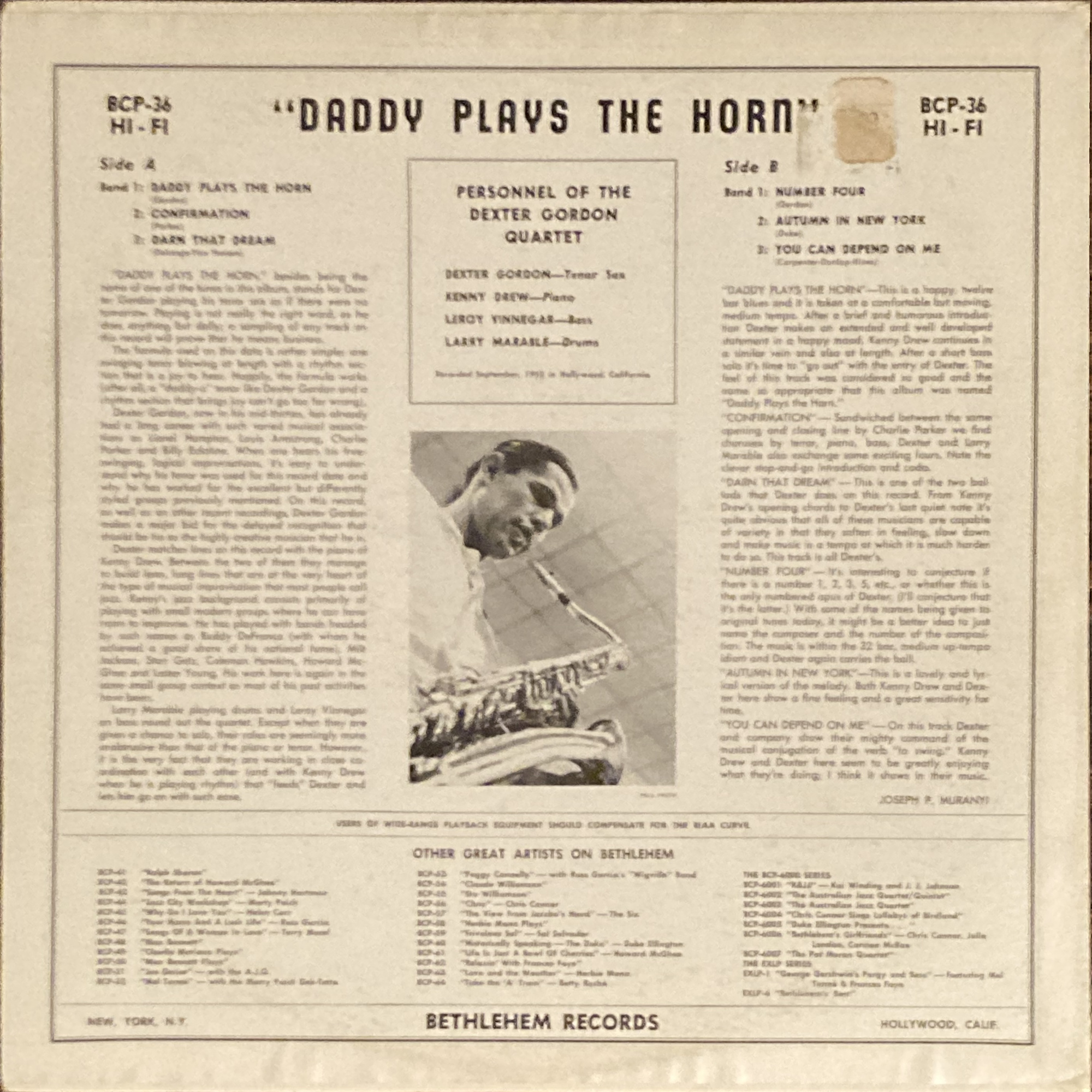
Cover address: NEW YORK, N.Y. , HOLLYWOOD CALIF.
Coating
Groove Guard
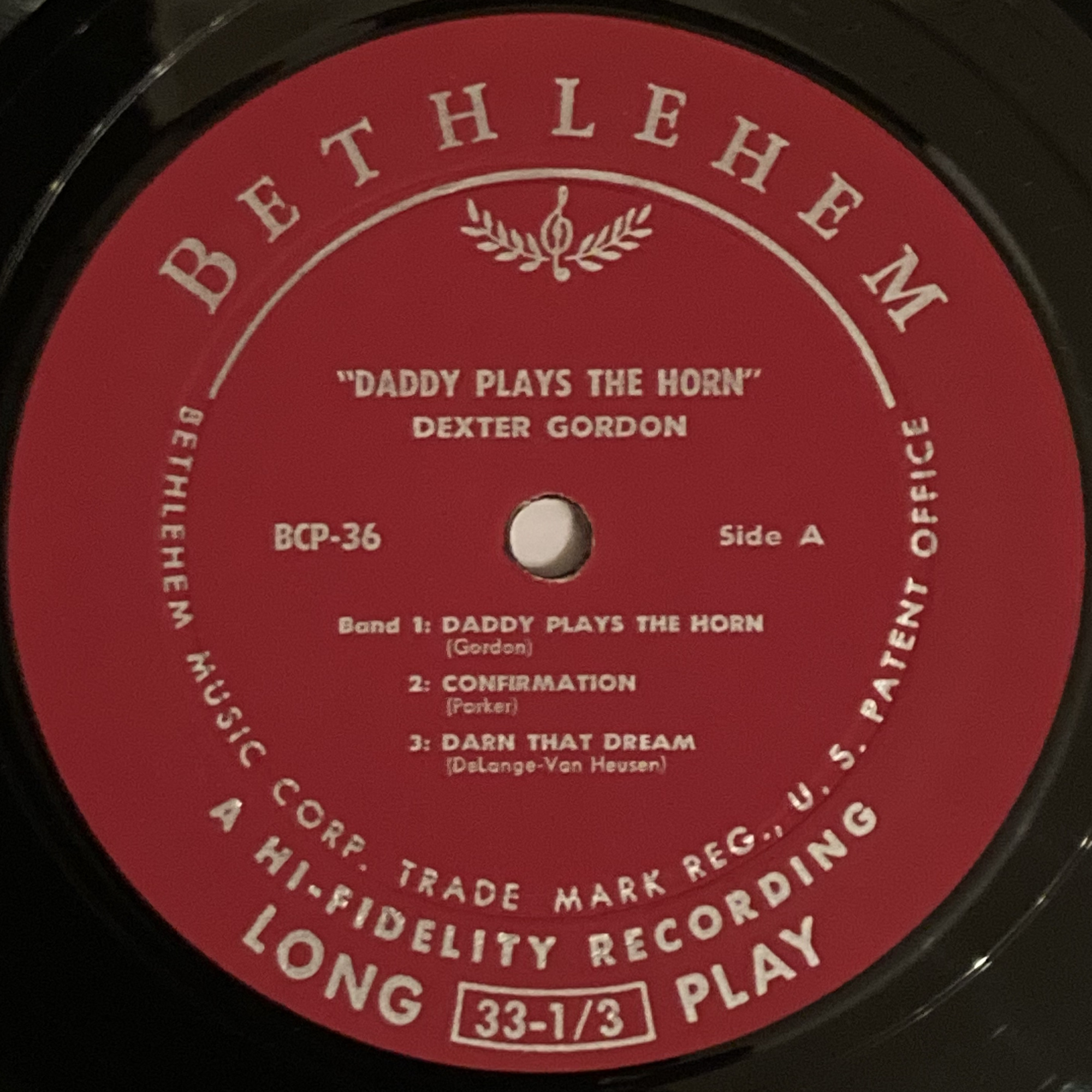
Label Side-A
Red Background Silver Letter with Laurel
Address: None
Deep Groove
Dead Wax Info: BCP-36A-D1, ☆, PAT
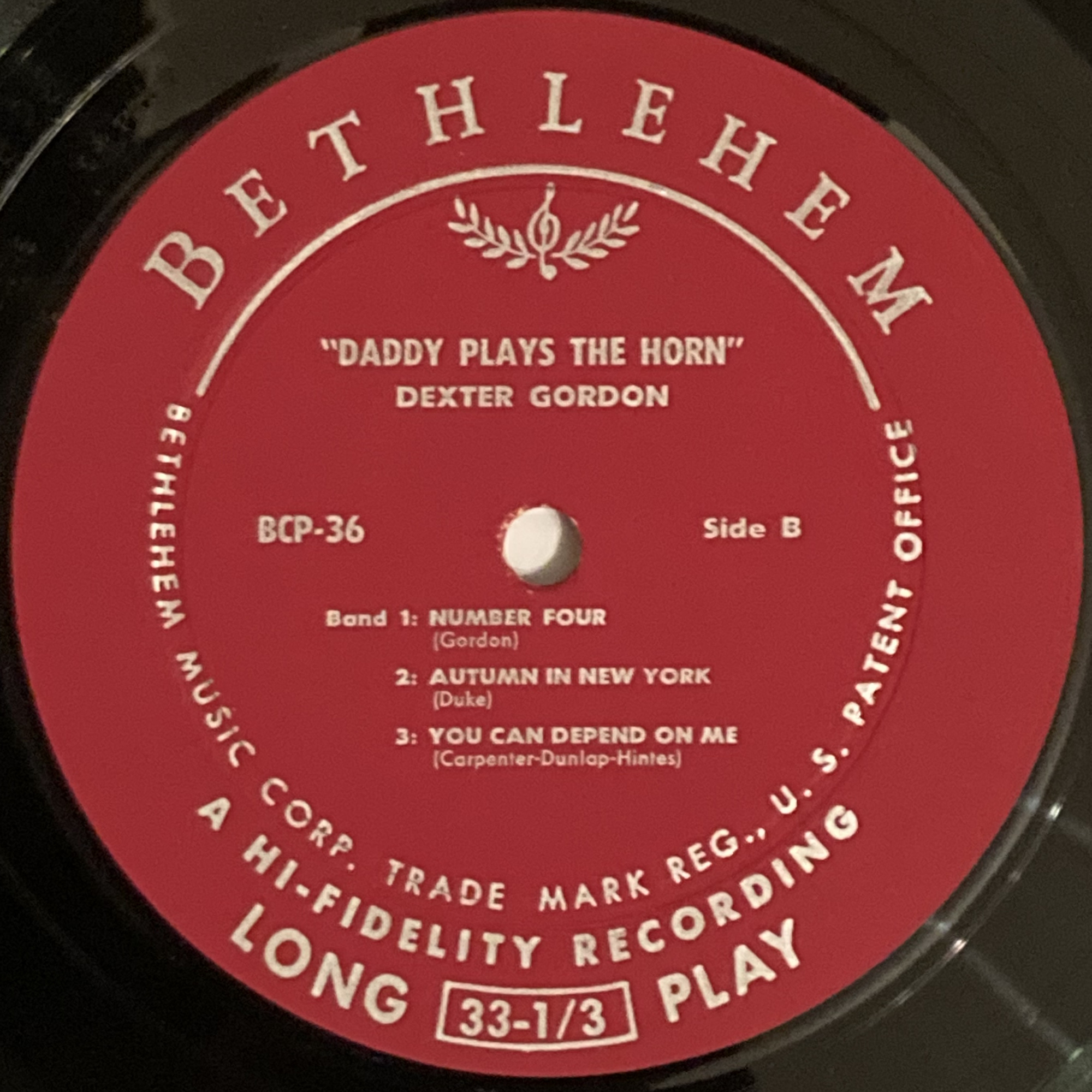
Label Side-B
Red Background Silver Letter with Laurel
Address: None
Deep Groove
Dead Wax Info: BCP-36B-D1, ☆, PAT
Personnel-
Drums: Lawrence Marable
Bass: Leroy Vinnegar
Piano: Kenny Drew
Tenor Sax: Dexter Gordon
Tracks-
Side-A
1) Daddy Plays the Horn 9’05”
2) Confirmation 7’51”
3) Darn That Dream 4’13”
Side-B
1) Number Four 4’49”
2) Autumn In New York 6’25”
3) You Can Depend on Me 9’04”
<裏ジャケ原文>
“DADDY PLAYS THE HORN,” besides being the name of one of the tunes in this album, stands for Dex- ter Gordon playing his tenor sax as if there were no tomorrow. Playing is not really the right word, as he does anything but dally; a sampling of any track on this record will prove that he means business.
The formula used on this date is rather simple; one swinging tenor blowing at length with a rhythm sec- tion that is a joy to hear. Happily, the formula works (after all, a “daddy-o” tenor like Dexter Gordon and a rhythm section that brings joy can’t go too far wrong).
Dexter Gordon, now in his mid-thirties, has already had a long career with such varied musical associa- tions as Lionel Hampton, Louis Armstrong, Charlie Parker and Billy Eckstine. When one hears his free- swinging, logical improvisations, it’s easy to under- stand why his tenor was used for this record date and why he has worked for the excellent but differently styled groups previously mentioned. On this record, as well as on other recent recordings, Dexter Gordon makes a major bid for the delayed recognition that should be his as the highly creative musician that he is.
Dexter matches lines on this record with the piano of Kenny Drew. Between the two of them they manage to build lean, long lines that are at the very heart of the type of musical improvisation that most people call jazz. Kenny’s jazz background consists primarily of playing with small modern groups where he can have room to improvise. He has played with bands headed by such names as Buddy DeFranco (with whom he achieved a good share of his national fame), Milt Jackson, Stan Getz, Coleman Hawkins, Howard Mc- Ghee and Lester Young. His work here is again in the same small group context as most of his past activities have been.
Larry Marable playing drums and Leroy Vinnegar on bass round out the quartet. Except when they are given a chance to solo, their roles are seemingly more unobtrusive than that of the piano or tenor. However, it is the very fact that they are working in close co- ordination with each other (and with Kenny Drew when he is playing rhythm) that “feeds” Dexter and lets him go on with such ease.
“DADDY PLAYS THE HORN”-This is a happy, twelve bar blues and it is taken at a comfortable but moving, medium tempo. After a brief and humorous introduc- tion Dexter makes an extended and well developed statement in a happy mood. Kenny Drew continues in a similar vein and also at length. After a short bass solo it’s time to “go out” with the entry of Dexter. The feel of this track was considered so good and the name so appropriate that this album was named “Daddy Plays the Horn.”
“CONFIRMATION” -Sandwiched between the same opening and closing line by Charlie Parker we find choruses by tenor, piano, bass; Dexter and Larry Marable also exchange some exciting fours. Note the clever stop-and-go introduction and coda.
“DARN THAT DREAM”- This is one of the two bal- lads that Dexter does on this record. From Kenny Drew’s opening chords to Dexter’s last quiet note it’s quite obvious that all of these musicians are capable of variety in that they soften in feeling, slow down and make music in a tempo at which it is much harder to do so. This track is all Dexter’s.
“NUMBER FOUR”-It’s interesting to conjecture if there is a number 1, 2, 3, 5, etc., or whether this is the only numbered opus of Dexter. (I’ll conjecture that it’s the latter.) With some of the names being given to original tunes today, it might be a better idea to just name the composer and the number of the composi- tion. The music is within the 32 bar, medium up-tempo idiom and Dexter again carries the ball.
“AUTUMN IN NEW YORK”-This is a lovely and lyr- ical version of the melody. Both Kenny Drew and Dex- ter here show a fine feeling and a great sensitivity for time.
“YOU CAN DEPEND ON ME” On this track Dexter and company show their mighty command of the musical conjugation of the verb “to swing.” Kenny Drew and Dexter here seem to be greatly enjoying what they’re doing; I think it shows in their music.
JOSEPH P. MURANYI
<裏ジャケ和訳>
『Daddy Plays the Horn』は、本作に収録された一曲のタイトルであると同時に、デクスター・ゴードンがまるで明日などないかのようにテナー・サックスを吹き鳴らす姿を象徴する言葉でもあります。「プレイ(演奏)」という言葉では生ぬるいかもしれません。彼は決して悠長に構えたりはせず、どのトラックを聴いても、彼が本気で取り組んでいることが伝わってくるからです。
本作の構成は極めてシンプルです。スウィング感あふれるテナー・サックスがたっぷりと吹きまくり、それを聴いていて楽しくなるようなリズム・セクションが支えるという形です。幸いなことに、この手法は見事に功を奏しています(デクスター・ゴードンのような「親分格(ダディ・オー)」のテナー奏者と、聴き手を喜ばせるリズム・セクションの組み合わせが失敗するはずもありません)。
30代半ばを迎えたデクスター・ゴードンは、すでにライオネル・ハンプトン、ルイ・アームストロング、チャーリー・パーカー、ビリー・エクスタインといった多彩な顔ぶれと共演し、長いキャリアを築いてきました。彼の自由でスウィング感に満ち、かつ論理的な即興演奏を聴けば、なぜ本作に彼のテナーが起用されたのか、そして彼が先述したような(スタイルこそ違えど優れた)グループで活躍してきたのかが容易に理解できます。本作や近年の録音において、デクスター・ゴードンは、極めて創造的なミュージシャンとして本来受けるべき正当な評価を勝ち取ろうと、力強い一歩を踏み出しています。
本作でデクスターは、ケニー・ドリューのピアノと対話するようにフレーズを紡いでいます。二人は、多くの人々が「ジャズ」と呼ぶ即興演奏の核心とも言える、無駄がなく伸びやかなフレーズを築き上げています。ケニーのジャズ・キャリアは、主に即興演奏の余地がある小編成のモダン・ジャズ・グループでの活動を中心に築かれてきました。彼は、バディ・デフランコ(彼との共演で全米的な名声を博しました)、ミルト・ジャクソン、スタン・ゲッツ、コールマン・ホーキンス、ハワード・マギー、レスター・ヤングといった名手たちが率いるバンドで演奏してきました。ここでの彼のプレイもまた、これまでの活動の大半と同様、小編成グループという文脈の中で展開されています。
ドラムのラリー・マラブルとベースのリロイ・ヴィネガーが加わり、カルテットが完成します。ソロをとる場面を除けば、彼らの役割はピアノやテナーに比べて一見控えめなものに映るかもしれません。しかし、彼らが互いに(そしてケニー・ドリューがリズムを刻む際は彼とも)緊密に連携しているという事実こそが、デクスターに「活力」を与え、彼をあのように軽やかに演奏させているのです。
「Daddy Plays the Horn」―これはハッピーな雰囲気の12小節ブルースで、心地よくも躍動感のあるミディアム・テンポで演奏されています。短くユーモラスなイントロの後、デクスターが上機嫌なムードで、長く充実したソロを展開します。ケニー・ドリューも同様の雰囲気で、やはり長めのソロを続けます。短いベース・ソロを挟み、デクスターが再び入ってきて曲を締めくくります。このトラックの雰囲気が素晴らしく、タイトルもあまりに適切だったため、アルバム自体が『Daddy Plays the Horn』と名付けられました。
「Confirmation」―チャーリー・パーカーによる同じフレーズで冒頭と結びが挟まれ、その間にテナー、ピアノ、ベースのソロが続きます。デクスターとラリー・マラブルによるエキサイティングな「4小節交換(フォア・バー・エクスチェンジ)」も見どころです。巧みな「ストップ・アンド・ゴー(演奏を止めては再開する)」のイントロとコーダにも注目してください。
「Darn That Dream」―これはデクスターが本作で取り上げている2曲のバラードのうちの1曲です。ケニー・ドリューの冒頭のコードからデクスターの最後の静かな音に至るまで、参加ミュージシャン全員が多彩な表現力を持っていることは明らかです。彼らは雰囲気を和らげ、テンポを落とし、演奏がより困難になるようなテンポ感の中で音楽を創り上げています。このトラックはデクスターの独壇場です。
「Number Four」―「ナンバー1、2、3、5」などが存在するのか、それともこれがデクスター唯一の番号付きの作品なのか、想像してみるのも面白いでしょう(私は後者だと推測します)。今日のオリジナル曲に付けられる名前を考えると、単に作曲者と曲の番号だけで呼ぶ方が良いのかもしれません。音楽は32小節構成のミディアム・アップ・テンポというスタイルで、ここでもデクスターが主導権を握っています。
「Autumn in New York」―このメロディの、美しく叙情的な演奏です。ここでもケニー・ドリューとデクスターは、素晴らしい情感と優れたタイム感(リズムの感覚)を披露しています。 「You Can Depend on Me」――このトラックで、デクスターとその仲間たちは、「スウィングする」という動詞の音楽的な活用を自在に操る、その圧倒的な手腕を披露しています。ケニー・ドリューとデクスターは、ここでの演奏を心から楽しんでいるようで、その楽しさが音楽にも表れているように感じられます。
ジョセフ・P・ムラニィ
※訳文の制作にはGoogleドライブとGoogle翻訳のお世話になりました。

コメント