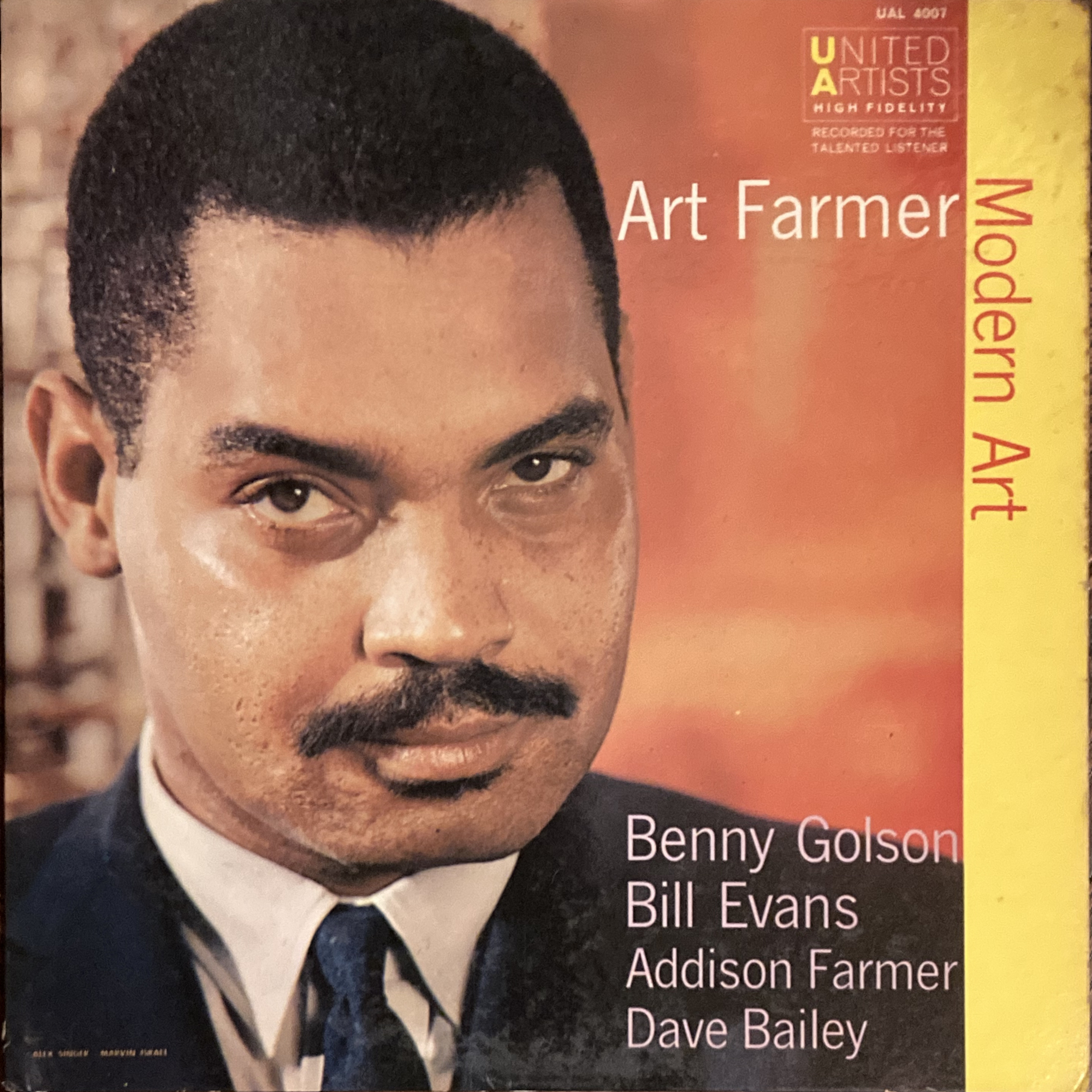
Label: UNITED ARTISTS
No.: UAL 4007
Title: MODERN ART
Musician: ART FARMER
Recorded: 1958/9/10
Monaural
Cover address: None
Coating無し
Groove Guard
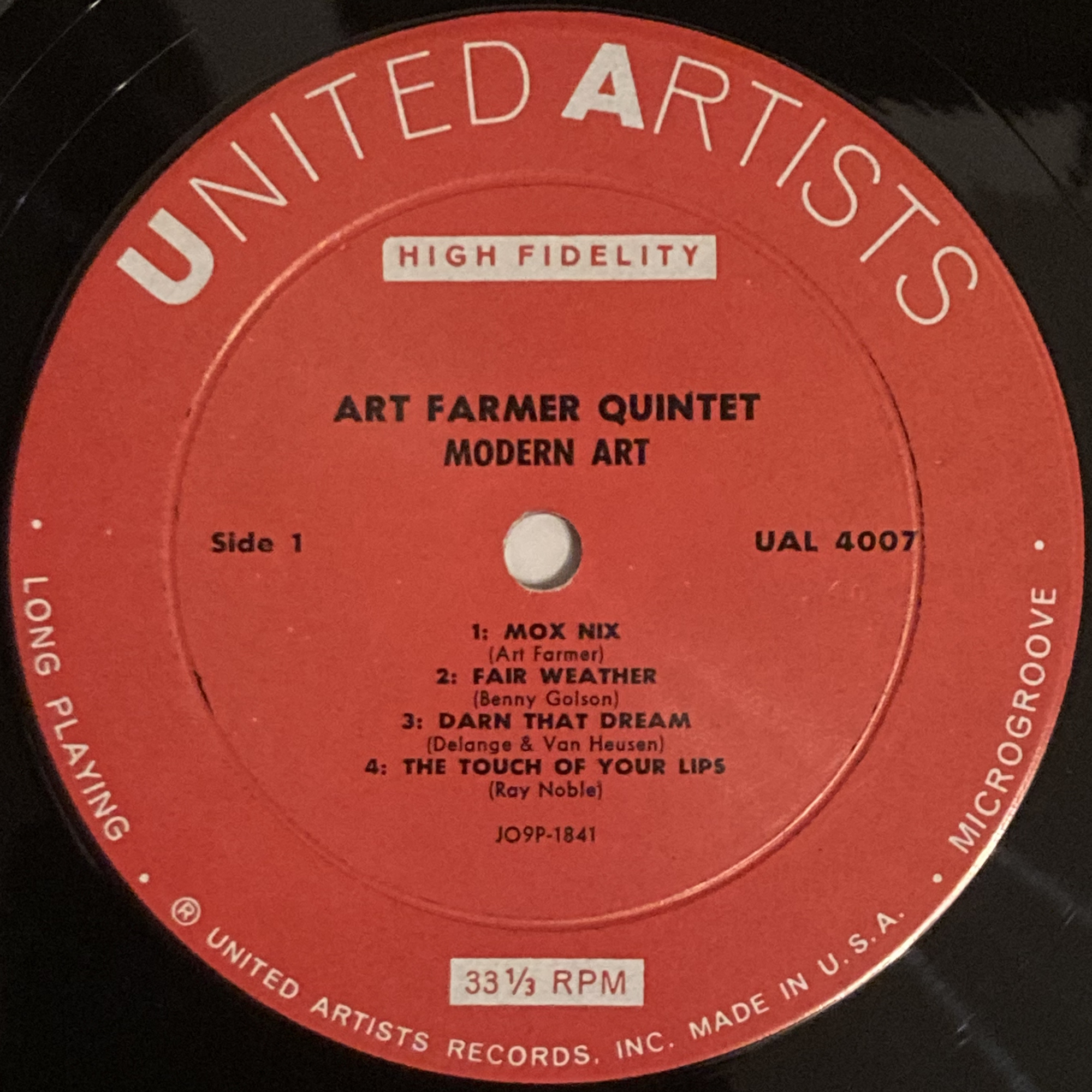
Label Side-1
Red Background
Black Letter
Address: None
Deep Groove
Dead Wax Info: J09P-1841-1, 10-23-58, A1, R
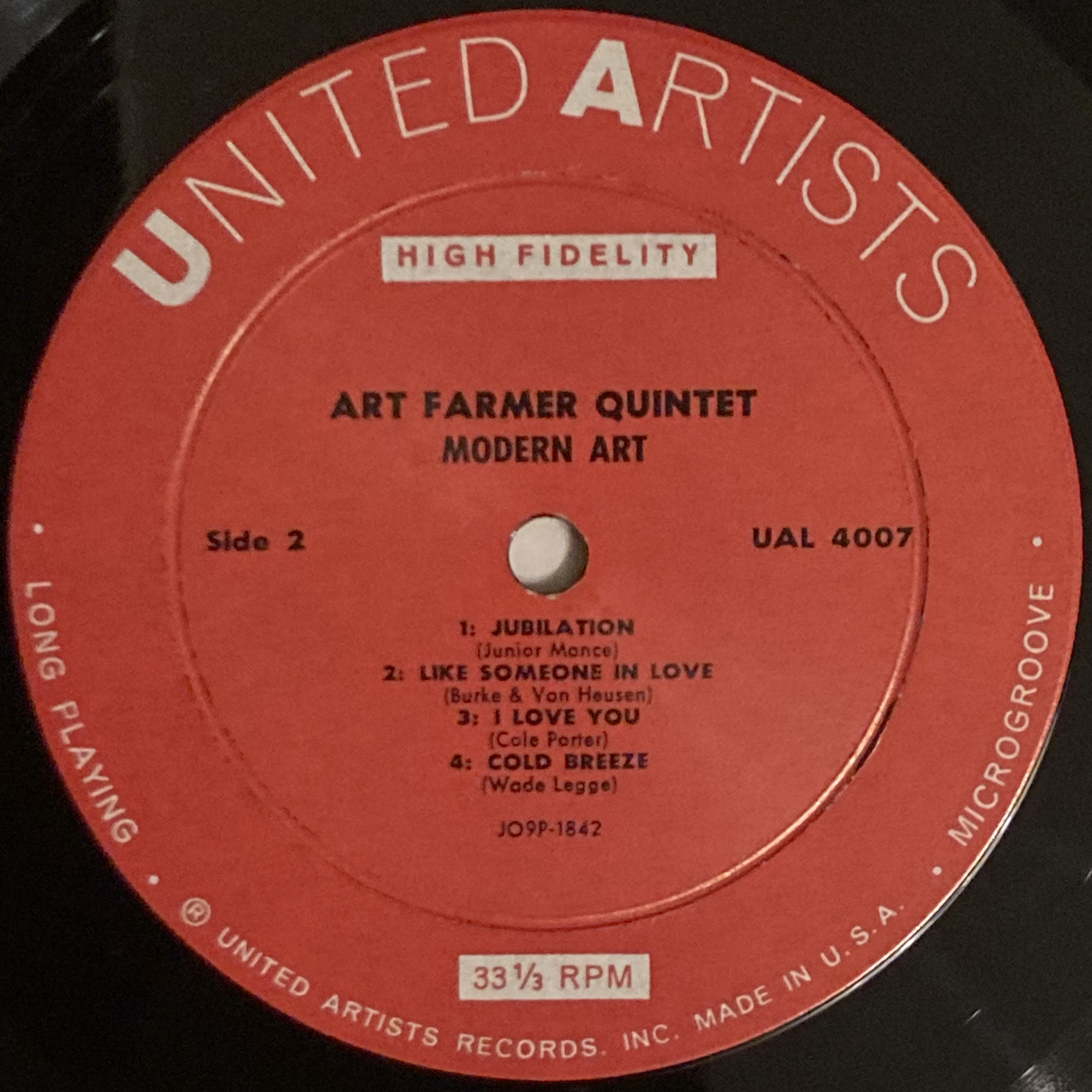
Label Side-2
Red Background
Black Letter
Address: None
Deep Groove
Dead Wax Info: J09P-1842-1, 10-23-58, A1, R
Personnel-
Drums: Dave Bailey
Bass: Addison Farmer
Piano: Bill Evans
Tenor Sax: Benny Golson
Trumpet: Art Farmer
Tracks-
Side-1
1) Mox Nix 4’41”
2) Fair Weather 5’45”
3) Darn That Dream 4’00”
4) The Touch of Your Lips 4’57”
Side-2
1) Jubilation 4’17”
2) Like Someone in Love 5’58”
3) I Love You 7’03”
4) Cold Breeze 3’56”
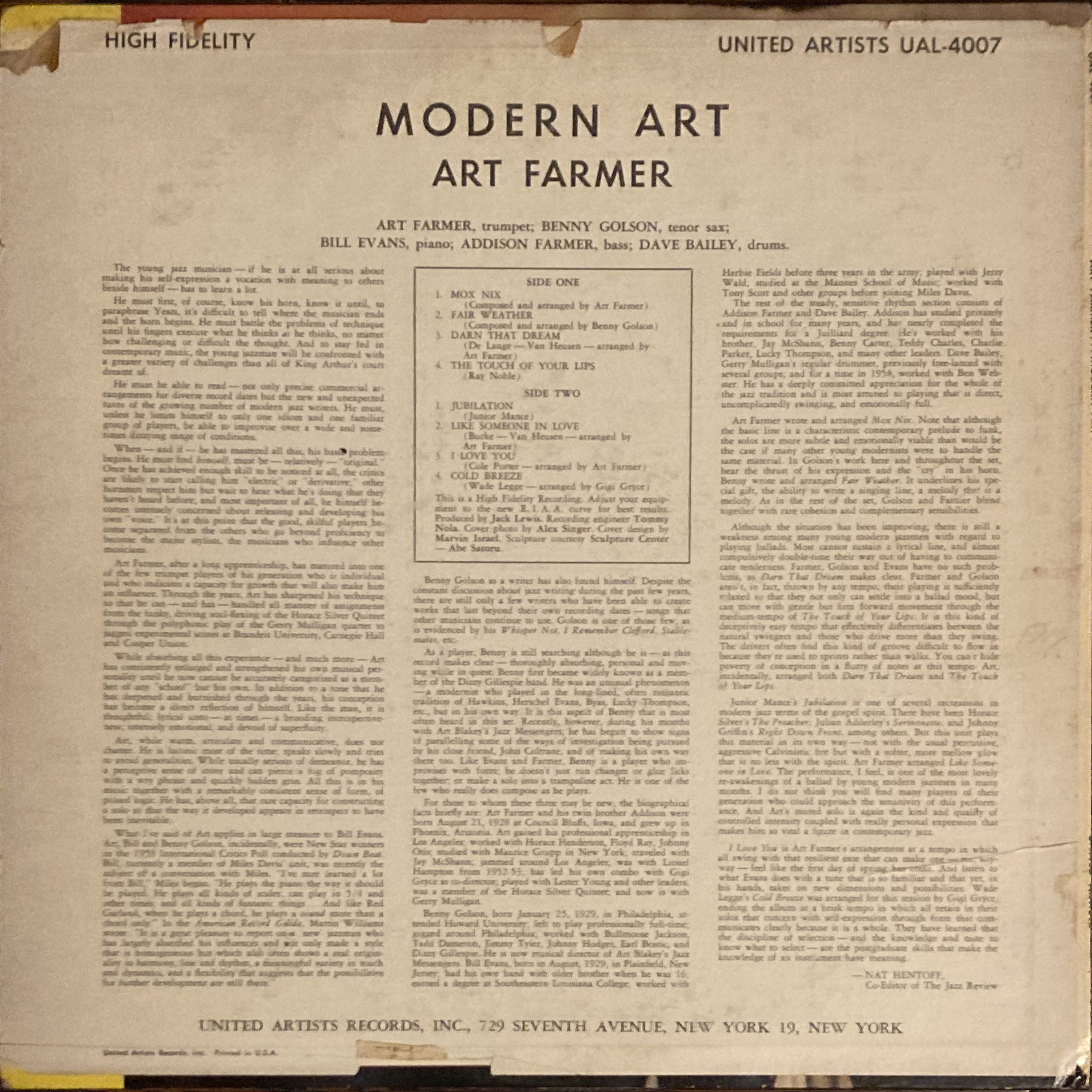
<裏ジャケ原文>
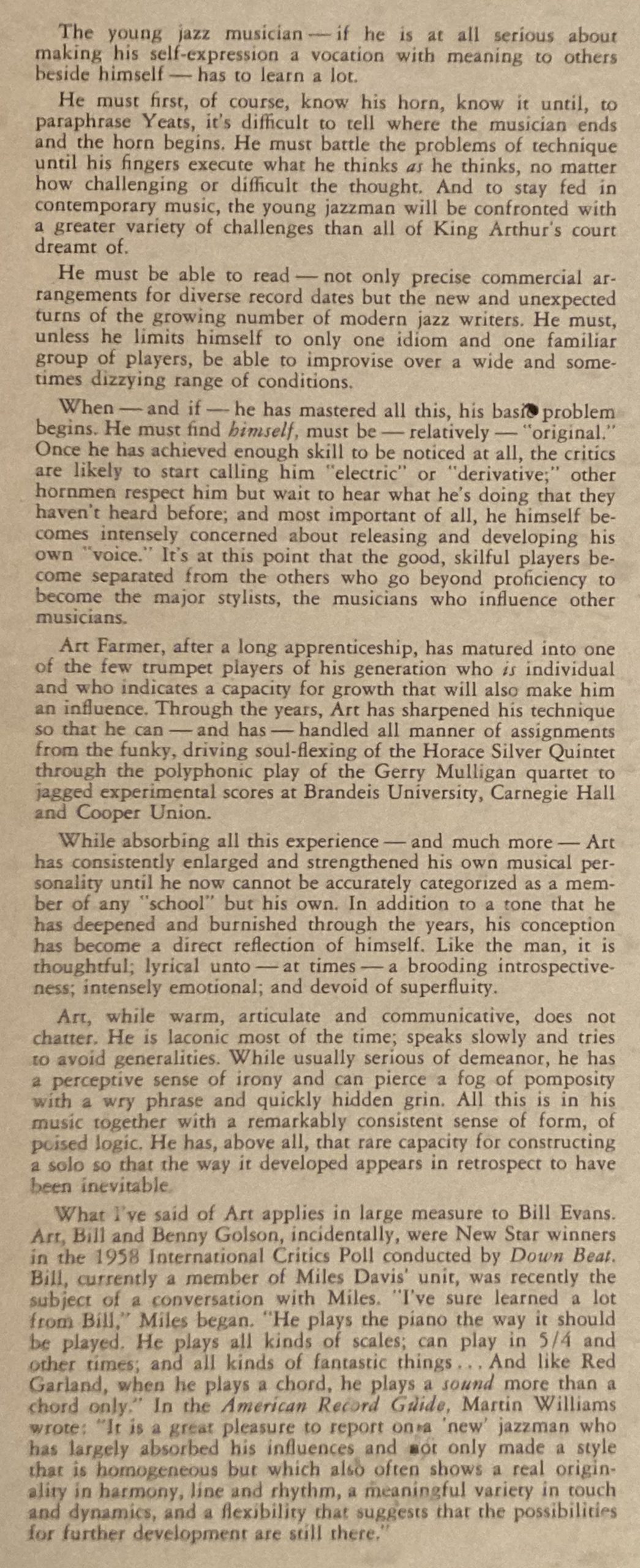
The young jazz musician-if he is at all serious about making his self-expression a vocation with meaning to others beside himself has to learn a lot.
He must first, of course, know his horn, know it until, to paraphrase Yeats, it’s difficult to tell where the musician ends and the horn begins. He must battle the problems of technique until his fingers execute what he thinks as he thinks, no matter how challenging or difficult the thought. And to stay fed in contemporary music, the young jazzman will be confronted with a greater variety of challenges than all of King Arthur’s court dreamt of.
He must be able to read – not only precise commercial ar- rangements for diverse record dates but the new and unexpected turns of the growing number of modern jazz writers. He must, unless he limits himself to only one idiom and one familiar group of players, be able to improvise over a wide and some- times dizzying range of conditions.
When- and if he has mastered all this, his basi problem begins. He must find himself, must be- relatively-“original.” Once he has achieved enough skill to be noticed at all, the critics are likely to start calling him “electric” or “derivative;” other hornmen respect him but wait to hear what he’s doing that they haven’t heard before; and most important of all, he himself be- comes intensely concerned about releasing and developing his own “voice.” It’s at this point that the good, skilful players be- come separated from the others who go beyond proficiency to become the major stylists, the musicians who influence other musicians.
Art Farmer, after a long apprenticeship, has matured into one of the few trumpet players of his generation who is individual and who indicates a capacity for growth that will also make him an influence. Through the years, Art has sharpened his technique so that he can- and has – handled all manner of assignments from the funky, driving soul-flexing of the Horace Silver Quintet through the polyphonic play of the Gerry Mulligan quartet to jagged experimental scores at Brandeis University, Carnegie Hall and Cooper Union.
While absorbing all this experience and much more – Art has consistently enlarged and strengthened his own musical per- sonality until he now cannot be accurately categorized as a mem- ber of any “school” but his own. In addition to a tone that he has deepened and burnished through the years, his conception has become a direct reflection of himself. Like the man, it is thoughtful; lyrical unto-at times a brooding introspective- ness; intensely emotional; and devoid of superfluity.
Art, while warm, articulate and communicative, does not chatter. He is laconic most of the time; speaks slowly and tries to avoid generalities. While usually serious of demeanor, he has a perceptive sense of irony and can pierce a fog of pomposity with a wry phrase and quickly hidden grin. All this is in his music together with a remarkably consistent sense of form, of poised logic. He has, above all, that rare capacity for constructing a solo so that the way it developed appears in retrospect to have been inevitable.
What I’ve said of Art applies in large measure to Bill Evans. Art, Bill and Benny Golson, incidentally, were New Star winners in the 1958 International Critics Poll conducted by Down Beat. Bill, currently a member of Miles Davis’ unit, was recently the subject of a conversation with Miles. “I’ve sure learned a lot from Bill,” Miles began. “He plays the piano the way it should be played. He plays all kinds of scales; can play in 5/4 and other times; and all kinds of fantastic things… And like Red Garland, when he plays a chord, he plays a sound more than a chord only.” In the American Record Guide, Martin Williams wrote: “It is a great pleasure to report on a ‘new’ jazzman who has largely absorbed his influences and not only made a style that is homogeneous but which also often shows a real origin- ality in harmony, line and rhythm, a meaningful variety in touch and dynamics, and a flexibility that suggests that the possibilities for further development are still there.
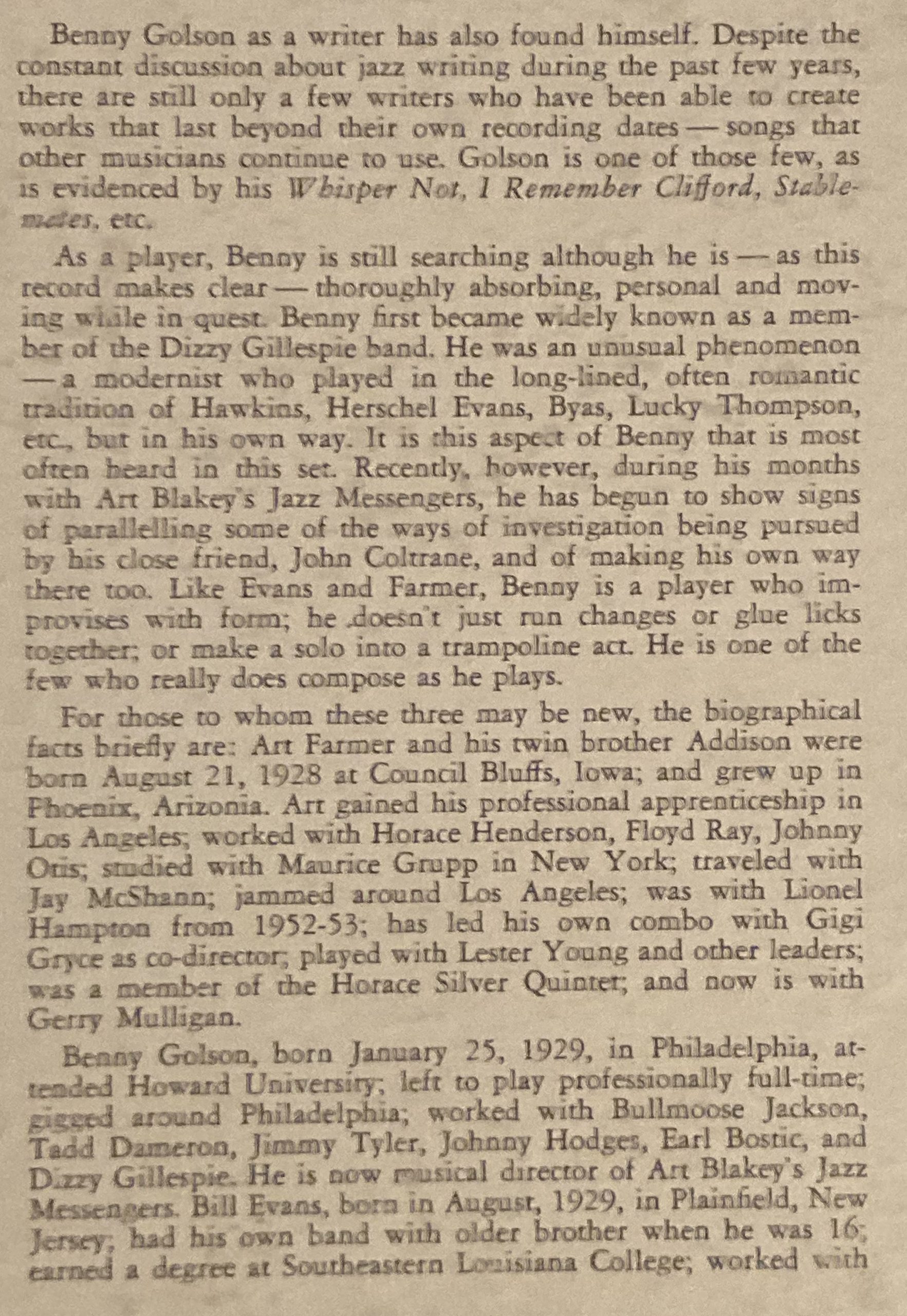
Benny Golson as a writer has also found himself. Despite the constant discussion about jazz writing during the past few years, there are still only a few writers who have been able to create works that last beyond their own recording dates- songs that other musicians continue to use. Golson is one of those few, as is evidenced by his Whisper Not, 1 Remember Clifford, Stable-
mates, etc.
As a player, Benny is still searching although he is as this record makes clear- thoroughly absorbing, personal and mov- ing while in quest. Benny first became widely known as a mem- ber of the Dizzy Gillespie band. He was an unusual phenomenon -a modernist who played in the long-lined, often romantic tradition of Hawkins, Herschel Evans, Byas, Lucky Thompson, etc., but in his own way. It is this aspect of Benny that is most often heard in this set. Recently, however, during his months with Art Blakey’s Jazz Messengers, he has begun to show signs of parallelling some of the ways of investigation being pursued by his close friend, John Coltrane, and of making his own way there too. Like Evans and Farmer, Benny is a player who im- provises with form; he doesn’t just run changes or glue licks together; or make a solo into a trampoline act. He is one of the few who really does compose as he plays.
For those to whom these three may be new, the biographical facts briefly are: Art Farmer and his twin brother Addison were born August 21, 1928 at Council Bluffs, Iowa; and grew up in Phoenix, Arizonia. Art gained his professional apprenticeship in Los Angeles; worked with Horace Henderson, Floyd Ray, Johnny Oris, studied with Maurice Grupp in New York; traveled with Jay McShann; jammed around Los Angeles; was with Lionel Hampton from 1952-53; has led his own combo with Gigi Gryce as co-director, played with Lester Young and other leaders; was a member of the Horace Silver Quinter; and now is with Gerry Mulligan.
Benny Golson, born January 25, 1929, in Philadelphia, at- tended Howard University, left to play professionally full-time; gigged around Philadelphia; worked with Bullmoose Jackson, Tadd Dameron, Jimmy Tyler, Johnny Hodges, Earl Bostic, and Dizzy Gillespie. He is now musical director of Art Blakey’s Jazz Messengers. Bill Evans, born in August, 1929, in Plainfield, New Jersey, had his own band with older brother when he was 16; earned a degree at Southeastern Louisiana College; worked with Herbie Fields before three years in the army; played with Jerry Wald; studied at the Mannes School of Music; worked with Tony Scott and other groups before joining Miles Davis.
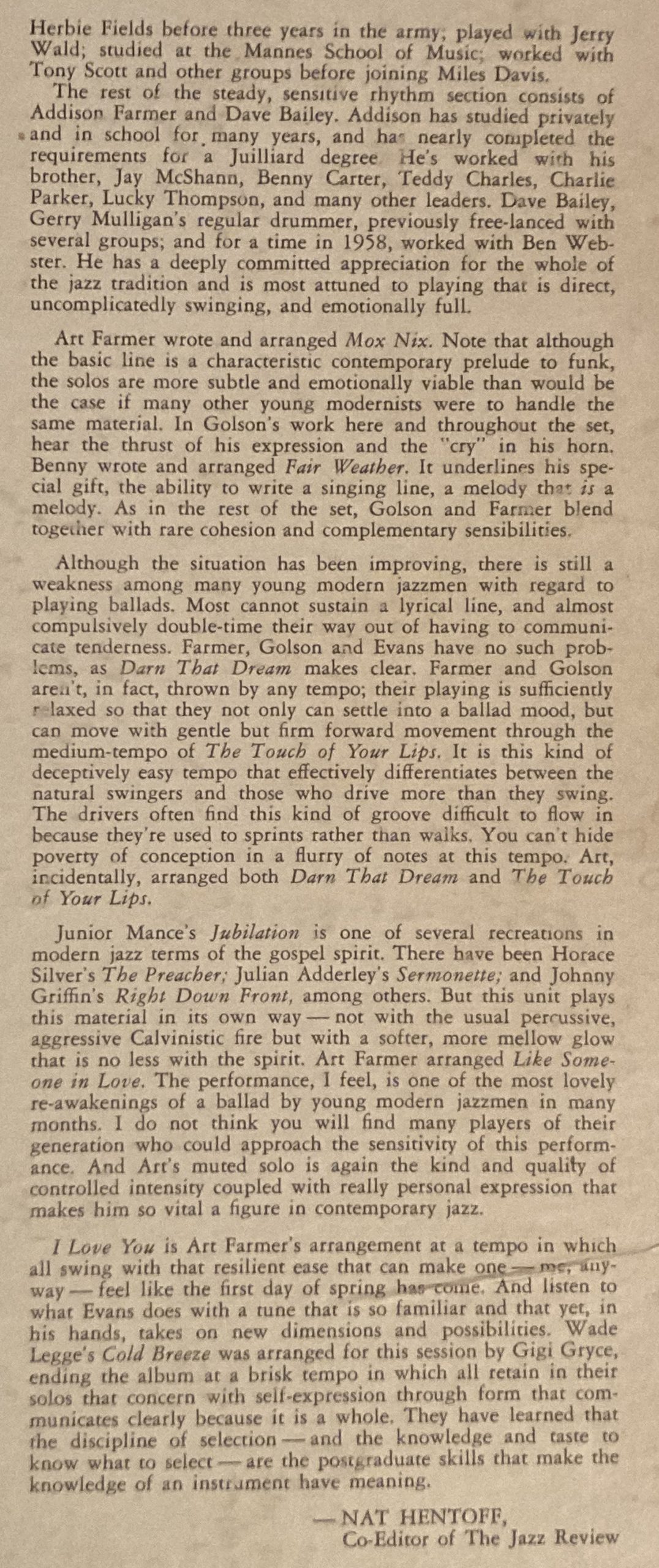
The rest of the steady, sensitive rhythm section consists of Addison Farmer and Dave Bailey. Addison has studied privately and in school for many years, and has nearly completed the requirements for a Juilliard degree He’s worked with his brother, Jay McShann, Benny Carter, Teddy Charles, Charlie Parker, Lucky Thompson, and many other leaders. Dave Bailey, Gerry Mulligan’s regular drummer, previously free-lanced with several groups; and for a time in 1958, worked with Ben Web- ster. He has a deeply committed appreciation for the whole of the jazz tradition and is most attuned to playing that is direct, uncomplicatedly swinging, and emotionally full.
Art Farmer wrote and arranged Mox Nix. Note that although the basic line is a characteristic contemporary prelude to funk, the solos are more subtle and emotionally viable than would be the case if many other young modernists were to handle the same material. In Golson’s work here and throughout the set, hear the thrust of his expression and the “cry” in his horn. Benny wrote and arranged Fair Weather. It underlines his spe- cial gift, the ability to write a singing line, a melody that is a melody. As in the rest of the set, Golson and Farmer blend together with rare cohesion and complementary sensibilities.
Although the situation has been improving, there is still a weakness among many young modern jazzmen with regard to playing ballads. Most cannot sustain a lyrical line, and almost compulsively double-time their way out of having to communi- cate tenderness. Farmer, Golson and Evans have no such prob- lems, as Darn That Dream makes clear. Farmer and Golson aren’t, in fact, thrown by any tempo; their playing is sufficiently relaxed so that they not only can settle into a ballad mood, but can move with gentle but firm forward movement through the medium-tempo of The Touch of Your Lips. It is this kind of deceptively easy tempo that effectively differentiates between the natural swingers and those who drive more than they swing. The drivers often find this kind of groove difficult to flow in because they’re used to sprints rather than walks. You can’t hide poverty of conception in a flurry of notes at this tempo. Art, incidentally, arranged both Darn That Dream and The Touch of Your Lips.
Junior Mance’s Jubilation is one of several recreations in modern jazz terms of the gospel spirit. There have been Horace Silver’s The Preacher; Julian Adderley’s Sermonette; and Johnny Griffin’s Right Down Front, among others. But this unit plays this material in its own way-not with the usual percussive, aggressive Calvinistic fire but with a softer, more mellow glow that is no less with the spirit. Art Farmer arranged Like Some- one in Love. The performance, I feel, is one of the most lovely re-awakenings of a ballad by young modern jazzmen in many months. I do not think you will find many players of their generation who could approach the sensitivity of this perform- ance. And Art’s muted solo is again the kind and quality of controlled intensity coupled with really personal expression that makes him so vital a figure in contemporary jazz.
I Love You is Art Farmer’s arrangement at a tempo in which all swing with that resilient ease that can make one-me, any- way feel like the first day of spring has come. And listen to what Evans does with a tune that is so familiar and that yet, in his hands, takes on new dimensions and possibilities. Wade Legge’s Cold Breeze was arranged for this session by Gigi Gryce, ending the album at a brisk tempo in which all retain in their solos that concern with self-expression through form that com- municates clearly because it is a whole. They have learned that the discipline of selection and the knowledge and taste to know what to select are the postgraduate skills that make the knowledge of an instrument have meaning.
NAT HENTOFF,
Co-Editor of The Jazz Review
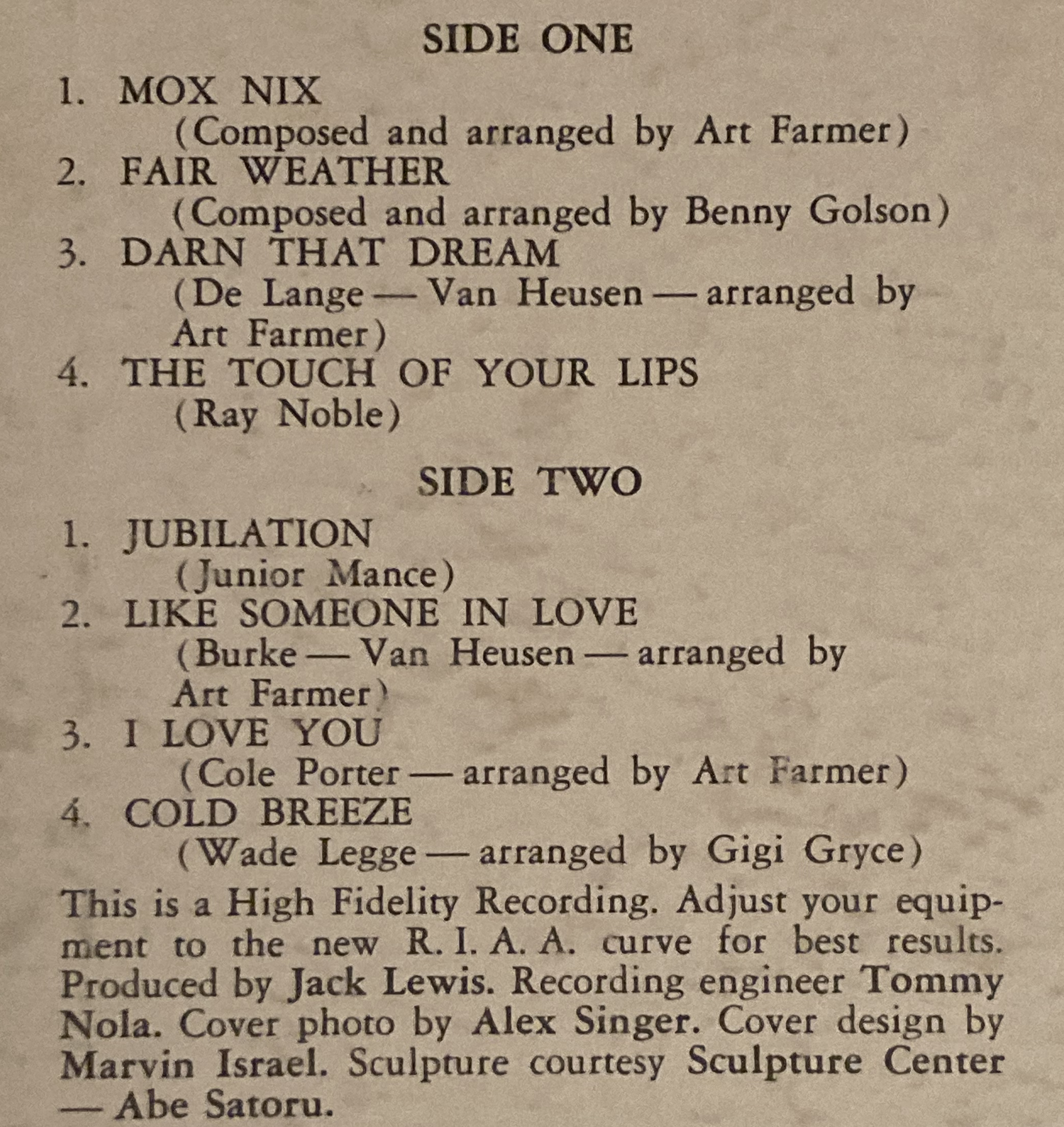
SIDE ONE
- MOX NIX
(Composed and arranged by Art Farmer) - FAIR WEATHER
(Composed and arranged by Benny Golson) - DARN THAT DREAM
(De Lange-Van Heusen-arranged by Art Farmer) - THE TOUCH OF YOUR LIPS
(Ray Noble)
SIDE TWO
- JUBILATION
(Junior Mance) - LIKE SOMEONE IN LOVE
(Burke-Van Heusen – arranged by Art Farmer) - I LOVE YOU
(Cole Porter-arranged by Art Farmer) 4. COLD BREEZE
(Wade Legge-arranged by Gigi Gryce) This is a High Fidelity Recording. Adjust your equip- ment to the new R. I. A. A. curve for best results. Produced by Jack Lewis. Recording engineer Tommy Nola. Cover photo by Alex Singer. Cover design by Marvin Israel. Sculpture courtesy Sculpture Center Abe Satoru.
<裏ジャケ和訳>
若いジャズ・ミュージシャンが、自身の自己表現を、自分以外の誰かにとっても意味のある「職業」にまで高めようと真剣に考えるなら、学ぶべきことは山ほどある。
まず何よりも、自分の楽器を完全に把握しなければならない。イェイツの言葉を借りれば、ミュージシャンと楽器の境界がどこにあるのか分からなくなるほどに、楽器と一体化しなければならないのだ。どれほど複雑で困難な音楽的アイデアであっても、頭に浮かんだ瞬間に指がそれをそのまま再現できるようになるまで、技術的な課題と格闘し続けなければならない。さらに、現代の音楽シーンで生計を立てていくためには、アーサー王の宮廷の騎士たちが夢見たどんな試練よりも、はるかに多様で困難な課題に直面することになるだろう。
楽譜を読みこなす能力も不可欠だ。レコーディングの現場で求められる緻密な商業的アレンジはもちろん、現代のジャズ作曲家たちが次々と生み出す、予測不能で斬新な展開にも対応できなければならない。特定のスタイルや、決まったメンバーとの演奏だけに固執しないのであれば、極めて広範で、時には目がくらむような多様な演奏状況下で即興演奏ができなければならないのだ。
こうしたすべてを習得したとき、真の課題が始まる。自分自身を見つけ出し、ある意味で「独創的」でなければならないからだ。周囲から注目されるだけの技術を身につけた途端、批評家たちは彼を「刺激的」だとか「模倣的」だとか評し始めるだろう。仲間のミュージシャンたちは敬意を払いつつも、彼がこれまで誰も聴いたことのないような新しい何かを提示してくれるのを待ち構える。そして何より重要なのは、彼自身が、自分だけの「声」を解き放ち、それを発展させていくことに深くこだわるようになるということだ。この段階に至って初めて、単に技術に長けただけのプレイヤーと、卓越した技術を超越し、他のミュージシャンに影響を与えるような「主要なスタイルを確立した音楽家」との間に、決定的な差が生まれるのである。
アート・ファーマーは、長い修業期間を経て、同世代の中でも数少ない、独自の個性を持つトランペット奏者へと成長した。彼にはさらなる成長の可能性が秘められており、今後、他のミュージシャンに影響を与える存在となるだろう。長年にわたり、アートは自身の技術を磨き上げてきた。その結果、ホレス・シルバー・クインテットでのファンキーで力強いソウルフルな演奏から、ジェリー・マリガン・カルテットでのポリフォニック(多声的)なアンサンブル、さらにはブランダイス大学、カーネギー・ホール、クーパー・ユニオンなどで披露された、鋭角的で実験的な楽曲に至るまで、あらゆる種類の音楽的課題を見事にこなしてきたのである。こうした経験の数々を吸収し、さらに多くのものを糧にしながら、アートは自身の音楽的個性を一貫して広げ、強固なものにしてきた。その結果、今や彼は、特定の「流派」の枠組みには到底当てはまらない、彼独自の音楽世界を確立するに至っている。長年をかけて深め、磨き上げられてきた音色に加え、彼の音楽的構想は、彼という人間そのものを如実に映し出すものとなっている。それは彼の人柄と同様に、思慮深く、叙情的であり――時には深く内省的で物思いに耽るような側面さえ見せ――、極めて感情豊かでありながら、無駄な要素が一切削ぎ落とされている。
アートは、温厚で、明晰に語り、他者と心を通わせる力を持っているが、決して饒舌ではない。普段は口数が少なく、ゆっくりと話し、ありふれた一般論を語ることは避ける。普段は真摯な態度でいることが多いものの、鋭い皮肉のセンスも持ち合わせており、気取った空気が漂う場であっても、ウィットに富んだ一言と、一瞬だけ見せるニヤリとした笑みで、その霧をたちどころに晴らしてしまう。こうした人間性は彼の音楽にも息づいており、そこには驚くほど一貫した形式感覚と、落ち着いた論理性が備わっている。何よりも特筆すべきは、ソロを構築する際、その展開があたかも「そうなるべくしてなった」かのように感じさせる、稀有な才能を持っていることである。
アートについて語ったことは、ビル・エヴァンスにも大部分が当てはまる。ちなみに、アート、ビル、そしてベニー・ゴルソンは、『ダウン・ビート』誌が1958年に行った国際批評家投票において、「ニュー・スター」部門の受賞者に選ばれている。現在マイルス・デイヴィスのバンドに在籍しているビルについて、先日マイルスと話す機会があった。マイルスはこう切り出した。「ビルからは本当に多くのことを学んだよ。彼はピアノを、本来あるべき姿で弾くんだ。あらゆる種類のスケールを弾きこなすし、5/4拍子やその他の拍子でも演奏できる。それに、実に素晴らしいことをいろいろとやってのける……。レッド・ガーランドと同じように、彼がコードを弾くとき、それは単なるコード以上の響きを伴っているんだ」 『アメリカン・レコード・ガイド』誌において、マーティン・ウィリアムズは次のように記している。「ある『新しい』ジャズ・ミュージシャンについて報告できることは大きな喜びだ。彼は、自身が受けた影響を深く消化し、統一感のあるスタイルを築き上げただけでなく、ハーモニー、旋律線、リズムの面で真の独創性を発揮している。また、タッチやダイナミクスには意義深い多様性があり、さらなる発展の可能性を秘めた柔軟性も備えている。
作曲家としてのベニー・ゴルソンもまた、自身のスタイルを確立した。ここ数年、ジャズの作曲に関する議論が絶えないが、レコーディングの時期を超えて残り続け、他のミュージシャンたちにも演奏され続けるような作品を生み出せる作曲家は、依然としてごくわずかである。ゴルソンはその数少ない一人であり、『ウィスパー・ノット(Whisper Not)』、『アイ・リメンバー・クリフォード(I Remember Clifford)』、『ステイブルメイツ(Stablemates)』といった楽曲がそれを証明している。
演奏家としてのベニーは、今もなお探求の途上にある。だが、本作が如実に示している通り、その探求の過程においてさえ、彼は音楽を完全に吸収し、独自の個性を発揮し、聴く者の心を動かす演奏を繰り広げている。ベニーが広く知られるようになったのは、ディジー・ガレスピー・バンドのメンバーとしてだった。彼は異色の存在だった。コールマン・ホーキンス、ハーシェル・エヴァンス、ドン・バイアス、ラッキー・トンプソンらに連なる、長く伸びやかな旋律線を持つロマンティックな伝統を継承しつつも、それを彼自身のやり方で表現していたからだ。本作において最も顕著に聴き取れるのは、ベニーのこうした側面である。もっとも最近では、アート・ブレイキー率いるジャズ・メッセンジャーズに在籍していた時期を通じて、親友であるジョン・コルトレーンが追求していた探求の道筋と重なるようなアプローチを見せ始め、そこでも彼独自の道を切り拓こうとしている。アート・ファーマーやベニー・ゴルソンといった面々は、形式を意識しながら即興演奏を行うタイプのプレイヤーだ。単にコード進行をなぞったり、決まり文句(リック)を継ぎ接ぎしたり、あるいはソロをサーカスのトランポリン・アクトのように見せ場だけのものにしたりはしない。彼らは、演奏しながら真の意味で『作曲』を行える、数少ないミュージシャンの一人なのである。
この3人(アート・ファーマー、ベニー・ゴルソン、そしてもう一人)について詳しくない読者のために、経歴を簡単に紹介しておこう。アート・ファーマーと双子の兄弟アディソンは、1928年8月21日、アイオワ州カウンシルブラフスで生まれ、アリゾナ州フェニックスで育った。アートはロサンゼルスでプロとしての研鑽を積み、ホレス……」フロイド・レイ・ヘンダーソン(別名ジョニー・オリス)は、ニューヨークでモーリス・グループに師事した。その後、ジェイ・マクシャンのバンドに同行し、ロサンゼルス周辺でジャム・セッションに参加。1952年から1953年にかけてはライオネル・ハンプトンのグループに在籍した。また、ジジ・グライスと共同リーダーを務める自身のコンボを率いたほか、レスター・ヤングら様々なリーダーのバンドでも演奏。ホレス・シルバー・クインテットのメンバーを経て、現在はジェリー・マリガンのグループで活動している。
ベニー・ゴルソンは1929年1月25日、フィラデルフィア生まれ。ハワード大学に通っていたが、プロとして本格的に活動するために中退した。フィラデルフィア周辺で演奏活動を行い、ブルムース・ジャクソン、タッド・ダメロン、ジミー・タイラー、ジョニー・ホッジス、アール・ボスティック、ディジー・ガレスピーらと共演した。現在はアート・ブレイキー率いるジャズ・メッセンジャーズの音楽監督を務めている。ビル・エヴァンスは1929年8月、ニュージャージー州プレインフィールド生まれ。16歳の頃には兄と共に自身のバンドを結成していた。サウスイースタン・ルイジアナ・カレッジで学位を取得し、軍隊での3年間の兵役の前にはハービー・フィールズのグループで活動した。その後、ジェリー・ウォルドとの共演やマンネス音楽院での学びを経て、トニー・スコットらのグループに参加し、やがてマイルス・デイヴィスのバンドに加わった。
安定感があり、繊細な表現力を備えたリズム・セクションを構成するのは、アディソン・ファーマーとデイヴ・ベイリーである。アディソンは長年にわたり個人レッスンや学校教育を通じて研鑽を積み、ジュリアード音楽院の学位取得に必要な課程をほぼ修了している。これまでに、自身の兄弟をはじめ、ジェイ・マクシャン、ベニー・カーター、テディ・チャールズ、チャーリー・パーカー、ラッキー・トンプソンなど、数多くのリーダーのもとで演奏してきた。ジェリー・マリガンのレギュラー・ドラマーであるデイヴ・ベイリーは、以前はフリーランスとして様々なグループで活動しており、1958年の一時期にはベン・ウェブスターとも共演した。彼はジャズの伝統全体に対して深い敬意を抱いており、ストレートで、素直にスウィングし、感情豊かな演奏を最も得意としている。
「モックス・ニックス(Mox Nix)」はアート・ファーマーが作曲・編曲を手がけた。この曲の基本ラインは、ファンクの先駆けとも言える現代的な特徴を備えているが、ここでのソロは、他の多くの若いモダン・ジャズ・ミュージシャンが同じ素材を扱った場合と比べると、より繊細で、感情の深みが感じられるものとなっている。ゴルソンの本作における仕事ぶりは……アルバム全体を通して、彼の表現の力強さ、そして楽器から発せられる「叫び」のような響きが耳に届く。ベニーが作曲・編曲を手がけた「フェア・ウェザー」は、彼の特別な才能――歌うような旋律、すなわち「真のメロディ」を書き出す力――を如実に物語っている。本作の他の楽曲と同様、ゴルソンとファーマーは、極めて高い一体感と、互いを補い合う感性をもって見事に溶け合っている。
状況は改善しつつあるものの、現代の若手モダン・ジャズ・ミュージシャンの多くには、バラード演奏において依然として弱点が見られる。彼らの大半は叙情的な旋律を維持し続けることができず、繊細な感情を表現しなければならない場面になると、強迫観念に駆られたかのようにダブル・タイム(倍テンポ)に逃げ込んでしまう。しかし、ファーマー、ゴルソン、エヴァンスにはそのような問題はない。『Darn That Dream』を聴けば、それが明らかだ。実際、ファーマーとゴルソンは、どんなテンポであっても動じることがない。彼らの演奏は非常にリラックスしており、バラードのムードに深く浸れるだけでなく、『The Touch of Your Lips』のようなミディアム・テンポの曲においても、穏やかでありながら確固たる前進の推進力を保つことができる。こうした、一見簡単そうに見えて実は難しいテンポこそが、「自然にスウィングできる者」と、「スウィングさせるというより、力ずくで推進させてしまう者」を明確に分かつものとなる。後者のタイプは、普段「歩く」ことよりも「全力疾走」することに慣れているため、こうしたグルーヴの中で自然に流れに乗ることに苦労しがちだ。このテンポでは、アイデアの貧困さを音の洪水で隠すことはできない。ちなみに、『Darn That Dream』と『The Touch of Your Lips』の編曲は、アート(・ファーマー)が手がけたものだ。
ジュニア・マンスの『Jubilation』は、ゴスペルの精神をモダン・ジャズの語法で再構築した数ある作品の一つである。これまでにも、ホレス・シルバーの『The Preacher』、ジュリアン・アダレイの『Sermonette』、ジョニー・グリフィンの『Right Down Front』といった例がある。しかし、このグループは独自の解釈でこの曲を演奏している。それは、よくある打楽器的な激しさや、カルヴァン派的な厳格さを伴う情熱とは異なり、より柔らかく、芳醇な輝きを放つものだが、ゴスペルの精神をしっかりと宿している。アート・ファーマーは『Like Someone in Love』の編曲を担当した。この演奏は、ここ数ヶ月の若手モダン・ジャズ・ミュージシャンによるバラード解釈の中でも、最も美しく、新たな息吹を吹き込んだものの一つだと感じる。彼らの世代で、これほど繊細な表現に迫れるプレイヤーはそう多くないだろう。また、アートのミュートをかけたソロには、抑制された強さと、彼ならではの個人的な表現が共存しており、これこそが現代ジャズにおいて彼を極めて重要な存在にしている所以である。
『I Love You』はアート・ファーマーによる編曲で、全員がしなやかで余裕のあるスウィングを聴かせている。その演奏を聴いていると、まるで春の訪れを感じるような、そんな心地よい気分にさせてくれる。エヴァンスが、誰もがよく知る楽曲をどのように料理しているのか、ぜひ聴いてみてほしい。彼の手にかかると、その曲は新たな側面や可能性を帯びて立ち現れる。ウェイド・レッグ作の「コールド・ブリーズ」は、ジジ・グライスがこのセッションのためにアレンジを手がけたものだ。アルバムの最後を飾るこの曲は、快活なテンポで展開される。各奏者のソロには、形式を通じた自己表現という一貫した姿勢が貫かれており、全体として一つのまとまりを持っているため、その意図が鮮明に伝わってくる。彼らは、何を選ぶかという「選択の規律」、そして何を選ぶべきかを見極めるための「知識とセンス」こそが、楽器の習熟に真の意味を与える、いわば「高等な技術」であることを理解しているのだ。
ナット・ヘントフ
『ザ・ジャズ・レビュー』誌 共同編集者
SIDE ONE
- MOX NIX
(作曲・編曲:アート・ファーマー) - FAIR WEATHER
(作曲・編曲:ベニー・ゴルソン) - DARN THAT DREAM
(デ・ランゲ=ヴァン・ヒューゼン/編曲:アート・ファーマー) - THE TOUCH OF YOUR LIPS
(レイ・ノーブル)
SIDE TWO
- JUBILATION
(ジュニア・マンス) - LIKE SOMEONE IN LOVE
(バーク=ヴァン・ヒューゼン/編曲:アート・ファーマー) - I LOVE YOU
(コール・ポーター/編曲:アート・ファーマー) - COLD BREEZE
(ウェイド・レッグ/編曲:ジジ・グライス)
本盤はハイ・ファイ・レコーディング(高忠実度録音)です。最良の再生結果を得るために、お使いの機器をR.I.A.A.カーブに合わせて調整してください。プロデュース:ジャック・ルイス。レコーディング・エンジニア:トミー・ノーラ。カバー写真:アレックス・シンガー。カバー・デザイン:マーヴィン・イズラエル。彫刻提供:スカルプチャー・センター(アベ・サトル作)。
※訳文の制作にはGoogleドライブとGoogle翻訳のお世話になりました。
ジャケットはありませんが、同じ演奏内容でLONDONレーベルから発売されたものも所有しています。
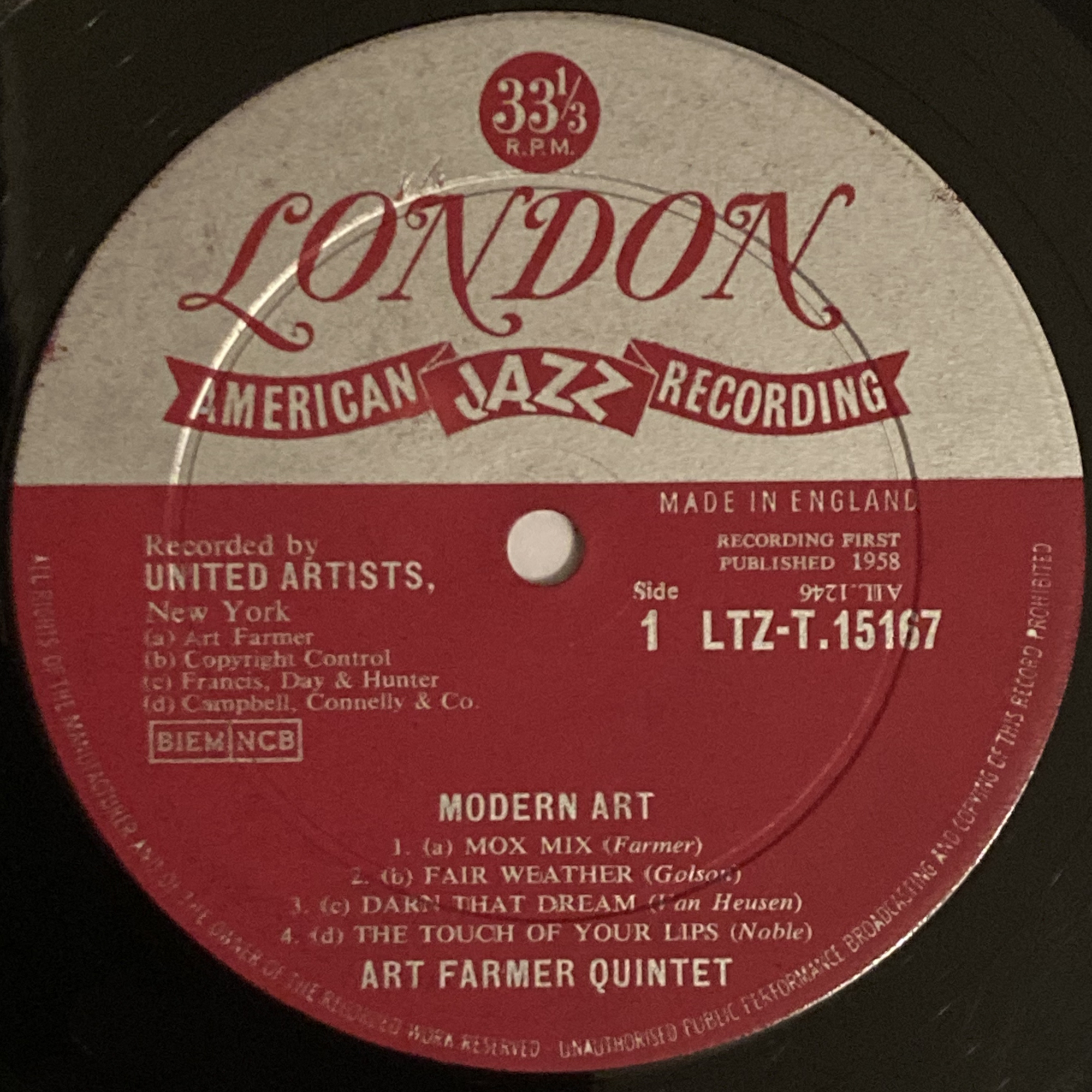
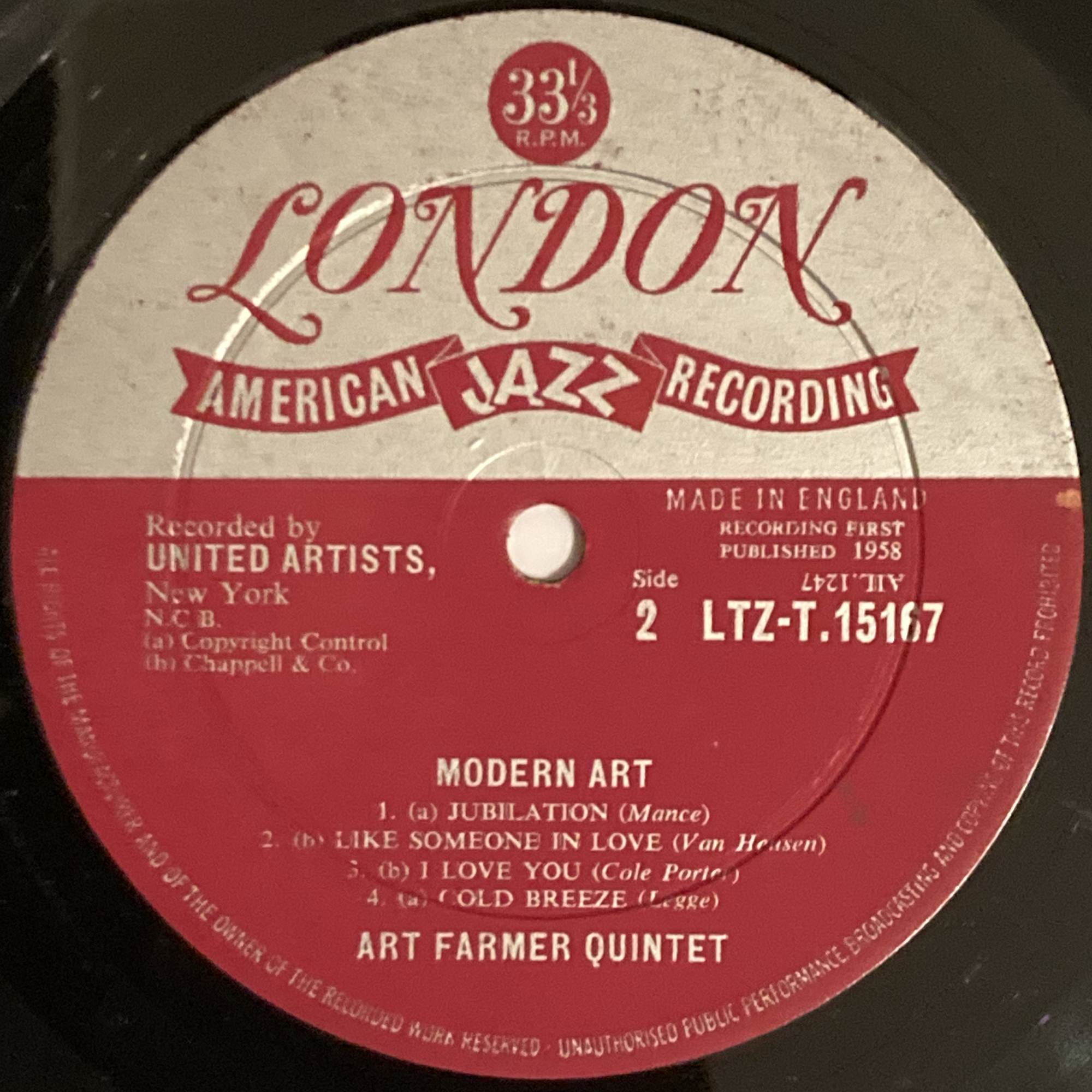
Groove Guard
Label Side-1
Red & Silver Background
Silver & Red Letter
Address: None
Deep Groove
Dead Wax Info: AIL-1246-1B, SM
Label Side-2
Red & Silver Background
Silver & Red Letter
Address: None
Deep Groove
Dead Wax Info: AIL-1247-1B, SM
コメント