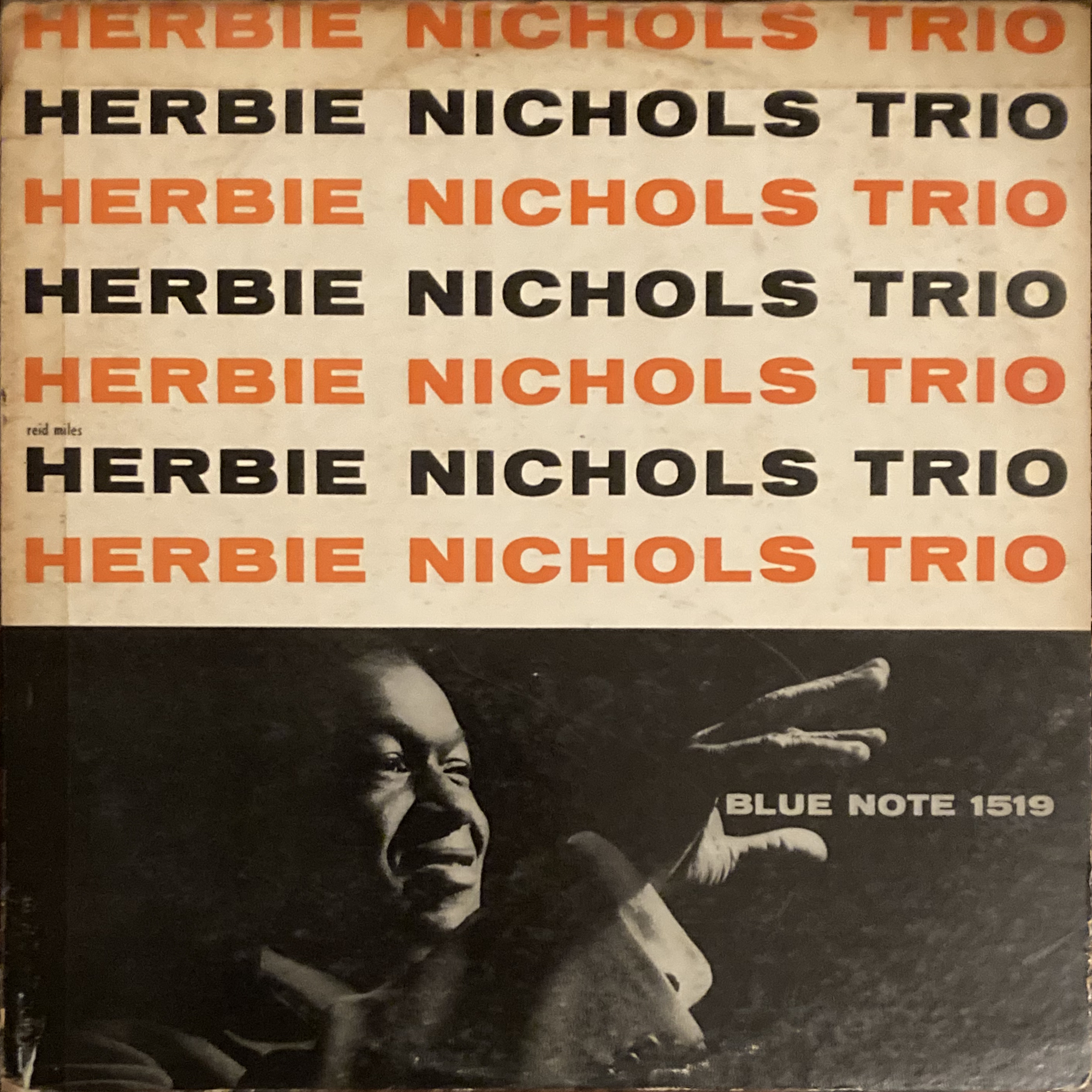
Label: Blue Note
No.: BLP 1519
Title: HERBIE NICHOLS TRIO
Musician: HERBIE NICHOLS
Recorded: 1955/8/1, 1955/8/7, 1956/4/19
Monaural
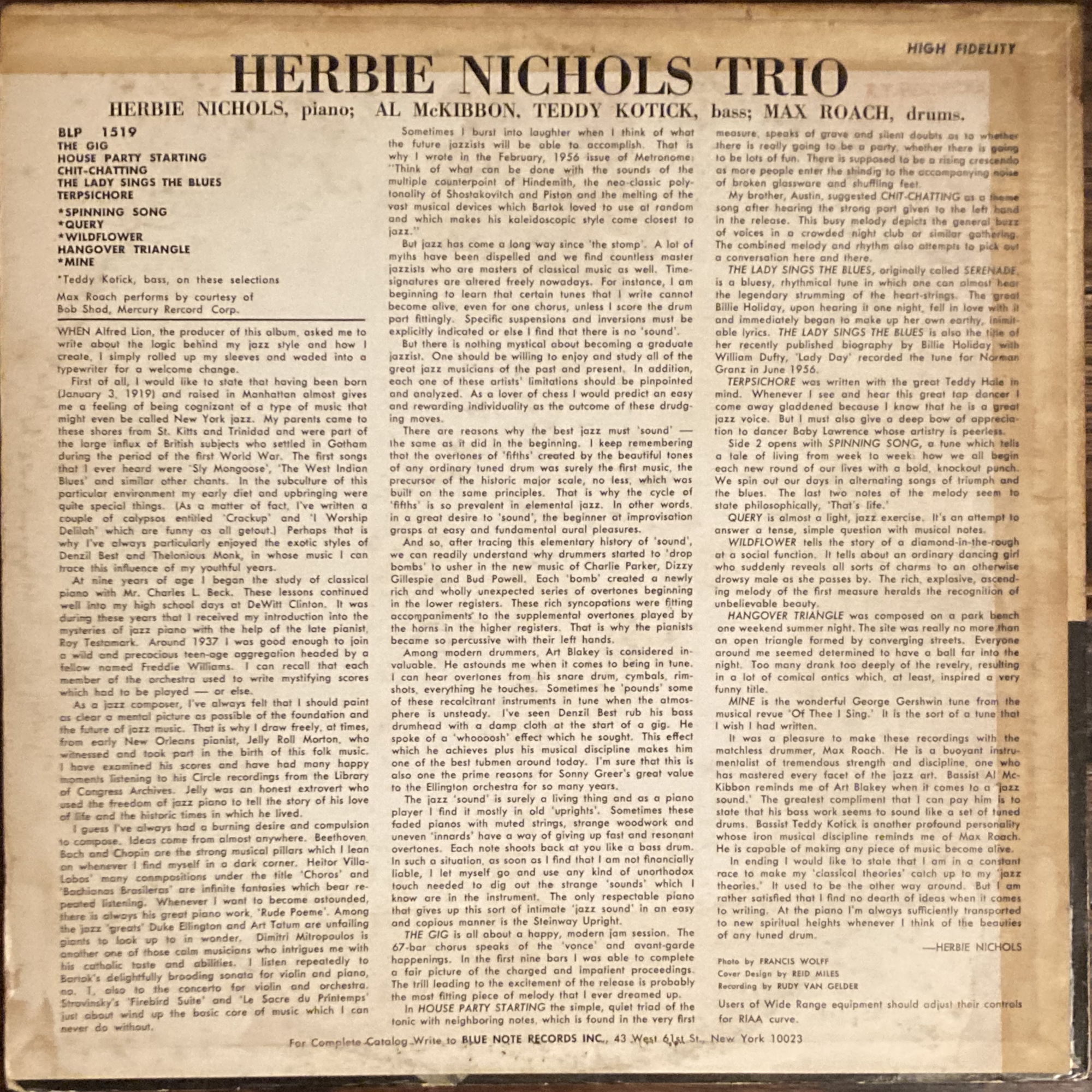
Cover address: 43 West 61st St, New York 23
Coating無し
Groove Guard
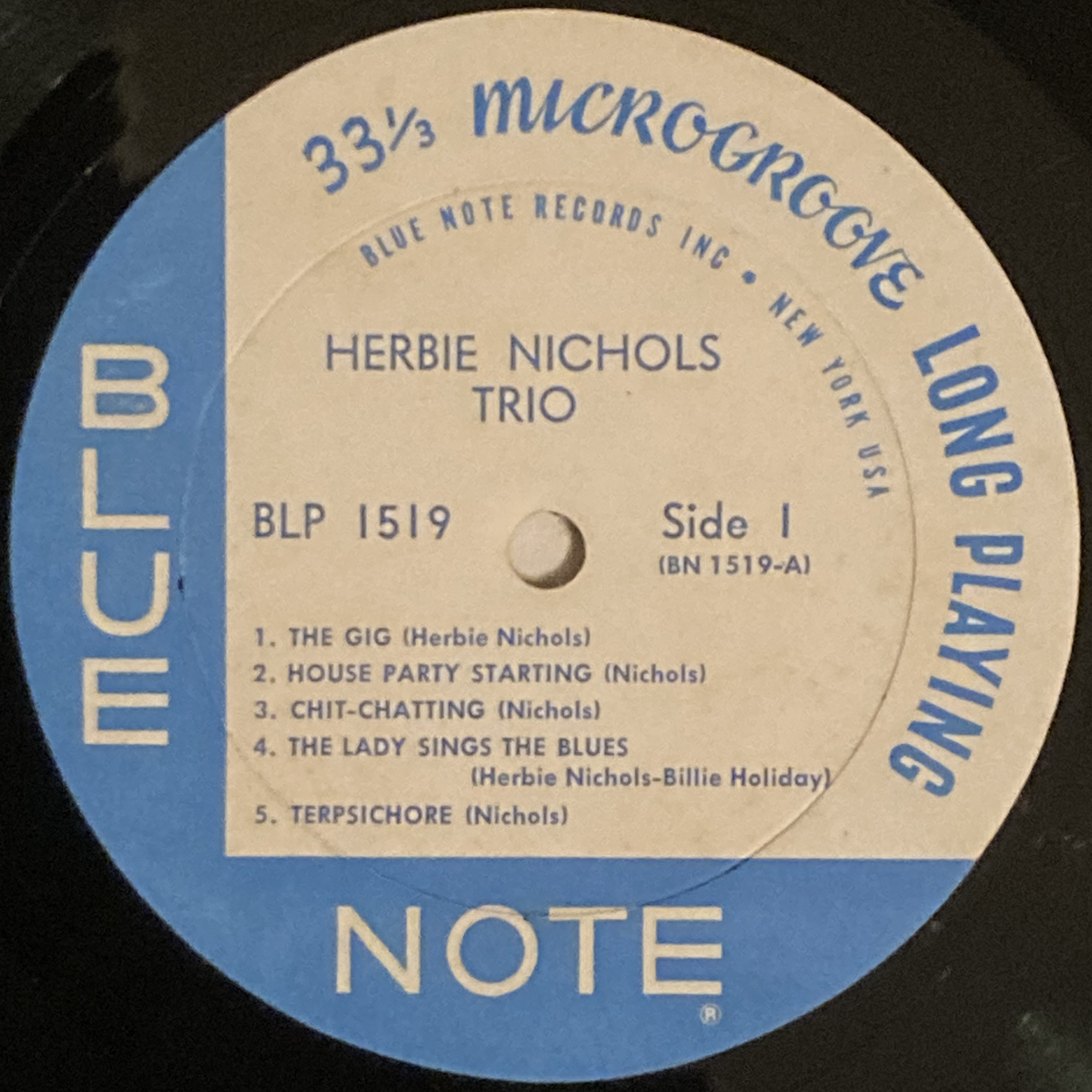
Label Side-1
Blue and White Background
White and Blue Letter With INC
Address: NEW YORK USA
Deep Groove無し
Dead Wax Info: 手書きRVG, BN-LP-1519-A, 9M, 1dot
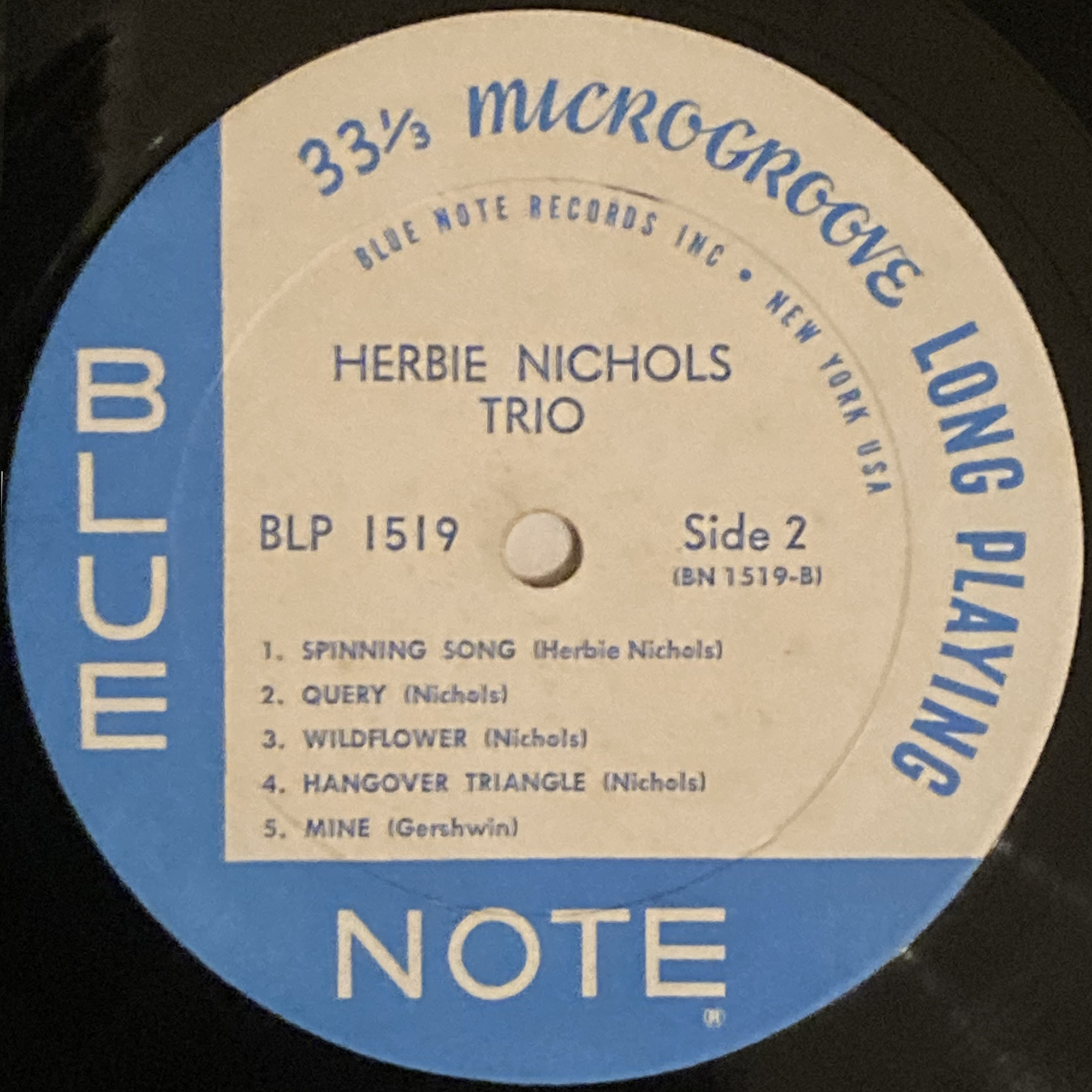
Label Side-2
Blue and White Background
White and Blue Letter With INC
Address: NEW YORK USA
Deep Groove無し
Dead Wax Info: 手書きRVG, BN-LP-1519-B, 9M, 1dot
Personnel- Recorded on 1955/8/1 Side1-(1),(2),(3),(4), Side2-(4)
Drums: Max Roach
Bass: Al McKibbon
Piano: Herbie Nichols
Personnel- Recorded on 1955/8/7 Side1-(5)
Drums: Max Roach
Bass: Al McKibbon
Piano: Herbie Nichols
Personnel- Recorded on 1956/4/19 SIde2-(1),(2),(3),(5)
Drums: Max Roach
Bass: Teddy Kotick
Piano: Herbie Nichols
Tracks-
Side-1
1) The Gig
2) House Party Starting
3) Chit-Chatting
4) The Lady Sings The Blues
5) Terpsichore
Side-2
1) Spinning Song
2) Query
3) Wildflower
4) Hangover Triangle
5) Mine
<裏ジャケ原文>
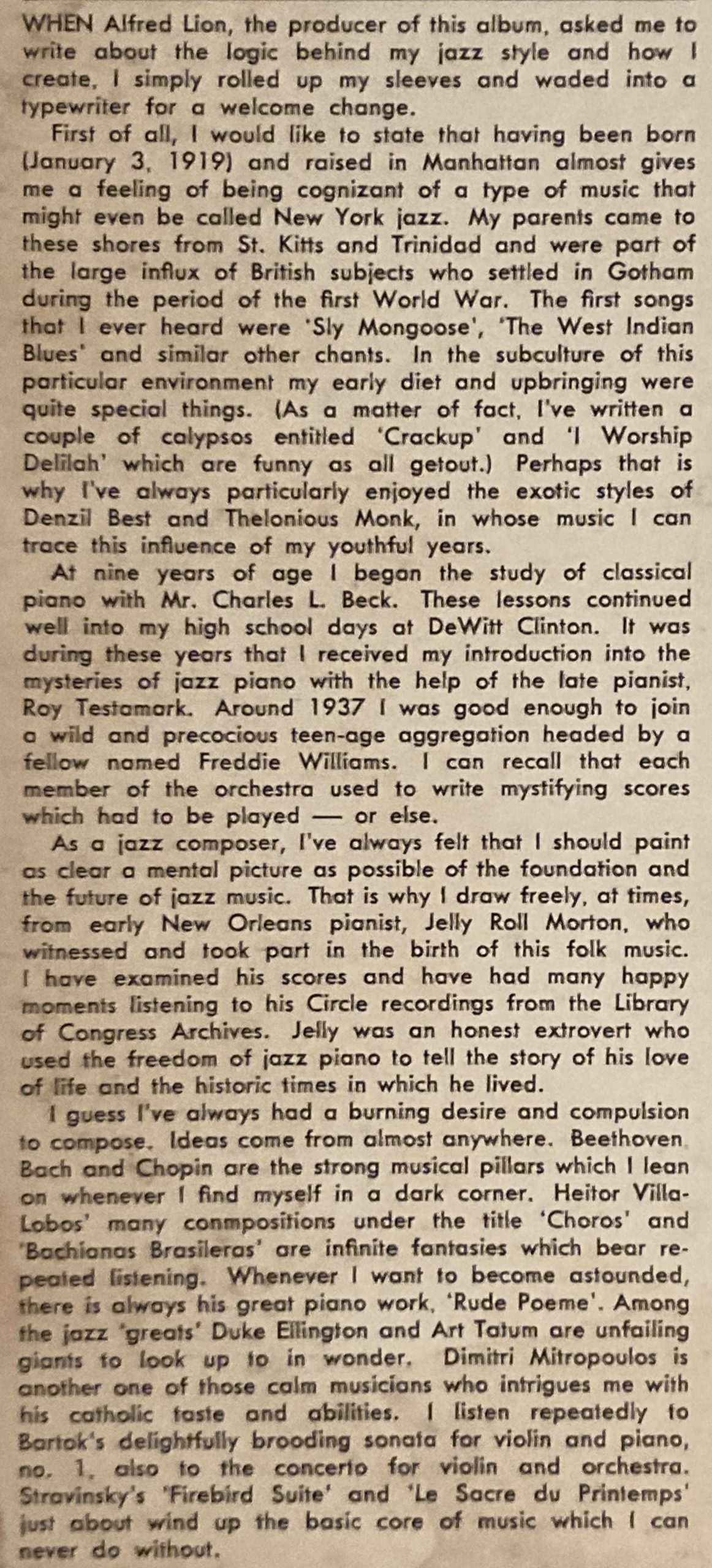
WHEN Alfred Lion, the producer of this album, asked me to write about the logic behind my jazz style and how I create, I simply rolled up my sleeves and waded into a typewriter for a welcome change.
First of all, I would like to state that having been born (January 3, 1919) and raised in Manhattan almost gives me a feeling of being cognizant of a type of music that might even be called New York jazz. My parents came to these shores from St. Kitts and Trinidad and were part of the large influx of British subjects who settled in Gotham during the period of the first World War. The first songs that I ever heard were ‘Sly Mongoose’, ‘The West Indian Blues’ and similar other chants. In the subculture of this particular environment my early diet and upbringing were quite special things. (As a matter of fact, I’ve written a couple of calypsos entitled ‘Crackup’ and ‘I Worship Delilah’ which are funny as all getout.) Perhaps that is why I’ve always particularly enjoyed the exotic styles of Denzil Best and Thelonious Monk, in whose music I can trace this influence of my youthful years.
At nine years of age I began the study of classical piano with Mr. Charles L. Beck. These lessons continued well into my high school days at DeWitt Clinton. It was during these years that I received my introduction into the mysteries of jazz piano with the help of the late pianist, Roy Testamark. Around 1937 I was good enough to join a wild and precocious teen-age aggregation headed by a fellow named Freddie Williams. I can recall that each member of the orchestra used to write mystifying scores which had to be played or else.
As a jazz composer, I’ve always felt that I should paint as clear a mental picture as possible of the foundation and the future of jazz music. That is why I draw freely, at times, from early New Orleans pianist, Jelly Roll Morton, who witnessed and took part in the birth of this folk music. I have examined his scores and have had many happy moments listening to his Circle recordings from the Library of Congress Archives. Jelly was an honest extrovert who used the freedom of jazz piano to tell the story of his love of life and the historic times in which he lived.
I guess I’ve always had a burning desire and compulsion to compose. Ideas come from almost anywhere. Beethoven. Bach and Chopin are the strong musical pillars which I lean on whenever I find myself in a dark corner. Heitor Villa- Lobos’ many conmpositions under the title ‘Choros’ and ‘Bachianas Brasileras’ are infinite fantasies which bear re- peated listening. Whenever I want to become astounded, there is always his great piano work, ‘Rude Poeme’. Among the jazz ‘greats’ Duke Ellington and Art Tatum are unfailing giants to look up to in wonder. Dimitri Mitropoulos is another one of those calm musicians who intrigues me with his catholic taste and abilities. I listen repeatedly to Bartok’s delightfully brooding sonata for violin and piano, no. 1, also to the concerto for violin and orchestra. Stravinsky’s ‘Firebird Suite’ and ‘Le Sacre du Printemps’ just about wind up the basic core of music which I can never do without.
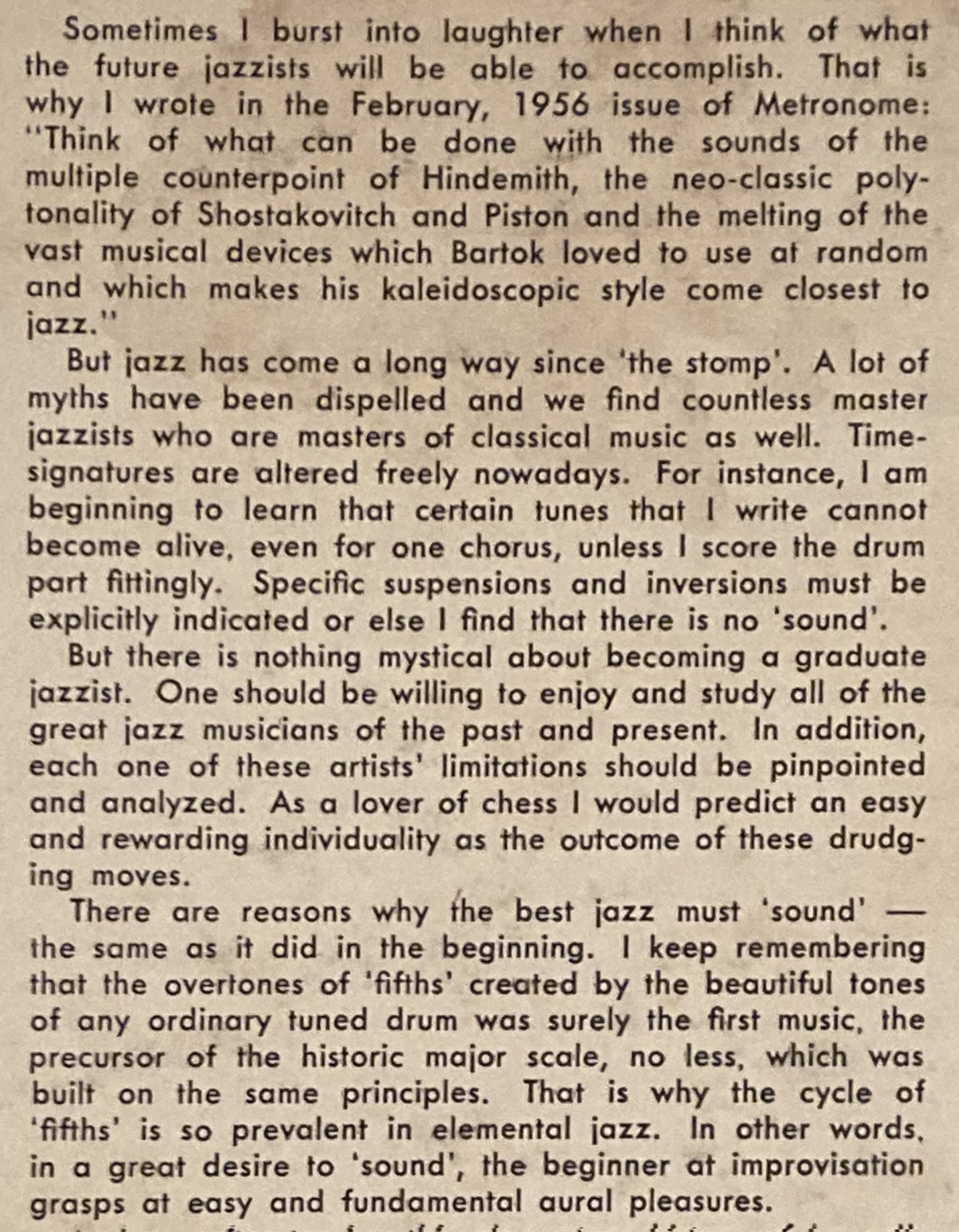
Sometimes I burst into laughter when I think of what the future jazzists will be able to accomplish. That is why I wrote in the February, 1956 issue of Metronome: “Think of what can be done with the sounds of the multiple counterpoint of Hindemith, the neo-classic poly- tonality of Shostakovitch and Piston and the melting of the vast musical devices which Bartok loved to use at random and which makes his kaleidoscopic style come closest to jazz.”
But jazz has come a long way since ‘the stomp’. A lot of myths have been dispelled and we find countless master jazzists who are masters of classical music as well. Time- signatures are altered freely nowadays. For instance, I am beginning to learn that certain tunes that I write cannot become alive, even for one chorus, unless I score the drum part fittingly. Specific suspensions and inversions must be explicitly indicated or else I find that there is no ‘sound’.
But there is nothing mystical about becoming a graduate jazzist. One should be willing to enjoy and study all of the great jazz musicians of the past and present. In addition, each one of these artists’ limitations should be pinpointed and analyzed. As a lover of chess I would predict an easy and rewarding individuality as the outcome of these drudging moves.
There are reasons why the best jazz must ‘sound’ the same as it did in the beginning. I keep remembering that the overtones of ‘fifths’ created by the beautiful tones of any ordinary tuned drum was surely the first music, the precursor of the historic major scale, no less, which was built on the same principles. That is why the cycle of ‘fifths’ is so prevalent in elemental jazz. In other words, in a great desire to ‘sound’, the beginner at improvisation grasps at easy and fundamental aural pleasures.
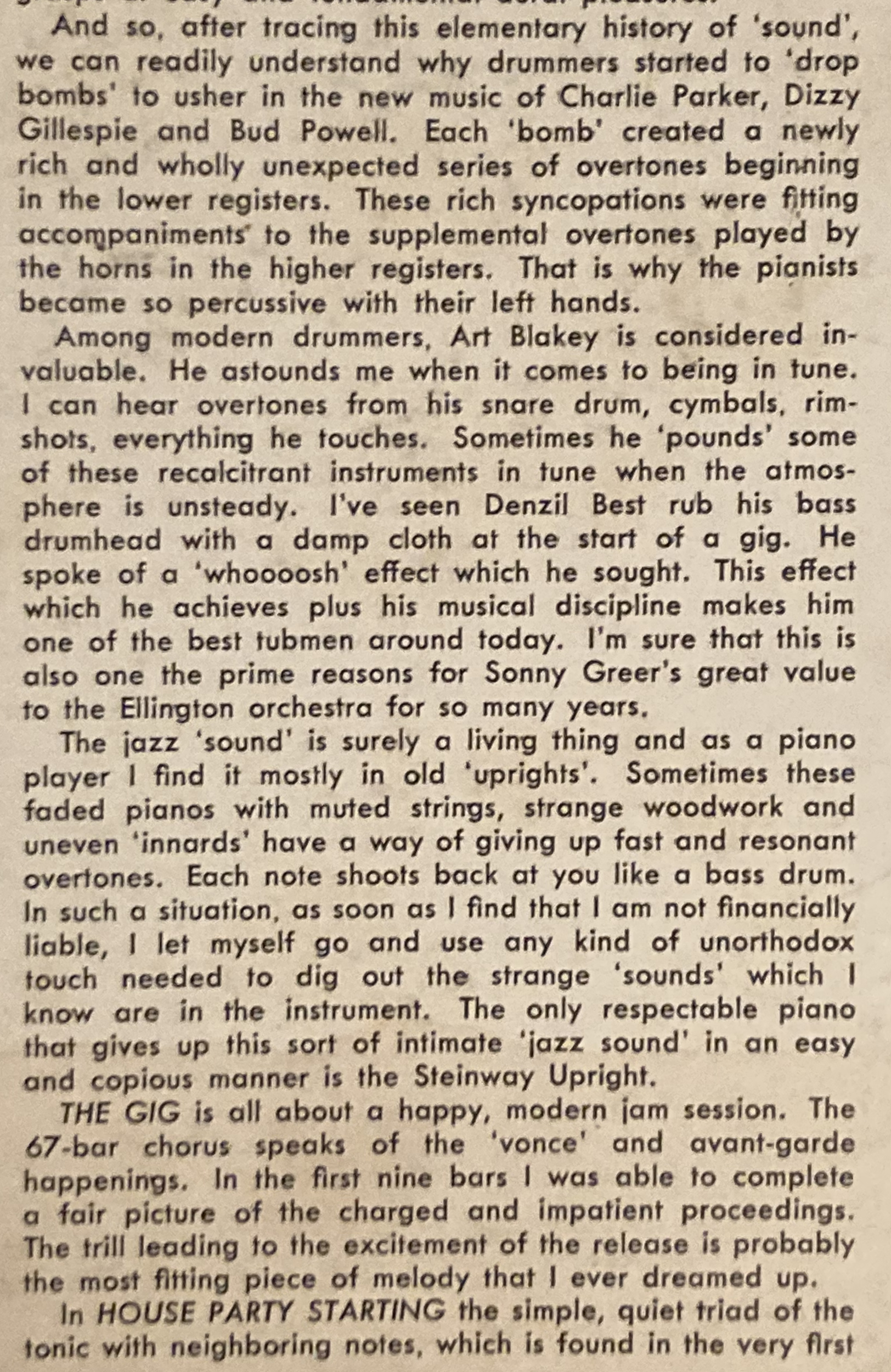
And so, after tracing this elementary history of ‘sound’, we can readily understand why drummers started to ‘drop bombs’ to usher in the new music of Charlie Parker, Dizzy Gillespie and Bud Powell. Each ‘bomb’ created a newly rich and wholly unexpected series of overtones beginning in the lower registers. These rich syncopations were fitting accompaniments to the supplemental overtones played by the horns in the higher registers. That is why the pianists became so percussive with their left hands.
Among modern drummers, Art Blakey is considered in- valuable. He astounds me when it comes to being in tune. I can hear overtones from his snare drum, cymbals, rim- shots, everything he touches. Sometimes he ‘pounds’ some of these recalcitrant instruments in tune when the atmos- phere is unsteady. I’ve seen Denzil Best rub his bass drumhead with a damp cloth at the start of a gig. He spoke of a ‘whoooosh’ effect which he sought. This effect which he achieves plus his musical discipline makes him one of the best tubmen around today. I’m sure that this is also one the prime reasons for Sonny Greer’s great value to the Ellington orchestra for so many years.
The jazz ‘sound’ is surely a living thing and as a piano player I find it mostly in old ‘uprights’. Sometimes these faded pianos with muted strings, strange woodwork and uneven ‘innards’ have a way of giving up fast and resonant overtones. Each note shoots back at you like a bass drum. In such a situation, as soon as I find that I am not financially liable, I let myself go and use any kind of unorthodox touch needed to dig out the strange ‘sounds’ which know are in the instrument. The only respectable piano that gives up this sort of intimate ‘jazz sound’ in an easy and copious manner is the Steinway Upright.
THE GIG is all about a happy, modern jam session. The 67-bar chorus speaks of the ‘vonce’ and avant-garde happenings. In the first nine bars I was able to complete a fair picture of the charged and impatient proceedings. The trill leading to the excitement of the release is probably the most fitting piece of melody that I ever dreamed up.
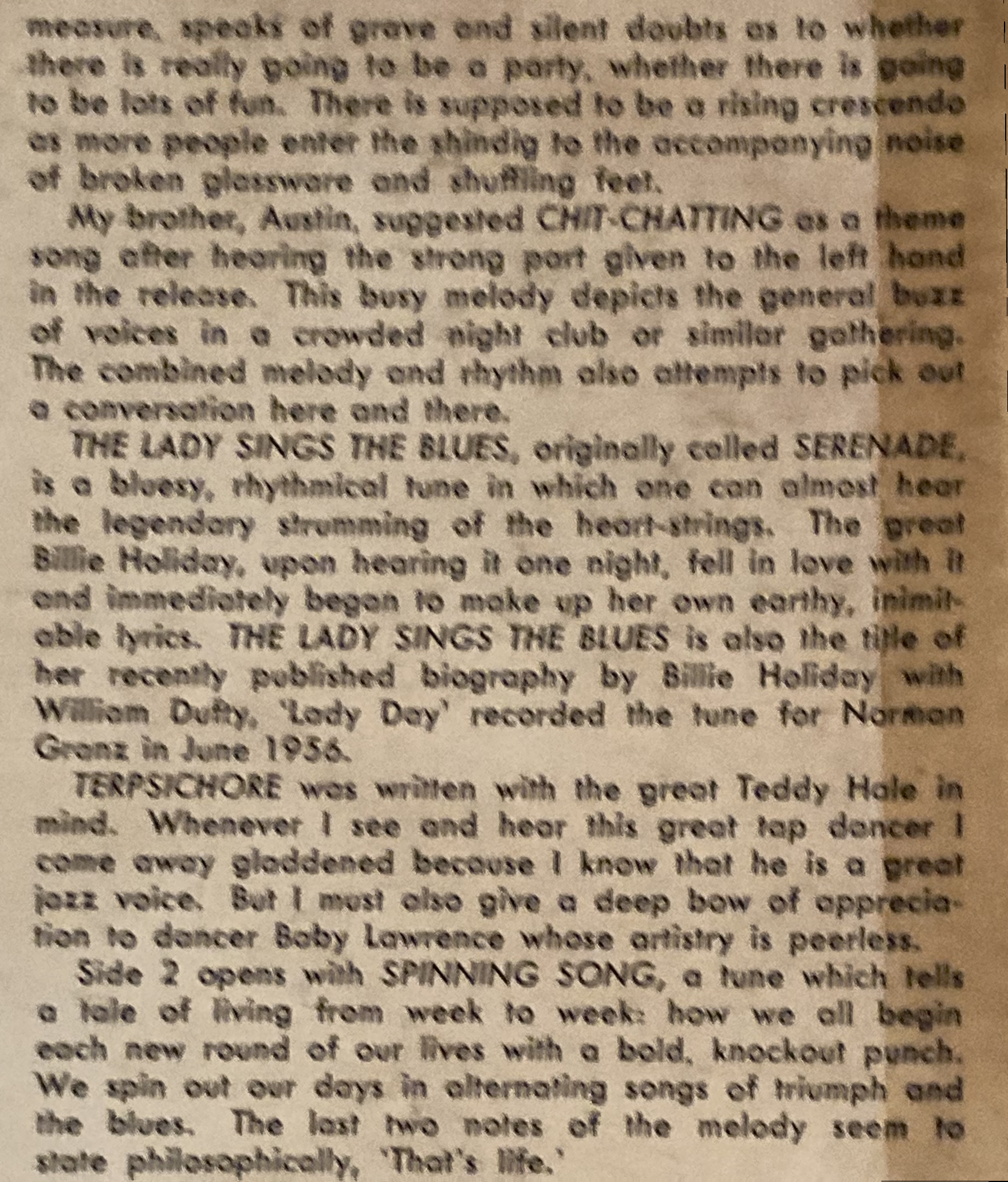
In HOUSE PARTY STARTING the simple, quiet triad of the tonic with neighboring notes, which is found in the very first measure, speaks of grave and silent doubts as to whether there is really going to be a party, whether there is going to be lots of fun. There is supposed to be a rising crescendo es more people enter the shindig to the accompanying noise of broken glassware and shuffling feet.
My brother, Austin, suggested CHIT-CHATTING es a theme song after hearing the strong port given to the left hand in the release. This busy melody depicts the general buzz of voices in a crowded night club or similar gathering. The combined melody and rhythm also attempts to pick out a conversation here and there.
THE LADY SINGS THE BLUES, originally called SERENADE, is a bluesy, rhythmical tune in which one can almost hear the legendary strumming of the heart-strings. The great Billie Holiday, upon hearing it one night, fell in love with it and immediately began to make up her own earthy, inimit able lyrics. THE LADY SINGS THE BLUES is also the title of her recently published biography by Billie Holiday with William Dufty, Lody Day’ recorded the tune for Norman Granz in June 1956.
TERPSICHORE was written with the great Teddy Hale in mind. Whenever I see and hear this great tap dancer 1 come away gladdened because I know that he is a great jozz voice. But I must also give a deep bow of apprecia- tion to dancer Boby Lawrence whose artistry is peerless.
Side 2 opens with SPINNING SONG, a tune which tells a tale of living from week to week: how we all begin each new round of our lives with a bold, knockout punch. We spin out our days in alternating songs of triumph and the blues. The last two notes of the melody seem to state philosophically, ‘That’s life.’
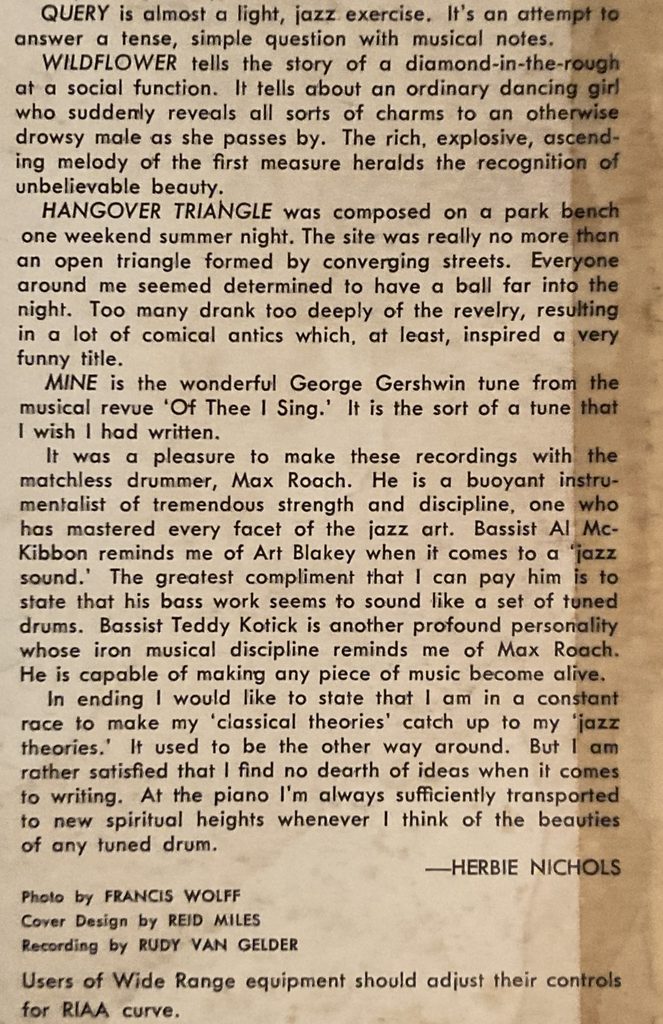
QUERY is almost a light, jazz exercise. It’s an attempt to answer a tense, simple question with musical notes.
WILDFLOWER tells the story of a diamond-in-the-rough at a social function. It tells about an ordinary dancing girl who suddenly reveals all sorts of charms to an otherwise drowsy male as she passes by. The rich, explosive, ascend- ing melody of the first measure heralds the recognition of unbelievable beauty.
HANGOVER TRIANGLE was composed on a park bench one weekend summer night. The site was really no more than an open triangle formed by converging streets. Everyone around me seemed determined to have a ball far into the night. Too many drank too deeply of the revelry, resulting in a lot of comical antics which, at least, inspired a very funny title.
MINE is the wonderful George Gershwin tune from the musical revue ‘Of Thee I Sing.’ It is the sort of a tune that I wish I had written.
It was a pleasure to make these recordings with the matchless drummer, Max Roach. He is a buoyant instru- mentalist of tremendous strength and discipline, one who has mastered every facet of the jazz art. Bassist Al Mc- Kibbon reminds me of Art Blakey when it comes to a ‘jazz sound.’ The greatest compliment that I can pay him is to state that his bass work seems to sound like a set of tuned drums. Bassist Teddy Kotick is another profound personality whose iron musical discipline reminds me of Max Roach. He is capable of making any piece of music become alive.
In ending I would like to state that I am in a constant race to make my ‘classical theories’ catch up to my ‘jazz theories.’ It used to be the other way around. But I am rather satisfied that I find no dearth of ideas when it comes to writing. At the piano I’m always sufficiently transported to new spiritual heights whenever I think of the beauties of any tuned drum.
Photo by FRANCIS WOLFF
Cover Design by REID MILES
Recording by RUDY VAN GELDER
-HERBIE NICHOLS
Users of Wide Range equipment should adjust their controls. for RIAA curve.
<裏ジャケ和訳>
本アルバムのプロデューサーであるアルフレッド・ライオンから、自身のジャズ・スタイルの背後にある論理や、どのように楽曲を創作しているのかについて書いてほしいと頼まれたとき、私は迷わず腕まくりをしてタイプライターに向かった。こうした作業は、たまには悪くない気分転換になるものだ。
まず言っておきたいのは、マンハッタンで生まれ(1919年1月3日)、そこで育った私は、いわば「ニューヨーク・ジャズ」とでも呼ぶべき音楽を、肌感覚として理解しているということだ。私の両親はセントクリストファー島とトリニダード島からやってきた。第一次世界大戦の時期にニューヨーク(ゴッサム)へ移住した、数多くのイギリス領出身者の一団に属していたのである。私が幼い頃に初めて耳にしたのは、『スライ・マングース(Sly Mongoose)』や『ザ・ウェスト・インディアン・ブルース(The West Indian Blues)』といった曲、あるいはそれらに類する歌の数々だった。こうした特殊な環境下で育ったことは、私の幼少期の体験として非常にユニークなものだったと言える。(実際、私は『クラックアップ(Crackup)』や『アイ・ワーシップ・デライラ(I Worship Delilah)』といったカリプソ曲を書いたこともあるのだが、これがとびきり面白い出来栄えなのだ。)おそらく、私がデンジル・ベストやセロニアス・モンクのエキゾチックなスタイルを特に好んできたのは、彼らの音楽の中に、こうした若き日の影響の痕跡を見出すことができるからなのだろう。
9歳のとき、私はチャールズ・L・ベック氏のもとでクラシック・ピアノを習い始めた。このレッスンは、デウィット・クリントン高校に通っていた頃まで続いた。ちょうどその時期、亡きピアニストのロイ・テスタマークの導きによって、私はジャズ・ピアノの奥深い世界へと足を踏み入れることになった。1937年頃には、フレディ・ウィリアムズという人物が率いる、若さゆえの奔放さと早熟さを備えたバンドに加われるほどの腕前になっていた。当時、楽団のメンバー全員がそれぞれ難解な譜面を持ち寄り、それを演奏しなければならないという決まりがあったことを覚えている。
ジャズの作曲家として、私は常に、ジャズという音楽の基盤と未来について、できるだけ鮮明なイメージを描き出したいと考えてきた。だからこそ、私は時折、ニューオーリンズの初期ピアニストであり、このフォーク・ミュージック(ジャズ)の誕生を目の当たりにし、その創成期に関わったジェリー・ロール・モートンの音楽から、自由にインスピレーションを取り入れているのである。私は彼の楽譜を研究し、また、アメリカ議会図書館のアーカイブに収蔵されている「サークル(Circle)」レーベルの録音を聴いて、心から楽しいひとときを過ごしてきました。ジェリーは、裏表のない開放的な性格の持ち主でした。彼はジャズ・ピアノという自由な表現手段を駆使して、自身の人生への愛、そして彼が生きた歴史的な時代について語ったのです。
私には、作曲をしたいという強烈な願望、あるいは衝動が、常にあったように思います。アイデアは、どこからともなく湧いてくるものです。ベートーヴェン、バッハ、ショパン――彼らは、私が暗闇に迷い込んだときに寄りかかることのできる、強固な音楽的支柱です。エイトール・ヴィラ=ロボスが「ショーロス」や「ブラジル風バッハ」と題して残した数々の作品は、何度聴いても飽きることのない、無限のファンタジーに満ちています。驚きに満ちた体験を求めているときには、彼の偉大なピアノ曲『荒々しい詩(Rude Poeme)』がいつも応えてくれます。ジャズの巨匠たちの中では、デューク・エリントンとアート・テイタムが、畏敬の念を抱かずにはいられない、揺るぎない巨人です。ディミトリ・ミトロプーロスもまた、その幅広い音楽的嗜好と才能で私を惹きつけてやまない、静謐な音楽家の一人です。私は、バルトークの、どこか陰鬱でありながらも魅力的なヴァイオリン・ソナタ第1番や、ヴァイオリン協奏曲を繰り返し聴いています。ストラヴィンスキーの『火の鳥』組曲や『春の祭典』も、私にとって欠かすことのできない音楽の核心を成す作品群です。
未来のジャズ・ミュージシャンたちが何を成し遂げるだろうかと思いを巡らせると、思わず笑いがこみ上げてくることがあります。だからこそ、私は1956年2月号の『メトロノーム』誌にこう記したのです。「ヒンデミットの多声的な対位法、ショスタコーヴィチやピストンの新古典主義的な多調性、そしてバルトークが自在に駆使した膨大な音楽的技法――それらを融合させたら、一体どんなものが生まれるだろうか。バルトークの万華鏡のようなスタイルは、ジャズに最も近いものと言えるだろう」と。
しかし、「ストンプ」の時代から今日まで、ジャズは長い道のりを歩んできました。多くの神話は打ち砕かれ、今やクラシック音楽にも精通したジャズの巨匠たちが数多く存在しています。今日では、拍子も自由に変化させられるようになったのです。例えば、私が書く曲の中には、ドラムパートを適切に譜面に落とし込まなければ、たとえ1コーラス分であっても生き生きと響いてこないものがある、ということが分かってきた。特定のサスペンション(係留音)や転回形を明示的に記譜しておかなければ、望むような「響き」が得られないのだ。
とはいえ、本格的なジャズ・ミュージシャンになることに、神秘的な要素など何もない。過去から現在に至る偉大なジャズ・ミュージシャンたちの音楽を楽しみ、研究する意欲を持つこと。そして、そうしたアーティスト一人ひとりが抱える限界を正確に見極め、分析すること。チェスを愛する者として言わせてもらえば、こうした地道な取り組みの果てには、自分らしい個性が自然と、しかも実りある形で確立されるはずである。
最高のジャズが、その黎明期と変わらぬ「響き」を保っていなければならないのには理由がある。私はいつもこう考える――ごく普通に調律されたドラムから生まれる「完全五度」の倍音こそが、音楽の原初的な姿であり、後に確立された長音階の先駆けそのものなのだと。長音階もまた、同じ原理に基づいて構築されているからだ。だからこそ、ジャズの根源的な要素として「五度圏(サイクル・オブ・フィフス)」が広く用いられているのである。言い換えれば、即興演奏を始めたばかりの奏者は、「響き」を追い求めるあまり、耳に心地よく、かつ根本的な快感をもたらす要素を本能的に掴み取ろうとするのだ。
こうした「響き」の初源的な歴史をたどれば、なぜドラマーたちが「ドロップ・ボム(爆弾を落とすような強烈なアクセント)」を繰り出し、チャーリー・パーカー、ディジー・ガレスピー、バド・パウエルらが切り拓いた新しい音楽を導き入れたのか、その理由がよく理解できる。放たれる「ボム」は、低音域から始まる、豊かで全く予想外の倍音群を生み出した。こうした豊かなシンコペーションは、管楽器が高音域で奏でる倍音と見事に調和し、補完し合う伴奏となったのである。ピアニストたちが左手でパーカッシブな演奏を行うようになったのも、まさにこのためだ。
現代のドラマーの中でも、アート・ブレイキーの存在は極めて貴重だ。彼は楽器の「調律」という点において、私を驚嘆させる。スネアドラム、シンバル、リムショット――彼が触れるものすべてから、倍音が響いてくるのが聞こえるのだ。演奏の雰囲気が不安定なときには、彼はあえて楽器を力強く叩くことで、その「言うことを聞かない」楽器を正しい響きへと導くことさえある。かつてデンジル・ベストが、ライブの開始前にバスドラムのヘッドを湿らせた布で拭いているのを見たことがある。彼は、そうすることで得られる「ウーッ」という独特の響きを求めていたのだ。彼が作り出すその響きと、音楽に対する厳格な規律こそが、彼を今日最高のドラマーの一人にしている。ソニー・グリアが長年にわたってエリントン・オーケストラで極めて重要な役割を果たし続けたのも、まさにこの点に大きな理由があるはずだ。
ジャズの「響き」とは、間違いなく生きているものだ。ピアニストである私にとって、その響きが最も色濃く感じられるのは、古い「アップライト・ピアノ」である。弦がくすみ、木工の作りも独特で、内部構造も不均一な、こうした古びたピアノからは、驚くほど素早く、共鳴豊かな倍音が飛び出してくることがある。一つひとつの音が、まるでバスドラムのように、弾き手に向かって力強く跳ね返ってくるのだ。こうした状況下では、金銭的な責任を負う必要がないとわかった途端、私は肩の力を抜き、楽器の中に潜んでいるはずの奇妙な「音」を引き出すために、型破りなアプローチを何でも試すことにしている。こうした親密な「ジャズ・サウンド」を、自然かつ豊かに引き出せるまともなピアノといえば、スタインウェイのアップライト・ピアノをおいて他にない。
「ザ・ギグ(THE GIG)」は、楽しく現代的なジャム・セッションをテーマにしている。67小節からなるコーラスは、その「勢い」やアヴァンギャルドな出来事を物語っている。最初の9小節で、緊張感に満ち、焦燥感すら漂うその場の雰囲気を十分に描き出すことができた。サビ(リリース)の興奮へとつながるトリルは、私自身が思いついたメロディの中でも、最もふさわしいものだと言えるだろう。
「ハウス・パーティー・スターティング(HOUSE PARTY STARTING)」の冒頭、トニックのシンプルな静かな三和音とそれに隣接する音符は、本当にパーティーが始まるのか、そして本当に楽しい時間が過ごせるのかという、深刻で静かな疑念を表現している。パーティーに人が集まるにつれ、グラスが割れる音や足音が混じり合い、クレッシェンドのように盛り上がっていく様子を描いている。
「チット・チャッティング(CHIT-CHATTING)」という曲は、サビ(リリース)部分で左手に力強いパートを配したのを聴いた弟のオースティンが、テーマ曲にどうかと提案してくれたものだ。この忙しないメロディは、混雑したナイトクラブや人が集まる場所での、ざわめく話し声を表現している。メロディとリズムを組み合わせることで、あちこちで交わされる会話の断片を浮かび上がらせようと試みた。
「ザ・レディ・シングス・ザ・ブルース(THE LADY SINGS THE BLUES)」は、もともと「セレナーデ(SERENADE)」というタイトルだった。ブルージーでリズミカルなこの曲には、まるで人の心の琴線が奏でられるような響きがある。ある夜、この曲を聴いた偉大なるビリー・ホリデイはすっかり気に入り、すぐに彼女ならではの、土着的で唯一無二の歌詞を書き上げた。この曲名は、ビリー・ホリデイがウィリアム・ダフティと共著で出版した自伝のタイトルにもなっている。彼女は1956年6月、ノーマン・グランツのプロデュースのもと、この曲をレコーディングした。
「テルプシコレー(TERPSICHORE)」は、偉大なテディ・ヘイルを念頭に置いて書いた曲である。この偉大なタップダンサーの姿を目にし、その音を耳にするたび、私は喜びで満たされる。彼がまさに「ジャズの偉大なる声」の持ち主であることを知っているからだ。また、比類なき芸術性を備えたダンサー、ボビー・ローレンスに対しても、深い敬意を表したい。
B面は「スピニング・ソング(Spinning Song)」で幕を開ける。この曲は、私たちが毎週毎週をどう生きているか、つまり、人生の新たな局面を迎えるたびに、誰もが力強く、鮮烈な一撃を繰り出して歩み始める様子を描いている。私たちは、勝利の歌とブルースを交互に奏でながら、日々を紡いでいくのだ。メロディの最後の二音は、まるで「それが人生というものさ」と、哲学的に語りかけているかのようだ。
「クエリー(Query)」は、軽やかなジャズの練習曲のような趣がある。張り詰めた、しかしシンプルな問いかけに対して、音符の数々で答えようとする試みだ。
「ワイルドフラワー(Wildflower)」は、社交の場で「磨けば光る原石」のような存在に出会う物語だ。どこにでもいそうな一人の踊り子が、通り過ぎる瞬間に、それまで退屈そうにしていた男性の目の前で、思いがけない魅力を次々と開花させていく。冒頭の小節で響く、豊かで爆発的、かつ上昇していくメロディは、信じられないほどの美しさが発見された瞬間を告げている。
『ハンオーバー・トライアングル(Hangover Triangle)』は、ある夏の週末の夜、公園のベンチで作曲された。その場所は、通りが交差してできた三角形の空き地に過ぎなかった。周囲の人々は皆、夜更けまで大いに楽しもうと意気込んでいる様子だった。中にはどんちゃん騒ぎにのめり込みすぎた者もいて、滑稽な振る舞いをいくつも目にすることになったが、それが結果として、とても面白いタイトルを思いつくきっかけとなった。
『マイン(Mine)』は、ミュージカル・レビュー『オブ・ジー・アイ・シング(Of Thee I Sing)』に登場する、ジョージ・ガーシュウィンによる素晴らしい楽曲だ。私が自分で書きたかったと思えるような曲である。
比類なきドラマー、マックス・ローチと共にレコーディングできたことは大きな喜びだった。彼は非常にエネルギッシュで、強靭な精神力と規律を兼ね備えた演奏家であり、ジャズという芸術のあらゆる側面を完全に習得している。ベーシストのアル・マッキボンは、「ジャズ・サウンド」という点において、アート・ブレイキーを彷彿とさせる。彼に対する最高の賛辞は、彼のベース演奏がまるで調律されたドラムセットのように響く、と言えることだろう。もう一人のベーシスト、テディ・コティックもまた、マックス・ローチを思わせるような厳格な音楽的規律を持つ、深みのある人物だ。彼はどんな楽曲であっても、そこに命を吹き込むことができる。
最後に付け加えておきたいのは、私は常に、自分の「クラシック音楽理論」を「ジャズ理論」に追いつかせようと奮闘しているということだ。かつてはその逆だったのだが。とはいえ、作曲のアイデアが尽きることはなく、その点には満足している。ピアノに向かっているとき、調律されたドラムの美しさに思いを馳せると、私はいつも、より高い精神的な境地へと誘われるのである。
写真:フランシス・ウルフ
カバー・デザイン:リード・マイルス
レコーディング:ルディ・ヴァン・ゲルダー
―ハービー・ニコルズ
ワイドレンジ(Wide Range)仕様の機器をお使いの方は、RIAAカーブに合わせてコントロールを調整してください。
※訳文の制作にはGoogleドライブとGoogle翻訳のお世話になりました。

コメント