Label: Blue Note
No.: BST 84114
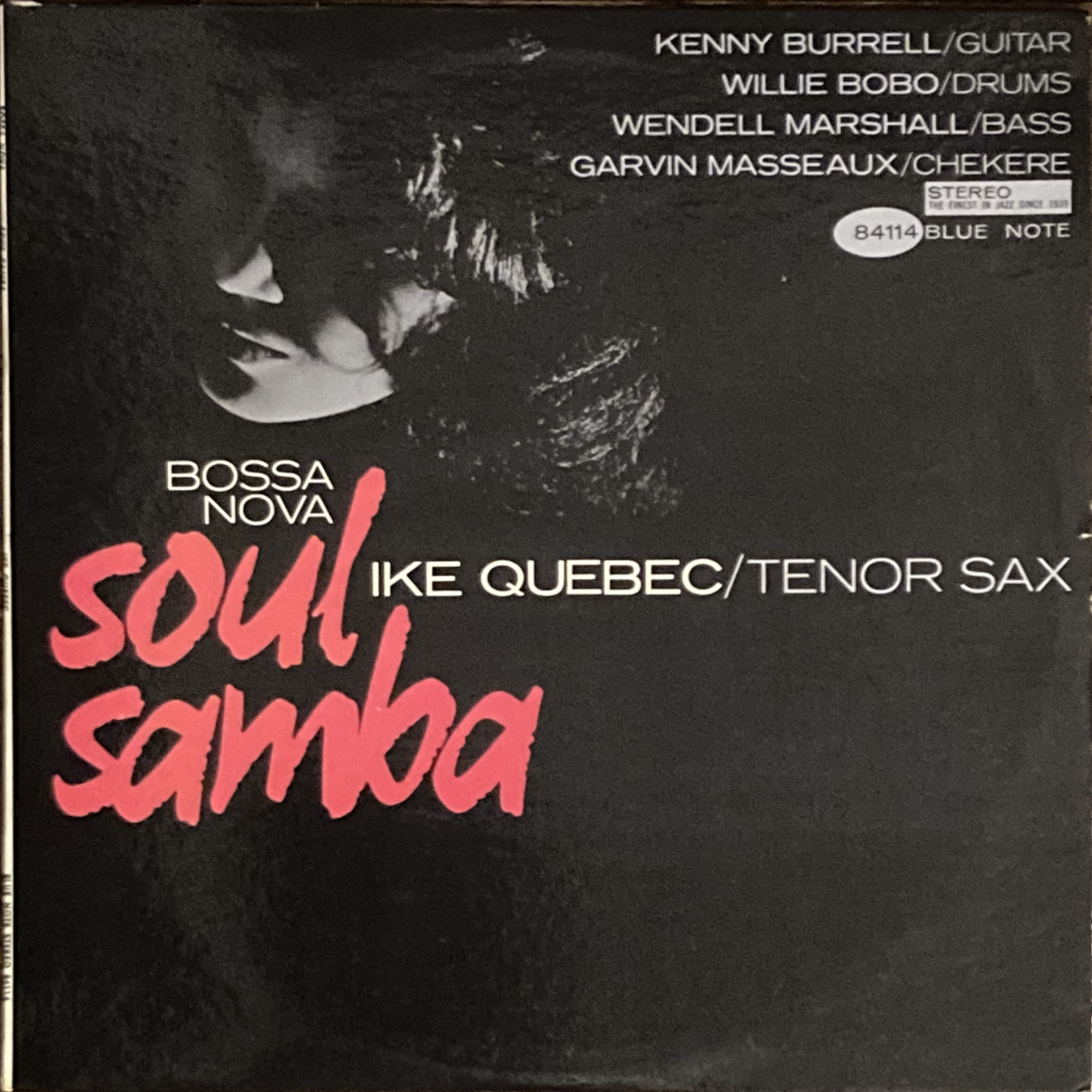
Title: BOSSA NOVA SOUL SAMBA
Musician: IKE QUEBEC
Recorded: 1962/10/5
Stereo
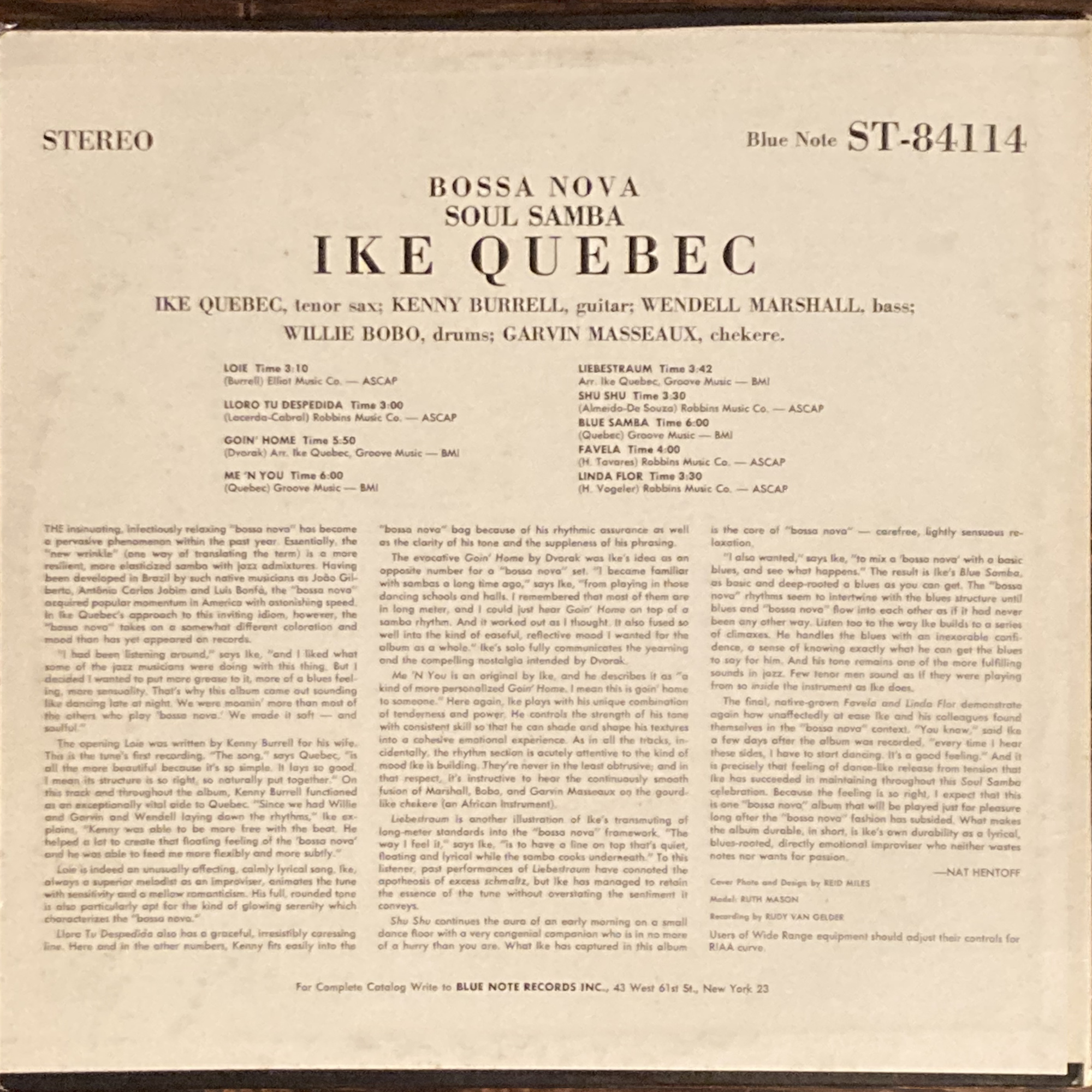
Cover address: 43 West 61st St, New York 23, INC
Laminate Coating
Groove Guard
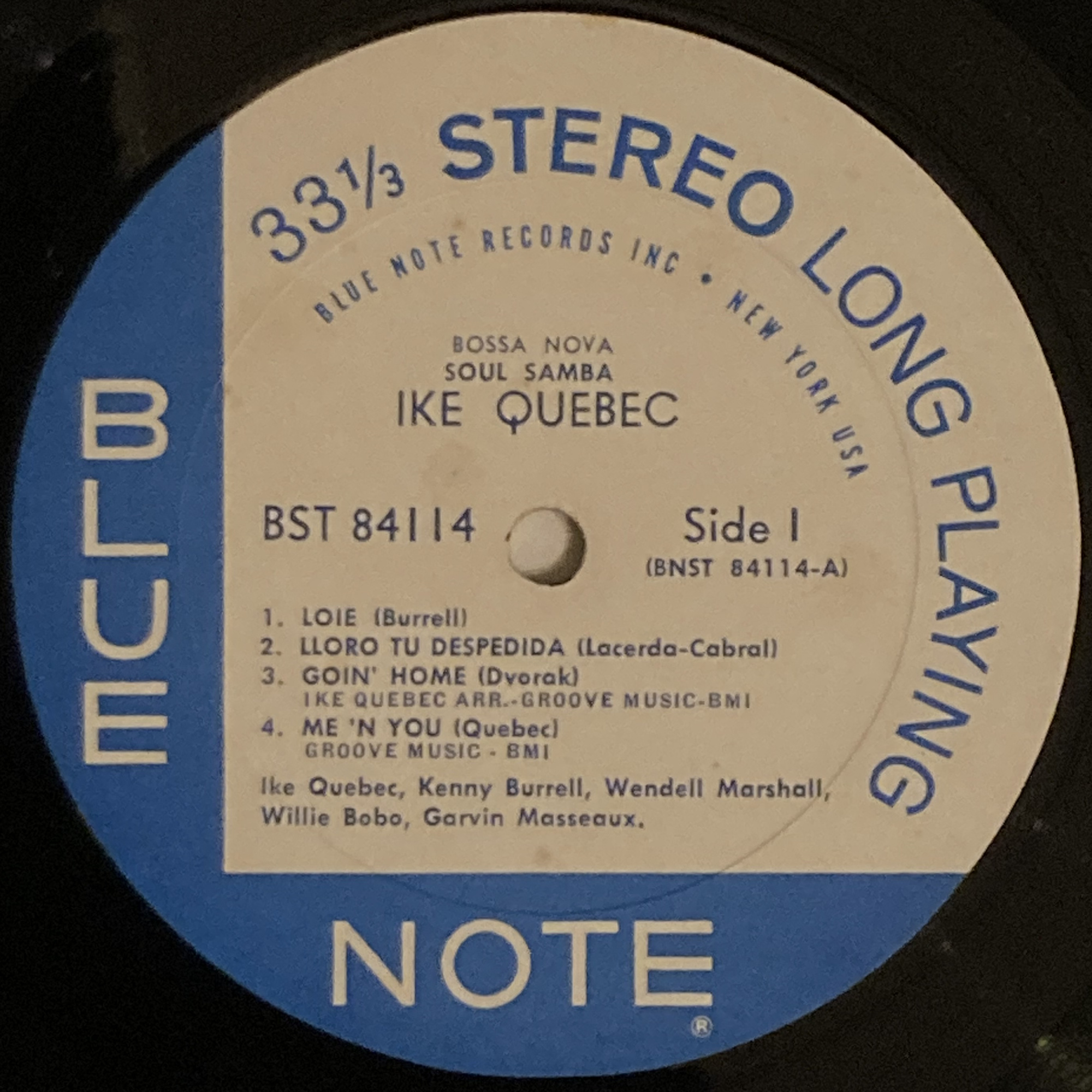
Label Side-1
Blue and White Background
White and Blue Letter With INC
Address: NEW YORK USA
Deep Groove無し
Dead Wax Info: VANGELDER STEREOスタンプ,BN-ST-84114-A, No dot
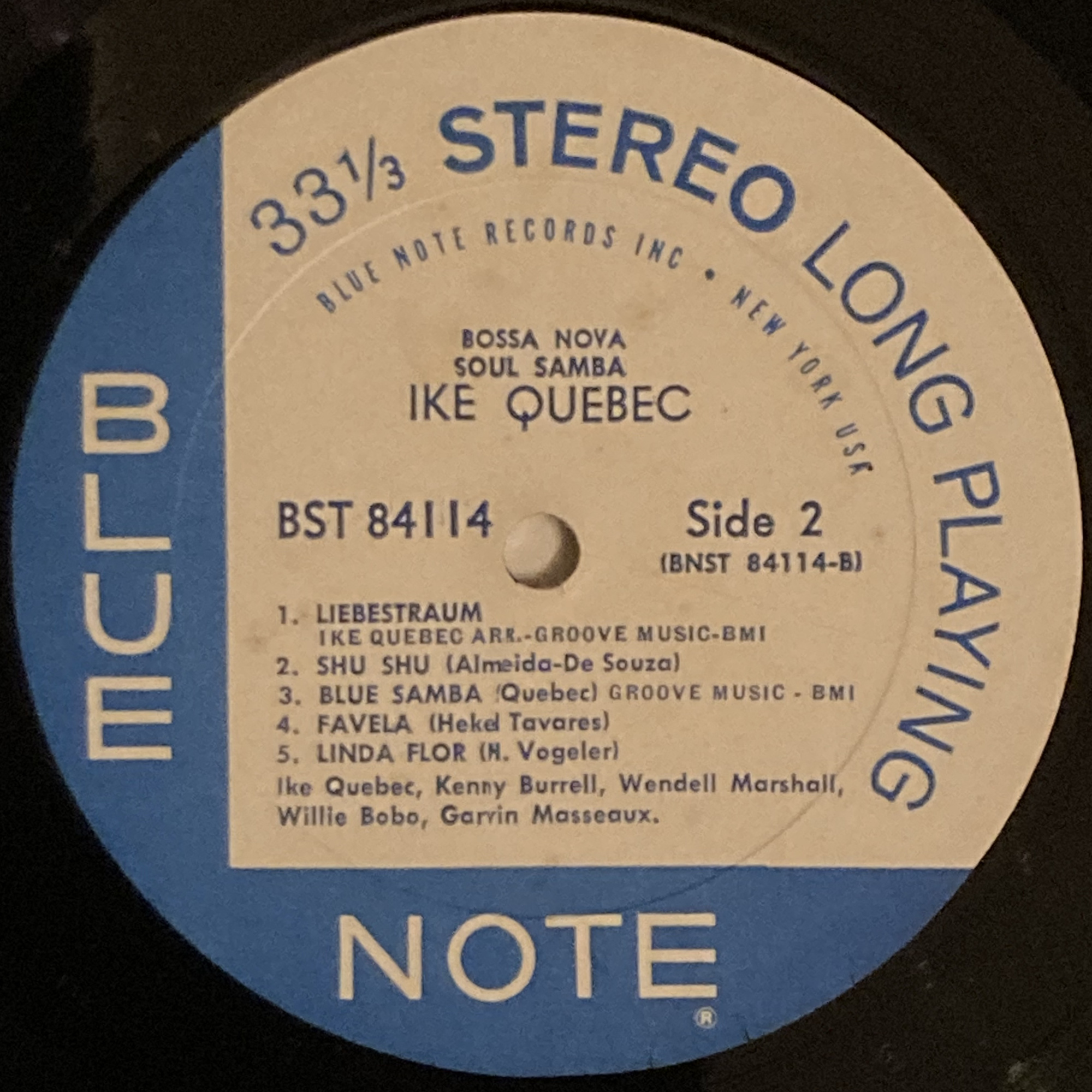
Label Side-2
Blue and White Background
White and Blue Letter With INC
Address: NEW YORK USA
Deep Groove無し
Dead Wax Info: VANGELDER STEREOスタンプ, BN-ST-84114-B, 1 dot
Personnel-
Drums: Willie Bobo
Bass: Wendell Marshall
Tenor Sax: Ike Quebec
Guitar: Kenny Burrell
chekere: Garvin Masseaux
Tracks-
Side-1
1) Loie 3’10”
2) Lloro Tu Despedida 3’00”
3) Goin’ Home 5’50”
4) Me’n You 6’00”
Side-2
1) Liebestraum 3’42”
2) Shu Shu 3’30”
3) Blue Samba 6’00”
4) Favela 4’00”
5) Linda Flor 3’30”
<裏ジャケ原文>
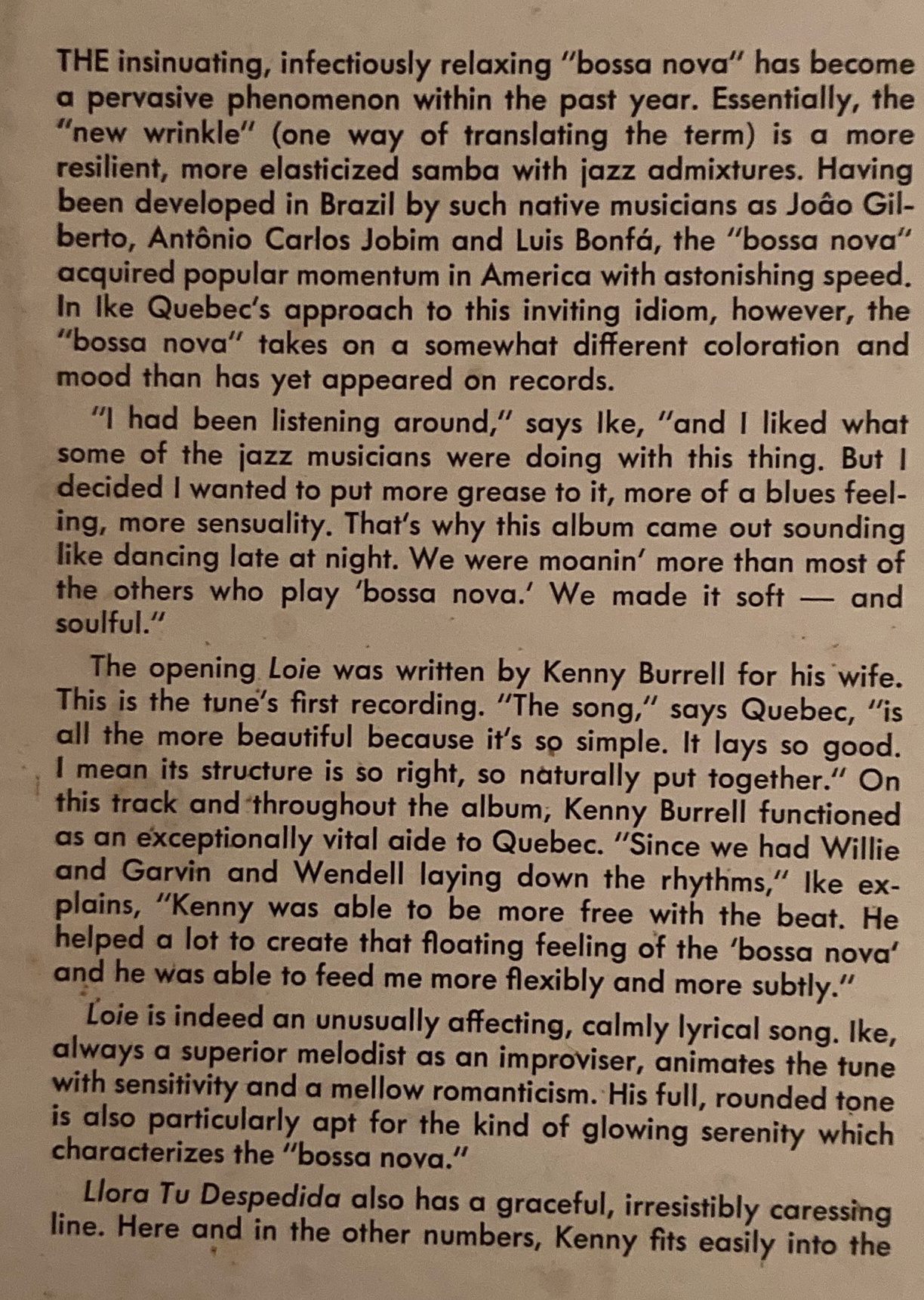
THE insinuating, infectiously relaxing “bossa nova” has become a pervasive phenomenon within the past year. Essentially, the “new wrinkle” (one way of translating the term) is a more resilient, more elasticized samba with jazz admixtures. Having been developed in Brazil by such native musicians as João Gil- berto, Antônio Carlos Jobim and Luis Bonfá, the “bossa nova” acquired popular momentum in America with astonishing speed. In Ike Quebec’s approach to this inviting idiom, however, the “bossa nova” takes on a somewhat different coloration and mood than has yet appeared on records.
“I had been listening around,” says Ike, “and I liked what some of the jazz musicians were doing with this thing. But I decided I wanted to put more grease to it, more of a blues feel- ing, more sensuality. That’s why this album came out sounding like dancing late at night. We were moanin’ more than most of the others who play ‘bossa nova.’ We made it soft and soulful.”
The opening Loie was written by Kenny Burrell for his wife. This is the tune’s first recording. “The song,” says Quebec, “is all the more beautiful because it’s so simple. It lays so good. I mean its structure is so right, so naturally put together.” On this track and throughout the album, Kenny Burrell functioned as an exceptionally vital aide to Quebec. “Since we had Willie and Garvin and Wendell laying down the rhythms,” Ike ex- plains, “Kenny was able to be more free with the beat. He helped a lot to create that floating feeling of the ‘bossa nova’ and he was able to feed me more flexibly and more subtly.”
Loie is indeed an unusually affecting, calmly lyrical song. Ike, always a superior melodist as an improviser, animates the tune with sensitivity and a mellow romanticism. His full, rounded tone is also particularly apt for the kind of glowing serenity which characterizes the “bossa nova.”
Llora Tu Despedida also has a graceful, irresistibly caressing line. Here and in the other numbers, Kenny fits easily into the “bossa nova” bag because of his rhythmic assurance as well as the clarity of his tone and the suppleness of his phrasing.
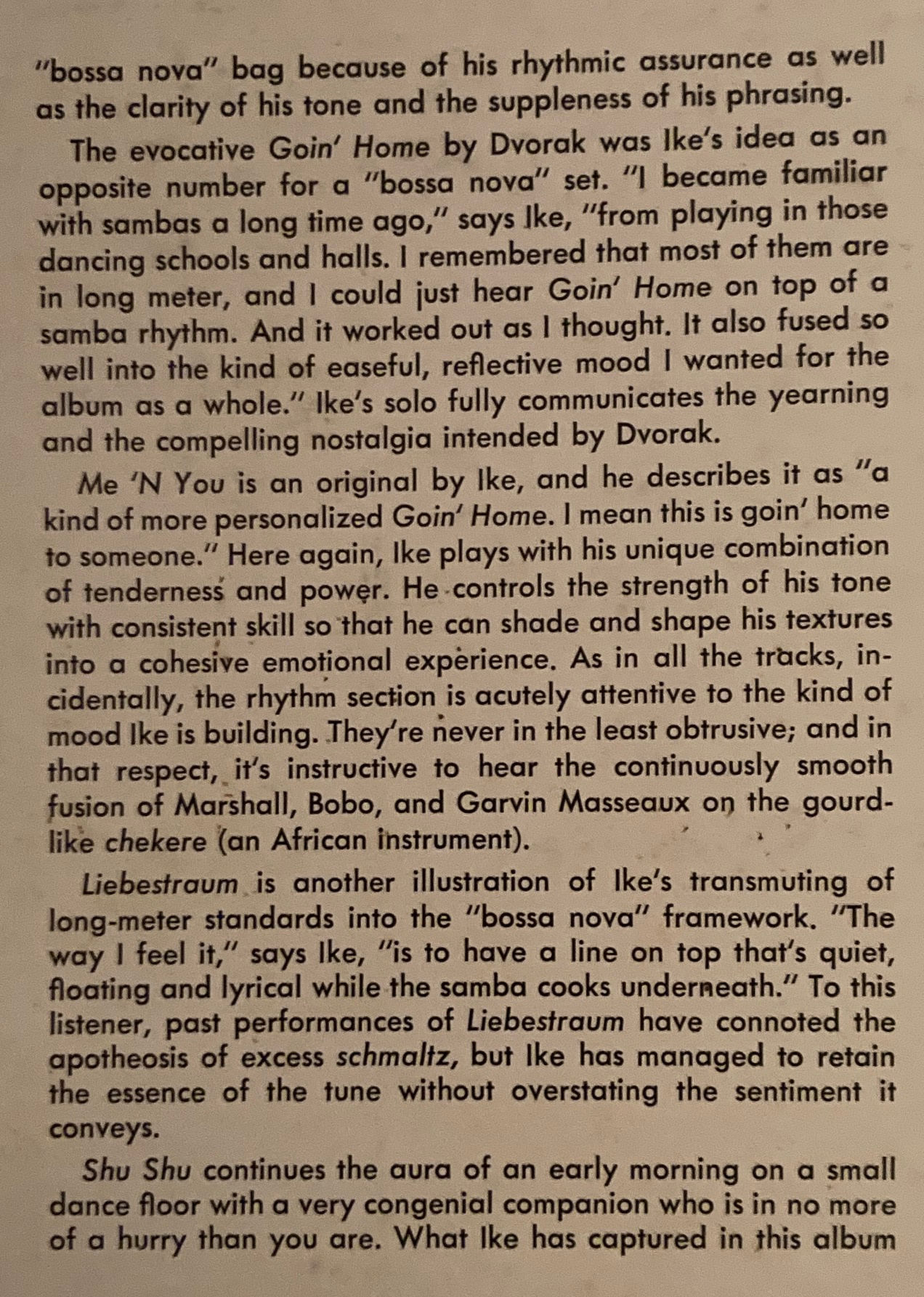
The evocative Goin’ Home by Dvorak was Ike’s idea as an opposite number for a “bossa nova” set. “I became familiar with sambas a long time ago,” says Ike, “from playing in those dancing schools and halls. I remembered that most of them are in long meter, and I could just hear Goin’ Home on top of a samba rhythm. And it worked out as I thought. It also fused so well into the kind of easeful, reflective mood I wanted for the album as a whole.” Ike’s solo fully communicates the yearning and the compelling nostalgia intended by Dvorak.
Me ‘N You is an original by Ike, and he describes it as “a kind of more personalized Goin’ Home. I mean this is goin’ home to someone.” Here again, Ike plays with his unique combination of tenderness and power. He controls the strength of his tone with consistent skill so that he can shade and shape his textures into a cohesive emotional experience. As in all the tracks, in- cidentally, the rhythm section is acutely attentive to the kind of mood Ike is building. They’re never in the least obtrusive; and in that respect, it’s instructive to hear the continuously smooth fusion of Marshall, Bobo, and Garvin Masseaux on the gourd- like chekere (an African instrument).
Liebestraum is another illustration of Ike’s transmuting of long-meter standards into the “bossa nova” framework. “The way I feel it,” says Ike, “is to have a line on top that’s quiet, floating and lyrical while the samba cooks underneath.” To this listener, past performances of Liebestraum have connoted the apotheosis of excess schmaltz, but Ike has managed to retain the essence of the tune without overstating the sentiment it conveys.
Shu Shu continues the aura of an early morning on a small dance floor with a very congenial companion who is in no more of a hurry than you are. What Ike has captured in this album is the core of “bossa nova” carefree, lightly sensuous re- laxation.
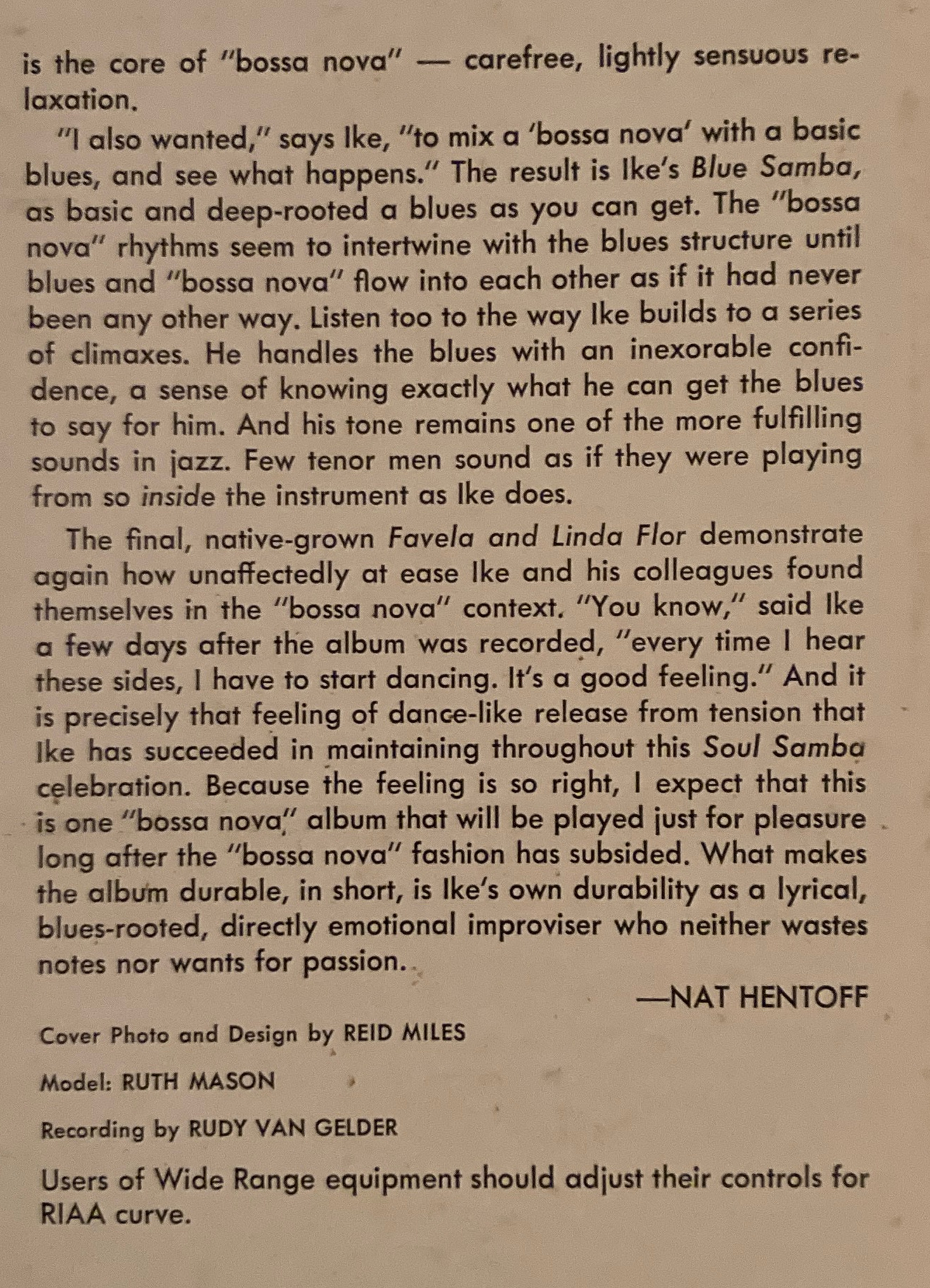
“I also wanted,” says Ike, “to mix a ‘bossa nova’ with a basic blues, and see what happens.” The result is Ike’s Blue Samba, as basic and deep-rooted a blues as you can get. The “bossa nova” rhythms seem to intertwine with the blues structure until blues and “bossa nova” flow into each other as if it had never been any other way. Listen too to the way Ike builds to a series of climaxes. He handles the blues with an inexorable confi- dence, a sense of knowing exactly what he can get the blues to say for him. And his tone remains one of the more fulfilling sounds in jazz. Few tenor men sound as if they were playing from so inside the instrument as Ike does.
The final, native-grown Favela and Linda Flor demonstrate again how unaffectedly at ease Ike and his colleagues found themselves in the “bossa nova” context. “You know,” said Ike a few days after the album was recorded, “every time I hear these sides, I have to start dancing. It’s a good feeling.” And it is precisely that feeling of dance-like release from tension that Ike has succeeded in maintaining throughout this Soul Samba celebration. Because the feeling is so right, I expect that this is one “bossa nova” album that will be played just for pleasure long after the “bossa nova” fashion has subsided. What makes the album durable, in short, is Ike’s own durability as a lyrical, blues-rooted, directly emotional improviser who neither wastes notes nor wants for passion..
Cover Photo and Design by REID MILES
Model: RUTH MASON
Recording by RUDY VAN GELDER
-NAT HENTOFF
Users of Wide Range equipment should adjust their controls for RIAA curve.
<裏ジャケ和訳文>
聴く者の心にすっと入り込み、思わずリラックスしてしまう「ボサ・ノヴァ」は、ここ1年で急速に広まり、一大ブームを巻き起こしました。その本質は、ジャズの要素を取り入れつつ、サンバをよりしなやかで弾力のあるものへと進化させた新しいスタイルにあります。ブラジルのジョアン・ジルベルト、アントニオ・カルロス・ジョビン、ルイス・ボンファといったミュージシャンたちによって生み出されたこの音楽は、アメリカでも驚くべき速さで人気を博しました。しかし、アイク・ケベックがこの魅力的なスタイルに取り組むにあたり、彼の「ボサ・ノヴァ」は、これまでのレコードとは一味違う色合いや雰囲気を帯びるものとなりました。
「いろいろと聴き比べてみて、ジャズ・ミュージシャンたちがこの音楽でやっていることはいいなと思ったんだ」とアイクは語ります。「でも、もっと『脂の乗った』感じというか、ブルースのフィーリングや官能的な要素を加えたいと思った。だから、このアルバムは深夜のダンス・フロアのような響きになったんだ。他の多くの『ボサ・ノヴァ』演奏者たちよりも、もっと『うねるような』表現(モアニング)を意識したし、柔らかくソウルフルなサウンドに仕上げたよ」
オープニング曲の「Loie(ロイ)」は、ケニー・バレルが妻のために書いた曲で、今回が初のレコーディングとなります。「この曲は、とてもシンプルだからこそ美しいんだ」とケベックは言います。「演奏もしっくりくる。つまり、構成が完璧で、自然にまとまっているんだ」。このトラックやアルバム全体を通して、ケニー・バレルはケベックにとって極めて重要なパートナーとしての役割を果たしました。「ウィリー、ガーヴィン、ウェンデルがリズムをしっかりと支えてくれていたから、ケニーはビートに対してより自由にアプローチできたんだ」とアイクは説明します。「彼は『ボサ・ノヴァ』特有の浮遊感を生み出すのに大きく貢献してくれたし、僕に対してより柔軟かつ繊細な反応を返してくれたよ」
「Loie」は、実に心に深く響く、穏やかで叙情的な曲です。即興演奏家として常に優れたメロディ・センスを持つアイクは、繊細さと芳醇なロマンティシズムを込めてこの曲に命を吹き込んでいます。彼の豊かで丸みのあるトーンは、「ボサ・ノヴァ」を特徴づける、あの温かく輝くような静けさを表現するのにうってつけです。
「Llora Tu Despedida(ロラ・トゥ・デスペディーダ)」もまた、優美で、聴く者を優しく包み込むような魅力的な旋律を持っています。本作や他の収録曲において、ケニーは確かなリズム感に加え、明瞭な音色としなやかなフレージングによって、「ボサノヴァ」というスタイルに違和感なく溶け込んでいます。
ドヴォルザークの情感豊かな名曲「家路(Goin’ Home)」を取り上げたのはアイクのアイデアで、ボサノヴァ・セットとの対比を意図したものでした。「昔、ダンス教室やダンスホールで演奏していた頃にサンバに親しんでいました」とアイクは語ります。「サンバの多くはロング・メーター(ゆったりとした拍子感)で演奏されることを覚えていて、サンバのリズムに乗せて『家路』を演奏するイメージが自然と湧いてきたんです。実際にやってみると、思い描いた通りにうまくいきました。アルバム全体に求めていた、ゆったりと落ち着いた内省的なムードにも見事に溶け込んでくれましたね」。アイクのソロは、ドヴォルザークが意図した切ない憧憬や、胸に迫るような郷愁の念を見事に表現しています。
「Me ‘N You」はアイクのオリジナル曲で、彼自身はこれを「『Goin’ Home』をより個人的にしたようなもの。つまり、誰かの元へ帰る(ゴーイン・ホーム)ということさ」と表現しています。ここでもアイクは、優しさと力強さを独自に組み合わせた演奏を披露しています。彼は確かな技術で音の強弱をコントロールし、音の質感を巧みに変化させながら、まとまりのある感情的な体験へと昇華させています。ちなみに、どの曲でも言えることですが、リズム・セクションはアイクが作り出すムードを鋭敏に感じ取っています。彼らは決して出しゃばることなく、その点において、マーシャル、ボボ、そしてガーヴィン・マッソー(ヒョウタンのような楽器であるシェケレを担当)が織りなす、絶えず滑らかに融合するアンサンブルを聴くことは非常に示唆に富んでいます。
「Liebestraum(愛の夢)」は、アイクがロング・メジャー(ゆったりとした拍子)のスタンダード・ナンバーを「ボサノヴァ」の枠組みへと変容させた好例です。「僕の感覚としては、サンバのリズムが熱を帯びて刻まれる一方で、その上では静かで、浮遊感があり、叙情的なメロディが流れている……そんな感じだね」とアイクは語ります。この曲の過去の演奏といえば、ともすれば過剰な感傷(シュマルツ)に陥りがちでしたが、アイクは感情を強調しすぎることなく、この曲の本質を見事に保っています。
「Shu Shu」は、小さなダンスフロアで、自分と同じように急ぐことなくゆったりとした時間を過ごせる親密なパートナーと踊る、早朝のような雰囲気を醸し出しています。アイクがこのアルバムで捉えたもの、それは「ボサノヴァ」の核心――つまり、気ままさ、軽やかな官能、そしてリラックスした心地よさなのです。
「『ボサノヴァ』と基本的なブルースを混ぜ合わせたらどうなるか、試してみたかったんだ」とアイクは言います。その結果生まれたのが「Ike’s Blue Samba」であり、これ以上ないほど基本的かつ根源的なブルース・ナンバーとなりました。「ボサノヴァ」のリズムがブルースの構成と絡み合い、やがてブルースと「ボサノヴァ」が互いに溶け合って、まるで最初からそうであったかのように自然な流れを生み出しています。アイクがクライマックスを次々と築き上げていく展開にも注目してください。彼は揺るぎない自信を持ってブルースを扱い、ブルースという音楽を使って何を表現できるかを完全に熟知しています。そしてその音色は、ジャズの中でもとりわけ充実した響きを保ち続けています。アイクほど、楽器の「内側」から響きを紡ぎ出しているように感じさせるテナー・サックス奏者は稀だ。
アルバムの最後を飾る、ブラジル生まれの楽曲「ファヴェーラ(Favela)」と「リンダ・フロール(Linda Flor)」は、アイクと共演者たちが「ボサノヴァ」という文脈の中で、いかに自然体でリラックスして演奏していたかを改めて物語っている。録音から数日後、アイクはこう語った。「この曲を聴くたびに、思わず踊り出したくなるんだ。実にいい気分だよ」。まさに、そうしたダンスのような、緊張から解き放たれた感覚こそが、この『ソウル・サンバ』という祝祭的なアルバム全体を通して、アイクが見事に表現し続けているものなのだ。その感覚があまりにも素晴らしいからこそ、このアルバムは「ボサノヴァ」ブームが去った後も、純粋に楽しむための作品として長く聴き継がれていくことだろう。要するに、このアルバムが色あせない魅力を放ち続けているのは、アイク自身の音楽的な「持続力」ゆえである。彼は、ブルースに根ざし、情感豊かでストレートな表現力を持ち、無駄な音を一切使わず、かつ情熱に満ちた即興演奏を行うアーティストなのだ。
カバー写真・デザイン:リード・マイルズ
モデル:ルース・メイソン
録音:ルディ・ヴァン・ゲルダー
―ナット・ヘントフ
ワイドレンジ(広帯域)再生機器をご使用の際は、RIAAカーブに合わせてコントロールを調整してください。
※訳文の製作にはGoogleドライブとGoogle翻訳のお世話になりました。


コメント