Label: CONTEMPORARY RECORDS
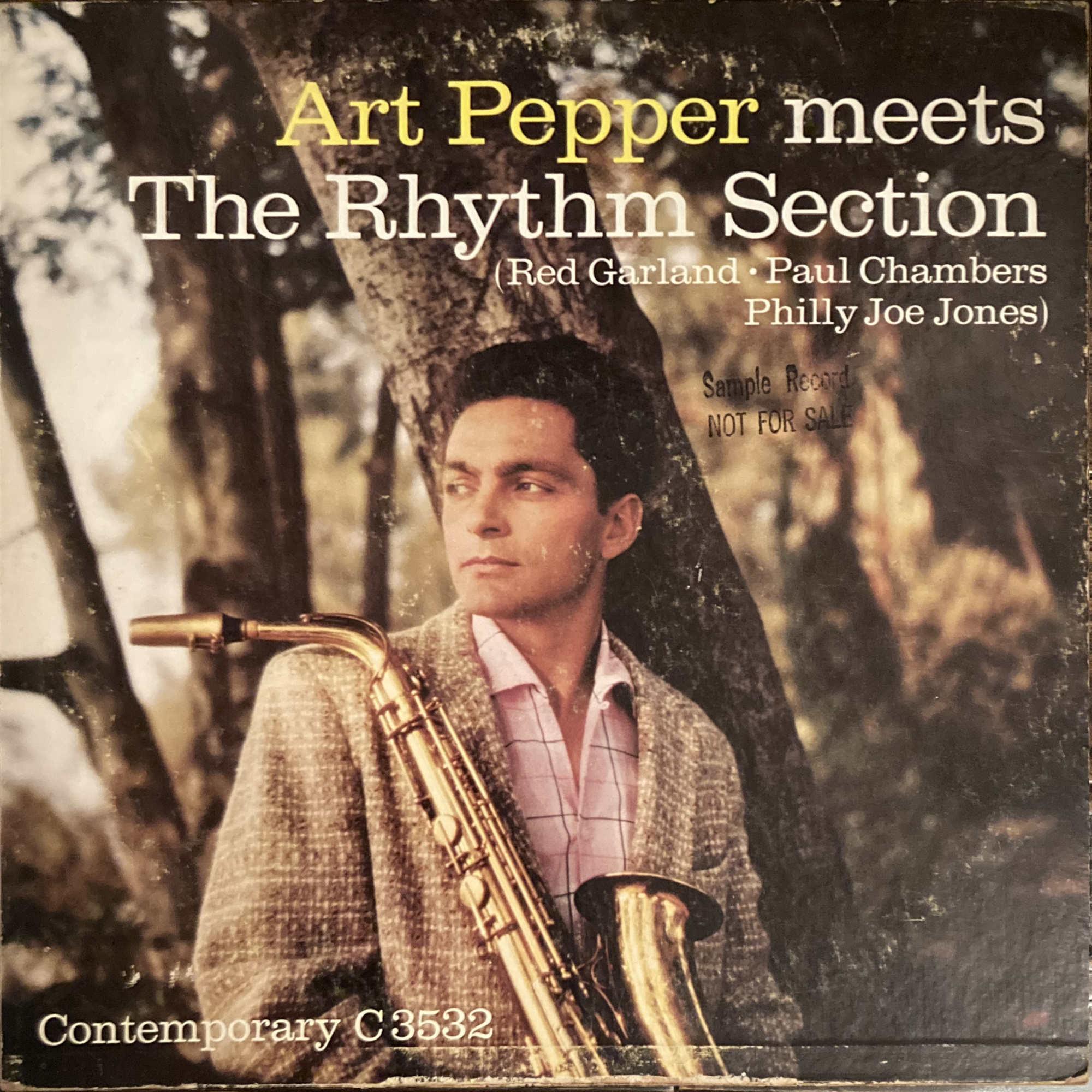
No.:C-3532
Title: ART PEPPER MEETS THE RHYTHM SECTION
Musician: ART PEPPER (4)
Recorded: 1957/1/19
Monaural
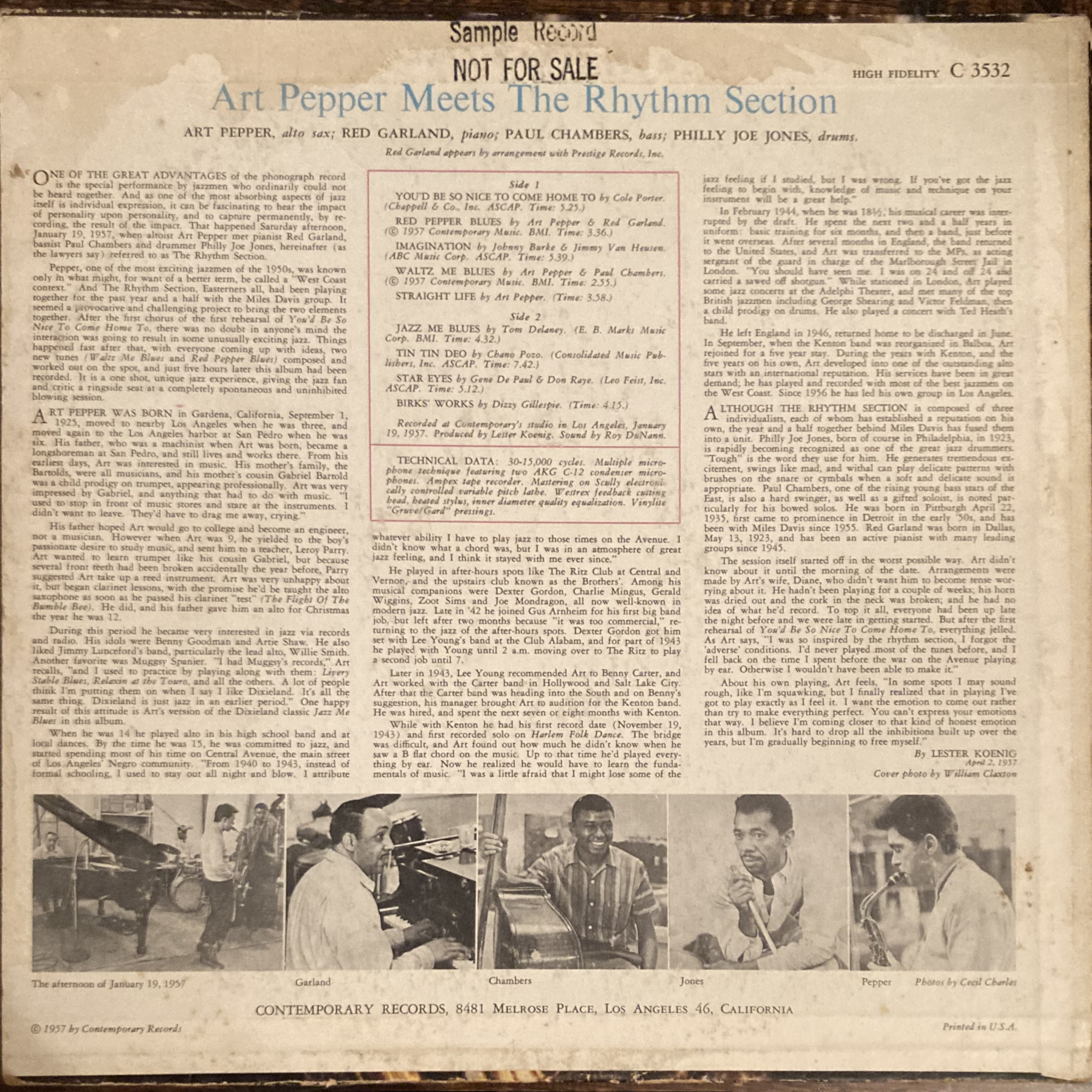
Cover address: 8481 MELROSE PLACE, LOS ANGELS 46, CALIFORNIA
Coating
裏面3色刷り
Groove Guard
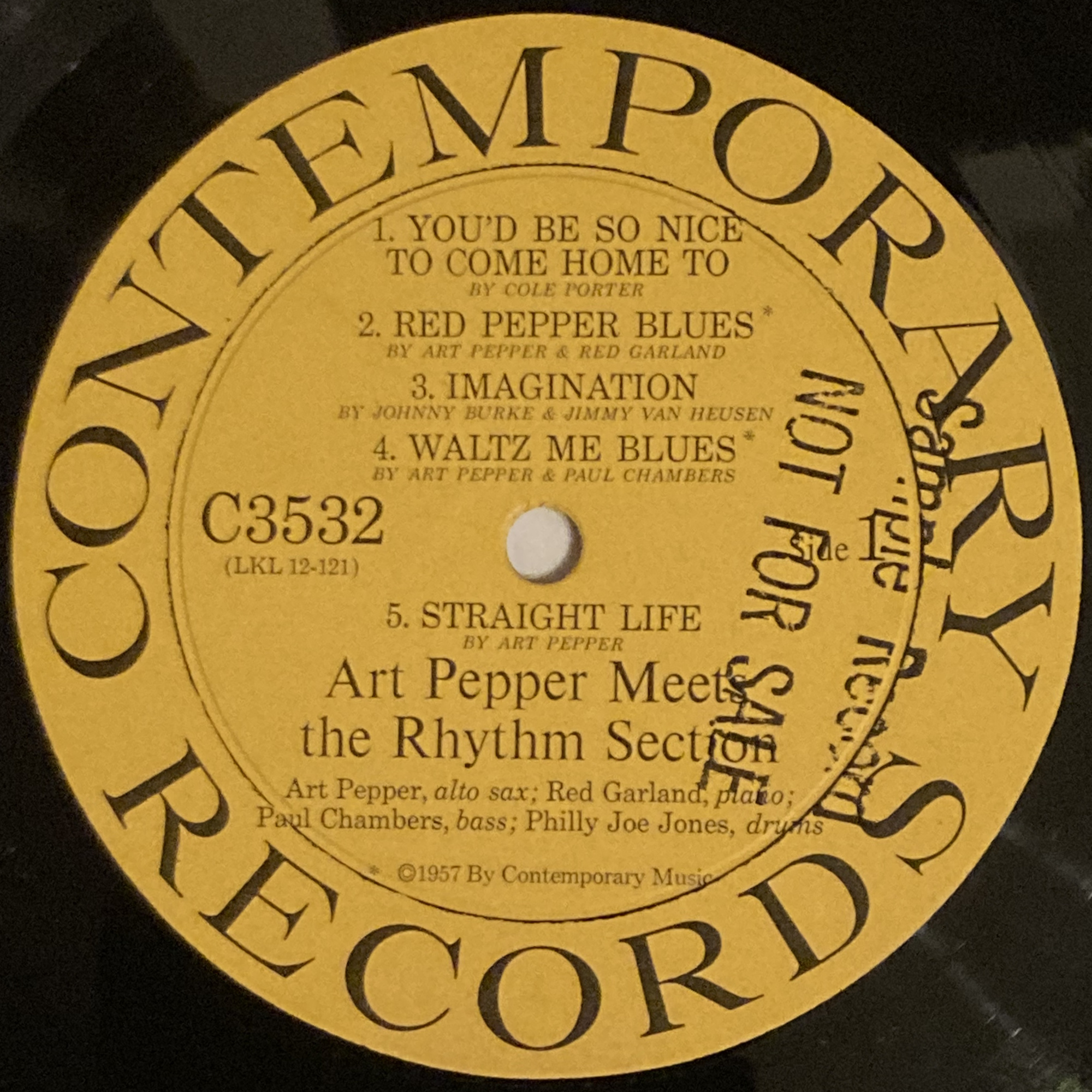
Label Side-1
Yellow Background
Black Letter, DJ COPY
Address: None
Deep Groove
Dead Wax Info: LKL-12-121-D2, H
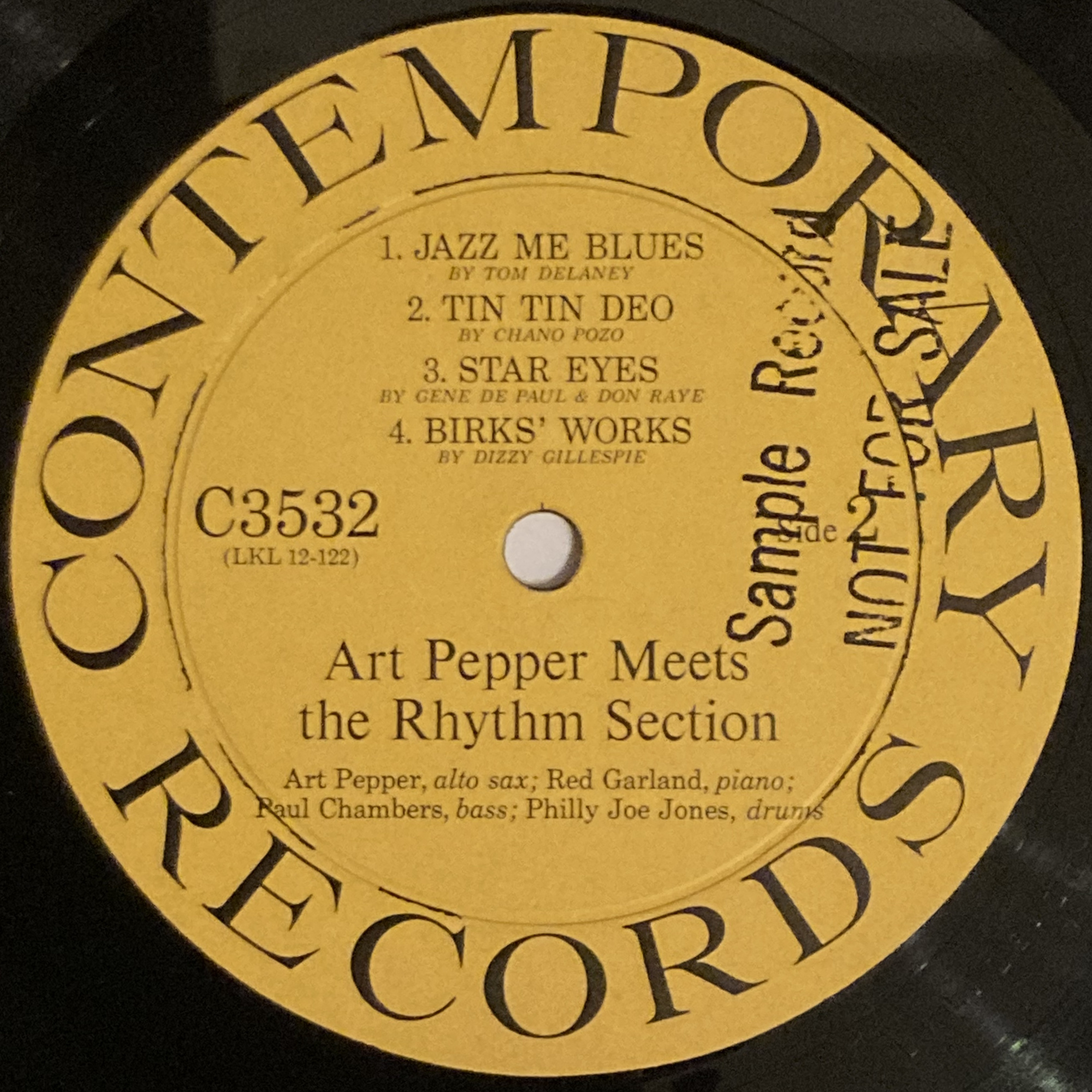
Label Side-2
Yellow Background
Black Letter, DJ COPY
Address: None
Deep Groove
Dead Wax Info: LKL-12-122-D2, H
Personnel-
Drums: Philly Joe Jones
Bass: Paul Chambers
Piano: Red Garland
Alto Sax: Art Pepper
Tracks-
Side-1
1) You’d Be So Nice To Come Home To 5’25”
2) Red Pepper Blues 3’36”
3) Imagination 5’39”
4) Waltz Me Blues 2’55”
5) Straight Life 3’58”
Side-2
1) Jazz Me Blues 4’32”
2) Tin Tin Deo 7’42”
3) Star Eyes 5’12”
4) Birks Works 4’15”
<裏ジャケ原文>
ON NE OF THE GREAT ADVANTAGES of the phonograph record is the special performance by jazzmen who ordinarily could not be heard together. And as one of the most absorbing aspects of jazz itself is individual expression, it can be fascinating to hear the impact of personality upon personality, and to capture permanently, by re- cording, the result of the impact. That happened Saturday afternoon, January 19, 1957, when altoist Art Pepper met pianist Red Garland, bassist Paul Chambers and drummer Philly Joe Jones, hereinafter (as the lawyers say) referred to as The Rhythm Section.
Pepper, one of the most exciting jazzmen of the 1950s, was known only in what might, for want of a better term, be called a “West Coast context.” And The Rhythm Section, Easterners all, had been playing together for the past year and a half with the Miles Davis group. seemed a provocative and challenging project to bring the two elements together. After the first chorus of the first rehearsal of You’d Be So Nice To Come Home To, there was no doubt in anyone’s mind the interaction was going to result in some unusually exciting jazz. Things happened fast after that, with everyone coming up with ideas, two new tunes (Waltz Me Blues and Red Pepper Blues) composed and worked out on the spot, and just five hours later this album had been recorded. It is a one shot, unique jazz experience, giving the jazz fan and critic a ringside seat at a completely spontaneous and uninhibited blowing session.
ART PEPPER WAS BORN in Gardena, California, September 1,
1925, moved to nearby Los Angeles when he was three, and moved again to the Los Angeles harbor at San Pedro when he was six. His father, who was a machinist when Art was born, became a longshoreman at San Pedro, and still lives and works there. From his earliest days, Art was interested in music. His mother’s family, the Bartolds, were all musicians, and his mother’s cousin Gabriel Bartold was a child prodigy on trumpet, appearing professionally. Art was very impressed by Gabriel, and anything that had to do with music. “I used to stop in front of music stores and stare at the instruments. I didn’t want to leave. They’d have to drag me away, crying.”
His father hoped Art would go to college and become an engineer, not a musician. However when Art was 9, he yielded to the boy’s passionate desire to study music, and sent him to a teacher, Leroy Parry. Art wanted to learn trumpet like his cousin Gabriel, but because several front teeth had been broken accidentally the year before, Parry suggested Art take up a reed instrument. Art was very unhappy about it, but began clarinet lessons, with the promise he’d be taught the alto saxophone as soon as he passed his clarinet “test” (The Flight Of The Bumble Bee). He did, and his father gave him an alto for Christmas the year he was 12.
During this period he became very interested in jazz via records and radio. His idols were Benny Goodman and Artie Shaw. He also liked Jimmy Lunceford’s band, particularly the lead alto, Willie Smith. Another favorite was Muggsy Spanier. “I had Muggsy’s records,” Art recalls, “and I used to practice by playing along with them: Livery Stable Blues, Relaxin at the Touro, and all the others. A lot of people think I’m putting them on when I say I like Dixieland. It’s all the same thing. Dixieland is just jazz in an earlier period.” One happy result of this attitude is Art’s version of the Dixieland classic Jazz Me Blues in this album.
When he was 14 he played alto in his high school band and at local dances. By the time he was 15, he was committed to jazz, and started spending most of his time on Central Avenue, the main street of Los Angeles’ Negro community. “From 1940 to 1943, instead of formal schooling, I used to stay out all night and blow. I attribute whatever ability I have to play jazz to those times on the Avenue. I didn’t know what a chord was, but I was in an atmosphere of great jazz feeling, and I think it stayed with me ever since.”
He played in after-hours spots like The Ritz Club at Central and Vernon, and the upstairs club known as the Brothers’. Among his musical companions were Dexter Gordon, Charlie Mingus, Gerald Wiggins, Zoot Sims and Joe Mondragon, all now well-known in modern jazz. Late in ’42 he joined Gus Arnheim for his first big band job, but left after two months because “it was too commercial,” re- turning to the jazz of the after-hours spots. Dexter Gordon got him set with Lee Young’s band at the Club Alabam, and for part of 1943 he played with Young until 2 a.m. moving over to The Ritz to play a second job until 7.
Later in 1943, Lee Young recommended Art to Benny Carter, and Art worked with the Carter band in Hollywood and Salt Lake City. After that the Carter band was heading into the South and on Benny’s suggestion, his manager brought Art to audition for the Kenton band. He was hired, and spent the next seven or eight months with Kenton.
While with Kenton he had his first record date (November 19, 1943) and first recorded solo on Harlem Folk Dance. The bridge was difficult, and Art found out how much he didn’t know when he saw a B flat chord on the music. Up to that time he’d played every- thing by ear. Now he realized he would have to learn the funda- mentals of music. “I was a little afraid that I might lose some of the jazz feeling if I studied, but I was wrong. If you’ve got the jazz feeling to begin with, knowledge of music and technique on your instrument will be a great help.”
In February 1944, when he was 1812, his musical career was inter- rupted by the draft. He spent the next two and a half years in uniform: basic training for six months, and then a band, just before it went overseas. After several months in England, the band returned to the United States, and Art was transferred to the MPs, as acting sergeant of the guard in charge of the Marlborough Street Jail in London. “You should have seen me. I was on 24 and off 24 and carried a sawed off shotgun.” While stationed in London, Art played some jazz concerts at the Adelphi Theater, and met many of the top British jazzmen including George Shearing and Victor Feldman, then a child prodigy on drums. He also played a concert with Ted Heath’s band.
He left England in 1946, returned home to be discharged in June. In September, when the Kenton band was reorganized in Balboa, Art rejoined for a five year stay. During the years with Kenton, and the five years on his own, Art developed into one of the outstanding alto stars with an international reputation. His services have been in great demand; he has played and recorded with most of the best jazzmen on the West Coast. Since 1956 he has led his own group in Los Angeles.
ALTHOUGH THE RHYTHM SECTION is composed of three
individualists, each of whom has established a reputation on his own, the year and a half together behind Miles Davis has fused them into a unit. Philly Joe Jones, born of course in Philadelphia, in 1923, is rapidly becoming recognized as one of the great jazz drummers. “Tough” is the word they use for him. He generates tremendous ex- citement, swings like mad, and withal can play delicate patterns with brushes on the snare or cymbals when a soft and delicate sound is appropriate. Paul Chambers, one of the rising young bass stars of the East, is also a hard swinger, as well as a gifted soloist, is noted par- ticularly for his bowed solos. He was born in Pittburgh April 22, 1935, first came to prominence in Detroit in the early ’50s, and has been with Miles Davis since 1955. Red Garland was born in Dallas, May 13, 1923, and has been an active pianist with many leading groups since 1945.
The session itself started off in the worst possible way. Art didn’t know about it until the morning of the date. Arrangements were made by Art’s wife, Diane, who didn’t want him to become tense wor- rying about it. He hadn’t been playing for a couple of weeks; his horn was dried out and the cork in the neck was broken; and he had no idea of what he’d record. To top it all, everyone had been up late the night before and we were late in getting started. But after the first rehearsal of You’d Be So Nice To Come Home To, everything jelled. As Art says, “I was so inspired by the rhythm section, I forgot the ‘adverse’ conditions. I’d never played most of the tunes before, and I fell back on the time I spent before the war on the Avenue playing by ear. Otherwise I wouldn’t have been able to make it.”
About his own playing, Art feels, “In some spots I may sound rough, like I’m squawking, but I finally realized that in playing I’ve got to play exactly as I feel it. I want the emotion to come out rather than try to make everything perfect. You can’t express your emotions that way. I believe I’m coming closer to that kind of honest emotion in this album. It’s hard to drop all the inhibitions built up over the years, but I’m gradually beginning to free myself.”
By LESTER KOENIG April 2, 1957 Cover photo by William Claxton
<裏ジャケ和訳文>
レコードという媒体が持つ大きな利点の一つは、普段なら共演することのないジャズ・ミュージシャン同士の特別な演奏を聴けることです。ジャズの最も魅力的な側面の一つは個々の表現にありますから、異なる個性がぶつかり合うことで生まれる影響を聴き取り、その結果を録音によって永遠に残すことは、実に興味深い体験と言えるでしょう。1957年1月19日の土曜日の午後、まさにそのようなことが起こりました。アルト・サックス奏者のアート・ペッパーが、ピアニストのレッド・ガーランド、ベーシストのポール・チェンバース、ドラマーのフィリー・ジョー・ジョーンズ――以下、法律用語風に言えば「リズム・セクション」と呼びます――と顔を合わせたのです。
1950年代を代表するエキサイティングなジャズ・ミュージシャンの一人であったペッパーは、当時は(他に適切な言葉が見当たらないため便宜上そう呼びますが)「ウェスト・コースト(西海岸)の文脈」でしか知られていない存在でした。一方、全員が東海岸出身である「リズム・セクション」の面々は、過去1年半にわたりマイルス・デイヴィス・グループで共に演奏を重ねてきていました。これら二つの要素を組み合わせるというのは、刺激的かつ挑戦的なプロジェクトに思えました。『You’d Be So Nice To Come Home To』のリハーサルで最初のコーラスを演奏し終えた時点で、誰もが確信しました。この相互作用から、並外れてエキサイティングなジャズが生まれるだろうと。その後は急速に物事が進みました。全員がアイデアを出し合い、その場で2曲のオリジナル曲(『Waltz Me Blues』と『Red Pepper Blues』)が作曲・構成され、わずか5時間後にはこのアルバムの録音が完了していたのです。これは一発録りによる唯一無二のジャズ体験であり、ジャズ・ファンや評論家を、完全な即興性と自由な精神に満ちた「ブローイング・セッション(即興演奏会)」の特等席へと誘うものです。
アート・ペッパーは1925年9月1日、カリフォルニア州ガーデナで生まれました。3歳の時に近隣のロサンゼルスへ、6歳の時にはロサンゼルス港のあるサン・ペドロへと移り住んでいます。アートの誕生当時は機械工だった父親は、サン・ペドロで港湾労働者となり、現在もそこで暮らし、働いています。アートは幼い頃から音楽に関心を抱いていました。母親の親族であるバルトルド家は皆ミュージシャンで、母親のいとこにあたるガブリエル・バルトルドは、プロとしても活動するトランペットの神童でした。アートはガブリエルや、音楽に関わるあらゆるものに強い感銘を受けていました。 「楽器店の前で立ち止まっては、中の楽器をじっと眺めていたものです。その場を離れたくなくて、泣き叫ぶ私を無理やり引きずっていかなければならないほどでした」
父親はアートに音楽家ではなく、大学へ進んでエンジニアになってほしいと願っていました。しかし、アートが9歳のとき、音楽を学びたいという少年の熱意に折れ、リロイ・パリーという教師に師事させることにしました。アートはいとこのガブリエルと同じようにトランペットを習いたがっていましたが、前年に不慮の事故で前歯を数本折っていたため、パリーはリード楽器を始めるよう勧めました。アートは不満に思いながらもクラリネットのレッスンを始めましたが、それには条件がありました。クラリネットの「テスト」(曲目は『熊蜂の飛行』)に合格したら、すぐにアルト・サックスを教えてもらえるという約束です。彼は見事に合格し、12歳のクリスマスのときに父親からアルト・サックスをプレゼントされました。
この時期、彼はレコードやラジオを通じてジャズに深くのめり込んでいきました。憧れのミュージシャンはベニー・グッドマンとアーティ・ショウでした。また、ジミー・ランスフォードのバンド、特にリード・アルト奏者のウィリー・スミスも気に入っていました。さらに、マグジー・スパニアもお気に入りでした。「マグジーのレコードを持っていて、それらに合わせて練習したものです。『リヴァリー・ステーブル・ブルース』や『リラクシン・アット・ザ・トゥーロ』など、いろいろな曲をね。私がディキシーランド・ジャズが好きだと言うと、冗談を言っていると思われることがよくあります。でも、結局は同じことなんです。ディキシーランド・ジャズというのは、単に初期のジャズというだけのことですから」こうした姿勢から生まれた素晴らしい成果の一つが、このアルバムに収録されているディキシーランド・ジャズの古典的名曲『ジャズ・ミー・ブルース』のアートによる演奏です。
14歳になると、彼は高校のバンドや地元のダンス・パーティーでアルト・サックスを演奏するようになりました。15歳になる頃にはジャズに完全に打ち込むようになり、ロサンゼルスの黒人コミュニティのメインストリートであるセントラル・アベニューで多くの時間を過ごすようになりました。「1940年から1943年にかけて、私は学校の授業に出る代わりに、一晩中外にいて演奏していました。私がジャズを演奏する能力を身につけられたのは、あの『アベニュー』での日々のおかげだと思っています。当時はコード(和音)の知識などありませんでしたが、素晴らしいジャズの雰囲気に包まれていて、その感覚がずっと自分の中に残っているのだと思います」彼は、セントラル・アベニューとバーノン・アベニューの交差点にあった「リッツ・クラブ」や、「ブラザーズ」として知られた2階のクラブといった、深夜営業の店(アフター・アワーズ・スポット)で演奏していました。当時の音楽仲間には、デクスター・ゴードン、チャーリー・ミンガス、ジェラルド・ウィギンズ、ズート・シムズ、ジョー・モンドラゴンといった、後にモダン・ジャズ界で名を馳せることになる面々がいました。1942年の後半、彼はガス・アーノハイムの楽団に加わり、自身初となるビッグ・バンドでの仕事に就きましたが、「商業的すぎる」という理由で2ヶ月後には離脱し、再び深夜営業の店でのジャズ演奏に戻りました。デクスター・ゴードンの紹介で「クラブ・アラバム」のリー・ヤング楽団に入った彼は、1943年の一時期、ヤングのバンドで午前2時まで演奏した後、「リッツ」へ移動して朝7時まで別の仕事をするという日々を送っていました。
1943年の後半、リー・ヤングの推薦でベニー・カーターと知り合ったアートは、ハリウッドやソルトレイクシティでカーターの楽団と共に活動しました。その後、カーター楽団が南部へのツアーに向かうことになった際、ベニーの提案を受けて、彼のマネージャーがアートをケントン楽団のオーディションに連れて行きました。彼は採用され、その後7、8ヶ月間をケントンと共に過ごすことになりました。
ケントン・オーケストラ在籍中、彼は初のレコーディング・セッション(1943年11月19日)に臨み、「ハーレム・フォーク・ダンス(Harlem Folk Dance)」で自身初のソロを録音した。その曲のブリッジ(中間部)は難しく、楽譜に「Bフラット(変ロ長調)」のコード記号を見つけた際、アートは自分がどれほど音楽の知識に欠けているかを思い知らされた。それまで彼はすべて耳を頼りに演奏してきたからだ。そこで彼は、音楽の基礎を学ぶ必要があると痛感した。「勉強するとジャズ特有のフィーリングが失われてしまうのではないかと少し心配していましたが、それは間違いでした。もともとジャズのフィーリングが備わっていれば、音楽の知識や楽器の演奏技術は大きな助けとなるのです」
1944年2月、18歳だった彼の音楽キャリアは徴兵によって中断された。その後2年半を軍隊で過ごすことになる。最初の6ヶ月は基礎訓練を受け、その後、海外派遣直前のバンドに配属された。イギリスで数ヶ月を過ごした後、バンドはアメリカへ帰還したが、アートは憲兵隊(MP)に転属となり、ロンドンのマールボロ・ストリート刑務所で警備担当の伍長代理を務めた。「当時の私の姿を見たら驚いたでしょうね。24時間勤務して24時間休むというローテーションで、銃身を切り詰めたショットガンを携行していましたから」。ロンドン駐留中、アートはアデルフィ・シアターでジャズ・コンサートに出演し、ジョージ・シアリングや、当時ドラムの神童として知られていたヴィクター・フェルドマンなど、イギリスのトップ・ジャズ・ミュージシャンたちと数多く交流した。また、テッド・ヒースのバンドともコンサートで共演している。
1946年にイギリスを離れて帰国し、6月に除隊した。9月、バルボアでケントン・バンドが再結成されると、彼は再びバンドに加わり、その後5年間にわたって在籍した。ケントン・バンドでの活動期間、そしてその後の独立した5年間を通じて、アートは国際的な名声を博する傑出したアルト・サックス奏者へと成長を遂げた。彼の演奏は多くの人々から求められ、西海岸のトップ・ジャズ・ミュージシャンの大半と共演やレコーディングを行ってきた。1956年以降は、ロサンゼルスで自身のグループを率いている。
リズム・セクションは、それぞれが独自の評価を確立している3人の個性派ミュージシャンで構成されているが、マイルズ・デイヴィスのバックで1年半にわたり共演を重ねたことで、彼らは一つの強固なユニットとして融合している。 1923年にフィラデルフィアで生まれたフィリー・ジョー・ジョーンズは、偉大なジャズ・ドラマーの一人として急速にその名を知られるようになっています。彼を評する際によく使われる言葉は「タフ(力強い)」です。彼は強烈な興奮を呼び起こし、猛烈なスウィングを見せる一方で、繊細なサウンドが求められる場面では、ブラシを使ってスネアやシンバルでデリケートなパターンを演奏することもできます。東海岸の若手ベーシストのホープであるポール・チェンバーズもまた、強烈なスウィングと優れたソロの才能を併せ持ち、特に弓を使ったソロ(アルコ奏法)で定評があります。彼は1935年4月22日にピッツバーグで生まれ、1950年代初頭にデトロイトで頭角を現し、1955年からはマイルス・デイヴィスのグループに参加しています。レッド・ガーランドは1923年5月13日にダラスで生まれ、1945年以来、数多くの主要なグループでピアニストとして活躍しています。
セッションそのものは、最悪の形で幕を開けました。アートは当日の朝まで、その予定を知らなかったのです。手配をしたのは妻のダイアンで、彼が事前にあれこれ悩んで緊張してしまうのを避けたかったからでした。彼はここ数週間楽器を吹いておらず、楽器は乾燥しきっていて、ネックのコルクも破損していました。おまけに、何を録音するのかさえ全く知らされていなかったのです。さらに悪いことに、前夜は皆が遅くまで起きていたため、開始時間も遅れてしまいました。しかし、「You’d Be So Nice To Come Home To」を一度リハーサルしてみると、すべてがうまく噛み合い始めました。アートはこう語っています。「リズム・セクションの演奏に触発されて、そうした『悪条件』のことなど忘れてしまったんだ。ほとんどの曲はそれまで演奏したことがなかったけれど、戦前に『アベニュー』で耳を頼りに演奏していた頃の経験が役に立ったよ。そうでなければ、乗り切れなかっただろうね」。
自身の演奏について、アートは次のように感じています。「ところどころ、音がひっくり返ったりして荒っぽく聞こえるかもしれない。でも、演奏する時は自分の感じたままに吹くべきなんだと、ようやく気づいたんだ。すべてを完璧にこなそうとするより、感情をありのままに表現したい。完璧さを求めていては、感情を表現することなんてできないからね。このアルバムでは、そうしたありのままの感情に近づけていると思う。長年積み重なってきた抑制を取り払うのは難しいけれど、少しずつ自分を解放できるようになってきているんだ」。
レスター・ケーニグ著(1957年4月2日) カバー写真:ウィリアム・クラクストン
※訳文の製作にはGoogleドライブとGoogle翻訳のお世話になりました。
コメント