Label: Blue Note
No.: BLP 1595
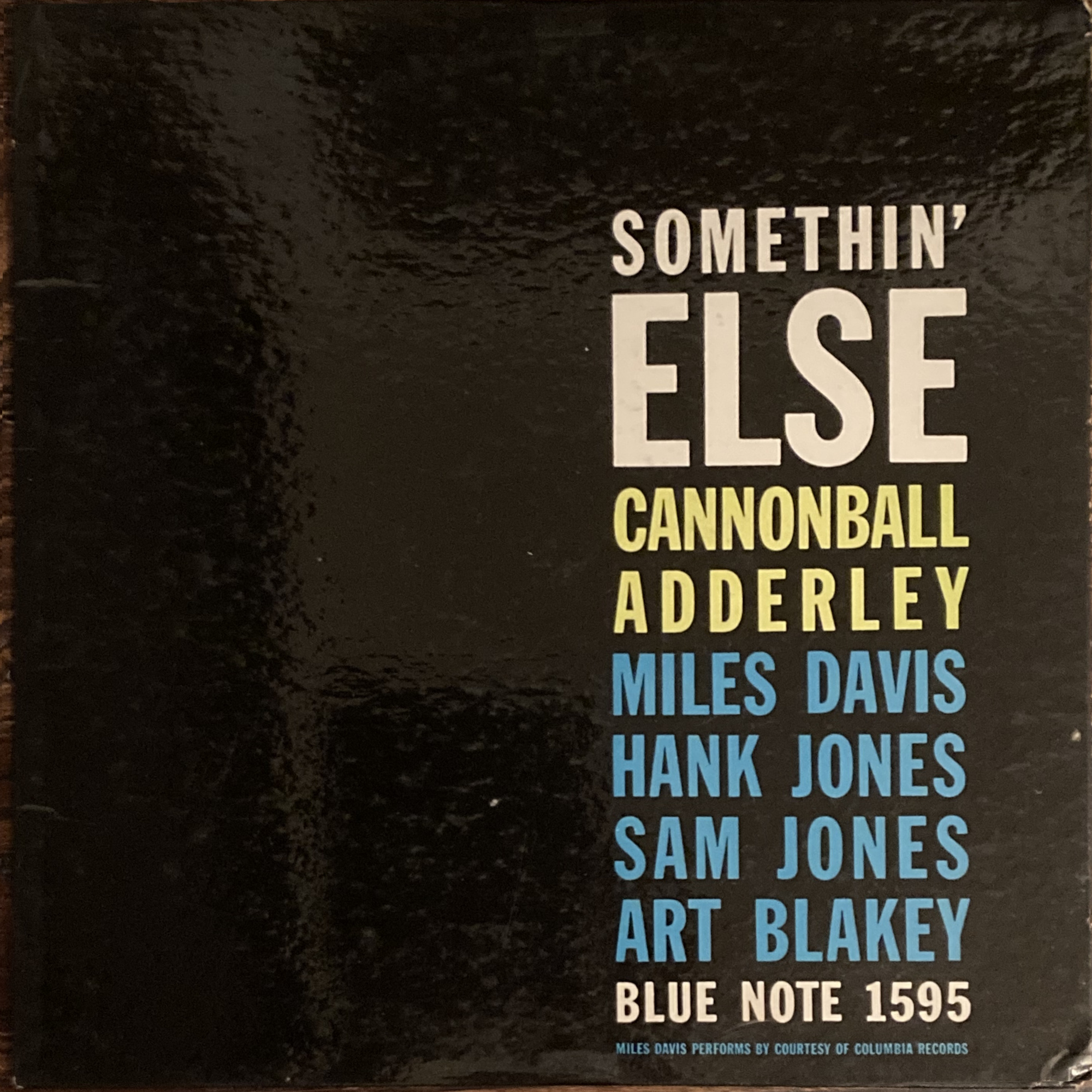
Title: SOMETHIN’ ELSE
Musician: CANNONBALL ADDERLEY
Recorded: 1958/3/9
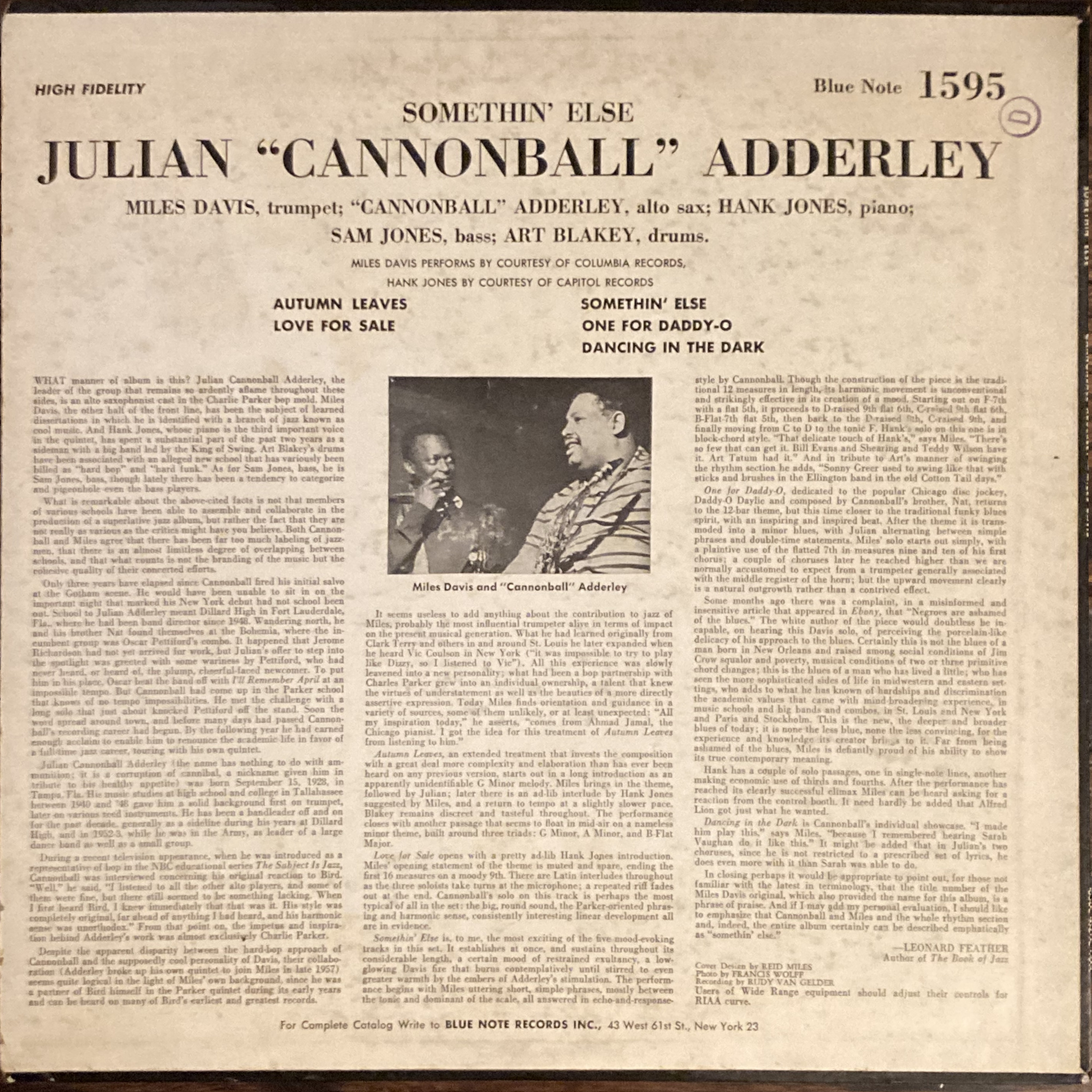
Cover address: 43 West 61st St, New York 23, INC
Laminate Coating
Groove Guard
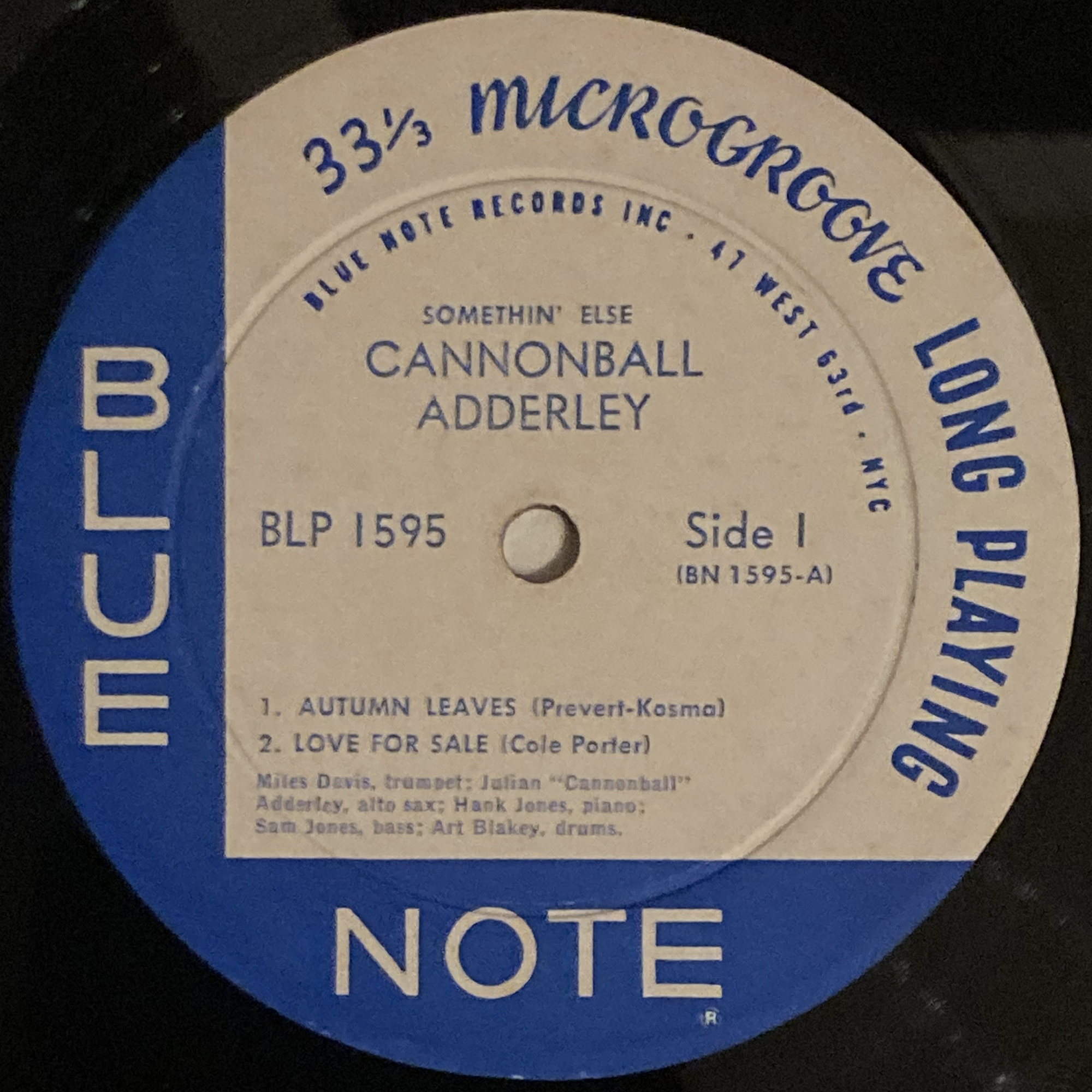
Label Side-1
Blue and White Background
White and Blue Letter With INC
Address: 47 WEST 63rd, NYC
Deep Groove
Dead Wax Info: RVGスタンプ, BN-LP-1595-A, P(Ear), 9M, No dot
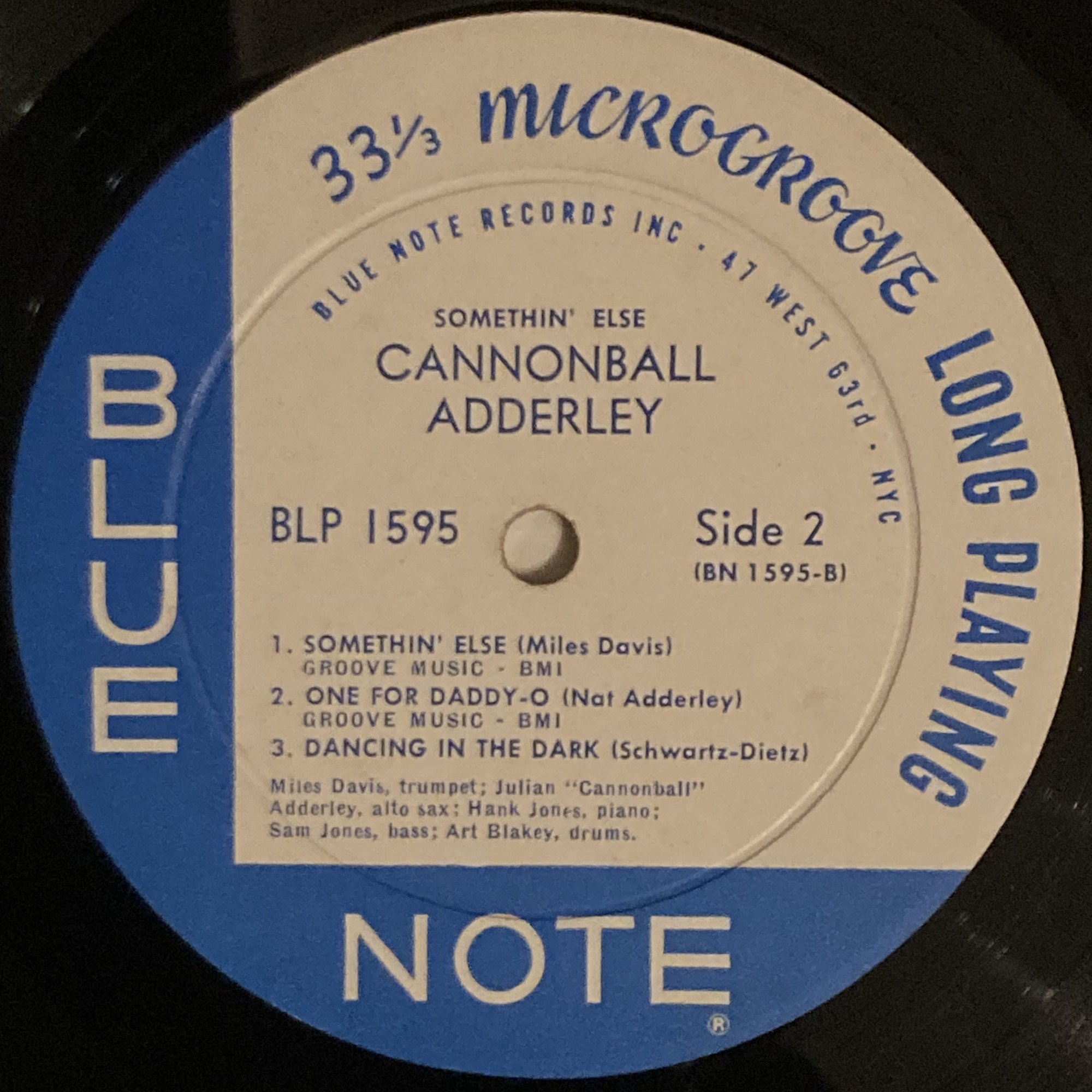
Label Side-2
Blue and White Background
White and Blue Letter With INC
Address: 47 WEST 63rd, NYC
Deep Groove
Dead Wax Info: RVGスタンプ, BN-LP-1595-B, P(Ear), 9M, No dot
Personnel-
Drums: Art Blakey
Bass: Sam Jones
Piano: Hank Jones
Alto Sax: Cannonball Adderley
Trumpet: Miles Davis
Tracks-
Side-1
1) Autumn Leaves 10’59”
2) Love For Sale 7’04”
Side-2
1) Somethin’ Else 8’13”
2) For Daddy-O 8’24”
3) Dancing in the Dark 4’05”
両面とも47WEST 63RDでDG付きですが、レーベルにINCとⓇがついていますので2nd盤の扱いになります。P(耳)マーク、9M、RVGスタンプが刻印されていますので盤自体は1stと遜色ないと思います。
<裏ジャケ原文>
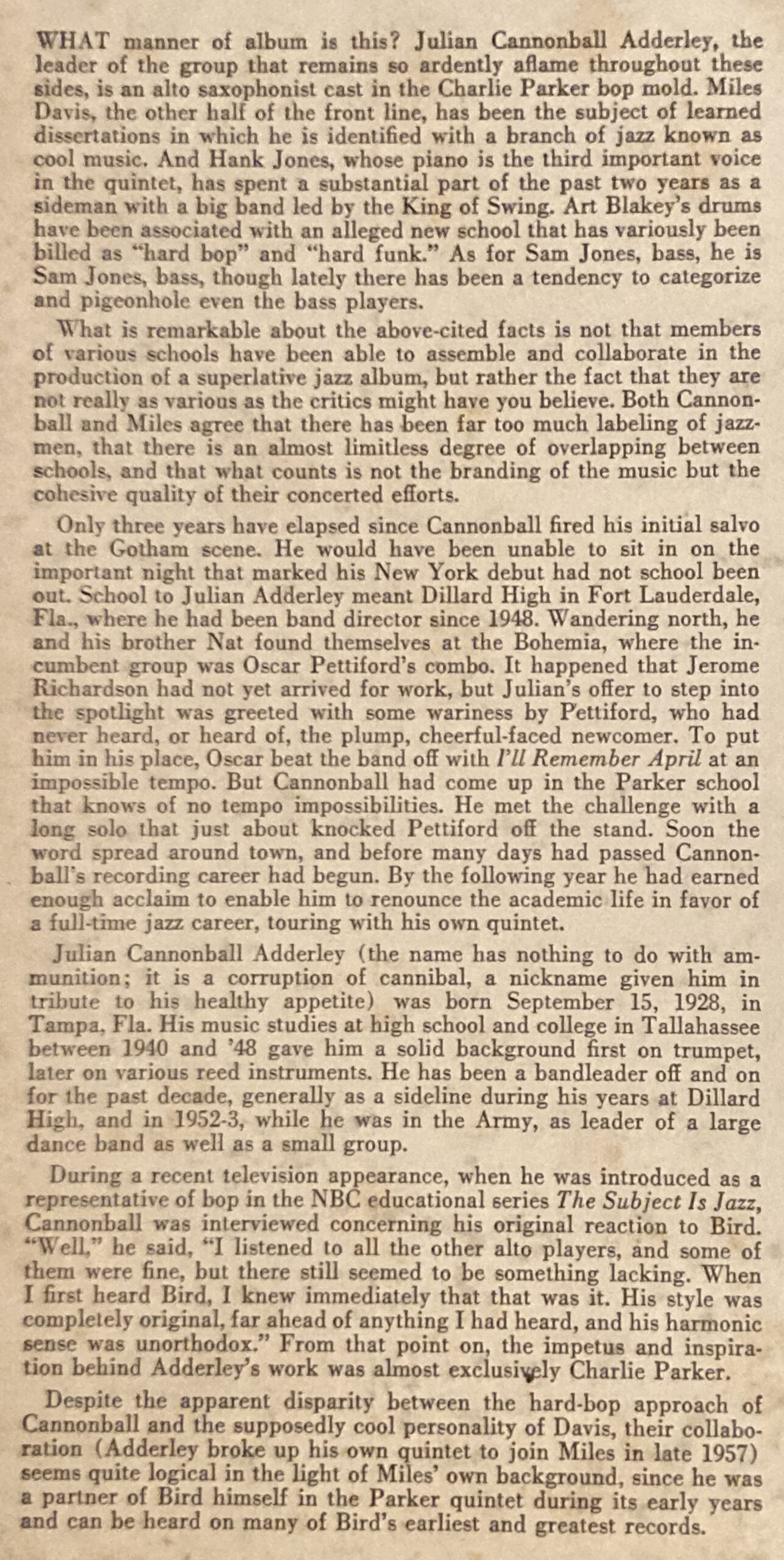
WHAT manner of album is this? Julian Cannonball Adderley, the leader of the group that remains so ardently aflame throughout these sides, is an alto saxophonist cast in the Charlie Parker bop mold. Miles Davis, the other half of the front line, has been the subject of learned dissertations in which he is identified with a branch of jazz known as cool music. And Hank Jones, whose piano is the third important voice in the quintet, has spent a substantial part of the past two years as a sideman with a big band led by the King of Swing. Art Blakey’s drums have been associated with an alleged new school that has variously been billed as “hard bop” and “hard funk.” As for Sam Jones, bass, he is Sam Jones, bass, though lately there has been a tendency to categorize and pigeonhole even the bass players.
What is remarkable about the above-cited facts is not that members of various schools have been able to assemble and collaborate in the production of a superlative jazz album, but rather the fact that they are not really as various as the critics might have you believe. Both Cannon- ball and Miles agree that there has been far too much labeling of jazz- men, that there is an almost limitless degree of overlapping between schools, and that what counts is not the branding of the music but the cohesive quality of their concerted efforts.
Only three years have elapsed since Cannonball fired his initial salvo at the Gotham scene. He would have been unable to sit in on the important night that marked his New York debut had not school been out. School to Julian Adderley meant Dillard High in Fort Lauderdale, Fla., where he had been band director since 1948. Wandering north, he and his brother Nat found themselves at the Bohemia, where the in- cumbent group was Oscar Pettiford’s combo. It happened that Jerome Richardson had not yet arrived for work, but Julian’s offer to step into the spotlight was greeted with some wariness by Pettiford, who had never heard, or heard of, the plump, cheerful-faced newcomer. To put him in his place, Oscar beat the band off with I’ll Remember April at an impossible tempo. But Cannonball had come up in the Parker school that knows of no tempo impossibilities. He met the challenge with a long solo that just about knocked Pettiford off the stand. Soon the word spread around town, and before many days had passed Cannon- ball’s recording career had begun. By the following year he had earned enough acclaim to enable him to renounce the academic life in favor of a full-time jazz career, touring with his own quintet.
Julian Cannonball Adderley (the name has nothing to do with am- munition; it is a corruption of cannibal, a nickname given him in tribute to his healthy appetite) was born September 15, 1928, in Tampa, Fla. His music studies at high school and college in Tallahassee between 1940 and ’48 gave him a solid background first on trumpet, later on various reed instruments. He has been a bandleader off and on for the past decade, generally as a sideline during his years at Dillard High, and in 1952-3, while he was in the Army, as leader of a large dance band as well as a small group.
During a recent television appearance, when he was introduced as a representative of bop in the NBC educational series The Subject Is Jazz, Cannonball was interviewed concerning his original reaction to Bird. “Well,” he said, “I listened to all the other alto players, and some of them were fine, but there still seemed to be something lacking. When I first heard Bird, I knew immediately that that was it. His style was completely original, far ahead of anything I had heard, and his harmonic sense was unorthodox.” From that point on, the impetus and inspira- tion behind Adderley’s work was almost exclusively Charlie Parker.
Despite the apparent disparity between the hard-bop approach of Cannonball and the supposedly cool personality of Davis, their collabo- ration (Adderley broke up his own quintet to join Miles in late 1957) seems quite logical in the light of Miles’ own background, since he was a partner of Bird himself in the Parker quintet during its early years and can be heard on many of Bird’s earliest and greatest records.
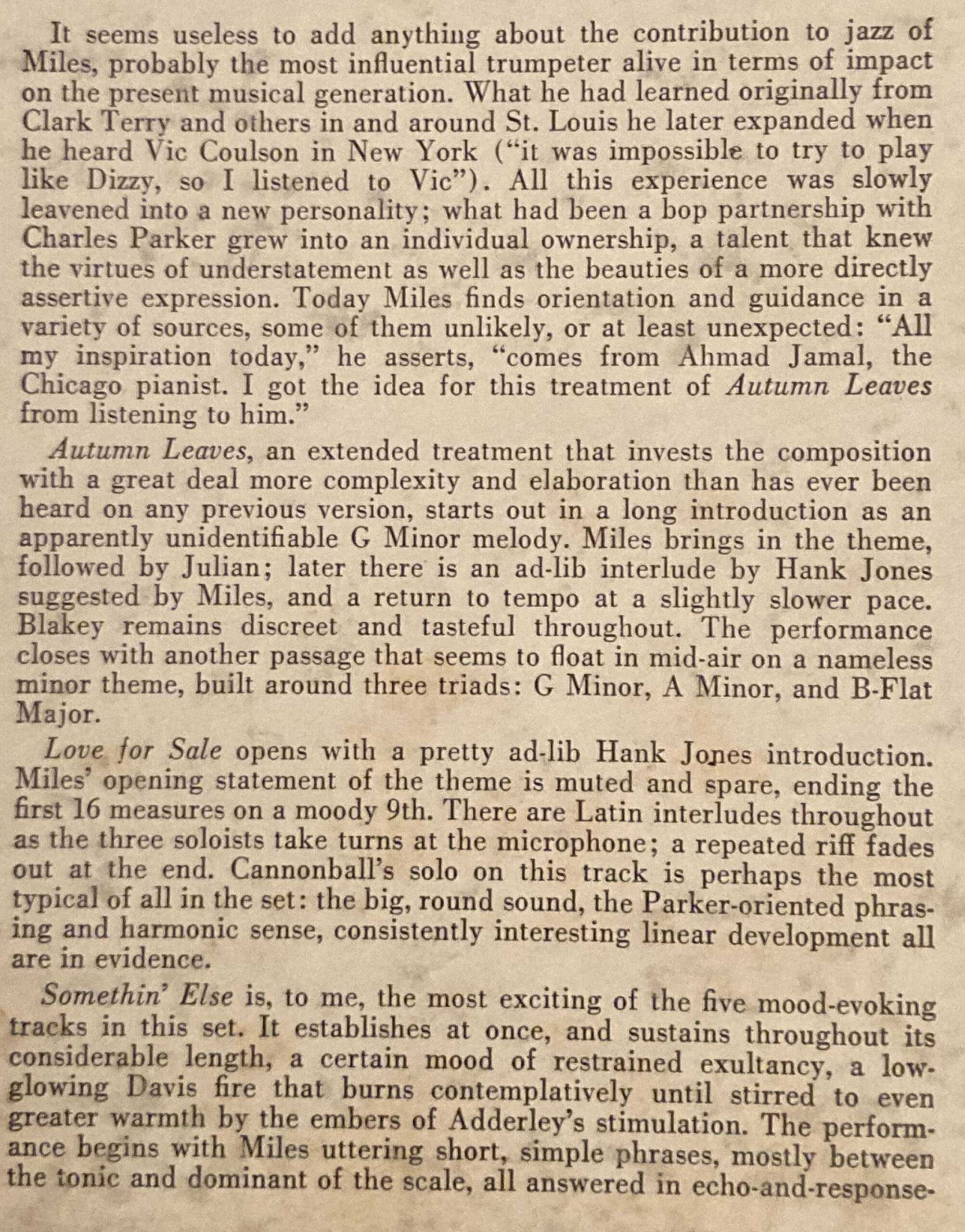
It seems useless to add anything about the contribution to jazz of Miles, probably the most influential trumpeter alive in terms of impact on the present musical generation. What he had learned originally from Clark Terry and others in and around St. Louis he later expanded when he heard Vic Coulson in New York (“it was impossible to try to play like Dizzy, so I listened to Vic”). All this experience was slowly leavened into a new personality; what had been a bop partnership with Charles Parker grew into an individual ownership, a talent that knew the virtues of understatement as well as the beauties of a more directly assertive expression. Today Miles finds orientation and guidance in a variety of sources, some of them unlikely, or at least unexpected: “All my inspiration today,” he asserts, “comes from Ahmad Jamal, the Chicago pianist. I got the idea for this treatment of Autumn Leaves from listening to him.”
Autumn Leaves, an extended treatment that invests the composition with a great deal more complexity and elaboration than has ever been heard on any previous version, starts out in a long introduction as an apparently unidentifiable G Minor melody. Miles brings in the theme, followed by Julian; later there is an ad-lib interlude by Hank Jones suggested by Miles, and a return to tempo at a slightly slower pace. Blakey remains discreet and tasteful throughout. The performance closes with another passage that seems to float in mid-air on a nameless minor theme, built around three triads: G Minor, A Minor, and B-Flat Major.
Love for Sale opens with a pretty ad-lib Hank Jones introduction. Miles’ opening statement of the theme is muted and spare, ending the first 16 measures on a moody 9th. There are Latin interludes throughout as the three soloists take turns at the microphone; a repeated riff fades out at the end. Cannonball’s solo on this track is perhaps the most typical of all in the set: the big, round sound, the Parker-oriented phras- ing and harmonic sense, consistently interesting linear development all are in evidence.
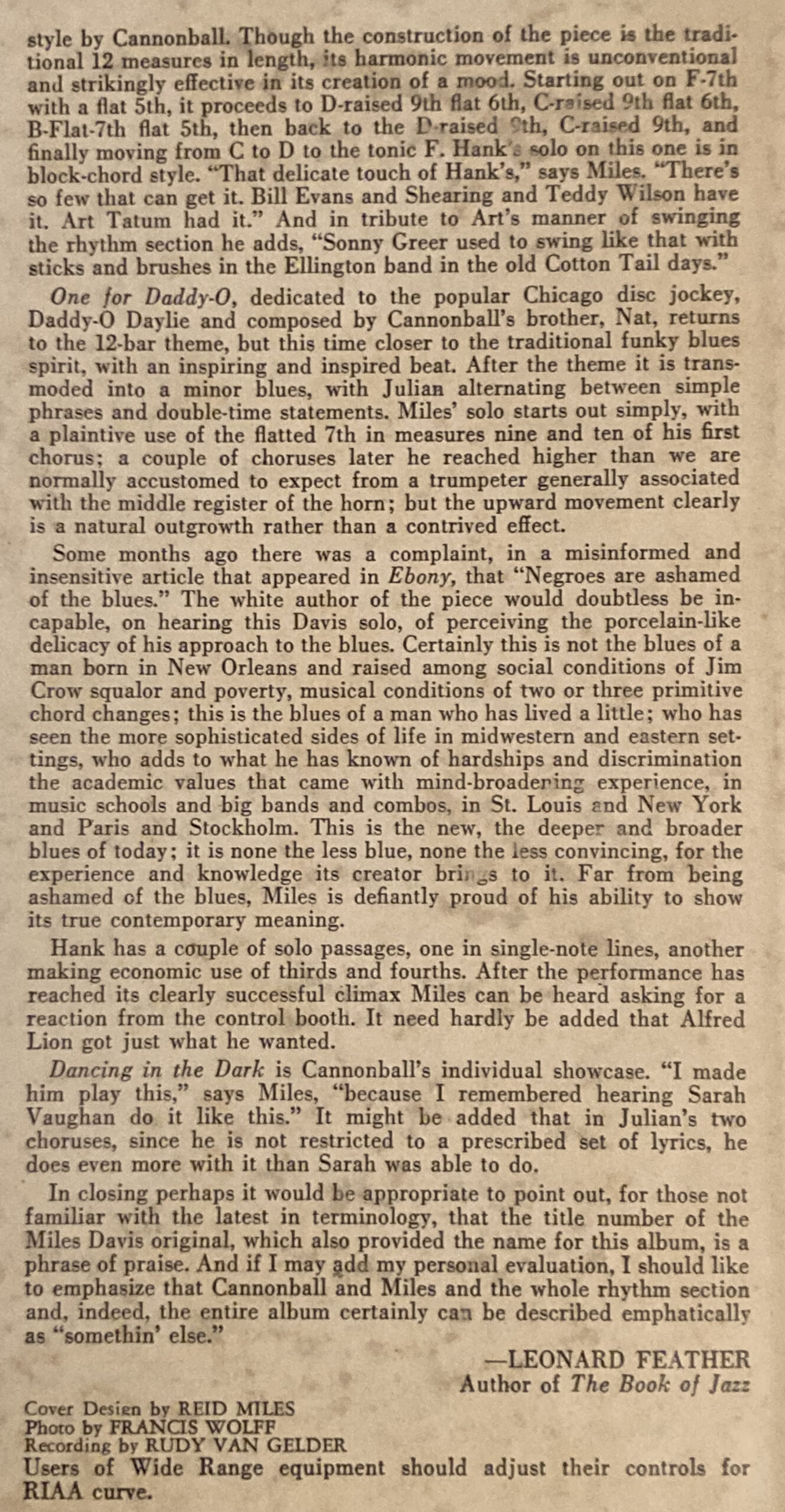
Somethin’ Else is, to me, the most exciting of the five mood-evoking tracks in this set. It establishes at once, and sustains throughout its considerable length, a certain mood of restrained exultancy, a low- glowing Davis fire that burns contemplatively until stirred to even greater warmth by the embers of Adderley’s stimulation. The perform- ance begins with Miles uttering short, simple phrases, mostly between the tonic and dominant of the scale, all answered in echo-and-response-style by Cannonball. Though the construction of the piece is the tradi- tional 12 measures in length, its harmonic movement is unconventional and strikingly effective in its creation of a mood. Starting out on F-7th with a flat 5th, it proceeds to D-raised 9th flat 6th, C-raised 9th flat 6th, B-Flat-7th flat 5th, then back to the D-raised 9th, C-raised 9th, and finally moving from C to D to the tonic F. Hank’s solo on this one is in block-chord style. “That delicate touch of Hank’s,” says Miles. “There’s so few that can get it. Bill Evans and Shearing and Teddy Wilson have it. Art Tatum had it.” And in tribute to Art’s manner of swinging the rhythm section he adds, “Sonny Greer used to swing like that with sticks and brushes in the Ellington band in the old Cotton Tail days.”
One for Daddy-0, dedicated to the popular Chicago disc jockey, Daddy-O Daylie and composed by Cannonball’s brother, Nat, returns to the 12-bar theme, but this time closer to the traditional funky blues spirit, with an inspiring and inspired beat. After the theme it is trans- moded into a minor blues, with Julian alternating between simple phrases and double-time statements. Miles’ solo starts out simply, with a plaintive use of the flatted 7th in measures nine and ten of his first chorus; a couple of choruses later he reached higher than we are normally accustomed to expect from a trumpeter generally associated with the middle register of the horn; but the upward movement clearly is a natural outgrowth rather than a contrived effect.
Some months ago there was a complaint, in a misinformed and insensitive article that appeared in Ebony, that “Negroes are ashamed of the blues.” The white author of the piece would doubtless be in- capable, on hearing this Davis solo, of perceiving the porcelain-like delicacy of his approach to the blues. Certainly this is not the blues of a man born in New Orleans and raised among social conditions of Jim Crow squalor and poverty, musical conditions of two or three primitive chord changes; this is the blues of a man who has lived a little; who has seen the more sophisticated sides of life in midwestern and eastern set- tings, who adds to what he has known of hardships and discrimination the academic values that came with mind-broadering experience, in music schools and big bands and combos, in St. Louis and New York and Paris and Stockholm. This is the new, the deeper and broader blues of today; it is none the less blue, none the less convincing, for the experience and knowledge its creator brings to it. Far from being ashamed of the blues, Miles is defiantly proud of his ability to show its true contemporary meaning.
Hank has a couple of solo passages, one in single-note lines, another making economic use of thirds and fourths. After the performance has reached its clearly successful climax Miles can be heard asking for a reaction from the control booth. It need hardly be added that Alfred Lion got just what he wanted.
Dancing in the Dark is Cannonball’s individual showcase. “I made him play this,” says Miles, “because I remembered hearing Sarah Vaughan do it like this.” It might be added that in Julian’s two choruses, since he is not restricted to a prescribed set of lyrics, he does even more with it than Sarah was able to do.
In closing perhaps it would be appropriate to point out, for those not familiar with the latest in terminology, that the title number of the Miles Davis original, which also provided the name for this album, is a phrase of praise. And if I may add my personal evaluation, I should like to emphasize that Cannonball and Miles and the whole rhythm section and, indeed, the entire album certainly can be described emphatically as “somethin’ else.”
Cover Design by REID MILES
Photo by FRANCIS WOLFF
Recording by RUDY VAN GELDER
-LEONARD FEATHER Author of The Book of Jazz
Users of Wide Range equipment should adjust their controls for RIAA curve.
<裏ジャケ和訳>
これは一体どのようなアルバムなのだろうか?全編を通じて熱い演奏を繰り広げるこのグループのリーダー、ジュリアン・“キャノンボール”・アダレイは、チャーリー・パーカー直系のバップ・スタイルを持つアルト・サックス奏者である。フロントラインのもう一人であるマイルス・デイヴィスは、ジャズの一派である「クール・ミュージック」の代表格として、多くの専門的な論考の対象となってきた。そして、このクインテットの重要な「第三の声」であるピアノのハンク・ジョーンズは、過去2年間の大半を、「スウィングの王様」が率いるビッグバンドのサイドマンとして過ごしてきた。アート・ブレイキーのドラミングは、「ハード・バップ」や「ハード・ファンク」など様々な呼び名で知られる、いわゆる「ニュー・スクール(新派)」と結びつけられてきた。一方、ベースのサム・ジョーンズはあくまでサム・ジョーンズであり続けているが、最近ではベーシストでさえも何らかのカテゴリーに分類し、型にはめようとする傾向が見られる。
ここで注目すべきは、異なる流派のメンバーが集まって最高傑作と言えるジャズ・アルバムを作り上げたという点ではない。むしろ、彼らが批評家たちの言うほど「多種多様」な存在ではないという事実こそが重要なのだ。キャノンボールもマイルスも、ジャズ・ミュージシャンにレッテルを貼る風潮が行き過ぎていること、流派間の境界線は限りなく曖昧であること、そして本当に重要なのは音楽に「ブランド名」を冠することではなく、彼らの共同作業から生まれる音楽的なまとまりや質の高さにあるという点で意見を同じくしている。
キャノンボールがニューヨークの音楽シーンに衝撃的なデビューを飾ってから、まだ3年しか経っていない。彼がニューヨーク・デビューを果たすことになったあの重要な夜、もし学校が休みでなければ、彼はそのセッションに参加することさえできなかっただろう。ジュリアン・アダレイにとっての「学校」とは、フロリダ州フォートローダーデールにあるディラード高校のことであり、彼は1948年以来、そこでバンド・ディレクターを務めていたのだ。北上した彼と弟のナットは、ある夜「ボヘミア」というクラブに立ち寄った。そこではオスカー・ペティフォードのコンボが演奏していた。たまたまジェローム・リチャードソンがまだ到着していなかったため、ジュリアンが代役として演奏したいと申し出たのだが、ペティフォードは警戒心を露わにした。そのふくよかで陽気な顔立ちの新人について、彼は演奏を聴いたこともなければ、名前を聞いたことすらなかったからだ。新人に「身の程」を教えようと、オスカーは『アイル・リメンバー・エイプリル(I’ll Remember April)』を常軌を逸したテンポで演奏し始めた。しかし、キャノンボールは「テンポに不可能はない」と説くパーカー流の音楽的背景で育った人物でした。彼はその難題に対し、ペティフォードが演奏台から転げ落ちんばかりの熱のこもった長いソロで応えてみせたのです。やがてその評判は街中に広まり、間もなくしてキャノンボールのレコーディング・キャリアが幕を開けました。翌年には、自身のクインテットを率いてツアーを行うなど、教職を離れてジャズ・ミュージシャンとして本格的に活動できるだけの評価を確立していました。
ジュリアン・キャノンボール・アダレイ(「キャノンボール」という名は弾薬とは無関係で、彼の旺盛な食欲にちなんで付けられた「カニバル=人食い人種」というあだ名が訛ったものです)は、1928年9月15日、フロリダ州タンパで生まれました。1940年から48年にかけてタラハシーの高校や大学で音楽を学び、トランペット、そして後には様々なリード楽器を習得して、確かな音楽的基礎を築きました。彼は過去10年間にわたり断続的にバンドリーダーを務めてきました。ディラード高校在職中は主に副業として活動し、1952年から53年にかけての兵役期間中には、大規模なダンス・バンドや小編成グループのリーダーも務めています。
キャノンボールは、NBCの教育番組『ザ・サブジェクト・イズ・ジャズ(The Subject Is Jazz)』にバップの代表格として出演した際、「バード(チャーリー・パーカー)」に初めて接した時の印象についてこう語っています。「他のアルト・サックス奏者も一通り聴いてみたし、中には素晴らしい演奏をする人もいたけれど、何かが物足りない気がしていました。でも、バードの演奏を初めて聴いた瞬間、これこそが求めていたものだと確信したんです。彼のスタイルは完全に独創的で、それまで聴いたどんな音楽よりも先を行っていましたし、ハーモニーの感覚も型破りなものでした」。それ以来、アダレイの音楽活動の原動力やインスピレーションの源は、ほぼ全面的にチャーリー・パーカーとなりました。
キャノンボールのハード・バップ・スタイルと、いわゆる「クール」な性格で知られるマイルス・デイヴィス。一見すると対照的な二人ですが、彼らの共演(アダレイは自身のクインテットを解散し、1957年後半にマイルスのバンドに加わりました)は、マイルスの経歴を考えれば極めて自然な流れだったと言えます。というのも、マイルス自身、初期のパーカー・クインテットでバードのパートナーを務め、バードの初期の傑作レコードの数々にその名を残しているからです。
現代の音楽世代に最も大きな影響を与えているトランペット奏者、マイルス・デイヴィス。彼がジャズ界に果たした貢献について、今さら付け加えることは無意味に思えるほどです。セントルイス周辺でクラーク・テリーらから学んだことを基礎とし、ニューヨークでヴィック・コールソンの演奏を聴いてさらにその音楽性を広げました(「ディジーのように吹こうとするのは無理だったから、ヴィックを聴くことにしたんだ」と彼は語っています)。こうした経験のすべてが時間をかけて熟成され、彼独自の音楽的個性が形成されていきました。チャーリー・パーカーとのバップ・パートナーとしての活動から、やがて彼自身のスタイルを確立するに至り、抑制の効いた表現の良さと、より直接的で力強い表現の美しさ、その双方を理解する才能を開花させたのです。今日、マイルスは様々なところから音楽の指針やインスピレーションを得ていますが、その中には一見意外に思えるもの、あるいは少なくとも予想外なものも含まれています。「今の僕のインスピレーションはすべて、シカゴのピアニスト、アーマッド・ジャマルから来ているんだ。『枯葉(Autumn Leaves)』のあの解釈も、彼の演奏を聴いて思いついたものだよ」と彼は断言しています。
『枯葉』の演奏は、それまでのどのバージョンよりも複雑で緻密な構成が施された長尺なものとなっており、一聴しただけでは何の曲かわからないようなGマイナーのメロディによる長いイントロダクションから始まります。やがてマイルスがテーマを提示し、続いてジュリアンが加わります。その後、マイルスの提案によるハンク・ジョーンズのアドリブ・インターリュードが入り、テンポをわずかに落として元のリズムに戻ります。ブレイキーは終始、控えめで品位ある演奏に徹しています。演奏は、Gマイナー、Aマイナー、Bフラット・メジャーという3つの三和音(トライアド)を軸にした、名もなきマイナー・キーのテーマによって締めくくられます。その響きは、まるで空中にふわりと浮かんでいるかのような余韻を残します。
「ラブ・フォー・セール」は、ハンク・ジョーンズによる美しいアドリブ・イントロで幕を開けます。マイルスが奏でる冒頭のテーマは、ミュートを効かせた抑制の利いたもので、最初の16小節はムードのある9th(ナインス)の音で終わります。3人のソリストが交代でソロをとる間、随所にラテン・タッチのインターリュードが挟まれ、最後はリフの繰り返しとともにフェードアウトしていきます。この曲でのキャノンボールのソロは、本作の中でも最も彼らしい演奏と言えるでしょう。豊かで丸みのある音色、パーカーの影響を感じさせるフレージングとハーモニー感覚、そして終始興味深い展開を見せるライン(旋律)の構築など、彼の持ち味が遺憾なく発揮されています。
私にとって、本作に収録されたムード豊かな5曲の中で最も刺激的なのが「Somethin’ Else」だ。この曲は、抑制された高揚感という独特のムードを冒頭から確立し、かなりの長尺にわたってそれを維持し続ける。それは、思索的な静けさを湛えつつも内側で静かに燃えるマイルスの「炎」であり、キャノンボールの刺激という残り火によって、さらに熱を帯びていくような性質のものだ。演奏は、マイルスが音階の主音(トニック)と属音(ドミナント)の間を行き来するような短くシンプルなフレーズを吹くところから始まり、キャノンボールがそれに応答するように呼応(コール・アンド・レスポンス)していく。曲の構成は伝統的な12小節形式だが、その和声進行は型破りであり、独特のムードを作り出す上で驚くほど効果的だ。Fマイナー・セブン(フラット5)で始まり、D(シャープ9th、フラット6th)、C(シャープ9th、フラット6th)、Bフラット・マイナー・セブン(フラット5)へと進み、再びD(シャープ9th)、C(シャープ9th)を経て、最後はCからD、そして主音であるFへと解決する。この曲でのハンクのソロは、ブロック・コード・スタイルで演奏されている。「ハンクのあの繊細なタッチ」とマイルスは語る。「あれを出せる人は本当に少ない。ビル・エヴァンス、シアリング、テディ・ウィルソンは持っている。アート・テイタムもそうだった」。そして、アートがリズム・セクションをスウィングさせる独特のスタイルに敬意を表し、こう付け加える。「昔、『コットン・テイル』の頃のエリントン・バンドで、ソニー・グリアがスティックやブラシを使ってあんなふうにスウィングしていたものさ」
シカゴの人気DJ、ダディ・オー・デイリーに捧げられ、キャノンボールの弟ナットが作曲した「One for Daddy-O」も12小節形式のテーマを持つが、こちらは伝統的なファンキー・ブルースの精神により近く、聴く者を鼓舞するような素晴らしいビートが特徴だ。テーマの後、曲はマイナー・ブルースへと転調し、ジュリアンはシンプルなフレーズとダブルタイム(倍の速さ)のフレーズを交互に繰り出す。マイルスのソロはシンプルな出だしで、最初のコーラスの9〜10小節目ではフラット7thの音を哀愁を帯びた響きで使っている。それから数コーラス後、彼は、通常中音域での演奏のイメージが強いトランペット奏者としては予想外の高音域にまで到達する。しかし、その上昇するような動きは、決して作為的な演出などではなく、ごく自然に湧き上がってきたものだ。
数ヶ月前、『エボニー(Ebony)』誌に掲載されたある記事で、「黒人はブルースを恥じている」という不正確かつ無神経な主張がなされたことがあった。その記事を書いた白人の著者は、このデイヴィスのソロを聴いたとしても、彼がブルースに対して見せる、あの陶磁器のように繊細なアプローチを理解することなど、間違いなくできなかっただろう。確かにこれは、ニューオーリンズに生まれ、「ジム・クロウ法」がもたらす貧困と悲惨な社会状況、そして単純な2、3のコード進行しかない音楽環境の中で育った男のブルースではない。これは、ある程度の人生経験を積み、中西部や東部で洗練された生活の側面も見てきた男のブルースなのだ。彼は、自ら味わった苦難や差別の経験に加え、セントルイス、ニューヨーク、パリ、ストックホルムといった土地での音楽学校、ビッグバンド、コンボでの活動を通じて得た、視野を広げるような音楽的知見をもそこに注ぎ込んでいる。これこそが、現代における新しく、より深く、より広がりのあるブルースである。作り手がそれまでに培った経験や知識が反映されているからといって、その「ブルースらしさ」や説得力が損なわれることは決してない。マイルスはブルースを恥じるどころか、その真の現代的意義を提示できる自分に、堂々たる誇りを抱いているのだ。
ハンクにはソロ・パートがいくつかあり、一つは単音によるライン、もう一つは3度や4度の音程を効果的かつ簡潔に使ったものだ。演奏が見事にクライマックスを迎えた後、コントロール・ブースに向かって反応を求めるマイルスの声が聞こえてくる。言うまでもなく、アルフレッド・ライオンはまさに望み通りのものを手に入れたのだった。
「ダンシング・イン・ザ・ダーク」はキャノンボールをフィーチャーした曲だ。「サラ・ヴォーンがこんな風に歌っていたのを覚えていたから、彼にこれを演奏させたんだ」とマイルスは語っている。付け加えるなら、ジュリアンは2コーラスにわたるソロの中で、決まった歌詞に縛られることなく演奏しているため、サラが表現し得た以上のものをこの曲から引き出していると言えるだろう。
最後に、最新の用語に馴染みのない方のために指摘しておきたいことがある。このアルバムのタイトルにもなっているマイルス・デイヴィスのオリジナル曲のタイトルは、ある「称賛の言葉」を意味しているのだ。私個人の評価を付け加えるならば、キャノンボール、マイルス、そしてリズム・セクションの全員、いやアルバム全体が、まさに「サムシン・エルス(別格の素晴らしさ)」と呼ぶにふさわしいものであることを強調しておきたい。
カバー・デザイン:リード・マイルス
写真:フランシス・ウルフ
録音:ルディ・ヴァン・ゲルダー
―レナード・フェザー(『The Book of Jazz』著者)
ワイドレンジ対応の再生機器をお使いの場合は、RIAAカーブに合わせてコントロールを調整してください。
※訳文の制作にはGoogleドライブとGoogle翻訳のお世話になりました。

コメント