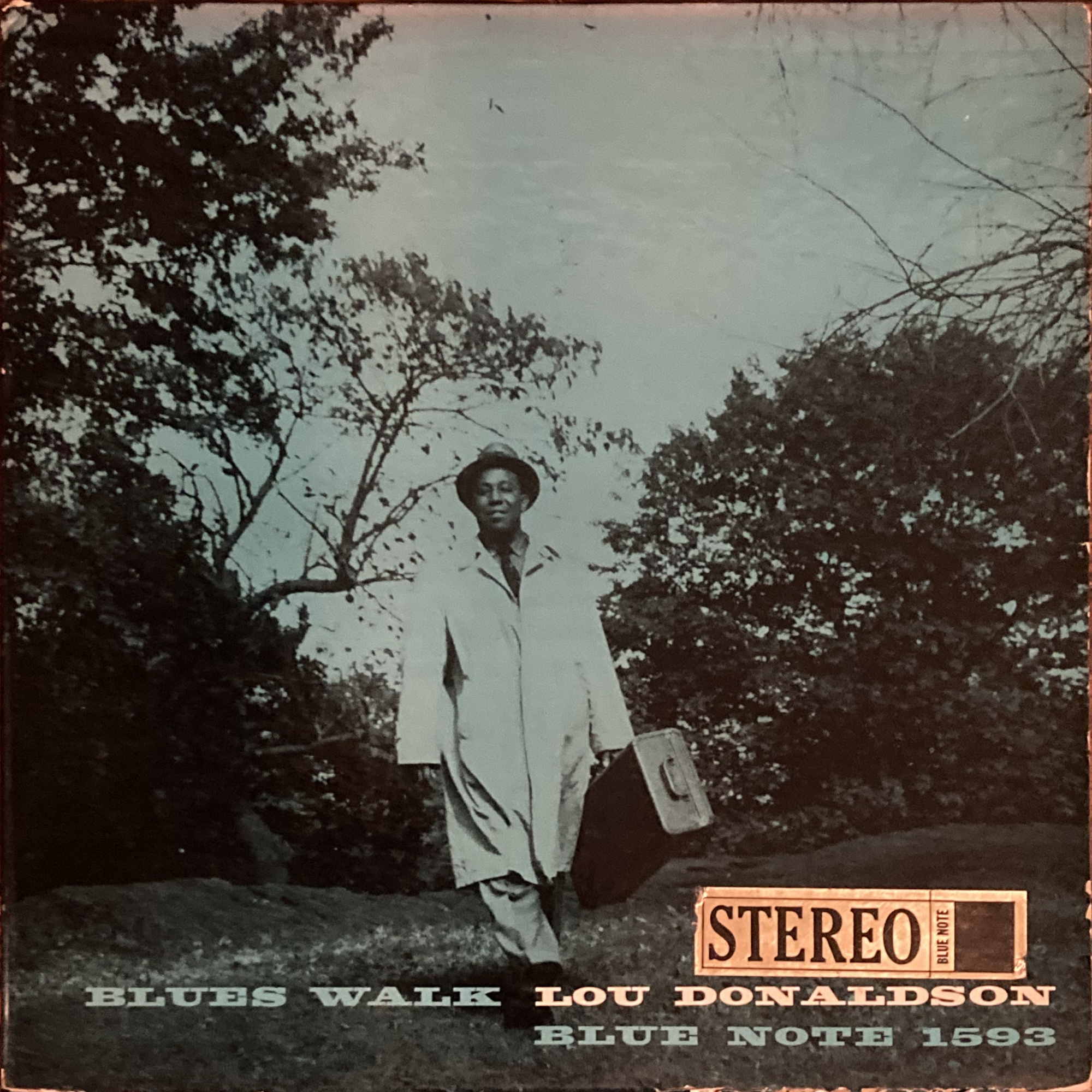
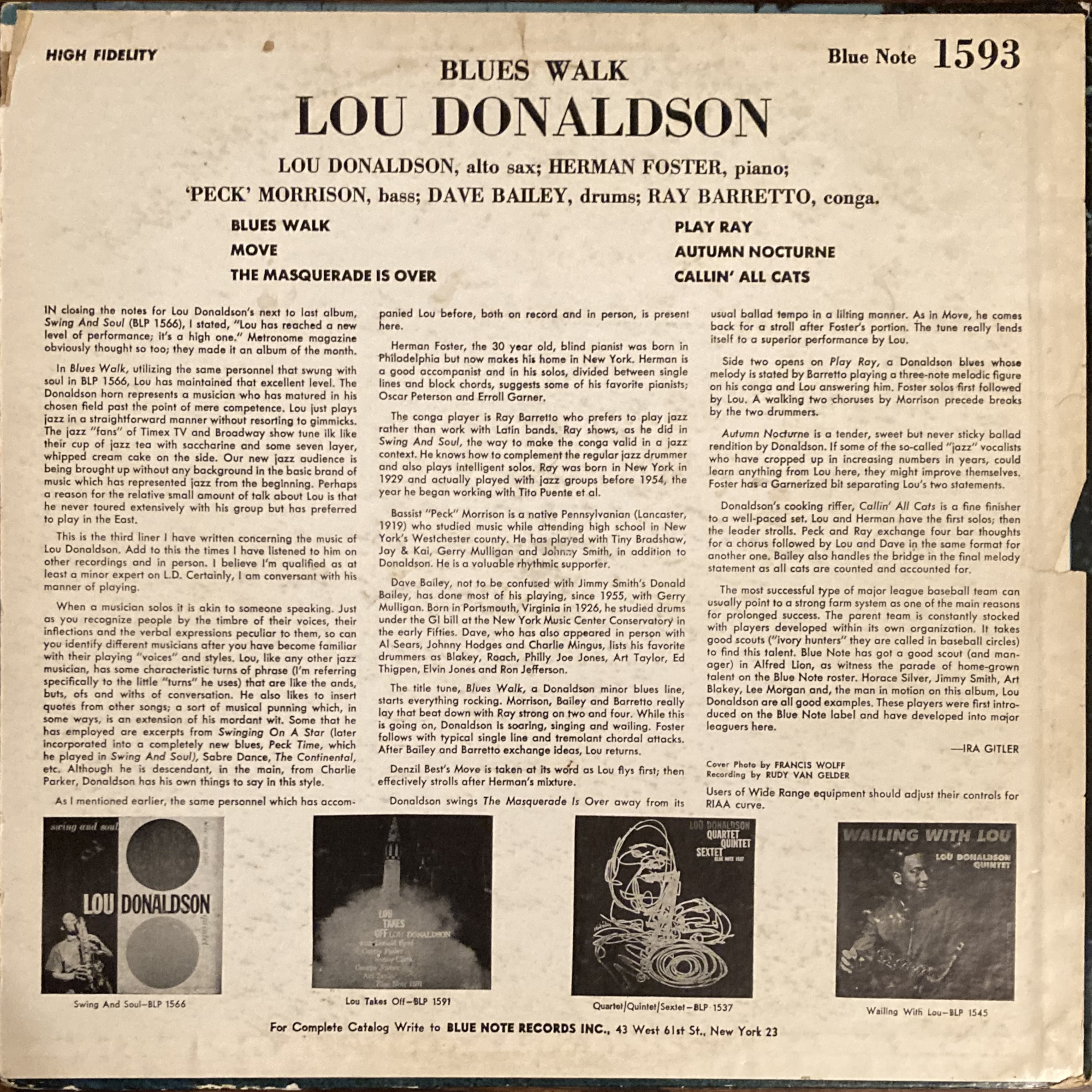
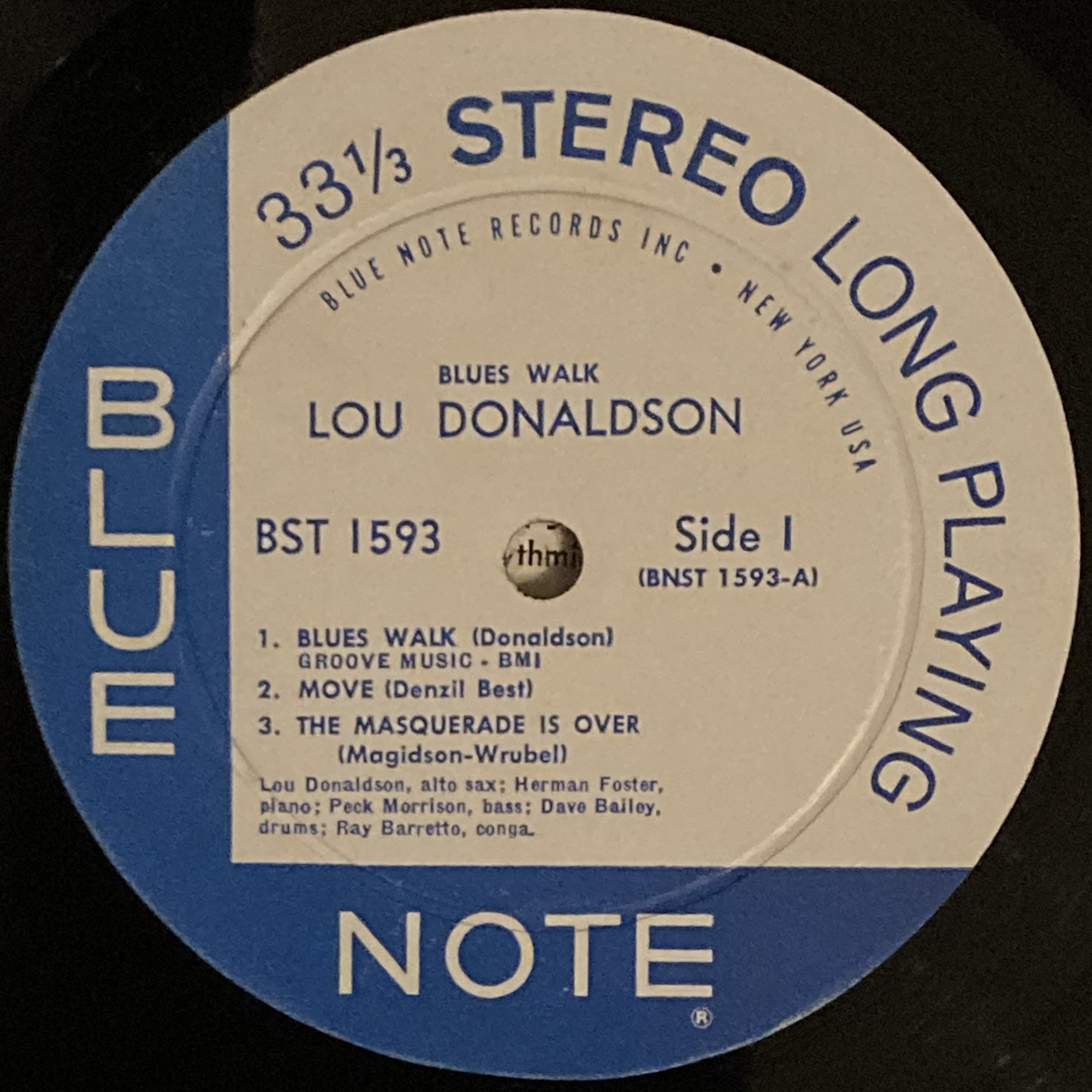
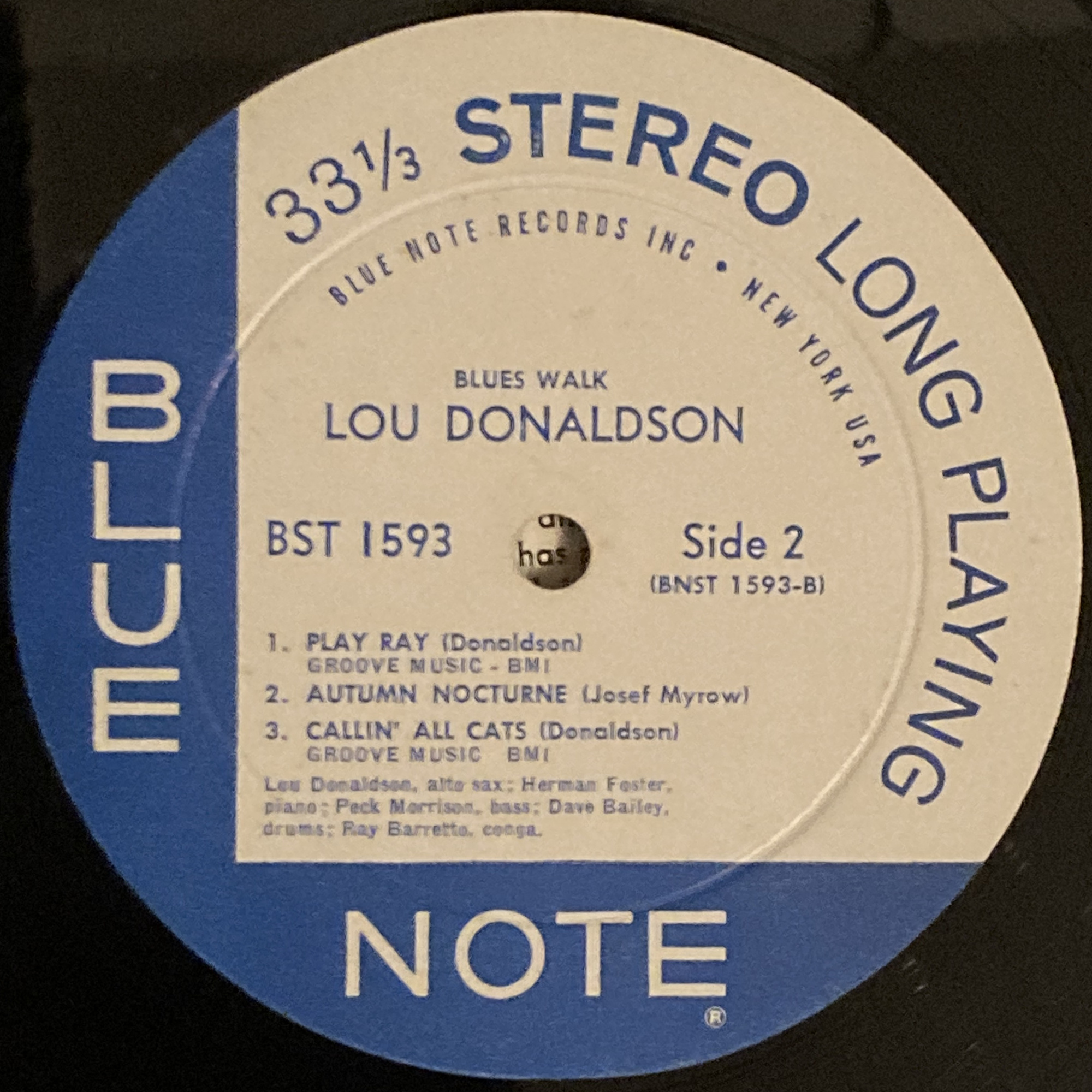
Label: BLUE NOTE
No.: BST 1593
Title: BLUES WALK
Musician: LOU DONALDSON
Recorded: 1958/7/28
Stereo
Cover address: 43 West 61st St, New York 23,
Laminate, INC有り, STEREOステッカー
Groove Guard
Label Side-1
Blue & White Background
White & Blue Letter, INC&R有り
Address: NEW YORK USA
Deep Groove
Dead Wax Info: BN-ST-1593-A, P(Ear), S-RVG STEREOスタンプ
Label Side-2
Blue & White Background
White & Blue Letter, INC&R有り
Address: NEW YORK USA
Deep Groove
Dead Wax Info: BN-ST-1593-B-1, P(Ear), S-RVG STEREOスタンプ
ドット無し
Personnel-
Drums: Dave Bailey
Bass: Peck Morrison
Piano: Herman Foster
Alto Sax: Lou Donaldson
Conga: Ray Barretto
Tracks-
Side-1
1) Blues Walk 6’41”
2) Move 5’51”
3) The Masquerade is Over 5’50”
Side-2
1) Play Ray 5’30”
2) Autumn Nocturne 4’53”
3) Callin’ All Cats 5’14”
<裏ジャケ原文>
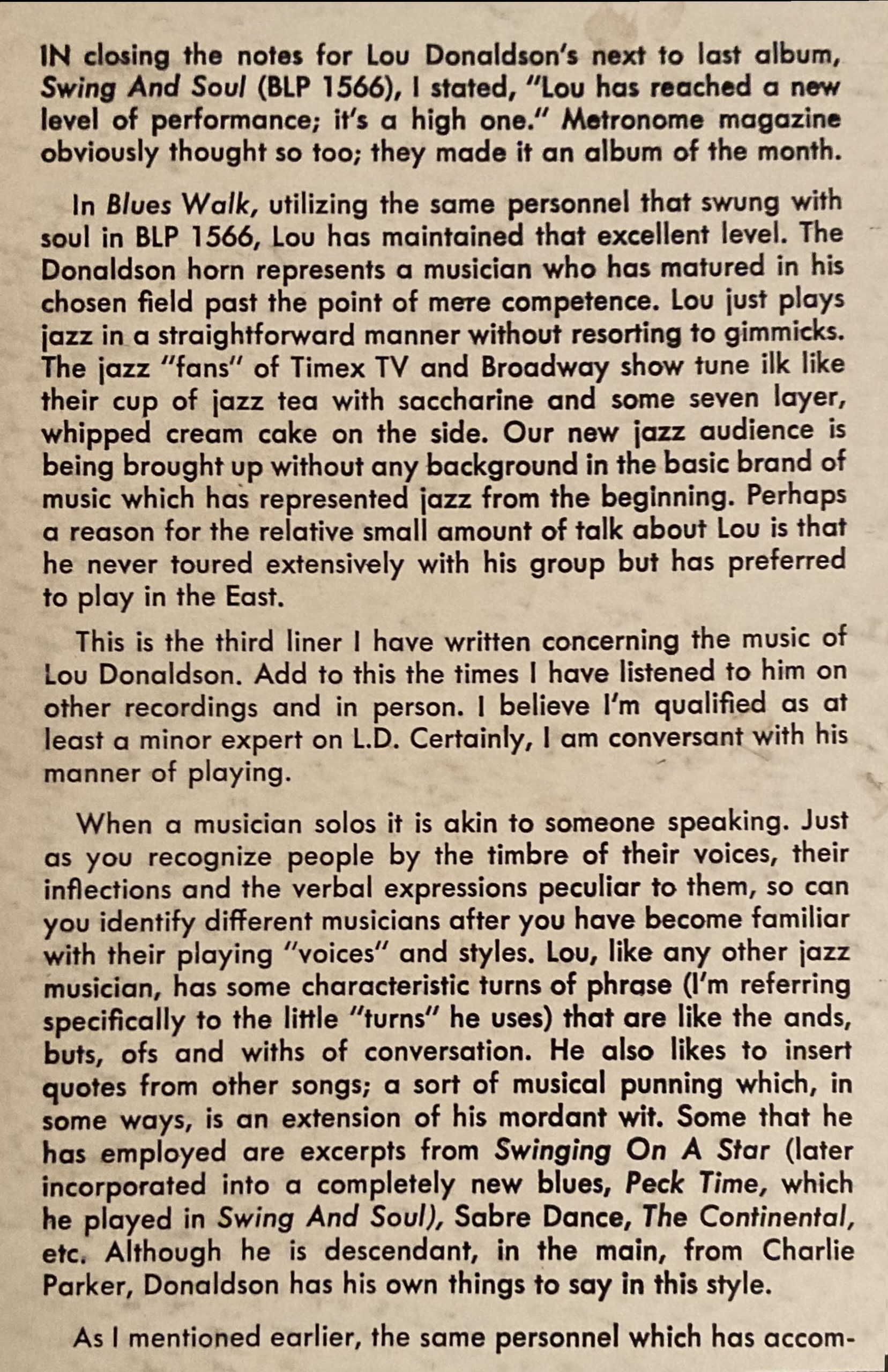
IN closing the notes for Lou Donaldson’s next to last album, Swing And Soul (BLP 1566), I stated, “Lou has reached a new level of performance; it’s a high one.” Metronome magazine obviously thought so too; they made it an album of the month.
In Blues Walk, utilizing the same personnel that swung with soul in BLP 1566, Lou has maintained that excellent level. The Donaldson horn represents a musician who has matured in his chosen field past the point of mere competence. Lou just plays jazz in a straightforward manner without resorting to gimmicks. The jazz “fans” of Timex TV and Broadway show tune ilk like their cup of jazz tea with saccharine and some seven layer, whipped cream cake on the side. Our new jazz audience is being brought up without any background in the basic brand of music which has represented jazz from the beginning. Perhaps a reason for the relative small amount of talk about Lou is that he never toured extensively with his group but has preferred to play in the East.
This is the third liner I have written concerning the music of Lou Donaldson. Add to this the times I have listened to him on other recordings and in person. I believe I’m qualified as at least a minor expert on L.D. Certainly, I am conversant with his manner of playing.
When a musician solos it is akin to someone speaking. Just as you recognize people by the timbre of their voices, their inflections and the verbal expressions peculiar to them, so can you identify different musicians after you have become familiar with their playing “voices” and styles. Lou, like any other jazz musician, has some characteristic turns of phrase (I’m referring specifically to the little “turns” he uses) that are like the ands, buts, ofs and withs of conversation. He also likes to insert quotes from other songs; a sort of musical punning which, in some ways, is an extension of his mordant wit. Some that he has employed are excerpts from Swinging On A Star (later incorporated into a completely new blues, Peck Time, which he played in Swing And Soul), Sabre Dance, The Continental, etc. Although he is descendant, in the main, from Charlie Parker, Donaldson has his own things to say in this style.
As I mentioned earlier, the same personnel which has accompanied Lou before, both on record and in person, is present here.
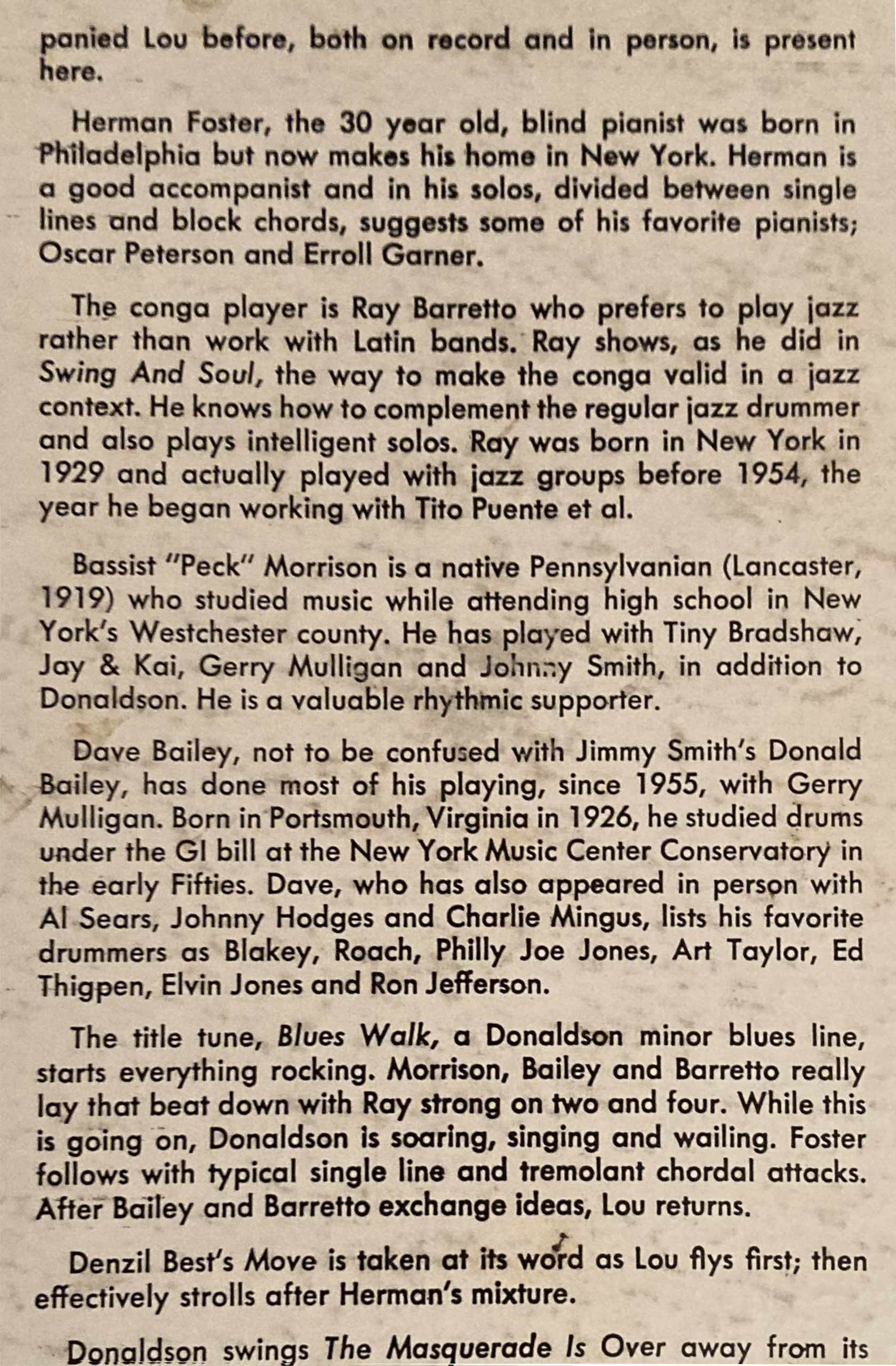
Herman Foster, the 30 year old, blind pianist was born in Philadelphia but now makes his home in New York. Herman is a good accompanist and in his solos, divided between single lines and block chords, suggests some of his favorite pianists; Oscar Peterson and Erroll Garner.
The conga player is Ray Barretto who prefers to play jazz rather than work with Latin bands. Ray shows, as he did in Swing And Soul, the way to make the conga valid in a jazz context. He knows how to complement the regular jazz drummer and also plays intelligent solos. Ray was born in New York in 1929 and actually played with jazz groups before 1954, the year he began working with Tito Puente et al.
Bassist “Peck” Morrison is a native Pennsylvanian (Lancaster, 1919) who studied music while attending high school in New York’s Westchester county. He has played with Tiny Bradshaw, Jay & Kai, Gerry Mulligan and Johnny Smith, in addition to Donaldson. He is a valuable rhythmic supporter.
Dave Bailey, not to be confused with Jimmy Smith’s Donald Bailey, has done most of his playing, since 1955, with Gerry Mulligan. Born in Portsmouth, Virginia in 1926, he studied drums under the GI bill at the New York Music Center Conservatory in the early Fifties. Dave, who has also appeared in person with Al Sears, Johnny Hodges and Charlie Mingus, lists his favorite drummers as Blakey, Roach, Philly Joe Jones, Art Taylor, Ed Thigpen, Elvin Jones and Ron Jefferson.
The title tune, Blues Walk, a Donaldson minor blues line, starts everything rocking. Morrison, Bailey and Barretto really lay that beat down with Ray strong on two and four. While this is going on, Donaldson is soaring, singing and wailing. Foster follows with typical single line and tremolant chordal attacks. After Bailey and Barretto exchange ideas, Lou returns.
Denzil Best’s Move is taken at its word as Lou flys first; then effectively strolls after Herman’s mixture.
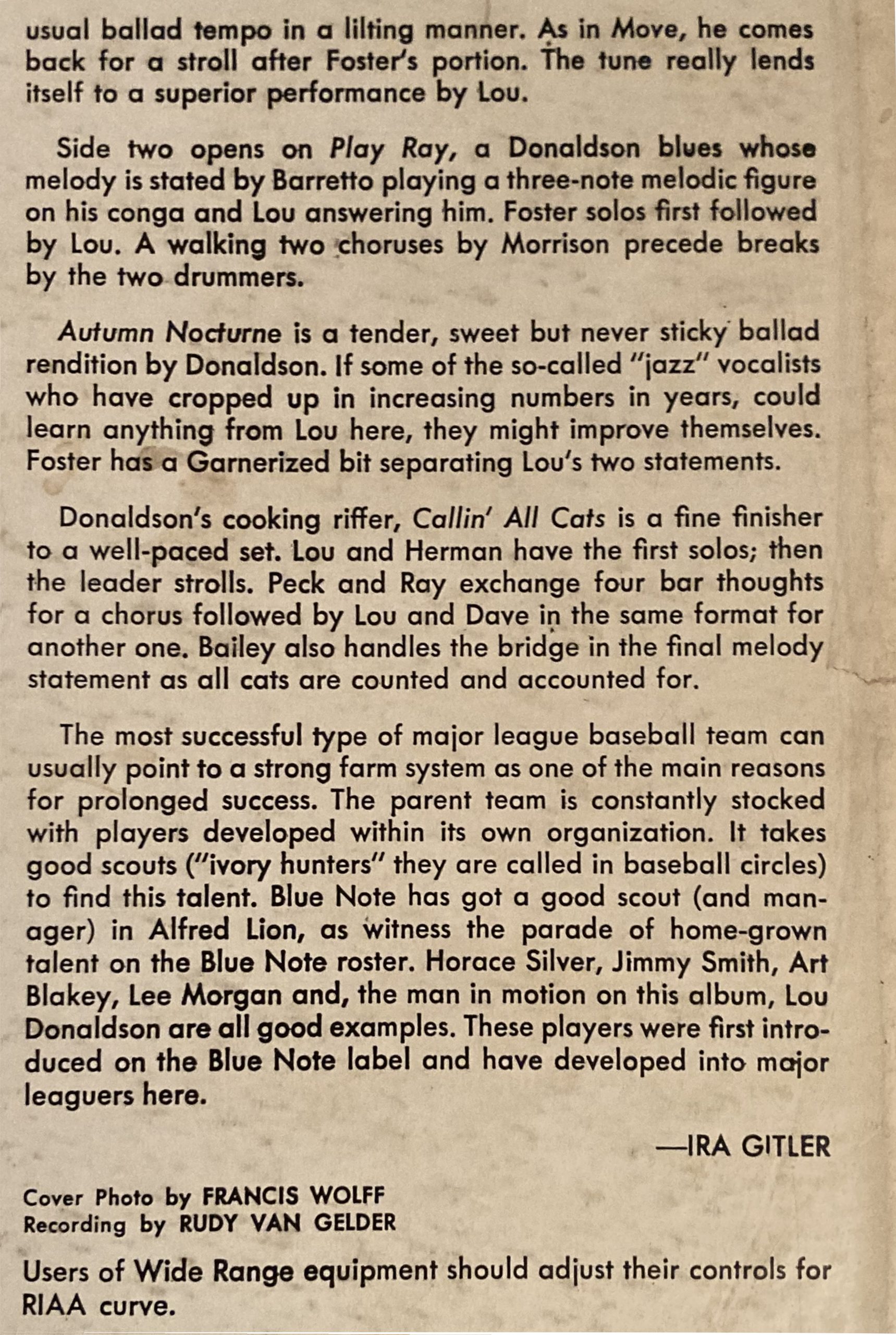
Donaldson swings The Masquerade Is Over away from its usual ballad tempo in a lilting manner. As in Move, he comes back for a stroll after Foster’s portion. The tune really lends itself to a superior performance by Lou.
Side two opens on Play Ray, a Donaldson blues whose melody is stated by Barretto playing a three-note melodic figure on his conga and Lou answering him. Foster solos first followed by Lou. A walking two choruses by Morrison precede breaks by the two drummers.
Autumn Nocturne is a tender, sweet but never sticky ballad rendition by Donaldson. If some of the so-called “jazz” vocalists who have cropped up in increasing numbers in years, could learn anything from Lou here, they might improve themselves. Foster has a Garnerized bit separating Lou’s two statements.
Donaldson’s cooking riffer, Callin’ All Cats is a fine finisher to a well-paced set. Lou and Herman have the first solos; then the leader strolls. Peck and Ray exchange four bar thoughts for a chorus followed by Lou and Dave in the same format for another one. Bailey also handles the bridge in the final melody statement as all cats are counted and accounted for.
The most successful type of major league baseball team can usually point to a strong farm system as one of the main reasons for prolonged success. The parent team is constantly stocked with players developed within its own organization. It takes good scouts (“ivory hunters” they are called in baseball circles) to find this talent. Blue Note has got a good scout (and man- ager) in Alfred Lion, as witness the parade of home-grown talent on the Blue Note roster. Horace Silver, Jimmy Smith, Art Blakey, Lee Morgan and, the man in motion on this album, Lou Donaldson are all good examples. These players were first intro- duced on the Blue Note label and have developed into major leaguers here.
-IRA GITLER
Cover Photo by FRANCIS WOLFF Recording by RUDY VAN GELDER
Users of Wide Range equipment should adjust their controls for RIAA curve.
<裏ジャケ和訳>
ルー・ドナルドソンの(本作の直前のアルバムである)『Swing And Soul』(BLP 1566)のライナーノーツを締めくくる際、私は「ルーは新たな演奏の境地に達した。それも極めて高いレベルだ」と記した。『メトロノーム』誌も同様に評価し、同作を「今月のアルバム」に選出している。
『Blues Walk』において、ルーは『Swing And Soul』でソウルフルなスウィングを聴かせたメンバーを再び起用し、その素晴らしい演奏水準を維持している。ドナルドソンのホーン・プレイは、単なる「有能な演奏家」という域を超え、自身の選んだ分野で円熟味を増したミュージシャンの姿を体現している。ルーはギミックに頼ることなく、あくまでストレートにジャズを演奏する。一方、テレビ番組(Timex TVなど)やブロードウェイ・ミュージカルの楽曲を好むようなジャズ「ファン」たちは、ジャズという飲み物にサッカリン(人工甘味料)をたっぷり入れ、さらにホイップクリームを何層にも重ねたケーキを添えるようなスタイルを好む傾向がある。現代の新しいジャズ・リスナー層は、ジャズの黎明期からその本質を形作ってきた音楽の基礎に触れることなく育ってきているのだ。ルーについて語られることが比較的少ない理由の一つは、彼が自身のグループを率いて大規模なツアーを行うのではなく、主に東部地域での演奏活動を好んできたからかもしれない。
ルー・ドナルドソンの音楽についてライナーノーツを書くのは、今回で3回目になる。これに加え、他の録音作品や実際のライブ演奏で彼の音楽を聴いてきた経験もある。私は少なくとも、L.D.(ルー・ドナルドソン)に関しては「ちょっとした専門家」と呼べる資格があると思う。少なくとも、彼の演奏スタイルには精通しているはずだ。
ミュージシャンがソロをとることは、人が言葉を話すことに似ている。声の音色や抑揚、その人特有の言い回しで相手を見分けられるのと同様に、ミュージシャンの演奏における「声」やスタイルに親しめば、誰が演奏しているのかを聞き分けられるようになるものだ。他のジャズ・ミュージシャンと同様、ルーにも特徴的なフレーズ回し(特に彼が多用する小さな「ターン」や装飾的な音の動きを指している)がある。それらは、日常会話における「そして(and)」「しかし(but)」「~の(of)」「~と共に(with)」といった言葉のような役割を果たしている。また、彼は他の曲のメロディを引用するのも好む。これは一種の音楽的な言葉遊びであり、ある意味では、彼の持つ辛辣なウィットの延長線上にあるものと言えるだろう。彼が取り入れているフレーズには、『Swinging On A Star』(後に『Swing And Soul』で演奏された完全な新曲ブルース『Peck Time』に組み込まれたもの)や、『Sabre Dance』、『The Continental』などからの引用が含まれています。ドナルドソンは、基本的にはチャーリー・パーカーの系譜に連なる奏者ですが、このスタイルの中で彼独自の表現を確立しています。
前述の通り、ここでもルーの録音やライブで以前から共演してきたメンバーが参加しています。
ハーマン・フォスターは30歳の全盲のピアニストで、フィラデルフィア出身ですが、現在はニューヨークを拠点に活動しています。彼は優れた伴奏者であり、シングル・ノートとブロック・コードを織り交ぜたソロからは、オスカー・ピーターソンやエロール・ガーナーといった彼のお気に入りのピアニストたちの影響がうかがえます。
コンガ奏者のレイ・バレットは、ラテン・バンドでの活動よりもジャズの演奏を好む人物です。『Swing And Soul』でも見せたように、彼はジャズという文脈の中でコンガを効果的に響かせる術を心得ています。通常のジャズ・ドラマーの演奏を巧みに引き立てるだけでなく、知的なソロも披露します。1929年ニューヨーク生まれのレイは、ティト・プエンテらとの活動を始めた1954年以前から、すでにジャズ・グループで演奏していました。
ベーシストの“ペック”モリソンはペンシルベニア州ランカスター出身(1919年生まれ)で、ニューヨーク州ウェストチェスター郡の高校に通いながら音楽を学びました。ドナルドソンのほか、タイニー・ブラッドショー、ジェイ&カイ、ジェリー・マリガン、ジョニー・スミスといったミュージシャンとも共演しています。彼は貴重なリズム・サポーターです。
デイヴ・ベイリー(ジミー・スミスのドナルド・ベイリーとは別人)は、1955年以降、主にジェリー・マリガンと共演しています。1926年、バージニア州ポーツマス生まれ。1950年代初頭、GI法(復員兵援護法)を利用してニューヨーク・ミュージック・センター音楽院でドラムを学びました。アル・シアーズ、ジョニー・ホッジス、チャールズ・ミンガスとも共演経験のあるデイヴは、好きなドラマーとしてブレイキー、ローチ、フィリー・ジョー・ジョーンズ、アート・テイラー、エド・シグペン、エルヴィン・ジョーンズ、ロン・ジェファーソンを挙げています。
タイトル曲「ブルース・ウォーク」は、ドナルドソンのマイナー・ブルース・ラインで幕を開け、ロックな雰囲気を醸し出す。モリソン、ベイリー、バレットは力強いビートを刻み、レイは2拍目と4拍目で力強く演奏する。その間、ドナルドソンは高らかに歌い、叫び声を上げる。フォスターは典型的な単音のフレーズと震えるようなコード進行でそれに続く。ベイリーとバレットがアイデアを交換した後、ルーが戻ってくる。
デンジル・ベストの「ムーブ」は、そのタイトル通り、ルーが最初に軽快に演奏し、その後ハーマンの演奏に続いて効果的にゆったりと演奏する。
ドナルドソンは「ザ・マスカレード・イズ・オーバー」を、いつものバラードのテンポから軽快にスウィングさせる。「ムーブ」と同様に、フォスターのパートの後にはゆったりと演奏する。この曲はルーの卓越した演奏にまさにうってつけだ。
B面は「プレイ・レイ」で始まる。ドナルドソンのブルースで、バレットがコンガで3音のメロディーを奏で、ルーがそれに答える形で始まる。フォスターのソロが最初に始まり、続いてルーがソロを披露する。モリソンのウォーキング・コーラスが2コーラス続き、その後2人のドラマーによるブレイクが入る。
「オータム・ノクターン」は、ドナルドソンによる優しく甘美でありながら、決して甘ったるくないバラードである。近年急増しているいわゆる「ジャズ」ボーカリストたちが、ここでのルー(・ドナルドソン)から何かを学べば、もっと良くなれるかもしれない。ルーが提示する2つのフレーズの間には、フォスターによるエロール・ガーナー風の演奏が挟まれている。
ドナルドソン作のノリの良いリフ・ナンバー「Callin’ All Cats」は、テンポの良いセットを締めくくるのにふさわしい一曲だ。まずルーとハーマンがソロを取り、続いてリーダー(ドナルドソン)が軽快にソロを披露する。ペックとレイが4小節ずつの掛け合いを1コーラス行い、その後ルーとデイヴが同じ形式でさらに1コーラス演奏する。最後のメロディ提示部ではベイリーがブリッジ(中間部)を担当し、全員が揃って演奏を締めくくる。
メジャーリーグで最も成功しているチームは、その長期的な成功の主な理由として、強力なファームシステム(若手育成組織)を挙げることが多い。親チームには、常に組織内で育成された選手が供給されているからだ。こうした才能を発掘するには、優れたスカウト(野球界では「アイボリー・ハンター」とも呼ばれる)が必要となる。ブルーノートにはアルフレッド・ライオンという優れたスカウト(兼マネージャー)がいた。ブルーノートの所属アーティストに生え抜きの才能が次々と名を連ねていることを見れば、それは明らかだ。ホレス・シルヴァー、ジミー・スミス、アート・ブレイキー、リー・モーガン、そして本作の主役であるルー・ドナルドソンなどがその好例である。彼らは皆、ブルーノート・レーベルからデビューし、同レーベルでメジャー級のアーティストへと成長を遂げたのだ。
-アイラ・ギトラー
カバー写真:フランシス・ウルフ 録音:ルディ・ヴァン・ゲルダー
ワイドレンジ対応の再生機器をお使いの場合は、RIAAカーブに合わせてコントロールを調整してください。
※訳文の制作にはGoogleドライブとGoogle翻訳のお世話になりました。

コメント