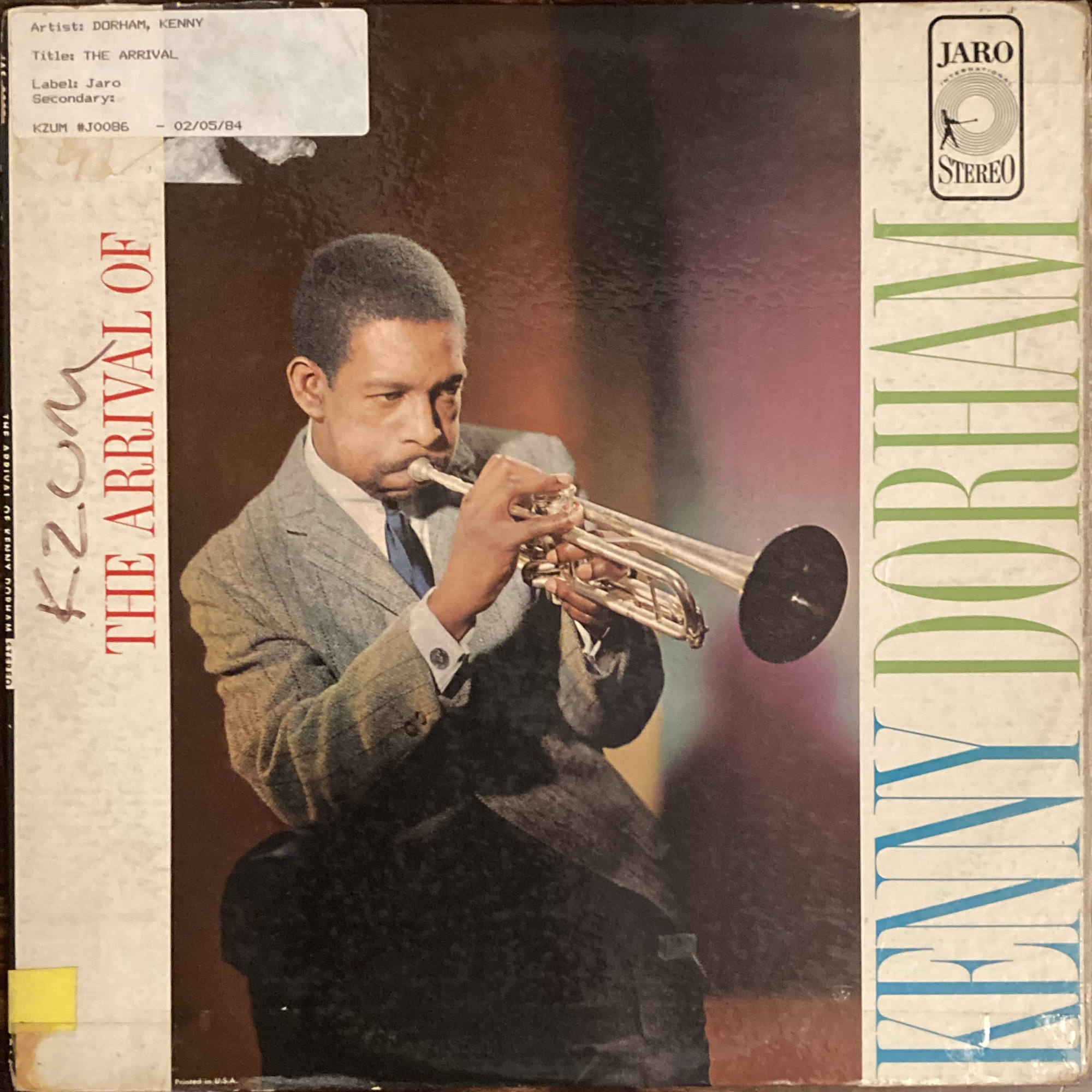
Label: JARO
No.: JAS 8007
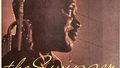
Title: THE ARRIVAL OF KENNY DORHAM
Musician: KENNY DORHAM
Recorded: 1960/1/10
Stereo
Cover address:
Laminate Coating
Groove Guard
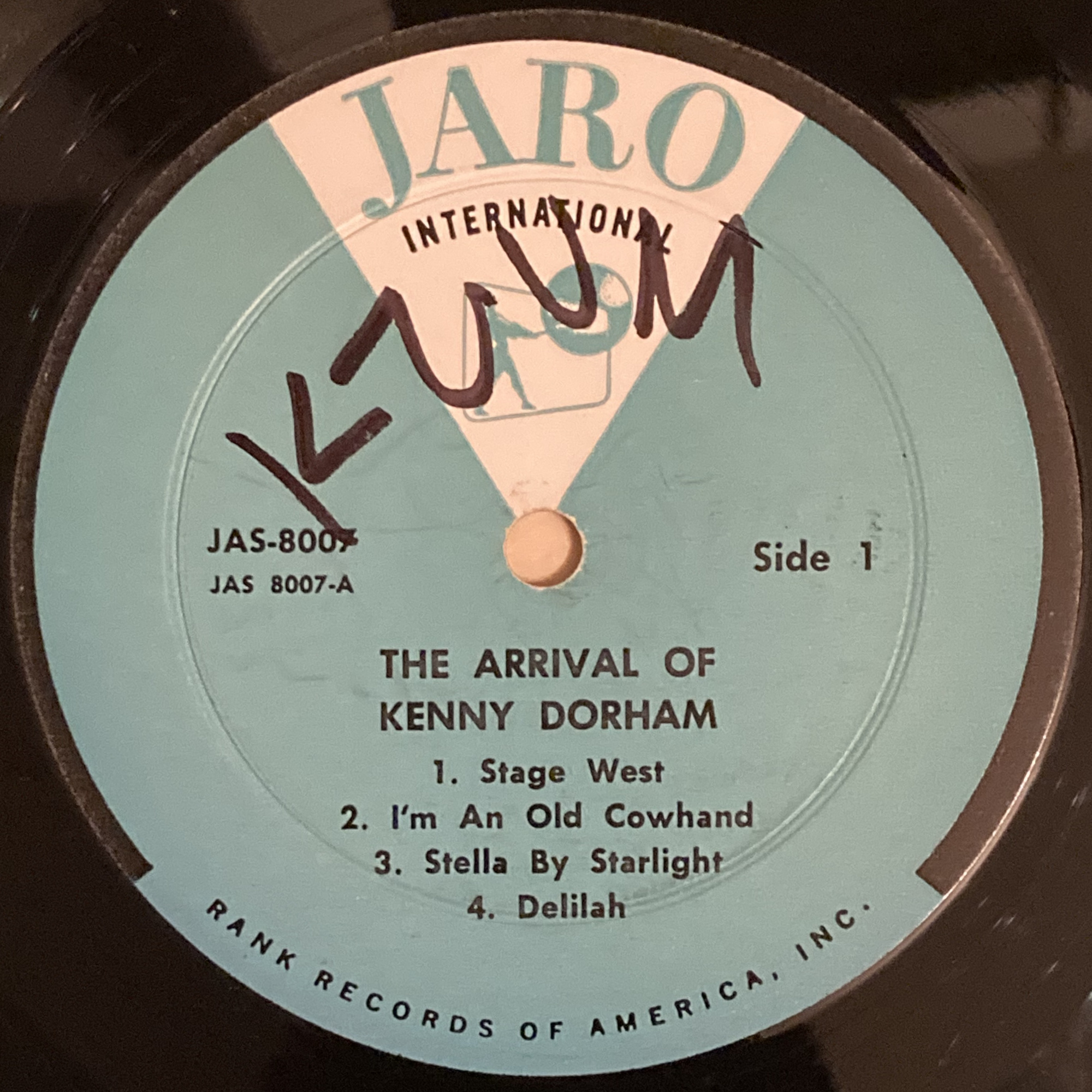
Label Side-1
Light Blue Background
Black Letter
Address:
Deep Groove
Dead Wax Info: JAS-8007A, A1
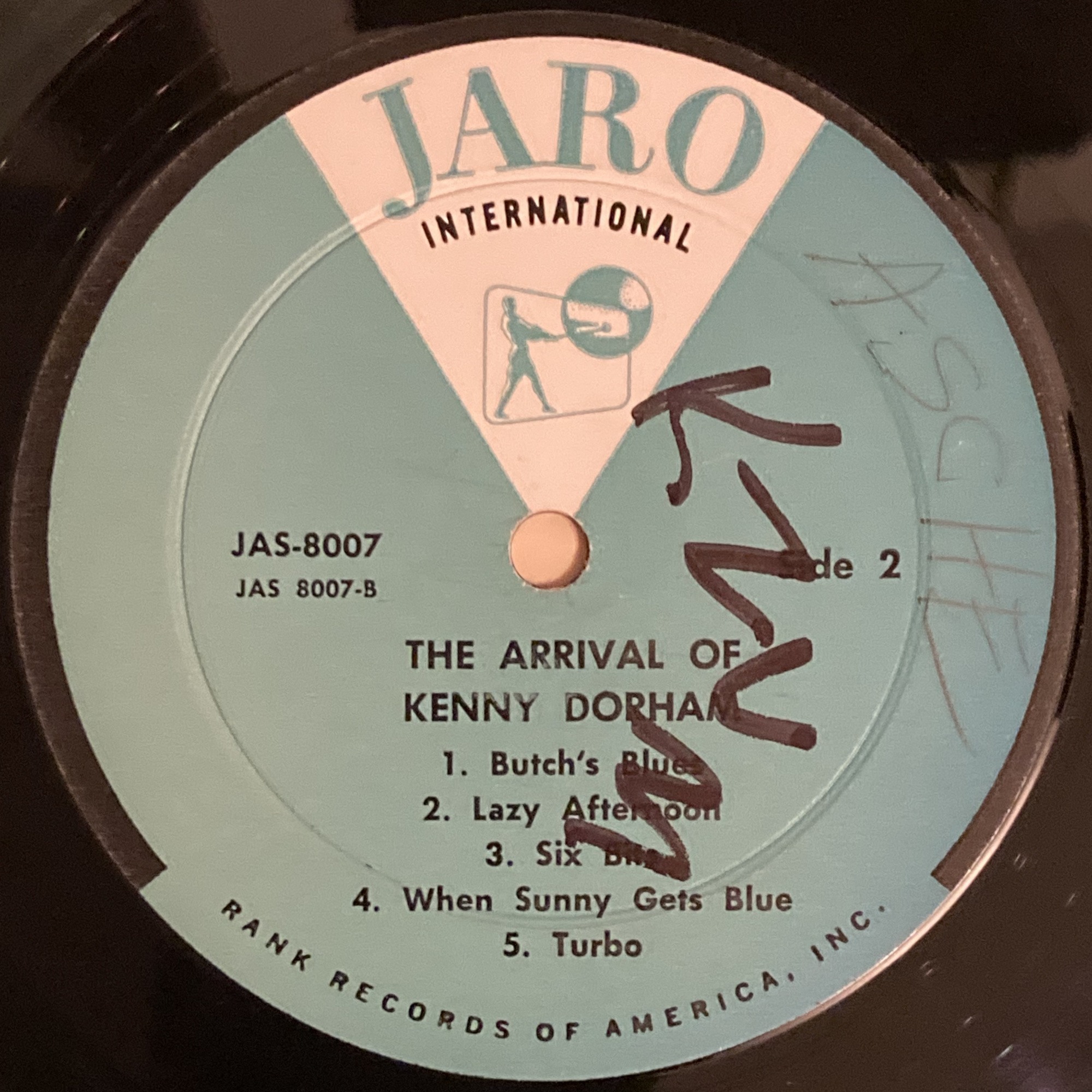
Label Side-2
Light Blue Background
Black Letter
Address:
Deep Groove
Dead Wax Info: JAS8007B, A1
Personnel-
Drums: Arnold Enlow
Bass: Butch Warren, Charlie Davis
Piano: Tommy Flanagan
Trumpet: Kenny Dorham
Tracks-
Side-1
1) Stage West 8’20”
2) I’m an Old Cowhand 4’09”
3) Stella by Starlight 5’01”
4) Delilah 4’25”
Side-2
1) Butch’s Blues 3’41”
2) Lazy Afternoon 3’10”
3) Six Bits 4’45”
4) When Sunny Gets Blue 4’36”
5) Turbo 3’44”
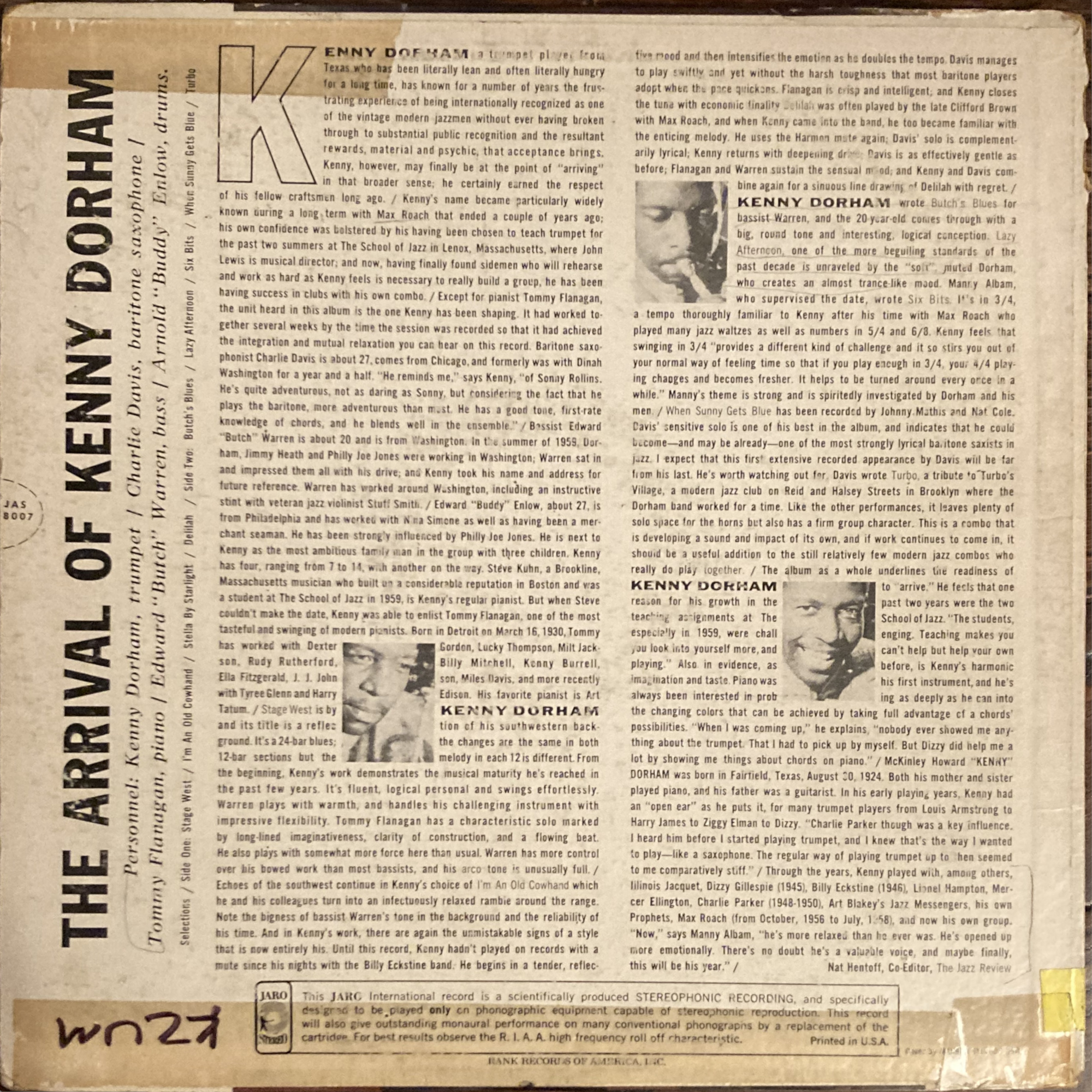
<裏ジャケ原文>
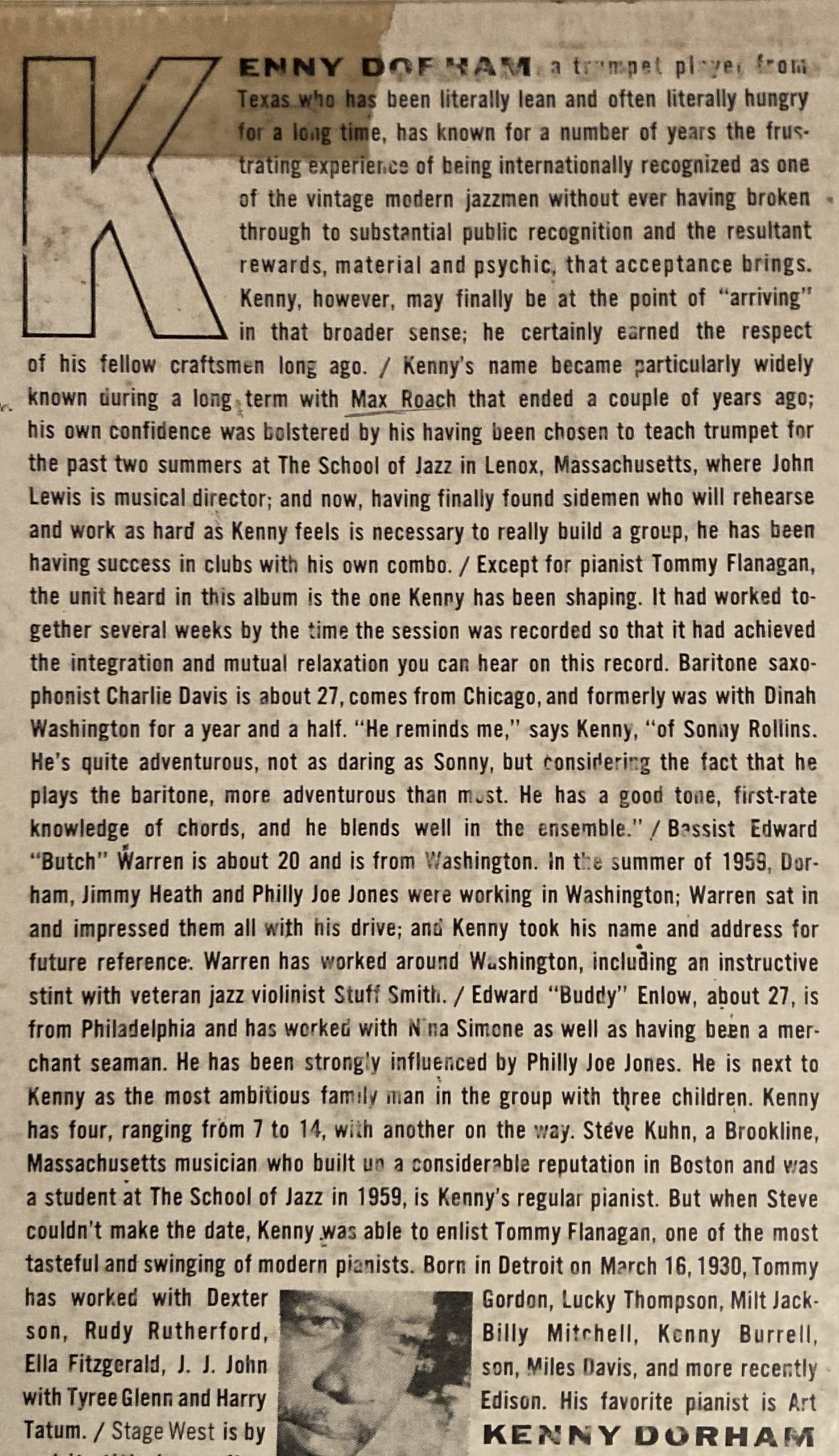
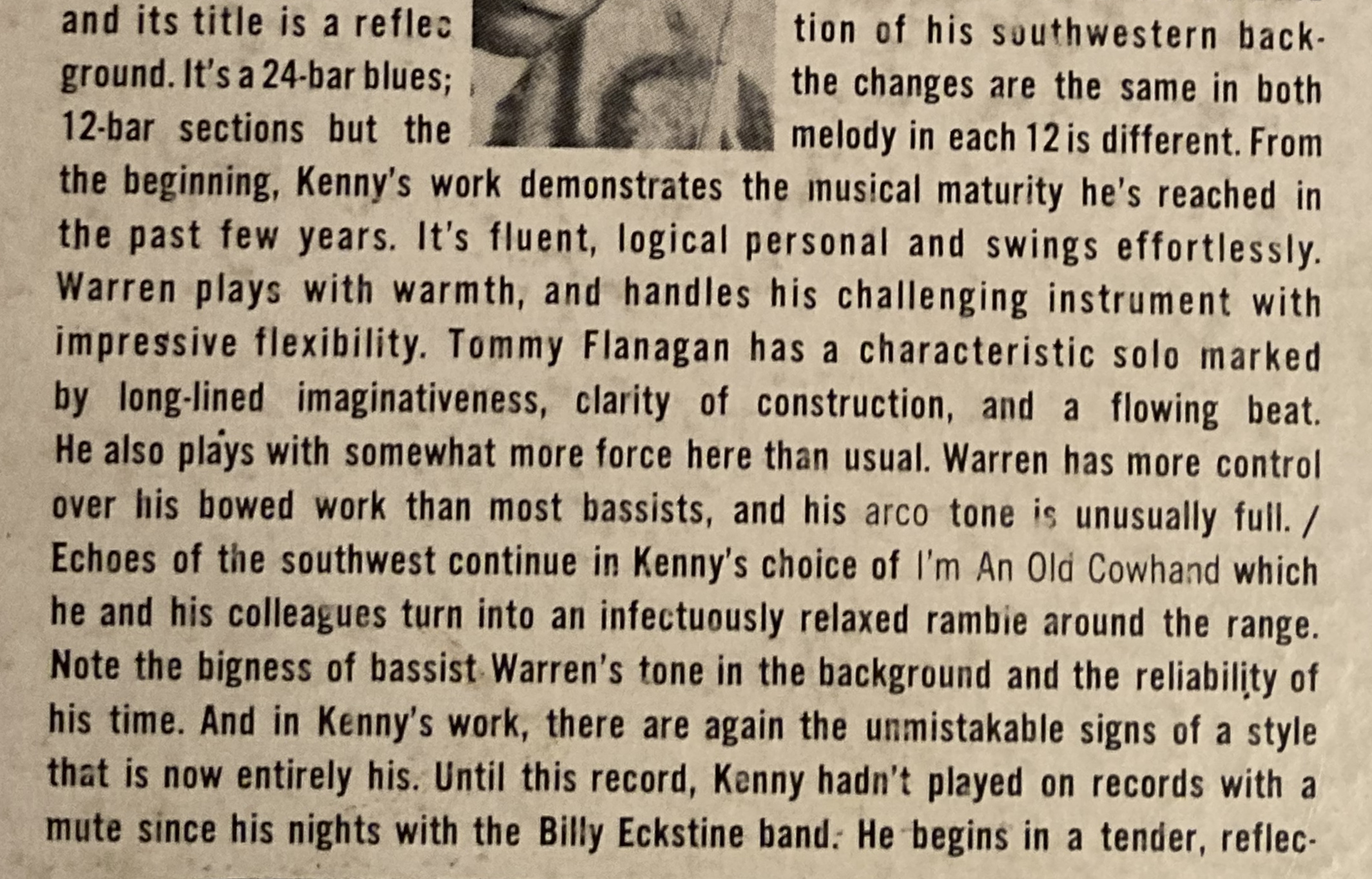
KENNY DORHAM a trumpet player from Texas who has been literally lean and often literally hungry for a long time, has known for a number of years the frustrating experience of being internationally recognized as one of the vintage modern jazzmen without ever having broken. through to substantial public recognition and the resultant rewards, material and psychic, that acceptance brings. Kenny, however, may finally be at the point of “arriving” in that broader sense; he certainly earned the respect of his fellow craftsmen long ago. / Kenny’s name became particularly widely known during a long term with Max Roach that ended a couple of years ago; his own confidence was bolstered by his having been chosen to teach trumpet for the past two summers at The School of Jazz in Lenox, Massachusetts, where John Lewis is musical director; and now, having finally found sidemen who will rehearse and work as hard as Kenny feels is necessary to really build a group, he has been having success in clubs with his own combo. / Except for pianist Tommy Flanagan, the unit heard in this album is the one Kenny has been shaping. It had worked to- gether several weeks by the time the session was recorded so that it had achieved the integration and mutual relaxation you can hear on this record. Baritone saxo- phonist Charlie Davis is about 27, comes from Chicago, and formerly was with Dinah Washington for a year and a half. “He reminds me,” says Kenny, “of Sonny Rollins. He’s quite adventurous, not as daring as Sonny, but considering the fact that he plays the baritone, more adventurous than most. He has a good tone, first-rate knowledge of chords, and he blends well in the ensemble.” / Bassist Edward “Butch” Warren is about 20 and is from Washington. In the summer of 1959, Dor- ham, Jimmy Heath and Philly Joe Jones were working in Washington; Warren sat in and impressed them all with his drive; and Kenny took his name and address for future reference. Warren has worked around Washington, including an instructive stint with veteran jazz violinist Stuff Smith. / Edward “Buddy” Enlow, about 27, is from Philadelphia and has worked with Nina Simone as well as having been a mer- chant seaman. He has been strongly influenced by Philly Joe Jones. He is next to Kenny as the most ambitious family man in the group with three children. Kenny has four, ranging from 7 to 14, with another on the way. Steve Kuhn, a Brookline, Massachusetts musician who built up a considerable reputation in Boston and was a student at The School of Jazz in 1959, is Kenny’s regular pianist. But when Steve couldn’t make the date, Kenny was able to enlist Tommy Flanagan, one of the most tasteful and swinging of modern pianists. Born in Detroit on March 16, 1930, Tommy has worked with Dexter Gordon, Lucky Thompson, Milt Jackson, Rudy Rutherford, Billy Mitchell, Kenny Burrell, Ella Fitzgerald, J. J. Johnson, Miles Davis, and more recently with Tyree Glenn and Harry Edison. His favorite pianist is Art Tatum./Stage West is by KENNY DORHAM and its title is a reflection of his southwestern background. It’s a 24-bar blues; the changes are the same in both 12-bar sections but the melody in each 12 is different. From the beginning, Kenny’s work demonstrates the musical maturity he’s reached in the past few years.
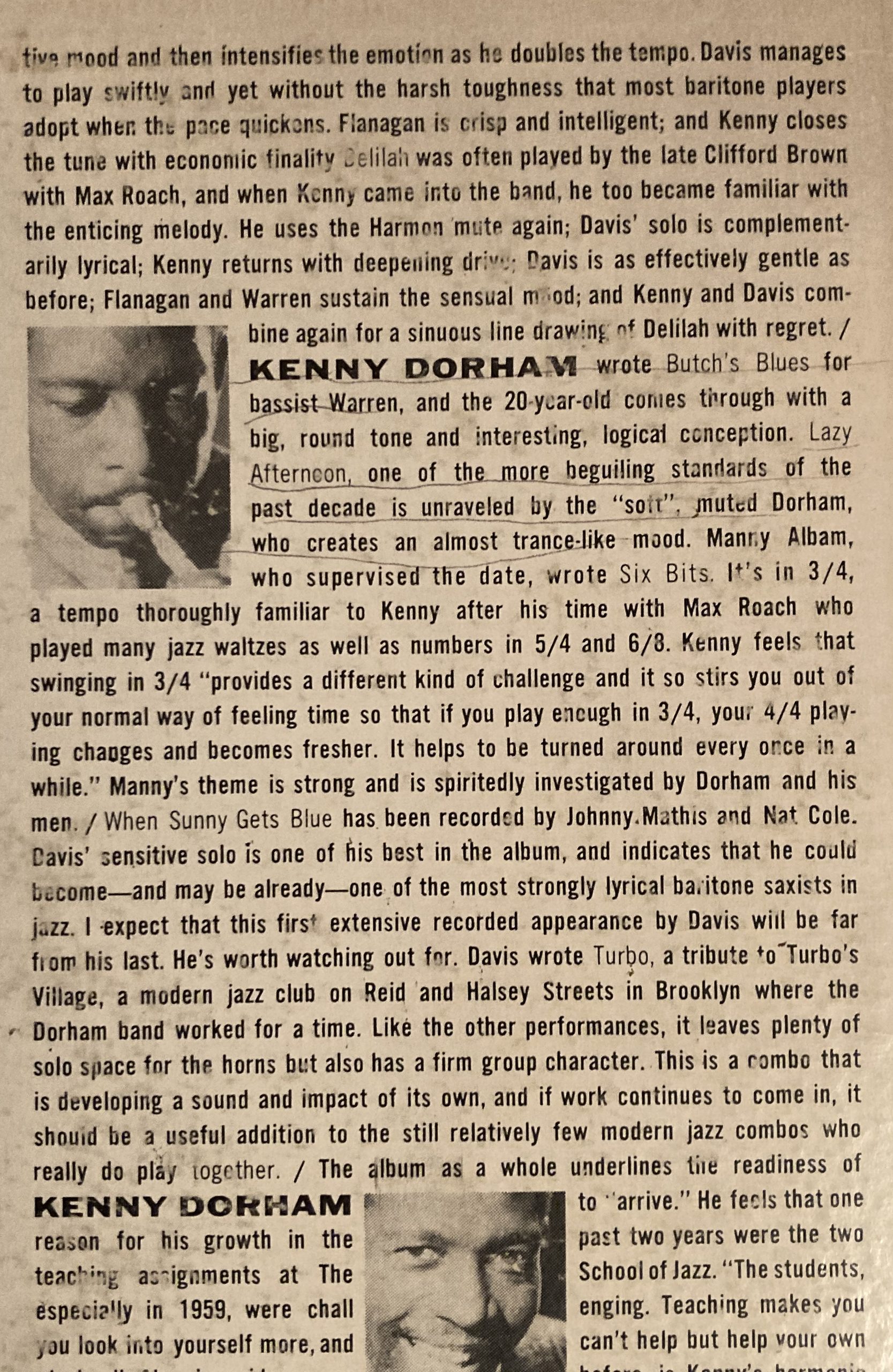
It’s fluent, logical personal and swings effortlessly. Warren plays with warmth, and handles his challenging instrument with impressive flexibility. Tommy Flanagan has a characteristic solo marked by long-lined imaginativeness, clarity of construction, and a flowing beat. He also plays with somewhat more force here than usual. Warren has more control over his bowed work than most bassists, and his arco tone is unusually full. / Echoes of the southwest continue in Kenny’s choice of I’m An Old Cowhand which he and his colleagues turn into an infectuously relaxed rambie around the range. Note the bigness of bassist Warren’s tone in the background and the reliability of his time. And in Kenny’s work, there are again the unmistakable signs of a style that is now entirely his. Until this record, Kenny hadn’t played on records with a mute since his nights with the Billy Eckstine band. He begins in a tender, reflective mood and then intensifies the emotion as he doubles the tempo. Davis manages to play swiftly and yet without the harsh toughness that most baritone players adopt when the pace quickens. Flanagan is crisp and intelligent; and Kenny closes the tune with economic finality Celilah was often played by the late Clifford Brown with Max Roach, and when Kenny came into the band, he too became familiar with the enticing melody. He uses the Harmon mute again; Davis’ solo is complement- arily lyrical; Kenny returns with deepening drive; Davis is as effectively gentle as before; Flanagan and Warren sustain the sensual mod; and Kenny and Davis com- bine again for a sinuous line drawing of Delilah with regret. / KENNY DORHAM wrote Butch’s Blues for bassist Warren, and the 20-year-old comes through with a big, round tone and interesting, logical conception. Lazy Afternoon, one of the more beguiling standards of the past decade is unraveled by the “soft”, muted Dorham, who creates an almost trance-like mood. Manny Albam, who supervised the date, wrote Six Bits. It’s in 3/4, a tempo thoroughly familiar to Kenny after his time with Max Roach who played many jazz waltzes as well as numbers in 5/4 and 6/8. Kenny feels that swinging in 3/4 “provides a different kind of challenge and it so stirs you out of your normal way of feeling time so that if you play encugh in 3/4, your 4/4 play- ing changes and becomes fresher. It helps to be turned around every once in a while.” Manny’s theme is strong and is spiritedly investigated by Dorham and his men. / When Sunny Gets Blue has been recorded by Johnny.Mathis and Nat Cole. Davis’ sensitive solo is one of his best in the album, and indicates that he could become-and may be already-one of the most strongly lyrical baritone saxists in jazz. I expect that this first extensive recorded appearance by Davis will be far from his last. He’s worth watching out for. Davis wrote Turbo, a tribute to Turbo’s Village, a modern jazz club on Reid and Halsey Streets in Brooklyn where the Dorham band worked for a time. Like the other performances, it leaves plenty of solo space for the horns but also has a firm group character. This is a combo that is developing a sound and impact of its own, and if work continues to come in, it should be a useful addition to the still relatively few modern jazz combos who really do play together. / The album as a whole underlines tire readiness of KENNY DORHAM to arrive.” He feels that one reason for his growth in the past two years were the two teaching assignments at The School of Jazz.
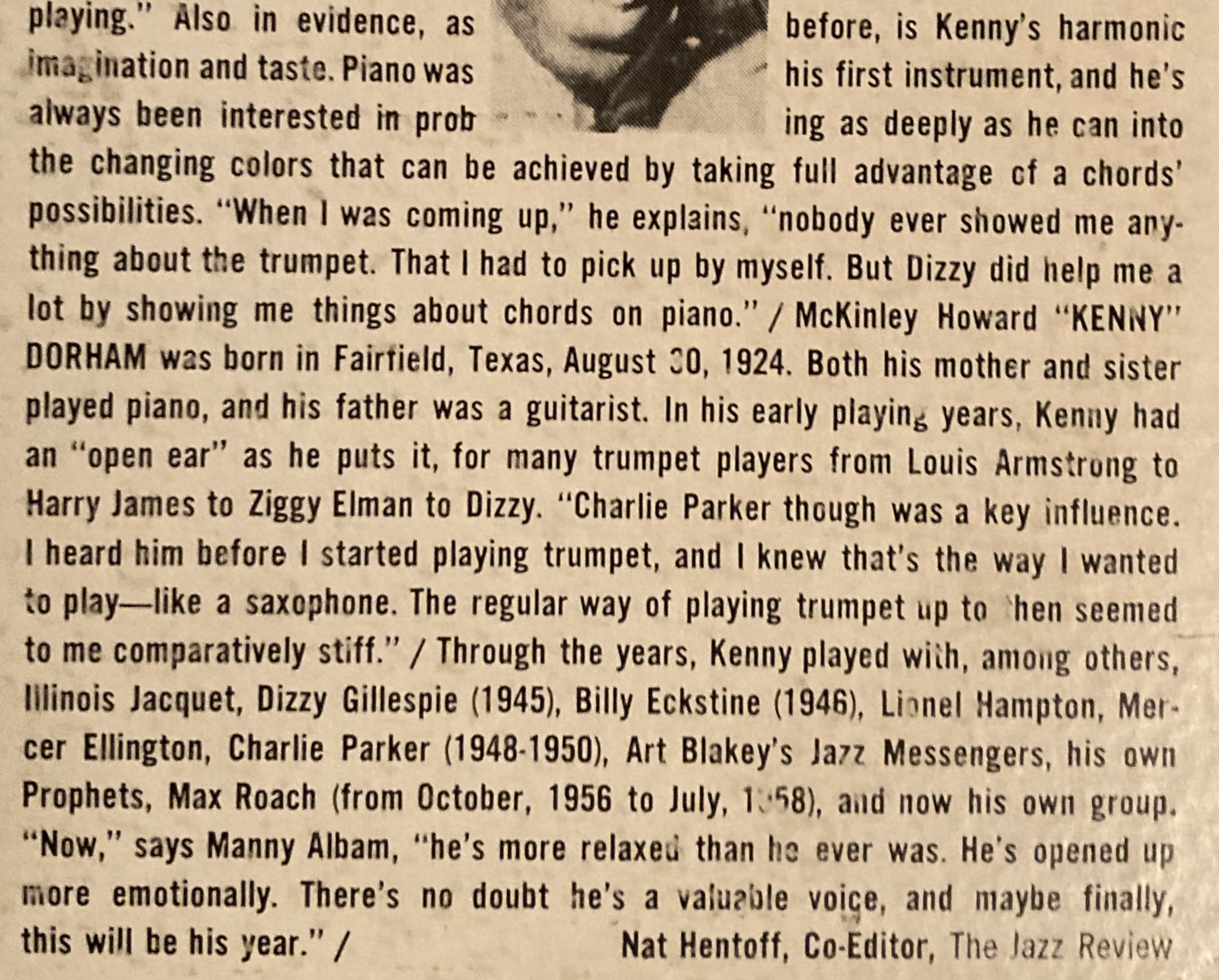
“The students, especially in 1959, were challenging. Teaching makes you you look into yourself more, and can’t help but help your own playing.” Also in evidence, as before, is Kenny’s harmonic imagination and taste. Piano was his first instrument, and he’s always been interested in probing as deeply as he can into the changing colors that can be achieved by taking full advantage of a chords’ possibilities. “When I was coming up,” he explains, “nobody ever showed me any- thing about the trumpet. That I had to pick up by myself. But Dizzy did help me a lot by showing me things about chords on piano.”/ McKinley Howard “KENNY” DORHAM was born in Fairfield, Texas, August 30, 1924. Both his mother and sister played piano, and his father was a guitarist. In his early playing years, Kenny had an “open ear” as he puts it, for many trumpet players from Louis Armstrong to Harry James to Ziggy Elman to Dizzy. “Charlie Parker though was a key influence. I heard him before I started playing trumpet, and I knew that’s the way I wanted to play like a saxophone. The regular way of playing trumpet up to hen seemed to me comparatively stiff.”/ Through the years, Kenny played with, among others, Illinois Jacquet, Dizzy Gillespie (1945), Billy Eckstine (1946), Lionel Hampton, Mer- cer Ellington, Charlie Parker (1948-1950), Art Blakey’s Jazz Messengers, his own Prophets, Max Roach (from October, 1956 to July, 1:58), and now his own group. “Now,” says Manny Albam, “he’s more relaxed than he ever was. He’s opened up more emotionally. There’s no doubt he’s a valuable voice, and maybe finally, this will be his year.” / Nat Hentoff, Co-Editor, The Jazz Review
<裏ジャケ和訳>
テキサス出身のトランペット奏者ケニー・ドーハムは、長い間、文字通り痩せこけ、また文字通り「飢え」に苦しむような生活を送ってきました。彼は、モダン・ジャズの重鎮の一人として国際的な評価を得ながらも、大衆的な成功や、それに伴う物質的・精神的な報酬を完全には手にできないという、もどかしい経験を長年味わってきました。しかし、ケニーは今、そうした広い意味での「成功」をようやく手にする地点に立っているのかもしれません。同業者からの尊敬は、とっくの昔に勝ち得ているのですから。/ ケニーの名が広く知られるようになったのは、数年前に終わったマックス・ローチとの長期にわたる共演期間中のことでした。また、ジョン・ルイスが音楽監督を務めるマサチューセッツ州レノックスの「スクール・オブ・ジャズ」で、過去2回の夏にわたりトランペットの講師に選ばれたことも、彼に自信を与えました。そして今、バンドを真に作り上げるために必要なだけの熱意を持ってリハーサルや演奏に取り組んでくれるサイドマンたちをようやく見つけ、自身のコンボを率いてクラブでの成功を収めています。/ ピアニストのトミー・フラナガンを除き、このアルバムで聴かれるユニットは、ケニーが時間をかけて作り上げてきたメンバーによるものです。セッションの録音時にはすでに数週間の共演を重ねており、このレコードで聴けるような一体感や、互いにリラックスした雰囲気が醸成されていました。バリトン・サックス奏者のチャーリー・デイヴィスはシカゴ出身の約27歳で、以前はダイナ・ワシントンのバンドに1年半ほど在籍していました。「彼はソニー・ロリンズを彷彿とさせるね」とケニーは語ります。「かなり冒険心に富んでいる。ソニーほど大胆ではないにせよ、バリトン・サックスという楽器を演奏することを考えれば、大抵の奏者よりもずっと冒険的だ。音色もいいし、コードに関する知識も一流で、アンサンブルにもよく溶け込んでいるよ。」/ ベーシストのエドワード・“ブッチ”・ウォーレンはワシントン出身の約20歳です。1959年の夏、ドーハム、ジミー・ヒース、フィリー・ジョー・ジョーンズがワシントンで活動していた際、ウォーレンがセッションに参加し、その推進力のある演奏で彼ら全員に強い印象を与えました。そこでケニーは、将来のために彼の名前と住所を控えておいたのです。ウォーレンはワシントン周辺で活動を続け、その中にはベテラン・ジャズ・ヴァイオリニストのスタッフ・スミスとの、彼にとって有意義な共演経験も含まれています。エドワード・“バディ”・エンロウ(27歳前後)はフィラデルフィア出身で、ニーナ・シモンとの共演歴があるほか、かつては商船の船員としても働いていました。彼はフィリー・ジョー・ジョーンズから強い影響を受けています。3人の子供を持つ彼は、ケニーに次いで、グループ内で最も意欲的な「良き家庭人」でもあります(ケニーには7歳から14歳までの4人の子供がおり、さらに新しい命も授かっています)。ケニーのレギュラー・ピアニストはスティーヴ・キューンです。彼はマサチューセッツ州ブルックライン出身のミュージシャンで、ボストンで確固たる評価を築き、1959年には「スクール・オブ・ジャズ」で学んだ経歴を持っています。しかし、スティーヴがスケジュールの都合で参加できない際、ケニーはトミー・フラナガンを起用することができました。フラナガンは、モダン・ピアニストの中でも極めて趣味が良く、スウィング感あふれる演奏をする一人です。1930年3月16日デトロイト生まれの彼は、これまでにデクスター・ゴードン、ラッキー・トンプソン、ミルト・ジャクソン、ルディ・ラザフォード、ビリー・ミッチェル、ケニー・バレル、エラ・フィッツジェラルド、J.J.ジョンソン、マイルス・デイヴィスらと共演し、近年ではタイリー・グレンやハリー・エジソンとも活動しています。彼が好むピアニストはアート・テイタムです。「ステージ・ウェスト(Stage West)」はケニー・ドーハムの作品で、そのタイトルは彼の南西部出身という背景を反映しています。これは24小節のブルース形式の曲で、前半と後半の12小節ずつでコード進行は同じですが、それぞれのメロディは異なります。冒頭から、ケニーの演奏には、彼がここ数年で到達した音楽的な成熟ぶりが表れています。
流麗かつ論理的で、個人的な味わいがあり、軽やかにスウィングする演奏だ。ウォーレンは温かみのあるプレイを見せ、難易度の高い楽器を驚くべき柔軟さで操っている。トミー・フラナガンは、長いフレーズによる想像力、構成の明快さ、そして流れるようなビートを特徴とするソロを披露している。また、ここでは普段よりも幾分力強いタッチで演奏している。ウォーレンは多くのベーシストよりも弓奏(アルコ)のコントロールに長けており、その音色は並外れて豊かだ。/ 南西部の雰囲気が漂う「I’m An Old Cowhand」の選曲にもその傾向が見られ、ケニーと共演者たちはこの曲を、牧場をのんびりと巡るような、思わず体が動き出すほどリラックスした演奏に仕上げている。バックで聴かれるベーシスト、ウォーレンの太い音色と、確かなタイム感(リズムの安定性)に注目したい。そしてケニーの演奏には、完全に彼自身のものとなったスタイルがはっきりと表れている。このレコード以前、ケニーがミュートを使って録音に参加したのは、ビリー・エクスタイン・バンドに在籍していた頃以来のことだった。彼は優しく内省的なムードで演奏を始め、テンポを倍にすると感情の起伏を強めていく。デイヴィスは速いテンポでも、多くのバリトン・サックス奏者に見られるような耳障りな硬さを出すことなく、軽快に演奏している。フラナガンは歯切れよく知的なプレイを見せ、ケニーは無駄のない簡潔さで曲を締めくくる。「Delilah(デライラ)」は、かつてクリフォード・ブラウンがマックス・ローチとの共演で頻繁に取り上げていた曲であり、ケニーもバンド加入後にその魅力的なメロディに親しむようになった。ここでも彼はハーマン・ミュートを使用している。デイヴィスのソロは叙情性に富み、ケニーが戻ってくるとドライブ感が増していく。デイヴィスは先ほどと同様、効果的に柔らかな音色を聴かせ、フラナガンとウォーレンが官能的なムードを支える中、ケニーとデイヴィスが再び絡み合い、「Delilah」の旋律を哀愁を帯びたしなやかなラインで描き出していく。/ ケニー・ドーハムはベーシストのウォーレンのために「Butch’s Blues」を書き下ろした。当時20歳だったウォーレンは、豊かで丸みのある音色と、興味深く論理的な音楽的構想を披露している。過去10年間で最も魅力的なスタンダード・ナンバーの一つである「Lazy Afternoon」は、ミュートをつけたドーハムの「ソフト」な演奏によって紡ぎ出され、聴き手をトランス状態へと誘うようなムードを作り出している。このセッションを監修したマニー・アルバムが「Six Bits」を作曲した。 3/4拍子というリズムは、マックス・ローチとの共演を通じてケニーが熟知しているものです。ローチはジャズ・ワルツに加え、5/4拍子や6/8拍子の楽曲も数多く演奏していました。ケニーは、3/4拍子でスウィングすることについて次のように語っています。「3/4拍子には独特の難しさがあり、それまでの拍子の捉え方を根底から揺さぶってくれます。だから、3/4拍子を十分に演奏していると、4/4拍子のプレイにも変化が生まれ、新鮮味が増すのです。たまにはそうやって感覚をひっくり返してみるのもいいものです」。マニー(Manny)のテーマは力強く、ドーラムとそのバンド・メンバーたちによって活気あふれる演奏が繰り広げられます。/「When Sunny Gets Blue」は、ジョニー・マティスやナット・キング・コールも取り上げている名曲です。ここでのデイヴィスの繊細なソロはこのアルバム屈指の出来栄えであり、彼がジャズ界で最も叙情的なバリトン・サックス奏者の一人になり得る(あるいは、すでにそうなっているかもしれない)ことを示唆しています。デイヴィスにとって本格的なレコーディングへの初参加となる本作ですが、これが最後になることはないでしょう。今後も要注目のプレイヤーです。デイヴィスは「Turbo」という曲を書いていますが、これはブルックリンのリード・ストリートとハルジー・ストリートの交差点付近にあったモダン・ジャズ・クラブ「ターボズ・ヴィレッジ(Turbo’s Village)」へのトリビュートです。ドーラムのバンドは一時期、そこで演奏していました。他の曲と同様、この曲でもホーン・セクションには十分なソロ・スペースが与えられていますが、同時にバンドとしての確固たる個性も感じられます。このコンボは独自のサウンドとインパクトを築きつつあり、今後も活動の機会に恵まれれば、真の意味で「アンサンブルとして機能している」数少ないモダン・ジャズ・コンボの一つとして、重要な存在になるはずです。/アルバム全体を通して、ケニー・ドーラムがブレイクの時を迎えようとしていることが浮き彫りになっています。彼自身、ここ2年間での自身の成長の要因の一つとして、「スクール・オブ・ジャズ(The School of Jazz)」での2度にわたる指導の経験を挙げています。
「特に1959年当時の生徒たちは、手強い相手でした。教えるということは自分自身を見つめ直すことでもあり、結果として自分の演奏にもプラスに働くものです」。そこには以前と同様、ケニーの持つ和声的な想像力とセンスも如実に表れています。ピアノは彼が最初に手にした楽器であり、彼は常に、コード(和音)の可能性を最大限に活かして生み出される音色の変化を、可能な限り深く探求することに関心を抱いてきました。「駆け出しの頃」と彼は語ります。「トランペットについて何かを教えてくれる人は誰もいませんでした。それは独学で身につけるしかなかったのです。でも、ディジー(・ガレスピー)はピアノでコードについて色々と教えてくれて、大いに助けになりました」。/ マッキンリー・ハワード・“ケニー”・ドーハムは、1924年8月30日、テキサス州フェアフィールドで生まれました。母親と姉妹はピアノを弾き、父親はギタリストでした。演奏活動を始めた当初、ケニーは――彼自身の言葉を借りれば――「開かれた耳」を持っており、ルイ・アームストロングからハリー・ジェームス、ジギー・エルマン、そしてディジーに至るまで、多くのトランペット奏者に耳を傾けていました。「中でもチャーリー・パーカーからの影響は決定的でした。トランペットを始める前に彼の演奏を聴いて、サックスのように吹きたい、こう演奏したいと確信したんです。それまでの一般的なトランペットの奏法は、私にはどうしても堅苦しいものに思えましたから」。/ 長年にわたり、ケニーはイリノイ・ジャケー、ディジー・ガレスピー(1945年)、ビリー・エクスタイン(1946年)、ライオネル・ハンプトン、マーサー・エリントン、チャーリー・パーカー(1948~1950年)、アート・ブレイキーのジャズ・メッセンジャーズ、自身のグループ「プロフェッツ」、マックス・ローチ(1956年10月~1958年7月)、そして現在は自身のグループといった面々と共演を重ねてきました。「今の彼は」とマニー・アルバムは言います。「かつてないほどリラックスしています。感情的にもよりオープンになりました。彼が貴重な才能の持ち主であることは疑いようがなく、もしかすると、今年こそが彼の飛躍の年になるかもしれません」。/ ナット・ヘントフ(『ジャズ・レビュー』誌共同編集者)
※訳文の制作にはGoogleドライブとGoogle翻訳のお世話になりました。
コメント